Cross Domain Recommender Systems Using
Matrix and Tensor Factorizations
A Thesis Submitted to the
College of Graduate and Postdoctoral Studies
in Partial Fulfillment of the Requirements
for the degree of Master of Science
in the Department of Computer Science
University of Saskatchewan
Saskatoon
By
Vahid Pourheidari
c
Permission to Use
In presenting this thesis in partial fulfilment of the requirements for a Postgraduate degree from the University of Saskatchewan, I agree that the Libraries of this University may make it freely available for inspection. I further agree that permission for copying of this thesis in any manner, in whole or in part, for scholarly purposes may be granted by the professor or professors who supervised my thesis work or, in their absence, by the Head of the Department or the Dean of the College in which my thesis work was done. It is understood that any copying or publication or use of this thesis or parts thereof for financial gain shall not be allowed without my written permission. It is also understood that due recognition shall be given to me and to the University of Saskatchewan in any scholarly use which may be made of any material in my thesis.
Requests for permission to copy or to make other use of material in this thesis in whole or part should be addressed to:
Head of the Department of Computer Science 176 Thorvaldson Buildin, 110 Science Place University of Saskatchewan
Saskatoon, Saskatchewan S7N 5C9 Canada
OR
Dean
College of Graduate and Postdoctoral Studies University of Saskatchewan
116 Thorvaldson Building, 110 Science Place Saskatoon, Saskatchewan S7N 5C9
Abstract
Today, the amount and importance of available data on the internet are growing expo-nentially. These digital data has become a primary source of information and the peoples life bonded to them tightly. The data comes in diverse shapes and from various resources and users utilize them in almost all their personal or social activities. However, selecting a desirable option from the huge list of available options can be really frustrating and time-consuming. Recommender systems aim to ease this process by finding the proper items which are more likely to be interested by users. Undoubtedly, there is not even one social media or online service which can continue its work properly without using recommender systems. On the other hand, almost all available recommendation techniques suffer from some common issues: the data sparsity, the cold-start, and the new-user problems.
This thesis tackles the mentioned problems using different methods. While, most of the recommender methods rely on using single domain information, in this thesis, the main focus is on using multi-domain information to create domain recommender systems. A cross-domain recommender system is not only able to handle the cold-start and new-user situations much better, but it also helps to incorporate different features exposed in diverse domains together and capture a better understanding of the users preferences which means producing more accurate recommendations.
In this thesis, a pre-clustering stage is proposed to reduce the data sparsity as well. Vari-ous cross-domain knowledge-based recommender systems are suggested to recommend items in two popular social media, the Twitter and LinkedIn, by using different information avail-able in both domains. The state of art techniques in this field, namely matrix factorization and tensor decomposition, are implemented to develop cross-domain recommender systems. The presented recommender systems based on the coupled nonnegative matrix factorization and PARAFAC-style tensor decomposition are evaluated using real-world datasets and it is shown that they superior to the baseline matrix factorization collaborative filtering. In addition, network analysis is performed on the extracted data from Twitter and LinkedIn.
Acknowledgements
First, I would like to thank my supervisor, Prof. Ralph Deters, for his trust in me and for his great advice and guidance during my M.Sc. program. His support and mentorship have guided me through all my research steps. And Also, special thanks to Prof. Julita Vassileva, Prof. Chanchal Roy, and Prof. Li Chen for their invaluable comments on my research.
I am really thankful to my amazing wife, Sara Rouhani, for both her emotional and academical support as well.
Contents
PERMISSION TO USE i ABSTRACT ii ACKNOWLEDGEMENTS iii CONTENTS iv LIST OF TABLES viLIST OF FIGURES vii
LIST OF EQUATIONS ix LIST OF ABBREVIATIONS xi 1 INTRODUCTION 1 1.1 Motivation . . . 1 1.2 Structure of Document . . . 3 2 PROBLEM STATEMENT 5 3 BACKGROUND AND RELATED WORKS 8 3.1 Recommendation Systems . . . 8
3.1.1 Introduction to recommender systems . . . 8
3.1.2 Recommender systems techniques . . . 12
3.1.3 Cross-domain recommender systems . . . 16
3.2 Matrix Factorization . . . 19
3.2.1 Preliminaries of matrix algebra . . . 19
3.2.2 Matrix and coupled matrix factorization techniques . . . 22
3.2.3 Matrix and coupled matrix factorization applications in recommender systems . . . 25
3.3 Tensor Decomposition . . . 27
3.3.1 Preliminaries of tensor algebra . . . 28
3.3.2 Tensor decomposition techniques . . . 29
3.3.3 Applications of tensor decomposition in recommender systems . . . . 32
3.4 Summary . . . 39
4 RESEARCH METHODOLOGIES AND IMPLEMENTATIONS 40 4.1 Dataset Description . . . 40
4.2 Part I: Knowledge-Based Recommender Systems . . . 43
4.2.2 Content-based recommender system . . . 44
4.2.3 Hybrid mix recommender system . . . 47
4.2.4 Hybrid feature combination recommender system . . . 48
4.3 Part II: Recommender System based on Coupled Matrix Factorization . . . . 48
4.3.1 k-modes pre-clustering . . . 48
4.3.2 Problem formulation . . . 51
4.3.3 Handling missing values . . . 53
4.3.4 Selecting the factorization rank . . . 55
4.3.5 Selecting the number of items to recommend . . . 58
4.4 Part III: Recommender System based on Tensor Decomposition . . . 60
4.4.1 Problem formulation . . . 61
4.4.2 Selecting the number of components . . . 64
4.4.3 Selecting the number of items to recommend . . . 65
5 RESULTS AND DISCUSSION 69 5.1 Network Analysis . . . 69
5.2 Knowledge-based Recommender Systems . . . 73
5.3 Recommender systems based on matrix and tensor factorizations . . . 76
6 CONCLUSION AND FUTURE DIRECTIONS 81 6.1 Summary of Contributions . . . 81
6.2 Open Research Issues . . . 84
List of Tables
3.1 Comparison between different recommender systems’ techniques . . . 16
3.2 Comparison between CP and Tucker decompositions . . . 32
4.1 Statistics of the dataset . . . 42
4.2 Sparsity characteristics of the original matrices . . . 49
4.3 Sparsity characteristics of the clustered matrices . . . 51
4.4 Sparsity properties of original and clustered tensors . . . 61
5.1 Number of nodes and edges in following accounts graph and skills graph . . . 72
5.2 Important nodes in the LinkedIn skills graph . . . 73
5.3 Characteristics of some of the popular languages in the LinkedIn skills graph 74 5.4 Statistic results of the knowledge-based recommender systems for suggesting Twitter accounts . . . 75
5.5 Statistic results of knowledge-based recommender systems for suggesting LinkedIn skills . . . 75
List of Figures
2.1 Cross-domain recommender system . . . 5
3.1 Relationship between the amount of available information and the user per-formance in term of the quality of decisions . . . 9
3.2 Recommender systems classification . . . 12
3.3 Classification of recommender systems from algorithmic point of view . . . . 13
3.4 A simple representation of content-based recommender system . . . 14
3.5 A simple representation of collaborative filtering recommender system . . . . 15
3.6 Various ways to define distinct domains . . . 18
3.7 Singular Value Decomposition (SVD) . . . 22
3.8 Nonnegative Matrix Factorization (NMF) . . . 24
3.9 Coupled NMF . . . 25
4.1 Schematic view of separate domains in our study . . . 41
4.2 The word-clouds of following accounts extracted from Twitter . . . 43
4.3 The word-clouds of skills obtained from LinkedIn . . . 44
4.4 Flowchart of the knowledge-based collaborative algorithm . . . 45
4.5 Flowchart of creating a description for each item in shape of (LinkedIn skill, Twitter account) . . . 46
4.6 Flowchart of the knowledge-based content-based algorithm . . . 47
4.7 Difference between actual user-account matrix and its corresponding predicted matrix using NMF . . . 55
4.8 Difference between actual user-skill matrix and its corresponding predicted matrix using NMF . . . 56
4.9 Comparison between coupled NMF-based recommender systems with different factorization rank; source domain is the user-skill matrix and target domain is the user-account matrix. . . 57
4.10 Comparison between coupled NMF-based recommender systems with differ-ent factorization rank; source domain is the user-account matrix and target domain is the user-skill matrix. . . 58
4.11 Coupled NMF-based recommender systems to recommend N items; source domain is the user-skill matrix and target domain is the user-account matrix. 59 4.12 Coupled NMF-based recommender systems to recommend N items; source domain is the user-account matrix and target domain is the user-skill matrix. 60 4.13 Schematic view of the constructed tensor . . . 62
4.14 The 3-way tensor can be thought as either list of user-account matrices or list of user-skill matrices . . . 63
4.15 CP decomposition of a 3-way tensor . . . 63 4.16 Create a score for each item in the target domain using the reconstructed tensor 64
4.17 Comparison between CP decomposition-based recommender systems with dif-ferent number of components, based on the precision. Twitter is the target domain. . . 66 4.18 Comparison between CP decomposition-based recommender systems with
dif-ferent number of components, based on the F-score. Twitter is the target domain. . . 66 4.19 Comparison between CP decomposition-based recommender systems with
dif-ferent number of components, based on the precision. LinkedIn is the target domain. . . 67 4.20 Comparison between CP decomposition-based recommender systems with
dif-ferent number of components, based on the F-score. LinkedIn is the target domain. . . 67 4.21 CP decomposition-based recommender system to recommend N items; target
domain is the Twitter domain. . . 68 4.22 CP decomposition-based recommender system to recommend N items; target
domain is the LinkedIn domain. . . 68 5.1 Schematic view of an edge in the created graphs . . . 70 5.2 Degree centrality versus number of nodes in the LinkedIn skills graph . . . . 71 5.3 Degree centrality versus number of nodes in the Twitter accounts graph . . . 71 5.4 Clustering coefficient versus number of nodes in the LinkedIn skills graph . . 72 5.5 Comparison between performance of the proposed knowledge-based
recom-mender systems . . . 76 5.6 Cross-domain recommender systems based on the coupled nonnegative matrix
factorization . . . 77 5.7 Cross-domain recommender systems based on tensor decomposition . . . 78 5.8 Comparison between different recommender systems to suggest Twitter
fol-lowing accounts . . . 78 5.9 Comparison between different recommender systems to suggest LinkedIn skills 80
List of Equations
3.0 Cosine similarity . . . 14
3.2 Inner product of vectors . . . 20
3.3 Matrix vectorization . . . 20
3.4 Kronecker product . . . 21
3.5 Set of all eigenvectors . . . 21
3.6 Spectral radius . . . 21
3.7 Matrix decomposition rank . . . 21
3.8 Frobenius norm . . . 22
3.9 Singular Value Decomposition (SVD) . . . 22
3.10 Best K-low-rank estimation . . . 23
3.11 Solving the SVD problem . . . 23
3.12 Nonnegative Matrix Factorization (NMF) . . . 23
3.13 Reconstruct the original matrix using the NMF’s factorization matrices . . . 23
3.14 NMF cost function . . . 24
3.15 NMF problem . . . 24
3.16 SVD-based coupled matrix factorization cost function . . . 24
3.17 NMF-based coupled matrix factorization cost function . . . 25
3.18 Coupled matrix factorization method proposed by Acar et al. . . 27
3.19 Coupled matrix factorization method proposed by Wang et al. . . 27
3.20 Mode-m unfolding . . . 28
3.21 Mode-m rank . . . 28
3.22 Khatri-Rao product . . . 29
3.23 CP decomposition as the sum of vectors’ 3-way outer products . . . 29
3.24 Factor matrices of CP decomposition . . . 30
3.25 CP decomposition as the matrices product . . . 30
3.26 CP decomposition cost function . . . 30
3.27 Tucker decomposition . . . 31
3.28 Element-wise representation of Tucker decomposition . . . 31
3.29 Tucker decomposition cost function . . . 31
4.1 k-modes dissimilarity function . . . 50
4.2 Description of δ in the k-modes dissimilarity function . . . 50
4.3 Coupled-NMF - difference between original and reconstructed matrices . . . 52
4.4 Coupled-NMF cost function . . . 52
4.5 Coupled-NMF problem . . . 52
4.6 Coupled-NMF regression term . . . 52
4.7 Coupled-NMF - partial differentiations of the cost function . . . 53
4.8 Coupled-NMF - simplified partial differentiations of the cost function . . . 53
4.9 Coupled-NMF - updated factor matrices using the SGD method . . . 53
4.10 Mean Squared Error (MSE) . . . 54
4.11 Precision formula . . . 57
4.13 TD - scoring formula for Twitter accounts . . . 64
4.14 TD - scoring formula for LinkedIn skills . . . 64
4.15 Precision formula . . . 65
4.16 Recall formula . . . 65
4.17 F-score formula . . . 65
5.1 Weight of the edge in the Twitter network . . . 70
List of Abbreviations
ALS Alternating Least Squares CP CANDECOMP/PARAFAC
HOSVD Higher-Order Singular Value Decomposition KNN K-Nearest Neighbor
LBSN Location-Based Social Network MAE Mean Absolute Error
MSE Mean Squared Error
NMF Nonnegative Matrix Factorization NN Neural Network
POI Point of Interest
RMSE Root Mean Squared Error SGD Stochastic Gradient Descent STS Social Tagging System
SVD Singular Value Decomposition TD Tensor Decomposition
1
INTRODUCTION
1.1
Motivation
With the extension of internet access during the last years, the number of online services and social media websites, as well as the number of their active users, have increased exponentially. The available data are not restricted anymore to those provided by broadcast websites and other service providers, but now, users create and share most of the online digital contents. People utilize diverse resources in the World Wide Web for either their personal activities, such as finding a movie to watch, searching for interesting books to read, or music to listen, following news trend, finding a place for dine, and so on, or other activities with the social aspects, like expanding their professional network, being in contact with their friends, even being familiar with new people and finding a partner. More importantly, people introduce themselves and share their opinions about diverse subjects in many different ways; by creating profiles on different social media, sharing an image, using a hashtag, writing articles on their personal blogs, or by leaving reviews for different products or services. In addition, users are not the only parties who use these data. Exploiting the diverse data and capturing the useful insights have become a necessary skill for businesses to keep themselves productive in this modern, fast pace, and competitive marketplace. Almost it is impossible to find a successful company or service provider which have not considered its users’ data as a valuable asset.
Although, this huge amount of data can be utilized to satisfy diverse users’ taste, how-ever, finding the right product or service which is suitable for a particular user can be an overwhelmingly hard process. It is when the recommender systems come into play. Rec-ommender systems are programs that aim to predict those items which are more likely to be suitable for a unique user. Users use the recommender systems to find their favorable
options within the large list of available options and online service providers utilize them to keep their users engaged. That is why the examples of recommender systems can be found in almost any online service provider website, from search engines to social media.
Recommender systems mainly rely on using the data, exposed by users in the past, to recommend new interesting items. Based on their implementation, they try to capture the similarities between the users, or the items, or both, in order to understand the users’ preferences. However, almost all of the available recommendation techniques face into some important obstacles. The first one is the sparse nature of available data on the internet or even a specific domain. A traditional instance is an online retailer website where only a low percentage of the cells in the user-item matrix are filled and others are unknown. Another problem is when the recommender system does not have a sufficient amount of information about a user (or users) to understand the explicit preferences and the latent relations. In this case, the recommender system cannot produce useful and accurate recommendations. It is called the cold-start problem. The new-user problem is a special case of the cold-start problem when the user is totally new to the system or does not have any previous rating history.
Users share different types of information in diverse domains. According to this fact, recently many studies have tried to integrate that information in order to address the men-tioned issues. The sparsity of data can be reduced by sharing the knowledge from one domain to another or by merging different features from diverse domains. Another promising point is that the data integration can potentially increase the accuracy of recommender systems in the cold-start situation. If a user is new to a domain, a cross-domain recommender system can use other previously shared information related to this user or subject to create a precise recommendation for that particular user in the new domain. Although, using the cross-domain recommender system can substantially answer many of the traditional techniques’ problem, however, this field is relatively new.
This thesis focuses on developing cross-domain recommender systems to tackle the data sparsity, the cold-start problem, the new-user problem, and also to increase the accuracy of the final recommended items. To investigate the effectiveness of this idea, different algorithms are designed and implemented, including knowledge-based collaborative, content-based,
hy-brid mix, and hyhy-brid recommender systems, a coupled nonnegative matrix factorization-based, and a tensor decomposition-based recommender system. In addition, the performances of these cross-domain recommender systems are evaluated using real datasets, extracted from two popular social media.
1.2
Structure of Document
As explained in the previous section, in this thesis we propose a number of cross-domain rec-ommender systems, comprising four different knowledge-based algorithms, a novel coupled matrix factorization model, and a multilinear tensor decomposition model, which result to more accurate recommendations in the target domain. The needed preliminaries to under-stand these models as well as detailed information about the modeling, implementation, and evaluation processes are organized in the next chapters as follow:
• Chapter 2: Problem Statement In this chapter the main goals of the thesis are presented. In addition, the implemented techniques and final findings of this research study are briefly explained.
• Chapter 3: Background and Related Works A comprehensive study about the recommender systems, their classification, and their various techniques are conducted in this chapter. Also, the required mathematical preliminaries of the matrix and tensor factorizations are presented here. In addition, it covers many recently published studies about the application of these techniques in the recommender systems field.
• Chapter 4: Research Methodologies and Implementations It includes detailed explanations about the proposed recommender systems. It is divided into four sections. In its first section, the characteristics of the extracted real-world dataset and its diverse domains are explained. The second section introduces four different knowledge-based cross-domain recommender systems. The coupled matrix factorization-based model is presented in the third section. And the final section comprises the detail of the suggested tensor decomposition-based recommender system.
• Chapter 5: Results and Discussion This chapter starts with the network analysis of the different domains in our dataset. It then covers the results of all the proposed recommendation models and the related discussions.
• Chapter 6: Conclusion and Future Directions The main research questions are reviewed in this chapter and all the significant findings of the thesis are explained again. In addition, the possible future directions for further studies are noted at the last part of this chapter.
2
PROBLEM STATEMENT
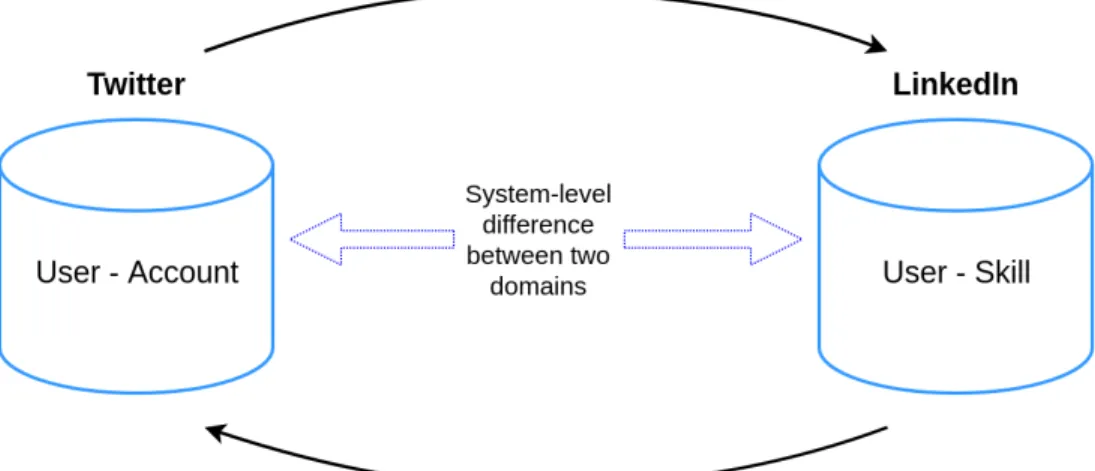
During the last years, there has been an increasing popularization of social media services. Nowadays, there is at least on specific-application social media for any particular purpose: from sharing images and videos to create a job-related network. All the available social media and all new start-ups in this area try to invent innovative solutions to attract new users and keep the current users engaged. At the core of all these techniques and solutions, there are recommender systems. They try to create a convenient experience for users by helping them to find their desired products, information, and services. These recommender systems usually use the provided data in a unique domain to make recommendations for that specific domain. However, recently researchers have found that using cross-domain recommender systems, which consider available data in multiple domains (Figure 2.1), can increase the accuracy of the recommended items and also reduces some serious problem such as the data sparsity and the cold-start. With this hypothesis in mind, we state the following specific research goals.
• 1. Review the importance of recommender systems, their classification, and the reasons users tend to utilize them. As we are going to produce novel algorithms and propose recommendation models using them, it is necessary to have a solid understanding of the recommender systems’ foundations. In order to improve the current state of the art methods on recommender systems, we need to have a good perspective about the available various techniques in this field, how they work, and how they help users.
• 2. Review the cross-domain recommendation concept. Since using the cross-domain recommender systems is relatively new in comparison to the traditional tech-niques, there are not still comprehensive definitions of different domains and knowledge-flow between them. We should fill this gap by summarizing the most important defini-tions of diverse domains and information integration methods, before trying to develop new cross-domain recommender systems.
• 3. Using a pre-clustering stage to reduce the inherent sparse nature of the data in various domains. One of the common issues of recommender systems is their inability to work well with the sparse data. On the other hand, one of the characteristics of social media data is their sparsity. In order to reduce the negative impact of this conflict, we will propose a pre-clustering step which can properly classify the categorical data in order to reduce the percentage of sparsity in the dataset.
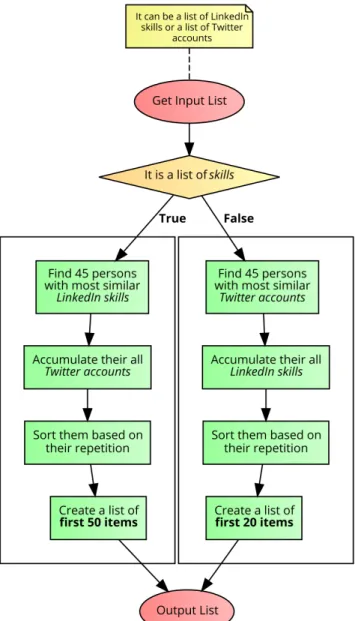
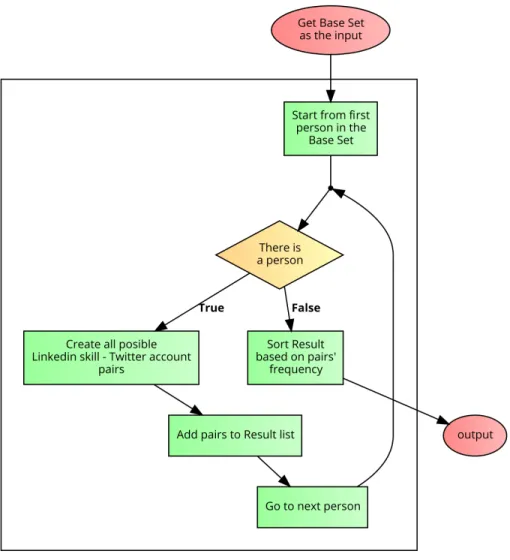
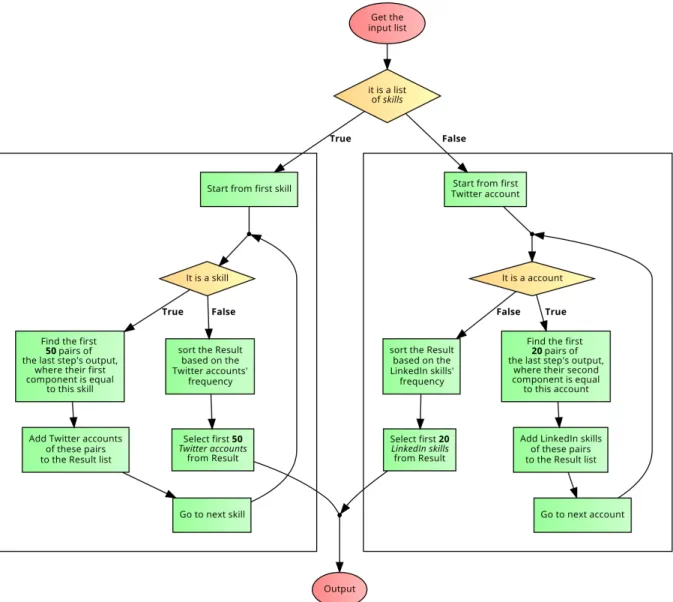
• 4. Develop various knowledge-based cross-domain recommendation models that exploit the users’ information in the source domain, or both the source and target domains, in order to suggest items in the target domain. The conducted studies in the two first questions would help us to understand the type of data we need for this research study. We shall extract this data from diverse social media which represent different features of identical users. Then, we will try to develop some cross-domain recommender systems which rely on the integration of various available data.
and their applications on recommender systems. These techniques are literally the state of art on cross-domain recommender system which attracts the researchers’ attention in the last few years. We shall start with their required preliminaries and then summarize their recent application in developing recommender systems.
• 6. Develop novel coupled matrix factorization-based and tensor decomposition-based cross-domain recommender systems. While traditional single-domain rec-ommender systems consider user preferences in on domain, the coupled matrix factor-ization are able to take different information into account in order to understand the various features of users’ preferences. In addition, the tensor decomposition method can be applied to uncover the implicit relationships between users, different items, and there features.
• 7. Analyze the performance of the proposed cross-domain recommender systems. According to the nature of the recommender systems’ job, that is suggesting a list of items which is more likely to be liked by the users, we will evaluate the effective-ness of the proposed recommender systems in term of their precision. The accuracies of these models are compared to each other as well as the baseline collaborative filtering recommender system.
Following the mentioned goals, in this thesis, we utilize different techniques in order to develop and analyze the following cross-domain recommendation methods:
• A knowledge-based collaborative filtering,
• A knowledge-based content-based,
• A knowledge-based hybrid mix,
• A knowledge-based hybrid feature combination,
• A coupled nonnegative matrix factorization-based,
3
BACKGROUND AND RELATED WORKS
3.1
Recommendation Systems
Due to the exponential growth of available data on the internet and social media as well as the number of active users, recommender systems have become a must-have part for almost all online service providers. Recommender systems provide a convenient experience for the users by suggesting them desired favorable products or services, such as a place to visit or dine, a book or a scientific paper to read, a movie to watch, an education program to attend and so on. Otherwise, without recommender systems, finding a proper option among the huge set of available options is a frustrating and time-consuming process and make users leave that social media. In this section, we will review the fundamental of recommender systems and their various recommending techniques. As the focus of this research study is on developing cross-domain recommender systems, then we will also review the multi-domains recommending approach as well.
3.1.1
Introduction to recommender systems
Recommender systems are programs that aim to provide proper suggestions for products or services that are most likely of interest of particular individuals or businesses [1]. Those products or services are generally called items and the individuals or businesses searching for desirable items are called users [2].
There are some cases that the necessity of recommender systems is more tangible. First and maybe the most important case is when we are dealing with an information overload system [3]. In informal language, the term of information overload simply means having or
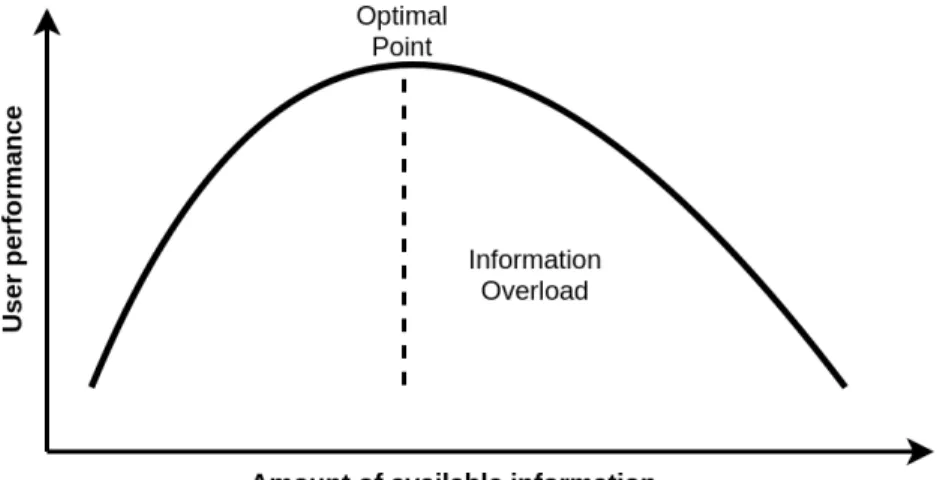
Figure 3.1: Relationship between the amount of available information and the user performance in term of the quality of decisions
receiving lots of information which is hard to understand as a whole. Within the research and scientific community, this term conveys a similar meaning and is applied to various fields such as cognitive overload, communication overload, and knowledge overload systems [4]. Many studies have shown that the performance of users varies with the amount of information they are exposed to. As a general rule, the quality of decisions and choices of users increases with increasing the amount of available information up to a certain point. However, after this threshold, further information cause a sharp drop in the performance of users [5]. Figure 3.1 shows a schematic illustration of this concept.
For example, today, the amount of available information on the internet is growing expo-nentially. This explosive rise in the accessible data may cause confusion for users and leads to frustrating experience since the overwhelming number of various choices makes finding the items of interest too difficult and even impossible. Recommender systems can effectively tackle this problem by helping users avoid confusion and frustration caused by searching a desirable option in a large list of available options. One common example of an information overload system is social media websites where millions or billions of users, forming online societies, are able to produce and share information and make new connections. As the magnitude of the information of these social media is vast, users usually are not able to find data and social connections they are looking for without the help of recommender systems. For instance, Facebook recommends new connections based on mutual friends, people who
are tagged in the same photo, or people of the group a user has been joined. Without these suggestions, even finding a friend by searching between all Facebook users seems to be tough. Another case which properly represents the importance of recommender systems is when a user does not have enough experience or qualification to evaluate all items in order to select an item which works best for him or her. The shopping experience on an online retailer website is a good example of this specific case [6].
Recommender systems are used to produce suggestions for different items in various do-mains. Recommending movies and TV serials [7], music [8], books [9], places [10], services [11] and foods [12] are only some examples of recommendation systems’ use cases. Bobadilla et al. [1] enumerate many other instances which recommender systems play a crucial role to create a pleasant experience for the users and improve the performance of different service providers. Also, Lu et al. [13] provide a comprehensive overview of recommender systems’ applications in their study. In general, without recommender systems, the users of all so-cial sites suffer from information overload. Therefore, recommender systems are important parts of all highly-rated internet sites and social applications such as Twitter 1, LinkedIn 2, Facebook 3, Netflix 4, Spotify 5, Last.fm 6, YouTube 7, and Amazon 8. These social media are implementing different techniques to create more effective suggestions to gain benefits by increasing the users’ satisfaction, increasing users’ loyalty, increasing users’ engagement, capturing more human-related data, improving their understanding of what user wants, and finally, increasing the number of sold products or services.
On the other hand, based on the study of Herlocker et al. [14], the usefulness of rec-ommender systems to facilitate many tasks motivates users to utilize these tools. Here, some important usages of recommender systems for users are covered. Users contribute with recommender systems mainly for:
• Finding good items: Obviously, users are using recommender systems to find favorable
1An online news and social networking service, https://twitter.com/
2An online social media with professional networking focus, https://www.linkedin.com/ 3An online social media and social networking service, https://www.facebook.com
4An online streaming of a library of films and television programs, https://www.netflix.com 5an online music streaming platform, https://www.spotify.com
6An online music service, https://www.last.fm 7A video sharing website, https://www.youtube.com 8An online e-commerce marketplace, www.amazon.com
items among all alternative items. Especially, when the number of related items is very large or the user does not have enough expertise to distinguish items based on his or her requirements.
• Expressing themselves: There are some users who are more interested in contribute with ratings and reviews and express their opinions rather than buying a commodity or service. Recommender systems can raise the level of satisfaction of these users and also increase their fidelity.
• Helping other users: Many users believe that their contribution in the recommender systems’ information profits all the community. Therefore, this can motivate them to engage with the recommender system. For example, with an online shopping site, a user who has already purchased and used an item is aware that her or his entered review and rating is useful to other users; this contribution does not have any benefit for the user, but, he or she tends to share information in order to improve the recommender system efficiency and help other users.
• Influencing other users: There are some users who utilize recommender systems in order to make it bias toward some particular items and influence other users into selecting those products or services.
As mentioned so far, recommender systems are essential parts of nowadays social media and they are implemented to provide a list of suggested items to users. However, since the context where recommender systems can be utilized is highly diverse, for instance, the criteria for recommending a movie and the criteria for recommending a scientific paper are entirely different; therefore, depending on the context, researchers introduced different types of recommender systems. The main difference of recommender systems is characterized by the filtering algorithm. The most common classification divides recommender systems into the content-based, collaborative, demographic, and hybrid algorithms [15]. This classification is shown in Figure 3.2. The mentioned filtering approached are explained in the following section.
Figure 3.2: Recommender systems classification
3.1.2
Recommender systems techniques
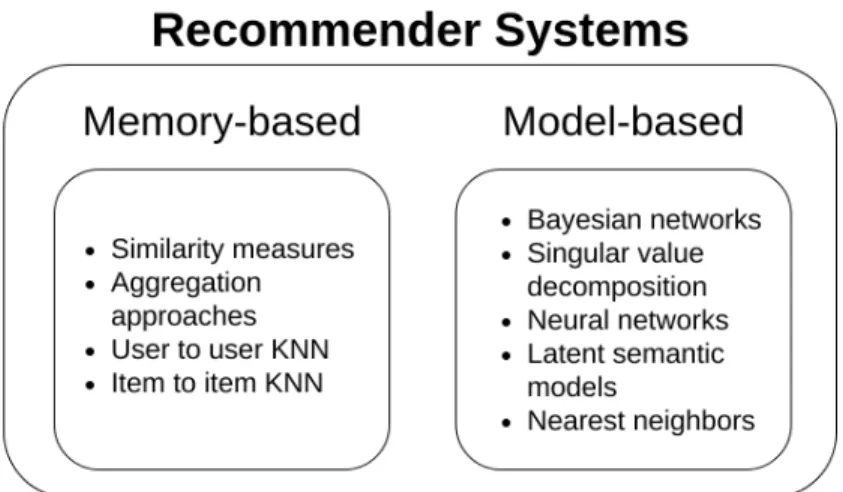
According to the wide usage of recommender systems and the growing number of researches in this area, many diverse recommendation techniques have been suggested. The various recommendation approaches can be categorized based on various criteria, for example, from the algorithmic point of view, different available techniques can be classified into memory-based and model-memory-based methods. Memory-memory-based approaches mainly use some heuristics to compare items and calculate the relevance of the items for a particular user. These methods usually work with the original rating matrix of users-items or use another rating generated before the referral process. Therefore, a memory-based method can be implemented easily because it has a simple logic and follows a particular goal only. On the other hand, it is less flexible in comparison to a model-based approach. In contrast to the memory-based techniques, model-based methods use more complicated algorithms, such as different machine learning tools, to build a prediction model from available data. They use recommender system information to produce a predictor model that generates items suggestion for a particular user. Popular memory-based and model-based methods are mentioned in the Figure 3.3.
There are other possible classifications and as mentioned before the most widely used classification divides all the proposed techniques into the four categories (Figure 3.2):
1. Content-based recommender systems: analyze the properties of items and suggest a group of items to a particular user which are most similar to the past selected items by that user.
2. Collaborative filtering-based recommender systems: investigate the rating similarities between users and suggest a group of items to a user which are already selected by
Figure 3.3: Classification of recommender systems from algorithmic point of view
most similar users to that unique user.
3. Demographic recommender systems: rely on this hypothesis that users with the same personal characteristics, such as gender, age, nationality, level of education, etc., have the same taste of items.
4. Hybrid recommender systems: are combinations of other recommender systems and usually are seen as a combination of collaborative with demographic method [16] or as a combination of collaborative with content-based approach [17, 18].
A content-based recommender system tries to understand the commonalities among the items a user has rated in past, then suggest the items that share the same features [19]. The schematic process of a content-based recommender system is displayed in Figure . How-ever, since these types of recommender systems relay on keywords that describe the content, they are most efficient for text-based content where keywords can be parsed dynamically. Otherwise, it can be highly inefficient to associate those keywords manually.
In order to understand the commonalities among the items, many content-based tech-niques rely on the popular Vector Space Model (VSM). In VSM we assume each item is a vector of its features ~ti = (w1, w2, ..., wn) ∈ IRn, So the i-th item has n various features
and the value of wj, 0 < j < n+ 1, reflects the impact of the j-th feature of the i-th item.
Also, another commonly used approach to create vectors of items is the TF-IDF method [20]. When the items vectors are created, the profile of a particular user is defined by aggregating
Figure 3.4: A simple representation of content-based recommender system
the models of those items he or she liked before. Finally, the utility of item i for user m
can be described by using a similarity measure, such as Cosine or Pearson correlation. The popular Cosine similarity is defined as:
cos(~um, ~ti) =
< ~um, ~ti > k~umk · k~tik
(3.1)
where, ~um indicates the profile of the userm.
Collaborative filtering-based recommender systems are based on the heuristic that users, who are similar, make choices which are similar (Figure 3.5). Therefore, these methods recommend items for a particular user based on the items previously rated highly by other similar users [21]. The similar users are found based on their histories of rating the same items that the user has seen and rated in the past; by correlating these past rating. One advantage of collaborative filtering is that it just uses rating patterns, so no content information is needed. Different learning methods can be used to create a collaborative filtering-based model, such as k-nearest neighbor (KNN)[22, 23], neural network (NN) [24], singular vector decomposition (SVD) [25], genetic algorithm [26], and latent semantic indexing (LSI) [27] approaches.
Although content-based and collaborative filtering recommender systems have their own advantages and use cases, however, both suffer from a problem known as the cold-start
Figure 3.5: A simple representation of collaborative filtering recommender system
problem. Cold-start happens because users have to rate (or buy, view, etc depending on the context) a sufficient number of items before a recommender system can really understand users’ preferences and generate reliable recommendations.
Hybrid recommenders seek to tackle the aforementioned issues about content-based and collaborative recommender systems and increase the effectiveness of the predictor model by combining both methods in different ways, such as:
• Mixed: produced recommendation from content-based and collaborative recommender systems are combined together and the top frequent items are suggested as the final recommendations.
• Feature combination: has some features of the content-based method and some features of the collaborative approach. The output of one of these recommender systems is used as an additional feature for another one.
• Switching: based on predefined conditions or context the system chooses among content-based or collaborative methods and applies the selected one.
It should be noted that even though hybrid recommender systems proved to be more accurate in many cases, they do not fully address the cold-start problem. In their study,
Table 3.1: Comparison between different recommender systems’ techniques
Recommender systems
techniques Main feature Main drawback(s)
Content based
Suggests new items which are most similar to the past selected items by a particular user
Incapable to find items’ quality based on the users’ pereference
Collaborative filtering
Recommends new items which are already selected by most similar users to an unique user
Suffers from cold-start problem and possible incorrect users’ rating
Demographic Classifies the users based on their
personal characteristics
Suffers from cold-start problem and incorrect personal
categorization
Hybrid
combines other recommender systems, especially content-based and
collaborative
An unwise combination of recommender systems can reduce the accuracy
Urmela et al. [28] compare various recommender systems techniques and also mention the most import drawback of each approaches. Here, we summarize their findings is Table 3.1.
Many present problems of most of the recommender systems come from the sparsity of data in one domain and also inability or weakness of different algorithms to handle the cold-start or new user situation. One possible solution that in this study is considered is using data integration between two or more various domains in order to develop cross-domain recommender system. It not only can reduce the sensitivity of the model to the cold-start problem, but also, it can increase the accuracy of the designed model by decreasing the sparsity of data. This matter is discussed in the next section.
3.1.3
Cross-domain recommender systems
Recommender systems have been used successfully in almost all social media to suggest de-sirable items to the users. Each social media website tries its best to develop more efficient algorithms in order to create more accurate recommender systems that accept the data
pro-vided by the users of that particular domain and return a list of suggested items. Likewise, most of the conducted research studies have focused on the single domain recommender sys-tems which use a single domain’s information to predict those isys-tems that are most likely to be interested of the users of that domain. On the other hand, there is another case, that a recommender system uses information of two or even more different domains to recom-mend items on one of those. This distinctive approach, which relies on multi-domain data integration to suggest more precise recommendations, is called cross-domain recommender system.
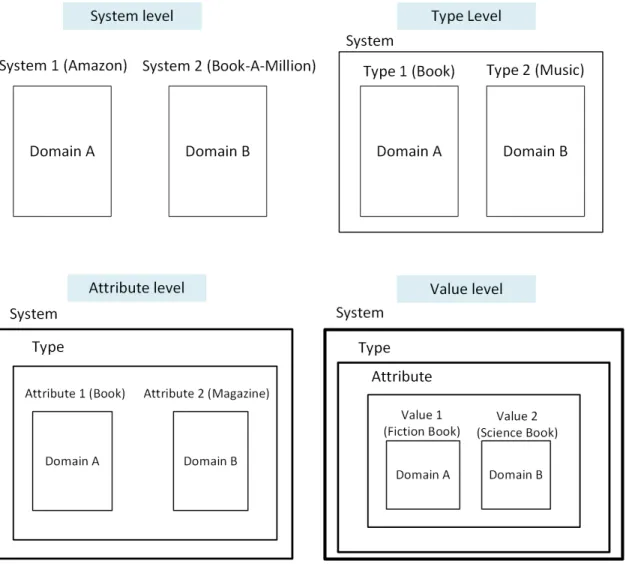
Researchers may consider different definitions for two distinct domains. Generally, we can consider four levels to describe the difference between two separate domains. Based on this classification, two domains may be considered as two distinct domains if they comprise one of the following cases:
1. Value level: same system, same type, same attributes, different values. Considering items in a unique system having the same type and same set of attributes, but, various values. For instance, two books in the same system can be considered to be in two distinct domains if they have different genres. Cao et al. [29] suppose various book categories as different domains in their study.
2. Attribute level: same system, same type, different attributes. Assuming items in a particular system which have the same type and maybe share some common attributes but they have some different attributes as well. For example, books and magazines have the identical type and many similar attributes, but they still have some specific attributes which cannot find in another one. An actual example is the Winoto and Tang research study [30] which movies and TV shows are considered as separate domains.
3. Type level: same system, different types. Happens when the items in a specific system have various types. For instance, Shapira et al. [31] assume movies and music in two distinct domains.
Figure 3.6: Various ways to define distinct domains
as books on Amazon and books on Book-A-Million9 can be considered as different domains. For example, in the Pan and Yang research [32] movies information extracted from MovieLens10, MoviePilot11, and Netflix are considered in different domains based on their source.
Above classification is displayed in the Figure 3.6 as well. Multi-domains approaches utilize various information exposed into separate domains by the same users or by different users to pursue some main goals. The most important one maybe is addressing the cold-start problem. Shapira et al. [31] tackle this problem by using data from two domains which have
9A bookstore chain in the United States, www.booksamillion.com 10A web-based recommender system for movies, https://movielens.org 11An online magazine covering the film industry, https://moviepilot.com
a type-level difference. One special case of the cold-start problem is the new-user problem. It means when a user joins to the community or just starts using the recommender system, this cannot provide accurate personalized suggestions because it does not know anything about the user’s preferences. Hu et al [33] extract books, movies, and music domains’ information and address the new-user issue in their proposed recommender system. Finally, one common goal of using multi-domain recommender systems is improving the accuracy of the predictor model [29, 34, 35].
In addition, the information flow between two distinct domains can have different shapes. Here we classify them into two major categories and later we will try each of those to create cross-domain recommender systems:
• Knowledge aggregation where the information from two domains is aggregated to each other and then is used to suggest items or create a predictor model. One possible manner is merging different features in two domains together.
• Knowledge transmission where the source domain is connected to the target domain using a common explicit feature or implicit latent feature, and the transferred knowledge from the source domain is used to produce recommendation is the target one.
3.2
Matrix Factorization
Many recommender systems implement matrix factorization technique to characterize users and items and extract latent factors of the rating matrix. The aim of this section is covering the preliminaries of related algebra and reviewing matrix and coupled matrix factorization techniques and their applications in the recommender systems.
3.2.1
Preliminaries of matrix algebra
As our convention, matrices are shown with uppercase letters and vectors are denoted by lowercase letters. Matrix A is a m×n table with m rows and n columns which contains scalars. In this study, we assume that all cells include only real scalars, so we can say that the set of m×n real matrices is indicated by IRm×n. The element in the i-th row and j-th
column of matrixA is denoted byAij. If a matrix have same number of rows and column, it
is called a square matrix. A diagonal matrix D is a square matrix which all elements except elements on its main diagonal is equal to zero, so for any elementAij in the matrixD ifi6=j
then Aij = 0. Identity matrix In is a n×n diagonal matrix where its diagonal elements
are equal to 1. A column vector is a matrix with only one column. Similarly, a row vector can be defined as a matrix of only one row. the rank of matrix A ∈ IRm×n, denoted by
rank(A), is the maximum number of its linearly independent columns (rows) vectors. Matrix
A is called rank-1 matrix if it is factorizable as an outer product of column vectorsu and
v, A=u⊗v. In this case, we can say rank(A) = 1.
Ho, in his study [36], present a comprehensive overview on matrix and vector linear algebra. Here, we shortly mention some of the main matrix manipulations which are good to know to have a better understanding of the matrix/tensor factorization techniques which are discussed in the following sections.
• Matrix product - A=B.C =BC, whereAij = ΣkBik.Ckj
• Transpose of matrix - [Aij]T =Aji
• Inner product of vectors - if u, v ∈IRn then:
hu, vi= Σiuivi =uTv (3.2)
• Matrix vectorization - LetsA∈IRm×n, then:
vec(A) = A:1 .. . A:n ∈IRmn (3.3)
• Inner product of matrices - hA, Bi=vec(A)Tvec(B) = Σ
ijAijBij
• Kronecker product - Assume matrix A∈IRm×n, then Kronecker of A and B is: A⊗B = A11B A12B · · · A1nB .. . ... . .. ... Am1B Am2B · · · AmnB (3.4)
• Outer product of vectors - Lets u∈ IRn and v ∈ IRm be two vectors. Then, their outer product is a matrix W, where Wij =uivj and W ∈ IRn×m. Outer product is an
special case of Kronecker product.
• Hadamard product - A = B ◦C, where Aij = BijCij. Hadamard product is an
elementwise product and A, B, C ∈IRm×n.
• Eigenvectors - λ∈IR is an eigenvalue and nonzero vector x∈IRn in an eigenvector of matrix A∈IRn×n if Ax=λx. σ(A) is the set of all eigenvalues of matrix A:
σ(A) = {xi|Axi =λix} (3.5)
and the spectral radius of matrix A is defined as follow:
ρ(A) =max{|λ| |λ∈σ(A)} (3.6)
• Rank-R decomposition of matrix - the minimal number of rank-1 matrices whose their linear combinations results the matrix A, is called the rabk-R decomposition of the matrix A:
A=
Σ
Rr=1βr(u(r)⊗v(r)) (3.7)where, βr is a scalar coefficient and R represents the rank-R decomposition of matrix
• Norms of a vector (or a matrix) - Norms are used to measure the magnitude of a vector or a matrix. A most common norm is the Frobenius norm:
kxkF=
p
hx, xi (3.8)
where, x can be either a vector or a matrix.
• Nonnegative matrix - matrices which all their elements are equal to or greater than zero are called nonnegative matrices.
3.2.2
Matrix and coupled matrix factorization techniques
Singular Value Decomposition (SVD)
The Singular Value Decomposition (SVD) [37] factorizes the real matrixA∈IRm×ninto three matrices U ∈IRm×m, Σ∈IRm×n, andV ∈IRn×n (Figure 3.7). The U and V are orthogonal matrices which are called left and right singular matrices and contain the left singular values and right singular values respectively. In fact, U is formed of singular vectors of AAT and
V is formed of singular vectors of ATA. Matrix Σ is a diagonal matrix which its diagonal elements represent the singular values of A. Therefore, based on the SVD:
A =UΣVT (3.9)
One another important point is that the best low-rank approximation of the matrix A, with respect to the Frobenius norm, is accomplished by truncating its SVD. Eckart and Young [38] proved that the best K-low-rank estimation of the matrix A can be desribed as follow:
A=UΣKVT (3.10)
where, ΣK is created by keeping only K largest singular values of matrix Σ and replacing
others by zeros.
We can use theU, V, and Σ matrices to reconstruct the original matrix A. The problem here is finding those three matrices such that the difference between A and ´A =UΣVT be
as smaller as possible. The most used measure is the Frobenius norm:
F(A, UΣVT) = 1
2 kA−UΣV
T k2
F (3.11)
Nonnegative Matrix Factorization (NMF)
Although the Nonnegative Matrix Factorization (NMF) first is introduced by Paatero and Tapper [39] , but it seems that the most popular research work in this field is the Lee and Seung study [40] .
Given an nonnegative matrix A ∈ IRm×n, where Aij ≥ 0, and a rank r, where r <
min(m, n), the NMF factorizes matrixA into two separate nonnegative matrices U ∈IRm×r and V ∈IRn×r (Figure 3.8). Therefore, we have:
A=U VT (3.12)
Again here we can reconstruct the original matrixA using U and V :
´
Figure 3.8: Nonnegative Matrix Factorization (NMF)
Using the Frobenius norm to calculate the difference betweenA and ´A [36], we have:
F(A, U VT) = 1 2 kA−U V T k2 F = 1 2
Σ
m i=1Σ
n j=1(Aij −[U VT]ij)2 (3.14)min
U∈IRm×r,V∈IRn×r 1 2 kA−U V T k2 F (3.15)Coupled matrix factorizations
SVD and NMF are two popular matrix factorization techniques and both have had many successful implementations in the recommender system field [41, 42, 15] and also in other areas. If we want to factorize two matrices which have one mode in common, in order to incorporate different features of these matrices together, we can implement a modified version of SVD or NMF.
The coupled matrix factorization technique, which we are considering in this study, applies same factorization approach on two matrices simultaneously. Assume nonnegative matrices
A∈IRm×nandB ∈IRm×q which have identical features on their first modes, then the SVD of
A andB are UAΣAVAT and UBΣBVBT. However, to factorize them at a same time we consider
U =UA=UB. Then, the coupled SVD corresponding to Equation 3.11 is:
F(A, B, UΣAVAT, UΣBVBT) = 1 2 kA−UΣAVAT k2Fk + kB−UΣBVBT k2F (3.16)
In addition, the NMF of matricesAand B are UAVAT and UBVBT respectively. Again, lets
U =UA=UB, then, as shown in Figure 3.9 schematically, the coupled NMF corresponding
to Equation 3.14 is as follow: F(A, B, U VAT, U VBT) = 1 2 kA−U VAT k2 F + kB−U VBT k2F (3.17) Figure 3.9: Coupled NMF
3.2.3
Matrix and coupled matrix factorization applications in
rec-ommender systems
By applying the matrix factorization techniques, such as SVD and NMF, on the user-item rating matrix, these techniques form some low-rank matrices (Figures 3.7 and 3.8) whose their production will approximate the rating matrix. This feature of matrix factorization approaches has a close affinity with this assumption that a small number of latent features affects the rating patterns [41].
Paterek [43] combine different collaborative filtering predicting algorithms, such as regu-larized SVD, post-processing SVD with KNN and K-means, in order to produce more
accu-rate models. Using the non-negative matrix factorization, Hernando et al. [44] convert the rating (user,item) table to two matrices whose their components lie between 0 and 1. They show that this method convey more understandable probabilistic meaning than classic matrix factorization. In addition, By comparing the accuracy of the predictions and recommenda-tions of the proposed method and classic matrix factorization, the authors indicate that this method produce more accurate results. In another popular research study, Koren et al. [41] develop a matrix factorization-based recommender system and also investigate various learning methods to solving the factorization problem, such as Stochastic Gradient Descent (SGD) and Alternating Least Squares (ALS). They show that matrix factorization models are superior to traditional KNN-based techniques and produce more precise recommendations. Ma et al. [45] take into account both information of users in the social network and rating matrix and implement a probabilistic matrix factorization. Their suggested method shows high accurate recommendation even for sparse data. In order to deal with the high amount of available data, Yu at all. [46] propose a nonparametric SVD matrix factorization which allows the latent factors to be data-driven. Also, they suggest new learning models which allow their nonparametric matrix factorization technique to be highly efficient on large-scale data. More recently, Guo et al [47] show that not only explicit patterns of user-item rating are important but also the implicit influence of rating matrix can play an important role. The authors suggest an SVD-based technique as a collaborative filtering recommender system which takes into account the explicit influence of trust (trust values), the implicit influence of trust (who trust whom), and the user-item rating. The implicit effect of trust is added to the rating matrix as an extra feature. And the explicit impact of trust is used to constrain that user latent factor should be matched with their social trust relationships. In this way, the latent factors of a particular user can be predicted from trust information, even only a few rating are available for that user.
One of the first implementations of coupled matrix factorization is the published study of Long et al [48]. In this study, they propose a model to clustering relational data, which come from different domains, using a coupled matrix factorization. Later, Singh and Gordon [49] conduct a similar study. They evaluate their proposed method by using separate matrices of user-movie, movie-genre, and movie-actor. Based on the highly accurate results, the authors
conclude that combining information from multiple domains and using the coupled matrix factorization leads to better predictions. In another study, Acar et al. [50] consider two different metabolomic matrices of X ∈ IRI×J and Y ∈ IRI×K which have the first mode in common. They perform a coupled matrix factorization to recommend potential biomarkers for apple intake. Their suggested method is finding the matrices A∈IRI∈R,B ∈IRJ∈R, and
C ∈IRK∈R that minimize the following equation:
F(A, B, C) =kX−ABT k2
F + kY −AC T k2
F (3.18)
More recently, Wang et al. [51] implement a coupled matrix factorization method to predict the response time in logistic services. For the service-response matrix R ∈ IRN∈M and its corresponding weight matrix W from the first domain, the order feature matrix
X ∈ IRN×S from the second domain, and finally the driver feature matrix Y ∈IRM×T from the third domain, their method is finding the matrices U, V,G, andH in order to minimize the following equation:
F(R, W, X, Y, U, V, G, H) = 1 2 kW◦(R−U V T )k2F +λ1 2 kX−U G T k2 F + λ2 2 kY−V H T k2 F (3.19)
3.3
Tensor Decomposition
Recently, many researchers have utilized the tensor-based representation of data in order to represent the multi-modal relationships between various features [52] within a single domain or multi-domains. In addition, the tensor decomposition techniques have been used in many studies to capture latent factors of different features and develop predictor and recommender systems. In this section, we will start by a review of multilinear algebra, then we will mention popular tensor decomposition techniques and their applications in the field of recommender systems.
3.3.1
Preliminaries of tensor algebra
A tensoris a multidimensional array. Sometimes it is described as a higher-order considera-tion of vectors and matrices. For example, a 3-way tensor, a cubic of data, can be considered as a list of 2D matrices. More formally, a tensor is a multilinear mapping over a set of vector spaces. for the real tensor A ∈IRI1×I2×···×IM, the M is the order of tensor. A tensor with
the order ofM also known asM-way tensor. Thedimension of tensor A in its I-th order is the number of distinct features on that order.
The followings are some fundamental definitions which are necessary to understand the math behind the tensor decomposition techniques [53]:
• Rank-1 tensor - If A ∈ IRI1×···×IM is an M-way tensor and there are vectors
u1, u2,· · · , uM such that A=u1⊗u2⊗ · · · ⊗uM, then tensorA is rank-1 tensor.
• mode-m vectors - the mode-m vectors of the Mth-order tensor A ∈ IRI1×···×IM is
calculated by varying index Im while keeping the other indices constant.
• Mode-m unfolding - Lets A ∈ IRI1×···×IM, then element (i
1 × i2 × · · · × iN) of
tensorAis mapped to element (im, j) of them-mode unfolding, also known asm-mode
matrixizing, of A, which is identified byA[m]∈IRI1···Im−1Im+1···IM, with:
j = 1 + N
X
k=1,k6=m (ik−1) k−1Y
n=1 n6=m In (3.20)• Mode-m rank - the mode-m rank of the M-way tensor A[m] ∈ IRI1···Im−1Im+1···IM is defined as:
RAm = rankm(A) = rank(A[m]) (3.21)
• Mode-m product - consider tensorA ∈IRI1×···×IM and matrixB ∈IRJm×Im, then the
• Khatri-Rao product - the Khatri-Rao product of matrices A ∈ IRI×J and B ∈
IRK×J, which is denoted by AB, is calculated as:
AB = h(a(1)⊗b(1))· · ·(a(l)⊗b(l))· · ·(a(L)⊗b(L))i (3.22)
where, [AB]ik,j =aijbkj and AB ∈IRIK×J and a⊗b represents the outer product
of a and b.
3.3.2
Tensor decomposition techniques
Allegedly, the idea of representing data through a multi-way model came from Cattell’s study [54]. However, the topic became more popular after Tucker’s great studies on multi-way factor analysis [55, 56, 57]. More recently, many researches have used tensor decompositions in the wide range of fields such as numerical analysis [58], graph analysis [59], neuroscience [60], image analysis and computer vision [61], social network analysis [62] and many other areas. Here, we review two widely used tensor decomposition techniques which have many successful implementations in the recommend systems as well.
CANDECOMP/PARAFAC (CP) decomposition
The idea of polyadic decomposition of tensors was first proposed by Hitchcock [63]. Fur-ther, it rediscovered by other researchers in the form of CANDECOMP (canonical polyadic decomposition) [64] and PARAFAC (parallel factor decomposition) [65]. Later, due to the Kiers study [66], this technique has become popular as the CANDECOMP/PARAFAC (CP) approach.
As in this research study we are using the 3-way tensor as part of our suggested solutions in the next chapter, here we are going to introduce the way CP decomposition. Assume 3-order tensorX ∈IRI×J×K, then based on CP we can represent theX as the sum of three-way outer products [67]: X = R X r=1 ar⊗br⊗cr (3.23)
where,ar∈IRI,br ∈IRJ, andcr∈IRK. R is a positive integer which is called the number
of components. In addition, The following matrices are identified as the factor matrices which are the combinations of the vectors from the rank-one components:
A= [a1 a2 · · · aR]
B = [b1 b2 · · · bR]
C = [c1 c2 · · · cR]
(3.24)
In can be shown that [68]
X ' AD(k)BT (3.25)
where,D(k) ≡diag(c
k:) fork = 1,2,· · · , K.
The CP decomposition may be regarded as the generalization of the matrix SVD because, as it can be seen in the Equation 3.25, like the SVD which factorizes a matrix to three matrices, the result of the CP decomposition can be represented as the three factor matrices. In order to solve the CP decomposition, we find theA,B, andC such that they minimize the following equation:
F(X, A, B, C) =
k
X − R X r=1 ar⊗br⊗crk
2 F =k
X −AD (k) BTk
2F (3.26)One of main the reasons for the popularity of the CP decomposition is that it is ease for interpretation. In fact, each decomposed rank-one component serves as a cluster is data. In addition, one another feature of CP decomposition is that its’ result is unique [69].
Tucker decomposition
The Tucker decomposition was first presented by Tucker in 1963 [55] and more comprehensive versions of this idea was introduced later in 1966 [57] by the same author. Although, Tucker offered three different methods in the later study, but the third, which known as Tucker-3, became more prevalent. Therefore, we shortly review this technique here and for the ease refer to Tucker-3 as Tucker decomposition technique.
Assume the 3-way tensorX ∈IRI×J×K. The Tucker technique decomposes this tensor to three factor matricesA∈IRI×R1, B ∈IRJ×R2,C ∈IRK×R3, and a smaller tensor, also known
as core tensor, G ∈IRR1×R2×R3. Therefore, we have:
X ' G ×1A×2 B×3C (3.27) Xi j k ' R1 X r1=1 R2 X r2=1 R3 X r3=1 Gr1r2r3Ai r1Bj r2Ck r3 (3.28)
The Tucker problem can be described as finding theG, A,B, andC for selected reduced dimensions R1, R2, and R3 in order to minimize the difference between the original tensor and the reconstructed one:
F(X,G, A, B, C) =
k
X −(G ×1A×2B×3C)k
2F (3.29)
In contrast with the CP decomposition, the Tucker’s result is not unique. However, this decomposition technique provides a good low-rank approximation of tensor, much like the SVD for matrices. Also, it is widely used for dimensional reduction purposes as well. Beside the Tucker-3 [57], another popular algorithm for Tucker decomposition is the Higher-Order Singular Value Decomposition (HOSVD) presented by De Lathauer et al. [70].
Papalexakis et al. [53] summerize popular tensor decomposition techniques and review their applications in many diverse fields, such as social network analysis, recommender sys-tems, computer networks, information retrieval, web mining, healthcare, speach and image processing, and urban computing. Moreover, in this survey paper, the authors cover most important studies that have attempted to design scalable tensor decompositions to handle large datasets and be compatible with the big data. Table 3.2 summerizes their findings.
Table 3.2: Comparison between CP and Tucker decompositions
Tensor decomposition
technique
Advantages Disadvantages Applications
CP
Easy to interpret, unique under mild
conditions
Hard to find the proper rank, hard
to determine the global minimum
Explanatory analysis, clustering, capturing
latent factors, compressing data which have low-rank multilinear
structure Tucker Compresses the tensor, extracts non-trilinear variations Hard to interpret, Nonunique result,
Compressing the data that do not have low tensor rank, analyzing relations between latent
components
3.3.3
Applications of tensor decomposition in recommender
sys-tems
CP applications
Zheng et al. [71] consider GPS data and develop a collaborative recommendation system to suggest locations and activities based on the users GPS traces. They construct a user-location-activity tensor and apply a nonnegative CP-style decomposition to this tensor along with four supplementary matrices. These matrices, namely user-location, user-user, location-feature, and activity-activity matrices, are integrated with the original tensor to deal with its inherent sparsity. Based on the result, using the additional information represented in the mentioned matrices increases the accuracy of the produced recommendations in comparison to the case that the only input information is the original 3-way tensor.
network with two different user types, such as male-female, doctor-patient, and employer-employee. They capture the present 2-way relationships in these networks by considering two separate third-order tensors in shape of (sender, receiver, attribute values of the receiver), which sender and receiver are network’s users with various types. Based on the interaction between the users, each element of the tensor might be positive or negative. If the message had sent by the sender got a positive response from the receiver the corresponding element is positive. However, if the receiver has negatively responded to the message or ignored it, the element is negative. The authors apply the CP method over two tensors separately. Each reconstructed tensor can be used to create 1-way recommendations, but, to follow the inherent 2-way relationships of the network they only collect those pairs which is recommended in both reconstructed tensors. To Evaluate their people-to-people recommendation system, Kutty et al. use a dataset collected from an online dating site and show that their method can achieve better precision and recall in comparison to former algorithms.
Kao et al. [73] show in their study that how CP decomposition can be applied to reveal topics and relationships in a temporal social network. In their case study, they extract data from Twitter including tweets related to a specific event. Considering various parameters such as user, retweeted user, term, hashtag, and time, they create 3-way and 4-way tensors and decompose them to explore the principal factors, different relationships between terms and users, and topic trend in different time windows.
Yao et al. [74] use the multidimensional information of check-in data from Location Based Social Networks (LBSNs) to develop a context-aware Point of Interest (POI) recommender system. They construct a 3-way user-location-time frame tensor and apply the CP technique to extract the hidden information. They also impose the users’ social connections as an addi-tional social regularization to improve the accuracy of the produced predictions. Since in the tensor decomposition technique the natural multidimensional relationship between LBSN’s data is considered properly, the suggested method results in more accurate recommendations rather than baseline linear algorithms.
Zheng et al. [75] develop a recommender system using a CP-based probabilistic tensor factorization which takes into account the social relationships, rating, item content, and contextual information by decomposing a 4-way user-item-context-rating tensor. Through
proving the superiority of the proposed approach in comparison with other common context-aware recommender systems, which most consider only two parameters, the authors show that different information types affect the users’ behavior simultaneously and considering them together results in more accurate predictions.
In another study, Park et al. [76] develop a tensor decomposition package, running on distributed Hadoop to manipulate large scale tensors. The core ideas in their work are handling the intermediate data explosion problem, reducing the floating point operations, and decreasing the number of redundant MapReduce jobs. The package consists of five different decomposition methods: CP, non-negative CP, Tucker, non-negative Tucker, and coupled matrix-tensor factorization. In order to analyze the obtained factor matrices from huge tensors, they also consider two more points. First, they consider only the top-k highest valued elements in each factor matrix because the number of elements in each matrix is too large to be explored easily. Second, they rank these top-k elements based on the calculated specificity score to avoid biased filtering toward frequent elements in different columns.
Almutairi et al. [77] investigate the application of matrix and tensor factorizations in the learning analytics by developing recommender models to predict students’ grades in courses which are new for them. They propose two models based on the coupled matrix factorization method which incorporate a main historical grades matrix with a context matrix. They consider absolute time, measured in semesters, in which the course is taken and student experience, which is equal to the number of semesters the student has been in the current program, as the contextual information. Moreover, they suggest another model based on the tensor decomposition as well. In this approach, they create a tensor by combining those matrices and apply the CP decomposition to predict the students’ fu