Energy Efficiency Prediction using Artificial Neural Network
Ahmed J. Khalil, Alaa M. Barhoom, Bassem S. Abu-Nasser, Musleh M. Musleh, Samy S. Abu-Naser
Department of Information Technology, Faculty of Engineering and Information Technology,
Al-Azhar University, Gaza, Palestine
Abstract. Buildings energy consumption is growing gradually and put away around 40% of total energy use. P redicting heating and cooling loads of a building in the initial phase of the design to find out optimal solutions amongst different designs is very important, as well as in the operating phase after the building has been finished for efficient energy. In this study, an artificial neural network model was designed and developed for predicting heating and cooling loads of a building based on a dataset for building energy performance. The main factors for input variables are: relative compactness, roof area, overall height, surface area, glazing are a, wall area, glazing area distribution of a building, orientation, and the output variables: heating and cooling loads of the building. The dataset used for training are the data published in the literature for various 768 residential buildings. The model was trained and validated, most important factors affecting heating load and cooling load are identified, and the accuracy for the validation was 99.60 %.
Keywords: Building, Energy, Prediction, Neural Networks, ANN
1.INTRODUCTION
Building energy consumption has been steadily increased over the past decades worldwide [1]. There has been a research about energy performance of buildings which study about energy waste and its perennial adverse impact on the environment [2,3]. Almost 40% of energy use of the building is for heating and cooling. It is important to make efforts to minimize heating and cooling loads to reduce total energy consumption in buildings. Hence, calculation of heating and cooling load properly is needed to determine the HVAC equipment and maintain indoor air quality adequately. Building energy ANN model is very useful to find out some parameters for optimum building design properly. However, it requires more skill to operate and take long time to investigate the effects of various parameters. Therefore, many researchers rely on machine learning tools to study the effects of various building parameters on some variables interest because this method is easier and faster than if required data set is available [4]. Various machine learning tools such as support vector machines [4], polynomial regression [5], and decision trees [3] have been developed to predict energy performance of building. They also have been used to predict Heating Load and Cooling Load. This study will explain Heating Load and Cooling Load prediction by using artificial neural network. Among many parameters, we focus on the eight parameters to predict Heating Load and Cooling Load namely relative compactness, surface area, wall area, roof area, overall height, orientation, glazing area, and glazing area distribution. Artificial Neural network was built to find out the value of Cooling Load and Heating Load based on 768 datasets from the reference [8] and the most important
parameters affecting Cooling Load and Heating Load loads using JustNN tool were determined.
Artificial Neural Network
Artificial Neural networks are a set of algorithms, modeled loosely after the human brain, that are designed to recognize patterns. They interpret sensory data through a kind of machine perception, labeling or clustering raw input. The patterns they recognize are numerical contained in vectors, into which all real-world data, are images, sound, text or time series, and must be translated [9].
Neural networks help us cluster and classify. You can think of them as a clustering and classification layer on top of the data you store and manage. They help to group unlabeled data according to similarities among the example inputs, and they classify data when they have a labeled dataset to train on. (Neural networks can also extract features that are fed to other algorithms for clustering and classification; so you can think of deep neural networks as components of larger machine-learning applications involving algorithms for reinforcement learning, classification and regression) [10].
What kind of problems does deep learning solve, and more importantly, can it solve yours? To know the answer, you need to ask questions:
What outcomes do I care about? Those outcomes are labels that could be applied to data: for example, spam or not_spam in an email filter, good_guy or bad_guy in fraud
detection, angry_customer or happy_customer in customer relationship management.
Do I have the data to accompany those labels? That is, can I find labeled data, or can I create a labeled dataset (with a service like AWS Mechanical Turk or Figure Eight or Mighty.ai) where spam has been labeled as spam, in order to teach an algorithm the correlation between labels and inputs?
Deep Neural Network maps inputs to outputs. It finds correlations. It is known as a “universal approximate”, because it can learn to approximate an unknown function f(x) = y between any input x and any output y, assuming they are related at all (by correlation or causation, for example). In the process of learning, a neural network finds the right f, or the correct manner of transforming x into y, whether that be f(x) = 3x + 12 or f(x) = 9x - 0.1. Here are a few examples of what deep learning can do [12-14]
Classification
All classification tasks depend upon labeled datasets; that is, humans must transfer their knowledge to the dataset in order for a neural network to learn the correlation between labels and data. This is known as supervised learning[15].
Detect faces, identify people in images, recognize facial expressions (angry, joyful)
Identify objects in images (stop signs, pedestrians, lane markers…)
Recognize gestures in video
Detect voices, identify speakers, transcribe speech to text, recognize sentiment in voices
Classify text as spam (in emails), or fraudulent (in insurance claims); recognize sentiment in text (customer feedback)
Any labels that humans can generate, any outcomes that you care about and which correlate to data, can be used to train a neural network.
Clustering
Clustering or grouping is the detection of similarities. Deep learning does not require labels to detect similarities. Learning without labels is called unsupervised learning. Unlabeled data is the majority of data in the world. One law of machine learning is: the more data an algorithm can train on, the more accurate it will be. Therefore, unsupervised learning has the potential to produce highly accurate models[16-20].
Search: Comparing documents, images or sounds to surface similar items.
Anomaly detection: The flipside of detecting similarities is detecting anomalies, or unusual
behavior. In many cases, unusual behavior
correlates highly with things you want to detect and prevent, such as fraud.
Predictive Analytics: Regressions
With classification, deep learning is able to establish correlations between, say, pixels in an image and the name of a person. You might call this a static prediction. By the same token, exposed to enough of the right data, deep learning is able to establish correlations between present events and future events. It can run regression between the past and the future. The future event is like the label in a sense. Deep learning doesn’t necessarily care about time, or the fact that something hasn’t happened yet. Given a time series, deep learning may read a string of number and predict the number most likely to occur next[21-24].
Hardware breakdowns (data centers, manufacturing, transport)
Health breakdowns (strokes, heart attacks based on vital stats and data from wearables)
Customer churn (predicting the likelihood that a customer will leave, based on web activity and metadata)
Employee turnover (ditto, but for employees) The better we can predict, the better we can prevent and pre-empt. As you can see, with neural networks, we’re moving towards a world of fewer surprises. Not zero surprises, just marginally fewer. We’re also moving toward a world of smarter agents that combine neural networks with other algorithms like reinforcement learning to attain goals [25-28].
Neural Network Components
Deep learning is the name we use for “stacked neural networks”; that is, networks composed of several layers[29-35]. The layers are made of nodes. A node is just a place where computation happens, loosely patterned on a neuron in the human brain, which fires when it encounters sufficient stimuli. A node combines input from the data with a set of coefficients, or weights that either amplify or dampen that input, thereby assigning significance to inputs with regard to the task the algorithm is trying to learn; e.g. which input is most helpful is classifying data without error? These input-weight products are summed and then the sum is passed through a node’s so-called activation function, to determine whether and to what extent that signal should progress further through the network to affect the ultimate outcome, say, an act of classification. If the signals pass through, the neuron has been “activated.”[36]
A node layer is a row of those neuron-like switches that turn on or off as the input is fed through the net. Each layer’s output is simultaneously the subsequent layer’s input, starting from an initial input layer receiving your data[37-45].
Pairing the model’s adjustable weights with input features is how we assign significance to those features with regard to how the neural network classifies and clusters input[46-48].
2.METHODOLOGY
Neural networks are complex nonlinear model that can be used to find the correlation between inputs and outputs. They can be applied in many research fields such as classification, function approximation, forecasting, clustering, and optimization [49,50]. There are two kinds of neural networks namely static and dynamic neural networks [51-54]. In this paper, static neural networks are used to train 768 data sets to correlate variable r elative compactness, r oof ar ea, overall h eight, surface area, glazing area, wall ar ea, glazing ar ea distribution of a building, orientation, and th e output variables: heating and cooling loads of the building. It is conducted by using JustNN Tool[55-60]. We used eight input variables, three hidden layers, and one output to predict Heating Load and Cooling Load. We select Heating Load and Cooling Load as output variables for training together (multi-output).
Table 1 Input variable
Table 2 Output variable
Variable Name Description of the variable
y1 Heating Load
y2 Cooling Load
1. Dataset Preprocessing
We wanted to use this dataset to a build an ANN model to predict the Heating Load and Cooling Load (attribute number 9 and 10).
The first thing we had to do, is choose a suitable factors for this prediction, and delete the unnecessary ones, we chose all the eight factors to be our input to the predictive model. Moreover, the dataset contain 768 samples. We divided these samples to 519 training samples, and 249 validation samples. In addition, because of the integer numbers of the inputs are too large comparing with the real rate values, we did a normalization to them so all the data are real[61].
Normalization formula was:
) )))) .
While checking the samples, it has been noticed that there no conflict between the instances; which means, the data are ready for training to predict Heating and Cooling Loads.
2. ANN Model
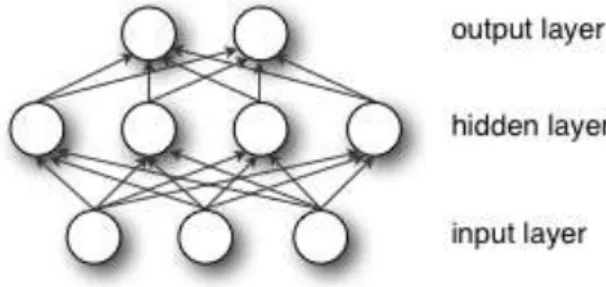
The resulted predictive ANN model is shown in Figure 2 and Figure 5.
Figure 1: Our ANN Model
3. Validation
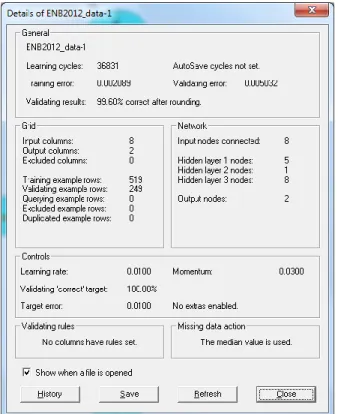
Our ANN model was able to predict Heating and Cooling Loads with 99.60% accuracy, with about 0.002 errors as seen in figure (3). Furthermore, The Model showed that the most effective factor in Heating and Cooling Loads are the Wall Area, Relative
Variable Name Description of the variable
X1 Relative Compactness X2 Surface Area X3 Wall Area X4 Roof Area X5 Overall Height X6 Orientation X7 Glazing Area
Compactness, Roof Area. More details are shown in figure (4).
Figure 2: Validation and Errors
Figure 3: Attributes Importance Figure 5: Details of our ANN Model
3.CONCLUSION
In this paper, building energy performance has been investigated using Artificial Neural Network model to predict Heating and Cooling loads and analysis using JustNN Tool was used to determine the effect of input variables based on the data in the literature.
•
A simple static neural network model gives a very good prediction (99.60%) in comparison with the original data sets of [8].•
The Wall Area, Relative Compactness, and Roof Area have significant effects on heating and cooling loads together for the present problem.The result of this study can only be applied for the building which has specification refers to [8]. The methodology developed in the study, however, can be applied in designing buildings to optimize energy performance for any given input variables based on either experimental or simulation results.
REFERENCES
1. European Commission, Directive 2002/91/EC of the European parliament and of the council of 16th December 2002 on the energy performance of buildings, Official journal of the European Communities, L1/65-L1/71,04 /01/2003.
2. L. Perez-Lombard, J. Ortiz, C. Pout, A review on buildings energy consumption information, Energy and Buildings 40 (3) (2008) 394-398.
3. W.G. Cai, Y. Wu, Y. Zhong, H. Ren, China building energy consumption: situation, challenges and corresponding measures, Energy Policy 37 (6) (2009) 2054-2059.
4. T. Catalina J. Virgone, E. Blanco, Development and validation of regression models to predict monthly heating demand for residential buildings, Energy and Buildings 40 (2008) 1825-1832.
5. K.K.W. Wan D.H.W. Li, D. Liu, J.C. Lam, Future trends of building heating and cooling loads and energy consumption in different climates, Building and Environment 46 (2011) 223-234.
6. Z. Yu, F. Haghigrat, B.C.M Fung, H. Yoshimo, A decision tree method for building energy demand modeling, Energy and Building, 42 (2010) 1637-1646.
7. B. Dong, C. Cao, S.E. Lee, Applying support vector machines to predict building energy consumption in tropical region, Energy and Buildings 37 (2005) 545-553.
8. A. Tsanas, A. Xifara, Accurate quantitative estimation of energy performance of residential buildings using statistical machine learning tools, Energy and Buildings (2012)
9. Nasser, I. M., et al. (2019). "A Proposed Artificial Neural Network for Predicting Movies Rates Category." International Journal of Academic Engineering Research (IJAER) 3(2): 21-25.
10. L. Dormehl, "Digital Trends," 5 1 2019. [Online]. Available: https://www.digitaltrends.com/cool-tech/what-is-an-artificial-neural-network/. [Accessed 15 3 2019].
11. Abu Naser, S. S. (2012). "Predicting learners performance using artificial neural networks in linear programming intelligent tutoring system." International Journal of Artificial Intelligence & Applications 3(2): 65.
12. Abu-Naser, S., et al. (1995). "& Beattie, GA (2000)." Expert system methodologies and applications-a decade review from: 9-26.
13. Afana, M., et al. (2018). "Artificial Neural Network for Forecasting Car Mileage per Gallon in the City." International Journal of Advanced Science and Technology 124: 51-59.
14. Ahmed, A., et al. (2019). "Knowledge-Based Systems Survey." International Journal of Academic Engineering Research (IJAER) 3(7): 1-22.
15. Akkila, A. N., et al. (2019). "Survey of Intelligent Tutoring Systems up to the end of 2017." International
16. Al-Ani, I. A. R., et al. (2007). "Water pollution and its effects on human health in rural areas of Faisalabad." Journal of Environmental Science and Technology 5(5): 1-17.
17. Alghoul, A., et al. (2018). "Email Classification Using Artificial Neural Network." International Journal of Academic Engineering Research (IJAER) 2(11): 8-14.
18. Alkronz, E. S., et al. (2019). "Prediction of Whether Mushroom is Edible or Poisonous Using Back-propagation Neural Network." International Journal of Academic and Applied Research (IJAAR) 3(2): 1-8.
19. Almasri, A., et al. (2019). "Intelligent Tutoring Systems Survey for the Period 2000-2018." International Journal of Academic Engineering Research (IJAER) 3(5): 21-37.
20. Al-Massri, R., et al. (2018). "Classification Prediction of SBRCTs Cancers Using Artificial Neural Network." International Journal of Academic Engineering Research (IJAER) 2(11): 1-7.
21. Al-Mubayyed, O. M., et al. (2019). "Predicting Overall Car Performance Using Artificial Neural Network." International Journal of Academic and Applied Research (IJAAR) 3(1): 1-5.
22. Al-Shawwa, M. and S. S. Abu-Naser (2019). "Predicting Birth Weight Using Artificial Neural Network." International Journal of Academic Health and Medical Research (IJAHMR) 3(1): 9-14.
23. Al-Shawwa, M. and S. S. Abu-Naser (2019). "Predicting Effect of Oxygen Consumption of Thylakoid Membranes
(Chloroplasts) from Spinach after Inhibition Using Artificial Neural Network." International Journal of Academic Engineering Research (IJAER) 3(2): 15-20.
24. Al-Shawwa, M., et al. (2018). "Predicting Temperature and Humidity in the Surrounding Environment Using Artificial Neural Network." International Journal of Academic Pedagogical Research (IJAPR) 2(9): 1-6.
25. Anderson, J., et al. (2005). "Adaptation of Problem Presentation and Feedback in an Intelligent Mathematics Tutor." Information Technology Journal 5(5): 167-207.
26. Ashqar, B. A. M. and S. S. Abu-Naser (2019). "Identifying Images of Invasive Hydrangea Using Pre-Trained Deep Convolutional Neural Networks." International Journal of Academic Engineering Research (IJAER) 3(3): 28-36. 27. Ashqar, B. A. M. and S. S. Abu-Naser (2019). "Image-Based Tomato Leaves Diseases Detection Using Deep Learning."
28. Ashqar, B. A., et al. (2019). "Plant Seedlings Classification Using Deep Learning." International Journal of Academic Information Systems Research (IJAISR) 3(1): 7-14.
29. Atallah, R. R. (2014). "Professor Samy S." Abu Naser, Data Mining Techniques in Higher Education an Empirical Study for the University of Palestine, IJMER 4(4): 48-52.
30. Atallah, R. R. and S. S. Abu Naser (2014). "Data mining techniques in higher education an empirical study for the university of Palestine." International Journal Of Modern Engineering Research (IJMER) 4(4): 48-52.
31. Baker, J., et al. "& Heller, R.(1996)." Information Visualization. Information Technology Journal 7(2). 32. Baker, J., et al. (1996). "Information Visualization." Information Technology Journal 7(2): pp: 403-404.
33. Chen, R.-S., et al. (2008). "Evaluating structural equation models with unobservable variables and measurement error." Information Technology Journal 10(2): 1055-1060.
34. Dalffa, M. A., et al. (2019). "Tic-Tac-Toe Learning Using Artificial Neural Networks." International Journal of Engineering and Information Systems (IJEAIS) 3(2): 9-19.
35. El_Jerjawi, N. S. and S. S. Abu-Naser (2018). "Diabetes Prediction Using Artificial Neural Network." International Journal of Advanced Science and Technology 121: 55-64.
36. El-Khatib, M. J., et al. (2019). "Glass Classification Using Artificial Neural Network." International Journal of Academic Pedagogical Research (IJAPR) 3(2): 25-31.
37. Elzamly, A., et al. (2015). "Classification of Software Risks with Discriminant Analysis Techniques in Software planning Development Process." International Journal of Advanced Science and Technology 81: 35-48.
38. Elzamly, A., et al. (2015). "Predicting Software Analysis Process Risks Using Linear Stepwise Discriminant Analysis: Statistical Methods." Int. J. Adv. Inf. Sci. Technol 38(38): 108-115.
39. Elzamly, A., et al. (2016). "A New Conceptual Framework Modelling for Cloud Computing Risk Management in Banking Organizations." International Journal of Grid and Distributed Computing 9(9): 137-154.
40. Elzamly, A., et al. (2017). "Predicting Critical Cloud Computing Security Issues using Artificial Neural Network (ANNs) Algorithms in Banking Organizations." International Journal of Information Technology and Electrical Engineering 6(2): 40-45.
41. Elzamly, A., et al. (2019). "Critical Cloud Computing Risks for Banking Organizations: Issues and Challenges." Religación. Revista de Ciencias Sociales y Humanidades 4(18).
42. Heriz, H. H., et al. (2018). "English Alphabet Prediction Using Artificial Neural Networks." International Journal of Academic Pedagogical Research (IJAPR) 2(11): 8-14.
43. Hissi, H. E.-., et al. (2008). "Medical Informatics: Computer Applications in Health Care and Biomedicine." Journal of Artificial Intelligence 3(4): 78-85.
44. Jamala, M. N. and S. S. Abu-Naser (2018). "Predicting MPG for Automobile Using Artificial Neural Network Analysis." International Journal of Academic Information Systems Research (IJAISR) 2(10): 5-21.
45. Kashf, D. W. A., et al. (2018). "Predicting DNA Lung Cancer using Artificial Neural Network." International Journal of Academic Pedagogical Research (IJAPR) 2(10): 6-13.
46. Kashkash, K., et al. (2005). "Expert system methodologies and applications-a decade review from 1995 to 2004." Journal of Artificial Intelligence 1(2): 9-26.
47. Li, L., et al. (2011). "Hybrid Quantum-inspired genetic algorithm for extracting association rule in data mining." Information Technology Journal 12(4): 1437-1441.
48. Marouf, A. and S. S. Abu-Naser (2018). "Predicting Antibiotic Susceptibility Using Artificial Neural Network." International Journal of Academic Pedagogical Research (IJAPR) 2(10): 1-5.
49. Masri, N., et al. (2019). "Survey of Rule-Based Systems." International Journal of Academic Information Systems Research (IJAISR) 3(7): 1-23.
50. Metwally, N. F., et al. (2018). "Diagnosis of Hepatitis Virus Using Artificial Neural Network." International Journal of Academic Pedagogical Research (IJAPR) 2(11): 1-7.
51. Nasser, I. M. and S. S. Abu-Naser (2019). "Artificial Neural Network for Predicting Animals Category." International Journal of Academic and Applied Research (IJAAR) 3(2): 18-24.
52. Nasser, I. M. and S. S. Abu-Naser (2019). "Lung Cancer Detection Using Artificial Neural Network." International Journal of Engineering and Information Systems (IJEAIS) 3(3): 17-23.
53. Nasser, I. M. and S. S. Abu-Naser (2019). "Predicting Books’ Overall Rating Using Artificial Neural Network." International Journal of Academic Engineering Research (IJAER) 3(8): 11-17.
54. Nasser, I. M. and S. S. Abu-Naser (2019). "Predicting Tumor Category Using Artificial Neural Networks." International Journal of Academic Health and Medical Research (IJAHMR) 3(2): 1-7.
55. Nasser, I. M., et al. (2019). "Artificial Neural Network for Diagnose Autism Spectrum Disorder." International Journal of Academic Information Systems Research (IJAISR) 3(2): 27-32.
56. Ng, S., et al. (2010). "Ad hoc networks based on rough set distance learning method." Information Technology Journal 10(9): 239-251.
57. Owaied, H. H., et al. (2009). "Using rules to support case-based reasoning for harmonizing melodies." Journal of Applied Sciences 11(14): pp: 31-41.
58. Sadek, R. M., et al. (2019). "Parkinson’s Disease Prediction Using Artificial Neural Network." International Journal of Academic Health and Medical Research (IJAHMR) 3(1): 1-8.
59. Salah, M., et al. (2018). "Predicting Medical Expenses Using Artificial Neural Network." International Journal of Engineering and Information Systems (IJEAIS) 2(20): 11-17.
60. Sulisel, O., et al. (2005). "Growth and Maturity of Intelligent Tutoring Systems." Information Technology Journal 7(7): 9-37. 61. Zaqout, I., et al. (2015). "Predicting Student Performance Using Artificial Neural Network: in the Faculty of Engineering and
Information Technology." International Journal of Hybrid Information Technology 8(2): 221-228.
62. Zaqout, I., et al. (2015). "Predicting Student Performance Using Artificial Neural Network: in the Faculty of Engineering and Information Technology." International Journal of Hybrid Information Technology 8(2): 221-228.
63. Zaqout, I., & Al-Hanjori, M. (2005). An improved technique for face recognition applications. Information and Learning Science, 119 (9/10), 529-544.
64. Zaqout, I. S. (2012). Printed Arabic Characters Classification Using A Statistical Approach. International Journal Of Computers & Technology, 3 (1), 1-5.
65. Zaqout, I. (2019). Diagnosis of skin lesions based on dermoscopic images using image processing techniques. Pattern Recognition-Selected Methods and Applications.
66. Zaqout, I., Zainuddin, R., & Baba, S. (2004). Human face detection in color images. Advances in Complex Systems, 7 (03n04), 369-383.
67. Zaqout, I. S. (2005). An integrated approach for detecting human faces in color images. Fakulti Sains Komputer dan Teknologi Maklumat, Universiti Malaya.
68. Zaqout, I. (2011). A Statistical Approach For Latin Handwritten Digit Recognition. IJACSA Editorial.
69. Zaqout, I. S. (2017). An efficient block-based algorithm for hair removal in dermoscopic images. Компьютерная оптика, 41 (4).
70. Zaqout, I., Zainuddin, R., & Baba, S. (2005). Pixel-based skin color detection technique, Machine Graphics and Vision. 14 (1), 61.