Handwriting Recognition
using Recurrent Neural Networks
Andrew William Senior Trinity Hall,
Cambridge, England.
A
September 1994
This thesis is submitted for consideration for the degree of Doctor of Philosophy
Summary
Computer handwritingrecognition oers a new way of improving the human-computer interface and of enabling human-computers to read and process the many handwritten documents that must currently be processed manually. This thesis describes the design of a system that can transcribe handwritten doc-uments.
First, a reviewof theaims andapplications of computerhandwritingrecog-nition is presented, followed by a description of relevant psychological re-search. Previous researchers' approaches to the problems of o-line hand-writing recognition are then described. A complete system for automatic, o-line recognition of handwriting is then detailed, which takes word images scanned from a handwritten page and produces word-level output. Methods for thenormalization and representationof handwrittenwords are described, including a novel technique for detecting stroke-like features. Three prob-ability estimation techniques are described, and their application to hand-writing recognition investigated. The method of combining the probability estimates to choose the most likely word is described, and performance im-provements are made by modelling the lengths of letters and the frequency of words in the corpus. The system is tested on a database of transcripts from a corpus of modern English and recognition results are shown. Recognition is described both with the search constrained to a xed vocabulary and with an unlimited vocabulary.
The nalchaptersummarizes thesystem andhighlights theadvancesmade before assessing where future work is most likely to bring about improve-ments.
Key words
O-line cursive script, handwriting recognition, OCR, recurrent neural net-works, forward-backward algorithm, hidden Markov models, duration mod-elling.
Declaration
This thesis describes research carried out at Cambridge University Engineer-ing Department between October 1991 and September 1994. It is the result of my own work and contains no work done in collaboration. The length of this thesis, including references and gure captions, is thirty-seven thousand words.
Acknowledgements
First of all, I would like to express my gratitude to the late Professor Frank Fallside, for supervising me during the rst half of this thesis and for pro-viding the original inspiration for this work. I am also indebted to Dr Tony Robinson who has supervised me admirably for the latter half of this thesis with enthusiastic guidance and support, particularly in the last few weeks.
I would like to thank everyone else in the Speech, Vision and Robotics group which Frank Fallside created. The group has been an ideal environ-ment, both socially and technically, in which to conduct research. Those in the group who have helped in the creation of this thesis are too numerous to mention individually.
Special thanks must go to Chen Tham and Andy Piper for friendship; to Fuzzy who proof-read at such short notice, and particularly to Tim Jervis whose friendship has been invaluable in the last three years.
The former Science and Engineering Research Council is to be thanked for providing the nancial support necessary for me to carry out this work. I would also like to thank everyone I met at Lexicus, IBM Hawthorne and AT&T Holmdel for recentfruitful discussions thathave helpedshape thewrit-ing of this thesis.
Finally, I would like to dedicate this thesis to my mother and to the mem-ory of my father. My parents have always supported me and to them I owe everything .
Contents
1 Introduction 7 1.1 This thesis : : : : : : : : : : : : : : : : : : : : : : : : : : : : : : : : 8 1.2 Original contribution : : : : : : : : : : : : : : : : : : : : : : : : : : 9 1.3 Notation : : : : : : : : : : : : : : : : : : : : : : : : : : : : : : : : : 9 2 Handwriting recognition 102.1 A taxonomy of handwriting recognition problems : : : : : : : : : 11 2.1.1 On-line versus o-line : : : : : : : : : : : : : : : : : : : : : 11 2.1.2 Author identication versus content determination : : : : 12 2.1.3 Writer independence : : : : : : : : : : : : : : : : : : : : : : 13 2.1.4 Vocabulary size : : : : : : : : : : : : : : : : : : : : : : : : : 13 2.1.5 Isolated characters : : : : : : : : : : : : : : : : : : : : : : : 13 2.1.6 Optical character recognition : : : : : : : : : : : : : : : : : 14 2.2 Applications : : : : : : : : : : : : : : : : : : : : : : : : : : : : : : : 15 2.2.1 Cheques : : : : : : : : : : : : : : : : : : : : : : : : : : : : : 16 2.2.2 From postcodes to addresses : : : : : : : : : : : : : : : : : 16 2.2.3 Form processing: : : : : : : : : : : : : : : : : : : : : : : : : 17 2.2.4 Other applications : : : : : : : : : : : : : : : : : : : : : : : 17 2.3 Existing o-line handwriting recognition systems : : : : : : : : : 18 2.3.1 Isolated characters or digits : : : : : : : : : : : : : : : : : : 18 2.3.2 O-line cursive script : : : : : : : : : : : : : : : : : : : : : 19
3 Psychology of reading 22
3.1 Reading by features: : : : : : : : : : : : : : : : : : : : : : : : : : : 23 3.2 Reading by letters and reading by words : : : : : : : : : : : : : : 25 3.3 Lexicon and context : : : : : : : : : : : : : : : : : : : : : : : : : : : 26 3.4 Summary : : : : : : : : : : : : : : : : : : : : : : : : : : : : : : : : : 27
4 Overview of the system 29
4.1 Summary of parts : : : : : : : : : : : : : : : : : : : : : : : : : : : : 29 4.2 Image acquisition and corpus choice : : : : : : : : : : : : : : : : : 30 4.3 A note on results : : : : : : : : : : : : : : : : : : : : : : : : : : : : 32 4.4 The remaining chapters : : : : : : : : : : : : : : : : : : : : : : : : 33
CONTENTS
5 Normalization and representation 34
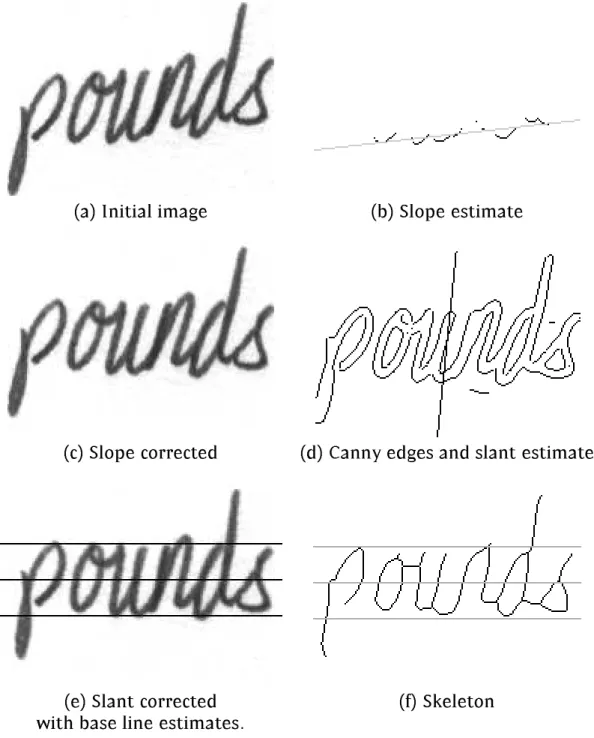
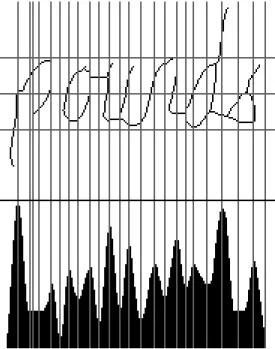
5.1 Normalization : : : : : : : : : : : : : : : : : : : : : : : : : : : : : : 34 5.1.1 Base line estimation and slope correction : : : : : : : : : 36 5.1.2 Slant correction : : : : : : : : : : : : : : : : : : : : : : : : : 38 5.1.3 Smoothing and thinning : : : : : : : : : : : : : : : : : : : : 39 5.2 Parametrization : : : : : : : : : : : : : : : : : : : : : : : : : : : : : 40 5.2.1 Skeleton coding : : : : : : : : : : : : : : : : : : : : : : : : : 40 5.2.2 Non-uniform quantization : : : : : : : : : : : : : : : : : : 43 5.2.3 An alternative approach : : : : : : : : : : : : : : : : : : : : 44 5.3 Finding handwriting features : : : : : : : : : : : : : : : : : : : : : 45 5.4 Summary : : : : : : : : : : : : : : : : : : : : : : : : : : : : : : : : : 46
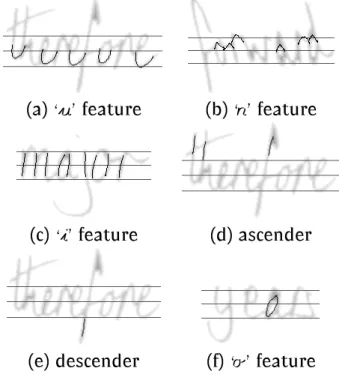
6 Finding large-scale features with snakes 47
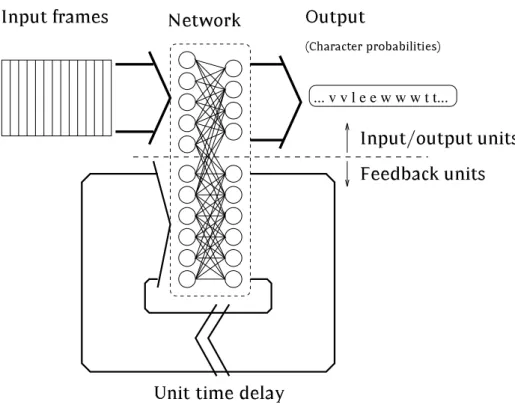
6.1 Finding strokes : : : : : : : : : : : : : : : : : : : : : : : : : : : : : 48 6.2 Snakes : : : : : : : : : : : : : : : : : : : : : : : : : : : : : : : : : : 48 6.3 Point distribution models and constraints : : : : : : : : : : : : : 50 6.4 Training feature models : : : : : : : : : : : : : : : : : : : : : : : : 52 6.5 Finding feature matches : : : : : : : : : : : : : : : : : : : : : : : : 53 6.6 Discussion : : : : : : : : : : : : : : : : : : : : : : : : : : : : : : : : 55 7 Recognition methods 57 7.1 Recurrent networks : : : : : : : : : : : : : : : : : : : : : : : : : : : 58 7.1.1 Training : : : : : : : : : : : : : : : : : : : : : : : : : : : : : 60 7.1.2 Network targets : : : : : : : : : : : : : : : : : : : : : : : : : 62 7.1.3 Generalization : : : : : : : : : : : : : : : : : : : : : : : : : : 63 7.1.4 Understanding the network : : : : : : : : : : : : : : : : : : 67 7.2 Time-delay neural networks : : : : : : : : : : : : : : : : : : : : : 73 7.3 Discrete probability estimation : : : : : : : : : : : : : : : : : : : : 74 7.3.1 A simple system : : : : : : : : : : : : : : : : : : : : : : : : : 75 7.3.2 Vector quantization: : : : : : : : : : : : : : : : : : : : : : : 75 7.3.3 Training : : : : : : : : : : : : : : : : : : : : : : : : : : : : : 77 7.3.4 Discussion : : : : : : : : : : : : : : : : : : : : : : : : : : : : 78 7.4 Summary : : : : : : : : : : : : : : : : : : : : : : : : : : : : : : : : : 79
8 Hidden Markov modelling 80
8.1 A basic hidden Markov model : : : : : : : : : : : : : : : : : : : : 80 8.1.1 Labelling : : : : : : : : : : : : : : : : : : : : : : : : : : : : : 84 8.1.2 Decoding : : : : : : : : : : : : : : : : : : : : : : : : : : : : : 85 8.2 Duration modelling : : : : : : : : : : : : : : : : : : : : : : : : : : : 85 8.2.1 Enforcing a minimum duration : : : : : : : : : : : : : : : : 86 8.2.2 Parametric distributions : : : : : : : : : : : : : : : : : : : : 88 8.2.3 Results : : : : : : : : : : : : : : : : : : : : : : : : : : : : : : 90 8.3 Target re-estimation : : : : : : : : : : : : : : : : : : : : : : : : : : 90 8.3.1 Forward-backward retraining : : : : : : : : : : : : : : : : : 93 8.4 Language modelling : : : : : : : : : : : : : : : : : : : : : : : : : : 96
CONTENTS 8.4.1 Vocabulary choice : : : : : : : : : : : : : : : : : : : : : : : : 96 8.4.2 Grammars : : : : : : : : : : : : : : : : : : : : : : : : : : : : 97 8.4.3 Experimental conditions : : : : : : : : : : : : : : : : : : : :100 8.4.4 Coverage : : : : : : : : : : : : : : : : : : : : : : : : : : : : :102 8.4.5 Search issues : : : : : : : : : : : : : : : : : : : : : : : : : :103 8.5 Rejection : : : : : : : : : : : : : : : : : : : : : : : : : : : : : : : : :105 8.6 Out-of-vocabulary word recognition : : : : : : : : : : : : : : : : :107 8.7 Summary : : : : : : : : : : : : : : : : : : : : : : : : : : : : : : : : :109
9 Conclusions 111
9.1 Further work: : : : : : : : : : : : : : : : : : : : : : : : : : : : : : :112
Bibliography 114
Chapter 1
Introduction
By this art you may contemplate the variation of the 23 letters.
Robert Burton. The Anatomy of Melancholy. The world is lling with computers. Whether we like it or not, they are becoming ubiquitous. As ever more people are forced into contact with com-puters and our dependence upon them continues to increase, it is essential that they become easier to use. As more of the world's information process-ing is done electronically, it becomes more important to make the transfer of information between people and machines simple and reliable.
One of the aspirations of the eld of articial intelligence, if one ignores for the time being the longer-term goals of analysing and emulating human intelligence, is simply to enablecomputers to accomplish tasks which are nat-ural to people. Thus computers should be better able to interact with people and to act in human society in a less constrained manner than has previously been possible. These aims are reected in the more modest attempt by the computer industry to make computers increasingly `user friendly'. In this vein, computers have come out of laboratories and into homes and oces; we communicate with them using mice and keyboards rather than punched cards and toggle switches. Handwriting is a natural means of communication which nearly everyone learns at an early age.1 Thus it would provide an easy
way of interacting with a computer, requiring no special training to use eec-tively. A computer able to read handwriting would be able to process a host of data which at the moment is not accessible to computer manipulation.
After this argument, it seems surprising how little research there has been into the computer recognition of handwriting. One reason advanced is that theoptimism aboutthecapabilities of imminentspeech recognition machines made people feel that other approaches were unnecessary. While some of the promises of speech recognition by machine have already been fullled, and researchers are still optimistic, some of the benets have been slow to materialize and people have thought again about what is required of human-computer interfaces. Though speech is a very convenient form of commu-1Downing and Leong (1982:p.299) quote an estimated world literacy rate of 71%. In those
people coming into contact with computers, the gure must be higher.
CHAPTER 1. INTRODUCTION nication, it is not always the most practical. In noisy environments, those where silence is important, or where a large number of people must work with computers, it is clear that voice input is not the best solution. Though computer professionals and secretaries would be loth to give up the conve-nience and speed of a keyboard, for those not familiar with keyboards, and for portable or occasional use, handwriting entry is clearly of practical value. This has lead to the growth in the last year or two of `pen computing' | the use of computers which allow input from an electronic stylus (Geake 1992).
In addition to a potential mode of direct communication with computers, handwriting recognition is essential to automate the processing of a myriad of handwritten documents already in circulation. From cheques and letters to tax returns and market research surveys, handwriting recognition has a huge potential to improve eciency and to obviate tedious transcription. As the Economist recently suggested, \Today's biggest prize in computer vision, however is text and handwriting...." (Browning 1992).
1.1 This thesis
This thesis investigates the use of handwriting recognition as a medium of communication between people and computers. After presenting a general overview of handwriting recognition, it focuses on the problem of reading handwritten documents. Later chapters present research carried out to de-velop a computer system which tackles this problem. The system has been described in earlier papers (Senior and Fallside 1993a; Senior 1993).
The thesis is divided into 9 chapters. This chapter describes the aim and contents of the thesis. The next chapter summarizes the aims and achieve-ments of other work in the eld of handwriting recognition and establishes a taxonomy of the eld into which the original work of this thesis can be t-ted. Applications for handwriting recognition are also examined. Chapter 3 studies work in the psychology of reading, to discover knowledge which can be put to use in the design of a machine handwriting recognition system.
Chapter 4 presents an overview of the handwriting recognition system that has been designed, and the following chapters describe the workings of individual parts of that system, including normalization and representa-tion (Senior 1994); feature-nding (Senior and Fallside 1993b); probability estimation and language modelling. Each of these chapters includes details of experiments carried out to assess the performance of the techniques pre-sented and a discussion of their validity.
The nal chapter draws together the conclusions of the chapters about the handwriting system and summarizes what has been achieved in this pro-gramme of research. Further work which could be carried on from this thesis is also suggested.
CHAPTER 1. INTRODUCTION
1.2 Original contribution
This thesis describes a new, complete o-line handwriting recognition sys-tem. The major original contributions described in this thesis are as follows: The system applies a novel approach, using recurrent neural networks for probability estimation. While the recurrent neural network has pre-viously been used for speech recognition, it has not before been applied to the recognition of handwriting.
The training of a recurrent neural network with the forward-backward algorithm is described here for the rst time.
The psychology of reading literatureis reviewed, showing how the study of human reading and writing gives an indication of the characteristics which might prove useful in a reading machine.
The methods used here to normalize handwritten words are an origi-nal synthesis of new and established techniques. Previously published methods are compared and improved upon.
Words are encoded in an original manner which is shown to be bet-ter than the common bit-map representation, and a novel method of feature detection, based upon the use of snakes is described.
Chapter 8 investigates the use of duration modelling for o-line hand-writing recognition and investigates the problems of out-of-vocabulary words with lexica of limited size.
1.3 Notation
Throughout this thesis, the distinction is made between a handwrittenword, and the idea of that word. To make this distinction, the following typo-graphical convention is employed. To represent a handwritten word or let-ter, the following font is used: `abcfghijklmnopqruvwxyz'; and to
de-note the letters or words as concepts (McGraw et al. 1994), this font is used: `abcdefghijklmnopqrstuvwxyz'. The purpose of the system described here is
to transcribe `word' into `words'. When the internal representation of the
system is referred to (section 5.2), a single frame of data is shown thus: xt; and the data representing a whole word are shown as x0. The set of let-ters as concepts is denoted and an arbitrary individual letter is shown i.
The discrete probabilities used throughout are denotedP. These include the probability of one or several frames of data given that frametis part of letter
i |P(xtji)orP(xt0ji)respectively; the probability that framet represents letteri given the data of the frame |P(ijxt); and the probability of thejth element of a framext, given that that frame represents letteri|P((xt)jji).
Chapter 2
Handwriting recognition
:::a vast population able to read but unable to distinguish what is worth reading.
G. M. Trevelyan. English Social History. As computer power has increased over the years, and their range of applica-bility has similarly increased, one of the major goals of research into com-puters has been to make comcom-puters easier to communicate with and thus to make their benets available to a much greater number of people. One of the major obstacles to the integration of computers as universal information processing systems is the fact that most useful business data is still stored on paper. Particularly when dealing with the general public, a huge amount of oce paperwork is handwritten. Letters and faxes, as well as forms or annotations to printed documents, may be handwritten; in many situations it would be highly desirable to process the contents of these documents by machine, for which handwriting recognition is essential.
Similarly, computer user interfaces need to be improved to enable com-munication between computers and a wider class of users in a greater variety of circumstances. While ideas such as the mouse and touch-sensitive screens have been developed, and much work has been carried out into computer speech recognition, there is still much scope for making the interface more natural for users who are not familiar with computers. Handwriting ranks very highly as a way of communicating linguistic information in a way which is natural to very many people. Though speech recognition has been claimed as the panacea for user-interface problems, it has been slow to achieve its promise, particularly in noisy environments, and the limitations of speech recognition have become clearer as research has advanced.
In the last few years the eld of handwritingrecognition has become much more popular. Not only are more researchers trying to tackle the problems that it presents, but solutions to these problems are slowly becoming avail-able and are actually being sold as useful products. Of late, pen computers have become available with handwriting recognition software for isolated characters and more recently for cursive script. Handwriting recognition sys-tems have already started to be used for reading zip codes on envelopes and
CHAPTER 2. HANDWRITING RECOGNITION amounts on cheques.
Before describing a new handwriting recognition system in later chapters, it is worth presenting here the eld of automatic handwriting recognition in its entirety. After describing a taxonomy of the eld, applications envisaged for handwriting recognition systems are discussed and work by other authors is presented to demonstrate the approaches taken.
2.1 A taxonomy of handwriting recognition problems
Having established the need for automatic handwriting recognition in gen-eral, it is useful to examine the eld more closely and to identify several areas with dierent applications and requiring dierent approaches. Though many techniques can be shared, the literature tends to divide into groups of researchers, each concentrating on a special area of handwriting recognition.
2.1.1 On-line versus o-line
The major division is between on-line and o-line systems. While other methods could be distinguished, handwriting recognition systems are gener-ally polarized between those receiving their data directly from some sort of pen device attached to the computer, and those which recognize handwrit-ing already present on a piece of paper | a handwrithandwrit-ingequivalent of Optical Character Recognition (OCR) which is already widely used for reading printed matter. In the literature dynamic is sometimes used to mean on-line and static o-line. So far, the majority of systems have tackled the easier, on-line, problem where the time ordering of strokes is available as well as pen up/down information; overlapping strokes can easily be distinguished and stroke positions are accurately known. On the other hand, o-line systems have to cope with the vagaries of dierent pen types, wide strokes which overlap and a lack of ordering information. The growth of pen computing has seen much investment in on-line systems, and the diculty of o-line recognition has deterred research until recently.
Since the on-line data from an electronic stylus are a one-dimensional stream of information, techniques from speech recognition have been suc-cessfully applied to this problem, including Hidden Markov Models (Belle-garda et al. 1994) and time-delay neural networks (Schenkel et al. 1994). The data from the tablet are usually (x;y) coordinates sampled at a constant fre-quency in time, though they are often re-parametrized to be equally-spaced, and represented in terms of arc-length, curvature, and angle, with informa-tion about whether the pen is touching the tablet. A particular problem of on-line recognition is how to handle delayed strokes | strokes which are written after the rest of the word, as in dotting `i's and crossing `t's. Some
authors choose to manage without this extra data; Schenkel et al. record its existence as a `hat' feature associated with the strokes over which the
CHAPTER 2. HANDWRITING RECOGNITION
IDENTIFICATION VERIFICATION RECOGNITION
TEXT SIGNATURE
ON-LINE OFF-LINEHANDWRITING
Figure2.1: Subdivisions of machinehandwritingrecognition (af-ter Plamondon and Lorette (1989)).
delayed strokes occur, and Bengio et al. (1994a) represent the surrounding visual context of all strokes so that the dot is seen above the cusp of the `i'.
Although applications and techniques vary considerably, the general tax-onomy of both o- and on-line handwriting analysis is similar; as is shown in gure 2.1 and described in the following section. While this thesis is con-cerned with o-line handwriting recognition, parallel work from on-line re-search is brought in throughout when there is a community of interests, such as in the modelling of handwriting production or in the application of prob-abilistic recognizers and grammatical constraints.
2.1.2 Author identication versus content determination
A second dichotomy in the eld, orthogonal to the on-line/o-line division is according to the information to be extracted from the handwriting. From both on-line and o-line data, it may be necessary to determine the author-ship of the writing, the content of what has been written, or both. In both cases, the eects of some variations should be ignored. To determine the au-thorship, dierences in personal style should be highlighted, to capture what is characteristic about one person's writing (their idioscript). Conversely, to determine the content of the writing, the variations due to idioscript should be eliminated and ignored. These two requirements result in very dierent approaches. Techniques also dier depending on whether the author is to be recognized from a signature or from a piece of text.
If the author of a piece of text or signature must be determined, the dis-tinction is made between verifying that the author is the claimed author (for instance in security or banking applications) or merely deciding between a pool of known authors, for instance in a writer-adaptive handwriting recog-nition system which uses dierent parameters for word recogrecog-nition according to the author. The former is the more useful, but of course the harder,
CHAPTER 2. HANDWRITING RECOGNITION lem. Plamondonand Lorette(1989) give an overview of handwritingsystems, and a thorough review of signature verication systems.
2.1.3 Writer independence
The whole eld of handwriting recognition is similar to the already well-developed subject of automatic speech recognition, which is often classied along the lines of speaker dependence, vocabulary size and isolated word vs. continuous speech. Analogues to each of these exist in handwriting recogni-tion, and are discussed in this and the following sections.
Handwriting styles are extremely diverse, depending both on the pattern used to teach handwriting to an individual and on the individual's idioscript (corresponding to spoken accents and idiolects). Because of this, it is more dicult to devise a system to recognize many peoples' handwriting than one which need only recognize the writing of a single author. Instead of creating a system which can recognize anybody's handwriting, the problem of multi-ple writers could be tackled by a system which is able to adapt to the current writer. Adaptation to the writer's style could be used when recognizing a lot of material by the same author, but would be of no use when identi-fying the city names on envelopes. Alternatively, many similar subsystems could be created, each recognizing one style of handwriting (or one individ-ual's handwriting). Then a global system would select the subsystem which corresponded to a particular handwriting sample.
2.1.4 Vocabulary size
The task of recognizing words from a small lexicon is much easier than from a large lexicon (where words are more likely to be similar to each other). Thus, animportantcriterion in assessing system performanceis thesize of the lexicon used. The lexicon will depend on the application of the recognition system. For a general text transcription system, a lexicon of 60,000 words (the number of references in a medium-sized dictionary), would cover about 98% of occurrences, and for specic domains, such as reading cheque values in words, or postal towns from envelopes, the vocabulary can be much smaller. Alternatively, it may be necessary for the system to recognize non-words if the user is likely to write words not in the lexicon, such as abbreviations, foreign words or names. This issue is discussed again in section 8.4.
2.1.5 Isolated characters
Segmentation of continuous speech into its component words has been found to be very dicult since in natural speech words run together with no silence between. For simpler tasks the recognition is made easier by forcing the speaker to pause between words. Similarly, in cursive script it is hard to dis-tinguish the boundaries between letters | the dierence between `ui' and
CHAPTER 2. HANDWRITING RECOGNITION `iu' or between`v]' and `^' is very slight. The task can be simplied by forcing
the writer to separate letters (discrete handwriting), to write in capitals or for the greatest clarity, to write clearly separated capitals in pre-printed boxes. When high reliability is required, the latter constraints may be unavoidable since they are already necessary to enable human readers to decipher re-sponses on forms. A number of authors have investigated the problem of recognizing isolated characters (section 2.3.1), particularly for the problem of reading postal codes. Other authors have researched the recognition of discrete handwriting (`hand print' where lower-case letters are written but must be separate) or pure cursive script.
Similar constraints can be placed on cursive script, forcing the author to write each word in a separate box, or on a guide line. These constraints are mainly to encourage clarity since the word segmentation problem proves less dicult than segmentation into characters, and less strict constraints could still ensure high accuracy segmentation of a page into its component words. Other authors have described methods of segmenting pages into words and distinguishing between gaps in words and gaps between words (Srihari et al. 1993).
2.1.6 Optical character recognition
O-line handwriting recognition has much in common with optical character recognition (OCR) | the reading of print by computer. This application re-ceived much attention during the 1980s and successful solutions have been found, with commercial packages available for microcomputers which can read type in a variety of fonts and in a certain amount of noise. The history and current status of OCR are reviewed by Mori et al. (1992) and Pavlidis (1993). In more dicult situations, these commercial packages are still not satisfactory. Authors describe problems working with unusual character sets and fonts, poor quality documents or documents in special formats (Bos and van der Moer 1993; McVeigh 1993). Indeed, it is not clear that OCR is eco-nomically viable in a great many cases when high accuracy is essential (Olsen 1993).
The reason why the success of OCR has not carried over into handwriting recognition is the great variability in handwriting. For type in a xed font, all letters `a' are produced from a single archetype, and thus are very similar
on the page, only being corrupted by a relatively small amount of noise in forms such as blurring, merging and slight positional variations. The process of handwriting is much more variable in all of these processes and suers from variations due to other eects such as co-articulation | the inuence of one letter on another. Also, with type, the symbols are usually distinct (except certain ligatures, as `', which can be learnt as a separate symbol) so the problem of segmentation is not present.
As a consequence of this the relatively simple techniques used in OCR, such as template matching, are inadequate when presented with the greater
CHAPTER 2. HANDWRITING RECOGNITION variability in handwriting so relatively little research in the OCR literature carries over to handwriting recognition.
2.2 Applications
This section reviews some of the more important applications that may be envisaged for o-line handwriting recognition. On-line recognition tends to be for data-entry to obviate a keyboard as in pen computers, but can also be used for special purposes such as using dynamic signatures to verify identity. One potential application in the long term is in using o-line techniques for on-line handwriting recognition. Currently, o-line performance lags be-hind that of on-line recognition systems, but over the next few years, as the technology improves it is likely that methods for both types of handwrit-ing recognition will converge, leadhandwrit-ing to more general systems and reduced development costs. This convergence can be seen in the model-based ap-proaches now being used (Pettier and Camillerapp 1993; Doermann 1993), which interpret o-line handwriting as a path of ink laid down over time, rather than as an image to be analysed independently of its method of pro-duction. The data that can be derived by such algorithms is very similar to the data available to an on-line recognizer.
In the longer term though, it would seem that the convergence is likely to treat both o-line and on-line words as a two-dimensional image, and not as a one-dimensional stream of trajectory data. The reason for this can be seen by looking at the psychology of reading (chapter 3) | the way people read is by looking at an image, not by analysing the pen path used to produce the writing. Since this involves ignoring the time information, at rst this seems to be a poor method of analysing on-line data. However, the informa-tion in handwriting is not transmitted in the timing of the pen trajectory. It does not matter whether the strokes of a word are written quickly or slowly, with changing speed, or even in random order, since it is the appearance of the nished word that matters. Thus, by discarding the time sequence, a source of mis-information is actually avoided. For instance, in current on-line systems, an `o' written clockwise must be recognized dierently from an
`o' written anticlockwise, for in the time sequence information, they appear
dierent. Someone who writes `a' may subsequently return to extend the
nal `a' stroke to make the word read `d', but this change would be lost on
a machine relying on the time-ordering of strokes. An o-line approach ig-nores these factors and simply looks at the nal position of the strokes, just as a human reader would. This approach also gives a satisfactory solution to the problem of delayed strokes (section 2.1.1). After these arguments, it may be seen that, while on-line recognition is better than o-line now, be-cause the timing information generally is consistent, a good o-line approach might ultimately cope with a wider variety of variation. Conversely, the tim-ing information is very useful when creattim-ing an author verication system |
CHAPTER 2. HANDWRITING RECOGNITION on-line signatures are much harder to forge than o-line signatures, since the dynamics of strokes (with pen both up and down) are harder to forge than the nished appearance.
2.2.1 Cheques
One important commercial application for o-line cursive script is in the ma-chine reading of bank cheques. While the amount in gures is easier to read, it should be checked that the amount in words is the same, and this can be used for conrmation where the numerical amount is unclear. Such a system would only need to have a small vocabulary (about thirty-ve words). Given a system that achieved high accuracy without a lexicon, one could check that the payee corresponded to the account to be credited. Such a system might also include signature verication, bringing about an increase in security with the reduction in drudgery and time. Given the number of cheques passing through the banking system each day, a cheque reading system, even if only able to condently verify half of the cheques, would save much labour on a tedious and unpleasant job. Cheques which could not be condently ver-ied by machine would still be processed manually, so accuracy would be maintained. The project supported by the French post oce has the goal of achieving a 1 in 100,000 error rate from the combined recognition of lit-eral and numerical amounts, but permitting 50% of cheques to be rejected for manual sorting (Leroux et al. 1991).
2.2.2 From postcodes to addresses
O-line systems capable of recognizing isolated handwritten digits have al-ready been created and installed in many post oces around the world, as part of automatic mail-sorting machines. Given a system to locate the post-code on an envelope (Wang and Srihari 1988; Martins and Allinson 1991; Palumbo et al. 1992) this can be read and used to direct mail automatically. Clearly certain countries such as the USA are at an advantage in having digit-only zip-codes and many researchers have already tackled this problem with reasonable success (section 2.3.1).
To process more mail automatically, systems must begin to use the infor-mation contained in the rest of the address. This allows the uncertainty in the postal code classication to be removed by comparing candidate zip codes with candidate addresses in a database of all address/zip code combinations, giving more high condence classications. Furthermore, for countries with limited resolution in the postcode, the address can be used to increase the resolution of sorting. U.S. postal service projects aim to use the address to determine an 11 digit delivery point code which species a single house even when only the ve digit zip code was provided.
Mail sorting can be seen as an ideal application for writer-independent handwritingrecognition, since it has a wide variety of levels of diculty, from
CHAPTER 2. HANDWRITING RECOGNITION isolated digits writtenat predeterminedlocations on an envelope, up to com-plete determination of an address without a postcode. Address recognition also admits of a certain amount of error while allowing a large rejection rate. Since there will always be some addresses that are illegible or incomprehen-sible to a machine, a `don't know' answer can be given and the item sent to a bin for human sorting. Further, some mail is already misrouted, so the postal service is considered fallible and the consequent delays are already tolerated.
2.2.3 Form processing
Another major application which is now receiving attention is the automatic processing of forms. Forms are widely used to collect data from the general public. For anythingmore than the most simple information, for which check boxes can be used, replies are handwritten in spaces provided. Much of this information must be stored in databases and can be processed automatically once enteredinto thecomputer. Dataentryis currentlythe bottle-neckin the process. Several authors have written systems to segment the handwritten data from the pre-printed form and then to transcribe the handwritten data. In some applications, this may be isolated capital letters written in boxes, but work is now moving on to hand print (Breuel 1994; Garris et al. 1994). Although forms must usually be hand printed to keep the writing as legible as possible, for human as well as machine processing, cursive recognition would still be useful for processing those forms that have mistakenly been lled out in cursive script.
2.2.4 Other applications
A variety of other oce document processing systems using o-line hand-writing recognition can easily be envisaged. Already many companies use electronic document processing systems which manipulate the scanned im-ages of documents rather than the documents themselves. This is clearly a very data-intensive task, but one way of reducing the data storage is to ex-tract the information and store text in ASCII (or perhaps in a richer format recording the style of writing). Documents would then be easily searchable and index construction would be made possible. Further possibilities exist in readinghandwrittendocuments for the blind or in automatic readingof faxes. Faxed orders could be processed and dispatched automatically and standard enquiries replied to without human intervention. Other faxes could be fed directly into an electronic mail system, providing at the very least automatic notication of fax arrival by reading the cover sheet, if not the full text of the document.
Of course, the advantages of handwriting recognition are not restricted to English or to the Roman alphabet, though these have probably attracted most research. In the literature there is a wide range of papers describing
CHAPTER 2. HANDWRITING RECOGNITION handwriting recognition in a multitude of languages. The basic problems of handwriting recognition are common to all languages, but the diversity of scripts means that very dierent approaches may be used. For example, Japanese Kanji (Mori and Yokosawa 1988) and Chinese (Lu et al. 1991) char-acters are strongly stroke-based, and charchar-acters are easy to segment from one another, but characters are very complex and there are many classes to distinguish. Arabic and roman alphabets can be cursive, and Arabic and some Hebrew require accurate recognition of diacritic marks. Govindan and Shivaprasad (1990) cite many more languages.
2.3 Existing o-line handwriting recognition systems
This section reviews some of the o-line handwriting systems which have been detailed in print. To do this it is convenient to classify them, as de-scribed above, into isolated character and cursive script systems. Here only a brief overview of these systems is given. Specic details are provided in later chapters when particular issues are discussed.
2.3.1 Isolated characters or digits
Suen et al. (1980) provide a good review of handwriting recognition up to 1980, concentrating on isolated character recognition | which had been the focus of research until then. They describe a variety of feature based ap-proaches and divide these into global features (templates or transformations such as Fourier, Walsh or Hadamard); point distributions (zoning, moments, n-tuples, characteristic loci and crossings and distances) and geometrical or topological features. The latter were, and have remained, the most popu-lar techniques, and involve separate detectors for each of several types of features such as loops, curves, straight sections, endpoints, angles and inter-sections. For instance, Impedovo et al. (1990) use cross-points, end-points and bend-points as their features, coding these as to their location in three horizontal and three vertical zones within each character. The encoded char-acters are then identied using a decision tree classier. Elliman and Banks (1991) also use features (end-point, junction, curve and loop) each of which is associated with a numerical quantity, such as curvature or length, before being decoded in a neural network (a feed-forward neural network or an adaptive feedback classier).
Nellis and Stonham (1991) and Hepp (1991) both use sets of global mor-phological features created by separately examining the left, right, top and bottom edges of each character. The prole of the character from each edge is coded as a separate feature for classication by a neural network.
Le Cun et al. (1989) and Fukushima (1980) take the approach of feeding a normalized bitmap image of the character to be recognized into their net-works (multi-layered perceptron and neocognitron respectively). Both these
CHAPTER 2. HANDWRITING RECOGNITION networks are constructed from layers of identical feature detectors, which become more specialized and less location specic deeper in the network, until the outputs of the nal layer correspond to characters, independent of location in the image.
A host of other authors have tackled the problem of recognizing isolated digits or characters in the last few years (Hepp 1991; Idan and Chevalier 1991; Impedovo et al. 1990; Lanitis et al. 1993), particularly since the increas-ing availability of data has made this a standard test problem for testincreas-ing pattern recognition methods (Simard et al. 1993; Hinton et al. 1992; Boser 1994). Isolated digit classiers have now become so good that research is concentrating on reading whole zip codes where the digits are often touching (Fontaine and Shastri 1992; Kimura and Shridhar 1991; Matan et al. 1992), and nding optimal combinations of multiple classiers now seems a more promising way of reducing error rates than nding better classiers. Huang and Suen (1993) cite several papers taking this approach. Performance is now being limited by the number of digits which are entirely ambiguous and could not be condently classied by human readers.
2.3.2 O-line cursive script
The problem of o-line cursive script recognition has received little atten-tion until recently, partly because of the diculty of the problem, but also because of the lack of data. Simon (1992) and Suen et al. (1993) give brief reviews of script recognizers, but the best review is probably by Lecolinet and Baret (1994). Simon makes the distinction between the segmentation approach and the global approach, according to whether words are identied by recognizing individual letters or by recognizing words as a whole. In fact, very few authors take the latter strategy. Plessis et al. (1993) use a holistic match, but only to reduce the size of their lexicon before using a more de-tailed recognition method. Lecolinet and Crettez (1991) use the terms explicit segmentation and implicit segmentation according to whether an attempt is made to divide the word into separatecharacters and recognize these individ-ually, or if the segmentation is a by-product of a recognition process working on a dierent unit of writing. Both approaches use strong evidence from well-written parts of words, together with a restricted lexicon, to recognize words which are partially badly written.
All the authors described below incorporate some form of preprocessing to normalize and clean the data. Some preprocessing methods are described in chapter 5. In each case, a recognition strategy then hypothesizes charac-ter or word identities, and because exact recognition is very dicult, all the approaches use a lexicon to constrain the responses to a known vocabulary.
Perhaps the most successful o-line handwriting recognition system is that of Kimura et al. (1993b,1993a) who have created a system for reading city or state names in addresses. These authors take a dual approach, with a rst, quick classication to reduce the lexicon size, followed by a more
CHAPTER 2. HANDWRITING RECOGNITION curate second classication using dierent techniques. The rst stage nds a rough explicit segmentation and each segment is classied as a letter. The second stage nds a dierent explicit segmentation by splitting the word into disjoint boxes and joining the boxes together using dynamic programming to form complete characters. These are then passed to a character classier. These authors report results of 91.5% recognition with a lexicon of 1000 words on the CEDAR database of words segmented from addresses in the U.S. mail (Hull 1993).
Cheriet and Suen's (1993) approach is also letter-based. However, their approach is to extract a number of key letters from each cursive word | par-ticularly the initial letter and those clearly identiable by ascenders, descen-ders or loops. For a small vocabulary task (reading cheques) as described in their paper, identifying these key letters might be sucient to identify most words, but the authors propose their techniques as a way of ltering, to reduce the number of words in the lexicon of possible matches.
Papers by Srihari and Bozinovic (1987; Bozinovic and Srihari 1989) take an explicit segmentation approach, but here each segment need not corre-spond to a character. They nd presegmentation points which include all the boundaries between characters, but also split some characters into two or more pieces. They then nd features (16 in all, including dots, curves, strokes, loops and cusps) within the segments by a series of event detectors and use the features to construct letter hypotheses according to statistics of feature occurrences gathered during training. Words are hypothesized via a stack method, where the most likely prexes are stored and expanded until the word end is reached. After the rst iteration of this procedure, the stack contains all the hypotheses for the rst letter in order of likelihood. The top (most likely) hypothesis is then expanded by looking at what letters could follow. The resultant two-letter sequences are put onto the stack, to be ex-panded when they are the most likely sequences. At the end of the word, the lexically correct word that is highest on the stack is chosen as the best match.
Srihari and Bozinovic conducted a number of experiments, using dier-ent writers and dierdier-ent lexica (780 and 7800 words). Testing on a single-author database of horizontal, non-slanting writing, a 77% recognition rate was obtained on the small lexicon, 48% on the large. A second single-author database yielded a 71% recognition rate on the smaller lexicon.
Yanikoglu and Sandon (1993) take a similar approach. They nd possible character segmentation points and attempt to classify segments or groups of up to three segments with a neural network classier trained on isolated letters. Incorrect segmentations tend to get lower classication scores than when a letter is correctly segmented, and when the scores are combined in a hidden Markov model, the best hypothesis for the groupings of segments and their identities is found. Results of 70% for single-author cursive word recognition are quoted for a lexicon of 30,000 words.
Edelman et al. (1990) have developed a handwriting reader which relies
CHAPTER 2. HANDWRITING RECOGNITION on the alignment of letter prototypes. Here, anchor points (e.g. endpoints; turning points at the top, bottom, left or right of a character) are found in the test word and these points are used to match the word against a set of prototype curves, coded as splines, which can be composed into lower-case characters. The system is hand-designed and is not trained automatically. Using a 30,000 word lexicon, these authors obtained an 81% recognition rate on the training set and around 50% on test sets by three authors. The stress of this system is on recognition without a lexicon, however, and recognition rates of 8{22% are given for three authors including the author whose writing was used to develop the system.
The problem of reading the amount on cheques (section 2.3.2) has been tackled by a number of authors in the problem posed by the French post oce. The task here is to recognize amounts written (in words) on postal cheques and to use these to verify the amounts written in gures. Moreau et al. (1991) identify a few characteristics of the cursive words and match these to a set of reference words with Dynamic Programming. The identied words are used togetherwith a grammar to verify the amountin gures. With a 60% rejection rate, the error rate achieved is 0.2%. Paquet and Lecourtier (1991) reduce each word to a series of curves which they match to examples in a lexicon. They achieve 60% correct on the 50% of words which are well-segmented and later (Paquet and Lecourtier 1993) achieve an error rate of 59% when rejecting 9.5% of words. Leroux et al. (1991) take two parallel ap-proaches | one is to recognize the word as a whole, by nding a few features and comparing with reference words. The second is a letter-by-letter ap-proach where the desire is to recognize only some of the letters, and to use this information to restrict the lexicon. Their system correctly identies 62% of words. The system described by Simon (1992) achieves a 0.15% error rate with a reject rate of 24% using a 25 word vocabulary.
Chapter 3
Psychology of reading
There is an art of reading as well as an art of thinking and an art of writing.
D'Israeli. Before attempting the machine recognition of handwriting, it is worthwhile considering the way that people read and write. Considering human read-ing may lead to an increased understandread-ing of the transfer of information through the medium of handwriting, so that it can be seen which processes play a useful role, and which are merely epiphenomena. If it can be un-derstood what information people use to recognize handwritten words, then a clue is found as to what features might be useful for a machine recogni-tion system. Other features are likely to be poorly preserved since they play no useful role. Understanding handwriting production may similarly give insights as to which features of handwriting are representations of the infor-mation and which mere artefacts of the generation process.
A large body of psychological data has been gathered on the processes involved in reading type, some of which is applicable to cursive script. Tay-lor and TayTay-lor (1983), Downing and Leong (1982) and Rayner and Pollatsek (1989) give thorough reviews of the psychology of reading. Most research so far has concentrated on reading individual letters or words out of context. It could be argued that this gives little indication of the processes occurring in normal reading where many words are visible and it is the text as a whole, not individual words, that is important. However results are hard to prove in such a natural environment with many variables, and it is only under re-stricted experimental conditions that hypotheses can be rigorously tested.
Research into reading, as in much of psychology, relies heavily on observ-ing what errors are made under dicult conditions. One technique is the use of tachistoscopes to ash a word in front of a subject for a very short time fol-lowed by a patterned mask to inhibit iconic memory, which otherwise allows the subject to preserve an image of the word mentally for an uncontrolled period of time.
CHAPTER 3. PSYCHOLOGY OF READING
3.1 Reading by features
As will be seen later, many approaches to handwriting recognition rely on detecting features in the writing, such as the strokes which go to make up individual letters. Hubel and Wiesel (1962) describe the processes early in the visual cortex. The complex cells that they discovered code the presence of bars and edges and provide a compact representation of lines which is particularly appropriate to the representationof writing and print. A number of authors have sought to determine what higher-level representation might be used specically for letters.
Bouma (1971) investigated the features which people use to recognize iso-lated characters by examining the confusions between letters presented ei-ther at a distance or for a short time, eccentrically in the subject's eld of view. Bouma uses the errors made by subjects to identify groups of confus-able, or `psychologically close', letters. Bouma's classication is shown in table 3.1.
Outer contour Bouma shape Code Letters
Short inner parts and rectangular envelope 1 a s z x
round envelope 2 e o c
oblique outer parts 3 r v w
vertical outer parts 4 n m u
Tall ascending extensions 5 d h k b
slenderness 6 t i l f
Projecting descender 7 g j p q y
Table 3.1: Bouma shapes.
Shape type Number of words sharing the same shape
1 2 3 4 5 6 7 8 9 10+
Outer contour 1389 250 102 45 23 20 16 9 7 36
Outer contour +initial 2301 313 77 34 14 7 2 3
Bouma shape 3201 83 20 3 1
Bouma shape + initial 3340 49 2
Table 3.2: Word discrimination using word shape measures on the text of this thesis.
Using these classes, words can be encoded according to their shape, so `' would become 527, but so also would `bo' which is seen to be similar
in shape. Taylor and Taylor used these Bouma shapes for a study on the text of their own book. Table 3.2 shows a similar experiment on the text of this
CHAPTER 3. PSYCHOLOGY OF READING thesis. The words are classied according to each of four shape description techniques, and the number of words of each shape is counted. The outer contour is a coarser coding than the Bouma shape, simply classifying letters as short, tall or projecting. The outer contour is enough to specify 1389 of the 3444 words uniquely, but there are 36 shapes shared by ten or more words each. If the rst letter is known, the ambiguity is further reduced. The Bouma shape, having more classes than outer contour, gives more unique shapes | 3201 words are uniquely labelled.
This study shows that, in conjunction with a lexicon of permitted words, a few simple features can identify most words, without the need to recog-nize the individual letters. Haber and Haber (1981) have carried out similar work into the eectiveness of letter shape for reading, and also give a deci-sion tree which might be used to distinguish the letters of the Helvetica font by observing only a limited set of features. Eldridge et al. (1984) investi-gate the variability of some handwriting features comparing variation in an individual's handwriting with that between individuals.
McGraw et al. (1994) further investigate the features that might be used in representing characters. Although their experiments are conducted with machine-generated letters made up of straight line segments, they investi-gate the recognition of letters at the limits of class-boundaries, so their work is of relevance to handwriting recognition. They suggest that letter recogni-tion is carried out by nding word features that ll roles in internal models of letters. Thus a letter `b' could be described as a loop with a short stroke
above and to the left, or as a tall stroke with a curved section joined at the lower right. These authors do not consider the possibility of overlapping features which might characterize the letter as well if not better. For in-stance, a `b' could also be described as a tall stroke overlapping a loop to the
right. They make the important point that the higher-level features used for reading are not likely to simply arise bottom-up from the visual processing system, as Hubel and Wiesel cells do, but to be dened top-down depend-ing on the classes to be distdepend-inguished. This depends in turn on the writdepend-ing system to be read, just as when learning a new language the boundaries be-tween phonemes have to be re-learnt according to the dierent distinctions and groupings made in that language.
Many studies have also been made into the processes involved in writing. If an accurate model of these processes can be found, then it could be used for representation of handwriting in a compact form, and for recognition. Alimi and Plamondon (1993) discuss a variety of models for handwriting genera-tion, and Abbink et al. (1993) and Singer and Tishby (1993) have used the Hollerbach (1981) model for modelling handwriting for recognition. Singer and Tishby derive a very compact code which represents the handwriting but also allows the easy removal of slant, slope and other variation, making the writing more legible. Teulings (1994) discusses feature extraction from on-line cursive script. As yet these approaches have usually been applied to on-line script where the pen trajectory is accurately known. The static nature
CHAPTER 3. PSYCHOLOGY OF READING of o-line writing does not lend itself to these approaches, though Doermann (1993) shows that o-line script can be considered in this way. However it seems that, while compact representations can be found using the model-based approach, reading is a visual process and dynamic approaches will al-ways fail to represent data such as the dots on a letter `i' appropriately, for
here it is important where the dot occurs, not when or how.
3.2 Reading by letters and reading by words
One of the fundamental ndings of reading research is the importance of recognition of words as single entities and not as the conjunction of their component characters. Taylor and Taylor cite work by Kolers & Magee, whose experimentsinvolved training subjects on inverted text (where the let-ters are all upside-down). They trained two groups | one to read words and one to nameletters | theneach groupwas switched to the othertask. No ev-idence was found that learning one task improved performance in the other, thus one may conclude that \relatively uent reading requires familiarity with the shapes of words, but not with the letters in those words."(p.195)
Further evidence for reading by words rather than individual letters is given by the word superiority eect. This is the term used for the phe-nomenon that a letter is better recognized (more frequently recognized cor-rectly when presentation time is short enough to induce errors) when pre-sented as partof a word thanwhenprepre-sented eitheron its own or surrounded by arbitrary characters in a non-word (for instance in Reicher's experiments described by Rayner and Pollatsek p.77).
It is interesting to note the work by Yamadori (1975) and Sasanuma (1984) which shows that damage to certain areas of the brains of Japanese read-ers can severely impair reading of Kana (syllabic) script whereas Kanji (mor-phemic) script is much less aected. This shows that dierent brain pathways must be used for the two script types and indicates that the mechanism of reading is more complex than it might at rst appear. Downing and Leong discuss the possibility of phonological, visual or both pathways for index-ing an internal lexicon, and the evidence seems to suggest that people use both a coding of the sounds of words and a coding of the visual image when recognizing words while reading.
Taylor and Taylor propose a reading mechanism with three paths:
Whole-word process This is a rapid process taking perhaps 50-100ms which is based only on the pattern of the word as a whole, or the rst half-dozen letters of longer words.
Letter-based process From 50ms after a word is presented, the individual letter identities are becoming available. (This could be understood as a progressive increase in the frequency of the lter used as suggested in work by Marr (1982)). Outer letters are identied rst, and may be used
CHAPTER 3. PSYCHOLOGY OF READING to adjust the rst hypothesis of the whole-word process, or to generate a new one. These authors also suggest that word units (prexes and suxes) may be recognized as single items.
Scan-parse process This process is the slowest and uses the letter identities to produce a phonetic version of the written word, which can be used as additional evidence for the word identity.
3.3 Lexicon and context
Reading relies on the use of a lexicon of words. Words that are written un-clearly can often only be identied because it is known that they must rep-resent a real word, rather than one of the other letter strings that might be `read into' the cursive word. The word of gure 3.1a could be interpreted in many ways, but a reader would generally opt for `minimum' because that
is a word. Psychological studies have veried the existence of some form of internal lexicon, though the form that this takes is unclear. Nevertheless the lexical decision task is an important tool in experiments. For this the exper-imenter measures the time taken to determine whether a string of letters is a word or not.
(a) (b)
Figure 3.1: Word ambiguity. (a) is identied by recognizing the two `i's and knowing that the word must be in the lexicon. (b)
is still ambiguous unless context is supplied.
Context is also signicant. The correct interpretation of the word ` min-imum' is made even more likely in a passage about optimization. (But
an-other might be understood in the context of a discussion of non-words in the psychology of reading.) Context is also important in choosing between valid word hypotheses. The word in gure 3.1b could equally well be iden-tied as `clump' or `dump' or even `jump', and it is only from the meaning of
surrounding words that the two can be distinguished. Grammar can be su-cient to distinguish ambiguous words, by determining from the surrounding context whether a word is a verb or a noun, or whether a verb is transitive or not. To implement this discrimination in an automatic system, some lan-guage model must be introduced to determine legitimate word sequences. Language models are discussed in section 8.4.
CHAPTER 3. PSYCHOLOGY OF READING Context is important for the skilled reading of passages of text, but is not considered by Rayner and Pollatsek (p.62) to be an important inuence on the reading of the words within that text. However, the results quoted by Edelman et al. (1990) show how dicult it can be to identify handwritten non-words, thus highlighting how important a restricted lexicon and context are.
\In comparison, peoplerecognize correctly 96.8% of handprinted characters [Neisser and Weene 1960], 95.6% of discretized hand-writing[Suen1983] andabout72% of cursive strings (see [Edelman 1988] appendix 1)."
Edelman's (1988) experimentconsisted of presentingnon-wordcursive strings to four subjects. The subjects had to type their reading of the cursive string, with no time limit to the responses, and allowing multiple guesses. Edelman found the error rate consistent with the error rate for individual letters.
The problem of handwriting recognition is complicated by the fact that muchhandwritingis intendedfor use only by theauthor. Whenpeople speak, it is invariably with the purpose of being understood by someone else, and that person is there to query any ambiguities immediately, or to indicate if the speech is dicult to understand for whatever reason. There is feed-back of any errors that are made, so behaviour can be corrected, with the aim of transferring information most eectively. On the other hand, writ-ing is usually read much later than it is created, and this feedback loop does not exist. Writing not legible to others is easily accepted by an author who already knows what is written. Particularly if a writer is used to wordpro-cessing documents for consumption by others, notes written for personal use may be written in a way that other readers cannot understand. Words may simply become illegible mnemonics comprehensible only to the author who knows the context in which they were written. However, it is just such notes to one's self that pen computers are designed to store and, it is claimed, recognize | an exacting if not impossible task.
3.4 Summary
From the work that has been reviewed in this chapter, it is possible to extract a numberof importantprinciples whichcan be used for guidancein thedesign of a machine to read cursive script. While following psychological studies might not yield the easiest nor the best method of tackling this problem, being aware of how people read gives an indication of the operations of the best reading machine known. Those factors which are seen to be important are summarized below, and taken into consideration in the design of the handwriting recognizer in the subsequent chapters.
First, in the recognition of written forms, it seems that beyond the simple representational level of the Hubel and Wiesel cells, people recognize letters
CHAPTER 3. PSYCHOLOGY OF READING by observing higher-level features. Though the exact features are unknown, it seems that they correspond to such elements as loops, curved strokes and straight line segments. If these features are how information is conveyed be-tween people in handwriting, then they would be a good choice of feature for a machine handwriting recognizer, as they are likely to be invariant between writers and under dierent conditions. Further, while people learn to read by recognizing individual letters, and this might be necessary for new or long words, skilled readers take in whole words at a time. It can also be seen that reading is made possible only by knowing that most words will fall into a prior vocabulary, and by using the context surrounding words to overcome ambiguity.
Chapter 4
Overview of the system
Polonius: What do you read my lord? Hamlet: Words, words, words.
Shakespeare. Hamlet. Having reviewed the literature, it is apparent that until recent years there has been a dearth of research and publications on the problems of o-line recognition, but that there is great potential for applying successful systems | particularly in the banking and postal elds. Recently the situation has changed, but there still remains a signicant gap between the performance of research systems and the accuracy required for practical implementations. To attempt to ll part of this gap, the system described in this thesis has been developed to carry out all the operations of o-line handwriting nition, from scanning to producing a machine-readable document of recog-nized words. This chapterbriey describes the whole system and then details a number of issues relating to the complete design, including a description of the databases used for experiments. Subsequent chapters present the other aspects of the system in more detail.
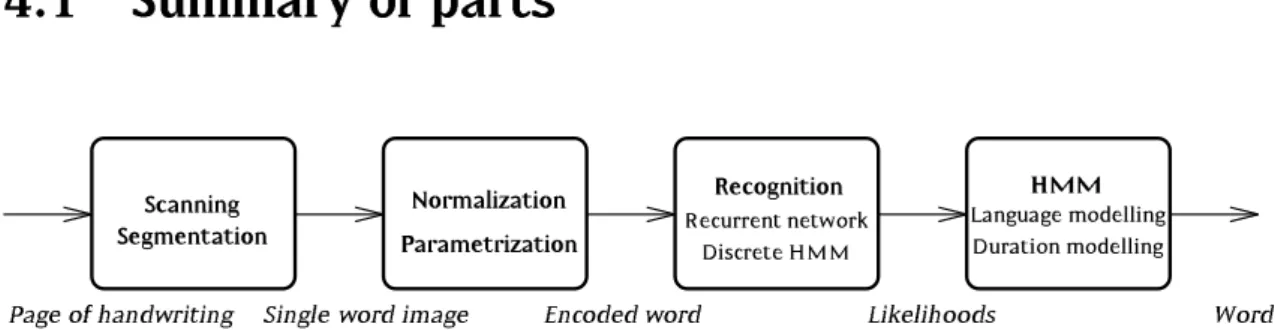
4.1 Summary of parts
Duration modelling
HMM
Recurrent networkRecognition
Discrete HMM Language modelling
Parametrization SegmentationScanning
Likelihoods
Encoded word Word
Single word image Page of handwriting
Normalization
Figure 4.1: A schematic of the recognition system, showing the main processes which must be carried out to identify the words in a handwritten document.
The system described in this thesis can be conveniently divided into the same broad sections as are found in most other handwriting recognition systems,
CHAPTER 4. OVERVIEW OF THE SYSTEM such as those described in chapter 2. The system begins with data acquisition and proceeds in a bottom-up manner, processing smaller amounts of data at successively higherlevels of representation, to arrive at a word identity which can be output in ASCII code.
To capture data from a handwritten document, in general some sort of scanner is used rather than a camera, to ensure controlled conditions, es-pecially of lighting. A variety of scanners is available, from hand-held units for reading a small amount of material, through at-bed scanners and ma-chines with sheet feed or page-turning, up to postal mama-chines with a very fast throughput.
The scanned image must be segmented into separate words (section 4.2) and then a series of image processing operations is carried out to normalize the image, as described in the rst half of chapter 5. The latter half of that chapter discusses the best way of representing the useful information con-tained in the image. That chapter and the next also discuss the derivation of handwritten features from the image, as a succinct way of describing the shape of the handwriting.
Chapter 7 then discusses how data probabilities can be estimatedfrom the encoded feature information. Three dierent pattern recognition techniques are described together with the training method for each. From each of these the probabilities are combined in a hidden Markov model system (chapter 8) which nds the best choice of word for the observed data. This system allows thenaturalincorporation of prior information aboutthelengths of letters and about a restricted list of permitted words, about the grammar of a language and potentially even the semantic context of the writing.
4.2 Image acquisition and corpus choice
The success of any decipherment depends upon the existence and availability of adequate material. How much is needed depends upon the nature of the problem to be solved, the character of the material, and so forth.
John Chadwick. The Decipherment of Linear B. The system is designed to process data captured from a scanner, but for research purposes it is convenient to work on a xed database stored on disk for repeatability and speed. Ideally work would have been conducted using a standard database to produce results which would be easily com-parable with the results quoted for other systems. In the speech recogni-tion community the producrecogni-tion of standard databases has made available large corpora of speech which individual institutions could not collect them-selves. This has enabled reliable comparison between dierent recognition systems and encouraged competition, albeit tending to narrow the goals of research towards performing well on the standard tasks. However, at the start of this research there was no o-line cursive database available, so
CHAPTER 4. OVERVIEW OF THE SYSTEM the only solution was to collect a new database. Subsequently the CEDAR database (Hull 1993) has been released, but it is designed specically for the task of isolated word recognition from address blocks, and introduces a number of special problems which did not fall into the already wide scope of this research. These problems include having to deal with overlapping words and having to remove guide lines, envelope patterns and other clutter, though work has been done to remove much of this noise (Doermann 1993; Kimura et al. 1993b).
In the database collected for this research, words were written by a single author on a plain, white A4 sheet. The writer used a black bre-tip pen which gave clear strokes with sharp edges, but the strokes are wide and overlap. The sheets, each containing 150{200 words, were then scanned on a at-bed scannerat 300 dots perinch resolution, in8 bits (256 levels of grey) to produce one le per page. Each page takes about 8Mbytes of storage in TIFF (Aldus and Microsoft 1988) format, when not compressed.
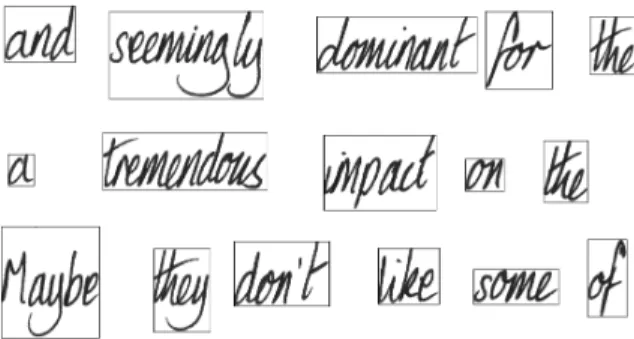
The next task is to segment each page into its component words. Under real conditions, this problem can be dicult. However, there exist published techniques for performing this operation (Garris et al. 1994; Yanikoglu and Sandon 1993) and it has not been studied in detail in this work. For this database each word was written within a wide border of white space to fa-cilitate segmentation. The algorithm for segmentation is thus very simple, merely looking for blank horizontal lines to partition between lines of text. Within lines of text, the algorithm looks for long horizontal gaps between words. If the algorithm fails, the automatically determined bounding boxes around words can be manually adjusted using a graphical tool developed for the purpose. Figure 4.2 shows a section of a page of data with the automatic segmentation displayed. Words are automatically labelled by alignment with the machine readable le which was used to prompt the writer.
Figure 4.2: A section of a page of the database, showing the bounding boxes detected automatically.
Initial tests were carried out on a database of the numbers written out as words (`one' to `nineteen', tens from `twenty' to `hundred', plus `thousand', `million' and `zero'). These words were chosen because they form a corpus useful for an application such as cheque verication, but the small vocabulary