Abstract
Machine translation services available on the Web are becoming increasingly popular. However, a pivot translation service is required to realize translations between non-English languages by cascading different translation services via English. As a result, the meaning of words often drifts due to the inconsistency, asymmetry and intransitivity of word selections among translation services. In this paper, we propose context-based coordination to maintain the consistency of word meanings during pivot translation services. First, we propose a method to automatically generate multilingual equivalent terms based on bilingual dictionaries and use generated terms to propagate context among combined translation services. Second, we show a multiagent architecture as one way of implementa-tion, wherein a coordinator agent gathers and propagates context from/to a translation agent. We generated trilingual equivalent noun terms and im-plemented a Japanese-to-German-and-back transla-tion, cascading into four translation services. The evaluation results showed that the generated terms can cover over 58% of all nouns. The translation quality was improved by 40% for all sentences, and the quality rating for all sentences increased by an average of 0.47 points on a five-point scale. These results indicate that we can realize consistent pivot translation services through context-based coordi-nation based on existing services.
1 Introduction
Recently, the number of languages used in Web pages has increased rapidly. People using English on the Internet now comprise 30% of all Internet users; users of Asian languages comprise 26%; users of European languages excluding Eng-lish comprise 25%; and users of all other languages comprise 20%.1 This trend introduces the requirement for translations
1
The latest estimation of Internet users by language, carried out in May 2008 by Internet World Stats. See:
http://www.internetworldstats.com/stats7.htm
between non-English languages in addition to between Eng-lish and non-EngEng-lish languages. Although the increase in the number of online translation services enables people to ac-cess machine translations easily, it is practically impossible to cover all combinations of n languages as the development of (n2-n) direct translation services would be extremely costly. The pivot translation service generated by combining multiple translation services via a pivot language is a prac-tical solution for such situation.
However, pivot translation often yields drifting for the meanings of words because of inconsistent word selection, making it difficult for users to continue communication. Es-tablishing common ground among users in ma-chine-translation-mediated communication is known to be difficult [Yamashita et al., 2009]; one of the causes of diffi-culty is inconsistent word selection [Yamashita and Ishida, 2006].
In phrase-based statistical machine translation (SMT), methods for pivot translation with no direct corpora between the source and target languages have been proposed [Uti-yama and Isahara, 2007; Wu and Wang, 2007]. In their ap-proach, the phrase-table required for SMT between the source and target languages is generated by combining phrase-tables between the source and pivot languages and the pivot and target languages. The phrase and lexical translation probabilities in the new table are estimated from original corpora, enabling more accurate selection of translated phrases. In the other approach for word selection problems, Kanayama and Watanabe [2003] proposed the linguistic annotation method. They embedded lexical and syntactical information for a source sentence into the intermediated sentence to assure the correctness of the pivot translation. However, the above approaches are not available immedi-ately in practice because it is not easy to prepare the enor-mous and reliable corpora required to merge phrase tables or to apply the linguistic approach to all translation services. In contrast, we propose a method to realize consistent transla-tion with available dictransla-tionaries and translatransla-tion services. To coordinate existing translation services, this study used the framework of service computing. In Web service com-position, the WS-Coordination (Web Services Coordination)2
2
http://www-106.ibm.com/developerworks/library/ws-coor
Context-Based Approach for Pivot Translation Services
Rie Tanaka
C&C Innovation Research
Laboratories, NEC
Corpora-tion, Nara, 6300101, Japan
[email protected]
Yohei Murakami
National Institute of Information
and Communications Technology
(NICT), Kyoto, 6190289, Japan
[email protected]
Toru Ishida
Department of Social
Infor-matics, Kyoto University,
Kyoto 6068501, Japan
[email protected]
specification enables the propagation of the service ID or port number as “CoordinationContext” to solve the semantic problems of service composition; it is also used to match input and output data types automatically [Hassine et al., 2006]. Moreover, the method of meta-level control for com-posite Web services in an open environment, known as “Service Supervision,” has been proposed for designers who are not authorized to modify each component Web service [Tanaka et al., 2009]. In terms of improving the performance of composite Web services, a context-aware approach called situated Web service (SiWS) has been proposed to improve the performance of Web services with diverse interfaces and various clients [Matsumura et al., 2006]. We took this type of approach to coordinate word selection of whole component services with context from outside the Web services. In the development of machine translations or language resources, Bramantoro et al. [2008] proposed a method to combine lan-guage resources and middleware architecture to integrate deep and shallow natural language processing components. This approach uses both language resources and language processing component as Web services: our context-based coordination approach can contribute towards the improve-ment of combined services in such areas.
To solve the word selection problem in pivot translation services, we propose the context-based coordination method for translation services. We regard the internal translation processes of services as black boxes and realize the coordi-nation outside the services instead of proposing a new ma-chine translation technology. This study addresses the fol-lowing issues.
Context-Based Coordination with Propagated Context
To ensure consistency in word selection, we propose the propagation of context across cascaded translation ser-vices by regarding the context as a set of multilingual equivalent terms. In the research area of bilingual dic-tionaries, methods to match the meanings of the words of different languages by combining multiple dictionaries are proposed. We refer to those methods and propose a method to generate the multilingual equivalent terms automatically based on commercially available bilingual dictionaries.
Multiagent Architecture for Coordination
This paper proposes a multiagent architecture as one way to implement context-based coordination, wherein the coordinator agent gathers and propagates the context from/to translation agents.
We implemented a coordinated Japa-nese-to-German-and-back translation service by cascading four translation services and obtained results indicating that the translation quality improved substantially. The advantage of this approach is that high-quality translations can be ex-tracted from existing translation services with existing bi-lingual dictionaries without modifying their internal coding systems.
2 Overview of Context-Based Approach
2.1 Issues in Composite Translation Services
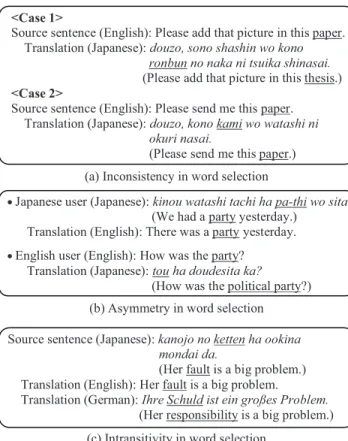
We conducted several experiments using the Language Grid [Ishida, 2006] and classified word selection errors into three categories: inconsistency, asymmetry, and intransitivity. Inconsistency is when translations of the same source word vary in different sentences. Asymmetry is when the back-translated word is different from the source word. The impact of these errors on communication has already been analyzed [Yamashita and Ishida, 2006]. Quantitative results with interview data show that lexical entrainment [Brennan and Clark, 1996] is disrupted by asymmetries in machine translations since they interfere with echoing. Intransitivity is when the word sense drifts across the cascaded machine translators.
Figure 1 presents examples of common problems en-countered by cascaded translation services. All original Japanese and German sentences in this paper are italicized and their English translations are provided in parentheses. (a) is an example of inconsistency, wherein the English word “paper” is translated to the Japanese word ronbun (thesis) in Case 1, while the same word is translated into kami (paper) in Case 2. Asymmetry is presented in (b). In the first step of the machine translation-mediated communication, the Japanese word pa-thi (party), which means a social gathering, is
<Case 1>
Source sentence (English): Please add that picture in this paper. Translation (Japanese): douzo, sono shashin wo kono
ronbun no naka ni tsuika shinasai.
(Please add that picture in this thesis.)
<Case 2>
Source sentence (English): Please send me this paper. Translation (Japanese): douzo, kono kami wo watashi ni
okuri nasai.
(Please send me this paper.) (a) Inconsistency in word selection
•Japanese user (Japanese): kinou watashi tachi ha pa-thi wo sita. (We had a party yesterday.)
Translation (English): There was a party yesterday.
•English user (English): How was the party? Translation (Japanese): tou ha doudesita ka?
(How was the political party?) (b) Asymmetry in word selection
Source sentence (Japanese): kanojo no ketten ha ookina
mondai da.
(Her fault is a big problem.) Translation (English): Her fault is a big problem. Translation (German): Ihre Schuld ist ein großes Problem.
(Her responsibility is a big problem.) (c) Intransitivity in word selection
translated into English correctly. However, when an English user echoes the word “party,” it is translated into the Japa-nese word tou (political party). Intransitivity is presented in (c). The Japanese word ketten (fault), which means a weak-ness of character, is translated into English correctly, but mistranslated to the German word Schuld (responsibility). This is because the intermediate English word “fault” has several meanings, and the English-German translator does not have any knowledge of the context for the preceding Japanese-English translation.
2.2 Context-Based Pivot Translation Service with
Multiagent Architecture
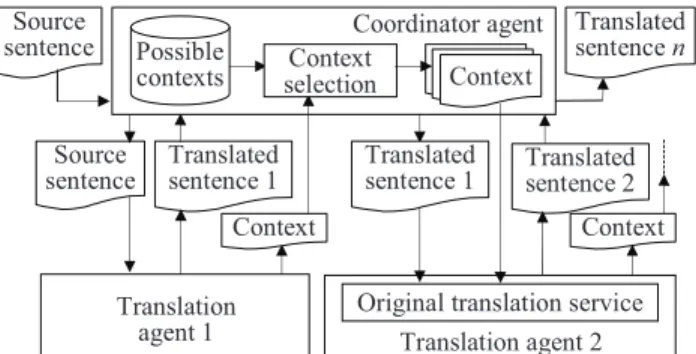
We propose a multiagent architecture for context-based pivot translation service, as shown in figure 2. The coordinator agent, which plays the role of controlling the whole transla-tion, gathers and propagates context from/to the translation agents in addition to requesting them to translate the sentence. It possesses all possible contexts internally, selects all con-texts that suit the context reported by the translation agent, and transfers them to the next translation agent. Translation agents possess the in-built functionality for the original translation service; they perform translations by taking into account the context provided by the coordinator agent, up-date the context, and transfer the result to the coordinator agent. They have knowledge of the languages and make lan-guage-specific processes or decisions. By using the agent framework, more advanced improvements are possible: for instance, adding the ability to interact with users in order to identify the context of the sentence.
Context can be represented in several ways, such as a set of characteristic words in a document, surrounding text, or talk of an expression. Since context in one language can be translated to other languages with multilingual equivalent terms, we represent context by sets of equivalent terms, not sets of terms in one language. In our architecture, we con-sider a set of terms in the source sentence as context in the source language and use equivalent terms as propagated context.
3 Generating Multilingual Equivalent Terms
The set of equivalent terms can be generated by analyzing generic bilingual dictionaries.3 However, since it is costly and difficult to manually develop multilingual dictionaries that include all words in all languages, we require an auto-mated method to develop such a dictionary. In previous work on this subject, the concepts for different languages were matched using bilingual dictionaries [Tokunaga and Tanaka, 1990]. We extended this idea to generate a set of trilingual equivalent terms (referred to hereafter as a triple). We rep-resent mappings of words belonging to different languages in the form of a graph; a word is represented as a vertex, and a3 Multilingual equivalent terms can also be developed manually,
as in the case of•EuroWordNet [Vossen, 1998].
mapping in bilingual dictionaries is represented as a directed edge. If the graph contains a triangle, the three words are considered equivalent terms. Figure 3 shows the two types of triangles: loop and transition. The loop triangle starts from a source language, looks up dictionaries three times, and re-turning to the source language. The transition triangle starts from a source language and looks up dictionaries to locate transitive and direct routes between the source and target languages. It is easy to generate a triple from such triangles. We call such triples generated from loop triangles loop-type triples hereafter.
Example 1 (A loop triangle representing “sky”)
Figure 4 shows an example of a loop triangle, starting with the Japanese word sora (sky/heaven/midair). Words such as “sky” are extracted by looking up a Japanese-English dic-tionary. The German word Himmel (sky/heaven) is obtained by looking up the word “sky” in an English-German dic-tionary. Since the source Japanese word is extracted from a German-Japanese dictionary, {sora (sky/heaven/midair), sky, Himmel (sky/heaven)}is considered as a triple. Continuing this process further yields other triples.
Word A (Japanese) Word B (English) Word C (German) Japanese- English
Dictionary (Japanese) Word A Word B (English) Word C (German) Word Bilingual Dictionary
(a) Loop triangle (b) Transition triangle Figure 3. Two types of shapes of triangles
Japanese English German heaven sky air Himmel (sky/heaven) ) Luft (midair) sora (sky/ heaven/ midair) ten (heaven)
Figure 4. A loop triangle representing the sense of “sky• Translation agent 2 Original translation service Source
sentence Possible Coordinator agent contexts
Source sentence
Translated
sentence 1 Translated sentence 2 Context Context Context selection Translated sentence 1 text Context Translation agent 1 Translated sentence n
This method can easily be extended to four or more lan-guages by combining triples generated in each of the three languages similar to the extension approach proposed by Wu et al. [Wu et al., 2008]. For example, for Japanese, English, German, and French words, Japanese-English-German tri-ples are obtained first followed by English-German-French triples. The quadruple is generated by combining two triples with identical English and German words. It is noteworthy that a triangle does not always imply equivalent terms. In the case where word A has word sense C1 and C2, word B has C2 and C3, and word C has C3 and C1, no shared sense exists between the three words. Assume that each word in a triple has n senses with uniform distribution, the probability of sharing the same sense is .83 for n = 2 and 0.91 for n = 3; this probability approaches 1 as n increases. In practice, the term frequencies of n senses are unequal, and the actual probabil-ity is higher than the calculated one. Thus we can obtain re-liable equivalent terms by combining triples if the number of languages increases.
In related research on dictionary formulation, a method to construct a bilingual dictionary using a third language as an intermediate is proposed [Tanaka and Umemura, 1994]. This study takes the example of generating a Japanese-French dictionary by connecting Japanese-English and Eng-lish-French dictionaries. It addresses the problem that a French word with a meaning different from that of the original Japanese word is obtained due to ambiguity in the intermediate English word; this problem is solved through inverse consultation with French-English and Eng-lish-Japanese dictionaries. We focus on obtaining more
reliable equivalent terms when dictionaries exist between each pair of languages and differ from the above research in terms of our assumptions and objectives. In order to realize coordination even when sufficient dictionaries are not available, methods such as inverse consultation are required to obtain equivalent terms.
4 Context-based Coordination Algorithms
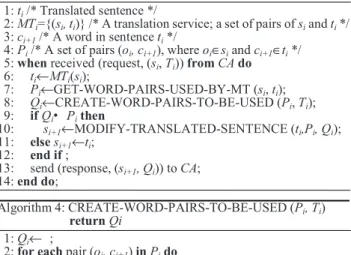
Algorithms of the multiagent architecture for the con-text-based coordination are shown in figure 5 and 6. These algorithms are simple implementations of our multiagent model. Let machine translator MTiinput source sentence si and output translated sentence ti. Let the translation agent MTAireceives source sentence si, generate and modify ti, and output si+1, which is a source sentence of MTAi+1. Let the coordinator agent CA repeat the coordination process from MTA1 to MTAn and receive sn+1 as the final result in the target language. Multilingual equivalent terms in n languages are grouped into n-tuples. The context Tiis a set of n-tuples and the i-th word in each n-tuple in Tiis included in si. In a n-tuple (w1, ..., wn), the words w2, ..., wn have the same meaning as w1 i.e. the same meaning as original sentence s1, and their use assures the correct translation.First, CA prepares the initial context T1 from s1 received from the user and starts translation. After MTAi returns the translated sentence si+1 and Qi—representing word pairs of the source word in si and translated word in si+1—CA
Algorithm 3: SERVICE-AGENT MTAi 1: ti /* Translated sentence */
2: MTi={(si, ti)} /* A translation service; a set of pairs of si and ti */
3: ci+1 /* A word in sentence ti */
4: Pi /* A set of pairs (oi, ci+1), where oi∈si and ci+1∈ti */
5: when received (request, (si, Ti)) fromCAdo
6: ti←MTi(si); 7: Pi←GET-WORD-PAIRS-USED-BY-MT (si, ti); 8: Qi←CREATE-WORD-PAIRS-TO-BE-USED (Pi, Ti); 9: ifQi• Pithen 10: si+1←MODIFY-TRANSLATED-SENTENCE (ti,Pi, Qi); 11: else si+1←ti; 12: end if ;
13: send (response, (si+1, Qi)) to CA;
14: end do;
Algorithm 4: CREATE-WORD-PAIRS-TO-BE-USED (Pi, Ti) returnQi
1: Qi← ;
2: for each pair (oi, ci+1) inPido
3: for eachn-tuple (w1, w2, ..., wn) inTido
4: ifoi∈(w1, w2, ..., wn) and ci+1∈(w1, w2, ..., wn) then
5: Qi←Qi• {(oi, ci+1)};
6: end if; 7: end loop; 8: if (oi, ci+1)∉Qithen
9: mi+1←i+1th word in n-tuple selected from {( w1, w2, ..., wn)|oi∈(w1, w2, ..., wn)};
10: Qi←Qi• {(oi, mi+1)};
11: end if; 12: end loop; 13: returnQi;
Figure 6. Algorithms of the translation agent MTA
Algorithm 1: COORDINATOR-AGENT CA
1: si /* Source sentence */
2: oi /* A word in sentence si */
3: MTA /* An ordered list of translation agents (MTA = {MTA1, MTA2, ..., MTAn}) */
4: MTAi = {(si, si+1)} /* A translation agent; a set of pairs of
sentence si and si+1 */
5: Ti /* A set of n-tuples (w1, w2, ..., wn), where wk is included in sk
(k i); All n-tuples are n-lingual equivalent terms */ 6: Qk /* A set of pairs (oi, mi+1), where oi∈si and mi+1 is the
modified translated word for oi */
7: when received (ask, s1) from user do
8: T1←{(w1, w2, ..., wn)| w1∈s1};
9: for eachMTAiinMTAdo
10: send (request, (si, Ti)) to MTAi;
11: when received (response, (si+1, Qi)) do;
12: Ti+1←SELECT-POSSIBLE-N-TUPLES (Ti, Qi);
13: end do; 14: end loop;
15: send (reply, sn+1) to user;
16: end do;
Algorithm 2: SELECT-POSSIBLE-N-TUPLES (Ti, Qi) returnTi+1
1: Ti+1← ;
2: for each pair (oi, mi+1) inQido
3: Ti+1←Ti+1• {(w1, w2, ..., wn)|( w1, w2, ..., wn)∈Ti, wi=oi and wi+1=mi+1};
4: end loop; 5: returnTi+1;
generates a new context Ti+1 for the i+1-th translation by narrowing down Ti such that the i+1-th word in each n-tuple appears in si+1 by the SELECT-POSSIBLE-N-TUPLES procedure. Ti+1 may contain ambiguity in word selection for the i+2-th word, as more than two n-tuples containing the same j-th word (1 j i+1) can exist with different i+2-th words. If there are several candidates for the i+2-th word, the i+1-th translation agent MTAi+1determines the most appro-priate one. The choice is noted to CA by Qi+1, and CA reflects it to the next translation.
MTAigenerates a translated sentence ti using MTito create Pi—a set of word pairs of source word oi and translated word ci+1—using the GET-WORD-PAIRS-USED-BY-MT pro-cedure. One way to implement this function is to divide si and ti into morphemes and map between them using bilingual dictionaries. Then, MTAimodifies words in Pibased on the
context Ti using the procedure
CRE-ATE-WORD-PAIRS-TO-BE-USED and Qi. Since Ti pre-serves the words used in the preceding i translations, the translated words excluded from Ti may have different meanings. Such words are replaced by words included in Ti, selected from among a few candidates if Ticontains ambi-guity. Finally, ti is modified by the procedure MOD-IFY-TRANSLATED-SENTENCE, wherein the words are replaced using Piand Qi. The word selection process can be improved through several methods: for instance, by referring
to term frequency or priority of words, in case the translation agent possesses this information. If the entire document or conversation logs are available, this information can be util-ized by CA to create an initial context T1.
Example 2 (Context-based translation)
We show the translation process for the sentence shown in figure 1(c). In this example, the replacement of target words is limited to nouns. Figure 7 shows the process of the Eng-lish-German translation agent MTA2 after the Japa-nese-English translation agent MTA1 completes its translation process. In the first step, the coordinator agent CA receives the Japanese source sentence s1 = “kanojo no ketten ha ookina mondai da (Her fault is a big problem),” sets all pos-sible n-tuples including the words in s1 and transfers s1 and T1 to MTA1. MTA1 then translates s1 into the English sentence t1 = “Her fault is a big problem” using the Japanese-English translation service MT1. MTA1 obtains pairs P1 of words in s1 and t1: P1 = {{ketten (fault), fault}, {mondai (problem), problem}}. MTA1 then examines the translated words. For example, if T1 contains triples including both ketten (fault) and “fault,” MTA1 realizes that they share the same meaning. If that is not the case, the triples may remain incomplete, and MTA1 has to abandon efforts to maintain context. If the triples are complete, then triples including both ketten (fault) and “fault” as well as those including both mondai (problem) and “problem” should be contained in T1. Therefore, translated words are not modified: Q1 = P1and s2 = t1. MTA1 then sends s2 and Q1 to CA and CA generates the new context T2. For example, both triples of T1 including both ketten (fault) and “fault” are to be included in T2, as shown in figure 7. In the second step, s2 and T2 are sent to the second Eng-lish-German translation agent MTA2. MTA2 translates s2 to the German sentence t2 = “Ihre Schuld ist ein großes Problem (Her responsibility is a big problem).” Pairs P2 are then ob-tained: P2 = {{fault, Schuld (responsibility)}, {problem, Problem (problem)}}. It appears that the word Schuld (re-sponsibility) has semantically drifted, as there is no triple in T2 that includes both “fault” and Schuld (responsibility). Thus it is replaced by a word that is included in a triple in T2, which also includes “fault.” If the first triple in figure 7 is selected, Q2 would be {{fault, Fehler (fault)}, {problem, Problem (problem)}}. MTA2 modifies t2 to s3: s3 = “Ihre Fehler ist ein großes Problem (Her fault is a big problem).” s3 is finally returned to the user.
5 Evaluation
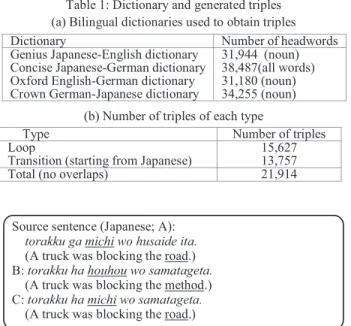
We constructed Japanese-English-German triples limiting their parts-of-speech to nouns. Table 1 lists the dictionaries used and the number of triples obtained from them. Transi-tion-type triples start with Japanese words. A total number of 21,914 triples were obtained. We first analyzed the effec-tiveness of the 21,914 triples in covering arbitrary Japanese documents. We used the term frequency of nouns in a Web corpus storing 470 million sentences containing 5000 million Japanese words [Kawahara and Kurohashi, 2006]. The triples
Figure 7. Example of Coordinated Translation Services Coordinator agent CA
s2
Her fault is a big problem.
English-German translation service MT2
Japanese-English translation agent MTA1
MODIFY- TRANSLATED- SENTENCE English-German translation agent MTA2
fault Fehler (fault), problem Problem (problem)
T1 Q1 ketten (fault) fault, mondai (problem) problem
{{ketten (fault), fault, Fehler (fault)},
{ketten (fault), fault, Mangel (fault)}, {mondai (problem), problem, Problem (problem)}} T2 t2 P2 Q2 GET-WORD-PAIRS -USED-BY-MT
fault Schuld (responsibility), problem Problem (problem)
s3
SELECT-POSSIBLE-N-TUPLES
CREATE-WORD- PAIRS-TO-BE- USED
Ihre Fehler ist ein großes Problem. (Her fault is a big problem.)
Ihre Schuld ist ein großes Problem.
(Her responsibility is a big problem.)
appeared to cover 58% of all nouns in the corpus and 40% of all parts-of-speech words. If the triples are used in descend-ing order of term frequency, 6,000 triples can cover 50% of nouns and 38% of all parts-of-speech words. This implies that a relatively small number of triples can cover the ma-jority of frequently used nouns.
We then conducted a preliminary evaluation of the quality of Japanese-German back translation using the cascade of Japanese-English, English-German, German-English, and English-Japanese translations. We compared the source Japanese sentence (A), back-translated Japanese sentence generated without context (B), and that generated based on context (C). For purposes for accuracy, we took the subjec-tive evaluation by three Japanese subjects who were nasubjec-tive speakers of Japanese. The subjects were asked to evaluate the translation quality on a five-point scale, how much of the original meaning of sentence A was conveyed through sen-tences B and C (5-All, 4-Most, 3-Much, 2-Little, 1-None). Source sentences were selected from the Machine Transla-tion Test Set provided by the NTT Natural Language Re-search Group4. We randomly selected 100 samples in which B and C were different. The results of Welch’s test show that there is a difference in quality between B and C with a con-fidence level greater than 98%.
On average, the translation quality improved for 41 sen-tences and the score increased by an average of 0.47 points using context-based coordination. For example, in figure 8, without context the Japanese word michi (road) is mistrans-lated to houhou (method). This error occurs because the in-termediate English word “way” has several meanings. The quality improved in the case of 34% for the sentences that were previously assigned a rating of 4 when translated
4
http://www.kecl.ntt.co.jp/mtg/resources/index.php
without coordination. Similarly, sentences with ratings of 3, 2, and 1 showed improvements for 32%, 49%, and 60% re-spectively with the context-based approach.
6 Conclusion
This study proposes a method for context-based coordination to overcome mistranslations during pivot translation, which occurs because of inconsistent word selection. The major aspects are summarized below.
Context-based Coordination with Propagated Context
We took an approach to propagate context across com-bined translation services. Treating context as a set of multilingual equivalent terms used in translation, we propose to obtain all possible terms based on triangle forms formed by the relationships between words and translated words extracted from bilingual dictionaries. Our triangle method can be easily extended to four or more languages, and it is efficient in obtaining a sufficient amount of terms; the evaluation results show that the generated equivalent noun terms cover 58% of nouns and 40% of all parts-of-speech appearing in arbitrary sen-tences.
Multiagent Architecture for Coordination
We proposed a multiagent architecture as one way to im-plement coordination with propagated context, wherein the coordinator agent gathers and propagates context from/to translation agents. Evaluation results of the translation quality of the indicated improvements in 41% of the total 100 sentences used and that the quality rating increased by an average of 0.47 points on a five-point scale. This architecture offers the flexibility of extension and the possibility of constructing a more complex com-position of translation services and other types of lan-guage resources.
By considering the translation services as black boxes, a substantial improvement in translation quality was realized. The advantage of our approach is that we can improve the translation quality without any corpora, training of transla-tion services with training sentences, or changing the inner components of systems; we only use available language re-sources and add some components outside existing transla-tion services. This improvement is not trivial in the inter-cultural collaboration domain [Ishida et al., 2007]. Con-text-based coordination approach will play an important role in the quality improvement of the component service itself making up the composite service, which is frequently con-sidered an issue of the component technologies.
Acknowledgments
This collaborative research was conducted between NICT and Kyoto University when the author Rie Tanaka was a master’s degree student at Kyoto University; it was sup-ported by the Kyoto University Global COE Program: In-formatics Education and Research Center for
Knowl-Table 1: Dictionary and generated triples (a) Bilingual dictionaries used to obtain triples
Dictionary Number of headwords
Genius Japanese-English dictionary Concise Japanese-German dictionary Oxford English-German dictionary Crown German-Japanese dictionary
31,944 (noun) 38,487(all words) 31,180 (noun) 34,255 (noun) (b) Number of triples of each type
Type Number of triples Loop
Transition (starting from Japanese)
15,627 13,757 Total (no overlaps) 21,914
Source sentence (Japanese; A):
torakku ga michi wo husaide ita.
(A truck was blocking the road.) B: torakku ha houhou wo samatageta.
(A truck was blocking the method.) C: torakku ha michi wo samatageta.
(A truck was blocking the road.)
edge-Circulating Society, Strategic Information and Com-munications R&D Promotion Programme from Ministry of Internal Affairs and Communications, and a Grant-in-Aid for Scientific Research (A) (21240014, 2009-2011) from the Japan Society for the Promotion of Science (JSPS).
References
[Bramantoro et al., 2008] Arif Bramantoro, Masahiro Tanaka, Yohei Murakami, Ulrich Schäfer and Toru Ishida. A Hybrid Integrated Architecture for Language Service Composition. ICWS-08, pages 345–352, 2008.
[Brennan and Clerk, 1996] Susan E. Brennan and Herbert H. Clark. Conceptual Pacts and Lexical Choice in Conver-sation. Journal of Experimental Psychology: Learning, Memory, and Cognition 22(6):1482–1493, 1996.
[Hassine et al., 2006] Ahlem Ben Hassine, Shigeo Matsubara and Toru Ishida. A Constraint-Based Approach to Hori-zontal Web Service Composition. ISWC-06, pages 130–143, 2006.
[Ishida, 2006] Toru Ishida. Language Grid: An Infrastructure for Intercultural Collaboration. SAINT-06, pages 96–100, keynote address, 2006.
[Ishida et al., 2007] Toru Ishida, Susan R. Fussell and Piek Vossen. (Eds.): Intercultural Collaboration. Lecture Notes in Computer Science, 4568, Springer-Verlag, 2007. [Kanayama and Watanabe, 2003] Hiroshi Kanayama and
Hideo Watanabe. Multilingual Translation via Annotated Hub Language. MT-Summit IX, pages 202–207, 2003. [Kawahara and Kurohashi, 2006] Daisuke Kawahara and
Sadao Kurohashi. Case Frame Compilation from the Web using High-Performance Computing. LREC-06, 2006. [Matsumura et al., 2006] Ikuo Matsumura, Toru Ishida,
Yohei Murakami and Yoshiyuki Fujishiro. Situated Web Service: Context-Aware Approach to High Speed Web Service Communication. ICWS-06, pages 673–680, 2006. [Tanaka and Umemura, 1994] Kumiko Tanaka and Kyoji Umemura. Construction of a Bilingual Dictionary Inter-mediated by a Third Language. COLING-94, pages 293–303, 1994.
[Tanaka et al., 2009] Masahiro Tanaka, Toru Ishida, Yohei Murakami, and Satoshi Morimoto. Service Supervision: Coordinating Web Services in Open Environment. ICWS-09, to be published, 2009.
[Tokunaga and Tanaka, 1990] Takenobu Tokunaga and Hozumi Tanaka. The Automatic Extraction of Concep-tual Items from Bilingual Dictionaries. PRICAI-90, pages 304–309, 1990.
[Utiyama and Isahara, 2007] Masao Utiyama and Hitoshi Isahara. A Comparison of Pivot Methods for Phrase-based Statistical Machine Translation. HLT-NAACL, pages 484–491, 2007
[Vossen, 1998] Piek Vossen. (Eds.) EuroWordNet: A Mul-tilingual Database with Lexical Semantic Networks.
Dordrecht, Netherlands: Kluwer, 1998. See: http://www.hum.uva.nl/ ewn/.
[Wu and Wang, 2007] Hua Wu and Haifeng Wang. Pivot Language Approach for Phrase-Based Statistical Ma-chine Translation. ACL’07, pages 856–863, 2007. [Wu et al., 2008] Yanchen Wu, Fang Li, Rie Tanaka and
Toru Ishida. Automatic Creation of N-lingual Synony-mous Word Sets. SKG-08, pages 141–148, 2008.
[Yamashita et al., 2009] Naomi Yamashita, Rieko Inaba, Hideaki Kuzuoka and Toru Ishida. Difficulties in Estab-lishing Common Ground in Multiparty Groups using Machine Translation. CHI’09, pages 679–688, 2009. [Yamashita and Ishida, 2006] Naomi Yamashita and Toru
Ishida. Effects of Machine Translation on Collaborative Work. CSCW-06, pages 515–523, 2006.