integration fast and error free. To meet this demand there are many network sniffer tools that will help in
integration of these vast systems.
Keywords: Packet Capture; Packet Sniffer; Network Monitoring; Wireshark; NIC
I.
INTRODUCTION
A packet sniffer is a program that can see all of the information passing over the network it is connected to. As data steams back and forth on the network the program looks at it or „sniffs‟ each packet. A packet is a part of a message that has been broken up. Packet analysis can help us understand network characteristics, learn who is on network, determine who or what is utilizing available bandwidth, identify peak network usage times, identify possible attacks or malicious activity, and find unsecured and bloated applications[1].
II.
WORKING
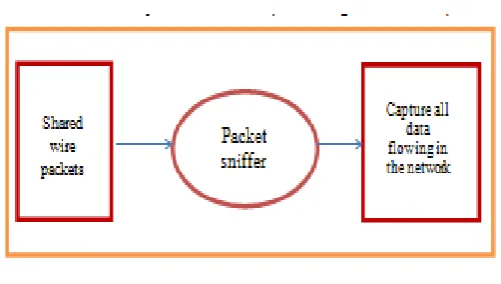
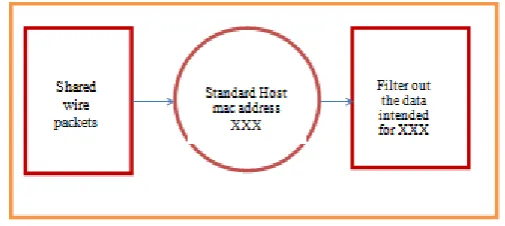
There are two modes in which a network interface of a machine work i.e Promiscuous and Non-promiscuous. Promiscuous mode in one in which the NIC of the machine can take over all packets and a frame it receives on network, namely this machine (involving its software) is sniffer. As shown in the following diagram[2]
Fig. 1 Promiscuous Mode
Fig. 2 Non- Promiscuous Mode
2.1
Components
Sniffer is a combination of hardware and software. Different sniffers may have various configurations on account of designation and final usage, but basically, a sniffer is composed of four parts:
Hardware: - most sniffing products can work with standard adapters. Some sniffers only support Ethernet
or wireless adapters whereas others support multi-adapters and allow customization.
Drive program: - this is a core component of a sniffer. Each sniffing product has its own drive program,
only after completing installation can a sniffer start to capture traffic and data from network.
Buffer: -a buffer is a storage device for captured data from network. In general, there are two modes of
buffers: keep capturing until the storage place full, or keep capturing and overflowing as the latest captured data keep replacing the oldest data.
Packet Analysis:-packet analysis can be done on real time or we can analyze packets after storing it. We
can analyze both header and actual data, when we store data in memory or we perform real time analysis, decoder is used to decode the data store in packets.
2.2
Working Principle
When a computer sends a data to the network, it sends in the form of packets. These packets are the blocks of data that are actually directed to the certain deputed system. Every sent data has its receiving point. So, all the data are directly handled by specific computer. A system reads and receives only that data which only that data which is intended for it. The packet sniffing process involves a collaborate effort between the software and the hardware. This process is broken down into three steps.
1. Packet sniffer collects raw binary data from the wire. Normally this is done by switching the selected network interface into unrestrained mode.
2. The collected binary data is converted into readable form.
3. The packet sniffer collected all data, verifies its protocol and begins its analysis.[3]
III
RELATED
WORK
dropdown box as shown in the figure below. By default no entries are selected and all the messages will be displayed by default. If you want to see the specific „TO‟ and „FROM‟ message then that entry should be selected. There is a color coding of the messages on the basis of the length of the message received and the actual length of the message. If there is a mismatch in the length then red color will be shown else it‟s a match then the message will be shown in green color. It‟s not that this tool will show only the recorded messages but also show the unrecorded messages as unknown event in yellow color.
Figure: - Proposed Network Tool
Figure: - Message window in the tool
Apart from the main functionality described above there are many other add-ons to this tool. If you want to see the byte format / hexadecimal format in which the message is flowing you can see that also along with the message window displayed in the right. In the message window there is search option also in case the message is too big to search for a particular keyword. Some messages also contain union so there is an option to manage union to see what structure in that union you want to see as shown in the diagram below:-
Figure: - Manage union dialog in tool
You take log of the whole set of messages currently received and save that in the text file and just study it for later use as shown in the figure below:-
Figure: - Creating Log File in tool
Figure: - Select message dialog in tool
V
RESULT
As is clear from the description above and various features provided with this tool, this tool is way above than the traditional sniffers available for the integration of a specific huge networking project. Suppose there are 1000 of messages that we need to check in a network. Then filtering and analyzing these messages byte wise with traditional sniffers will take on average 15 minutes, depending on the frequency, length etc. of the message. On the other hand in this proposed tool it will hardly take 30 seconds. So will the traditional sniffer it take 15*1000=15000 minutes= 250 hours= 11 days (approx.) that too working day and night. On our proposed tool it will take 30*1000=30,000 seconds= 500 minutes=9 hours (approx.). So this is a huge decrease in time from 11 days to 1/3rd a day. This has saved so much of resources and decrease in the cost of integration. There is no comparison on the basis of precision also as our proposed tool is very precise in comparison to the manual counting and analysis of bytes where messages are as huge as hundreds of byte also. Apart from one time making of text files of the messages there is huge saving of time and precision by using the proposed tool.
VI
CONCLUSION
In this paper we have seen that how with the help of this network analysis tool we have made the integration of vast projects like of Indian navy so fast and hassle free. With the help of the tool integration became so transparent which was earlier a very difficult task as to determine which software exe is actually sending the wrong data.
REFERENCES
3 (Chris Sanders and Chris Sanders, “Practical Packet Analysis” Pub. Date: May 17, 2007 ISBN-13:978-1-59327-149-7)
5 Pallavi Asrodia\* and Hemlata Patel, “Analysis of Various Packet Sniffing Tools for Network Monitoring and Analysis”, International Journal of Electrical, Electronics and Computer Engineering vol.1 no.1 pp. 55-58(2012).
6 S. McCanne and V.Jacobson. "The BSD Packet Filter: New Architecture for User Level Packet Capture", USENIX Conference, January, Pages 259-270(1993)..
7 Dulal C. Kar Felix Fuentes. Ethereal vs. tcpdump: A comparative study on packet sniffing tools for educational purpose. Journal of Computing Sciences in Colleges archive, Volume 20(4), pp 169-176, (2005)..
8 All about capsa [Online] Available www.colasoft.com. 9 All about Tools [Online] Available: http://www. sectools.org.