Extracting Interlinear Glossed Text from L
ATEX Documents
Mathias Schenner, Sebastian Nordhoff
Language Science Press, Freie Universit¨at Berlin, Habelschwerdter Allee 45, 14195 Berlin [email protected], [email protected]
Abstract
We presenttexigt, a command-line tool for the extraction of structured linguistic data from LATEX source documents, and a language
resource that has been generated using this tool: a corpus of interlinear glossed text (IGT) extracted from open access books published by Language Science Press. Extracted examples are represented in a simple XML format that is easy to process and can be used to validate certain aspects of interlinear glossed text. The main challenge involved is the parsing of TEX and LATEX documents. We review
why this task is impossible in general and how thetexhsHaskell library uses a layered architecture and selective early evaluation (expansion) during lexing and parsing in order to provide access to structured representations of LATEX documents at several levels.
In particular, its parsing modules generate an abstract syntax tree for LATEX documents after expansion of all user-defined macros and
lexer-level commands that serves as an ideal interface for the extraction of interlinear glossed text bytexigt. This architecture can easily be adapted to extract other types of linguistic data structures from LATEX source documents.
Keywords:Interlinear Glossed Text, LaTeX, Parsing
1.
Introduction
We present a tool for the extraction of structured linguistic data from LATEX source documents and a language resource
that has been generated using this tool: a corpus of inter-linear glossed text (IGT) extracted from open access books published by Language Science Press.
Many linguistic research papers and books are written in LATEX, using more or less semantic markup. Our goal is to
take advantage of this existing structural information and systematically extract linguistic data structures from prop-erly formatted LATEX documents. This route can
comple-ment existing tools for harvesting IGT from PDF docu-ments, in particular ODIN (Lewis and Xia, 2010), which have to cope with much more noise in the source chan-nel resulting from lossy pdf-to-text conversion. However, parsing LATEX comes with its own challenges, as detailed in
section 5.
In addition to extracting data, the tool we are presenting can also be used forvalidatingLATEX encodings of IGT. For
example, it can check whether the number of words and morphemes in the source line match those in the gloss lines or whether the formatting used in gloss lines conforms to certain conventions codified by the Leipzig Glossing Rules (Bickel et al., 2008).
2.
Interlinear Glossed Text
Interlinear glossed text (IGT) is a commonly used format for describing linguistic data, typically comprised of sev-eral word-aligned lines and a single free translation line. A simple example, taken from Holton and Robinson (2014, p.163), is shown in (1).
(1) Ke’e fish
pi-ga-ussar. 1PL-3SG-catch
‘We’re catching fish.’
The first line contains a phrase in the original language, with words split into morphemes separated by a dash.
The second line provides a word-aligned morpheme-by-morpheme analysis, and the final line gives a free trans-lation of the whole phrase in English.
3.
Representations of IGT in L
ATEX
While the LATEX format itself (Lamport, 1994) does not
di-rectly support typesetting interlinear glossed text (without resorting to table markup or other means of manual for-matting), there are several third-party packages that have been designed to add a convenient syntax for encoding IGT. Popular choices in linguistic communities aregb4e,1
linguex2andExPex.3 We will focus on describing the widely adopted gb4e, although our conversion tool sup-ports other packages as well.
The gb4e package provides a list-like environment for numbered examples that may contain IGT blocks. The ba-sic syntax for glossed examples is illustrated in Figure 1. Examples are contained in an exeenvironment and pre-fixed by an\excommand. A block of word-aligned lines is introduced by\gll(two lines) or\glll(three lines), and each line is terminated by a hard line break (\\). An example item may contain an arbitrary number of subex-amples. This is encoded by wrapping the subexamples in anxlistenvironment, as illustrated in Figure 2.
There are several other ways of encoding IGT usinggb4e. For example, the package exposes some unofficial (undoc-umented) abbreviations for opening and closing example containers that are sometimes used in the wild. The use of these\eaand\zcommands is illustrated in the real-world example in Figure 3.
Even if the package did not provide these shortcuts directly, LATEX users are free to define their own macros with
simi-lar functionality. Moreover, a document written in LATEX
1
Available at http://ctan.org/pkg/gb4e, accessed on 2016-03-01.
2
Available at http://www.ctan.org/pkg/linguex, accessed on 2016-03-01.
3Available athttp://www.ctan.org/pkg/expex,
has full access to the low-level commands of the underly-ing TEX language (Knuth, 1984). While LATEX provides a
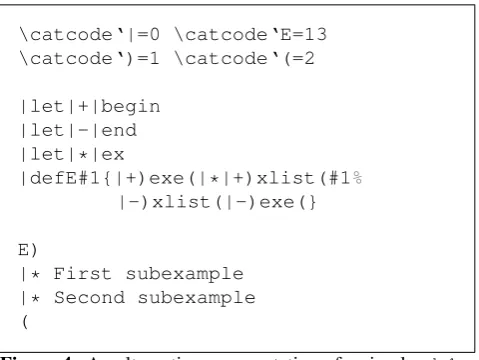
well-organized semantic markup layer for documents, its abstractions are not enforced in any way and can easily be broken by making use of low-level primitive commands. The listing in Figure 4 may serve as an arbitrary example. Although the last four lines might not look like idiomatic LATEX, they are perfectly valid and in the context set up by
the preceding lines they are in fact equivalent to the listing in Figure 2 and produce identical output.
In general, the concrete syntax a document author wishes to use can be customized almost without restrictions. TEX is dynamically programmable down to the lexer level. For example, authors are free to choose their own escape char-acter (instead of the conventional backslash), they can de-fine their own grouping characters (instead of the conven-tional braces), they can define their own comment character (instead of the conventional percentage sign), they can
de-\begin{exe}
\ex\glll
sw1m1-sw1m2 sw2m1 sw3m1-sw3m2\\
g1w1m1-g1w1m2 g1w2m1 g1w3m1-g1w3m2\\
g2w1m1-g2w1m2 g2w2m1 g2w3m1-g2w3m2\\
\glt ‘This is the translation line’
\end{exe}
Figure 1: Encoding of IGT using thegb4eLATEX
pack-age, showing an example consisting of one source line, two gloss lines and a translation line. Each of the aligned lines contains three words which in turn consist of one or two morphemes.
\begin{exe}
\ex
\begin{xlist}
\ex First subexample
\ex Second subexample
\end{xlist}
\end{exe}
Figure 2: Nested unglossed example sentences using the
gb4eLATEX package.
\ea
\label{ex:4:8}
\langinfo{Western Pantar}{AP}%
{\citealt{Holton2010}} \\
\gll Ke’e pi-ga-ussar. \\
fish \textsc{1pl-3sg}-catch \\
\glt ‘We’re catching fish.’
\z
Figure 3: A glossed example sentence from the LATEX
sources of Holton and Robinson (2014, p.163) using the
gb4e package with unofficial environment abbreviations and a customlanginfocommand for supplying metain-formation.
fine their own macro names and environment names, and so on. All of these settings can have local scope, so au-thors are free to use a wild mix of mutually inconsistent set-tings across their document. While these options for con-trolling TEX may seem exotic or marginal to some casual LATEX users, they are the bread and butter of LATEX package
writers. Many commonly used commands crucially depend on these functionalities. For example, the \verb com-mand and the verbatim environment allow the author to enter special characters without escaping by temporar-ily changing the category codes of these characters behind the scenes.
4.
Extracting IGT from L
ATEX
While there are many tools for rendering IGT and other lin-guistic data structures to a LATEX representation for
typeset-ting, there are almost no tools that can go the other way. We are trying to fill this gap with a tool calledtexigt4 that extracts IGT instances from LATEX documents and converts
them to an XML representation described in section 6. One main challenge is that IGT encodings in LATEX
docu-ments may contain arbitrary TEX and LATEX macros from
various sources, including (a) standard macros for font styles, citations, footnotes, cross-references or even low-level formatting instructions, (b) macros from imported packages, liketipa5for phonetic symbols orleipzig6
for standard glossing abbreviations, and (c) additional user-defined macros of arbitrary complexity, as illustrated in Figure 4. In other words, robust extraction of IGT data from LATEX documents is only possible on the shoulders of
a full-blown TEX parser.
4
Seehttps://github.com/langsci/xmlbooks for further details.
5
Available at http://www.ctan.org/pkg/tipa, ac-cessed on 2016-03-01.
6
Available at http://www.ctan.org/pkg/leipzig, accessed on 2016-03-01.
\catcode‘|=0 \catcode‘E=13 \catcode‘)=1 \catcode‘(=2
|let|+|begin |let|-|end |let|*|ex
|defE#1{|+)exe(|*|+)xlist(#1%
|-)xlist(|-)exe(}
E)
|* First subexample |* Second subexample (
Figure 4: An alternative representation of a simplegb4e
example in somewhat obscure but perfectly valid LATEX.
For this reason,texigtis built on top of a separate open source TEX parsing library,texhs7, also developed at Lan-guage Science Press, mainly for the conversion of linguistic books from LATEX to XML, HTML and EPUB. It is
writ-ten in Haskell (Marlow, 2010) and provides an interface for accessing the abstract syntax tree of LATEX documents (as
will be detailed in section 5). This tree is then walked by
texigt, looking for and analyzing IGT containers. After converting special characters to Unicode and discarding ir-relevant formatting instructions,texigtdetects word and morpheme boundaries in aligned lines and constructs an in-ternal representation for all encountered IGT instances that is later serialized to the XML format described in section 6.
5.
Parsing L
ATEX
The major task involved in the extraction of IGT is the pars-ing of LATEX documents. Ideally, we want a representational
layer that abstracts away from irrelevant differences in con-crete syntax, like between Figures 2 and 4. In this section we review the challenges involved and explore howtexhs
tries to provide clean interfaces to the structure of arbitrary LATEX documents. Since LATEX is basically a superset of
TEX, we will focus on parsing TEX in the following subsec-tions.
5.1.
Parsing TEX is impossible
How hard is it to write a robust TEX parser? For a start, here are three facts that suggest that the task is at least not trivial.
First, TEX is a powerful and flexible programming lan-guage. For example, it has been used to control a Mars rover (Hicks, 2009) or to embed functional programming idioms (Jeffrey, 1990).
Second, the TEX language lacks a formal grammar or spec-ification. This is not to deny that its reference implementa-tion has an excellent and extensive documentaimplementa-tion (Knuth, 1986), but this lengthy treatment does not replace a concise formal specification.
Third, TEX is an unusual and highly dynamic program-ming language. An interesting symptom of this is that the TEX engine is conventionally described as a living organism (Knuth, 1984, chapter 7) with eyes, mouth and stomach, rather than in terms of compiler theory.
However, at the core of the third issue is the fact that lex-ing, parsing and evaluation are deeply intertwined in TEX. In fact, as Erdweg and Ostermann (2011) point out, TEX is a dynamic language that cannot be parsed in general. There are TEX documents that do not have a syntax tree at all. Here is a simple example from Erdweg and Ostermann (2011, 398):
\def\app#1#2{#1#2}
Is the body of this macro definition a macro application or a text sequence? Well, it can be both, depending on the arguments:
\def\id#1{#1}
\app a b
\app \id c
7Available at https://github.com/synsem/texhs,
accessed on 2016-03-01.
In the first application of\appit is a text sequence. In the second application of\appit is a macro application. And its gets worse:
Since TEX is a Turing-complete language, the property whether a program has a parse tree is even undecidable. (Erdweg and Ostermann, 2011, 398)
Several language features prevent a static analysis of TEX documents. Erdweg and Ostermann (2011) mention dy-namic scoping, higher-order arguments, the lexical macro system (macro arguments and macro bodies need not have complete syntax trees) and the custom macro call syntax using delimited parameters. In addition, TEX features com-mands like\expandafterthat modify the evaluation or-der, conditionals that induce their own grouping structure independent of the regular block structure and a category code system for dynamically classifying characters.
5.2.
Faking a TEX parser
Since lexing, parsing and evaluation (expansion) are deeply intertwined in TEX, it is impossible to write a (correct) static TEX parser. If we do not want to restrict ourselves to an artificial subset of TEX that can be statically parsed, we need to mimic TEX’s behavior and intermingle parsing and evaluation to some degree. All of the more powerful LATEX-to-Markup converters follow this strategy, including
LaTeXML8andplasTeX9.
Thetexhslibrary we are using fortexigtapproaches this problem in the following way that turned out to be suc-cessful in practice. Broadly speaking, TEX and LATEX
com-mands are partitioned into two sets: First,lexer-level com-mandsare macros that need to be evaluated during lexing because they may change the behavior of the lexer. Ex-amples include category code changes (\catcode), mod-ifications of the expansion order (\expandafter), user-level macro definitions (\let, \def, \newcommand), and conditionals (\if, \ifx). Second, document-level commands are macros that need not be evaluated dur-ing lexdur-ing or parsdur-ing. Examples include formatting instructions (\emph, \textit), sectioning commands (\section, \chapter), anchors and cross-references (\label,\ref), and bibliographic citations (\cite). Using this strategy,texhsprovides access to an abstract syntax tree of a LATEX document after expansion of all
user-defined macros and lexer-level commands. Depite of their radical differences in concrete syntax the practically equiv-alent LATEX listings in Figures 2 and 4 receive an identical
representation at this level. Their common abstract syntax tree is shown in Figure 5.
texigtuses the representation at this level in order to ex-tractgb4eexample containers and glossed example sen-tences.
8
Available athttp://dlmf.nist.gov/LaTeXML/, ac-cessed on 2016-03-01.
9Available athttp://tiarno.github.io/plastex/,
6.
Representations of IGT in XML
In order to capture as much information as possible from the LATEX source document, we are using a data model thatclosely mirrors the one used by LATEX IGT packages, in
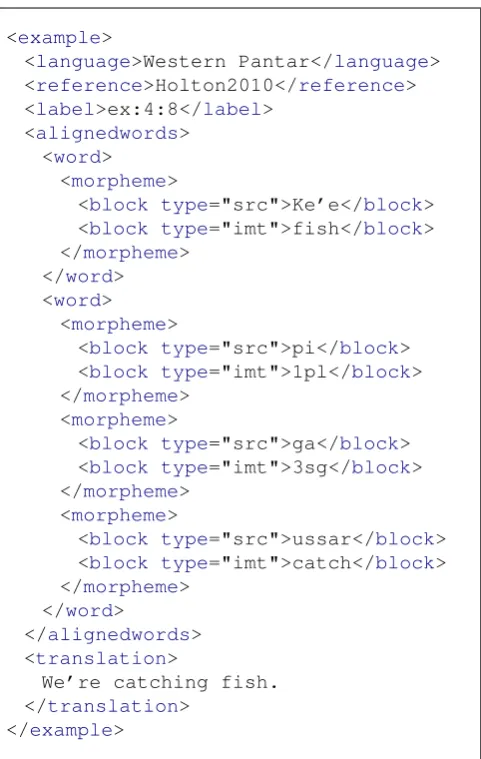
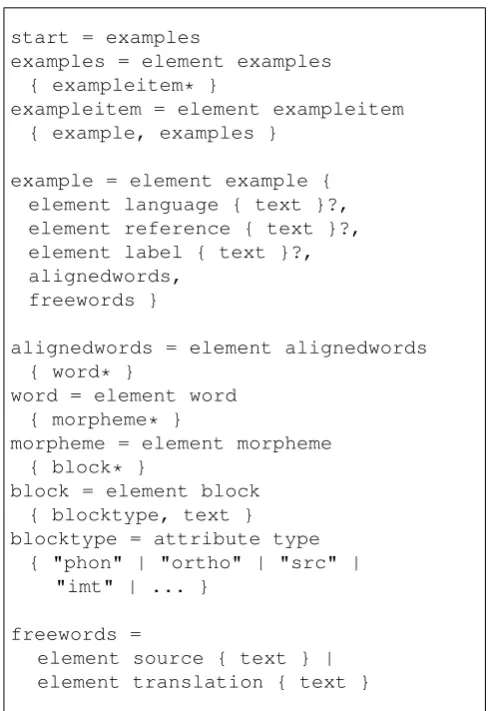
particular gb4e. The XML serialization format for this data model is the primary output of the texigt con-version tool. It is illustrated in Figure 6 and described by a minimalistic RelaxNG schema shown in Figure 7 and available at https://github.com/langsci/ xmlbooks, where a tutorial-style introduction to this for-mat is also provided.
This data model is simpler than most of the IGT represen-tations that have been proposed in the past and it should be straightforward to convert thetexigtXML output to other formats like Xigt (Goodman et al., 2015), TypeCraft (Beermann and Mihaylov, 2014) or GrAF (Ide and Suder-man, 2007).
7.
Application: Extracting IGT from
LangSci Books
We have used texigt to extract IGT from books lished by Language Science Press, an open access pub-lisher of linguistic monographs that uses LATEX for
type-setting. The corpus is available at https://github. com/langsci/xmlbooks, together with documenta-tion and a simple query tool. The number of glossed and unglossed examples extracted from each book is shown in Table 1.
8.
Conclusion and Future Directions
texigt is a tool for extracting and validating IGT em-bedded in LATEX documents. There are at least two
direc-tions that seem promising for further development. First, the extraction of IGT can be improved by supporting ex-tensions like grammaticality judgments or explicit
indica-Group "exe" [] [ Command "ex" [], Group "xlist" [] [
Command "ex" [], Str "First", Space,
Str "subexample", Space,
Command "ex" [], Str "Second", Space,
Str "subexample", Space
] ]
Figure 5: The internal representation produced by the
texhs parsing modules for the gb4e examples in Fig-ure 2 and FigFig-ure 4 (slightly simplified). Notice that despite of the substantial differences in concrete syntax between these two listings, they are both represented by the same value shown here after thetexhsparsing stage.
tions of constituent structure in the form of labeled brack-eting, empty categories or co-indexing. Second, non-IGT data structures that are commonly used in linguistics could be extracted as well by taking advantage of LATEX
encod-ing conventions for syntax trees (qtree10, forest11), semantic formulas, feature structures (AVMs) or discourse representation structures.
9.
Acknowledgements
This work was supported by a grant from the DFG to Stefan M¨uller and Martin Haspelmath (FKZ MU 2822/8-1). See http://hpsg. fu-berlin.de/˜stefan/Pub/lsp-dfg.html and http://langsci-press.org/ for more information about Language Science Press.
10
Available athttp://www.ctan.org/tex-archive/ macros/latex/contrib/qtree/, accessed on 2016-03-01.
11
Available at http://www.ctan.org/pkg/forest, accessed on 2016-03-01.
<example>
<language>Western Pantar</language> <reference>Holton2010</reference> <label>ex:4:8</label>
<alignedwords> <word>
<morpheme>
<block type="src">Ke’e</block> <block type="imt">fish</block> </morpheme>
</word> <word>
<morpheme>
<block type="src">pi</block> <block type="imt">1pl</block> </morpheme>
<morpheme>
<block type="src">ga</block> <block type="imt">3sg</block> </morpheme>
<morpheme>
<block type="src">ussar</block> <block type="imt">catch</block> </morpheme>
</word>
</alignedwords> <translation>
We’re catching fish. </translation>
</example>
10.
Bibliographical References
Beermann, D. and Mihaylov, P. (2014). TypeCraft collabo-rative databasing and resource sharing for linguists. Lan-guage Resources and Evaluation, 48(2):203–225. Bergh¨all, L. (2015). A Grammar of Mauwake. Number 4
in Studies in Diversity Linguistics. Language Science Press, Berlin.
Bickel, B., Comrie, B., and Haspelmath, M. (2008). The Leipzig glossing rules: Conven-tions for interlinear morpheme-by-morpheme glosses. http://www.eva.mpg.de/lingua/ resources/glossing-rules.php, accessed on 2015-10-16.
Erdweg, S. T. and Ostermann, K. (2011). Featherweight TEX and parser correctness. In Brian Malloy, et al., ed-itors, Software Language Engineering: Third Interna-tional Conference, SLE 2010, number 6563 in LNCS, pages 397–416, Berlin/Heidelberg. Springer.
Goodman, M. W., Crowgey, J., Xia, F., and Bender, E. M. (2015). Xigt: Extensible interlinear glossed text for natural language processing. Language Resources and Evaluation, 49:455–485.
Hicks, S. (2009). Rapid prototyping in TEX. The Monad.Reader, 13:5–16.
Holton, G. and Robinson, L. C. (2014). The linguistic position of the Timor-Alor-Pantar languages. In Marian
start = examples
examples = element examples { exampleitem* }
exampleitem = element exampleitem { example, examples }
example = element example { element language { text }?, element reference { text }?, element label { text }?, alignedwords,
freewords }
alignedwords = element alignedwords { word* }
word = element word { morpheme* }
morpheme = element morpheme { block* }
block = element block { blocktype, text } blocktype = attribute type
{ "phon" | "ortho" | "src" | "imt" | ... }
freewords =
element source { text } | element translation { text }
Figure 7: Minimalistic XML schema for representing lin-guistic example sentences in RELAX NG Compact Syntax.
Klamer, editor,The Alor-Pantar Languages: History and Typology, number 3 in Studies in Diversity Linguistics, pages 155–198. Language Science Press, Berlin. Ide, N. and Suderman, K. (2007). GrAF: A graph-based
format for linguistic annotations. InProceedings of the Linguistic Annotation Workshop, pages 1–8, Prague. As-sociation for Computational Linguistics.
Jeffrey, A. (1990). Lists in TeX’s mouth. TUGboat, 11(2):237–245.
Knuth, D. E. (1984). The TEXbook, volume A of Com-puters & Typesetting. Addison-Wesley, Reading, Mas-sachusetts.
Knuth, D. E. (1986). TEX: The Program, volume B of Computers & Typesetting. Addison-Wesley, Reading, Massachusetts.
Lamport, L. (1994). LATEX: A Document Preparation
Sys-tem. Addison-Wesley, Reading, Massachusetts.
Lewis, W. D. and Xia, F. (2010). Developing ODIN: A multilingual repository of annotated language data for hundreds of the world’s languages. Literary and Linguis-tic Computing, 25(3):303–319.
Simon Marlow, editor. (2010). Haskell 2010 Language Report. Haskell.org, https://www.haskell. org/definition/haskell2010.pdf, accessed on 2012-10-10.
source glossed unglossed
berghall.xml 1467 5
cangemi.xml 10 4
dahl.xml 409 36
handschuh.xml 369 24
klamer.xml 352 102
schackow.xml 1561 2
wilbur.xml 327 0
total 4495 173