Available online: https://edupediapublications.org/journals/index.php/IJR/ P a g e | 1421
Novel Efficient and secure protocol design to exchange
information in network
M.SRIDHAR1, Dr. S.MURUGAN2
Research Scholar, CSE, Sathyabama University, Chennai, Tamilnadu
Prof, CSE, Sathyabama University, Chennai, Tamilnadu
ABSTRACT
We study the issues of key creation for secure many-to-many communications. issue is
impressed by the proliferation of large-scale distributed file systems supporting parallel access to
multiple storage devices. Our work focuses on the current internet normal for such file systems,
i.e., parallel Network file system (pNFS), that makes use of Kerberos to establish parallel session
keys between senders and storage devices. Our review of the prevailing Kerberos-based protocol
shows that it has variety of limitations: (i) a information server facilitating key exchange between
the senders and also the storage devices has heavy work that restricts the quantifiability of the
protocol; (ii) the protocol doesn't offer forward secrecy; (iii) the information server generates
itself all the session keys that are used between the data owners and storage devices, and this
inherently results in key escrow. During this paper, we propose a range of authenticated key
exchange protocols that are designed to handle the higher than issues. we show that our protocols
are capable of reducing up to approximately fifty four of the work of the information server and
concurrently supporting forward secrecy and escrow-freeness. All this needs only atiny low
fraction of enhanced computation overhead at the data owner.
Available online: https://edupediapublications.org/journals/index.php/IJR/ P a g e | 1422
1. INTRODUCTION:
In a parallel file system, file information is
distributed across multiple storage devices
or nodes to permit concurrent access by
multiple tasks of a parallel application. this
can be usually utilized in giant-scale cluster
computing that focuses on high performance
and reliable access to large datasets. That is,
higher I/O information measure is achieved
through concurrent access to multiple
storage devices among giant compute
clusters; whereas information loss is
protected through information mirroring
mistreatment fault-tolerant marking
algorithms. Some samples of
high-performance parallel file systems that are in
production use are the IBM General Parallel
file system (GPFS) , Google file system
(GoogleFS) , Lustre , Parallel Virtual file
system (PVFS) , and Panasas file system ;
whereas there also exist analysis comes on
distributed object storage systems like Usra
Minor , Ceph , and Gfarm . These are
sometimes needed for advanced scientific or
data-intensive applications like, seismic
processing, digital animation studios,
procedure fluid dynamics, and
semiconductor producing. In these
environments, hundreds or thousands of file
system data owners share information and
generate very high aggregate I/O load on the
file system supporting petabyte- or
terabyte-scale storage capacities vices. in this work,
we investigate issue of secure severalto-
many communications in large-scale
network file systems that support parallel
access to multiple storage devices. That is,
we consider a communication model
wherever there area unit a large variety of
data owners (potentially tons of or
thousands) accessing multiple remote and
distributed storage devices (which also
could scale up to tons of or thousands) in
parallel. significantly, we target the way to
exchange key materials and establish
parallel secure sessions between the data
owners and the storage devices within the
parallel Network file system (pNFS) —the
current web standard—in an economical and
scalable manner. the development of pNFS
is driven by Panasas and so it shares several
common options and is compatible with
several existing commercial/proprietary
Available online: https://edupediapublications.org/journals/index.php/IJR/ P a g e | 1423
2. METHODOLOGY
The current style of NFS/pNFS focuses on
ability,instead of efficiency and scalability,
of assorted mechanisms to produce basic
security. Moreover, key creation between a
data owner and multiple storage devices in
pNFS are supported those for NFS, that is,
they're not designed specifically for parallel
communications. Hence, the information
server isn't only responsible for process
access requests to storage devices (by
granting valid layouts to authenticated and
licensed clients), but also needed to come up
with all the corresponding session keys that
the data owner must communicate securely
with the storage devices to that it's been
granted access. Consequently, the
information server may become a
performance bottleneck for the classification
system. Moreover, such protocol style ends
up in key escrow. Hence, in theory, the
server will learn all info transmitted between
a consumer and a device. This, in turn,
makes the server an attractive target for
attackers. Another problem of the present
approach is that past session keys is exposed
if a storage device’s long-run key shared
with the information server is compromised.
we believe that this can be a realistic threat
since a large-scale file system could have
thousands of geographically distributed
storage devices.It may not be feasible to
provide strong physical security and
network protection for all the storage
devices.
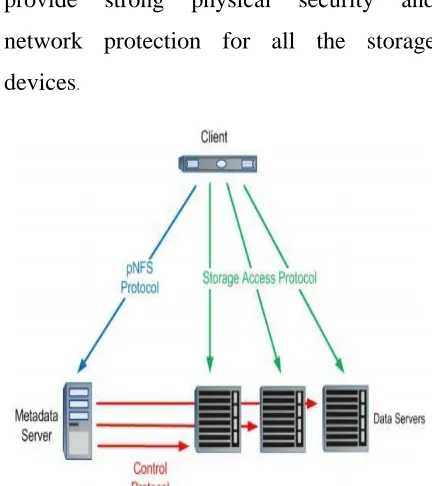
Fig 1:System architecture
We implement 3 authenticated key exchange
protocols for parallel network classification
system (pNFS). Our protocols supply 3
Kerberos-Available online: https://edupediapublications.org/journals/index.php/IJR/ P a g e | 1424
based pNFS protocol. First, the information
server execution our protocols has a lot of
lower workload than that of the
Kerberos-based approach. Second, 2 our protocols
give forward secrecy: one is part forward
secure (with relation to multiple sessions
among a time period), whereas the other is
totally forward secure (with respect to a
session). Third, we have designed a protocol
that not only provides forward secrecy,
however is additionally escrow-free.
3.Related Works:
The multi-core revolution has
brought the difficulty of parallel
programming to the forefront of computer
code development generally. several parallel
programming models are developed within
the past, however, there's no solidly
established technology to choose up because
the obvious alternative for exploiting
correspondence on today’s thought
multi-cores and on networks of multimulti-cores, serving
as affordable superior platforms. Even a lot
of seriously, several of the established
technologies area unit tied to 1 specific
category of parallel machines, and are
ill-suited to cope with radical fine arts changes.
To additional boost procedure capabilities,
usually graphics process units (GPUs) or
co-processors are added to the current
configuration, leading to a extremely
heterogeneous computing platform.
Programming such a platform is difficult for
parallel computing specialists, in addition to
domain specialists new to parallel
programming. The programming models for
such a platform thus need to strike a balance
between simplifying the task of parallel
programming whereas still delivering high
performance on heterogeneous hardware,
that is that the motivation for using these
platforms within the initial place. in this
survey we aim to convey guidance to
domain experts in search of a high-level
programming model that may exploit such
heterogeneous hardware with token
computer user effort. we explore the realm
of parallel programming models, classify the
established technologies on language as well
as on system level, and assess their
suitability for property parallel programming
in the long-term, specially envisioning
further heterogeneousness within the
Available online: https://edupediapublications.org/journals/index.php/IJR/ P a g e | 1425
Section two. we establish many major
challenges of parallel programming in
Section 3: computer user productivity,
performance portability, scalability, and
adaptively, which require to be
self-addressed, since exploiting parallelism is
that the main supply of increased
performance. we then explore many
implementation technologies, managing
these challenges. Specially, we classify the
prevailing parallel programming models in
Table one of Section four supported their
various level of abstraction over parallel
coordination. In Section five, we present a
variety of low- and high-level models for
programming heterogeneous architectures
and discuss these trends in GPU
programming. Furthermore, we summary
many representative policy control
mechanisms in Table two of Section vi, and
discuss the foremost system-level
technologies that have well-tried successful
across a variety of parallel architectures. we
summaries our findings from this in-depth
study of models and systems in Section
eight. 2. Trends in Parallel Architectures
Hardware design substantially affects
application performance [1]. Therefore, it's
necessary to require the characteristics of the
target design into account, particularly as
novel parallel architectures are progressively
heterogeneous and stratified.
4. Conclusion:
We implement 3 authenticated key exchange protocols for parallel network
classification system (pNFS). Our protocols
supply 3 appealing advantages over present
Kerberos-based pNFS protocol. First, the
information server execution our protocols
has a lot of lower workload than that of the
Kerberos-based approach. Second, 2 our
protocols give forward secrecy: one is part
forward secure (with relation to multiple
sessions among a time period), whereas the
other is totally forward secure (with respect
to a session). Third, we have designed a
protocol that not only provides forward
secrecy, however is additionally
escrow-free.
5. Bibliography
[1] M. Abd-El-Malek, W.V. Courtright II,
C. Cranor, G.R. Ganger, J. Hendricks,A.J.
Klosterman, M.P. Mesnier, M. Prasad, B.
Available online: https://edupediapublications.org/journals/index.php/IJR/ P a g e | 1426
Sinnamohideen, J.D. Strunk, E. Thereska,
M. Wachs, and J.J. Wylie. Ursa Minor:
Versatile cluster-based storage. In
Proceedings of the 4th USENIX Conference
on File and Storage Technologies
(FAST),pages 59–72. USENIX Association,
Dec 2005.
[2] C. Adams. The simple public-key
GSS-API mechanism (SPKM). The Internet
Engineering Task Force (IETF), RFC 2025,
Oct 1996.
[3] A. Adya, W.J. Bolosky, M. Castro, G.
Cermak, R. Chaiken,J.R. Douceur, J.
Howell, J.R. Lorch, M. Theimer, and R.
Wattenhofer.FARSITE: Federated,
available, and reliable storage for an
incompletely trusted environment. In
Proceedings of the 5th Symposium on
Operating System Design and
Implementation (OSDI). USENIX
Association, Dec2002.
[4] M.K. Aguilera, M. Ji, M. Lillibridge, J.
MacCormick, E. Oertli,D.G. Andersen, M.
Burrows, T. Mann, and C.A. Thekkath.
Blocklevelsecurity for network-attached
disks. In Proceedings of the 2nd
International Conference on File and
Storage Technologies (FAST).USENIX
Association, Mar 2003.
[5] M. Armbrust, A. Fox, R. Griffith, A.D.
Joseph, R.H. Katz, A. Konwinski,G. Lee,
D.A. Patterson, A. Rabkin, I. Stoica, and M.
Zaharia. A viewof cloud computing.
Communications of the ACM, 53(4):50–58.
ACMPress, Apr 2010.
[6] Amazon simple storage service (Amazon
S3). http://aws.amazon.com/s3/.
[7] M. Bellare, D. Pointcheval, and P.
Rogaway. Authenticated key exchange
secure against dictionary attacks. In
Advances in Cryptology– Proceedings of
EUROCRYPT, pages 139–155. Springer
LNCS 1807,May 2000.
[8] D. Boneh, C. Gentry, and B. Waters.
Collusion resistant broadcast encryption
with short ciphertexts and private keys. In
Advances in Cryptology – Proceedings of
CRYPTO, pages 258–275. Springer LNCS
3621, Aug 2005.
[9] B. Callaghan, B. Pawlowski, and P.
Staubach. NFS version 3 protocol
specification. The Internet Engineering Task
Available online: https://edupediapublications.org/journals/index.php/IJR/ P a g e | 1427
[10] R. Canetti and H. Krawczyk. Analysis
of key-exchange protocols and their use for
building secure channels. In Advances in
Cryptology –Proceedings of EUROCRYPT,
pages 453–474. Springer LNCS 2045,May
2001.
4506,
[11]CloudStore.http://gcloud.civilservice.gov.uk/cloudstore/
.[12] Crypto++ 5.6.0 Benchmarks. http://www.cryptopp.com/benchmarks.html.
[13] J. Dean and S. Ghemawat. MapReduce: Simplified data processin on large clusters. In
Proceedings of the 6th Symposium on OperatingSystem Design and Implementation (OSDI),
pages 137–150. USENIX Association, Dec 2004.
May 2006.
[14] M. Eisler. LIPKEY - A Low Infrastructure Public Key mechanism using SPKM. The
Internet Engineering Task Force (IETF), RFC 2847, Jun 2000.
[15] M. Eisler. XDR: External data representation standard. The Internet