Reversible Data Hiding Based On PPM and
DPM – A Review
Nitheesh C. N.
1, Arathy C. Haran V.
2PG Student, Dept. of ECE, Mar Baselios College of Engineering and Technology, Thiruvananthapuram, Kerala, India1
Assistant Professor, Dept. of ECE, Mar Baselios College of Engineering and Technology, Thiruvananthapuram,
Kerala, India2
ABSTRACT: Reversible data hiding (RDH) is a data hiding technique that embed secret message into the cover image. In RDH both the embedded message and the cover image can be completely recovered. Among the RDH techniques the histogram based method has attracted the attention. There are different RDH methods have been proposed so far include RDH based on pixel pair mapping (PPM) and RDH based on (DPM). The basic idea of PPM is to use the values of pixel pair as a reference coordinate, and search a coordinate in the neighbourhood set of this pixel pair according to a given message digit. In order to increase the embedding capacity a RDH based on difference pair mapping has been proposed. DPM is an injective mapping defined on difference-pairs, and it is a natural extension of expansion embedding and shifting techniques used in current histogram-based methods. Here in this paper a comparative study between RDH based on PPM and DPM have been proposed. The RDH based on DPM will give better result than PPM.
KEYWORDS: Reversible data hiding, pixel pair mapping, difference pair mapping.
I.INTRODUCTION
Data hiding is referred to as a process to hide data (representing some information) into cover media. That is, the data hiding process links two sets of data, a set of the embedded data and another set of the cover media data. The relationship between these two sets of data characterizes different applications. For instance, in covert communications, the hidden data may often be irrelevant to the cover media. In authentication, however, the embedded data are closely related to the cover media. In these two types of applications, invisibility of hidden data is an important requirement. In most cases of data hiding, the cover media will experience some distortion due to data hiding and cannot be inverted back to the original media. That is, some permanent distortion has occurred to the cover media even after the hidden data have been extracted out. In some applications, such as medical diagnosis and law enforcement, it is critical to reverse the marked media back to the original cover media after the hidden data are retrieved for some legal considerations. In other applications, such as remote sensing and high-energy particle physical experimental investigation, it is also desired that the original cover media can be recovered because of the required high-precision nature. The marking techniques satisfying this requirement are referred to as reversible, lossless, distortion-free, or invertible data hiding techniques.
There are many RDH methods proposed so far, e.g., the RDH methods based on lossless compression [7]–[9], difference expansion [10]–[13], histogram modification [14]–[17], prediction-error expansion [18]–[23], and integer transform [24]–[28], etc. Among them, the histogram-based ones have attracted much attention. The histogram-based methods modify the histogram in such a way that certain bins are shifted to create vacant space while some other bins are utilized to carry data by filling the vacant space. This type of methods can well control the embedding distortion and provide a sufficient EC. Lee et al. 's method can be implemented by modifying the two-dimensional pixel-intensity-histogram according to injective mapping defined on pixel pairs which is known as Pixel-Pair Mapping (PPM). Pixel Pair Mapping (PPM) is an injective mapping defined on pixel pairs. Lee et al.'s method of difference expansion is implemented by modifying the two-dimensional pixel intensity- histogram according to a Pixel Pair Mapping (PPM). Pixel Pair Mapping (PPM) which is the modified version of existing Lee method groups two columns of pixel values along both the direction (forward and backward) and creates redundant space for the data to be embedded. Data embedding and extraction procedure takes place along both the direction. The difference image is produced by grouping two columns of pixel values in both the direction. Traversing in both directions creates more redundant space for data embedding than Lee method.
For the difference-pair-mapping(DPM) method, by considering a pixel-pair and its context, a local image region is projected to a two-dimensional space to obtain a sequence consisting of difference-pairs. Then, a two-dimensional difference-histogram is generated by counting the difference-pairs. Finally, reversible data embedding is implemented according to a specifically designed difference-pair-mapping (DPM). Here, the DPM is an injective mapping defined on difference-pairs, and it is a natural extension of expansion embedding and shifting techniques used in current histogram-based methods. By using the two-dimensional difference-histogram and this specific DPM, compared with the conventional one-dimensional histogram based methods, more pixels are used for carrying data while the number of shifted pixels is reduced as well, and thus an improved embedding performance is achieved.
II.PIXEL PAIR MAPPING
Lee et al. [15] proposed a difference-histogram based RDH method. The existing Lee method of difference expansion, groups two columns of pixel values in a cover image forming a pixel pair which is then used to create a difference image for the purpose of data embedding. Data embedding and Data extraction procedure takes place in a single direction and Lee method utilized difference histogram to create difference image. Based on the pixel values of the difference image the data is embedded into the image and the marked image is created. The pixel values of the marked image are then used to extract the embedded data and marked values of the difference image are used to recover the original image.
Pixel Pair Mapping (PPM) is an injective mapping defined on pixel pairs. Lee et al.’s [15] method of difference expansion is implemented by modifying the two-dimensional pixel intensity- histogram according to a Pixel Pair Mapping (PPM). Pixel Pair Mapping (PPM) which is the modified version of existing Lee method groups two columns of pixel values along both the direction (forward and backward) and creates redundant space for the data to be embedded. Data embedding and extraction procedure takes place along both the direction. The difference image is produced by grouping two columns of pixel values in both the direction. Traversing in both directions creates more redundant space for data embedding than Lee method.
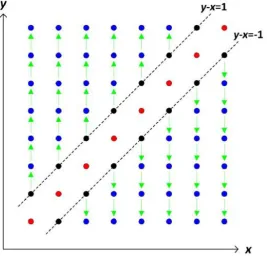
The Lee et al.’s [15] embedding procedure can be demonstrated by a PPM shown in fig. 1, in which a subset of 𝑍2 is
Fig. 1: PPM for illustrating data embedding procedure for Lee et al.’s method
According to this PPM, for a cover pixel-pair (𝑥, 𝑦), its marked value can be determined in the following way:
1. if 𝑦 − 𝑥 = 0 (i.e., (𝑥, 𝑦) is a red point), the marked pixel pair is taken as (𝑥, 𝑦) itself.
2. if 𝑦 − 𝑥 = 1 or 𝑦 − 𝑥 = −1 (i.e., (𝑥, 𝑦) is a black point).
a. if the to-be-embedded data bit 𝑏 = 0, the marked pixel-pair is taken as (𝑥, 𝑦) itself.
b. if the to-be-embedded data bit 𝑏 = 1, the marked pixel-pair is taken as its associate blue point.
3. if 𝑦 − 𝑥 > 1 or 𝑦 − 𝑥 < −1 (i.e., (𝑥, 𝑦) is a blue point), the marked pixel-pair is taken as its associate blue
point.
The corresponding data extraction and image restoration process can also be demonstrated according to the PPM since it is an injection, i.e., each point has at most one inverse. The trivial description is omitted. From the PPM viewpoint, Lee et al.’s[15] difference-histogram based method is actually implemented by modifying the two-dimensional
pixel-intensity-histogram. Lee et al.’s method only modifies the second pixel of the pair. Thus two modification directions,
up and down, are allowed in data embedding.
This is to say, in PPM, a point (𝑥, 𝑦) can be either mapped to its upper neighbour (𝑥, 𝑦 + 1) or lower neighbor(𝑥, 𝑦 − 1) Actually, one can also modify the first pixel without introducing additional distortion resulting in modification directions left and right. In this way, the associate mapped point of (𝑥, 𝑦) has four choices: (𝑥 − 1, 𝑦),(𝑥 + 1, 𝑦),
(𝑥, 𝑦 − 1) or (𝑥, 𝑦 + 1) (see fig. 2).
Fig. 2: Four modification direction of the pixel pair (𝑥, 𝑦).
(x, y+1)
(x+1, y)
(x-1, y)
(x, y)
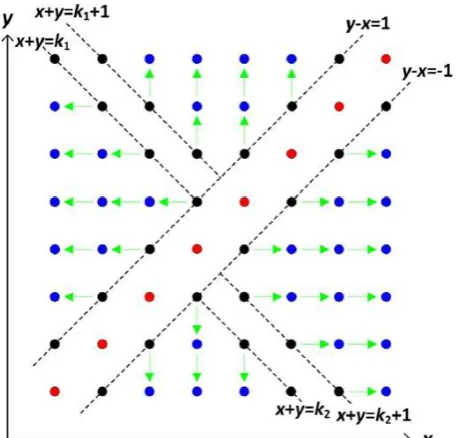
Fig. 3: Modified PPM for illustrating data embedding procedure for Lee et al.’s method
The modified PPM method involves combination of existing PPM method and the modified Lee method of grouping any number of columns thereby creating more redundant space along both the directions (forward and backward). The number of columns to be grouped is made to be user defined. The pixel pair formed by grouping any number of columns is always one less than the number of columns grouped.
The modified Lee method of grouping any number of columns is carried out in forward direction and the existing PPM method of grouping two columns is carried out in backward direction (as shown in fig. 3). Data embedding and Data extraction process takes place along both the direction. The redundant space for the purpose of data embedding created by the proposed method is more when compared with the existing methods. Modified PPM method produced better embedding performance (hiding capacity) than PPM method.
III.DIFFERENCE PAIR MAPPING
Difference Pair Mapping (DPM) is an injective method utilizing the values of difference pairs. DPM method implemented along both the directions (forward and backward) is an extended version of DPM. In bidirectional DPM the difference values for pixels is obtained by making use of the prediction values of pixel-pairs. The prediction values are obtained along both the direction. Consider a pixel-pair (x, y),[1] in forward direction the prediction value of y is used for computing the difference value and in reverse direction the prediction value of x is used for computing the difference value. By utilizing the prediction values and the arbitrary threshold value, DPM method along both the direction (forward and backward) aims to increase the embedding performance. In order to compute the prediction value of x, the Gradient-Adjusted-Prediction (GAP) is used for an accurate estimation which is used in adaptive embedding technique. Since most of the medical images contain darker areas more than lighter areas, the space for embedding the data is usually is less in medical images. By making use of the prediction values the DPM method along both the direction selects smooth pixels for the purpose of data embedding. The DPM technique carried out in both forward and reverse direction which produces better embedding performance (Hiding capacity) than forward direction. The prediction values computed along both the direction makes the embedding process secure by making the data to be known only for the intended receiver. For each pixel-pair (x , y), the prediction of x to get z is computed using GAP predictor. For a pixel-pair(𝑥, 𝑦), the two difference values 𝑑1= 𝑥 − 𝑦 and 𝑑2= 𝑦 − 𝑧 are computed to form a
𝑧 =
𝑣1, 𝑖𝑓 𝑑𝑣 − 𝑑ℎ > 80 𝑣1+𝑢
2 , 𝑖𝑓 𝑑𝑣 − 𝑑ℎ ∈ (32,80]
𝑣1+3𝑢
4 , 𝑖𝑓 𝑑𝑣 − 𝑑ℎ ∈ (8,32]
𝑢, 𝑖𝑓 𝑑𝑣 − 𝑑𝑣 ∈ [−8,8] 𝑣4+3𝑢
4 , 𝑖𝑓 𝑑𝑣 − 𝑑ℎ ∈ [−32,8)
𝑣4+𝑢
2 , 𝑖𝑓 𝑑𝑣 − 𝑑ℎ ∈ [−80, −32]
𝑣4, 𝑖𝑓 𝑑𝑣 − 𝑑ℎ < −80
(1)
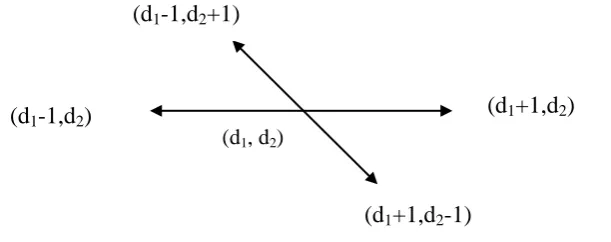
Inspired by the aforementioned new PPM, either 𝑥 or 𝑦 is modified by 1. In this situation, since (𝑥, 𝑦) has four modification directions, the difference-pair (𝑑1, 𝑑2) also has four modification directions: (𝑑1− 1, 𝑑2) , (𝑑1+ 1, 𝑑2),
(𝑑1+ 1, 𝑑2− 1) or (𝑑1− 1, 𝑑2+ 1) (see Fig. 4). For example, by modifying 𝑦 to 𝑦 + 1, the modification direction to
(𝑥, 𝑦) is ―up‖ and the corresponding modification direction to (𝑑1, 𝑑2) is ―upper-left‖, since 𝑑1 changes to 𝑑1− 1 and
𝑑2changes to 𝑑2+ 1. Based on these four modification directions, a new RDH scheme is introduced by designing a
DPM.
Fig. 4: The modification direction of the difference pair (𝑑1, 𝑑2).
IV
.
TWO DIMENSIONL DIFFERENCE HISTOGRAMIn two-dimensional difference histogram, by considering a pixel-pair and its context, a local image region is projected to a two-dimensional space to obtain a sequence consisting of pairs. Then, a two-dimensional difference-histogram is generated by counting the difference-pairs. For a pixel-pair (𝑥, 𝑦) , two difference values 𝑑1= 𝑥 − 𝑦 and
𝑑2= 𝑦 − 𝑧 are computed to form a two-dimensional difference-histogram of (𝑑1, 𝑑2) , where 𝑧 is a prediction of
𝑦 from equation (1). Using this paira histogram is plotted, it is called two dimensional difference histogram.
Here difference pair (𝑑1, 𝑑2) because of taking the pair (𝑑1, 𝑑2) for the plot of histogram, which is the difference between the pixels. In this method, by considering a pixel-pair and its context, a local image region is projected to a two-dimensional space to obtain a sequence consisting of pairs. Then, a two-dimensional difference-histogram is generated by counting the difference-pairs. Finally, reversible data embedding is implemented according to a specifically designed difference-pair-mapping (DPM). Here, the DPM is an injective mapping defined on difference-pairs, and it is a natural extension of expansion embedding and shifting techniques used in current histogram-based methods. By using the two-dimensional difference-histogram and this specific DPM, compared with the conventional one-dimensional histogram based methods, more pixels are used for carrying data while the number of shifted pixels is reduced as well, and thus an improved embedding performance is achieved. In addition, inspired by the embedding-position-selection techniques introduced in previous works, a pixel-pair-selection strategy is adopted in this method to priorly use the pixel-pairs located in smooth image regions to embed data. This may further enhance the embedding performance.
(d
1, d
2)
(d
1+1,d
2-1)
(d
1+1,d
2)
(d1-1,d2+1)
V .GRADIENT ADJUSTED PREDICTION (GAP)
GAP is a simple, adaptive, non-linear predictor that can adapt itself to the intensity gradients near the predicted pixel [24]. Hence it is more robust than the traditional DPCM like linear predictors, particularly in areas of strong edges. GAP differs from the existing linear predictors in that it weights the neighbouring pixels of
𝑥, 𝑦 according to the estimated gradient of the image. In GAP the gradient of the intensity function at the current
pixel (𝑥, 𝑦) is estimated by computing the following quantities:
𝑑𝑣 = 𝑣1− 𝑣5 + 𝑣3− 𝑣7 + 𝑣4− 𝑣8 (2)
𝑑ℎ = 𝑣1− 𝑣2 + 𝑣3− 𝑣4 + 𝑣4− 𝑣5 (3)
And
𝑢 =(𝑣1+ 𝑣4)
2 +
(𝑣3− 𝑣5)
4
Where 𝑣1, … . 𝑣5, 𝑣7, 𝑣8 are neighbouring pixels of (𝑥, 𝑦) (see in fig: 5)
Fig. 5: Pixel block for the GAP predictor for 𝑦.
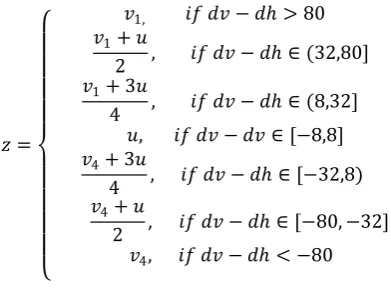
The prediction of the pixel 𝑦 in the pixel pair (𝑥, 𝑦) is done using equation (4)
𝑧 =
𝑣1, 𝑖𝑓 𝑑𝑣 − 𝑑ℎ > 80
𝑣1+ 𝑢
2 , 𝑖𝑓 𝑑𝑣 − 𝑑ℎ ∈ (32,80]
𝑣1+ 3𝑢
4 , 𝑖𝑓 𝑑𝑣 − 𝑑ℎ ∈ (8,32]
𝑢, 𝑖𝑓 𝑑𝑣 − 𝑑𝑣 ∈ [−8,8]
𝑣4+ 3𝑢
4 , 𝑖𝑓 𝑑𝑣 − 𝑑ℎ ∈ [−32,8)
𝑣4+ 𝑢
2 , 𝑖𝑓 𝑑𝑣 − 𝑑ℎ ∈ [−80, −32]
𝑣4, 𝑖𝑓 𝑑𝑣 − 𝑑ℎ < −80
(4)
VI.CONCLUSION
In this paper, a RDH method based on pixel pair mapping (PPM) and difference pair mapping (DPM) have been discussed. PPM is an injective mapping based on pixel pair. The pixel pair is shifted forward or backward to create reduntant space for the data to be embedded. In the modified PPM more redundant space are created to improve the embedding capacity. Difference pair mapping (DPM) is an injective mapping based on difference pair. The difference value is obtained by using the prediction values of the pixel pair. DPM is a natural extension of expansion embedding and shifting algorithm. DPM utilizing the difference pair and two-dimensional difference histogram create more redundant space and thus the embedding capacity has been improved.
REFERENCES
[1] Xiaolong Li, Weiming Zhang, and Bin Yang, ―A Novel Reversible Data Hiding Based on Two-Dimensional Difference-Histogram Modification,‖ IEEE Transcations on Information Forensics and Security, vol. 8, no. 7, July 2013.
[2] Vinod kumar C., Natarajan V. and santhosh muraledharan S., ―Difference Expansion Based Reversible Data Hiding for Medical Images‖
International Conference on Communication and Signal Processing, April 2014.
j j+1 j+2 j+3
i x y 𝑣1 𝑣2
i+1 𝑣3 𝑣4 𝑣5 𝑣6
[3] Zhicheng Ni, Yun-Qing Shi, Nirwan Ansari and Wei Su, ―Reversible Data Embedding,‖ lEEE Transactions on Circuits and Systems for Video Technology, vol. 16, no.3, 2006.
[4] Z. Ni, Y. Q. Shi, N. Ansari, andW. Su, ―Reversible data hiding,‖ IEEE Trans. Circuits Syst. Video Technol., vol. 16, no. 3, pp. 354–362, Mar. 2006.
[5] W. L. Tai, C. M. Yeh, and C. C. Chang, ―Reversible data hiding based on histogram modification of pixel differences,‖ IEEE Trans. Circuits Syst. Video Technol., vol. 19, no. 6, pp. 906–910, Jun. 2009.
[6] Y. Hu, H. K. Lee, and J. Li, ―DE-based reversible data hiding with improved overflow location map,‖ IEEE Trans. Circuits Syst. VideoTechnol., vol. 19, no. 2, pp. 250–260, Feb. 2009.
[7] J. Fridrich, M. Goljan, and R. Du, ―Lossless data embedding—new paradigm in digital watermarking,‖ EURASIP J. Appl. Signal Process., vol. 2002, no. 2, pp. 185–196, Feb. 2002.
[8] M. U. Celik, G. Sharma, A. M. Tekalp, and E. Saber, ―Lossless generalized- LSB data embedding,‖ IEEE Trans. Image Process., vol. 14, no. 2, pp. 253–266, Feb. 2005.
[9] M. U. Celik, G. Sharma, and A. M. Tekalp, ―Lossless watermarking for image authentication: A new framework and an implementation,‖ IEEE Trans. Image Process., vol. 15, no. 4, pp. 1042–1049, Apr. 2006.
[10] J. Tian, ―Reversible data embedding using a difference expansion,‖ IEEE Trans. Circuits Syst. Video Technol., vol. 13, no. 8, pp. 890–896, Aug. 2003.
[11] A. M. Alattar, ―Reversible watermark using the difference expansion of a generalized integer transform,‖ IEEE Trans. Image Process., vol. 13, no. 8, pp. 1147–1156, Aug. 2004.
[12] L. Kamstra and H. J. A. M. Heijmans, ―Reversible data embedding into images using wavelet techniques and sorting,‖ IEEE Trans. Image Process., vol. 14, no. 12, pp. 2082–2090, Dec. 2005.
[13] W. L. Tai, C. M. Yeh, and C. C. Chang, ―Reversible data hiding based on histogram modification of pixel differences,‖ IEEE Trans. Circuits Syst. Video Technol., vol. 19, no. 6, pp. 906–910, Jun. 2009.
[14] Z.Ni, Y.Q. Shi, N. Ansari, andW. Su, ―Reversible data hiding,‖ IEEE Trans. Circuits Syst. Video Technol., vol. 16, no. 3, pp. 354–362, Mar. 2006.
[15] S. K. Lee, Y. H. Suh, and Y. S. Ho, ―Reversible image authentication based on watermarking,‖ in Proc. IEEE ICME, 2006, pp. 1321–1324. [16] M. Fallahpour, ―Reversible image data hiding based on gradient adjusted prediction,‖ IEICE Electron. Express, vol. 5, no. 20, pp. 870–876, Oct.
2008.
[17] W. Hong, T. S. Chen, and C. W. Shiu, ―Reversible data hiding for high quality images using modification of prediction errors,‖ J. Syst. Software, vol. 82, no. 11, pp. 1833–1842, Nov. 2009.
[18] D. M. Thodi and J. J. Rodriguez, ―Expansion embedding techniques for reversible watermarking,‖ IEEE Trans. Image Process., vol. 16, no. 3, pp. 721–730, Mar. 2007.
[19] Y. Hu, H. K. Lee, and J. Li, ―DE-based reversible data hiding with improved overflow location map,‖ IEEE Trans. Circuits Syst. Video Technol., vol. 19, no. 2, pp. 250–260, Feb. 2009.
[20] D. Coltuc, ―Improved embedding for prediction-based reversible watermarking,‖ IEEE Trans. Inf. Forensics Security, vol. 6, no. 3, pp. 873–882, Sep. 2011.
[21] X. Gao, L. An, Y. Yuan, D. Tao, and X. Li, ―Lossless data embedding using generalized statistical quantity histogram,‖ IEEE Trans. Circuits Syst. Video Technol., vol. 21, no. 8, pp. 1061–1070, Aug. 2011.
[22] X. Li, B. Yang, and T. Zeng, ―Efficient reversible watermarking based on adaptive prediction-error expansion and pixel selection,‖ IEEETrans. Image Process., vol. 20, no. 12, pp. 3524–3533, Dec. 2011.
[23] H.-T.Wu and J. Huang, ―Reversible image watermarking on prediction errors by efficient histogram modification,‖ Signal Process., vol. 92, no. 12, pp. 3000–3009, Dec. 2012.
[24] D. Coltuc and J. M. Chassery, ―Very fast watermarking by reversible contrast mapping,‖ IEEE Signal Process. Lett., vol. 14, no. 4, pp.255–258, Apr. 2007.
[25] S. Weng, Y. Zhao, J. S. Pan, and R. Ni, ―Reversible watermarking based on invariability and adjustment on pixel pairs,‖ IEEE SignalProcess. Lett., vol. 15, no. , pp. 721–724, 2008.
[26] X. Wang, X. Li, B. Yang, and Z. Guo, ―Efficient generalized integer transform for reversible watermarking,‖ IEEE Signal Process. Lett., vol. 17, no. 6, pp. 567–570, Jun. 2010.
[27] F. Peng, X. Li, and B. Yang, ―Adaptive reversible data hiding scheme based on integer transform,‖ Signal Process., vol. 92, no. 1, pp. 54–62, Jan. 2012.