ISSN 2286-4822 www.euacademic.org
Impact Factor: 3.4546 (UIF) DRJI Value: 5.9 (B+)
Teaching the Addition of Two Natural Numbers
Within 5: A Study Based on “Mathematization”
NGUYEN PHU LOC School of Education, Can Tho University Vietnam NGUYEN THI HONG DUYEN
Pedagogics College of Soctrang Vietnam
Abstract:
In 1970, the theory of Realistic Mathematics Education (RME) was originated in Netherlands and since then, it has been popular throughout the world. Freudenthal developed this theory from his view of mathematics: Mathematics as an activity and mathematics must be connected to the reality. So, this theory proposed teaching mathematics should bring more opportunities to students to reinvent knowledge. In other words, the teacher makes it possible for the process of mathematization to occur in the class. In this paper, we presented our results obtained by doing a research on applying the idea of mathematization to teach the addition of two natural numbers within 5.
Key words: The addition of two natural numbers within 5, mathematics education, realistic mathematics education, RME, mathematization.
I. INTRODUCTION
Figure 1: Intuitive picture for introducing the addition within 5 [ 2 ]
Figure 1 shows that the textbook "Mathematics 1” for primary schools of Vietnam builds the concept of natural numbers from 1 to 5 based on the cardinal numbers. Therefore, to present the addition of two natural numbers within 5, the textbook uses the following definition:
The sum of two natural numbers n = card (A) and m = card (B) is n + m (= card (AUB)), where sets A and B are finite and disjoint sets.
Particularly, to define the sum "4+1" and "1+4", the textbook authors use three intuitive images. Each image indicates a set which is the union of two finite, disjoint sets. Two finite and disjoint sets sequentially consist of a set of four fish and a set of one fish, a set of one hat and a set of four hats, a set of four dots and a set of one dot. It is obvious that sets of four dots and one dot represent for the number 4 and the number 1, respectively. The union of these sets, the set of five dots represents for the number 5. After generalizing from the above specific images, the sum of 4 and 1 is defined to be 5, note that "4 + 1 = 5" and "1 + 4 = 5". Likewise, the sum of 2 and 3," 2+3" and "3+2" is to generalize from the sum of three ducks and two ducks, the sum of two sweaters and three sweaters, and the sum of three dots and two dots.
implement the lesson on the addition within 5 for 1st - grade students in a Primary school of Vietnam.
II. THEORETICAL BACKGROUND
Mathematizing refers to the various ways of organizing activities in order to exhibit characteristics of mathematics, such as generality, certainty, exactness and brevity. According to Freudenthal, mathematics lessons should give students the “guided” opportunity to “re-invent” mathematics by doing it. This means that in mathematics education, the focal point should not be on mathematics as a closed system but on the activity, on the process of mathematization [1]. Freudenthal distinguished two kinds of mathematization. Horizontal mathematization refers to the process of describing a context problem in mathematical terms - to be able to solve it with mathematical means. Vertical mathematization refers to mathematizing one's own mathematical activity. Through vertical mathematization, the student reaches a higher level of mathematics. It is in the process of progressive mathematization- which comprises both the horizontal and vertical component - that the students construct (new) mathematics.
III. METHODOLOGY
Designing contextual problem
To help students to gain the knowledge of the addition of two natural numbers within 5 in a real situation, we designed a situation, namely “Flower arranging” and a mini game, namely “Pairing”.
Describe the situation: The class is divided into small groups, and each group consists of five students. There are two kinds of rose flower in class, they are yellow rose and white rose. Given task: Each member of each group takes only one flower so that the vase of flowers must have two colors.
Handout
Mini game “Pairing”: The main rule to play this game is the knowledge of the addition of two natural numbers within 5.
Each student receives one card on which has a natural number smaller than 5. Each two of students is a correct pair if and only if the sum of two numbers on two cards is 5.
Participants: 38 students studying grade 1 (class 1A in Soc Trang Pedagogical Practice School) participate in the experimental lesson. In this lesson, their teacher used the situation and the mini game we designed. These students have not learned the addition of two natural numbers within 5 yet.
IV. LESSON IMPLEMENTATION AND ANALYZING
4.1. Lesson implementation
Unit: The addition of two natural numbers within 5 (Phép cộng
trong phạm vi 5). Class: 1A.
School: Soctrang Pedagogical Practice (Thực hành Sư phạm Sóc Trăng), Soctrang province, Vietnam.
Time: from 8:10 AM to 8:50 AM on Tuesday, October 11th, 2016.
Observer: Nguyen Thi Hong Duyen.
Before starting the lesson, the teacher divided the class into seven groups named sequentially as Star fruit, Watermelon, Apple, Mango, Strawberry, Durian, Pineapple and Grape. The Grape has three students and the others have enough five students.
Flower arranging:
1. The teacher: I will sell rose flowers, and each member in groups is allowed to buy only one flower. Remember that the vase of flowers must have enough two colors.
While the teacher and the observer were selling flowers for eight groups, students were happy to choose flower. Some of them made joke by imaginary action - pay for the flower. All groups finished the vase of flowers quickly.
2. The teacher: Now, I will give a new task for all groups. Let's finish the handout such that the number of flowers in your group is equal to the number of flowers in the handout, by crossing out redundant flowers. Do all you understand?
3. All students: Yes.
All groups finished the handout exactly.
4. The teacher: Now, I invite a representative of each group to talk about the group's vase: How many white flowers are there in the group's vase? How many yellow flowers are there in the group's vase? And how many flowers are there in the group's vase?
Sequentially, eight groups showed about the group's vase according to the given questions.
5. A representative of group Start fruit: The vase has 2 white flowers and 3 yellow flowers. The vase has all five flowers. 6. A representative of group Watermelon: The vase has 1 white flower and 4 yellow flowers. The vase has all five flowers.
8. A representative of group Mango: The vase has 4 white flowers and 1 yellow flower. The vase has all five flowers.
9. A representative of group Strawberry: The vase has 2 white flowers and 3 yellow flowers. The vase has all five flowers. 10. A representative of group Durian: The vase has 1 white flower and 4 yellow flowers. The vase has all five flowers.
11. A representative of group Pineapple: The vase has 2 white flowers and 3 yellow flowers. The vase has all five flowers. 12. A representative of group Grape: The vase has 4 white flowers and 1 yellow flower. The vase has all five flowers.
After that, the teacher showed all products on a table.
13. The teacher: Now, pay attention, please! Let's observe the vase of Group Star fruit. It has three yellow flowers and two white yellow flowers. So, how many flowers are there in this vase?
Most students answered quickly: five. The teacher invited one student to answer.
14. Phu: Dear teacher, has five.
15. The teacher: Speak full sentence, please! 16. Phu: Dear teacher, the vase has five flowers.
17. The teacher: Now, you see that if we add 3 yellow flowers
to 2 white flowers, how many flowers we get?
The teacher invited one student. 18. Thu: Dear teacher, five.
19. The teacher: Five flowers, thank you. So, we continue to obverse the vase of group Apple. There are three white and two yellow flowers. So, how many flowers are there in this vase? 20. Ha: Dear teacher, five.
21. The teacher: Five flowers, thank you. So, if three white flowers and to two yellow flowers, how many flowers we get? 22. Luu: Dear teacher, five.
23. The teacher: Speak full sentence, please!
24. The teacher: So, if add three flowers to two flowers, how many flowers we get?
Most students raised their hands to answer. The teacher invited one student.
25. Tran: ...
Because she whispered, the teacher invited another student.
26. Ngan: Dear teacher, three white flowers…
"Needn’t mention about colour", the teacher interrupted. Ngan continued: dear teacher, five flowers.
"Full answer, please", the teacher asked.
Ngan continued: Add three flowers to two flowers get five flowers.
27. The teacher: Now, I will gift the number of candies to each group such that the quantity and the colour of candies correspond with the quantity and the colour of flowers.
28. The teacher: Group Star fruit, how many yellow and white candies you will receive?
29. A representative of group Star fruit: dear teacher, three yellow and two white.
30. The teacher: So, let’s pay attention, add three yellow candies and two white candies together, how many candies we get?
31. Most students: Five.
32. The teacher: Look at the gift of group Apple, add three white candies and two yellow candies together, how many candies we get?
33. Most students: Five.
34. The teacher: So, if add three candies to two candies then get five. And, add three flowers to two flowers get also five. In short, we have: three add to two is equal five.
The teacher wrote on the blackboard: "3 + 2 = 5"
After that, the teacher wrote more "2 + 3 = 5", "1 + 4 = 5" on the
blackboard.
35. The teacher: Now, let's look at "4 + 1 = 5" and "1 + 4 = 5" and find out similarities and differences between them.
36. Minh: Dear teacher, the same is No.1 and No.4, the difference is No.4 precedes No.1, No.1 precedes No.4.
37. The teacher: Not really clear, who can speak clearly? Compare two equations. Ngan, please!
38. Ngan: Dear teacher, the same is No.1 and No.4, the difference is No.4 precedes No.1, No.1 precedes No.4.
39. The teacher: Ngan and Minh had the same answer. There is one more similarity. My, please!
40. My: Dear teacher, two numbers five are identical.
41. The teacher: Two numbers five are identical. So, I have to combine two answers in order to have the correct answer. Add 4 to 1 is equal 5, Add 1 to 4 is also equal 5. How about two results?
42. The class in unison: Equal.
43. The teacher: Yes, the same. What properties two equations have? How about No.1 and No.4?
44. The class in unison: They are inverted.
45. The teacher: Exactly, they are inverted. How about the result if we invert two quantities shown in the addition? Is it change?
46. The class in unison: No
47. No change. And the unit we learn today is the addition of two natural numbers within 5. Repeat it, please.
The class repeated loudly the title of the unit while the teacher was writing it on the backboard. Then, the teacher called more three students to repeat. After that, the teacher asked the class speak in unison loudly: "3 + 2 =5", "2 + 3 = 5", "4 + 1 = 5", "1 + 4 = 5". Then, the teacher asked three more students repeat.
"," 1 plus 4 is?" All students in class answered quickly and exactly," is equal 5".
Next, the teacher introduced the mini game, "Pairing".
Mini game “Pairing”:
48. The teacher: I will give each you one card randomly. You have to find out one friend such that add two numbers in two cards together, you will get five. Do you understand?
49. Most students in unison: Yes.
50. The teacher: For examples, I have got No. 1, which number I have to find out?
51. The class in unison: No. 4.
52. The teacher: Right, I will find who keeps No.4. Add them together to get which number?
53. The class in unison: No. 5
54. The teacher: Ok, now I will contribute cards for all you. After each student had one card, the game began. Students were so exited. They found one friend to match a correct pair quickly. The teacher asked two students in a pair stand close together in order to the teacher could test the result.
55. The teacher: All right, you all win in this game. The teacher continued to review the lesson.
56. The teacher: So, if you hold No. 2 then you have to find which number?
57. Most students in unison: No.3
58. The teacher: So, if you hold No. 4 then you have to find which number?
59. Most students in unison: No.1
60. The teacher: So, if you hold No. 1 then you have to find which number?
61. Most students in unison: No.4
62. The teacher: So, if you hold No. 3 then you have to find which number?
63. Most students in unison: No.2
4.2Lesson analyzing
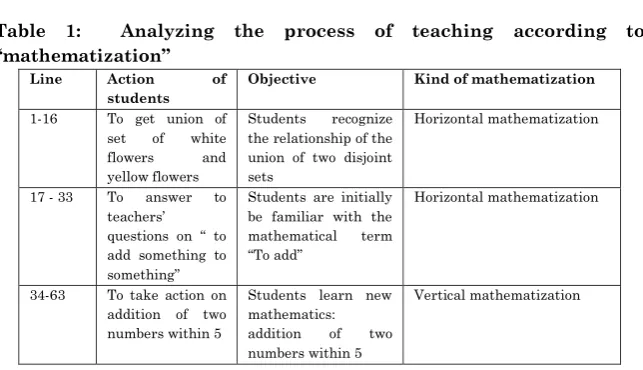
Table 1: Analyzing the process of teaching according to “mathematization”
Line Action of
students
Objective Kind of mathematization
1-16 To get union of set of white flowers and yellow flowers
Students recognize the relationship of the union of two disjoint sets
Horizontal mathematization
17 - 33 To answer to teachers’ questions on “ to add something to something”
Students are initially be familiar with the mathematical term “To add”
Horizontal mathematization
34-63 To take action on addition of two numbers within 5
Students learn new mathematics: addition of two numbers within 5
Vertical mathematization
The Table 1 showed that the processing of teaching “The addition of two natural numbers within 5” consisted of stages of
mathematization. In the environment of horizontal
mathematization, the students had opportunities to take action (observing, counting, describing, adding,…) on particular objects (flowers,..); while in the environment of vertical mathematization, they acted on abstract objects (mathematical objects): 1, 2, 3, 4, 5. As a result of these processes, they learn what the addition of two numbers within 5 is – new mathematics to them.
CONCLUSION
REFERENCES
[1] Freudenthal, H. (1991). Revisiting Mathematics Education:
China Lectures. Dordrecht: Kluwer Academic Publishers.
![Figure 1: Intuitive picture for introducing the addition within 5 [ 2 ]](https://thumb-us.123doks.com/thumbv2/123dok_us/7769303.1278591/2.439.94.382.67.177/figure-intuitive-picture-introducing-addition.webp)