The CS
2Block Cipher
?Tom St Denis Secure Science Corporation
Abstract. In this paper we describe our new CS2 block cipher which is an extension of the original CS-Cipher. Our new design inherits the efficiency of the original design while being upgraded to support a larger block size as well as use a slightly improved substitution box. We prove that our design is immune to differential and linear cryptanalysis as well as argue it resists several other known attacks.
Keywords.Secret Key-Cryptography, Pseudo-Hadamard Transform.
1
Introduction
In [2] the CS–Cipher was introduced. It is a 64–bit block cipher designed for efficiency on 8–bit processors as well as in hardware. In their design they intro-duced the use of multipermutations [4] as a design construct as well as a very non-linear round transform. In a subsequent paper [3] Vaudenay claimed that the active substitution box “sbox” count is at least 72 over the full cipher, thus concluding the design is immune to differential and linear cryptanalysis. As of yet no full cryptanalysis of the CS–Cipher is known to exist.
In this paper we extend the CS–Cipher using the results of [5] and [7] to produce an efficient 128–bit block cipher with a 128–bit secret key. We show how our design can be implemented efficiently as well as explain the hardware rationale. We also prove that our design is immune to both differential and linear cryptanalysis. We further argue that our design resists several other known attacks.
2
Design
The CS2 block cipher is a substitution–permutation network (SPN) which
ac-cepts a 128–bit plaintextP and produces a 128–bit ciphertext C. It accepts a 128–bit keyKwhich is processed by our key schedule to produce the thirty–three round keysK0..32required.
2.1 Non-Linear Substitutionγ
The non-linear substitutionγis by far the most critical part of our design because its size and delay greatly affect the cipher as a whole. We had to strike a balance between efficiency and security to ensure the overall design was both efficient, practical and secure. Ultimately we decided to use a 4×4 sbox ˆγin a SPN like construction similar to the designs of Twofish and WHIRLPOOL.
x0x1x 2x 3x 4x 5x6x7x 8x 9xAxBxCxDx Ex Fx
ˆ
γ(x) 8x4x 0x DxAx7x6x2xBx5x 3x 9x 1x Fx CxEx
Fig. 1.Non-Linear Substitution ˆγ(x)
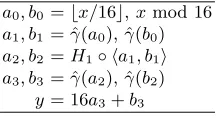
LetH1 represent the FPHT overGF(2)[x]/(x4+x3+ 1).
a0, b0=bx/16c,xmod 16
a1, b1= ˆγ(a0), ˆγ(b0)
a2, b2=H1◦ ha1, b1i
a3, b3= ˆγ(a2), ˆγ(b2)
y= 16a3+b3
Fig. 2.Non-Linear Substitutiony=γ(x)
2.2 Non-Linear Multipermutationθ(x)
As in the CS-Cipher we have used a (2,3)−multipermutation with two differ-ences. We applied the non-linear substitution before the linear transform and we use theH1 transform overGF(2)[x]/(x8+x4+x3+x+ 1) instead of a linear
transform overZ16
2 . The overall concept and purpose remains the same.
a0, b0=bx/256c,xmod 256
a1, b1=γ(a0),γ(b0)
a2, b2=H1◦ ha1, b1i
y= 256a2+b2
2.3 Round Transform ζ(P, r, K)
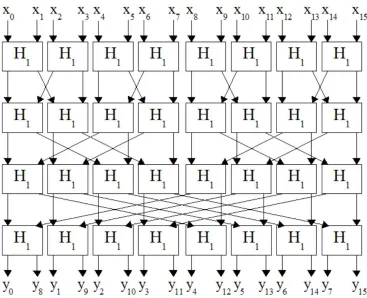
The round transformζis theH4transform implemented in a network mode (fig.
4). TheH1 transforms have been replaced by the non-linear multipermutation
θ. Before layerl of the network the round keyK4r+lis exclusively or’ed against the block. To describe the transform we shall make use of the coordinate pairing tables ρ0..3 (fig. 5). Letρp,q,r represent thep’thρ table,q’th pair and the r’th value of the pair. For example,ρ3,7,0= 7.
ρ00,1 2,3 4,5 6,7 8,9 10,11 12,13 14,15
ρ10,2 1,3 4,6 5,7 8,10 9,11 12,14 13,15
ρ20,4 1,5 2,6 3,7 8,12 9,13 10,14 11,15
ρ30,8 1,9 2,10 3,11 4,12 5,13 6,14 7,15
Fig. 5.Coordinate Pairings Tablesρ
1. fork= 0 to 3 do 1.1 x←x⊕K4r+k
1.2 form= 0 to 7 do
1.2.1y←θ(256xρk,m,0+xρk,m,1)
1.2.2xρk,m,0← by/256c, xρk,m,1←ymod 256
2. returnx.
Fig. 6.Round functiony=ζ(x, r, K)
2.4 Key Schedule
The key schedule (fig.7) is responsible for accepting a 128–bit input key and producing the thirty–three required round keys. LetKArepresent the secret key and KA,j represent the j’th octet of the secret key. Let σi represent the i’th 128–bit constant andσi,jrepresent thej’th octet of thei’th constant defined by (1).
σi,j=γ(γ(i)⊕j),0≤i <32,0≤j <16 (1) In this design the we use consecutive values ofσas the layer keys for the round functionζ in order to produce the round keys. For the purposes of efficiency we create a modified version ofζ called ˆζ which emits the intermediate outputs of every layer as round keys.
1. fork= 0 to 7 do
1.1{K4k+0, K4k+1, K4k+2, K4k+3} ←ζˆ(KA, σ4k)
1.2KA←K4k+3
2.K32,j←γ(KA,j),0≤j≤15
2.5 Block Cipher
The entire cipher is simply eight rounds of the ζ round function followed by a final post-whitening key step.
1. fork= 0 to 7 do 1.1x←ζ(x, k, K) 2. returnx⊕K32.
Fig. 8.CS2 Block Cipher
We note that no decryption routine is described. While the cipher is a bi-jection a decryption routine was not deemed necessary since many useful modes of operations such as CTR, OMAC and EAX only make use of the forward direction of the cipher.
3
Design Rational
This cipher has been designed primarily with hardware and embedded software in mind. Most of the design choices have been related to the gate depth of the round function as well as the code size on the typical 8-bit processor (such as the Intel 8051). There are a variety of implementation options as well.
3.1 Non-Linear Substitutionγ
The non-linear substitutionγwas designed to have an efficient hardware imple-mentation while still having ideal cryptographic properties. The function ˆγ can be written as the following multivariate equations.
y0=x0x1⊕x0x2⊕x3⊕x0x1x3⊕x0x2x3⊕x1x2x3
y1=x2⊕x3⊕x0x3
y2=x0⊕x1x2⊕x0x1x3
y3= 1⊕x0⊕x1⊕x0x1x2⊕x2x3
(2)
TheH1 function can be written easily as well.
y0=x3⊕x4
y1=x0⊕x5
y2=x1⊕x6
y3=x2⊕x7⊕x3
y4=x4⊕x0
y5=x5⊕x1
y6=x6⊕x2
y7=x7⊕x3
The function was also designed to have the following cryptographic proper-ties.
1. AnDPmax(γ) of 25610 ≈2−4.67
2. AnLPmax(γ) of 25616 = 2−4
3. An algebraic degree of six.
4. No fixed (γ(x) =x) or points of involution (γ(γ(x)) =x).
The low differential and linear profiles help prevent high probability trails (and hulls) from forming. Even though the design primarily relies on the wide– trail design philosophy it was still thought important to minimize such charac-teristics. The algebraic degree has been raised to the maximum value of six for such a function to help prevent trivial algebraic style attacks. Even though no such attacks against CS–Cipher are known it was another design consideration. Finally fixed points and points of involution were avoided to prevent fixed points in the round transform. They also guarantee thatK31and K32 are distinct.
In hardware the most practical design implementation would be to compute
γas a function of ˆγandH1. This will result in a very low gate count compared to
what an 8×8 ROM would require and have a reasonable gate delay. In software
γis best implemented as an array placed in ROM.
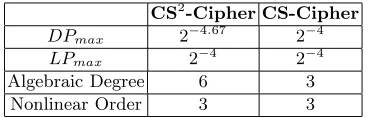
CS2-Cipher CS-Cipher
DPmax 2−4.67 2−4
LPmax 2−4 2−4
Algebraic Degree 6 3
Nonlinear Order 3 3
Fig. 9.Comparison between substitution boxes of CS2-Cipher and CS-Cipher.
3.2 Non-Linear multipermutationθ
The non-linear multipermutation was also designed to be efficient in hardware to implement. Assuming that the twoγ substitutions are implemented in par-allel the overall gate depth is not much higher than that of the substitutions themselves. The following equations give the H1 function as it applies to this
y0=x8⊕x7
y1=x0⊕x9⊕x7
y2=x1⊕x10
y3=x2⊕x11⊕x7
y4=x3⊕x12⊕x7
y5=x4⊕x13
y6=x5⊕x14
y7=x6⊕x15
y8=x8⊕x0
y9=x9⊕x1
y10=x10⊕x2
y11=x11⊕x3
y12=x12⊕x4
y13=x13⊕x5
y14=x14⊕x6
y15=x15⊕x7
(4)
3.3 Round Function ζ
The round functionζ was chosen for its efficient implementation which yields a gate delay of four times the gate delay of the θ function. As a result the round function has a relatively low gate delay. The coordinate pairings table was designed to create a Fast pseudo-Hadamard Transform (FPHT) [5] so that it has a provable branch and two round trail weight.
Our choice of the FPHT was motivated by the fact that like the SHARK [6] design it resists the saturation and truncated differential attacks very well. That is, since every output coordinate is a non-null function of all of the input coordinate diffusion is optimal. However, unlike the SHARK design our round transform has a more efficientO(logn) time implementation and nearly twice as many active coordinates over two rounds.
In hardware the best approach in terms of space and time complexity would be to implement ζ as a pipeline. The transform network has four layers which could accommodate up to four blocks at a time (suitable for CTR mode) with only a modest addition to the design. In each layer the eightθtransforms could be implemented in parallel since they are very small.
In software the ideal approach in terms of space would be to implement the four layers of the transform network as separate subroutines that could be called both by ˆζ andζ. In terms of speed it would be ideal to inline the layers to save on index pointer setup and stack operation time.
3.4 Key Schedule
based off of the sine function and used a full call toζ to produce a single 128– bit round key word. Not only did this severely penalize on–the–fly round key computation but it also made the design larger and hindered cryptanalysis.
Our original 256–bit key designs were designed to use the round function to lower the design, implementation and cryptanalysis time. However, all of our attempts were either weak against reduced round related keys attacks or were too inefficient for on–the-fly computation. As a result for this design we reduced the key size to 128–bits.
The round constants can both be computed easily on–the–fly fromγand also stored in ROM for quick access. The nested nature (eqn. 1) of the round keys allows a minimal 17 table lookups by first computingγ(i) and using it for the other octets of thei’th round key constant.
The round keys are extracted after every layer of ˆζ so that they can computed on–the–fly with just over the cost of one encryption (with pre–computed round keys). In hardware, the round keys can be computed within each pipeline stage just before they are required. That is, each pipeline stage would have two buffers. One buffer stores the round key to be used in that stage against the plaintext and the other holds the computed (at the same time as the plaintext is encrypted) round key for the next round. At the end of each pipeline stage the plaintext and new round key are forwarded to the next pipeline stage. As a result, with over twice the gate count and a single pipeline cycle penalty per plaintext the circuit can encrypt up to four plaintexts under up to four different keys at once.
4
Cryptanalysis
4.1 Linear and Differential Cryptanalysis
In [7] it was proved that two rounds ofζ will have at least twenty-four active coordinates. As a result both linear and differential cryptanalysis become inef-fective quickly. With six rounds any four round trail will have a probability far too low to be useful. Eight rounds provides a large margin of security from both attacks.
Rounds in Attack Differential Cryptanalysis Linear Cryptanalysis
2 2112 273
4 2224 2145
6 2336 2216
4.2 Truncated Differentials
In truncated differential attacks the goal is to predict only part of the output difference or more importantly predict a pattern of difference propagation. For example, the pattern ∆x → ∆y : ha, bi → h0, ci for non–zero a, b, c is a valid truncated differential for theθ function. In the attack a truncated differential that does not have uniform probability is exploited to create a key distinguishing attack on the last round of the cipher.
For example, in the case of the two point pseudo-Hadamard Transform over the integers modulo 256 the input differenceh128 +a,0icauses the output dif-ferenceh0, bifor 0< a <128 and any non–zerob with a probability of one. For a truly random permutation you would expect this to occur with a probability of 1
256 and such a bias can be exploited.
In the case of CS2we used a (2,3)
−multipermutation which achieves close to ideal properties. The differenceha, bifor non–zero a, bshall behave as expected for a random function. It shall emit differences ofh0, ciandhd,0ifor the appro-priate 2√#θ−2 as would be expected from a random function. The only flaw is that an input difference with one zero shall always emit an output with two non–zero coordinates. As of yet no known exploit of this property is known to exist.
4.3 Higher Order Differential Cryptanalysis
The nonlinear order of the γ function is three which means there exists third order derivatives which produce a constant output. It is thought that this attack cannot defeat more than three rounds of the design due to the fact that the γ
function has been placed within theζ round transform not just at the edge.
4.4 Slide and Boomerang Attacks
The slide attack is not applicable as every round and every layer have their own round keys. Also during the key scheduling every emitted key is based on a unique grouping ofσ constants. The constants also help prevent fixed points in the key schedule from emitting short periodic round keys.
While the decryption routine is not defined in this paper it can be shown to have the same two round trail weight as the forward direction. Therefore, it does not seem likely that the boomerang attack applies to this design.
4.5 Related Key Attacks
5
Conclusion
A simple, efficient and secure block cipher has been proposed. It was designed after the CS block cipher as well as the research into FPHT transforms of [5] and [7]. We feel that the design is a reasonable alternative to Rijndael for hardware platforms since it is equally as efficient and does not rely on a highly algebraic non-linear transform.
References
[1] J. Daemen and L. Knudsen and V. Rijmen, “The Block Cipher SQUARE”, Fast Software Encryption, v.1267 of Lecture Notes in Computer Science, pp. 149–165. Springer-Verlag, 1997
[2] J. Stern and S. Vaudenay. CS-Cipher. In Fifth International Workshop on Fast Software Encryption, Berlin, Germany, March 1998. Springer-Verlag. [3] S.Vaudenay, “On the Security of the CS-Cipher”, Fast Software Encryption,
March 1999, Springer-Verlag, pp. 260-274
[4] S. Vaudenay, “On the Need for Multipermutations: Cryptanalysis of MD4 and SAFER”, LIENS - 94 - 23, November 1994
[5] T. St Denis, “Fast Pseudo-Hadamard Transforms”, Cryptology ePrint Archive, Report 2004-010
[6] A. Bossalaers, J. Daemen, B. Preneel, V. Rijmen, E. De Win, “The Cipher SHARK”, Fast Software Encryption, pp. 99–111, 1996.
[7] T. St Denis, “The CSQUARE Transform”, Cryptology ePrint Archive, Report 2004-026
Appendix A - Test Vectors
KEY: 00 01 02 03 04 05 06 07 08 09 0a 0b 0c 0d 0e 0f PT : 00 01 02 03 04 05 06 07 08 09 0a 0b 0c 0d 0e 0f CT : 58 70 f4 0b d1 57 00 ff 1e 66 bb b7 0b c3 6e 50
KEY: 0f 0e 0d 0c 0b 0a 09 08 07 06 05 04 03 02 01 00 PT : 0f 0e 0d 0c 0b 0a 09 08 07 06 05 04 03 02 01 00 CT : ca f2 58 81 d8 da fa 5f 16 a1 8a 0e f5 92 e3 f8