"2001 Cambridge University Press
What contributes to depression in Parkinson’s
disease ?
A. S C H R A G , M. J A H A N S H A H I N . P . Q U I N N"
From the Department of Clinical Neurology,Institute of Neurology,London
ABSTRACT
Background. Depression is a common problem in patients with Parkinson’s disease, but its mechanism is poorly understood. It is thought that neurochemical changes contribute to its occurrence, but it is unclear why some patients develop depression and others do not. Using a community-based sample of patients with Parkinson’s disease, we investigated the contributions of impairment, disability and handicap to depression in Parkinson’s disease.
Methods. Ninety-seven patients seen in a population-based study on the prevalence of Parkinson’s disease completed the Beck Depression Inventory (BDI). Clinical and historical information on symptoms and complications of Parkinson’s disease were obtained from the patients by a neurologist. In addition, clinician and patient ratings of disability on the Schwab and England scale were obtained and a quality of life questionnaire was completed.
Results. Moderate to severe depression (BDI18) was reported by 19n6 % of the patients. Higher depression scores were associated with advancing disease severity, recent self-reported deterioration,
higher akinesia scores, a mini-mental score of 25 and occurrence of falls. Disability as rated by
the neurologist accounted for 34 % of the variance of depression scores. Self-reported impairment
of cognitive function and the feeling of stigmatization accounted for50 % of the variance of
depression scores.
Conclusions. Depression in patients with Parkinson’s disease is associated with advancing disease severity, recent disease deterioration and occurrence of falls. Regression analysis suggests that depression in Parkinson’s disease is more strongly influenced by the patients’ perceptions of handicap than by actual disability. The treatment of depression should therefore be targeted independently of treatment of the motor symptoms of Parkinson’s disease, and consider the patients’ own perception of their disease.
INTRODUCTION
Depression occurs more frequently in patients with Parkinson’s disease than in the age-matched population (Warburton, 1967 ; Robins, 1976 ;
Cantello et al. 1986 ; Gotham et al. 1986 ;
Ehmannet al. 1990). It is presumed that in many
cases depression is related to the neurochemical
changes in Parkinson’s disease (Mayeux et al.
1984, 1986 ; Ringet al. 1994 ; Charlton, 1997),
but its mechanism is poorly understood, and it is unclear why some patients develop depression
"Address for correspondence : Professor Niall P. Quinn, De-partment of Clinical Neurology, Institute of Neurology, Queen Square, London WC1N 3BG.
while others do not. There is no clear relationship between depression and severity or duration of Parkinson’s disease or with the occurrence of specific parkinsonian symptoms (Brown & Jahanshahi, 1995). In addition, except for depression as an off-period symptom, depression does not improve consistently with medical or surgical antiparkinsonian treatment (Lieberman,
1998 ; Quinn, 1998 ; Fetoniet al. 1999).
There-fore, it has been suggested that personal and social factors (MacCarthy & Brown, 1989), and reactions of the patient to the disease, play a role in determining depression in Parkinson’s disease. However, disability and personal and
social factors only account for 50 % of the
variance of depression (MacCarthy & Brown, 1989).
The World Health Organization (1980) has suggested a useful model to assess the impact of chronic disease on patients’ lives. The objective impairment caused by the disease, such as presence and severity of symptoms, may lead to disability, the functional deficit resulting from impairment. Impairment and disability can both result in handicap, which depends on the patient’s social and personal circumstances and
his\her social roles and physical and emotional
make-up. Although handicap usually results from the disability associated with impairment, it can result directly from impairment even without any accompanying disability (e.g. symptoms causing social embarrassment). Fur-thermore, patients with the same objective impairment (symptom severity) may experience very different degrees of disability and handicap. Mediating factors like personality traits or social circumstances can prevent or increase handicap in patients with the same level of disability or impairment. Thus, although these concepts overlap, they measure different aspects of the impact of illness and may therefore contribute differentially to depression.
We investigated some of the factors that may contribute to depression in a population-based sample of patients with Parkinson’s disease. In the framework of the WHO model, we evaluated the relation of depression with various motor and non-motor symptoms of Parkinson’s dis-ease, with the associated disability, as measured by a clinician on the Schwab and England scale, and with self-reported handicap as indexed by a quality of life (QoL) measure.
METHOD
Case ascertainment
This study was part of a larger population-based study on the prevalence of parkinsonism with the primary aim of differentiating different types of parkinsonism. The methods of study design and case ascertainment have been reported
previously (Schrag et al. 1999). In brief, the
records of 15 general practices in the area of London were screened for patients with a suspicion of Parkinson’s disease or parkin-sonism, for patients with tremor with onset after the age of 50, and for patients who had ever
received antiparkinsonian drugs. As the health care system in the UK is organized locally the population of a general practice is representative of the surrounding area. In addition, the general practitioner acts as a ‘ gatekeeper ’ of the National Health Service, so that patients are only referred to specialists by their general practitioners. All participating patients had a semi-structured general and neurological in-terview and examination, and clinical details were collected during the diagnostic visit. Details of the patients’ medical history were extracted from their general practitioners’ records. Di-agnosis of probable Parkinson’s disease was made according to strict clinical diagnostic criteria (Gibb & Lees, 1989). Patients with atypical parkinsonism, vascular parkinsonism, drug-induced parkinsonism, and those with parkinsonism following dementia were excluded. Overall, 242 patients fulfilled screening criteria and participation rate was high (84 %). Among all patients seen, 124 were diagnosed with idiopathic Parkinson’s disease and were included in this study.
Instruments
The clinical assessment included the Hoehn and Yahr Disease Severity Scale (Hoehn & Yahr, 1967), the Unified Parkinson’s Disease Rating
Scale (UPDRS ; Fahn et al. 1987) the Schwab
and England Disability Scale (Schwab & England, 1969), and the Mini-Mental State
Examination (MMSE ; Folsteinet al. 1975). In
addition, all patients were asked to complete a questionnaire booklet and return it in a stamped, addressed envelope. This booklet comprised the Beck Depression Inventory, a widely used
21-item depression inventory (BDI ; Beck et al.
1961), and the PDQ-39, a disease-specific quality
of life (QoL) instrument (Petoet al. 1995). The
PDQ-39 comprises 39 questions each with five different answer options, from which eight subscores (mobility, activities of daily living, emotional well-being, stigma, social support, cognition, communication and bodily dis-comfort) can be derived, which can be totalled to give one summary index. The maximum score of 100 indicates the worst level of problem. On the BDI, higher scores (range 0–63) indicate more severe depression, and the cut-off score for moderate to severe depression used was 18
Jahanshahi & Marsden, 1988). Patients were also asked to rate their current general level of health compared with the past 12 months as better, much the same, or worse than on the day of completion.
Statistical analysis
Clinical and historical information on features and complications of PD were analysed with regard to their influence on depression scores. In addition, the association between depression scores and the results of the QoL questionnaire was investigated. Akinesia scores were calculated as the sum of items 19 and 23 to 26 of the UPDRS for both sides, and the tremor score from items 20 and 21 for both sides. The tremor-dominant subtype of PD was defined as patients with a ratio of tremor to bradykinesia score (subscores from the UPDRS motor scale and
history)0n5, and the akinetic-rigid subtype as
patients with a ratio of 0n5. The subdimensions
and summary scores of the QoL instrument were calculated according to the respective scoring algorithms. The data were inspected for normality and equality of variance. Mean values were then compared with one-way analysis of variance, and Pearson rank correlations were
calculated for examining associations of
variables. Categorical data were analysed using the chi-square and Fisher’s exact tests, where appropriate. Significance was accepted at the
1 % level (P 0n01). Stepwise multiple
regression analysis was used to determine the factors contributing independently to depression
scores at a significance level ofP 0n05.
RESULTS
Of the 124 patients 97 (78 %) returned the
questionnaires. Their mean age was 73 (..
11n3) years with a mean disease duration of 5n8
(.. 4n9) years, and a mean onset age of 67n6
(.. 12n5) years. There were 50 men and 47
women who responded, mean Hoehn and Yahr
stage was 2n4 (.. 0n9), mean MMSE was 27n5
(out of 30 ; .. 3n6), and mean PDQ-39 score
was 30n0 (.. 19n3). Seventeen patients (18 %)
had MMS scores of 25. There was no
statistical difference between responders and non-responders with respect to age, disease duration, sex, Hoehn and Yahr stage, Schwab and England score or MMSE score.
Extent of depression
The mean BDI score in this sample was 12 (..
10n5 ; ranging from 0 to 54). Among the 97
responders 35 (36n1 %) had mild (BDI score
9–17), 10 (10n3 %) moderate (BDI score 18–23)
and 9 (9n3 %) severe depression (BDI score
24). Thus moderate to severe depression was
reported by 19n6 % of the sample.
The WHO model of impairment, disability and handicap
To test the validity of this model to explain depression scores in patients with Parkinson’s disease, we performed a factor analysis with varimax rotation using the different scales in this study. This resulted in two independent com-ponents which each accounted for 34 % of the total variance. Factor one had loadings between
0n70 and 0n88 for all measures of impairment
(Hoehn and Yahr stage, akinesia score, tremor score, MMSE score) as well as clinician- and patient-rated disability. Factor two had loadings
between 0n51 and 0n82 for all measures of
handicap (all subdimension of the PDQ-39 apart from the activities of daily living subdimension,
which had a loading for factor one of 0n56). It
therefore seems appropriate to interpret factor one as reflecting impairment and disability and factor two as reflecting handicap.
Relation of depression to patient and disease characteristics
Using Pearson correlations, there was a mod-erate, but significant, correlation of increasing depression scores with higher disease severity as
measured by the Hoehn and Yahr scale (rl
0n36,P 0n001) and higher akinesia scores (rl
0n37, P 0n01), and a trend for a correlation
with higher tremor scores (rl0n25, P 0n05),
but not with age (rlk0n02, Pl0n9), age at
onset (rlk0n07,Pl0n6) or disease duration (r
lk0n02, Pl0n8), even after controlling for
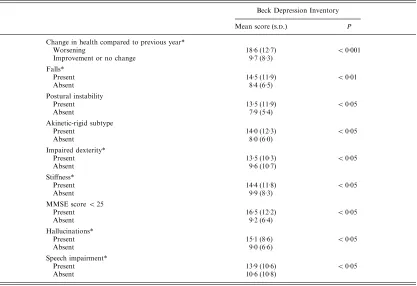
disease severity. Using one-way analysis of variance, depression scores were significantly higher in patients who reported recent
deterio-ration of their health (P 0n001) and those with
falls (P 0n01) than for those without these
features (see Table 1). There was also a trend for patients with the akinetic-rigid subtype
of Parkinson’s disease (P 0n05), with
Table 1. Factors associated with significantly increased depression scores
Beck Depression Inventory
Mean score (..) P
Change in health compared to previous year*
Worsening 18n6 (12n7) 0n001
Improvement or no change 9n7 (8n3) Falls*
Present 14n5 (11n9) 0n01
Absent 8n4 (6n5)
Postural instability
Present 13n5 (11n9) 0n05
Absent 7n9 (5n4)
Akinetic-rigid subtype
Present 14n0 (12n3) 0n05
Absent 8n0 (6n0)
Impaired dexterity*
Present 13n5 (10n3) 0n05
Absent 9n6 (10n7)
Stiffness*
Present 14n4 (11n8) 0n05
Absent 9n9 (8n3)
MMSE score 25
Present 16n5 (12n2) 0n05
Absent 9n2 (6n4)
Hallucinations*
Present 15n1 (8n6) 0n05
Absent 9n0 (6n6)
Speech impairment*
Present 13n9 (10n6) 0n05
Absent 10n6 (10n8)
* Self-reported.
MMSE, Mini-Mental State Examination.
of 25 (P 0n05), self-reported hallucinations
(P 0n05), stiffness (P 0n05) and impairment
of dexterity (P 0n05) or speech (P 0n05), to
have higher depression scores. In contrast,
gender (Pl0n1), onset before or after age 55 (P
l0n9), current age above or below 60 (Pl0n8),
or the presence or absence of tremor (Pl0n4) or
rigidity (Pl0n6), and self-report of dyskinesias
(Pl0n5), on–off fluctuations (Pl0n3) or of
response to levodopa (Pl0n4) did not have a
significant effect on depression scores.
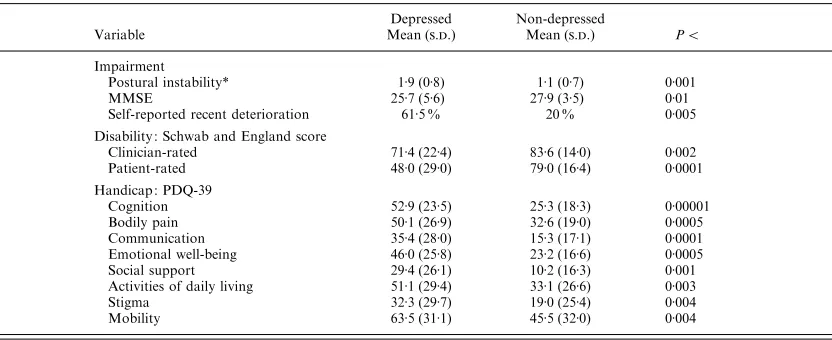
A proportion of patients with moderate to severe depression were in the early stages of illness. However, overall more than 90 % of patients with depression scores of 18 or more had Hoehn and Yahr stages of 3, 4 or 5. Also,
patients with BDI scores of 18 had
signifi-cantly greater postural instability, as measured
on the UPDRS motor scale (P 0n001), more
frequently reported recent deterioration of their
health (P 0n005), and tended to have lower
MMSE scores (P 0n01 ; Table 2). Overall,
47 % of patients with MMSE scores of 24
compared with 14 % of those with MMSE
scores of 25 had BDI scores of 18. No
significant difference was found between de-pressed and non-dede-pressed patients with regard
to age (Pl0n7), sex (Pl1n0) or age at onset (P
l0n2), tremor (Pl0n6), rigidity (Pl0n9) and
akinesia scores (Pl0n1), presence\absence of
fluctuations (Pl0n3), dyskinesias (Pl0n3) or
hallucinations (Pl0n1), socio-economic status
(Pl0n2) or living conditions (Pl0n3).
Relation of depression to disability
Patients with BDI scores of 18 had
signifi-cantly greater disability scores than those with
scores of 18 as rated by the clinician (Pl
0n002) or the patient (Pl0n0001 ; Table 2).
Depression scores increased with decreasing Schwab and England scores, indicating greater depression with increased disability, whether
assessed by the clinician (rlk0n57,P 0n0001),
Table 2. Comparison of the depressed(BDI17)and non-depressed patients on measures of impairment,disability and handicap(standard deviations are in parentheses)
Depressed Non-depressed
Variable Mean (..) Mean (..) P
Impairment
Postural instability* 1n9 (0n8) 1n1 (0n7) 0n001 MMSE 25n7 (5n6) 27n9 (3n5) 0n01 Self-reported recent deterioration 61n5 % 20 % 0n005 Disability : Schwab and England score
Clinician-rated 71n4 (22n4) 83n6 (14n0) 0n002 Patient-rated 48n0 (29n0) 79n0 (16n4) 0n0001 Handicap : PDQ-39
Cognition 52n9 (23n5) 25n3 (18n3) 0n00001 Bodily pain 50n1 (26n9) 32n6 (19n0) 0n0005 Communication 35n4 (28n0) 15n3 (17n1) 0n0001 Emotional well-being 46n0 (25n8) 23n2 (16n6) 0n0005 Social support 29n4 (26n1) 10n2 (16n3) 0n001 Activities of daily living 51n1 (29n4) 33n1 (26n6) 0n003 Stigma 32n3 (29n7) 19n0 (25n4) 0n004 Mobility 63n5 (31n1) 45n5 (32n0) 0n004
* Measured on the Unified Parkinson’s Disease Rating Scale (Fahnet al. 1987).
MMSE, Mini-Mental State Examination (Folsteinet al. 1975) ; PDQ-39, Parkinson’s disease specific quality of life questionnaire (Peto
et al. 1995).
was a strong correlation between the clinician’s and the patient’s rating of disability on the
Schwab and England scale (rl0n89,
P 0n0001). However, patients with BDI scores
of 18 rated their disability greater than the
clinician, whereas no difference between clinician and patient-rated disability was seen in patients with BDI scores below 18 (two-factor mixed
ANOVAF(1, 95)l15n3,P 0n001).
Relation of depression to self-rated health status
Depression scores were most closely related to subjectively perceived impairment of cognition,
as measured on the PDQ-39, (rl0n67,
P 0n0001). They were also significantly
corre-lated with impairment of all other aspects of QoL, although less strongly with impairment of
social support, as measured on the PDQ-39 (rl
0n32,P 0n01). The patients with a BDI score of
18 had significantly worse scores on all areas
of QoL (see Table 2). Even when controlling for disability as measured by the clinician-rated Schwab and England score, BDI scores corre-lated with all areas of QoL, albeit less signifi-cantly.
Predictors of depression in Parkinson’s disease : multiple regression analysis
To determine the factors that contributed most to depression, we performed a series of stepwise
multiple regression analyses entering all factors that had shown a significant and sizeable correlation with depression scores or resulted in significantly different depression scores. In the context of the WHO model, we performed separate analyses for measures of impairment, disability and handicap. First, parameters measuring impairment (Hoehn and Yahr stage, akinesia score, postural instability, MMSE score and recent deterioration) were entered. Secondly, in a separate analysis, disability scores, as measured by the Schwab and England scale by the clinician and by the patient, were entered. Thirdly, a stepwise multiple regression was performed with QoL scores as the independent variables to detemine which specific aspects of handicap related most closely to depression. Finally, an overall analysis was carried out, using measures of impairment, disability and handicap in a single regression analysis, to determine the best overall predictors of de-pression.
Disease characteristics – degree of impairment
scores (adjustedR#l0n28,P 0n001). No other disease-related factor or patient characteristic additionally contributed to the prediction of depression scores.
Disability
Disability, as measured by the clinician-rated Schwab and England scores, explained 34 % of
the variance of depression (P 0n0001).
Patient-rated Schwab and England scores alone
explained 51 % of the variance of depression
(P 0n0001).
Quality of life
Stepwise multiple regression with QoL subscores revealed that impairment in the areas of cog-nition, emotional well-being, stigma, and ac-tivities of daily living (as measured on the PDQ-39) predicted depression scores in 66 % of
patients (P 0n0001). When the domain that
overlaps with depression (emotional well-being) was excluded from the analysis, subjective
impairment of cognition (adjustedR#lk0n47,
P 0n0001), and the feeling of stigmatization,
(R# change 0n08, P 0n0001), still predicted
53 % of the variance of depression scores.
Overall : impairment,disability and QoL When measures of impairment, disability and QoL (excluding emotional well-being) were all entered in a stepwise regression analysis,
im-pairment of cognition (adjusted R#l0n47,
P 0n0001) and stigmatization (R# changel
0n08, P 0n003), as measured on the PDQ-39,
the clinician-rated disability (R#changel0n05,
Pl0n006), and the patient’s report of recent
deterioration (R# changel0n04, Pl0n014)
accounted for 60 % of the variance of depression scores.
DISCUSSION
Prevalence of depression in Parkinson’s disease
Moderate to severe depression with BDI scores
of 18 was seen in 19n6 % of patients with
Parkinson’s disease in a population-based sample. Studies in clinic-based samples or using different instruments have reported a wide range of depression rates (Celesia & Wanamaker, 1972 ;
Mayeux et al. 1981 ; Cummings, 1992), but in
the only comparable, population-based study in Sweden a similar rate of 24 % was found when
using the same instrument and cut-off score, although the authors diagnosed major
de-pression in only 7n7 % of patients in that sample
(Tandberget al. 1996). We considered the BDI
a suitable instrument to measure the severity of depression in patients with Parkinson’s disease in this study and to examine the influence of factors contributing to depression for several reasons. First, it is widely used and has been repeatedly shown to be valid in patients with Parkinson’s disease. Secondly, it enables quan-titative assessment of the severity of depression. Thirdly, its validity and internal consistency have been shown to be comparable in patients
with Parkinson’s disease and controls (Levinet
al. 1988).
Factors contributing to depression in Parkinson’s disease
We used the WHO model of impairment, disability and handicap to investigate factors contributing to depression in Parkinson’s dis-ease. Although there is obvious overlap between these concepts, impairment reflects objectively measured clinical symptoms and signs, whereas disability measures the individual’s functioning in his environment, and handicap depends on the individual’s perception of the impact of
illness on his\her life influenced by a variety of
personal, social and cultural factors. Thus, each of these concepts is useful in its own right to assess the effect of Parkinson’s disease on an individual, thus differentially contributing to the understanding of depression in Parkinson’s disease. In order to test the validity of this model, a factor analysis with the different scales used was performed and confirmed the existence of two separate dimensions, one relating to measures of impairment and disability, and the other to measures of handicap. Disability was not sufficiently different from measures of impairment to result in an independent factor. As there was a strong correlation between Hoehn and Yahr stage and the Schwab and England scale, which is mainly based on physical functioning, it is not surprising that they related to the same independent factor. However, the Schwab and England scale was the only measure of disability used, and the inclusion of other measures of disability may have resulted in a third independent factor.
disease severity was overall associated with higher depression scores, but the prevalence of depression had a bimodal distribution, with a percentage of patients being depressed at initial stages of the disease (Hoehn and Yahr stage
1n5), and a larger percentage at later stages (4
and 5). This finding has also been previously
reported (Celesia & Wanamaker, 1972 ;
Starksteinet al. 1990), and may indicate reactive
depression soon after diagnosis, improvement of depression in the process of adaptation to a slowly advancing disease and improvement in parkinsonian features after initial treatment, and subsequent recurrence of depression as the
disease and its response to medication
deteriorates.
In accordance with previous reports, sub-groups of patients with the akinetic-rigid subtype
of Parkinson’s disease (Starkstein et al. 1998)
and those with cognitive impairment (Starkstein et al. 1990) were more likely to be depressed than those without these characteristics. In add-ition, we found that postural instability and recent deterioration were also associated with higher depression scores, whereas age, type of onset, sex, age and the presence of fluctuations or dyskinesias did not influence patients’ overall mood.
However, measures of impairment only pre-dicted a small percentage of the variance of depression (28 %). Objective disease severity, as rated on the Hoehn and Yahr scale, predicted 19 % of the variance of depression scores, which is similar to the findings of previous studies (Brown & Jahanshahi, 1995). The consistent finding that only a small proportion of the variance of depression scores can be predicted by disease severity suggests that the development of mood disorder may be determined by a separate mechanism from that underlying the motor dysfunction in Parkinson’s disease.
Although no other disease-related factors contributed to prediction of depression scores, the patients’ own report of a recent deterioration in their condition accounted for a further 11 % of the variance of depression scores. In this cross-sectional study, we did not assess disease progression over time objectively, and self-reported deterioration of the motor symptoms may be influenced by depressed patients’ pessi-mistic view of their condition. Thus, the direction of effect cannot be clearly established. However,
this finding is in agreement with previous studies which found that deterioration is an important factor in developing depression in Parkinson’s
disease (Brown et al. 1989 ; Starkstein et al.
1998), and with studies in other chronic diseases, where a progressive course is associated with higher depression scores (Moos & Solomon,
1965 ; Mindhamet al. 1981 ; McIvoret al. 1984 ;
Starksteinet al. 1992).
Clinician-rated disability, on the other hand, correlated strongly with depression and was the strongest single predictor of depression in Parkinson’s disease in this study. It explained 34 % of the variance of the depression scores, which is more than twice that found in previous
studies (Gotham et al. 1986 ; MacCarthy &
Brown, 1989 ; Ehmannet al. 1990). As may be
expected, the patients’ own rating of disability correlated even more strongly with their de-pression scores, but again the direction of effect is unclear and it is possible that presence of depression colours the patients’ perceptions of disability negatively. This is supported by the finding that depressed patients had significantly greater self-rated than clinician-rated disability, whereas there was no such difference in non-depressed patients. However, this confounding factor is not applicable to the clinician-rated disability scores.
con-Impairment
Disability
Handicap
28%
53% Observer-rated: 34%
Patient-rated: 51%
60%
Depression
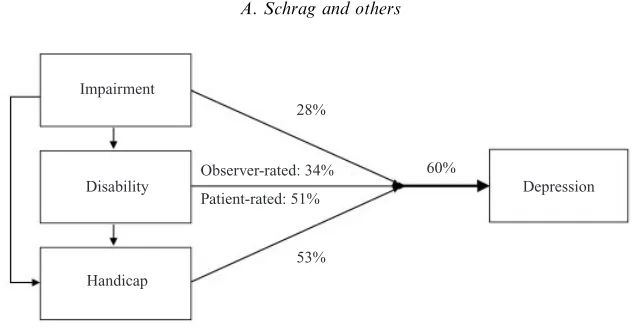
F. 1. The contribution of impairment, disability and handicap to depression in Parkinson’s disease.
tribution of cognitive impairment and social stigmatization emphasizes the importance of these factors for the patients’ well-being beyond the degree of physical impairment.
This study has several limitations. Depression was measured using the BDI, but we did not perform a structured psychiatric assessment. The prevalence rate therefore relates to the proportion of patients scoring highly on that scale rather than the presence of a depressive illness. Self-assessment may however be un-reliable, particularly in demented patients. Fur-thermore, social functioning, social ties and other social, economic, personal and cultural issues were not assessed in this study. As these are likely to play an important role in the occurrence of depression, a higher proportion of the variance of depression scores might have been explained had these factors been measured. Overall, in this study depression in Parkinson’s disease was found to be the result of a multi-factorial process, with objective impairment ex-plaining only a comparatively small percentage of depression scores. Disability accounted for a greater proportion of the variability of depress-ion scores, but the best predictor of depressdepress-ion was the patients’ handicap, as measured by a health-related QoL instrument. Handicap, as in-dexed by a QoL measure, predicted more than 50 % of the variance of depression scores (see Fig. 1). A strong association of depression with self-reported handicap, in the context of its less strong association with measures of disease severity, supports the notion that depression is at least partly a reaction to the impact of the disease on the individual’s QoL. In contrast, from their population-based study of depression
in patients with Parkinson’s disease, Tandberg et al. (1997) concluded that depression is a primary consequence of brain dysfunction. However, in their study, the only parameter assessing personal and social factors was nursing-home placement, and the patients’ per-ceptions were not considered. We therefore propose that, without disputing the known biochemical changes that may contribute to depression in Parkinson’s disease, the patients’ own personal circumstances and perception also influence its occurrence. The clinical differences between depressed and non-depressed patients (Table 1) emphasise the complexity of this model, and suggest that subgroups of patients, such as those with postural instability and cognitive decline, may be more predisposed to developing depression.
fo-cusing treatment exclusively on the motor symptoms of Parkinson’s disease.
The financial support of SmithKline Beecham Pharmaceuticals (A. S.) and the Wellcome Trust (M. J.) is gratefully acknowledged.
REFERENCES
Beck, A. T., Ward, C., Mendelson, M., Mock, J. & Erbaugh, J. (1961). An inventory for measuring depression.Archives of General
Psychiatry4, 561–567.
Brown, R. & Jahanshahi, M. (1995). Depression in Parkinson’s disease : a psychosocial viewpoint. Advances in Neurology 65, 61–84.
Brown, R. G., MacCarthy, B., Jahanshahi, M. & Marsden, C. D. (1989). Accuracy of self-reported disability in patients with parkinsonism.Archives of Neurology46, 955–959.
Cantello, R., Gilli, M., Riccio, A. & Bergamasco, B. (1986). Mood changes associated with ‘ end-of-dose deterioration ’ in Parkinson’s disease : a controlled study.Journal of Neurology,Neurosurgery and
Psychiatry49, 1182–1190.
Celesia, G. G. & Wanamaker, W. M. (1972). Psychiatric disturbances in Parkinson’s disease.Diseases of the Nervous System33, 577–583. Charlton, C. G. (1997). Depletion of nigrostriatal and forebrain tyrosine hydroxylase by S-adenosylmethionine : a model that may explain the occurrence of depression in Parkinson’s disease.Life
Sciences61, 495–502.
Cummings, J. L. (1992). Depression and Parkinson’s disease : a review.American Journal of Psychiatry149, 443–454.
Ehmann, T. S., Beninger, R. J., Gawel, M. J. & Riopelle, R. J. (1990). Depressive symptoms in Parkinson’s disease : a comparison with disabled and control subjects.Journal of Geriatric Psychiatry
and Neurology3, 3–9.
Fahn, S., Elton, R. L. & Members of the UPDRS Development Committee (1987). Unified Parkinson’s Disease Rating Scale. In
Recent Developments in Parkinson’s Disease,Vol. 2(ed. S. Fahn,
C. D. Marsden, D. B. Calne and M. Goldstein), pp. 153–163, MacMillan Healthcare Information : Florham Park, NJ. Fetoni, V., Soliveri, P., Monza, D., Testa, D. & Girotti, F. (1999).
Affective symptoms in multiple system atrophy and Parkinson’s disease : response to levodopa therapy. Journal of Neurology,
Neurosurgery and Psychiatry66, 541–544.
Folstein, M. F., Folstein, S. E. & McHugh, P. R. (1975). ‘ Mini-mental state ’. A practical method for grading the cognitive state of patients for the clinician. Journal of Psychiatric Research 12, 189–198.
Gibb, W. R. & Lees, A. J. (1989). The significance of the Lewy body in the diagnosis of idiopathic Parkinson’s disease.Neuropathology
and Applied Neurobiology15, 27–44.
Gotham, A. M., Brown, R. G. & Marsden, C. D. (1986). Depression in Parkinson’s disease : a quantitative and qualitative analysis.
Journal of Neurology,Neurosurgery and Psychiatry49, 381–389.
Hoehn, M. M. & Yahr, M. D. (1967). Parkinsonism : onset, progression and mortality.Neurology17, 427–442.
Jahanshahi, M. & Marsden, C. D. (1988). Depression in torticollis : a controlled study.Psychological Medicine18, 925–933. Levin, B. E., Llabre, M. M. & Weiner, W. J. (1988). Parkinson’s
disease and depression : psychometric properties of the Beck Depression Inventory. Journal of Neurology Neurosurgery and
Psychiatry51, 1401–1404.
Lieberman, A. (1998). Managing the neuropsychiatric symptoms of Parkinson’s disease.Neurology50(suppl. 6), S33–S38.
MacCarthy, B. & Brown, R. (1989). Psychosocial factors in Parkinson’s disease. British Journal of Clinical Psychology 28, 41–52.
McIvor, G. P., Riklan, M. & Reznikoff, M. (1984). Depression in multiple sclerosis as a function of length and severity of illness, age, remissions, and perceived social support. Journal of Clinical
Psychology40, 1028–1033.
Mayeux, R., Stern, Y., Rosen, J. & Leventhal, J. (1981). Depression, intellectual impairment, and Parkinson disease. Neurology 32, 645–650.
Mayeux, R., Stern, Y., Cote, L. & Williams, J. B. (1984). Altered serotonin metabolism in depressed patients with Parkinson’s disease.Neurology34, 642–646.
Mayeux, R., Stern, Y., Williams, J. B., Cote, L., Frantz, A. & Dyrenfurth, I. (1986). Clinical and biochemical features of depression in Parkinson’s disease.American Journal of Psychiatry
143, 756–759.
Mindham, R. H., Bagshaw, A., James, S. A. & Swannell, A. J. (1981). Factors associated with the appearance of psychiatric symptoms in rheumatoid arthritis. Journal of Psychosomatic
Research25, 429–435.
Moos, R. H. & Solomon, G. F. (1965). Personality correlates of the degree of functional incapacity of patients with physical disease.
Journal of Chronic Disease18, 1019–1038.
Peto, V., Jenkinson, C., Fitzpatrick, R. & Greenhall, R. (1995). The development and validation of a short measure of functioning and well being for individuals with Parkinson’s disease.Quality of Life
Research4, 241–248.
Quinn, N. P. (1998). Classification of fluctuations in patients with Parkinson’s disease.Neurology51(suppl. 2), S25–S29. Ring, H. A., Bench, C. J., Trimble, M. R., Brooks, D. J., Frackowiak,
R. S. & Dolan, R. J. (1994). Depression in Parkinson’s disease. A positron emission study.British Journal of Psychiatry165, 333–339. Robins, A. H. (1976). Depression in patients with Parkinsonism.
British Journal of Psychiatry128, 141–145.
Schrag, A., Ben-Shlomo, Y. & Quinn, N. P. ( 1999). The population prevalence of progressive supranuclear palsy and multiple system atrophy.Lancet354, 171–175.
Schwab, R. S. & England, A. C. (1969). Projection technique for evaluating surgery in Parkinson’s disease. InThird Symposium on
in Parkinson’s Disease (ed. F. J. Gillingham and I. M. L.
Donaldson), pp. 152–157. Livingstone : Edinburgh.
Starkstein, S. E., Preziosi, T. J., Bolduc, P. L. & Robinson, R. G. (1990). Depression in Parkinson’s disease.Journal of Nervous and
Mental Disease178, 27–31.
Starkstein, S. E., Mayberg, H. S., Leiguarda, R., Preziosi, T. J. & Robinson, R. G. (1992). A prospective longitudinal study of depression, cognitive decline, and physical impairments in patients with Parkinson’s disease.Journal of Neurology,Neurosurgery and
Psychiatry55, 377–382.
Starkstein, S. E., Petracca, G., Chemerinski, E., Teson, A., Sabe, L., Merello, M. & Leiguarda, R. (1998). Depression in classic versus akinetic-rigid Parkinson’s disease.Movement Disorders13, 29–33. Tandberg, E., Larsen, J. P., Aarsland, D. & Cummings, J. L. (1996). The occurrence of depression in Parkinson’s disease. A community-based study.Archives of Neurology53, 175–179.
Tandberg, E., Larsen, J. P., Aarsland, D., Laake, K. & Cummings, J. L. (1997). Risk factors for depression in Parkinson disease.
Archives of Neurology54, 625–630.
Warburton, J. W. (1967). Depressive symptoms in Parkinson patients referred for thalamotomy.Journal of Neurology,Neurosurgery and
Psychiatry30, 368–370.
World Health Organization (1980).International Classification of
Impairments,Disabilities and Handicaps.A Manual of Classification
Relating to the Consequences of Disease. World Health