© 2014, IJCSMC All Rights Reserved
441
Available Online atwww.ijcsmc.comInternational Journal of Computer Science and Mobile Computing
A Monthly Journal of Computer Science and Information Technology
ISSN 2320–088X
IJCSMC, Vol. 3, Issue. 1, January 2014, pg.441 – 446
SURVEY ARTICLE
A Survey Paper on Image Segmentation
with Thresholding
Prof. S. T. Khandare
1, Mr. Akshay D. Isalkar
2¹,2Department of Computer Sci. & Engg., SGBAU, India
1
[email protected]; 2 [email protected]
Abstract— In computer vision, image segmentation is the process of partitioning a digital image into multiple sections. The goal of segmentation is to simplify and/or change the representation of an image into something that is more important and easier to examine. Image segmentation is typically used to locate objects and background in images. More exactly, image segmentation is the process of assigning a label to every pixel in an image such that pixels with the same label share certain visual characteristics. Image segmentation is an important signal processing tool that is widely employed in many applications including object detection, object-based coding, object tracking, image retrieval, and clinical organ or tissue identification. Thresholding is the basic method of image segmentation. From a grayscale image, thresholding can be used to generate binary images. The idea of this method is to select the threshold value. A number of accepted methods are used in engineering including the maximum entropy method, Otsu's method that uses maximum variance, and k-means clustering. The main idea is that, the proposed segmentation can be work effectively for image based on automatic thresholding and color model based image segmentation.
Keywords- Segmentation; thresholding; gray scale image; entropy; Ostu’s method; k-means clustering
I. INTRODUCTION
Our main focus of work is on development of an optimized approach for the color image segmentation, where we will explore the concept of thresholding by referring the color image statistical data. To achieve the aim of the proposed work, we will develop the thresholding mechanism. To achieve thresholding, local and global analysis, and evaluation of the color image data will be explored.
Main aim of the work is to develop a segmentation approach for color images based on an automatic thresholding and color models. To achieve the main aim of the work focus is on Quad-Tree decomposition and automatic thresholding by representing image into different color models [Yuan and Chen, 2009].
The main objective of the work is divided in the following sub-objectives.
To develop a mechanism for the image partitioning from image decomposition point of view.
To develop the mechanism for thresholding logic.
To develop the mechanism for the contour threshold.
© 2014, IJCSMC All Rights Reserved
442
To develop the mechanism for the different color space representation for given color image
Finally, devise an approach which will provide the better experimental results for the color image segmentation and image fusion.
II.MOTIVATION
Now days the computing power is increasing so it need to produce complex image processing tools. Hundreds of segmentation techniques are proposed now days, but there is no single method which can be considered to be good for all images, nor are all methods uniformly good for a specific type of image. Moreover, technologies developed for one domain of image may not apply to other domains of image. Most of the image processing applications found on binary or gray image but very few on color image segmentation. Color image processing area grows faster in theoretical point of view rather than practical point of view. The electronic devices are more and the chip technology increases so it creates the pressure to improve the color image segmentation faster. In the recent segmentation scheme lacks in some point of view that no sensitivity to grey level difference, color image information in darken image is unreliable, no common method for processing. It has many criteria to handle in digital color image processing that include image segmentation, image fusion, image compression, image recognition and many more. We will introduce image segmentation scheme for color images that deals with automatic thresholding and color model based segmentation. Image thresholding is the front-stage processing of image segmentation. In general, we assume that there are three rewards in image segmentation. The first is the computation speed. When segmenting an image, we do not want that it will take much time for processing. The second is good region connectivity of its segmenting result. When segmenting an image, we do not want the result of segmenting region to be disconnected. If the result of segmenting region is disconnected, we need take many resources to record the boundaries of the over-segment results. It is not we want to get the results. The third is good region matching as a result, it will be reliable.
The work in this paper is motivated from a practical point of view by several disadvantages of existing methods. The first problem is the incapability of all known methods to appropriately segment objects from the background exclusive of interference from object shadows and highlights. There is inadequate research on the combination of basic automatic thresholding and color model based segmentation similarity measures to improve color similarity calculations given the advantages of improving the performance of each color images. There are many challenging issues for the development of a unified approach to image segmentation that can be applied to all kinds of images. Even the choice of a suitable technique for a specific type of image is a complex problem up to current study; there is no universally adopted method of quantification of segmented output. The selection of the threshold is very crucial as for same part of the image low intensity variation may correspond to edges of interest, while the other part may require high intensity variation.
III.LITERATURE SURVEY
Before we consider each of the methods in detail, we briefly look at the field of image segmentation overall. [Fue and Mui, 1981] classified segmentation techniques for image segmentation into three broad categories: characteristic feature thresholding or clustering, edge detection, and region extraction methods. This survey was done from the point of view of cytology image processing. A critical appreciation of several methods of thresholding, edge detection and region extraction has been done. This includes some graph theoretical approaches. For color image thresholding, only a brief mention about it has been given.
[Haralic and Shaprio, 1985] classified image segmentation techniques as: measurement space guided spatial clustering, single linkage region growing scheme, hybrid linkage region growing scheme, centroid linkage region growing scheme and split and merge schemes. According to them, the difference between clustering and segmentation is that clustering involves grouping in measurement space: while in image segmentation the grouping is involved in the spatial domain of the image. Segmentation tries to do the groupings in the measurement space, particularly for multispectral images. For multispectral data, instead of clustering in the full measurement space [Haralic and Shaprio, 1985] suggested to work in multiple lower order projection spaces, and then refelect these clusters back to the full measurement space.
[Shaoo et.al., 1988] surveyed only segmentation algorithms based on thresholding and attempted to evaluate the performance of some thresholding algorithms using some uniformity and shape measures. They categorized global thresholding techniques into two classes: point dependent techniques called gray level histogram based and region dependent techniques called modified histogram or co-occurrence based. The fairly detailed discussion on probabilistic relaxation is available. They also revived several methods of multi-thresholding techniques. We offer the following comments about the previous reviews on image segmentation.
None of techniques considers fuzzy set theoretic segmentation techniques.
Neural network based techniques are also not included.
The problem of objective evolution of segmentation results has not been adequately dealt with except
© 2014, IJCSMC All Rights Reserved
443
Color image segmentation has not been paid proper attention.
Segmentation of range images/magnetic resonance images has not been considered at all.
[Hedley and Yan, 1992] has been applied successfully the Sobel operator to all three planes in the RGB space and the gradients were summed to obtain the resultant edges. They compute the Sobel operator on each of the three RGB planes and then sum the results. For their map processing application where colors and objects are well defined, this seems to be an adequate technique for edge detection. However, for more complex color images where it is necessary to capture better the correlation between the planes, this approach would probably be inadequate.
[Carron et. al., 1994] applied the Sobel operator to each component of the HSI space and the individual results were combined using a trade-off parameter between hue and intensity. An interesting feature of this trade-off parameter was its dependence on the level saturation. The results of this combination are not convincing given the test images used (there are only minor differences between results where hue information is used as compared to those where it is not). Color image scenes containing shadows might have provided a better indication of the capabilities of combining the information contained within the individual HSI planes.
[Liu and Yang, 1994] suggested image segmentation classification techniques for image segmentation into three categories: histogram-based, neighborhood-based, and physically-based methods. Histogram-based methods usually perform some sort of clustering in a pre-defined measurement space, e.g. RGB. The implementation proposed by neighborhood-based techniques considers small local neighborhoods in an image and use this information to aid in decision-making. The [Deng and Majunath, 1999] paper proposes a method that falls roughly into this class. The third type of approaches uses the actual physics of light and the color formation process to perform segmentation, and the method proposed by [Healey et.al., 1992] in is a prime example.
For color images, a number of approaches have been proposed from processing individual planes [Carron et. al., 1994] to true vector-based approaches [Dony and Haykin, 1999]. The computational load of computing edges on individual planes can be much smaller than that of computing edges on the color vector. However, this seems to be a trade-off between speed and algorithm performance. The vector-based approaches exploit the correlation between the color planes much more effectively than the computation on single planes. This is why most researchers have concentrated on the vector-based approaches.
[Zhiguang et.al., 2008] find that image segmentation method based on graph theory is mainly used for gray images, and thresholding of segmentation must be predefined. So they proposed the unsupervised segmentation for color image based on graph theory. Combining with entropy in information theory, they suggest an unsupervised method for color image segmentation based on Minimum Spanning Tree (MST). The image is mapped into a weighted undirected graph, the pixels are considered to be as nodes, the best thresholding is obtained by objective function of maximum weighted entropy to realize unsupervised segmentation. Their experiment results show that the new algorithm ensures the color image segmentation excellent disturbance attenuation performance and better separability.
[Yi-hua et.al., 2009] find the drawbacks in existing work as: grey level image is not suitable for images with complex object, edge based method is not suitable for blurred images and images with complex edges is not continent to process, snake based scheme venerable to impact of initial curve, watershed segmentation sometimes lead to over segmentation problem, and graph cut theory consider the global gray level and space information which create the image segmentation problem. So [Yi-hua et.al., 2009] proposed a novel image segmentation method based on random walk model. First of all, they down- sampling the original large image to the small image which can be solved faster, then the little image segmentation leads to sparse linear equations of much minor scale. After receiving the solution, the possibility results will be up-sampling to the upper layer, and then resolve the sparse linear equations in this layer; repeating this up-sampling process until to the top layer which is the source image. Segment the final probability image with a known threshold. They test their algorithm on two natural images and compare the segmentation results with that from the original random walk algorithm technique. The segmentation results show that their results are much better.
[Maire et.al., 2009] investigated two fundamental problems in computer vision: contour detection and image segmentation. They presented new state-of-the-art algorithms techniques for both of these tasks. Proposed segmentation algorithm consists of generic machinery for transforming the output of any contour detector into a hierarchical region tree. In this manner, they reduce the problem of image segmentation to that of contour detection. Their approach is to contour detection couples multi-scale local brightness, color, and texture cues to a powerful globalization framework using spectral clustering. This approach outperforms existing image segmentation algorithms on measures of both boundary and segment quality. These hierarchical segmentations can optionally be further refined by user-specified annotations. While the majority of this work focuses on processing static images.
© 2014, IJCSMC All Rights Reserved
444
picture, thus yielding suitable segmentation results in different areas. They proposed a robust segmentation method that is suitable for nonspecific image fike format. The techniques are based on the hierarchical segmentation under quad-tree decomposition [Chen et. al., 2007], an image is adequately decomposed into many blocks and sub-blocks according to the image contents. Simulation results demonstrate that the proposed method is superior to the conventional methods to some level. Due to avoiding human interferences and reducing operating time, the proposed method is more robust and suitable to various image and video applications than the conventional segmentation methods.
[Maia and Hongpeng, 2010] to improve the performance of image segmentation investigated a new image segmentation techniques based on Grey Graph Cut which integrates grey theory and graph cut theory methods. In the methods, first the image is taken as a weighted undirected graph. After then, the relationships of grey-levels and locations in local regions are discussed via grey relational investigation, a grey weighted matrix is recognized, based on which a grey partition function is derived. After, the image is transformed to binarized with the gray-level that corresponds to the minimum value of the grey panel function. Investigational results on visible light image and SAR image indicate that the proposed technique, being better to some existing methods like Otsu and Normalized Cut etc., not only that can segment the images with obvious difference among targets and backgrounds, but also hold back image noise effectively.
[Harrabi and Braiek, 2012] presented a new color image segmentation technique, based on multilevel
threshold and data fusion techniques which aim at combining different data sources associated to the same color image in order to increase the information quality and to get a more reliable and accurate segmentation effect. The projected segmentation approach is conceptually different and explores a novel strategy. In fact, in its place of considering only one image for every application, the method consists in combining many realizations of the identical image, together, in categorize to increase the information quality and to get an best segmented image. They used an optimal multi-level thresholding is based on the two-stage Otsu optimization approach and The notion of mass functions, in the Dempster-Shafer (DS) evidence theory technology, is linked to the Gaussian distribution, and the final segmentation is realized, on an input image, that is expressed in different color spaces. A major problem in the field of color image segmentation area, and even image segmentation in universal, has been what is known as 'the lack of ground truth' [Deng and Majunath, 1999]. Up to recently with the creation of the segmentation dataset, each paper's authors would use completely different images to test their algorithms and techniques. Therefore, it was extremely difficult to judge the class of a segmentation technique or even to compare it with its peers. The choice of dataset is a first step in trying to create a sort of standard for segmentation result. Though, segmentation is immobile a very subjective task in nature and even within the dataset, there are numerous discrepancies. For this reason, comparisons of algorithms have been traditionally quite problematic task. In this survey, as an alternative of trying to draw direct comparisons between algorithms, they attempted to list out the comparison between automatic thresholding using quad-tree decomposition and color image segmentation based on different color models techniques.
IV.PROPOSED SYSTEM DESIGN
The work is divided into analysis of an image segmentation methods based on the modified edge-following scheme and image segmentation method using thresholds automatically determined from picture contents.
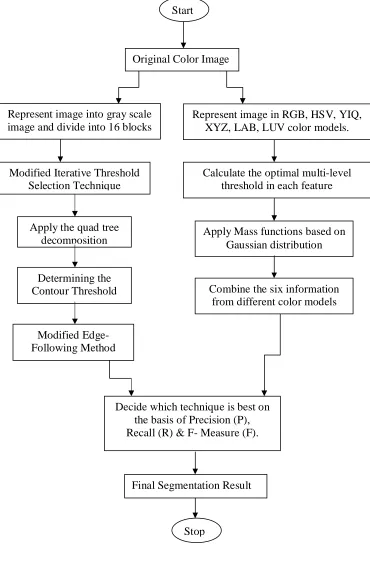
In the first segmentation scheme the focus is on region based segmentation where different thresholds are automatically determined according to areas with varied contents in a picture, thus yielding suitable segmentation results in different areas. First, the iterative threshold selection technique is modified to calculate the initial-point threshold of the whole image or a particular block. Second, the quad-tree decomposition that starts from the whole image employs gray-level gradient characteristics of the currently-processed block to decide further decomposition or not. After the quad-tree decomposition, the initial-point threshold in each decomposed block is adopted to determine initial points. Additionally, the contour threshold is determined based on the histogram of gradients in each decomposed block. Particularly, contour thresholds could eliminate inappropriate contours to increase the accuracy of the search and minimize the required searching time. Finally, the edge-following method is modified and then conducted based on initial points and contour thresholds to find contours precisely and rapidly. By using the Berkeley segmentation data set with realistic images, the proposed method is demonstrated to take the least computational time for achieving fairly good segmentation performance in various image types [Yuan and Chen, 2009]..
© 2014, IJCSMC All Rights Reserved
445
spaces, namely the C = {RGB, HIS, YIQ, XYZ, LAB, and LUV} color spaces. The examples show that the images provided by these different sources are redundant and complementary. In this sense, data fusion techniques appear as an appealing approach for color image segmentation. The purpose of this study is to apply this method for medical images segmentation [Rafika and Ezzedine, 2012]. We aim at providing assistance to automatic thresholding of color image segmentation. The flowchart below illustrates the working of proposed work in figure 1.
Figure 1: Flowchart of proposed work
Calculate the optimal multi-level
threshold in each feature
Start
Represent image in RGB, HSV, YIQ,
XYZ, LAB, LUV color models.
Original Color Image
Modified Iterative Threshold
Selection Technique
Represent image into gray scale
image and divide into 16 blocks
Apply Mass functions based on
Gaussian distribution
Combine the six information
from different color models
Apply the quad tree
decomposition
Determining the
Contour Threshold
Modified
Edge-Following Method
Decide which technique is best on
the basis of Precision (P),
Recall (R) & F- Measure (F).
Final Segmentation Result
© 2014, IJCSMC All Rights Reserved
446
V. CONCLUSION
This work proposes an automatically threshold detection mechanism to perform a good segmentation. Different start-point thresholds are selected and given to regions with extreme and flat changes in gray-level values of a image. The contour thresholds are selected by analysing the decomposed regions that preventing the search from declining into the incorrect path, and reduction in computational time can be obtained. The contour search process technique also believes the gradients of the left and right neighbouring points of every forecasted contour point, in order to subordinate the possibility of the method being unnatural by the neighbouring noise interferences. Most of the searching procedure requires only the calculation of the gradients of three directions using eight compass directions that reduce the searching time. The planned method can carry out segmentation on objects within another object and objects that are close up to each other. In management of blurry objects from an out-of-focus explosion, the projected method can be also segmenting the essential objects. The planned method could take the smallest amount of computational time to find strong and high-quality segmentation performance than the traditional ones. Therefore, the proposed method can be extensively and successfully working in various segmentation applications.
REFERENCES
[1] [Pal et. al., 1993] A Review on Image Segmentation Techniques, Pattern Recognition Socity, Britain,
volume 26, No. 9, pp. 1274.
[2] [Fue and Mui, 1981] A survey on image segmentation, Pattern Recognition 13, 3-16.
[3] [Haralic and Shaprio, 1985] Survey, image segmentation techniques, Computer Vision Graphics Image
Process, 29, 100-132.
[4] [Shaoo et.al., 1988] A survey of thresholding techniques, Computer Vision Graphics Image Process, 41, 233-260.
[5] [Hedley and Yan, 1992] Segmentation of color images using spatial and color space information, Journal
of Electronic Imaging, vol. 1, pp. 374-380.
[6] [Healey et.al., 1992] Segmenting Images Using Normalized Color, IEEE Transactions on Systems, Man.
and Cybernetics, 22(1): 64-73.
[7] [Carron et. al., 1994] Color edge detector using jointly Hue, Saturation and Intensity, in Proc. IEEE International Conference on Image Processing, pp. 977-981.
[8] [Liu and Yang, 1994] Multiresolution Color Image Segmentation, IEEE Transactions on Pattern Analysis
and Machine Intelligence, 16(7): 689-700.
[9] [Deng and Majunath,1999] Color Image Segmentation, Proc. IEEE Computer Society Conference on
Computer Vision and Pattern Recognition, Fort Collins, CO, USA, p.446-51 vol. 2.
[10] [Dony and Wesolkowski, 1999] Edge Detection on Color Images Using RGB Vector Angle, Proceedings
of CCECE 1999.
[11] [Yuan and Oscal, 2009] Image Segmentation Method Using Thresholds Automatically Determined from
Picture Contents, EURASIP Journal on Image and Video Processing.
[12] [Zhiguang et.al., 2008] Unsupervised Segmentation for Color Image Based on Graph Theory, IEEE
Second International Symposium on Intelligent Information Technology Application, 978-0-7695-3497-8.
[13] [Yi-hua et.al., 2009] A Novel Image Segmentation Method Based on Random Walk, IEEE Second
Asia-Pacific Conference on Computational Intelligence and Industrial Applications, PACIIA, 978-1-4244-4607-0/09.
[14] [Yuan and Chen, 2009] Image Segmentation Method Using Thresholds Automatically Determined from
Picture Contents, EURASIP Journal on Image and Video Processing Volume 2009, Article ID 140492, 15 pages doi:10.1155/2009/140492.
[15] [Maia and Hongpeng, 2010] A New Image Segmentation Method Based on Grey Graph Cut, IEEE Third
International Joint Conference on Computational Science and Optimization, 978-0-7695-4030-6/10.
[16] [Harrabi and Braiek, 2012] Color image segmentation using multi-level thresholding approach and data fusion techniques: application in the breast cancer cells images, EURASIP Journal on Image and Video Processing.
[17] [Rafika and Ezzedine, 2012] Color image segmentation using multi-level thresholding approach and data
fusion techniques: application in the breast cancer cells images, EURASIP Journal on Image and Video Processing.
[18] [Carlo Dal et. al., 2012] “Fusion of Geometry and Color Information for Scene Segmentation”, IEEE