arXiv:1312.3748v1 [cs.IT] 13 Dec 2013
On Eavesdropper-Tolerance Capability of Two-Hop
Wireless Networks
Yuanyu Zhang, Yulong Shen, Hua Wang and Xiaohong Jiang, Senior Memeber, IEEE
Abstract—Two-hop wireless network serves as the basic net-work model for the study of general wireless netnet-works, while cooperative jamming is a promising scheme to achieve the physi-cal layer security. This paper establishes a theoretiphysi-cal framework for the study of eavesdropper-tolerance capability (i.e., the exact maximum number of eavesdroppers that can be tolerated) in a two-hop wireless network, where the cooperative jamming is adopted to ensure security defined by secrecy outage probability (SOP) and opportunistic relaying is adopted to guarantee relia-bility defined by transmission outage probarelia-bility (TOP). For the concerned network, closed form modeling for both SOP and TOP is first conducted based on the Central Limit Theorem. With the help of SOP and TOP models and also the Stochastic Ordering Theory, the model for eavesdropper-tolerance capability analysis is then developed. Finally, extensive simulation and numerical results are provided to illustrate the efficiency of our theoretical framework as well as the eavesdropper-tolerance capability of the concerned network from adopting cooperative jamming and opportunistic relaying.
Index Terms—Security, networking, reliability, eavesdropper-tolerance.
I. INTRODUCTION
T
WO-HOP wireless networks, in which a source can communicate with its destination directly or via a inter-mediate relay, have been a class of basic and attractive network scenarios [1]. More importantly, the performance analysis in such two-hop networks lays the groundwork for the study in general multi-hop wireless networks. Due to the broadcast nature of wireless channels and the increasing demand for exchanging confidential information, ensuring secure and re-liable transmission in such wireless networks has become a challenging yet critical task in practice, especially for those applications demanding high security and reliability, such as battle command, emergency treatment and disaster relief.Traditionally, information is secured above the physical layer by applying cryptography [2] or other approaches [3]. The idea of cryptography is to encrypt the information through a cryptographic algorithm (e.g., RSA and AES) that is hard to break in practice by any eavesdropper with limited com-puting power and without the secret key. These schemes are therefore termed computationally secure [4], since they are built around the unproven computational hardness assumption.
Y. Zhang and Y. Shen are with the School of Computer Science and Technology, Xidian University, China. E-mail:[email protected]; [email protected]
H. Wang is with the Department of Maths and Computing, University of Southern Queensland, Australia. Email: [email protected]
X. Jiang is with the School of Systems Information Science, Future University Hakodate, 116-2, Kameda Nakano-Cho, Hakodate, Hokkaido, 041-8655, Japan. E-mail:[email protected].
However, recent advances in computing power (e.g., quantum computing) could make it possible to break such difficult cryptographic algorithms [5] and thus the demand for ever-lasting security in modern wireless communications becomes more and more urgent. That is why there is an increasing interest recently in physical layer security, behind which the fundamental idea is to exploit the inherent physical charac-teristics of communication channels to provide
information-theoretic security to the legitimate transmissions without the
assistance of a secret key [6], [7]. It is more important that no limitations are assumed for the eavesdroppers in terms of the computing power or network parameter knowledge. Moreover, the physical layer security approaches can offer some signif-icant advantages over the traditional cryptographic scheme, like no need to employ complicated cryptographic algorithms and guaranteeing an everlasting security without applying key distribution and management, which is extremely expensive and difficult for large scale decentralized networks. Addition-ally, physical layer techniques can be used with cryptographic approaches in a complementary way and thus can augment the security achieved by cryptography. Therefore, physical layer approaches have been very promising in guaranteeing a strong form of security in wireless communications.
the secrecy outage probability and outage secrecy capacity of a quasi-static Rayleigh fading channel and showed that fading alone can guarantee the information-theoretic security even when the eavesdropper has a better average SNR than the legitimate receiver. Tekin and Yener [16] introduced the
cooperative jamming scheme where a nontransmitting user
can increase the secrecy capacity by transmitting jamming signal instead of its codewords to confuse the eavesdropper. Since random noise can be generated by helper nodes rather than extra antennas, cooperating jamming has been widely introduced to enhance the physical layer security in wireless networks [17]–[27].
By now, various works have been dedicated to explore the security performances in wireless networks with cooperative jamming. For instance, the per-node secure throughput in large decentralized networks was explored in [17], [18], [28], the secrecy capacity maximization problem was investigated in [19]–[21] based on cooperative communication, how to design efficient jamming strategies in terms of power or position of jamming was analyzed in [22]–[24], the opportunistic selection and use of the relays to enhance the physical layer security was studied in [25]–[27]. However, to the best of our knowledge, relatively fewer works consider the performance limits of the eavesdropper-tolerance capability of a network. As shown in [29], [30], the density of the eavesdroppers has a dramatic impact on the connectivity of secrecy graph and the secrecy throughput, which implies that the number of eavesdroppers present in the network is critical in guaranteeing the network security. Knowing the relationship between the eavesdropper-tolerance capability and other network parameters not only plays an important role in the security performance analysis of the network but also serve as the guideline on determining the system parameters to build a secure network for the designers. Therefore, we focus on the eavesdropper-tolerance capability study of a two-hop wireless network in this paper.
The related works regarding eavesdropper-tolerance ca-pability can be classified into two categories according to the network size. For infinite network scenarios, the scaling law of eavesdropper-tolerance capability against the per-node throughput was studied in [28] by constructing a highway sys-tem. By cooperative jamming, Goeckel et al. [31] considered one source-destination pair with opportunistic relaying scheme [32], where the best relay is selected among the available relays based on some policy in terms of their channels to the source and destination, and analyzed the asymptotic behavior of eavesdropper-tolerance capability as the number of relays goes to infinity. However, the metrics used in their paper cannot fully reflect the security and reliability of the end-to-end transmission. This work was later generalized to a scenario with multiple source-destination pairs where artificial noises are generated from concurrent transmitters [33]. For finite network scenarios, Shen et al. [34] proposed a flexible relay selection scheme and derived the lower bound on the eavesdropper-tolerance capability. However, it is notable that all the above works have focused on either the order-sense scaling law results for infinite networks, or bounds for finite networks. Such order sense results or bounds are certainly important but cannot reflect the actual eavesdropper-tolerance
capability in more practical network scenarios with finite nodes, which is more important for the system designers. In our previous work [35], we considered a random relay selection scheme and derived the exact eavesdropper-tolerance capability, which can exactly tell us how many eavesdroppers a network can tolerate at most for a desired level of security and reliability. However, the results showed that with the ran-dom relay selection, the eavesdropper-tolerance performance is not good, especially for small-scale networks and high security/reliability requirement.
In this paper, we establish a theoretical framework to explore the eavesdropper-tolerance capability in a two-hop wireless network, where the cooperative jamming is adopted to ensure security defined by secrecy outage probability (SOP) and opportunistic relaying is adopted to guarantee reliability defined by transmission outage probability (TOP). Different from [31], we use different outage probability metrics that can fully characterize the security and reliability of the end-to-end transmission. More importantly, we consider the inherent channel dependence of the transmissions in two hops, which is critical in determining the exact eavesdropper-tolerance capability. Our contributions can be summarized as follows:
• We first apply the the Central Limit Theorem to develop the closed form models for both SOP and TOP of a source-destination transmission.
• Based on the SOP and TOP models and also the Stochas-tic Ordering Theory, we then conduct analysis to reveal the monotonicity properties of SOP and TOP. With the help of such properties, the model for eavesdropper-tolerance capability is derived.
• A simulator is developed to validate the efficiency of our theoretical framework and numerical results are also provided to illustrate the eavesdropper-tolerance capabil-ity of the concerned network from adopting cooperative jamming and opportunistic relaying.
The reminder of the paper is organized as follows. Section II introduces the system model and problem formulation. In Section III, we conduct the closed form modeling of SOP and TOP of the end-to-end transmission. The model for eavesdropper-tolerance capability analysis is developed in Section IV. Section V presents the simulation and numerical results to validate our theoretical model and Section VI concludes the paper.
II. SYSTEMMODEL ANDPROBLEMFORMULATION
A. System Model and Assumptions
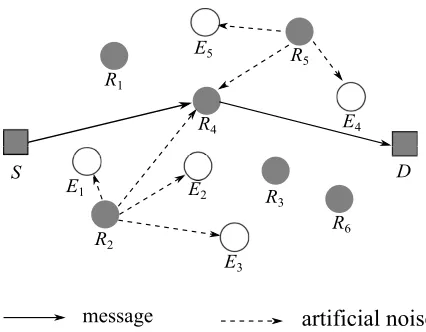
As depicted in Fig.1, we consider a two-hop wireless network scenario consisting of a source node S, a destination node D, nlegitimate half-duplex relays R1, R2,· · ·, Rn that
cannot transmit and receive at the same time and m passive and independently-operating eavesdroppers E1, E2,· · · , Em.
S D
E1 E
2
E3 E
5
E4 R
1
R2
R3 R4
R5
R6
message
artificial noise
Fig. 1. System scenario: SourceSis transmitting message to the destination
D with the help of relaysR1, R2,· · ·, Rn (n = 6in this figure) while
eavesdroppers E1, E2,· · ·, Em (m = 5 in this figure) are attempting to
intercept the message. In this figure, R4 is the message relay andR2,R5
are noise-generating relays.
We aim to ensure both the secure and reliable transmission from S to D against these eavesdroppers of unknown channel and location information.
A slow and flat block Rayleigh Fading environment is as-sumed, where the channel remains static for one coherence in-terval and varies randomly and independently from inin-terval to interval. Thus, the channel from a transmitter A to a receiver B can be represented by a complex zero-mean Gaussian random variable hA,B and the corresponding channel gain|hA,B|2 is
an exponential random variable. Without loss of generality, we assume that |hA,B|2 = |hB,A|2 and E|hA,B|2 = 1, where
E
·
stands for the expectation operator. It is assumed that the source S and the relays transmit with the same power
Pt. In addition, we assume the network is interference-limited
and thus the noise at each receiver is negligible. Therefore, when A is transmitting and relays with indices in R are generating noise, the received signal-to-interference ratio (SIR) at a receiver B can be formulated as
SIRA,B=
Pt· |hA,B|2
P
j∈RPt· |hRj,B|
2 =
|hA,B|2
P
j∈R|hRj,B|
2.
For the eavesdroppers and legitimate receivers, we use posi-tiveγeandγrespectively to denote the minimum SIR required
to recover the received message. That is, a legitimate receiver (eavesdropper) is able to decode the transmitted message if and only if its received SIR exceedsγ(γe). This SIR threshold
scheme can be easily mapped to the Wyner’s encoding scheme where the transmitter chooses two rates, the rate of transmitted codewords Rt and the rate of the confidential message Rs
[8], [17]. The rate difference Re = Rt−Rs reflects the
cost of securing the message against the eavesdroppers. The conversions between the thresholds and the code rates are as follows:
γ= 2Rt−1,
γe= 2Re−1.
Therefore, the results in this paper also applies to the Wyner’s encoding scheme.
In order to improve the link condition from S to D, an opportunistic relaying scheme is adopted, where the best relay
Rb is selected by a timer-based method explained in [32] to
forward messages. Here,bis given by
b= arg max∆
j
min{|hS,Rj|
2
,|hRj,D|
2
}.
The transmission then can be conducted in two phases. In the first phase, S transmits the message to Rb. At the same
time, relays with indices in R1 = j
j 6= b,|hRj,Rb|
2 <
τ , whereτ is the noise-generating threshold to control the interference at legitimate receivers, generate artificial noise to suppress the eavesdroppers. Analogous to the first phase,Rb
forwards its received message toD with relays whose indices are in R2 = j
j 6= b,|hRj,D|
2 < τ generating noise to
assist the transmission in the second phase.
B. Problem Formulation
In this subsection, we first introduce the concepts of TOP and SOP of the concerned network, based on which we then formulate our problem regarding the eavesdropper-tolerance capability in this paper.
To fully characterize the security and reliability perfor-mances of the transmission, we adopt the same outage defini-tions in [17]. Consider the direct link from a transmitter A to a legitimate receiver B. We say transmission outage happens if
B cannot decode the message (i.e.,SIRA,B< γ) and secrecy
outage happens if at least one of the eavesdroppers (say Ei)
can decode the message (i.e.,SIRA,Ei≥γe). It is shown in
[36] that securing each of the individual links is sufficient to secure the end-to-end path. Thus, the secrecy (transmission) outage of the S→Rb →D link occurs if eitherS →Rb or
Rb→Dsuffers from secrecy (transmission) outage. Then we
can introduce the following definitions:
• TOP for opportunistic relayingPbstto: This probability is defined as the probability that the transmission outage of the S →Rb →D link happens under the opportunistic
relaying scheme.
• SOP for opportunistic relaying Pbstso: This probability is defined as the probability that the secrecy outage of the S →Rb →D link happens under the opportunistic
relaying scheme.
Based on the above definitions, Pto
bst and Pbstso can be
formulated as
Pbstto =P(SIRS,Rb< γ∪SIRRb,D < γ) (1)
= 1−P(SIRS,Rb≥γ, SIRRb,D≥γ)
= 1−P |hS,Rb|
2
P
j∈R1|hRj,Rb|
2 ≥γ,
|hRb,D|
2
P
j∈R2|hRj,D|
2 ≥γ
and
Pso
bst = P m
[
i=1
{SIRS,Ei≥γe} ∪
m
[
i=1
{SIRRb,Ei≥γe}
!
(2)
= 1−P
m
\
i=1
{SIRS,Ei< γe},
m
\
i=1
{SIRRb,Ei < γe}
!
(a)
= 1−
"
P
m
\
i=1
{SIRS,Ei< γe}
#2
= 1−
"
P
m
\
i=1
n |hS,E
i|
2
P
j∈R1|hRj,Ei|2
< γe
o #2
whereP(·)stands for the probability operator and(a)follows since the received power of each eavesdropper in two phases are independent and identically distributed. It is notable that the second P(·)term in (1) cannot be formulated as
P(SIRS,Rb ≥γ)P(SIRRb,D ≥γ),
since SIRS,Rb and SIRRb,D are dependent, as will be
ob-served in Appendix A.
Since security and reliability are two important metrics in network design, we use the SOP constraint εsand TOP
con-straintεtto represent the security and reliability requirements
of the end-to-end transmission. We say that the transmission from S to D is secure if and only if Pso
bst ≤ εs and it is
reliable if and only if Pto
bst ≤εt. Notice that largerεs andεt
represent less stringent security and reliability requirements. In this paper, we aim to determine the exactPto
bstandPbstso, which
can be then used to determine the exact eavesdropper-tolerance capability while ensuring both the reliable and secure end-to-end transmission. We usem∗
bst to represent the
eavesdropper-tolerance capability for the opportunistic relaying scheme hereafter.
Based on the above observations, we are now ready to formulate our problem. From the definition of Pto
bst andPbstso,
we can see that when given the number of system relays
n, the SIR thresholds γ,γe, the security requirementεs and
reliability requirement εt, m∗bst only depends on the
noise-generating thresholdτ. Thus, we define the maximum number of eavesdroppers that can be tolerated for a specified τ by
Mbst(τ) =max{m:Pbstso(n, m, τ)≤εs}.
Now the considered problem can be formulated as
maximize
τ Mbst(τ)
subject to Pbstto(n, τ)≤εt, τ ≥0
εt∈[0,1], εs∈[0,1]
(3)
where Pbstto and Pbstso are regarded as functions. That is, we want to maximizeMbst(τ)overτ. We useτbstb to represent the
optimal τ that maximizesMbst(τ)for opportunistic relaying
scheme and thus we have m∗
bst=Mbst(τbstb ).
In order to explore the efficiency of the opportunistic relaying scheme, we also give the eavesdropper-tolerance capability of the same network scenario but with a random relay selection scheme as a comparison, which is considered in [35]. Similarly, for random relay selection scheme, we define
the TOP by Pto
ran, the SOP by Pranso , the optimal τ by τranb
and the eavesdropper-tolerance capability bym∗ran.
III. OUTAGEPERFORMANCES
In this section we determine the TOP Pto
bst and SOP Pbstso
of the network with opportunistic relaying scheme based on some theoretical analysis. Applying the same approach, we also give the outage probabilities of the network with random relay selection scheme.
A. SOP and TOP For Opportunistic Relaying
Before determining the TOP of a network with opportunistic relaying, we first define the total interference at the legitimate receiver in two phases by
I1=
X
j∈R1
|hRj,Rb|
2, I 2=
X
j∈R2
|hRj,D|
2.
Then, we establish the following lemmas regarding the prob-ability distribution ofI1,I2and an important joint probability
of the channel gains in two phases, which is critical in determiningPto
bst.
Lemma 1: For one message transmission from S to D, the
total interference I1 and I2 are independent and identically
distributed, and can be approximated by a normal random variable. Thus, the corresponding pdf is given by
f(x)≈fˆ(x) =e
(x−µ)2 2σ2
σ√2π ,
where
µ= (n−1)h1−(1 +τ)e−τi
is the mean and
σ=
r
(n−1)h1−τ2e−τ−(1 +τ)2e−2τi
is the standard derivation of the normal random variable.
Lemma 2: For one message transmission from S to D, the
joint probability that |hS,Rb|
2 is greater than some constant
x≥0and |hRb,D|
2 is greater than some constanty ≥0 can
be determined as
P|hS,Rb|
2
≥x,|hRb,D|
2
≥y
= 1−(1−e−2max{x,y})n
+ne−max{x,y}hϕ(n, min{x, y})−ϕ(n, max{x, y})i,
where
ϕ(n, x) =e−x2F1
1
2,1−n; 3 2;e
−2x
and2F1 is the Gaussian hypergeometric function.
Remark 1: SinceSand relays transmit with the same power,
Pt can be reduced in determining the TOP as shown in (1),
and thus it is not considered in Lemma 1. The proofs of the above lemmas can be found in Appendix A.
For a two-hop wireless network with opportunistic relaying scheme, we are now ready to derive its TOP Pto
Pso
bst of the end-to-end transmission based on Lemma 1 and
Lemma 2.
Theorem 1: Consider the network scenario in Fig.1 with opportunistic relaying scheme. The TOP Pto
bst and SOP Pbstso
can be given by
Pbstto ≈2
Z (n−1)τ
0
g(n, γ, x) ˆf(x)
Φ(x−µ
σ )−Φ(− µ σ) dx −2
Z (n−1)τ
0
Z x
0
ne−γxϕ(n, γy) ˆf(x) ˆf(y)dydx (4)
and
Pbstso = 1−
m X k=1 m k
(−1)kh(1−e−τ)ck+e−τin−1
!2
(5)
where
c= 1
1 +γe
, fˆ(x) = e
(x−µ)2 2σ2
σ√2π ,
Φ(x) = √1 2π
Z x
−∞
e−t
2 2dt,
µ= (n−1)h1−(1 +τ)e−τi,
σ=
r
(n−1)h1−τ2e−τ−(1 +τ)2e−2τi,
g(n, γ, x) = (1−e−2γx)n+ne−γxϕ(n, γx),
ϕ(n, x) =e−x2F1
1
2,1−n; 3 2;e
−2x
and2F1 is the Gaussian hypergeometric function.
Proof: 1) We first prove thePto
bst in (4). According to the
definition in (1), we have
Pbstto = 1−P
SIRS,Rb≥γ, SIRRb,D≥γ
= 1−P |hS,Rb|
2
≥γI1,|hRb,D|
2
≥γI2
Applying the law of total probability, we have
Pto
bst= 1−EI1,I2
h
P |hS,Rb|
2
≥γI1,|hRb,D|
2
≥γI2
i
(6)
(b)
≈ 1−
Z (n−1)τ
0
Z (n−1)τ
0
P|hS,Rb|
2
≥γx,|hRb,D|
2
≥γy
×fˆ(x) ˆf(y)dydx
(c)
= 2
Z (n−1)τ
0
Z x
0
(
(1−e−2γx)n
−ne−γxhϕ(n, γy)−ϕ(n, γx)i
)
ˆ
f(x) ˆf(y)dydx
= 2
Z (n−1)τ
0
Z x
0
g(n, γ, x) ˆf(x) ˆf(y)dydx
−2
Z (n−1)τ
0
Z x
0
ne−γxϕ(n, γy) ˆf(x) ˆf(y)dydx
= 2
Z (n−1)τ
0
g(n, γ, x) ˆf(x)
Φ(x−µ
σ )−Φ(− µ σ) dx −2
Z (n−1)τ
0
Z x
0
ne−γxϕ(n, γy) ˆf(x) ˆf(y)dydx,
where(b) is due to Lemma 1 and(c)follows after applying Lemma 2.
2) Now we proceed to prove thePbstso in (5). According to the definition in (2), we first need to derive the probability PTm
i=1
n |h
S,Ei|2
P
j∈R1|hRj ,Ei|
2 < γe
o
.
Note that the number of noise-generating relays in the first phase|R1|follows the binomial distributionB(n−1,1−e−τ).
Now, we define the event that there are l noise-generating relays in the first phase (i.e., |R1| = l) by Bl and thus we
have
P
m
\
i=1
n |hS,E
i|
2
P
j∈R1|hRj,Ei|2
< γe
o
(7)
=
n−1
X l=0 P m \ i=1
n |hS,E
i|
2
P
j∈R1|hRj,Ei|
2 < γe
o Bl
P(Bl)
(d)
=
n−1
X
l=0
m
Y
i=1
P |hS,Ei|
2
P
j∈R1|hRj,Ei|
2 < γe
Bl
P(Bl)
(e)
=
n−1
X
l=0
m
Y
i=1
Eh1−e−γePj∈R1|hRj ,Ei| 2i
P(Bl)
(f)
=
n−1
X
l=0
m
Y
i=1
1− Y
j∈R1
Ehe−γe|hRj ,Ei|2i
!
P(Bl)
=
n−1
X
l=0
"
1−
1
1 +γe
l#m
n−1
l
(1−e−τ)l(e−τ)n−1−l
=
n−1
X l=0 m X k=1 m k
(−1)k
n−1
l
clk(1−e−τ)l(e−τ)n−1−l
(g)
= m X k=1 m k
(−1)kh(1−e−τ)ck+e−τin−1
where (d) follows since all the {SIRS,Ei, i = 1,· · ·, m}
applying the law of total probability and the expectation is computed with respect to {|hRj,Ei|
2, j ∈ R
1}, (f) follows
since all the |hRj,Ei|
2 are independent and identically
dis-tributed and (g) follows by applying the binomial theorem. Therefore, (5) follows after substituting (7) into (2).
B. SOP and TOP For Random Relay Selection
Applying the same approach, we now can establish the following lemma about the TOP and SOP under the random relay selection scheme.
Lemma 3: Consider the network scenario in Fig.1 with
random relay selection scheme. The TOPPto
ranand SOPPranso
can be given by
Pranto = 1−
e−τ+1−e
−(1+γ)τ
1 +γ
2n−2
(8)
and
Pso
ran= 1− m
X
k=1
m
k
(−1)kh(1−e−τ)ck+e−τin−1
!2
(9)
wherec=1+1γ
e.
Remark 2: The distributions of I1 andI2 are not used in
determining thePto
ranin (8), because the channel gains in two
hops are independent. Therefore, we can give an exact TOP. The detailed proof can be found in [35]. It is also noticed that the SOPPso
ranin (9) is identical toPbstso in (5). This is because
that the noise-generating schemes are identical in these two schemes and the message relay selection has no impact on the intercepting behavior of the eavesdroppers.
IV. EAVESDROPPER-TOLERANCECAPABILITY
Eavesdropper-tolerance capability characterizes how many eavesdroppers that can be tolerated at most by a wireless network withnrelays in order to guarantee the desired security requirementεs and reliability requirementεt. In this section,
we determine the eavesdropper-tolerance capability for oppor-tunistic relaying scheme based on the problem formulation in section II-B. The eavesdropper-tolerance capability for random relay selection scheme is also provided by applying the same approach.
A. Eavesdropper-Tolerance Capability for Opportunistic Re-laying
It can be observed from the transmission scheme in section II-A and the problem formulation in section II-B that the noise-generating threshold τ is a critical parameter in determining the eavesdropper-tolerance capability. Too largeτwill do harm to the end-to-end transmission, while too smallτis not enough to interfere the eavesdroppers. Therefore, finding a optimal τ
is the key to solving our considered problem. Before solving the problem, we establish the following lemma based on the Stochastic Ordering in [37].
Lemma 4: Let X and Y be two N-dimensional random vectors such that
P(X∈U)≤P(Y∈U) for all upper sets U ∈RN.
ThenX is said to be smaller thanY in the usual stochastic order (denoted byX≤stY). And for all increasing function
φ, we always haveE[φ(X)]≤E[φ(Y)].
Based on the above lemma, we then establish the following lemmas in terms of the monotonicity of SOP and TOP with respect toτ.
Lemma 5: The TOPPbstto for opportunistic relaying scheme increases as τ increases.
Proof: For any 0 < τ1 < τ2, we use random vector
I1 = (I11, I21) to represent the interferences in two phases
when the noise-generating threshold is τ1 and I2 = (I12, I22)
to represent those interferences for τ2. For any upper set
U =
(I1, I2)I1≥x≥0, I2≥y≥0 , we always have
P(I1∈U) =P(I11≥x)P(I21≥y)
and
P(I2∈U) =P(I12≥x)P(I22≥y).
It is easy to see that P(I11 ≥ x) < P(I12 ≥ x) and P(I21 ≥
y) < P(I2
2 ≥ y), since more interference can be generated
as τ increases. Therefore, we have P(I1 ∈ U) < P(I2 ∈
U) and then I1 ≤st I2 according to Lemma 4. Define the
termP |hS,Rb|
2≥γI
1,|hRb,D|
2≥γI
2in (6) byΓ(I)which
decreases as Iincreases, where I= (I1, I2). Thus, we have
E[Γ(I1)]>E[Γ(I2)]according to Lemma 4. That is, for any
0 < τ1 < τ2, we always have Pbstto(τ1) < Pbstto(τ2), which
indicates the TOPPto
bst increases with τ.
Lemma 6: The SOPPso
bst for opportunistic relaying scheme
decreases asτ increases, whereas increases asmincreases.
Proof: Notice that the step following(f)in (7) can also be written as
E
"
1−
1 1 +γe
|R1|#
,
where the expectation is computed with respect to |R1|. For
any0≤τ1< τ2, we use two random variables|R11|and|R21|
to represent the number of noise-generating relays in the first phase, where
|R11| ∼B(n−1,1−e−τ1)
and
|R21| ∼B(n−1,1−e−τ2).
It is shown in [38] that |R11| ≤st |R21|. Applying Lemma 4
again, we can see that
E
"
1−
1
1 +γe
|R11|#
<E
"
1−
1
1 +γe
|R21|#
Therefore, the SOPPso
bst decreases asτ increases.
Next, we consider the step following(f)in (7) again. It is easy to see that the term
1−( 1 1 +γe
)l∈[0,1).
Thus, the term
1− 1 1+γe
lm
decreases withm. Therefore,
the SOPPso
Define step (g) in (7) by a function G(m, n, τ). Then we can derive the eavesdropper-tolerance capability m∗bst for opportunistic relaying scheme based on Lemma5and Lemma 6.
Theorem 2: Consider the network scenario in Fig.1 with opportunistic relaying scheme. The eavesdropper-tolerance capability under the security constraint εs and reliability
constraint εtis
mbst∗ =max{m:G(m, n, τbstb )≥√1−εs}, (10)
where
G(m, n, τb
bst) = m
X
k=1
m
k
(−1)kh(1−e−τbstb )ck+e−τ b bst
in−1 ,
c= 1+1γ
e andτ
b
bst is the solution ofPbstto =εt.
Proof: As shown in (3), we need to find the optimal τ
that maximizesMbst(τ), where
Mbst(τ) =max{m:G(m, n, τ)≥
√
1−εs},
according to its definition. Since the TOPPbstto increases with
τ according to Lemma5, in order to guarantee the reliability (i.e., Pto
bst ≤ εt), τ must take values in the region [0, τm],
whereτmis the solution ofPbstto =εt.
Next, we need to prove thatτmis the optimalτ (i.e.,τbstb =
τm). That is, for any τ∈[0, τm)we always have Mbst(τ)≤
Mbst(τm). Now we prove it by contradiction. Suppose there
exists a τ′ ∈[0, τm)such that Mbst(τ′)≥Mbst(τm) + 1. It
is easy to see that
G(Mbst(τm) + 1, n, τm)<
√ 1−εs,
since Mbst(τm) is the largest m satisfying G(m, n, τm) ≥
√
1−εs. By Lemma 6, it can be observed that G(m, n, τ)
increases with τ, whereas decreases with m. Thus, we have
G(Mbst(τm) + 1, n, τ′)< G(Mbst(τm) + 1, n, τm)<√1−εs
and
G(Mbst(τm) + 1, n, τ′)≥G(Mbst(τ′), n, τ′)≥
√ 1−εs.
We can see that the above two inequalities are contradictory. Thus, for any τ ∈ [0, τm) we always have Mbst(τ) ≤
Mbst(τm)(i.e.,τbstb =τm) and thus the eavesdropper-tolerance
capability is m∗
bst=Mbst(τbstb ).
B. Eavesdropper-Tolerance Capability for Random Relay Se-lection
Applying the same approach, we can establish the following lemma regarding the eavesdropper-tolerance capability for random relay selection.
Lemma 7: Consider the network scenario in Fig.1 with
random relay selection scheme. The eavesdropper-tolerance capability under the security constraint εs and reliability
constraint εtis
m∗ran=max{m:G(m, n, τranb )≥
√
1−εs}, (11)
where
G(m, n, τranb ) =
m
X
k=1
m
k
(−1)kh(1−e−τranb )ck+e−τranb
in−1 ,
c= 1
1+γe andτ
b
ran is the solution of
e−τ+1−e
−(1+γ)τ
1 +γ = (1−εt)
1 2n−2.
Remark 3: Although the exact expressions for m∗bst and
m∗ranare not available, it is easy to calculate them numerically due to the monotonicity of G(m, n, τ) with respect to m, after calculating the corresponding optimal noise-generating thresholdτ for these two relay selection schemes.
V. NUMERICALRESULTS ANDDISCUSSION
In this section, we first verify our theoretical model for TOP and SOP through extensive simulations. We then explore how the number of relays n, the SIR thresholds γ, γe, the
security constraintεsand the reliability constraintεtaffect the
eavesdropper-tolerance capability for opportunistic relaying scheme. Besides, we illustrate the inherent tradeoffs between the eavesdropper-tolerance capability and security/reliability constraint. Finally, we compare the opportunistic relaying scheme with the random relay selection scheme with respect to the eavesdropper-tolerance capability.
A. Model Validation
A simulator was developed in C++ to simulate the message transmission from the source S to the destination D based on the transmission scheme in section II-A, which is now available at [39]. The SIR threshold for legitimate receivers is fixed asγ= 10and that for eavesdroppers is fixed asγe= 0.5.
The total number of end-to-end transmissions is fixed as 100000. The channel varies randomly and independently from one transmission to another. The simulated TOP (SOP) is calculated as the ratio of the number of transmissions suffering from transmission outage (secrecy outage) to the total number 100000. Notice that the simulations with other settings can be easily performed by our simulator as well.
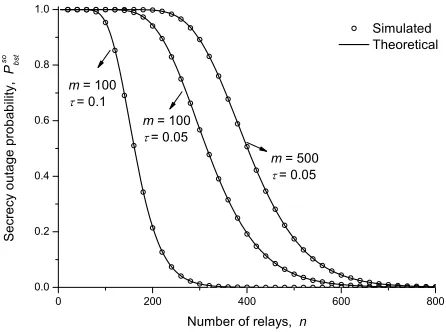
Extensive simulations have been conducted to verify our TOP and SOP models. For the TOP, we considered three different network scenarios of τ = 0.05, 0.075 and 0.1, which correspond to low interference, moderate interference and high interference compared to the considered network size. For the SOP, we also considered three different network scenarios of (m = 100, τ = 0.05), (m = 100, τ = 0.1) and(m= 500, τ = 0.05), which correspond to sparse eaves-droppers with low interference, sparse eaveseaves-droppers with high interference, and dense eavesdroppers with low interference. The corresponding simulated results and theoretical results are summarized in Fig. 2 and Fig.3.
Fig.2 and Fig.3 indicate clearly that the simulated results match nicely with the theoretical ones for both TOP and SOP, so our theoretical model can be used to efficiently explore the eavesdropper-tolerance capability. A further careful ob-servation of Fig.2 shows that there is still a very small gap between the simulated results and the theoretical results when the number of relays n is very small. For example, for the case thatτ = 0.075, the simulated value for Pto
bst is 0.10314
0 100 200 300 400 500 600 0.0
0.2 0.4 0.6 0.8 1.0
= 0.05 = 0.075
T
r
a
n
sm
i
ssi
o
n
o
u
t
a
g
e
p
r
o
b
a
b
i
l
i
t
y,
P
to
b
s
t
Number of relays, n
Simulated
Theoretical = 0.1
Fig. 2. TOP for opportunistic relaying Pto
bst vs. number of relaysnwith
different settings ofτ, whenγ= 10.
0 200 400 600 800
0.0 0.2 0.4 0.6 0.8 1.0
m = 500
= 0.05 m = 100
= 0.05
S
e
cr
e
cy
o
u
t
a
g
e
p
r
o
b
a
b
i
l
i
t
y,
P
s
o
b
s
t
Number of relays, n
Simulated
Theoretical
m = 100
= 0.1
Fig. 3. SOP for opportunistic relaying Pso
bst vs. number of relays nwith
different settings ofmandτ, whenγe= 0.5.
0.46645 forn = 80. This is because that the Central Limit Theorem used in deriving our theoretical result fails to model the pdf of the total interferenceI1andI2 very well for small
values of n. We can see from Fig.2 that Pto
bst increases with
n. This suggests that although the best relay selection scheme can benefit the transmission as n increases, the interferences from the noise-generating relays dominate the tendency of the receivedSIRat legitimate receivers. By comparing these three curves in Fig.2, it can also be observed that Pbstto increases as τ increases, which agrees with Lemma 5. This is due to the reason that more interferences will be generated at the intended receiver for lager τ, and thus it is more difficult for the receivers to successfully recover the messages.
We can see from Fig.3 that Pso
bst decreases as nincreases.
This is because more interferences can be generated at the eavesdroppers by distributing more relays for a specific τ. By comparing these three curves in Fig.3, it can also be observed that Pso
bst increases as m increases while decreases
0.10 0.08
0.06
0.04
0.02
0.00 0
2000 4000 6000 8000
0.00 0.02
0.04 0.06
0.08 0.10
E
a
v
e
s
d
r
o
p
p
e
r
-t
o
l
e
r
a
n
c
e
c
a
p
a
b
i
l
i
t
y
,
m
* b
s
t
S e
cu ri
ty co
n st
r a
in t,
s
R e
lia b
ility co
n st
r a
in t,
t
Fig. 4. Eavesdropper-tolerance capabilitym∗
bstfor opportunistic relaying vs.
reliability constraintεt and security constraintεs withn= 2000,γ= 10
andγe= 0.5.
as τ increases, which agree with Lemma6. This is intuitive since distributing more eavesdroppers by the adversary would post more potential threats to the end-to-end transmission and increasing τ would generate more interferences at the eavesdroppers, so it is more difficult for them to successfully decode the messages.
B. Eavesdropper-tolerance Performances
Based on the SOP and TOP models, we now explore the performance of eavesdropper-tolerance capability for oppor-tunistic relaying scheme. To illustrate the impact of security and reliability constraints on the eavesdropper-tolerance capa-bility, we show in Fig.4 the behavior ofm∗
bstvs.εtandεsfor
the network scenario of n = 2000, γ = 10, γe = 0.5, which
implies that the eavesdroppers have a much better decoding ability than the legitimate receivers. We can observe from Fig.4 thatm∗
bstincreases asεtandεsincrease. This reflects that the
network can tolerate more eavesdroppers by relaxing either the security or reliability requirement. A careful observation of Fig.4 indicates thatεtincreases asεsdecreases in order to
guarantee a certain level of eavesdropper-tolerance capability. For example, εt has to increase from 0.04 to 0.085 as εs
decreases from 0.03 to 0.02 for achieving an eavesdropper-tolerance capacity of about 1000. This suggests that either the security or reliability requirement has to sacrifice for the other one in order to achieve a certain eavesdropper-tolerance capability. From the above discussions, we can see that there exists clear tradeoffs between the eavesdropper-tolerance capability and the reliability/security constraint.
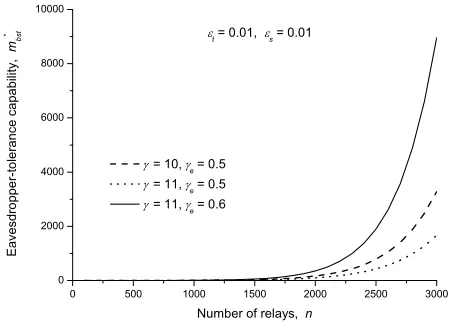
To explore how the number of relays affects the eavesdropper-tolerance capability, we illustrate m∗
bst vs.n in
Fig.5 withεt= 0.01andεs= 0.01for different settings ofγ
and γe. It can be observed from Fig.5 that m∗bst increases
as n increases. This is because that although the optimal thresholdτb
0 500 1000 1500 2000 2500 3000 0
2000 4000 6000 8000 10000
E
a
ve
sd
r
o
p
p
e
r
-t
o
l
e
r
a
n
ce
ca
p
a
b
i
l
i
t
y,
m
*
b
s
t
Number of relays, n = 10,
e = 0.5
= 11, e
= 0.5
= 11, e
= 0.6 t
= 0.01, s
= 0.01
Fig. 5. Eavesdropper-tolerance capability m∗
bst for opportunistic relaying
vs. number of relaysnwithεt= 0.01, andεs= 0.01.
0 500 1000 1500 2000 2500 3000
0 40 80 120 160 200
E
a
ve
sd
r
o
p
p
e
r
-t
o
l
e
r
a
n
ce
ca
p
a
b
i
l
i
t
y,
m
*
r
a
n
Number of relays, n = 0.6,
e = 0.5
= 0.7, e
= 0.5
= 0.7, e
= 0.6 t
= 0.1, s
= 0.1
Fig. 6. Eavesdropper-tolerance capabilitym∗
ranfor random relay selection
vs. number of relaysnwithεt= 0.1, andεs= 0.1.
constraint εt, the corresponding expected number of
noise-generating nodes increases, so more interferences can be generated to suppress the eavesdroppers while the desired reliability can still be ensured. By comparing the three curves, we can also observe thatm∗bst increases asγeincreases, while
decreases as γ increases. This is intuitive since decreasing the decoding ability (i.e.,increasing γe) of the eavesdroppers
would decrease the SOP, while decreasing the decoding ability (i.e.,increasing γ) of legitimate receivers would increase the TOP. It is interesting to notice thatm∗
bstincreases dramatically
when n is above some threshold in Fig.5. For example, for the case that γ = 11 and γe = 0.6 this threshold is about
2500. Thus, distributing more relays would be an efficient approach to enhance the eavesdropper-tolerance capability in the construction of a network.
In order to explore the efficiency of the opportunistic relaying scheme, we also illustrate the eavesdropper-tolerance capability m∗
ran of random relay selection scheme vs. the
number of relays n in Fig.6 with εt = 0.1 and εs = 0.1
for different setting ofγ andγe. Notice that the security and
reliability requirements here are much more relaxed and the decoding ability of the legitimate receivers are much more improved than those for opportunistic relaying in Fig.5. For example, γ = 0.6 is much smaller compared to γ = 10 in Fig.5. That means we consider a much more conservative scenario for random relay selection scheme and the network can hardly tolerate any eavesdropper if we consider the same scenario as that in Fig.5. It can be observed from Fig.6 that
m∗
ran also increases as γe increases, while decreases as γ
increases due to the same reason presented in the discussion of Fig.5. Even for such a conservative scenario, we still can observe from Fig.6 and Fig.5 that the eavesdropper tolerance capability of random relay selection is orders of magnitude less than that of opportunistic relaying scheme, especially for large values of n. For example, for the case that γ = 0.7 and γe = 0.6 in Fig.6 the network can tolerate about 207
eavesdroppers, which is much less than 8959 eavesdroppers for the case thatγ= 11andγe= 0.6in Fig.5 whenn= 3000.
As the eavesdropper-tolerance capability for random relay selection scheme decreases with γ, it will decreases to 0 if we increases γ to 11. This implies that the opportunistic re-laying scheme can achieve a significantly better eavesdropper-tolerance capability than random relay selection.
VI. CONCLUSION
This paper established a theoretical framework to analyze the eavesdropper-tolerance capability of a two-hop wireless network, where cooperative jamming and opportunistic re-laying techniques are adopted to provide secure and reliable end-to-end transmission against passive and independently-operating eavesdroppers of unknown location and channel information. We first apply the Central Limit Theorem to model the TOP and SOP in closed form, based on which and also the Stochastic Ordering we then develop the model for eavesdropper-tolerance capability analysis. Our results indicate that in general more eavesdroppers can be tolerated in the concerned network if a less stringent requirement on both met-rics security and reliability is allowed, but a tradeoff between the requirements on these two metrics does exist to ensure a certain level of eavesdropper-tolerance capability. The results in this paper also reveal that the opportunistic relaying scheme significantly outperforms the random relay selection scheme in terms of the eavesdropper-tolerance capability, and the scheme can guarantee an acceptable eavesdropper-tolerance capability even when a stringent requirement on security and reliability is imposed.
APPENDIXA
PROOF OFLEMMA1AND2
Proof of Lemma 1: From the transmission protocol and the i.i.d fading assumption, we can easily see that I1 andI2 are
the sum of random variables which are smaller thanτ among
n−1i.i.d random variables and thusI1andI2are independent
Now we takeI1for example to determine the distribution of
the total interference in both hops. Fist, we define a function
U(x) =1x<τ(x)·x,
where
1x<τ(x) =
1, x < τ
0, otherwise
is an indicator function and thenI1 can be formulated as
I1=
n
X
j=1,j6=b
U(|hRj,Rb|
2)
,
which is the sum of n−1 i.i.d random variables with pdf given by the following mixed density and mass function
fU(u) =
e−τδ(u) +e−u, 0≤u≤τ
0, otherwise,
whereδ(x)is the Dirac delta function. The mean and variance of the mixed-type random variableU(|hRj,Rb|
2)can be given
by
µ1= 1−(1 +τ)e−τ
and
σ21= 1−τ2e−τ−(1 +τ)2e−2τ.
Therefore, the pdf of I1 can be recursively given by the
following mixed density and mass function
f(x) =
e−(n−1)τδ(x) +p
n−1(x)e−x, 0≤x≤(n−1)τ
0, otherwise ,
where pn−1(x) is a piecewise function and coincides with
different polynomial functions of degree at mostn−2on each interval(kτ,(k+ 1)τ]for0≤k≤n−2. However, it is quite difficult to determine the functionpn−1(x), especially for large
n. Thus, we approximate it by a normal random variable with mean µ= (n−1)µ1 and varianceσ2= (n−1)σ12, according
to the Central Limit Theorem and its pdf can be approximated by
f(x)≈fˆ(x) = e
(x−µ)2 2σ2
σ√2π
where
µ= (n−1)h1−(1 +τ)e−τi
and
σ=
r
(n−1)h1−τ2e−τ−(1 +τ)2e−2τi.
Proof of Lemma 2: Before deriving the probability in Lemma 2, we first define the event that relay Rk, k =
1,· · ·, n is selected as the message relay by Ak (i.e., b =
k). Besides, we use a new random variable Sj to define
min{|hS,Rj|
2,|h
Rj,D|
2} for each relayR
j. It is notable that
Sj, j= 1,· · ·, nis an exponential random variable with mean
1
2. Then, we have
Ak
∆
=
n
\
j=1,j6=k
(Sj≤Sk).
Now, applying the law of total probability, we have
P|hS,Rb|
2
≥x,|hRb,D|
2
≥y (12)
=
n
X
k=1
P |hS,Rk|
2
≥x,|hRk,D|
2
≥y, Ak
=
n
X
k=1
P |hS,Rk|
2≥x,|h
Rk,D|
2≥y,
n
\
j=1,j6=k
(Sj ≤Sk)
!
(h)
=
n
X
k=1
Z ∞
0 P |
hS,Rk|
2
≥x,|hRk,D|
2
≥y,
Sk =s,
n
\
j=1,j6=k
(Sj ≤s)
!
ds
=
n
X
k=1
Z ∞
0
P|hS,Rk|
2
≥x,|hRk,D|
2
≥y, Sk =s
×P
n
\
j=1,j6=k
(Sj ≤s)
!
ds
=
n
X
k=1
Z ∞
0
P|hS,Rk|
2
≥x,|hRk,D|
2
≥y, Sk=s
×(1−e−2s)n−1ds,
where(h)integrates over all the valuesSk can take.
Whenx≥y≥0, (12) can be reduced to
P|hS,Rb|
2
≥x,|hRb,D|
2
≥y (13)
=
n
X
k=1
(
Z ∞
x
P|hS,Rk|
2=
s,|hRk,D|
2
≥s(1−e−2s)n−1
ds
+
Z x
y
P|hS,Rk|
2
> x,|hRk,D|
2=
s(1−e−2s)n−1
ds
+
Z ∞
x
P|hS,Rk|
2> s,|h
Rk,D|
2=s(1−e−2s)n−1ds
)
= 2n
Z ∞
x
(1−e−2s)n−1
e2s ds+ne
−xZ x
y
(1−e−2s)n−1
es ds
= 1−(1−e−2x)n−1+
ne−x
Z e−y
e−x
(1−t2)n−1
dt
= 1−(1−e−2x)n−1+ne−xhϕ(n, y)−ϕ(n, x)i,
where
ϕ(n, x) =e−x2F1
1
2,1−n; 3 2;e
−2x
and2F1 is the Gaussian hypergeometric function.
Similarly, when0≤x < y, (12) can be reduced to
P|hS,Rb|
2
≥x,|hRb,D|
2
≥y (14)
= 1−(1−e−2y)n−1+
ne−yhϕ(n, x)−ϕ(n, y)i
REFERENCES
[1] S. Narayanan and P. University, Two-hop Forwarding in Wireless
Net-works. Polytechnic University, 2006.
[2] W. Stallings, Creptography and network security: principles and
prac-tice, 5th ed. Prentice Hall, January 2010.
[3] Y. Xie, S. Tang, Y. Xiang, and J. Hu, “Resisting web proxy-based http attacks by temporal and spatial locality behavior,” Parallel and
Distributed Systems, IEEE Transactions on, vol. 24, no. 7, pp. 1401–
1410, 2013.
[4] W. Diffie and M. E. Hellman, “New directions in cryptography,” IEEE
Transactions on Information Theory, vol. 22, no. 6, pp. 644–654, 1976.
[5] P. Shor, “Algorithms for quantum computation: discrete logarithms and factoring,” in Foundations of Computer Science, 1994 Proceedings., 35th
Annual Symposium on, 1994, pp. 124–134.
[6] M. Bloch, J. Barros, M. R. D. Rodrigues, and S. McLaughlin, “Wireless information-theoretic security,” Information Theory, IEEE Transactions
on, vol. 54, no. 6, pp. 2515–2534, 2008.
[7] A. Mukherjee, S. A. A. Fakoorian, J. Huang, and A. L. Swindlehurst, “Principles of physical layer security in multiuser wireless networks: A survey,” CoRR, vol. abs/1011.3754, 2010. [Online]. Available: http://arxiv.org/abs/1011.3754
[8] A. D. Wyner, “The wire-tap channel,” Bell System Technical Journal, vol. 54, no. 8, pp. 1355–1387, 1975.
[9] I. Csisz´ar and J. Korner, “Broadcast channels with confidential mes-sages,” IEEE Trans. Inf. Theory, vol. 24, no. 3, pp. 339–348, 1978. [10] S. Leung-Yan-Cheong and M. Hellman, “The gaussian wire-tap
chan-nel,” IEEE Trans. Inf. Theory, vol. 24, no. 4, pp. 451–456, 1978. [11] U. Maurer, “Secret key agreement by public discussion from common
information,” Information Theory, IEEE Transactions on, vol. 39, no. 3, pp. 733–742, 1993.
[12] A. Hero, “Secure space-time communication,” Information Theory, IEEE
Transactions on, vol. 49, no. 12, pp. 3235–3249, 2003.
[13] R. Negi and S. Goel, “Secret communication using artificial noise,” in
IEEE Vehicular Technology Conference, 2005, pp. 1906–1910.
[14] S. Goel and R. Negi, “Secret communication in presence of colluding eavesdroppers,” in IEEE Military Communications Conference, 2005, pp. 1501–1506.
[15] J. Barros and M. R. Rodrigues, “Secrecy capacity of wireless channels,” in IEEE International Symposium on Information Theory, 2006, pp. 356– 360.
[16] E. Tekin and A. Yener, “The general gaussian multiple-access and two-way wiretap channels: Achievable rates and cooperative jamming,” IEEE
Transactions on Information Theory, vol. 54, no. 6, pp. 2735–2751,
2008.
[17] X. Zhou, R. Ganti, J. Andrews, and A. Hjørungnes, “On the throughput cost of physical layer security in decentralized wireless networks,” IEEE
Trans. Wireless Commun, vol. 10, no. 8, pp. 2764–2775, 2011.
[18] C. Capar, D. Goeckel, B. Liu, and D. Towsley, “Secret communication in large wireless networks without eavesdropper location information,” in INFOCOM, 2012 Proceedings IEEE, 2012, pp. 1152–1160. [19] L. Dong, Z. Han, A. Petropulu, and H. V. Poor, “Improving wireless
physical layer security via cooperating relays,” IEEE Trans. Signal
Process, vol. 58, pp. 1875–1888, 2010.
[20] J. Li, A. Petropulu, and S. Weber, “On cooperative relaying schemes for wireless physical layer security,” Signal Processing, IEEE Transactions
on, vol. 59, no. 10, pp. 4985–4997, 2011.
[21] B. Han and J. Li, “Secrecy capacity maximization for secure cooperative ad-hoc networks,” in INFOCOM, 2013 Proceedings IEEE, 2013, pp. 2796–2804.
[22] J. Vilela, M. Bloch, J. Barros, and S. McLaughlin, “Wireless secrecy regions with friendly jamming,” IEEE Transactions on Information
Forensics and Security, vol. 6, no. 2, pp. 256–266, 2011.
[23] J. Vilela, P. Pinto, and J. Barros, “Position-based jamming for enhanced wireless secrecy,” Information Forensics and Security, IEEE
Transac-tions on, vol. 6, no. 3, pp. 616–627, 2011.
[24] J. Huang and A. Swindlehurst, “Cooperative jamming for secure com-munications in mimo relay networks,” IEEE Transactions on Signal
Processing, vol. 59, no. 10, pp. 4871–4884, 2011.
[25] I. Krikidis, J. Thompson, and S. Mclaughlin, “Relay selection for secure cooperative networks with jamming,” IEEE Trans. Wireless Commun, vol. 8, no. 10, pp. 5003–5011, 2009.
[26] Z. Ding, K. Leung, D. Goeckel, and D. Towsley, “Opportunistic relaying for secrecy communications: Cooperative jamming vs. relay chatting,”
Wireless Communications, IEEE Transactions on, vol. 10, no. 6, pp.
1725–1729, 2011.
[27] R. Bassily and S. Ulukus, “Deaf cooperation and relay selection strategies for secure communication in multiple relay networks,” Signal
Processing, IEEE Transactions on, vol. 61, no. 6, pp. 1544–1554, 2013.
[28] S. Vasudevan, D. Goeckel, and D. Towsley, “Security-capacity trade-off in large wireless networks using keyless secrecy,” in ACM international
symposium on Mobile ad hoc networking and computing, 2010, pp. 21–
30.
[29] M. Haenggi, “The secrecy graph and some of its properties,” in IEEE
International Symposium on Information Theory, 2008, pp. 539–543.
[30] Y. Liang, H. Poor, and L. Ying, “Secrecy throughput of manets under passive and active attacks,” IEEE Trans. Inf. Theory, vol. 57, no. 10, pp. 6692–6702, 2011.
[31] D. Goeckel, S. Vasudevan, D. Towsley, S. Adams, Z. Ding, and K. Le-ung, “Artificial noise generation from cooperative relays for everlasting secrecy in two-hop wireless networks,” IEEE J. Sel. Areas Commun., vol. 29, pp. 2067–2076, 2011.
[32] A. Bletsas, S. Khisti, D. Reed, and A. Lippman, “A simple cooperative diversity method based on network path selection,” IEEE J. Sel. Areas
Commun., vol. 24, no. 3, pp. 659–672, Mar. 2006.
[33] A. Sheikholeslami, D. Goeckel, H. Pishro-Nik, and D. Towsley, “Phys-ical layer security from inter-session interference in large wireless networks,” in Proceeding of IEEE INFOCOM 2012, 2012, pp. 1179– 1187.
[34] Y. Shen, X. Jiang, and J. Ma, “Flexible relay selection for secure com-munication in two-hop wireless networks,” in Modeling Optimization
in Mobile, Ad Hoc Wireless Networks (WiOpt), 2013 11th International Symposium on, 2013, pp. 648–651.
[35] Y. Zhang, Y. Shen, and X. Jiang, “Eavesdropper tolerance capability study in two-hop cooperative wireless networks,” in 2013 2nd IEEE/CIC
International Conference on Communications in China (ICCC): QRS: QoS, Reliability and Security, 2013, pp. 219–223.
[36] O. Koyluoglu, C. Koksal, and H. El Mamal, “On secrecy capacity scaling in wireless networks,” IEEE Trans. Inf. Theory, vol. 58, no. 5, pp. 3000– 3015, 2012.
[37] M. Shaked and J. Shanthikumar, Stochastic orders, 1st ed., ser. Springer Series in Statistics. Springer, Nov. 2010.
[38] A. Klenke and L. Mattner, “Stochastic ordering of classical discrete distributions,” Advances in Applied Probability, vol. 42(2), pp. 393–410, 2010.