Scholarship@Western
Scholarship@Western
Electronic Thesis and Dissertation Repository
12-7-2015 12:00 AM
Surface Reconstruction from Noisy and Sparse Data
Surface Reconstruction from Noisy and Sparse Data
Mark A. Brophy
The University of Western Ontario Supervisor
Dr. John Barron
The University of Western Ontario Joint Supervisor Dr. Steven Beauchemin
The University of Western Ontario Graduate Program in Computer Science
A thesis submitted in partial fulfillment of the requirements for the degree in Doctor of Philosophy
© Mark A. Brophy 2015
Follow this and additional works at: https://ir.lib.uwo.ca/etd
Part of the Other Computer Sciences Commons
Recommended Citation Recommended Citation
Brophy, Mark A., "Surface Reconstruction from Noisy and Sparse Data" (2015). Electronic Thesis and Dissertation Repository. 3375.
https://ir.lib.uwo.ca/etd/3375
This Dissertation/Thesis is brought to you for free and open access by Scholarship@Western. It has been accepted for inclusion in Electronic Thesis and Dissertation Repository by an authorized administrator of
from
Noisy and Sparse Data
by
Mark Brophy
Faculty of Science
Department of Computer Science
Submitted in partial fulfillment
of the requirements for the degree of
Doctor of Philosophy
School of Graduate and Postdoctoral Studies
The University of Western Ontario
London, Ontario, Canada
c
We introduce a set of algorithms for registering, filtering and measuring the similarity of unorganized 3D point clouds, usually obtained from multiple views.
We contribute a method for computing the similarity between point clouds that represent closed surfaces, specifically segmented tumours from CT scans. We obtain watertight surfaces and utilize volumetric overlap to determine similarity in a volumetric way. This similarity measure is used to quantify treatment variability based on target volume segmentation both prior to and following radiotherapy planning stages.
We also contribute an algorithm for the drift-free registration of thin, non-rigid scans, where drift is the build-up of error caused by sequential pairwise registration, which is the alignment of each scan to its neighbour. We construct an average scan using mutual nearest neighbours, each scan is registered to this average scan, after which we update the average scan and continue this process until convergence. The use case herein is for merging scans of plants from multiple views and registering vascular scans together.
Our final contribution is a method for filtering noisy point clouds, specif-ically those constructed from merged depth maps as obtained from a range scanner or multiple view stereo (MVS), applying techniques that have been utilized in finding outliers in clustered data, but not in MVS. We utilize ker-nel density estimation to obtain a probability density function over the space of observed points, utilizing variable bandwidths based on the nature of the neighbouring points, Mahalanobis and reachability distances that is more dis-criminative than a classical Mahalanobis distance-based metric.
A special thank you to my supervisor Dr. John Barron, you’ve been
in-finitely helpful, patient and caring. Having someone to learn from and bounce
ideas off has been invaluable. You are simultaneously pragmatic and creative
in your approach to problem solving. Likewise, thank you to my co-supervisor
Dr. Steven Beauchemin, you gave me guidance and room to experiment from
the very beginning, allowing me to explore and truly understand and own the
process of my postgraduate studies. Penning publications with both of you
has been an honour. Thank you to Spencer Martin and Ayan Chaudhury, you
both have been fantastic collaborators.
Thank you to my partner Erika, you have always been loving, supportive
and proud. Even at the lowest points of my research, you have never
enter-tained the idea of giving up. Similarly, thank you to my mother and father,
you have been incredible throughout this entire process. All three of you have
overlooked my glaring shortcomings and helped me move forward on more
occasions than I can count. Thank you to Dr. Paul Azzopardi, Sam Hinds,
Jonathan Hornell-Kennedy and everyone at the London Western Track and
Field Club for making London my home for many years.
Thank you to all of the great scientists at Western who have inspired me,
but especially those in my area: in addition to supervisors John and Steven,
thank you to Drs. Yuri Boykov, Olga Veksler and Mahmoud R. El-Sakka. You
all continue to show me what ambitious, top notch vision research looks like.
Thank you to the members of my committee, Drs. John Zelek, Ken A.
McIsaac, Mahmoud El-Sakka and Charles Ling: I know that your schedules
are absurdly busy at this time of year and I appreciate your commitment to
both my personal growth and academe at large.
ABSTRACT ii
ACKNOWLEDGEMENTS iii
CONTENTS iv
LIST OF TABLES vii
LIST OF FIGURES viii
1 Introduction 1
1.1 Contributions . . . 2
1.2 Publications . . . 3
1.3 Overview of Thesis . . . 4
2 Energy based surface reconstruction for point clouds 7 2.1 Preliminaries: Minimization, Smoothing and Segmentation . . 9
2.2 Level Sets and Snakes . . . 11
2.2.1 Geodesic Active Contours . . . 12
2.3 Graph Cuts . . . 13
2.3.1 Multiview Graph Cuts . . . 14
2.4 Total Variation . . . 16
2.4.1 Total Variation Surface Reconstruction . . . 17
2.5 Chan-Vese: Active Contours without Edges . . . 18
2.5.1 Shape Priors in Level Set Formulations . . . 19
2.6 Segmentation of Point Clouds with Level Sets . . . 21
2.7 Flux-based Functionals . . . 21
2.7.1 Continuous Global Optimization . . . 24
2.7.2 Global Minimization for Shape Fitting . . . 25
2.7.3 Power Watersheds . . . 25
2.8 Summary of Methods . . . 27
3.1 Introduction . . . 28
3.2 Background . . . 30
3.3 Problem . . . 31
3.4 Methodology . . . 32
3.5 Point Cloud Construction . . . 35
3.5.1 Surface Fitting . . . 36
3.5.2 Computing Normals . . . 38
3.5.3 Minimal Surface Fitting to Segmented Point Cloud . . 39
3.6 Similarity Quantification . . . 41
3.7 Results . . . 42
3.8 Conclusions and Future Work . . . 47
4 Global Registration of Multiple Thin Structures 50 4.1 Previous Work . . . 54
4.2 Proposed Method . . . 57
4.2.1 Approximate Alignment . . . 60
4.2.2 Global Non-Rigid Registration via MNN . . . 60
Global Registration . . . 60
4.3 Results . . . 61
4.3.1 Synthetic Vascular Data . . . 61
4.3.2 Plant Data . . . 62
4.4 Conclusions and Future Work . . . 69
5 Kernel Density Filtering for Noisy Point Clouds in One Step 70 5.1 Introduction . . . 71
5.2 Previous Work . . . 73
5.3 Obtaining a Probability Density Function from Measured Data 77 5.3.1 Kernel Density Functions . . . 78
5.3.2 Mahalanobis Distance . . . 78
5.3.3 Local Bandwidth Estimation . . . 80
5.4 Methodology . . . 80
5.4.1 Reachability Distance . . . 81
5.5 Kernel Density Filtering on Data with Additive Noise . . . 82
5.6 Results . . . 83
5.7 Conclusions and Future Work . . . 88
6.2 Future Work . . . 91
BIBLIOGRAPHY 92
VITA 100
3.1 Coefficient of Variation for VOE. . . 47
4.1 Quantitative results for different algorithms and data sets. . . 57
5.1 Confusion matrix describing the different classifications of in-liers and outin-liers. . . 83
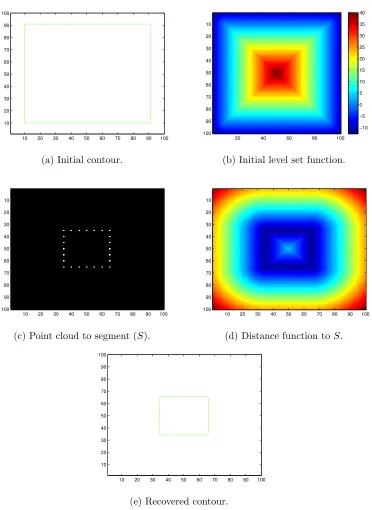
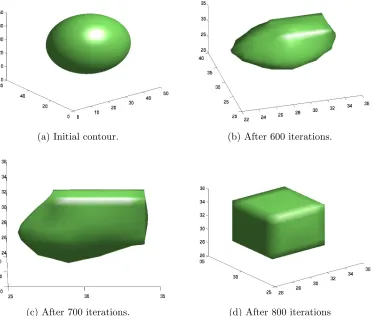
2.1 Level set segmentation of a 2D point cloud. . . 22 2.2 Level set segmentation of a 3D point cloud of a cube. . . 23
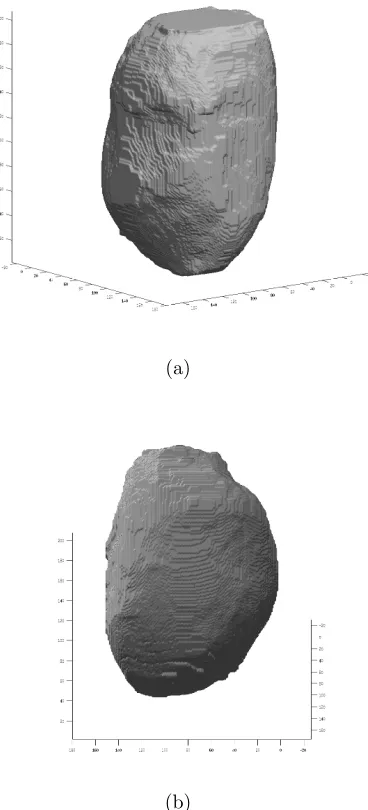
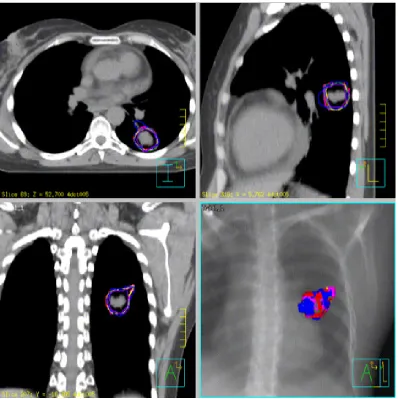
3.1 Two different views of the same segmented primary GTV. Note the top of the surface is flat and this made the volume fitting more challenging because the flux width has to be wider to ensure that the entire surface is contained. The flat top is visible in (a). . . 33 3.2 Slices of physician provided segmentations for patient E. The
GTVs on different axes are shown at top left, top right and bottom left, while the bottom right image shows the superim-posed 3D meshes for all segmentations. Top left shows a slice at
z = 52.7, top right shows slicex = 5.62 and bottom left shows slice y=−18.485. . . 34 3.3 Point cloud extracted from physician segmentations. . . 35 3.4 Approximate meshed surface for point cloud seen in Figure 3.3,
as fitted using the ball pivoting algorithm. . . 37 3.5 Normals calculated for an approximate surface. . . 38 3.6 Three different segmentations of patient 3’s nodal tumour by
different physicians. . . 43 3.7 Six segmentations of patient 3’s primary tumour by different
physicians. . . 44 3.8 Graph of volumetric overlap for gated tumours for each patient. 45 3.9 Graph of RMS distance for gated tumours for each patient. . . 45 3.10 Slices of physician provided segmentations for patient B GTV
on different axes are shown at top left, top right and bottom left, while bottom right shows the superimposed 3D meshes for all segmentations. Top left shows a slice at z = 53.400, top right shows slice x = −5.313 and bottom bottom left shows a slice aty =−17.808. . . 49
to obtain our data set. . . 52 4.2 Pairwise registration results for two scans of the Stanford Bunny.
Top row: original two views, Bottom row: results obtained us-ing Rusu et al. (FPFH) [61], Fitzgibbon (LMICP) [23], Jian and Vemuri (GMMReg) [33] and Myronenko and Song (CPD)
[49]. . . 57 4.3 Pairwise registration results two scans of the real Arabidopsis
plant data. Top row: the original two views. Bottom row: results obtained using Rusu et al. [61], Fitzgibbon [23] and Myronenko and Song [49]. . . 58 4.4 12 scans of the Arabidopsis plant, prior to registration, but with
rotation and and translation pre-applied. . . 64 4.5 12 scans captured in 30◦ increments about the plant and then
merged into a single point cloud using MNN. Shown from two viewpoints, front facing on the left and from above on the right. 65 4.6 20 synthetic scans of vascular data merged into a single point
cloud using MNN, as seen from two viewpoints, front and back. 66 4.7 MNN versus sequential pairwise registration on vascular data,
registering the first scan to each of the subsequent scans. . . . 67 4.8 MNN versus sequential pairwise registration on the plant data. 68
5.1 The Buddhapoint cloud with 5:1 ratio of noise to inliers added. 75 5.2 The Bunny point cloud with 5:1 ratio of noise to inliers added. 76 5.3 ROC curve for anisotropic filters on theBunnypoint cloud with
5:1 noise. The reachability distance/adaptive method is in red. 84 5.4 ROC curve for anisotropic filters on the Buddha point cloud
with 5:1 noise. The reachability distance/adaptive method is in red. . . 84 5.5 Buddha, filtered. The reachability distance-based filtering method
leaves almost no outliers. . . 85 5.6 The Bunny point cloud with 5:1 noise, filtered. . . 87
Chapter 1
Introduction
This thesis began its life as a theoretical work on capturing the shape of 3D
objects. To test the surface fitting method that I was working on, I began
constructing point cloud data by sampling spheres and cubes. I constructed
an approximate initial surface, evolved the shape of this surface until it fit the
points well, and recovered a good facsimile of the originally sampled surface.
Two problems arose. First, the process of evolving the surfaces requires
high precision. The surface could only be evolved extremely slowly due to the
numerical instability exhibited by the method when making large jumps in the
solution space. Second, surface evolution methods in general are notoriously
difficult to minimize when there is noise present. Any sort of perturbation
of points or the presence of outliers impacted negatively on the ability of the
method to converge.
As I tried to utilize surface evolution based methods on real problems, these
limitations became abundantly clear. The results from the depth maps that
I reconstructed from multiple images and attempted to mesh were poor due
parameteri-zation, with the surface “leaking” through gaps between points with excessive
spacing.
Similarly, my attempts to register depth maps and unorganized point
clouds using surface-based methods were filled with folly. Capturing the shape
of point clouds using statistical methods is the basis of this thesis. Whether it
is fitting watertight surfaces to tumours and quantifying their similarity,
reg-istering multiple point clouds into a single point cloud, or explicitly removing
outliers from an extremely noisy point cloud prior to meshing, the consistent
theme is that a good model is required to solve real world problems.
This thesis suggests some algorithms to help ameliorate the inherent
prob-lems surrounding shape recovery for both static and moving scenes and objects.
We deal with the recovery of non-rigid shape from both partial range scans
from multiple views and segmented point clouds from MRI data, as well as
the Stanford Bunny [71] and the Happy Buddha [39] data sets.
1.1
Contributions
The contributions of this thesis are as follows:
• A global method [10, 15] for non-rigid registration of multiple thin 3D
structures from range scans. Its efficacy is demonstrated on both
syn-thetic vascular data and real scans of a mature Arabidopsis plant. The
positions of both the leaves and the branches change from scan to scan
(as the plant rotates on a turntable underneath a ceiling fan). Our
global method utilizes the pair based algorithm of these scans based on
the Coherent Point Drift (CPD) algorithm of Myronenko and Song [49].
seg-menting tumours from MRI data. For each tumour, we construct an
approximate surface to obtain normals, we use Boykov and Lempitsky’s
[38] flux-based method for obtaining watertight surfaces, and then we
compare these surfaces using volumetric overlap estimation (VOE).
• A method [9] for filtering point clouds using variable bandwidth in
con-junction with an anisotropic kernel density filter. We filter noisy point
clouds generated from merged, noisy depth maps in a single step,
allow-ing us to fit a surface to the resultant point cloud. This algorithm is
useful for removing outliers from range scans and other noisy 3D data,
and can work as a useful preprocessing step before registration or surface
fitting.
All work herein was performed by the author, with the exception of the
pair based registrations of the Bunny and Arabidopsis, as seen in Figures 4.2,
4.3 and Table 4.1 (performed by Ayan Chaudhury) as well as the statistical
analyses seen in Figures 3.8, 3.9 and Table 3.1 (performed by Spencer Martin.)
1.2
Publications
Three journal papers (one is in submission), along with two conference papers
have been published based on this work.
1. M.A. Brophy, A. Chaudhury, S.S. Beauchemin, and J.L. Barron. A
method for global nonrigid registration of multiple thin structures. In
Proceedings of the 12th Conference on Computer and Robot Vision (CRV), pages 214 - 221. IEEE, June 2015.
for noisy point clouds in one step. In Proceedings of the Irish Machine Vision and Image Processing Conference, pages 27 – 34. August 2015. 3. A. Chaudhury, M.A. Brophy, and J.L. Barron. Junction point detection
in 3D plant point clouds using multi-modal analysis and tls
approxima-tion. In Submitted, August 25, 2015.
4. S. Martin, C. Johnson, M.A. Brophy, D.A. Palma, J.L. Barron, S.S.
Beauchemin, A.V. Louie, E. Yu, B. Yaremko, B. Ahmad, G.B.
Ro-drigues, and S. Gaede. Impact of target volume segmentation accuracy
and variability on treatment planning for 4d-ct-based non-small cell lung
cancer radiotherapy. Acta Oncologica, 54(3): 322 – 332, March 2015. 5. S. Martin, M. Brophy, G. Rodrigues, D. Palma, A. Louie, B. Yaremko,
B.A.E. Yu, S.S. Beauchemin, J.L. Barron, and S. Gaede. A proposed
framework for consensus-based lung tumour volume auto-segmentation
in four- dimensional computed tomography imaging. Physics in Medicine and Biology, 60(4):1497 - 1518, February 2015.
1.3
Overview of Thesis
This thesis deals with algorithms for constructing meshed 3D models of
ob-jects from various data sources, be it from range scans, multiple 2D images,
physician-segmented CT data, etc.
The following chapters are unified in their application to unorganized point
clouds. Chapter 2 provides a review of energy-based methods for fitting
sur-faces to point clouds, while the chapters that follow are largely for registering,
In Chapter 3, we describe our method for comparison of pairs of
unorga-nized point clouds, specifically for the comparison of tumour volumes for the
purpose of quantifying physician performance in segmenting tumours from CT
scans. We utilize Boykov and Lempitsky’s [38] method for obtaining
water-tight meshes for the tumour volumes, and perform both point-based (mutual
nearest neighbours) and volumetric (Jaccard index) to quantify the variability
of a set of physicians’ performance of lung tumour volumes over the various
breathing phases.
In Chapter 4, we present a global algorithm for drift-free alignment of
mul-tiple range scans of “thin” data into a single point cloud (suitable for further
processing, such as triangular meshing and volume calculation). We consider
two sets of non-rigid data: synthetic vascular data and real Arabidopsis plant
data. Our method builds on the coherent point drift algorithm, and aligns
multiple point clouds into a single 3D point cloud. The plant data was
ac-quired in a growth chamber, where the fan caused jittering in both the branch
and leaf data. For each scan, we construct a target scan from the centroids
of its Mutual Nearest Neighbours (MNN) in all other scans and iteratively
register to this, as opposed to registering pairwise scans sequentially. We have
have adapted MNN for use in non-rigid scenarios, producing a method that
will not degrade as more scans are registered, and produces better results than
sequential pairwise registration.
Chapter 5 describes our method for filtering very noisy point clouds. We
utilize techniques that have roots in clustering data and apply it to the
filter-ing of point clouds. The probability density function (PDF) is approximated
via a method called kernel density estimation (KDE). Our filter uses
Maha-lanobis distance, variable bandwidth and reachability distance, which gives
filter.
Finally, Chapter 6 presents the conclusions of the thesis and gives future
Chapter 2
Energy based surface
reconstruction for point clouds
With modern range sensor technology, the ability to capture high quality
struc-tural information has never been easier: obtaining an accurate depth map for
almost any opaque object is as simple as pushing a button as range scanners
and high quality stereo algorithms are available to the masses.
Despite this, many of the problems surrounding the accurate fitting of a
surface to point cloud and merging multiple point clouds into a single scan
remain difficult. Problems in this domain are often ill-posed and thus we must
provide additional constraints on our search domain in order to find a suitable
solution.
This chapter gives an overview of methods for reconstructing 3D object
models from unorganized point clouds, initially born out of a desire to solve
this problem elegantly using evolving surfaces guided by partial differential
equations. Most of our work is both discrete and statistical in nature, using
both earlier work and modern techniques.
As we mentioned above, most of the problems we solve are ill-posed, and
thus we need to understand exactly what this means and the ramifications
that this will have on our work. We begin by reviewing the fundamentals
of energy-based methods before we deal with the details of surface fitting.
Discrete, graph cut-based methods and continuous total variation methods
are the state of the art. However the utilization of flux, curvature and shape
priors that began with level sets is also illuminating.
Though this is a review of 3D methods, we’ll often introduce and illustrate
methods via 2D image segmentation, as this is where this work is rooted.
In short, though 2D and 3D (MRI or CT, for example) image segmentation
involves segmenting dense intensity data instead of sparse binary data, the
techniques for performing either one have influenced techniques for performing
the other. In short, understanding image segmentation is core to obtaining a
2.1
Preliminaries: Minimization, Smoothing
and Segmentation
Many problems in Computer Vision are intricately tied: an optimal solution of
one problem often provides meaningful insight into other seemingly unrelated
problems. Most vision problems of interest areill-posed, and thus require some sort of restriction in terms of the solution space of its parameters in order to
find a good solution. This is true of fitting a surface to a scattered set of points
[3], where there are an infinite number of surfaces that fit said points [27].
As shown in the sections that follow, these constraints often involve finding
optimally denoised, diffused or smoothed regions to avoid getting stuck in
local minima while propagating a contour. One desires the solution space of a
function to be strict in terms of its shape: Ideally, a function ismonotonically
or strictlyincreasing, resulting in a convex orsemi-convex space to search for the minimum.
When a solution space u is convex or semi-convex, one can guarantee a
global minimum will be obtained via gradient descent. In one dimension, such
a solution space will resemble a parabola while in two dimensions the solution
space resembles a paraboloid. The direction of the step is the one of steepest descent, so such a scheme is guaranteed to find a global minimum since the “steepest” path will eventually lead to a minimal value. This method of energy
minimization is extremely common in Computer Vision and can be found using
level sets. Level sets are the subject of Section 2.2.
The idea behind the piecewise-smooth Mumford-Shah functional [48] was
to provide both a smooth approximation u of an image I, and a partitioning
notion: One imagines that the segmentation of an image that obtains the
maximal smoothness for each area would result in very good separation of
objects that exist in the image. The functional, given by Brox and Cremers
[11]:
E(u, K) =
Z
Ω
(u−I)2dx+λ
Z
Ω−K
|∇|∇u|2dx+v|K| (2.1)
operates on the image I : Ω→R with domain Ω⊂R2 and seeks the edge set
Kthat partitions functionuinto smooth sections, whereuis an approximation
of I. Thus, K segments Ω into n (which is unknown prior to minimization)
disjoint regions, Ω1···n. The functional seeks both the optimaluand the optimal K. v ≥0 and λ≥0 are weighting parameters.
As pointed out by Brox and Cremers [11], Mumford and Shah [48] wrote
nearly 100 pages of theory without ever suggesting how one would actually
find a minimizer of Equation (2.1) or its simplified (piecewise-constant) form,
the latter of which is obtained when λ→ ∞ as:
E(u, K) = X
i
Z
Ωi
(ui−I)2dx+vo|K|, (2.2)
wherev0 is the re-scaled version of v, and each ui is now a single value, as
op-posed to in Equation (2.1), where it was a function. In other words, the image
is approximated by a piecewise constant function, as opposed to a piecewise
2.2
Level Sets and Snakes
Kass et al.’s [36] seminal paper on snakes in the late 80’s served as a source
of inspiration for a huge body of work that includes geodesic active contours,
active contours without edges, etc. Variational methods like snakes are still
applied to problems in image segmentation, stereo, multiview reconstruction,
and more recently to multi-region segmentation.
The original formulation of snakes evolved a contour according to a
com-bination of image forces and external constraint forces
E(C) =α
Z 1
0
|C0(q)2dq+β
Z 1
0
|C00(q)|2dq−λ Z 1
0
|∇I(C(q))|dq (2.3)
where C is a curve that is parameterized by q, yielding a point in R2. In the original implementation, a term was included to allow for user interactivity
to avoid the contours tendency to get stuck in local minima. The first two
terms (α and β) control the first- and second-order smoothness of the
con-tour’s internal energy. The first-order term makes the snake behave like a
“membrane”, while the second-order term makes it act like a “thin plate” [36].
The attractiveness of the contour to edges (the external energy) is controlled
by λ. This external force ensures that a local minimum is found at an image
edge, while the internal force ensures piecewise smoothness of the contour.
This energy is then converted to its Euler-Lagrange equation and solved
via gradient descent. The success of such a scheme is highly dependent on a
good initialization, however. As was noted by Kass et al. [36], the contour
2.2.1
Geodesic Active Contours
Caselles et al.’s [14] scheme for image segmentation, while inspired by snakes,
was based on curve evolution via mean curvature and geometric flows, not
energy minimization. Their method involved contour propagation
(deforma-tion) according to a velocity function defined in terms of curve regularity and
closeness to a boundary. By embedding an evolving contour C into a level
set formulation, the representation of C is both implicit and parameter free.
Further, different topologies can be captured by the zero level set, and thus
contours are able to split and join without requiring any sort of heuristics,
a definite improvement on the original snakes implementation. Multi-object
segmentation may be performed without knowing the number of objects in
advance.
Caselles et al.’s functional:
EGAC(C) =
Z L(C)
0
g(|∇I0(C(s))|)ds, (2.4)
the so-calledgeodesic active contour, removes the parameterization of the curve
C that was present in Equation (2.3). It is replaced with the total Euclidean
length of the curve, L(C), as defined by the Euclidean element of length, ds.
The boundary function:
g(|∇I0|) =
1 1 +β|∇I0|2
, (2.5)
is essentially an edge detector with a weighting function β. The
minimizer of Equation (2.4):
∂tC= (κg− h∇g,N i)N,
or in level set form as:
∂tφ =
κg+h∇g, ∇φ
|∇φ|i
, (2.6)
where the evolving curve C is embedded as the zero level set of φ such that
C(t) ={x∈RN|φ(x, t) = 0}.
2.3
Graph Cuts
For many vision problems that can be approximated by level sets, graph cuts
can find a global minimum for many binary labeling problems as well as a
good approximation for multi-labeling problems. Instead of evolving a surface
based on forces related to topology, weighted by the data, solving problems
with graph cuts instead involves solving problems by finding a way to embed
them on an appropriate graph, performing various modifications and then
finding a minimum cut along the edges of the graph. Graph cuts came to
prominence for image segmentation, specifically for separating a foreground
object from its background. This is a classic binary labeling problem, solving
the same problem as Chan-Vese did in Equation (2.15).
A graph is built with two types of links, t-links (to terminal nodes) and n
-links (to neighbouring nodes). The nodes typically represent a discrete grid. In
the case of an image, each pixel would have a node, and it would have n-links
etc. A node will also have a t-link to either an s- or t-node, i.e., a source or
a sink. The assignment of these nodes depends on initialization strategy, and
will change based on the strong moves that are performed during optimization.
Prior to finding the max-flow/min-cut, the labels for nodes are found using
α-expansion and α–β-swap.
In iterative α-expansion, any subset of pixels can be changed to a label
α that is fixed; the algorithm goes through each possible label until no more
improvements can be made. At each step, a region Pα can only expand. α
-expansion allows, for a selected labelαto change any node’s label toα, so long
as it decreases the total energy of the min-cut. Likewise, a α–β-swap allows
for any two labels to be swapped so long as they decrease the total energy of
the min cut.
Graph cuts energies typically have both a data and a smoothness term. A
data term might be intensity if the graph represents an image, or a distance
function if a set of points has been discretized and embedded on a graph for
the purpose of segmentation. If the smoothness term is metric then we use
α-expansion, otherwise, we use α–β-swap.
The smoothness term is specifically for penalizing discontinuities between
neighbouring points. In other words, it penalizes differing labels that
neigh-bour one another.
2.3.1
Multiview Graph Cuts
Vogiatzis et al. [74] construct a dense graph from photo-consistency values,
which is different from fitting surfaces to point clouds, but They use graph cuts
a voxel. The weights between two nodes is
wij =
4πh2
3 ρ
xi+xj
2
(2.7)
wherexi andxj are connected voxels, andρ(·) is a photo-consistency /
match-ing function. A balloonmatch-ing force wb = λh3 connects each point to the sink,
while the voxels on the perimeter of the volume have value ∞.
Sormann et al. [66] take a set of depth maps and construct a signed distance
function for each, which are then combined. They dilate the zero level set to
form a watertight “crust” band, and calculate the confidence at each voxel
from an unsigned distance function using the method of Hornung and Kobbert
[29], who find the minimum cut of the unsigned distance function around a
“dilated” crust of input points, the output of which is a closed / watertight
surface. They perform volumetric diffusion on the unsigned distance function.
The use of unsigned distance removes the need for orientation data and is more
robust to noise. The points are placed / rasterized on the grid and then an
unsigned dilation operator is utilized.
The diffusion simply happens iteratively over a 6-neighbourhood until all
non-empty voxels v on the grid are 6-connected.
φ(v) = 1
|N(v)|+ 1 φ(v) + Σu∈N(v)φ(u)
, (2.8)
with the constraint that φ(v) remains zero for all initial sparse surface
points. The number of diffusion steps is not overly important, in fact, even
2.4
Total Variation
Total variation, for a continuous signal is computed as integral of the absolute
gradient, or for a discrete signal, as V(u) = P
n|∇u|. Total variation lessens
oscillations, but allows for discontinuities. It is used as a regularization term.
As was noted above, the success of the geodesic active contour model is
also contingent on a good initialization due to the presence of local minima in
the solution space. Bresson et al. [24] unified the Rudin, Osher and Fatemi
(ROF) model
EROF(u, λ) =
Z
Ω
|∇u|dx+λ
Z
Ω
(u−f)2dx, (2.9)
with the geodesic active contour model [7]. The ROF model denoises images
while preserving edges. Instead of embedding the contour as the zero level set
of a higher-order function, they instead chose to iteratively minimize an energy
u and segment the result using some threshold µ ∈ [0,1], typically chosen to
be µ >0.5.
Bresson et al. replaced the total variation norm in Equation (2.9) with
their own weighted total variation norm T Vg(u), with the previously-defined
weight function, g(x). This weighted norm
T Vg(u) =g
Z
Ω
|∇u|dx (2.10)
introduces a link between the ROF model and the geodesic active contour
functional from Equation (2.4). When one sets the input u of the weighted
active contour
T Vg(u= 1ΩC) =
Z
Ω
g(x)|∇1ΩC|dx (2.11)
=
Z
C
g(x)ds =EGAC(C). (2.12)
Note that the gradient of the characteristic function is the boundary of the
closed region, ∂Ω. Thus, the only values integrated over are the diffusivities g
values on the boundary C, ∂Ω.
They also replaced the L2-norm with theL1-norm, noting that in the
regu-larization process, the disappearing of features is determined entirely in terms
of geometric characteristics, specifically the area and length of the contours
and not contrast (as it is when using the L2-norm).
Their non-strictly convex energy functional
EGGAC(u, λ) =
Z
Ω
g(x)|∇u|dx+λ
Z
Ω
|u−f|dx,
is very similar to the ROF model. Using the calculus of variations, one obtains
a partial differential equation
∂u
∂t =gdiv
∇u
|∇u|
+<∇g, ∇u
|∇u| >+λ
u−f
|u−f|,
from which the resultant energy u is thresholded, and a global minimum is
obtained. This is proved in Bresson et al.’s [7] appendix.
2.4.1
Total Variation Surface Reconstruction
In addition to creating a solver for the Chan Vese functional, Jian et al. [34]
Zach et al. [76] utilize the total variation (TV)|∇u|introduced by Rudin et
al. [24] on robust range image integration. They minimize an energy functional
consisting of both the TV term for regularization and an L1 data term for data
fidelity. Their energy function is fairly straightforward
E =
Z
|∇u|+λΣi∈I(x)wi|u−fi| dx. (2.13)
2.5
Chan-Vese: Active Contours without Edges
Chan and Vese [73] proposed to solve the segmentation problem posed by
the piecewise-constant Mumford-Shah functional by further simplifying the
problem to a two-phase segmentation. While active contours rely heavily on a
strong gradient separating the foreground and background of the image, Chan
and Vese find a boundary that minimizes both the interior pixels’ variance
from the interior mean, and the exterior pixels’ variance from the exterior
mean. To define these regions, they utilize the Heaviside function
H(φ) =
1 φ ≥0
0 φ <0
(2.14)
Contour C is embedded as the zero level set of a 3D function φ. Their
func-tional
ECV(φ, c1, c2) = Z
Ω
{H(φ)(I(w)−c1)2+ (1−H(φ))(I(w)−c2)2+λ|∇H(φ)|}dw,
(2.15)
attempts to find the best approximation ofI as a pair of unconnected regions
mean values of I in the interior and exterior, and are formally defined as
c1 =
R
I(x)H(φ)dx
R
H(φ)dx (2.16)
c2 =
R
I(x)(1−H(φ))dx
R
(1−H(φ))dx . (2.17)
In practise, both the Heaviside function and the Dirac function are
regu-larized [73]. Using these regularizations in Equation (2.15) and computing the
subsequent Euler-Lagrange equations results in a PDE
∂φ
∂t =δε(φ)(λin(I(x)−cin)
2−λ
out(I(x)−cout)2+µ) in Ω ∂φ
∂n = 0 on ∂Ω
φ=φ0 in Ω,
where ∂φ∂n is the partial derivative of φ in the direction of the outward normal
to the boundary ∂Ω.
Chan Vese suffers from the fact that it is highly dependent on its
initializa-tion. Like snakes, the model is not convex – it suffers from being a two valued
function [26].
2.5.1
Shape Priors in Level Set Formulations
When most objects are projected onto a 2D plane, their resultant 2d
bound-aries vary depending on the orientation of the plane with respect to the object.
Therefore, when using a shape prior, it is necessary to estimate the projective
transformation parameters along with the best fit of the shape prior.
set formulation by generating a signed distance function from a pre-defined
2D contour. They defined equivalence between two objects of equal shape by their contours Ω1,Ω2 ⊂R2 by their signed distance functions φ1, φ2
φ2(x, y) = rφ1
(x−a) cosθ+ (y−b) sinθ
r ,
−(x−a) sinθ+ (y−b) cosθ r
,
noting a unique solution to |∇φ|= 1, constrained by
φ =
>0 x∈Ω\∂Ω
= 0 x∈∂Ω
<0 x∈R2\Ω
, (2.18)
where (a, b) is the centre of φ2, and r and θ are the scaling factor and angle
of rotation, respectively. One can generate an object’s equivalent shapes by
choosing different values for (a, b, r, θ).
Chan and Zhu added a shape prior to the Chan-Vese functional (2.15)
ECV+SP(φ) = ECV(φ) +Eshape(φ),
where
Eshape(φ) =
Z
Ω
(H(φ)−H(ψ0))2dydx.
Instead of only iteratively solving for ∂φ∂t, one iterates back and forth between
solving for ∂φ∂t and the gradient descents for the shape priors transformational
2.6
Segmentation of Point Clouds with Level
Sets
Once a set of disparity maps have been calculated and perspectively projected
into a 3D volume, a surface can be evolved to fit the points using the convection
method of Zhao et al. [79]. This is demonstrated on a sparse 2D point cloud
in Figure 2.1, although the evolution equation used:
∂φ
∂t =∇d(x)· ∇φ+d(x)∇ ·
∇φ
|∇φ|, (2.19)
is different than the one used by Zhao et al. [79] in that it incorporates mean
curvature in the regularization.
2.7
Flux-based Functionals
Unlike Zhao et al. [79] who utilize distance from sparse surface points,
Savad-jiev et al. [62] reconstruct the surface by utilizing a field of vectors that are
normal to the surface. They assume that for the points in a small
neighbour-hood there exists a surface that the points have been sampled from. They
find normals and smooth them based on local curvature, and then solve for
the flux. Flux takes a vector field as input and produces a scalar which is
essentially the amount of flow through a unit area of a surface. A minimizer
for the functional
f lux(t) =
Z 1
0
< V, N >||Cp||dp=
Z L(t)
0
10 20 30 40 50 60 70 80 90 100 10 20 30 40 50 60 70 80 90 100
(a) Initial contour.
20 40 60 80 100
10 20 30 40 50 60 70 80 90 100 −10 −5 0 5 10 15 20 25 30 35 40
(b) Initial level set function.
10 20 30 40 50 60 70 80 90 100 10 20 30 40 50 60 70 80 90 100
(c) Point cloud to segment (S).
10 20 30 40 50 60 70 80 90 100 10 20 30 40 50 60 70 80 90 100
(d) Distance function toS.
10 20 30 40 50 60 70 80 90 100 10 20 30 40 50 60 70 80 90 100
(e) Recovered contour.
(a) Initial contour. (b) After 600 iterations.
(c) After 700 iterations. (d) After 800 iterations
is found using level sets as described in 2.2. The normal vector field of a
level set φ isN =δφ/|δφ|. The point cloud to which we wish to fit a surface
has normal information for each point, but a dense field is required to evolve
the level set. A box filter is used obtain F but propagate smoothed normal
information. F drives surface evolution towards the points
φt+F φ= 0. (2.21)
The idea of using flux for segmentation was introduced by Vasilevskiy and
Siddiqi [72] and applied to 2D and 3D MRA images of blood vessels. They
take an image I and compute the flux by using its gradient ∇I as the vector
field V, wishing to maximize the flux through its boundary, which is either a curve or a surface.
2.7.1
Continuous Global Optimization
Pan and Skala [52] start with a set of points with weak orientation data (like
[38]) and use total variation to measure the smoothness of function
Es =
Z Z Z
S
|∇f(x, y, z)|dxdydz (2.22)
where | · | is the L1 norm. A smaller norm indicates a more smooth function,
which a larger norm means the space is less smooth.
They use flux for their data term. A vector fieldF approximates the normal
directions via a smoothing filter. They designEdsuch that the gradient of the
implicit function is best aligned with this vector field
Ed=
Z
Ω
i.e. the optimal dot product between ∇f and F is zero.
2.7.2
Global Minimization for Shape Fitting
Lempitsky and Boykov [38] build on both graph cuts and Savadjiev et al.’s
[62] functional. They choose to solve for a sparse set of normals where only
weak orientation data is necessary. They too utilize a flux-based functional
max←−S
Z
S
< vs, ns > ds, (2.24)
though they solve for a thin band around the discretized points on the grid,
which is expanded as as needed using their TouchExpand [38] algorithm. Neighbouring nodes are connected via n-links, these represent the
regu-larizing term. The data term is represented by t-links, where nodes with
potentials greater than zero U(p)> 0 are connected to the source and nodes
with potentials less than zeroU(p)<0 are connected to the sink.
2.7.3
Power Watersheds
Couprie et al. [20] also use a graph based solution to find a solution to the
total variation problem mentioned above, specifically looking for the solution
u to
min
u∈[0,1] Z
Ω
w(z)p|∇u(z)|qdz, (2.25)
subject to u(z) = 0∀z ∈ Ωin and u(z) = 1∀z ∈ Ωout, where Ωin is the set
of labels inside of the surface and Ωout is the outside set. They construct a
graph G of edges (E) and nodes (V), discretizing the points on the grid and
Each unlabeled sub-graph with maximal weight is merged into a single
point, and then for each plateau (a maximal set of connected edges with
iden-tical weight), we look in the neighbourhood of each node and assign the node
the value
min
x
X
eij inE
wijp|xi−xj|q (2.26)
s.t.x(F) = 1, x(B) = 0. (2.27)
where
wij = min(dP(i), dP(j)),
and dP(·) is the distance between the nearest point in the set of all nodes P.
The power watersheds algorithm looks for a labeling xx of G, which is
initialized with seed labelsx(B) andx(F) on some points.
The algorithm is evaluated by iteratively finding an unlabeled node with
maximal weight, and then finding the maximal sub-graph of edges with equal
weight.
If this graph contains nodes with a known label then we find the surface
label based on minimizing Equation (2.26). Otherwise, all nodes are merged
and we find the next unlabeled node with maximal weight. Like Boykov and
Lempitsky [38], the power watershed algorithm can operate in a thin band,
which they define as the subset of the grid where the thresholded distance
2.8
Summary of Methods
The previous sections provided an overview of energy based methods for
sur-face fitting to point clouds. Some of the reviewed algorithms are in 2D space,
but the problems in 2D and 3D are extremely similar, and many of the 3D
algorithms described above were inspired by the 2D algorithms mentioned.
Graph cut based methods have proved to be extremely effective for 3D
surface fitting, as have TV methods. Surfaces constructed using graph cuts
will have small metrification artifacts [5], and level sets based methods will
often get stuck in local minima. TV methods lack metrification artifacts, but
are difficult to implement when compared with graph cuts. Both are great
Chapter 3
A Method for Quantitative
Comparison of 4D-CT Lung
Tumour Segmentations
3.1
Introduction
Internal imaging techniques have made it possible to develop treatments that
are minimally invasive. It is, however, incredibly difficult for an oncologist
to accurately determine the boundaries of a tumour; there is huge variability
among a group of oncologists’ segmentations of a tumour in a single patient.
Inter-observer variability is the biggest source of uncertainty in treatment
plan-ning in radiotherapy [31]. We wish to quantify treatment variability based on
target volume segmentation both prior to and following radiotherapy planning
stages. The gross tumour volume (GTV) is the portion of the tumour that can
be imaged: its volume does not necessarily contain the entirety of tumuorous
four-dimensional computed tomography (4D-CT) is complicated by tumour motion
during the breathing cycle. Oncologists therefore provide segmentations at ten
breathing phases (0%,10%,· · · ,90%) to ensure that dosages will be applied
to the entirety of the tumour. These respiratory phases each represent a
per-centage of full inspiration.
In addition, tumours are “gated”, which essentially means that some
ad-justment for the tumour’s position between these breathing phases is accounted
for using some type of motion tracking. Generating a 4D-CT usually involves
combining multiple 3D-CTs at various phases of the breathing cycle.
There has been substantial research into auto-segmentation of target
vol-umes from 4D-CT, but currently the most effective method is to segment the
gross tumour volume (GTV) on each CT data set (i.e. each respiratory phase),
which we then combine these to form a single integrated gross tumour volume
(IGTV). To account for low contrast and/or unseen areas of disease, the
mar-gin of this volume is expanded by 5-10mm. We refer to this larger volume as
the clinical target volume (CTV); it is the area that we wish to treat.
Finally, a similar and related term is the planned treatment volume (PTV).
The PTV’s purpose is to address the fact that uncertainties exist in both the
planning and delivery of radiographic treatment. The dose may be distributed
unevenly, and likewise, there areas of the body for which exposure to radiation
would have severe effects, and thus the PTV must factor these things in as
well. These are referred to as organs at risk (OR) [12].
The data we utilize are unorganized point clouds, segmented tumours from
CT data; it is not intensity data. We start with the points that each physician
specified as the boundaries on each slice in the CT data. The CT scans and
segmentations were obtained at the London Regional Cancer Program. The
contributors, and are present to help explain the larger significance of the
work.
We contribute a method for computing a similarity measure for the
volu-metric comparison of sparse point clouds of tumours as segmented from CT
data (as well as the actual computation of volumetric overlap and
distance-based error) for the compared point clouds in the data set.
3.2
Background
For reasons we described in Chapter 2, we rely on Lempitsky and Boykov’s
[38] flux-based method for providing a globally optimal surface for each point
cloud. Their method solves for a sparse set of normals where only weak
ori-entation data is necessary. They rasterize the points onto a dense 3D volume
and solve their functional on a thin band surrounding the points, using the
Touch Expand algorithm. Touch Expand is an algorithm for solving max-flow
problems on a graph with source and sink arcs.
The surface fitting function
max←−S
Z
S
< vs, ns> ds (3.1)
uses normals and the surface velocity and is specifically for the circumstance
when perfect data is available. That is obviously not the case here, and thus
the elastic membrane prior is utilized. We want to compute
min←−S
Z
S
λds−
Z
S
< v, ns> ds. (3.2)
s and the sink t. We then have non-terminal nodes p ∈ P, each of which represents a voxel and is connected to its neighbouring nodes via n-links and
terminal links of the form (s, p) and (p, t), as was explained in Section 2.3.
Neighbouring nodes are connected via n-links, these represent the
regu-larizing term. The data term is represented by t-links, where nodes with
potentials greater than zero U(p)> 0 are connected to the source and nodes
with potentials less than zeroU(p)<0 are connected to the sink.
We also utilize the method’s closed topology, which works by extending
the boundary of the dense grid in each dimension and setting the boundary
points’ t-links to a large, negative value.
The sparse vector field {¯vi|p¯i ∈ P} is blurred by the width of the flux’s
diffuse radius, a parameter set prior to run-time. In practice, a box filter is
used to perform thisntimes, wheren is a preset parameter. The result of this
blurring is to obtain a semi-dense field ¯vp = ΣNi=1¯vpi. These vectors are a set
of semi-dense averaged normals, obtained by applying said box filter to sparse
normals.
3.3
Problem
The method by which physicians segment a dense 4d image to produce a 3D
point cloud, outlining the perimeter of 2D slices, produces a set of points that
incompletely describes the surface. Specifically, the segmentation is performed
by a physician in an application called Pinnacle Treatment Planning System
[67]. On the periphery of each dimension, the edge is implied, i.e., in one
slice there will be a segmentation performed, and then in the adjacent slice
there won’t be. In some cases, the segmentation in the next-to-last slice will
current process of segmentation, not a problem with a physician failing to do
their job.
Given sparse and incomplete data, as we see on the top of Figure 3.1a, how
do we compare the difference between two point clouds in a meaningful way?
This makes using volumetric methods for comparison difficult. Similarly, using
point based methods don’t solve this problem either; we have large swaths
which are implied parts of the tumour that also need to be quantified.
3.4
Methodology
Ten patients with Non-Small Cell Lung Cancer (NSCLC) were imaged
us-ing 4d-CT usus-ing a Big Bore CT scanner, along with the Real-time Position
Management (RPM) system for gating. The 4d data has x, y, z and intensity
values, where thez-axis is the coronal plane, the x-axis is the sagittal plane,
the y-axis is the axial plane and their units are in millimetres (mm). RPM
in-volves having markers placed on the patient’s abdomen or chest, and tracking
these markers using an infrared camera. Using this, the images are generated
at the breathing phases and correspond to one another, both for a patient’s
images captured at different phases, and other patients’ images captured at
the same phase [46].
Thus, 10 4D-CT images are generated for each patient, an example of
which can be seen in Figure 3.2 A 4D-CT can be thought of as a “stack”
of intensity images: a loaf of multi-coloured bread is an apt comparison. A
physician takes each of these “slices” for a single breathing phase, and must
identify the interior of the tumour for this slice from the exterior, typically
with a mouse by clicking around the boundary of the tumour. In addition
(a)
(b)
is inter-observer variation [31] – it is also a highly time consuming task, as a
single 4D-CT image often has more than 100 slices.
3.5
Point Cloud Construction
Each 2D point (xi, yi) is combined with itszs, the height (i.e. slice)
measure-ment, and these points are collected to make a single point cloud, an example
of which is seen in Figure 3.3. The larger goal of this work is to determine the
efficacy of treatment, but the technical goal is to deliver a method that can
consistently measure how well the treatment is administered, i.e. how much
overlap there is between the tumour and the treated area.
3.5.1
Surface Fitting
The nature of the point clouds combined with our need for a watertight surface
created a significant challenge in providing an accurate surface fitting. If one
thinks about the slices of a 3D-CT, the “top” of the tumour will typically be
quite wide in terms of the segmentation. The other points are generally fairly
evenly-spaced, but the top and bottom often have a large gap and this makes
getting a “tight” fitting surface a problem. To generate accurate, automated
and watertight segmentations for almost 1000 images is a challenge.
The flux based surface fitting method requires approximate orientation
data for computing the max-flow/min-cut. It is, as they note, acceptable to
use a single normal for all points in a single range scan. We do not have the
benefit of such orientation information, so we first fit an approximate surface
and then find vertex normals based on this surface.
Our C++ application (trimesh normal) that imported each of these files sequentially first constructed an approximate surface mesh to get a field of
normal vectors that is approximates the true field. We used the ball pivoting
algorithm to first fit the approximate surface, and then compute the normals
using said surface. Our application uses VCGLIB’s [18] routines for ball
pivot-ing, normal estimation and orientation, and TouchExpand [38] for watertight
surface fitting.
Ball pivoting is an advancing front algorithm [1]. A “seed” point is selected,
and two neighbours are searched for such that they can be circumscribed in the
radius of the ball with an empty interior. If such a pair of vertices are found,
a triangle is created [22]. The ball is then pivoted, i.e. it is rotated around the
edge until it circumscribes another point, forming another triangle. In the case
Figure 3.4: Approximate meshed surface for point cloud seen in Figure 3.3, as fitted using the ball pivoting algorithm.
edge is chosen. This process is continued until all edges have been traversed,
at which point a new seed triangle is found [1].
The ball pivoting algorithm is uses a sphere of radius r (in our caser = 1)
and “rolls” it over the point cloud, adding a triangle (i.e. edges and a surface)
if the ball contains three points only. In Figure 3.4 we see the approximate
sur-face fit after ball pivoting has been applied, which we then utilize to compute
Figure 3.5: Normals calculated for an approximate surface.
3.5.2
Computing Normals
We first calculate the per face normals for our newly-constructed mesh. For
each triangle with vertices p1, p2, p3, we calculate vector u = p1 − p2 and
v = p3 −p1, then the normal n = u×v. The choice of variable assignment
determines the orientation of the normal, i.e., whether it points inward or
outward, so we wind the normals subsequently.
We then normalize the lengths of these normals and utilize them to compute
the normal for each vertex. We use equally weighted averaging of facets, i.e.
nv||
P3
i=1ni, where nv is a vertex normal and || implies parallelism and thus
subsequent normalization, i.e. nv =nv|nnvv|, we borrow this notation from [35].
As we said above, the computed normals’ orientation is strictly based on
they are pointing outward, an example of such a field can be seen in Figure
3.5.
Computing accurate surfaces for each patient ended up being heavily
com-putationally expensive. Computing almost 1000 watertight, globally optimal
surfaces is expensive, and one of our requirements was that the resultant 3D
volumes are comparable. Our bounding box encapsulated every point, but
also had a boundary at the maximum and minimum of each dimension, as
TouchExpand needs sufficient space around a voxel to approximate the energy
using neighbouring voxels: when neighbouring points are boundaries, we
expe-rienced trouble with convergence. We settled on a grid size of 150×150×150,
which is quite large and resulted in expensive surface computations, but given
that the bounding box encapsulatedalltumours, it was necessary to have high resolution since in practice some tumour volumes would only be occupying a
small amount of the bounding box.
There was an element of trial and error in generating a set of terms that
could accurately capture an appropriate surface for our entire set of point
clouds. In practice it was very easy to tell when a surface was not watertight:
when we computed the volumetric overlap [28] whereEo is zero when overlap
is perfect, and one when no overlap exists.
3.5.3
Minimal Surface Fitting to Segmented Point Cloud
As we discussed in Chapter 2, we use the minimal surface as a guiding principle
for our surface fitting: we wish to obtain the surface with a volume that
encapsulates the points to which we are trying to fit the surface. In the
preliminaries, we mentioned that this idea was introduced to the vision world
minima due to the level sets implementation.
Instead, we use a graph cuts-based method, specifically the flux-based
method as introduced by Boykov and Lempitsky [38]. Again, as we
men-tioned in the introduction, graph cuts-based methods promise to provide a
global minimizer for the proposed functional.
From the ball pivoting algorithm, we now have a mesh, comprised of faces
with normals, from which we generate vertex normals. We then rasterize our
vertices onto a discrete grid and compute the flux for these points.
For our purposes, we used TouchExpand with a topology constraint (closed
surface) with a larger diffuse radius for the flux (df = 2, versus the default of
df = 1), as well as an extra iteration. This is to ensure that we can guarantee
a closed surface.
The result of TouchExpand is a binary, dense 3D volume where the inside
of the point cloud is marked by 1’s and the outside by 0’s. Given our problem
of computing volumetric overlap, this is convenient, as we can compute Eo
directly by just iterating over all points.
We performed a cursory visual inspection of each generated mesh to
en-sure a watertight result, however, our method could easily detect when we
lacked convergence, i.e. a closed surface. If the volumetric overlap was less
than a reasonable threshold (generally 70%), it was usually obvious that
trimesh normal surfhad failed to obtain a watertight surface for one (or both) of the point clouds. While each tumour had been segmented by eight doctors,
3.6
Similarity Quantification
We chose the method of Lempitsky and Boykov [38] after our evaluation of
many methods, as seen in Chapter 2, primarily because it solves both our core
problems. Surface evolution methods and local methods cannot guarantee
finding a global minimum when fitting a watertight surface to a point cloud.
Their TouchExpand library is freely available and has an optional shape prior
for closed surfaces.
Definition 3.6.1 (Volumetric Overlap). For two watertight surfacesS andG
that exist on the same grid structure, if all occupied voxelssi are occupied by
Gand all voxelsgi are occupied byS, we say that a perfect volumetric overlap
(V OE = 0) occurs
More specifically, the volumetric overlap is
Eo(S, G) = 1−(|S∩G|)/(|S∪G|). (3.3)
We use Eo, a.k.a. the Jaccard index because, as we point out in [46],
usingR2 error is disproportionately punishing as distance increases between a source and target. Moreover, the numbers aren’t comparable between tumours
of largely varying sizes: we wish to know how well the physician performed
independent of the size of the tumour.
Definition 3.6.2 (Nearest Neighbour of xand Y). For a pointx, the nearest
neighbour in a set of points Y = {y1,· · · , yn} is the point yi with minimum
Euclidean distance from x, i.e.
N N(x, Y) = minp(x−yi)2,∀yi ∈Y .
Definition 3.6.3 (Nearest Neighbours of X and Y). For a set of points X,
the nearest neighbours of a set of points Y is a set such that N N(X, Y) =
N N(xj, Y)∀xj ∈X .
Definition 3.6.4 (Symmetric Nearest Neighbour). For two sets of points X
and Y, two pointsxm and yn are considered symmetric (i.e. mutual) nearest
neighbours ifynis the nearest neighbour ofxm andynis the nearest neighbour
of xm.
In practice, we store our point clouds in kdtrees to improve the complexity
of computing nearest neighbour options, which we use to compute the
sym-metric RM S−E, which is the RM S−E for symmetric nearest neighbours.
3.7
Results
As we see in Figure 3.10, segmentations of patient B’s GTV will vary greatly
among physicians. Each colour represents a different physician’s segmentation.
In the top left and bottom left of Figure 3.10, we see a large difference on
the y-axis; each physician has a very different view of what does and does not
encompass the tumour. Indeed, the reconstructions shown in the bottom right
of Figure 3.10 (each has a different colour), are extremely different from one
another.
This, in fact, is a moderate variation. Figures 3.6 and 3.7 show how
dra-matically different a set of physicians’ interpretation of what does and does
not constitute a tumour can be in both primary and nodal data.
For the VOE of the primary IGTV, the combined GTVs from all 10
breath-ing phases, in terms of observer (intra-patient) we saw a large variation.
(a)
(b)
(c)
(a) (b)
(c) (d)
(e) (f)
Figure 3.8: Graph of volumetric overlap for gated tumours for each patient.
(9.0± .6) to (35.6±7.5) and in nodal tumours (16.4±.5) to (29.1±4.1).
We saw inter-patient σ from 0.6% to 13.2% for primary tumours and from
1.5% to 13.1% for nodal tumours. For symmetric RMS distances
(individ-ual results can be seen in Figure 3.9), we saw (3.4±.4)mm to (7.8±.8)mm
for primary IGTVs with standard deviations in the range (0.2mm,1.2mm).
The nodal IGTVs had mean observer RMS symmetric distances ranging from
(4.1±.8)mm to (6.5±.7)mm with σ ranging from 0.2mm to 3.2mm. Note
that RMS is a distance but VOE is a ratio, hence the lack of a unit in the
former.
The symmetric RMS distances are affected by the size of the tumour
vol-ume, and the nodes are smaller than the primary volume. It is also
substan-tially more difficult to accurately segment the nodal volumes, parsubstan-tially because
nodes tend to exist in low contrast areas.
Both lymph nodes can be affected, in which case there will be more than
one nodal volume. The process of constructing an initial, approximate
sur-face, calculating surface normals and then utilizing [38] handles this constraint
effectively, utilizing the same parameters as those used for the GTV to ensure
that comparisons are fair.
For each of the hundreds of segmented point clouds, our method
success-fully fit a watertight figure, some examples of which can be seen in Figures 3.1.
This required an element of trial and error, as it was necessary to find
param-eters that would avoid smoothing out contours and still maintain a watertight
surface. Our results demonstrate a clear trend, so in addition to guarantees
that TouchExpand provides in terms of optimality, we can feel confident that
it successfully captures an accurately modeled, representative shape.
The COVs (coefficient of variation) of physician segmentations of both the
Table 3.1: Coefficient of Variation for VOE.
Two patients did not have nodal tumours, but of the five of the eight who did,
the COVs of nodal IGTVs were larger than the primary IGTVs, though for
patient D, the primary GTV has a very large COV (93.25%). Overall, both
nodal and primary GTV segmentations tend to have very high COVs.
3.8
Conclusions and Future Work
One clear conclusion from our research is that there is a high degree of variation
among physicians’ interpretations of what is and is not tumourous growth and
thus their resultant segmentations and dose distributions are highly variable.
This is true of both primary and nodal tumours, and though nodal tumour
performance is more variable, both suffer from the same problem to a large
degree.
Advancements in technology have brought about improved target
localiza-tion via gating of imaged data, as well as methods to more effectively target
tumours with radiation. The process of segmentation remains error prone;
performance of physicians and help ensure that patients are being given
ap-propriate dosages.
Because the human cost is so high, experimentation is limited. The data set
that we have produced here was hugely time consuming to compile, meanwhile,
limited human and physical capital within the health-care system is the norm.
Any steps toward automation and standardization will be a huge win, and the
method presented is a step in that direction.
We would like, in future work, to perform a similar analysis on different
types of tumours, in hopes of obtaining a quantitative measure of what types
Chapter 4
Global Registration of Multiple
Thin Structures
Building a 3D model is extremely useful for many practical applications where
inferring measurements about the shape or size of an object is a
require-ment. With the rapid acceleration of hardware capability in terms of CPU
power, storage and 3D scanners, we can now capture huge amounts of data
and the fidelity of the resultant models is constrained by the quality of
merg-ing/reconstruction algorithms. Due to recent advancements of robotic
tech-nologies and low cost laser scanners, building real time automated systems
is becoming possible for plant science and agricultural applications, where a
major task is to build a 3D model of the plant to analyze different biological
properties (like growth, etc.). However, the complex recursive structure of
a plant makes the problem of aligning multiple views extremely hard, unlike
building a 3D model of a rigid object like Stanford bunny. Also in medical
robotics, automatic analysis of medical images is a crucial step. A common