Available Online atwww.ijcsmc.com
International Journal of Computer Science and Mobile Computing
A Monthly Journal of Computer Science and Information Technology
ISSN 2320–088X
IJCSMC, Vol. 4, Issue. 2, February 2015, pg.144 – 148
RESEARCH ARTICLE
Prediction of Link and Path for User’s Web
Browsing Using Markov Model
Anand Charpate, Chetan Bramhankar, Prashant Gaikawad, A.D.Londhe
Dept. of Computer Engg., Pune University, India
[email protected] [email protected] [email protected]
[email protected]
Abstract-- World Wide Web is a huge storehouse of web pages and links. It offers large quantity of data for the Interne users. The growth of web is incredible as around one million pages are added per day. Users’ accesses are recorded in weblogs. Web usage mining is a kind of mining techniques in logs[1].Because of the remarkable usage, the log files are growing at a faster rate and the size is becoming very large. This leads to the difficulty for mining the usage log according to the needs. This provides a vast field for the researchers to provide their suggestion to develop a better mining technique. In this paper, we analyze and study Markov model and all-Kth Markov model in Web prediction[2]. We propose a new modified Markov model to alleviate the issue of scalability in the number of paths. In addition, we present a new two-tier prediction framework that creates an example classifier EC, based on the training examples and the generated classifiers. We show that such framework can improve the prediction time without compromising prediction accuracy[5]. We have used standard benchmark data sets to analyze, compare, and demonstrate the effectiveness of our techniques using variations of Markov models and association rule mining. Our experiments show the effectiveness of our modified Markov model in reducing the number of paths without compromising accuracy. Additionally, the results support our analysis conclusions that accuracy improves with higher orders of all-Kth model.
Key words— All-Kth Markov model ,web mining, Markov model
I. INTRODUCTION
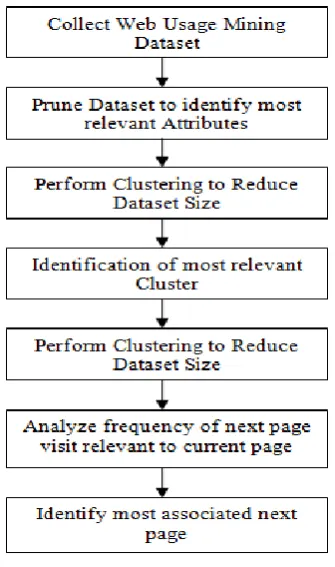
applications. Therefore, it is crucial to look for scalable and practical solutions that improve both training and prediction processes. Improving the prediction process can reduce the user’s access times while browsing, and it can ease network traffic by avoiding visiting unnecessary pages. When a user is reading his current accessed page, the next predicted page is loaded into the user cache memory. It decreases the loading time for next page access at user end so that the web page retrieval efficiency will be improved[7]. The concept of web page prediction is the application comes under the web page mining along with data mining. When the page access is performed, it comes under the web content mining to locate and load the predicted page into the cache. When the history of the web server is collected in the form of user web usage history and presented in the form of web pages. Once the information database gets available, the next work is to perform the data mining operations to prediction. But generally, the size of this kind of datasets is quite large, because of this to reduce the dataset size, some clustering process is required. The clustering can be static session based clustering or an intelligent clustering using some analytical approach. Once the clustering is performed, the identification of the appropriate cluster is performed to that relates the user existence[4]. This identified cluster is selected as the working dataset based on which the prediction is performed. The prediction process is basically to identify the frequency of next visiting pages in relevancy to the current page. Once the prediction analysis is performed, the association identification is performed to identify most associated next page. This page is then selected as the next predicted web page. In this paper we did literature survey on “Users‟ future request prediction – Web Usage Mining”. The various methods have been proposed on this work and this paper highlights about the various techniques advantages & limitations. The prediction process is basically to identify the frequency of next visiting pages in relevancy to the current page. Once the prediction analysis is performed, the association identification is performed to identify most associated next page. This page is then selected as the next predicted web page. The basic structural model of this working process is shown in figure 1.
Figure 1 : Basic Structure of Web Page Prediction
In this paper, an improved web page prediction model is presented. The presented work is the improved with the association of three main concepts: markov model, vague rules and the association mining. Markov model will work as the intelligent prediction approach that will be filtered at two different levels using vague rules. Vague will define the intelligent rule set by performing the dataset analysis. At the later stage, the association mining will be implemented to perform the web page prediction for the caching.
II. LITERATURE SURVEY
previous and historic path data are predicted then it is referred as path based prediction. Point-based prediction is based on user’s current actions. Markov model by means of the anticipation-Maximization algorithm where they detachment locate punter by means of a replica-based bunch move toward. They displayed the paths for users with each cluster after partitioning the users into clusters, Our work is not a model based but space based and we worn Markov replica for forecast rather than clustering. In another paper the authors construct Markov models from log files and they use co-citation and coupling similarities for measuring the conceptual relationships between Web pages that coalesce two Markov replica and cluster process methodology for mesh page connection forecast. To Cluster conceptually related pages Citation Cluster algorithm is then proposed.
III. MOTIVATION AND RELATED WORK
Millions of users access web sites in all over the world. When they access a websites, a large amount of data generated in log files which is very important because many times user repeatedly access the same type of web pages and the record is maintained in log files[1]. These series can be considered as a web access pattern which is helpful to find out the user behavior. Through this behavior information, we can find out the accurate user next request prediction that can reduce the browsing time of web pages. In recent years, there has been an increasing number of research works done with regard to web usage mining „ Future request prediction‟. The main motivation of this survey is to know the what research has been done on Web usage mining in future request prediction. The wide usage of the Internet in various fields has increased the automatic extraction of the log data from the web sites. The usage of data mining techniques on the data collected from the web helps us pattern selection, which acts as a traditional way of decision-making tools. Web usage mining is the application of the data mining techniques on the web-collected data, which is already present in the form of various patterns. Web usage mining is presented on secondary data such as (user name, ip address, date and time, their type of browsers used, type of URL used to view the site etc.) which is deduced from the interactions of the users in between the web sessions.
IV. PROPOSED MODEL
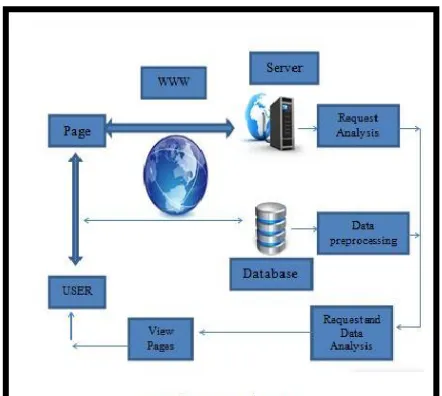
Figure 2 :Proposed System Architecture
V. Markov Model
The basic concept of Markov model is to predict the next action depending on the result of previous actions. In Web prediction, the next action corresponds to predicting the next page to be visited. The previous actions correspond to the previous pages that have already been visited. In Web prediction, the Kth-order Markov model is the probability that a user will visit the kth page provided that she has visited the ordered k – 1 pages For example, in the second-order Markov model, prediction of the next Web page is computed based only on the two Web pages previously visited. The main advantages of Markov model are its efficiency and performance in terms of model building and prediction time. It can be easily shown that building the kth order of Markov model is linear with the size of the training set . The key idea is to use an efficient data structure such as hash tables to build and keep track of each pattern along its probability. Prediction is performed in constant time because the running time of accessing an entry in a hash table is constant. Note that a specific order of Markov model cannot predict for a session that was not observed in the training set since such session will have zero probability.
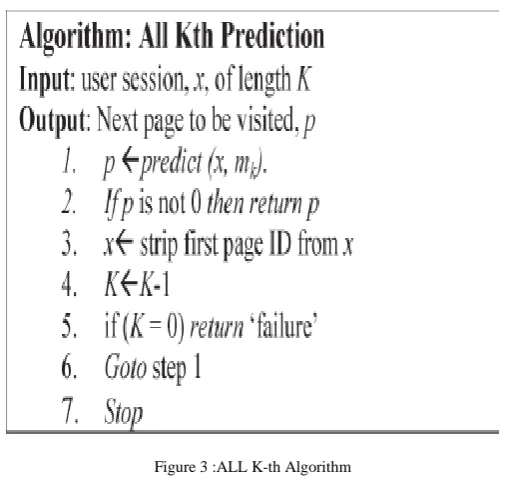
All-Kth Markov Model
Figure 3 :ALL K-th Algorithm
VI. CONCLUSION
The paper gives a brief literature survey of research field in web user browsing prediction. The higher order markov model is suited and found to be best for methodology to implement. The frame work included the concept of variable length markov model and page rank , page rank concept may be used when the website is newly launched and the weblog is not sufficiently created so page rank may be used to predict the page and it may be also used when the ambiguity will arrived in the markov model.
ACKNOWLEDGEMENT
We would like to express our deep sense of gratitude to express our gratitude and sincere thanks to our Head of Department Pr of. V. N.
NANDGAONKAR and Project Guide Prof. A.D.LONDHE for their assistance in solving various difficulties. The acknowledgement will be
incomplete if we do not record our sense of gratitude to our Principal, Dr. C. L. PRABHUNE who gave us necessary guidance,
encouragement by providing us with all facility available to work on project.
REFERENCES
[1] Dembczynski, K., Kotłowski, W., Sydow, M.: Effective Prediction of Web User Behaviour with User-Level Models, 2007.
[2] M. Awad, L. Khan, and B. Thuraisingham, “Predicting WWW surfing using multiple evidence combination,” VLDB J., vol. 17, no. 3, pp. 401–417, May 2008.
[3] Marcelo Maia, Jussara Almeida, and Virg ılioAlmeida . Identifying user behavior in online social networks. In Proceedings of the 1st Workshop on Social Network Systems ,Social Nets’08,pages1–6, NewYork, NY, USA, 2008. ACM.
[4] M. T. Hassan, K. N. Junejo, and A. Karim, “Learning and predicting key Web navigation patterns using Bayesian models,” in Proc. Int. Conf. Comput. Sci. Appl. II, Seoul, Korea, 2009, pp. 877–887.
[5] HAUGER, D., PARAMYTHIS, A., AND WEIBELZAHL, S. 2011. Using browser interaction data to determine page reading behavior. In Proceedings of the 19th International Conference on User Modelling, adaption, and Personalization (UMAP).147–158
[6] LEIVA, L. A. 2011. Mining the browsing context: Discovering interaction profiles via behavioral clustering. In Adjunct Proceedings of the 19th Conference on User Modeling, Adaptation, and Personalization (UMAP) . 31–33