Scholarship@Western
Scholarship@Western
Electronic Thesis and Dissertation Repository
3-2-2017 12:00 AM
Developing Predictive Models of Driver Behaviour for the Design
Developing Predictive Models of Driver Behaviour for the Design
of Advanced Driving Assistance Systems
of Advanced Driving Assistance Systems
Seyed Mohsen Zabihi
The University of Western Ontario
Supervisor
Dr. Steven Beauchemin
The University of Western Ontario Graduate Program in Computer Science
A thesis submitted in partial fulfillment of the requirements for the degree in Doctor of Philosophy
© Seyed Mohsen Zabihi 2017
Follow this and additional works at: https://ir.lib.uwo.ca/etd
Part of the Artificial Intelligence and Robotics Commons
Recommended Citation Recommended Citation
Zabihi, Seyed Mohsen, "Developing Predictive Models of Driver Behaviour for the Design of Advanced Driving Assistance Systems" (2017). Electronic Thesis and Dissertation Repository. 4431.
https://ir.lib.uwo.ca/etd/4431
This Dissertation/Thesis is brought to you for free and open access by Scholarship@Western. It has been accepted for inclusion in Electronic Thesis and Dissertation Repository by an authorized administrator of
World-wide injuries in vehicle accidents have been on the rise in recent years, mainly due to driver error. The main objective of this research is to develop a predictive system for driving maneuvers by analyzing the cognitive behavior (cephalo-ocular) and the driving behavior of the driver (how the ve-hicle is being driven). Advanced Driving Assistance Systems (ADAS) include different driving functions, such as vehicle parking, lane departure warning, blind spot detection, and so on. While much research has been performed on developing automated co-driver systems, little attention has been paid to the fact that the driver plays an important role in driving events. Therefore, it is crucial to monitor events and factors that directly concern the driver. As a goal, we perform a quantitative and qualitative analysis of driver behavior to find its relationship with driver intentionality and driving-related actions. We have designed and developed an instrumented vehicle (RoadLAB) that is able to record several synchronized streams of data, including the surrounding environment of the driver, vehicle functions and driver cephalo-ocular behav-ior, such as gaze/head information. We subsequently analyze and study the behavior of several drivers to find out if there is a meaningful relation between driver behavior and the next driving maneuver.
Foremost, I would like to express my sincere gratitude to my supervisor,
Dr. Steven Beauchemin, for the continuous support of my Ph.D study and
research, for his patience, motivation, enthusiasm, and immense knowledge.
His guidance helped me in all the time of research and writing of this thesis.
I could not have imagined having a better advisor and mentor for my Ph.D
study.
Besides my advisor, I would like to thank the rest of my thesis
commit-tee: Dr. Robert Laganiere, Dr. Ken McIsaac, Dr. John Barron, and Dr.
Marc Moreno Maza, for their encouragement, insightful comments, and hard
questions.
I would like to thank my fellow labmates in RoadLAB: Jamal and Junaed,
for the stimulating discussions, and for all the fun we have had in the last few
years.
I would also like to express my gratitude to my parents, for supporting me
spiritually throughout my life.
Finally, I must acknowledge my wife and best friend, Azadeh, without
whose love, encouragement and patience, I would not have finished this thesis.
ABSTRACT i
ACKNOWLEDGEMENTS ii
CONTENTS iii
LIST OF TABLES vi
LIST OF FIGURES vii
1 Introduction 1
1.1 Literature Survey . . . 2
1.1.1 Driver modeling . . . 3
1.1.2 Driver models focusing on the driver . . . 4
1.1.3 Advanced driver assistance systems . . . 5
Driver information systems . . . 6
Comfort systems . . . 6
Semiautonomous systems . . . 7
Autonomous systems . . . 8
1.1.4 Driver maneuver prediction . . . 8
Driving maneuvers . . . 8
Maneuver prediction models . . . 10
1.2 Research Overview . . . 12
1.2.1 Primary Conjecture . . . 12
1.2.2 Hypotheses . . . 13
1.2.3 Methodology . . . 14
1.3 Contributions . . . 18
1.4 Thesis Organization . . . 19
2.1.1 Context . . . 31
2.1.2 Background . . . 32
2.2 Literature Survey . . . 33
2.3 Proposed Method . . . 34
2.3.1 Hypothesis Generation . . . 36
2.3.2 Hypothesis Verification . . . 39
2.4 Experimental Results . . . 40
2.5 Conclusion . . . 42
3
Traffic Signs Detection and Recognition
47
3.1 Introduction . . . 483.2 Literature Survey . . . 49
3.3 Proposed Method . . . 51
3.3.1 Gaze Localization . . . 51
3.3.2 Detection Phase . . . 54
3.3.3 Recognition Phase . . . 55
3.4 Experimental Results . . . 60
3.5 Conclusion . . . 62
4
Vehicle Localization
70
4.1 Introduction . . . 704.2 Literature Survey . . . 73
4.3 Proposed Method . . . 75
4.3.1 Modelling Observed Road Lanes . . . 75
4.3.2 Localization by Particle Filtering . . . 76
Ground Plane Estimation . . . 77
Lanes feature detection . . . 79
GPS Correction . . . 79
4.4 Experimental Results . . . 83
4.5 Conclusion . . . 85
5
Driving Manoeuvre Prediction
91
5.1 Introduction . . . 925.2 Literature Survey . . . 93
5.3 Proposed Method . . . 96
5.3.1 Modelling Driver Manoeuvres Using IO-HMM . . . 97 5.3.2 Cephalo-Ocular Behaviour and Vehicle Dynamics Features 98
5.4.2 Prediction Procedure . . . 101 5.5 Experimental Results . . . 102 5.6 Conclusion . . . 105
6 Conclusion and Future Work 110
6.1 Future Work . . . 111
BIBLIOGRAPHY 113
1.1 Classification of driving maneuvers provided by [47]
and [43]. . . 9
2.1 Detection rates and false positives per frame for different views and vehicles . . . 41
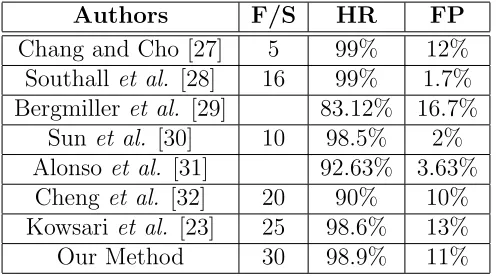
2.2 Comparison on frame rates, hit rates, and false pos-itives for various methods . . . 42
3.1 Detection Rate and False Positive Rate per Frame 61 3.2 Accuracy Rate of Recognition Phase. . . 61
4.1 Results of vehicle positioning absolute errors in world coordinate system. . . 85
4.2 Results of vehicle orientation absolute errors. . . 85
5.1 Description of Driving Sequences Used For Experi-ments. . . 100
5.2 Results of driving manoeuvres prediction on our data set. . . 103
1.1 Activation chain of a Collision Warning / Collision Mitigation
system. . . 7
1.2 Vehicular instrumentation configuration in RoadLAB. . . 15
1.3 A description of the DEV parametrization within software layers . 17 2.1 Vehicular instrumentation configuration. a) (top-left): In-vehicle non-contact infra-red binocular gaze tracking system. b): Forward scene stereo imaging system mounted on the roof of the vehicle. . . 35
2.2 (top): A depiction of the driver attentional gaze cone. It is generally accepted that the radius of the cone is approximately 13◦ [1] and (bottom): reprojection of 3D attentional circle onto the 2D ellipsoid on image plane of the forward stereo scene system. . . 35
2.3 (left): Estimated horizon lines and (right): their correspond-ing depth maps. . . 36
2.4 Displays of various LoGs, PoGs, and attentional gaze areas projected onto the forward stereo scene system of the vehicle. . . 39
2.5 A depiction of Haar-like features. . . 40
2.6 Detection results within the RoI, including false positives and negatives. 40 2.7 ROC curve obtained from experiments. . . 41
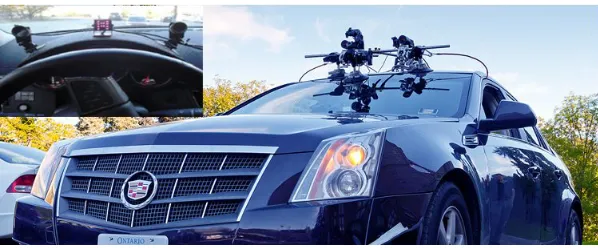
3.1 Physical configuration of the experimental vehicle with the exter-nal stereo cameras mounted on the roof. The dashboard-mounted eye tracker is displayed in the top-left part of the image.. . . . 50
3.2 Attentional gaze areas projected onto the forward stereo system of the vehicle. . . 52
3.3 (top): Positive samples (bottom): Average image. . . 53
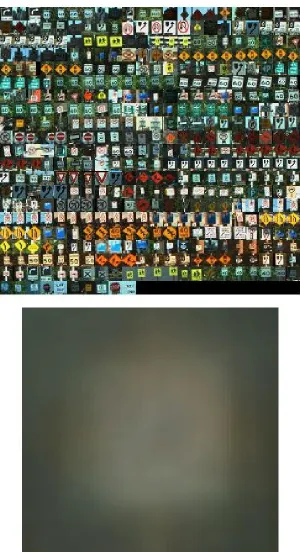
3.4 An Illustration of Hard Negative Mining. . . 56
3.5 Examples of template signs. . . 56
3.7 DOG scale space images(left): template sign(right): detected
sign. . . 58
3.8 Detection and recognition results a) (top): SEEN SIGNS b) (bottom): MISSED SIGNS. . . 61
3.9 The ROC curve resulting from our experiments. . . 63
3.10 The Confusion Matrix resulting from our experiments . . . 63
4.1 Overview of the proposed vehicle localization approach . . . 75
4.2 a) (left): Lane features detected by Algorithm 1 b) (right): Projected lane splines on the image . . . 80
4.3 a) (left): The path covered by the experimental vehicle. b) (right): Images obtained by the map building application show-ing splines as lane markers. The green spline indicates the mid-dle of lanes. . . 84
4.4 Vehicle positional and orientational errors. The horizontal axis is quantified in frames. . . 84
5.1 (top): Our Vehicular instrumentation configuration. (bot-tom): Anticipating the probabilities of different driving ma-noeuvres using vehicle dynamics and driver cephalo-ocular be-haviour. . . 93
5.2 Overview of the proposed approach for predicting driving ma-noeuvres.. . . 97
5.3 IO-HMM Layers: The model includes a Hidden Layer, rep-resenting the driver’s state; an Output Layer, reprep-resenting fea-tures related to driver cephalo-ocular behaviour; and an Input Layer representing features related to vehicle dynamics. . . 97
5.4 Gaze points are shown on driving images 5 seconds before a left turn, going straight, and a right turn. Images are divided into six regions.. . . 98
5.5 Our data set. . . 100
5.6 Confusion matrices for our prediction model. . . 104
5.7 The plot shows the impact of prediction threshold on F1-score for IO-HMM G+H. . . 105
Chapter 1
Introduction
Safety in urban and rural driving is becoming an issue of growing concern
since the number of vehicles and also vehicle accidents are increasing
consider-ably. To overcome this issue, a variety of Advanced Driver Assistance Systems
(ADAS), such as collision avoidance systems, speed control and warning
sys-tems, have been developed to assist in performing the complex driving task.
These systems should pay attention to the important role of the human driver
as a main element in most driving events and take into consideration all the
fac-tors that may concern the driver of the vehicle. Undoubtedly, improving these
safety systems is a very important goal for the vehicle industry and
govern-ments in providing safer and more comfortable driving. These improvegovern-ments
can reduce the amount and severity of vehicle accidence as well as improve
vehicle manufacturers’ reputations with respect to vehicle safety. We describe
the current literature in the areas of driver modeling and Driver maneuver
1.1
Literature Survey
A variety of driving assistance systems have been proposed in recent years and
could profit from information related to the driver of the vehicle. Some systems
analyze driver behavior to realize the driver’s intentions in diverse driving
situations. Especially in the area of safe driving, the driver and his behavior
can demonstrate the driver’s intentions. Most vehicle collisions are due to
human errors caused by the driver (or drivers). An in-depth study of vehicle
collisions carried out in the US in 1999 shows that distracted or inattentive
drivers are the cause of more than 70% of the rear-end collisions recorded each
year in the US [67]. This finding is backed by results from the ’Naturalistic
Driving Study’, a large field study conducted in the USA [41], which states that
about 80% of collisions are due to distraction. It is obvious that distractions
caused by recent in-vehicle devices, such as GPS maps, entertainment systems
and mobile telephones, increase a driver’s accident risk [57].
Almost every driver has experienced a warning from a passenger, perhaps
alerting him or her to prevent an accident with another vehicle or a pedestrian.
An intelligent ADAS (i-ADAS) is also trying to work as a co-driver to prevent
these accidents by warning the driver or even taking control of the vehicle. It is
actually a computer system inside a vehicle that can collaborate with the driver
to manage the driving tasks. Detecting the state of the driver (his behavior)
and the vehicle (environment), could hence provide valuable information for
the system in assisting the driver effectively in different situations.
The main questions in this area are how and what kind of information about
the driver could be used in the optimization of driver assistance systems. The
field of research engaged in describing the driver and his driving behavior is
1.1.1
Driver modeling
Driver modeling, as the name suggests, tries to model driver behavior in
driv-ing situations. Driver modeldriv-ing is a very broad field and much work has been
done in a variety of research areas for the past 60 years. Pl¨ochl and Edelmann
[45] provide an overview of different driving models. They divided the models
into four categories, which to some extent can also be seen as a temporal
devel-opment of the field of driver modeling, fueled by increasing vehicle complexity
and computational power:
1. Focus on the vehicle. the vehicle is the main goal of these models.
In this case, the driver model usually serves as part of the closed loop
testing of vehicle performance under various driving conditions.
2. Focus on the driver. In this case the driver is the target. This includes
efforts to model aspects, such as driving style or psychological states
while driving, such as stress or distraction.
3. Focus on the vehicle/driver combination. It is a combination of
the two previous areas i.e. the interaction between driver and vehicle.
4. Focus on the environment/traffic. These models simulate traffic
conditions. The main goal is to understand how certain traffic situations
emerge and how undesirable ones can be prevented.
In this work, we concentrate on the driver and his behavior to develop a
predictive model of driver’s intentionality and maneuvers. For this reason, the
1.1.2
Driver models focusing on the driver
The goal of this section is describing driver modeling in the context of this
work. Pl¨ochl and Edelmann [45] divide the research area interested in the
understanding of human driving behavior into two groups:
• Understanding driver and (individual) driver behavior
• Path and speed planning, optimized driver/driving behavior
The first group is related to modeling how we drive a vehicle. The main goal
is to figure out how a driver does maneuvers. Driver behavior can be predicted
by knowing how a driver acts in certain driving tasks, such as turning, lane
changing and overtaking a vehicle. Chandler et al. [12] implemented a
vehicle-following model and used data from experiments with real vehicles to set the
model’s parameters. Ioannou [21] implemented an Adaptive Cruise Control
(ACC) system and compared it to three different human driver models. The
results showed that the ACC system was able to provide a safer driving. A
hybrid three-layered ACC system based on fuzzy logic and neural network has
been implemented by Germann in 1995 [14].
Some other maneuvers have been also studied: emergency braking ([53],[52]),
lane change ([38], [30]), and turning at intersections ([13],[11]). Predicting the
driver’s intention could provide valuable information in the context of ADAS,
as will be discussed later.
A number of methods have been implemented for assessing the driver’s
sleepiness. Most of them utilize some features in the driver’s face through
video cameras and use eye [10],[42],[24], eyelid [10],[51] or head movements [25],
[10],[24] to infer sleepiness. A few indirect algorithms, usually using steering
It is shown that distraction is one of the main factors in driving
acci-dents. Accordingly, detecting that a driver is distracted can be very helpful
and prevent some dangerous accidents. As mentioned before, the ’Naturalistic
Driving Study’ concluded that about 80% of collisions were caused by
distrac-tion. Some work has been done on detecting the driver’s distraction by a video
camera capturing the driver’s upper body [17],[56],[31]. Cell-phone usage [49]
and the on-board information systems, such as radio or GPS [60] may cause
distraction.
The second group is related to more complicated maneuvers on a larger
timescale than single maneuvers. At this level, driver model is formed based
on a series of single maneuvers. For example, overtaking a vehicle consisting
not only changing lanes to pass a preceding vehicle, but joining the original
lane afterwards. Some methods have been presented in this context to predict
the driver’s intent [29],[55].
1.1.3
Advanced driver assistance systems
Advanced driver assistance systems (ADAS), which is the main target of driver
modeling, are proposed to provide safety for drivers in different driving
situ-ations. We give an overview of ADAS systems in this section in order to
understand the relationship between driver modeling and these systems.
These systems may use a variety of information, including the vehicle itself
(the vehicles velocity, signals, steering angle, etc.), a navigation system or
sensors that detect obstacles in the environment. For a systematic overview,
this large number of systems can divide to four groups [7]:
• Driver information systems
• Semiautonomous systems
• Autonomous systems
These groups will be explained in more detail, describing the current
avail-able systems in each group.
Driver information systems
Driver information systems present required information to the driver in
driv-ing scenes by auditory and/or visual equipment. Some systems, such as Lane
Departure Warning (LDW) or Collision Warning (CW) fall into this group.
LDW systems warns the driver if the vehicle is changing the current lane.
These systems work based on the detection of the lane, which can be
per-formed by evaluating data from video or infrared sensors monitoring the front
view of the vehicle. Nowadays, plenty of vehicle manufacturers offer a LDW
system or the more complex Lane Keeping Assist (LKA) system. The goal of
CW systems is to inform the driver in the matter of an approaching accident.
This driver information is usually the first in a chain of assistance systems,
ending up in a automatic operation of the vehicles brake regarding a failure in
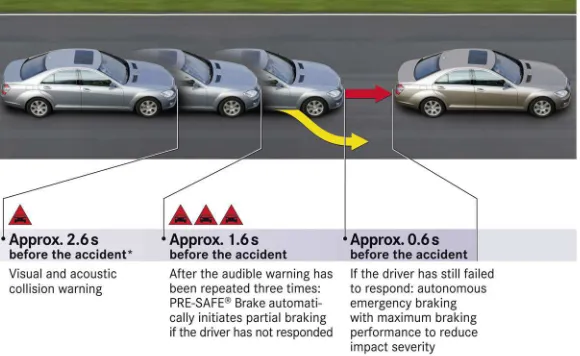
the response from the driver. Fig. 1.1 depicts a current available case for such
a chain published by Mercedes Benz1 in 2008. Both could profit from models
describing the driver and his behavior.
Comfort systems
Comfort systems assist the driver in the case of commonplace driving tasks
by taking control of some parts of vehicle. Some systems in this group are
1http://www.emercedesbenz.com/Nov08/12 001507 Mercedes Benz TecDay
Figure 1.1: Activation chain of a Collision Warning / Collision Mitigation system.
ACC, Lane Keeping Assist (LKA) or Active Steering (AS). ACC is well known
among the systems which are used in numerous vehicles. This system adjusts
the vehicle velocity according to the current traffic and the distance from
preceding vehicles. LKA systems employ a small force on the steering wheel
to delay or prevent the lane crossing.
Semiautonomous systems
Semi-autonomous systems help the driver in performing complicated
maneu-vers by controling the vehicle in some cases. Drimaneu-vers make the last decision and
take control of the vehicle in these systems in contrary to the autonomous
sys-tems that take control of the system and provide vehicle’s safety in some
situa-tions. Intelligent Park Assist (IPA) system is an instance for semi-autonomous
Autonomous systems
Autonomous systems, as the name indicates, take control of the vehicle in
specific situations without help from the driver. These systems carry the
full responsibility for their actions, so they need to be very specific about
the current situation and the state of the vehicle. The goal of autonomous
systems is, one day, to design a fully autonomous vehicle and provide safety
in all driving situations.
The Antilock Braking System (ABS) was the first assistance system used
in commercial vehicles1. This system makes the vehicle stay on track during
a braking maneuver, even under adverse conditions, such as icy or wet roads.
This is done by adjusting the hydraulic brake pressure at each wheel (or front
and rear wheels) separately.
1.1.4
Driver maneuver prediction
Predicting driving maneuvers is the main goal of driver modeling in advanced
driver assistance systems.
Driving maneuvers
A specific move or series of moves in driving will be called a maneuver. Driving
maneuvers can be defined based on traffic and road infrastructure [7]. Reichart
[47] and Tolle [62] classified the driving maneuvers, which are listed in Table
1.1. These two classifications are almost similar at some level of granularity
with just minor differnces. The proposed maneuvers are enough to do any
urban or rural trip as well as driving on highways. The other maneuver
clas-sifications are proposed in different contexts are almost similar to the ones
showed here. For example, Okuno et al. [43] discuss diverse maneuvers taken
place on highways.
Table 1.1: Classification of driving maneuvers provided by [47] and [43]
Reichart T¨olle
Follow lane Start
React to obstacle Follow Turn at intersection Approach vehicle
Cross intersection Overtake vehicle Turn into street Cross intersection
Change lane Change lane Turn around Turn at intersection Drive backwards Drive backwards
Choose velocity Park
Follow vehicle
To model the behavior of a driver accurately, it is necessary to go one
step further since people may do the same maneuvers differently in different
situations, according to the level of granularity. Therefore, the maneuvers
should be partitioned based on, for example, direction (left turn vs. right turn)
or region (a lane change in a city vs. one on highways). Other factors, such as
weather conditions, traffic flow, number of lanes and etc. can be considered.
Therefore, a maneuver is a tactical driving task, such as stopping at a traffic
light, changing the lane or turning at an intersection. These maneuvers can
be differentiated by the situational factors, such as type of road, speed limit,
number of lanes and the existence of other vehicles, pedestrians, traffic signs
Maneuver prediction models
After defining a driving maneuver, we should determine what a driver model
is to be developed to predict the maneuvers. Predicting driving maneuvers
involves creating a model of human behavior, so it is a challenging task. A
large number of internal and environmental factors can affect human behavior
[7]. These factors include emotional factors, such as stress and anger,
physi-cal characteristics, environmental conditions, such as bad weather and traffic
conditions, distraction, driving skills and so on. Building an effective and
complete model based on all these factors is difficult and also impossible in
practice. In fact, the proposed methods in the literature have used a subset of
above factors. A hybrid driver model has been described in [26] that is able to
predict driver behavior. The proposed model is based on visual and
vestibu-lar information so that control both the lateral and longitudinal motions of a
vehicle.
The driver behavior models can be grouped into two categories [7]. The
first is the cognitive driver model, which is based on human psychological
be-haviors. These models pay attention to, for example, mental and attentional
features that a driver shows in performing different maneuvers. The models in
the next category which are called behaviorist driver models and they utilize
information in the surrounding environment of the driver, including vehicles,
pedestrians and the the other objects on road. The most cited methods in
this literature are based on one of these two categories and it is clear that
each group of these models has its own deficiencies. Evidently, a combination
of information in both categories can be more helpful and practical in
under-standing driver behavior and predicting the most probable next maneuver.
processing, such as memory and visual information. The psychological factors
can be incorporated in cognitive driver behavior modeling include distraction,
reaction time, body strength, vision, impairment (stress, fatigue, alcohol, etc.)
and so on [20]. Metari et al. [39] analyzed the cephalo-ocular behavior of
drivers in vehicle/road events, such as overtaking and crossing an
intersec-tion. This is specially concerned with finding the relationship between vision
behavior of older drivers and their actions in road events. They posited the
cephalo-ocular information can be related to the driving maneuvers a driver
decides to make. Some other researchers have also tested the impact of eye
movements on control of actions in everyday events, such as driving [32], [34].
Analysis of driver behavior in a cognitive architecture is very important
for determining the motivation behind making a special decision in a driving
event [48]. For example, when a driver decides to make a left or right turn,
visual information can show that he looks at the mirrors, blind spots, traffic
and so on. So, a faster and safer action can be chosen or offered by an ADAS to
assist the driver during driving. Baumann and Krems [8] model the situation
awareness of a driver in a cognitive architecture.
Despite the fact that cognitive behaviors specifically model visual
informa-tion, such as gaze tracking, what are important for predicting driver behavior,
little research has been done in this domain. The main reason that these
models have not received much attentions could be the complexity that the
systems have in measuring and providing cognitive behavior information.
On the other hand, behaviorist driver models try to find how the driver
in-teracts with his surrounding environment including the other vehicles and also
his vehicle parts, such as the brake and the accelerator pedals, the turn
sig-nals and the steering wheel. Modern vehicles are already equipped with some
systems [1] for detecting distance, lidar systems [36] for obstacle detection,
visual systems [66] for road objects detection and vehicle navigation systems,
such as GPS [35] have been used in advanced driving assistance systems.
1.2
Research Overview
The main objective in this research is to develop predictive models of driver
behavior for the design of advanced automated driving assistance systems for
road vehicles. The automated co-driver, as an intelligent system, would be
able to alert the driver about an unseen object, such as a vehicle, pedestrian,
or any other obstacle, or even take control of the vehicle in some cases when
the driver is momentarily incapacitated. The Advanced Driver Assistance
System (ADAS) should understand the driver’s behavior and intent in different
situations sufficiently enough to determine what is the most probable next
maneuver and intervene if necessary.
ADAS needs to receive information from the vehicle, road, and environment
to put the behavior of the driver in context. Therefore, the system should
locate the road ahead of the vehicle, pedestrians and obstacles as well as
monitor the behavior of the driver. Developing models of driver intentionality
prediction based on such information may lead to advances in providing
safety-related vehicular technologies and accident prevention strategies.
1.2.1
Primary Conjecture
Studies of driver behavior models have shown drivers’ intentionality can be
determined from various perspectives. Advanced driver assistance systems
effective solution may be the one that monitors and analyzes driver
behav-ior in order to prevent unsafe maneuvers [16]. Eyes play an important role
in detecting driver’s intentionality since the driver looks directly at objects
and chooses an action based on the information provided by the fixation [6].
According to observations, we believe correlating visual behavior (gaze
infor-mation, saccades, etc.) and driver environment state (vehicles, pedestrians,
traffic signs, etc.) can yield a predictive model of driver behavior.
1.2.2
Hypotheses
It is believed that human error is the primary factor in most vehicle
acci-dents [64]. Consequently, we focus on some hypotheses from which the short
term goals of this proposal are derived from the primary conjecture. Towards
this aim, we break down the main conjecture into hypotheses which can be
investigated effectively and practically:
1. Driver intentionality and driving actions can be predicted partly by
Cephalo-ocular behavior: Driving actions may be involved with complex
cephalo-ocular behaviors. It is clear that cephalo-ocular behavior cannot directly predict
all driving actions since vehicle functions (such as velocity, steering wheel
angle, turning signals) and current driving actions should be taken into
consideration. Therefore, both current actions and ocular behaviors may
be predictive of the next driving action.
2. Objects detected within the attentional visual area of drivers can reveal a
driver’s intent: The attentional visual area of drivers is a central part of
safe driving. The probability of unsafe lane departure and vehicle
[33]. As a matter of fact, objects detected in the visual field of a driver
may have an impact on driver intent. However, every visual fixation
does not mean the driver is paying attention to the event carefully since
long fixation may be synonymous with distraction in some cases. Shinar
[54] posited that certain ocular patterns, such as fixation with regular
saccades (eye movements), demonstrate visual attention which mostly
reveals driver intent. Therefore, it is essential to analyze relevant and
meaningful cephalo-ocular behaviors of drivers in order to understand
driver intent in such a way as to predict it.
3. Some vehicle accidents may be due to unseen, important information
in the visual area the driver does not pay attention to: It is generally
accepted that the human central field of view (the pitch and yaw angles of
gaze direction) is±6.5◦ [58]. Consequently, a driver cannot pay attention
to the whole surrounding environment and misses some information that
affects the choice of a proper action.
Investigation of these hypotheses will extend the current knowledge of
cog-nitive driver models as well as the development of a predictive driving behavior
model capable of assisting the driver effectively.
1.2.3
Methodology
To verify the mentioned hypothesis, a modern vehicle with OBD II
CAN-bus channels has been equipped with RoadLAB [9]. As Fig. 1.2 shows, this
instrumented vehicle can monitor and record the following:
Figure 1.2: Vehicular instrumentation configuration in RoadLAB.
2. the internal network of the vehicle, such as odometry and vehicle
func-tions;
3. the driver cephalo-ocular behavior including head/eye rotation, gaze
in-formation, and saccades.
All of these items have been included in sixteen driving sequences for
six-teen drivers. These sequences have been recorded with the RoadLAB
exper-imental vehicle in an urban area of London Ontario, Canada and include all
the aforementioned information, such as gaze/head information, GPS data
and vehicle odometry, and wide angle views of road in real time. Item 1 is
addressed with a combination of calibrated, short and long-range stereo
cam-eras and software designed for monitoring driving conditions at the front and
sides of the vehicle. Our choice of passive sensors is motivated by the fact that
data acquisition is non-invasive and provides information conveyed by visual
elements, such as road surface markings and signs, which are critical to the
task of driving and yet unavailable to active sensors, such as millimeter-wave
radars or laser range finders. Item 2 is addressed with an interface between the
vehi-cle odometry (independent wheel rotation, acceleration) and partial elements
of the driver behavior (operation of steering system, accelerator and brake
pedals, turn signals, entertainment devices, electrical windows, and other
ve-hicular equipment). Item 3 is addressed by instrumenting the vehicle with a
tracking system measuring relevant cephalo-ocular parameters. We are using
FaceLAB, a commercialized gaze and head tracking system, to detect the gaze
and head pose. The cross calibration between the image acquisition stereo
systems and FaceLAB employs a new algorithm developed as a part of the
project.
The vehicular instrumentation provides Driver-Environment-Vehicle (DEV)
data streams for which a functional parametrization is required [4]. A
behav-ioral driving agent model relating the cognitive state of the driver (the
cephalo-ocular behavior, in particular), the vehicle odometry, and the vehicular
envi-ronment is inferred in the form of Real-Time Descriptors(RTD) consisting of:
1. a Contextual Feature Set (CFS), descriptive of nearby vehicles, lanes
and road boundaries, pedestrians, and other commonly encountered
el-ements, as obtained and located with on-board sensors and real-time
vision processes;
2. the Cognitive State of the Driver (CSD), descriptive of driving
maneu-vers, usage of vehicle equipment, acknowledged elements within the CFS
(by way of intersecting driver 3D gaze direction with elements of the
CFS), and level of attention;
3. the Vehicle State and Odometryset (VSO), descriptive of current speed,
acceleration, position of steering wheel, state of braking system, and
CFS CSD
VSO
CFS CSD
VSO
Driving Assistance
Behavior Model and Prediction
Front/Side Stereo Systems
OBD−II/CANbus
GPS Unit Driving Agent
Instr. Vehicle Environment
Layer 1 Layer 2 Layer 3 Layer 4
Current RTD Predicted RTD
Cephalo−Ocular Tracking
Figure 1.3: A description of the DEV parametrization within software layers
We further structure the RTDs in layers of increasing data abstraction
(from device drivers to real-time data analysis), and integrate RTDs within a
retroactive mechanism (see Figure 1.3) in which both current and predicted
RTDs assist in determining the state of the DEV data set, yielding the
struc-ture required to test the validity of research hypotheses regarding driver
inten-tionality and action prediction. Research on the parametrization of the DEV
set with respect to the creation of effective driver behavior prediction models
1.3
Contributions
This thesis is an inherent part of the RoadLAB research program, instigated
by Professor Steven Beauchemin, and is entirely concerned with vehicular
instrumentation for the purpose of the study of driver intent. Chapters 2, 3,
4, and 5 have been published (or in the process of being) in recognized
peer-reviewed venues. In what follows I describe my contributions with regards to
each publication within the thesis:
1. Chapter 2: S.M Zabihi, S.S. Beauchemin, G. de Medeiros, and M.A.
Bauer, Frame-Rate Vehicle Detection within the Attentional Visual Area
of Drivers, IEEE Intelligent Vehicles Symposium (IV14), Dearborn, MI,
USA, pp. 146-150, June 8-11 2014.
• After initial discussions with Professor Beauchemin about the
at-tentional visual area of the driver and the importance of detecting
relevant objects located within the attentional visual area of drivers,
I developed a technique that is the first of its kind in that it
identi-fies vehicles the driver is most likely to be aware of at any moment
while in the act of driving.
2. Chapter 3: S.J. Zabihi, S.M. Zabihi, S.S. Beauchemin, and M.A. Bauer,
Detection and Recognition of Traffic Signs Inside the Attentional Visual
Field of Drivers, Submitted to, IEEE Intelligent Vehicles Symposium
(IV17), Redondo Beach, California, USA, June 11-14 2017.
• Jamal, researcher at RoadLab, and I decided to extend my vehicle
detection approach to detect traffic signs on driving scenes as well.
traffic signs inside the the attentional field of drivers. The system
is also able to infer whether the driver was likely to have seen the
sign or not based on computing the intersection of the detected
bounding box and drivers gaze area.
3. Chapter 4: S.M Zabihi, S.S. Beauchemin, G. de Medeiros, and M.A.
Bauer,Lane-Based Vehicle Localization in Urban Environments, accepted
in IEEE International Conference on Vehicular Electronics and Safety
(ICVES15), Yokohama, Japan, November 5-7 2015.
• Since GPS is challenged in urban environments where satellite
visi-bility and multipath situations are unavoidable, I proposed a method
by which vehicular speed and a map-based lane detection process
are called upon to improve the positional accuracy of GPS.
4. Chapter 5: S.M. Zabihi, S.S. Beauchemin, and M.A. Bauer, Real-Time
Driving Manoeuvre Prediction Using IO-HMM and Driver Cephalo-Ocular
Behaviour, Submitted to , IEEE Intelligent Vehicles Symposium (IV17),
Redondo Beach, California, USA, June 11-14 2017.
• For the purpose of developing an Advanced Driver Assistance
Sys-tem, I developed a model of driver behaviour for turn manoeuvres
that I then apply to anticipate the most likely turn manoeuvre a
driver will effect a few seconds ahead of time.
1.4
Thesis Organization
The organization of the thesis is as follows, in Chapter 2 and 3, contributions
of drivers, are presented. In chapter 4, we explain our lane-based vehicle
localization method. The approach improves the positional accuracy of GPS.
Chapter 5 provides the main contribution to this research, which consists of
developing a prediction model to anticipate the most likely manoeuvre a driver
will effect a few seconds ahead of time. Finally, chapter 6 offers a conclusion
Bibliography
[1] Ramzi Abou-Jaoude. Acc radar sensor technology, test requirements, and
test solutions. Intelligent Transportation Systems, IEEE Transactions on,
4(3):115–122, 2003.
[2] Gabriel Agamennoni, Stewart Worrall, Jon R. Ward, and Eduardo M.
Neboty. Automated extraction of driver behaviour primitives using
bayesian agglomerative sequence segmentation. InIntelligent
Transporta-tion Systems (ITSC), IEEE 17th InternaTransporta-tional Conference on, pages
1449–1455. IEEE, 2014.
[3] Hideomi Amata, Chiyomi Miyajima, Takanori Nishino, Norihide Kitaoka,
and Kazuya Takeda. Prediction model of driving behavior based on
traf-fic conditions and driver types. In Intelligent Transportation Systems,
ITSC’09. 12th International IEEE Conference on, pages 1–6. IEEE, 2009.
[4] Angelos Amditis, Katia Pagle, Somya Joshi, and Evangelos Bekiaris.
Driver–vehicle–environment monitoring for on-board driver support
sys-tems: Lessons learned from design and implementation. Applied
er-gonomics, 41(2):225–235, 2010.
[5] George J. Andersen. Focused attention in three-dimensional space.
Per-ception & Psychophysics, 47(2):112–120, 1990.
[6] Dana H. Ballard, Mary M. Hayhoe, and Jeff B. Pelz. Memory
represen-tations in natural tasks. Journal of Cognitive Neuroscience, 7(1):66–80,
1995.
[7] Colin Bauer. A driver specific maneuver prediction model based on fuzzy
[8] Martin RK. Baumann and Josef F. Krems. A comprehension based
cog-nitive model of situation awareness. In Digital Human Modeling, pages
192–201. Springer, 2009.
[9] Steven S. Beauchemin, Michael A. Bauer, Taha Kowsari, and Ji Cho.
Portable and scalable vision-based vehicular instrumentation for the
anal-ysis of driver intentionality. Instrumentation and Measurement, IEEE
Transactions on, 61(2):391–401, 2012.
[10] Luis Miguel Bergasa, Jes´us Nuevo, Miguel A Sotelo, Rafael Barea, and
Mar´ıa Elena Lopez. Real-time system for monitoring driver vigilance.
Intelligent Transportation Systems, IEEE Transactions on, 7(1):63–77,
2006.
[11] Holger Berndt and Klaus Dietmayer. Driver intention inference with
ve-hicle onboard sensors. InVehicular Electronics and Safety (ICVES), 2009
IEEE International Conference on, pages 102–107. IEEE, 2009.
[12] Robert E. Chandler, Robert Herman, and Elliott W. Montroll. Traffic
dynamics: studies in car following. Operations research, 6(2):165–184,
1958.
[13] Shinko Yuanhsien Cheng and Mohan M. Trivedi. Turn-intent analysis
using body pose for intelligent driver assistance. Pervasive Computing,
IEEE, 5(4):28–37, 2006.
[14] S. Dermann and R. Isermann. Nonlinear distance and cruise control for
passenger cars. In Proceedings of the American Control Conference,
[15] Ueruen Dogan, Hannes Edelbrunner, and Ioannis Iossifidis. Towards a
driver model: Preliminary study of lane change behavior. In Intelligent
Transportation Systems, 2008. ITSC 2008. 11th International IEEE
Con-ference on, pages 931–937. IEEE, 2008.
[16] Birsen Donmez, Linda Ng. Boyle, and John D. Lee. Safety implications
of providing real-time feedback to distracted drivers. Accident Analysis
& Prevention, 39(3):581–590, 2007.
[17] Tiziana DOrazio, Marco Leo, Cataldo Guaragnella, and Arcangelo
Dis-tante. A visual approach for driver inattention detection. Pattern
Recog-nition, 40(8):2341–2355, 2007.
[18] Sean R. Eddy. Hidden markov models. Current opinion in structural
biology, 6(3):361–365, 1996.
[19] Yoav Freund and Robert E. Schapire. A desicion-theoretic generalization
of on-line learning and an application to boosting. In Computational
learning theory, pages 23–37. Springer, 1995.
[20] Samer Hamdar. Driver behavior modeling. In Handbook of Intelligent
Vehicles, pages 537–558. Springer, 2012.
[21] Petros A. Ioannou and Cheng-Chih C. Chien. Autonomous intelligent
cruise control. Vehicular Technology, IEEE Transactions on, 42(4):657–
672, 1993.
[22] Anil K Jain, Jianchang Mao, and K Moidin Mohiuddin. Artificial neural
networks: A tutorial. IEEE computer, 29(3):31–44, 1996.
[23] Finn V. Jensen. An introduction to Bayesian networks, volume 210. UCL
[24] Qiang Ji, Zhiwei Zhu, and Peilin Lan. Real-time nonintrusive monitoring
and prediction of driver fatigue.Vehicular Technology, IEEE Transactions
on, 53(4):1052–1068, 2004.
[25] Shanshan Jin, So-Youn Park, and Ju-Jang Lee. Driver fatigue detection
using a genetic algorithm. Artificial Life and Robotics, 11(1):87–90, 2007.
[26] U. Kiencke, R. Majjad, and S. Kramer. Modeling and performance
analy-sis of a hybrid driver model. Control Engineering Practice, 7(8):985–991,
1999.
[27] T. Kowsari, S.S. Beauchemin, and J. Cho. Real-time vehicle detection
and tracking using stereo vision and multi-view adaboost. In Intelligent
Transportation Systems (ITSC), 14th International IEEE Conference on,
pages 1255–1260. IEEE, 2011.
[28] KF. Kraiss and H. Kuttelwesch. Identification and application of neural
operator models in a car driving situation. In Neural Networks,
IJCNN-91-Seattle International Joint Conference on, volume 2, pages 917–vol.
IEEE, 1991.
[29] John Krumm. A markov model for driver turn prediction. SAE SP,
2193(1), 2008.
[30] Nobuyuki Kuge, Tomohiro Yamamura, Osamu Shimoyama, and Andrew
Liu. A driver behavior recognition method based on a driver model
frame-work. SAE transactions, 109(6):469–476, 2000.
[31] MH. Kutila, M. Jokela, T. M¨akinen, J. Viitanen, G. Markkula, and TW.
implementation. Proceedings of the Institution of Mechanical Engineers,
Part D: Journal of Automobile Engineering, 221(9):1027–1040, 2007.
[32] Michael F. Land. Eye movements and the control of actions in everyday
life. Progress in retinal and eye research, 25(3):296–324, 2006.
[33] Yi-Ching Lee, John D. Lee, and Linda Ng. Boyle. Visual attention in
driv-ing: the effects of cognitive load and visual disruption. Human Factors:
The Journal of the Human Factors and Ergonomics Society, 49(4):721–
733, 2007.
[34] F. Lethaus and J. Rataj. Do eye movements reflect driving manoeuvres.
IET Intelligent Transport Systems, 1(3):199–204, 2007.
[35] J.P. L¨owenau, P.J. Venhovens, and J.H. Bernasch. Advanced vehicle
navigation applied in the bmw real time light simulation. Journal of
Navigation, 53(01):30–41, 2000.
[36] Meng Lu, Kees Wevers, and Rob Van Der Heijden. Technical
feasibil-ity of advanced driver assistance systems (adas) for road traffic safety.
Transportation Planning and Technology, 28(3):167–187, 2005.
[37] Charles C. MacAdam and Gregory E. Johnson. Application of
elemen-tary neural networks and preview sensors for representing driver steering
control behaviour. Vehicle System Dynamics, 25(1):3–30, 1996.
[38] Joel C. McCall, David P. Wipf, Mohan M. Trivedi, and Bhaskar D.
Rao. Lane change intent analysis using robust operators and sparse
bayesian learning.Intelligent Transportation Systems, IEEE Transactions
[39] Samy Metari, Florent Prel, Thierry Moszkowicz, Denis Laurendeau,
Nor-mand Teasdale, Steven Beauchemin, and Martin Simoneau. A computer
vision framework for the analysis and interpretation of the cephalo-ocular
behavior of drivers. Machine vision and applications, 24(1):159–173, 2013.
[40] Dejan Mitrovic. Machine learning for car navigation. In Engineering of
Intelligent Systems, pages 670–675. Springer, 2001.
[41] Vicki L. Neale, Thomas A. Dingus, Sheila G. Klauer, Jeremy Sudweeks,
and Michael Goodman. An overview of the 100-car naturalistic study and
findings. National Highway Traffic Safety Administration, 2005.
[42] Yoshihiro Noguchi, Roongroj Nopsuwanchai, Mieko Ohsuga, and
Yoshiyuki Kamakura. Classification of blink waveforms towards the
as-sessment of drivers arousal level-an approach for hmm based classification
from blinking video sequence. In Engineering Psychology and Cognitive
Ergonomics, pages 779–786. Springer, 2007.
[43] Akihiro Okuno, Kenji Fujita, and Atsushi Kutami. Visual navigation of
an autonomous on-road vehicle: autonomous cruising on highways. In
Vision-based vehicle guidance, pages 222–237. Springer, 1992.
[44] Nuria Oliver and Alex P. Pentland. Graphical models for driver behavior
recognition in a smartcar. InIntelligent Vehicles Symposium. Proceedings
of the IEEE, pages 7–12. IEEE, 2000.
[45] Manfred Pl¨ochl and Johannes Edelmann. Driver models in automobile
dynamics application. Vehicle System Dynamics, 45(7-8):699–741, 2007.
[46] D. Polling, Max Mulder, Marinus Maria van Paassen, and QP. Chu.
bayesian networks. InSystems, Man and Cybernetics, IEEE International
Conference on, volume 1, pages 853–858. IEEE, 2005.
[47] G¨unter Reichart. Menschliche zuverl¨assigkeit beim f¨uhren von
kraft-fahrzeugen. VDI-Verlag, 2001.
[48] Dario D. Salvucci. Modeling driver behavior in a cognitive architecture.
Human Factors: The Journal of the Human Factors and Ergonomics
So-ciety, 48(2):362–380, 2006.
[49] Dario D. Salvucci and Kristen L. Macuga. Predicting the effects of
cellular-phone dialing on driver performance.Cognitive Systems Research,
3(1):95–102, 2002.
[50] David Sandberg and Mattias Wahde. Particle swarm optimization of
feedforward neural networks for the detection of drowsy driving. InNeural
Networks, 2008. IJCNN 2008.(IEEE World Congress on Computational
Intelligence). IEEE International Joint Conference on, pages 788–793.
IEEE, 2008.
[51] Deng Sanpeng, Xu Xiaoli, Yang Xuecui, and Miao Dehua. Research on the
driver fatigue monitoring method based on the dempster-shafer theory. In
Control and Decision Conference (CCDC), pages 4176–4179. IEEE, 2010.
[52] J. Schmitt, A. Breu, M. Maurer, and B. Farber. Simulation des
bremsverhaltens in gefahrensituationen mittels experimentell validiertem
fahrermodell. VDI BERICHTE, 2015:75, 2007.
[53] J. Schmitt and B. F¨arber. Verbesserung von fas durch
[54] David Shinar. Looks are (almost) everything: where drivers look to get
information. Human Factors: The Journal of the Human Factors and
Ergonomics Society, 50(3):380–384, 2008.
[55] Reid Simmons, Brett Browning, Yilu Zhang, and Varsha Sadekar.
Learn-ing to predict driver route and destination intent. In Intelligent
Trans-portation Systems Conferenc. ITSC’06. IEEE, pages 127–132. IEEE,
2006.
[56] Paul Smith, Mubarak Shah, and Niels da Vitoria Lobo. Determining
driver visual attention with one camera. Intelligent Transportation
Sys-tems, IEEE Transactions on, 4(4):205–218, 2003.
[57] Jane C. Stutts, American Automobile Association, et al.The role of driver
distraction in traffic crashes. Foundation for Traffic Safety Washington,
DC, 2001.
[58] Kenji Takagi, Haruki Kawanaka, Md. Shoaib Bhuiyan, and Koji Oguri.
Estimation of a three-dimensional gaze point and the gaze target from
the road images. In Intelligent Transportation Systems (ITSC), 14th
In-ternational IEEE Conference on, pages 526–531. IEEE, 2011.
[59] Wataru Takano, Akihiro Matsushita, Keijiro Iwao, and Yoshihiko
Naka-mura. Recognition of human driving behaviors based on stochastic
symbolization of time series signal. In Intelligent Robots and Systems.
IEEE/RSJ International Conference on, pages 167–172. IEEE, 2008.
[60] Fabio Tango, Luca Minin, Francesco Tesauri, and Roberto Montanari.
correlations of drivers model parameters. Applied ergonomics, 41(2):211–
224, 2010.
[61] Shigeki Tezuka, Hitoshi Soma, and Katsuya Tanifuji. A study of driver
behavior inference model at time of lane change using bayesian networks.
In Industrial Technology, 2006. ICIT 2006. IEEE International
Confer-ence on, pages 2308–2313. IEEE, 2006.
[62] W. T¨olle. Ein Fahrman¨overkonzept f¨ur einen maschinellen Kopiloten.
PhD thesis, Universit¨at Karlsruhe, 1996.
[63] Jack V. Tu. Advantages and disadvantages of using artificial neural
net-works versus logistic regression for predicting medical outcomes. Journal
of clinical epidemiology, 49(11):1225–1231, 1996.
[64] Yoshiyuki Umemura. Driver behavior and active safety (overview). R&D
Review of Toyota CRDL, 39(2):1–8, 2004.
[65] Paul Viola and Michael Jones. Rapid object detection using a boosted
cascade of simple features. In Computer Vision and Pattern
Recogni-tion (CVPR). Proceedings of IEEE Computer Society Conference on,
vol-ume 1, pages I–511. IEEE, 2001.
[66] Ljubo Vlacic, Michel Parent, and Fumio Harashima. Intelligent vehicle
technologies: theory and applications. Butterworth-Heinemann, 2001.
[67] Christopher J. Wiacek and Wassim G. Najm. Driver/vehicle
characteris-tics in rear-end precrash scenarios based on the general estimates system
Chapter 2
Vehicle Detection
This Chapter is a reformatted version of the following article:
S.M. Zabihi, S.S. Beauchemin, E.A.M. de Medeiros and M.A. Bauer,
Frame-Rate Vehicle Detection within the Attentional Visual Area of Drivers, IEEE
Intelligent Vehicles Symposium (IV14), Dearborn, MI, USA, pp. 146-150,
June 8-11 2014.
This contribution consists of a frame-rate, vision-based, on-board method
which detects vehicles within the attentional visual area of the driver. The
method herein uses the 3D absolute gaze point of the driver obtained through
the combined use of a front-view stereo imaging system and a non-contact 3D
gaze tracker, alongside hypothesis-generation reducing techniques for vehicular
detection such as horizon line detection. Trained AdaBoost classifiers are used
in the detection process. This technique is the first of its kind in that it
identifies vehicles the driver is most likely to be aware of at any moment while
2.1
Introduction
It has been known for some time that driver ocular movements often provide
information on the very next maneuver to be effected [2], such as in the case of
negotiating a road bend [4]. Our research program focuses on the development
of intelligent, Advanced Driving Assistance Systems (i-ADAS) which include
the driver as a pivotal element of driving error prediction and correction.
2.1.1
Context
The underlying principle underpinning this research is to determine to what
extent current maneuvers and ocular behavior are predictive of the next
ma-neuver and also whether this predicted mama-neuver is consonant with the
cur-rent driving context (other vehicles, pedestrians, signage, and lanes, among
others). Our current vision for i-ADAS is that of intervening (by a switch to
autonomous driving) only when the next predicted maneuver poses a
measur-able traffic risk. Vehicular control is then returned once the danger has abated
and the driver is capable of correctly controlling the vehicle. Such an i-ADAS,
once realized, would certainly significantly reduce vehicle accidents, injuries,
and fatalities, without removing the driver from the act of commuting.
The complexities involved in such an endeavor require many stages of
re-search, such as the study of driver behavior as it pertains to ocular movements
and current maneuvers, the precise detection and understanding of traffic
con-text surrounding the vehicle, and a correct assessment of objects that are
perceived (or not) by the driver. This contribution relates to the latter, as it
consists of an attempt at detecting vehicles located in the attentional visual
2.1.2
Background
More than 30,000 people die in vehicle-related accidents in the United States
every year [33]. Current Driver Assistance Systems (DAS) such as Electronic
Stability Control have reduced these grim numbers over the recent years.
How-ever much more remains to be accomplished since driver actions, maneuvers,
and ocular behavior as they relate to the environment are usually not included
in the retroactive mechanisms composing DAS. Given that most vehicle
acci-dents are rooted in human error, the next steps in ADAS research are clearly
laid out. One crucial task is to automatically and reliably detect relevant
objects in the environment which the driver may or may not have seen, as a
starting point of a driver-aware assistance system.
Many vision-based algorithms have been developed for the purpose of
de-tecting vehicles at frame rate in recent years, but many such techniques lack
the required accuracy and speed to be of any practical use. Reducing the search
space for Hypothesis Generation (HG) and extracting only the relevant
infor-mation may assist in reaching higher efficiency. The most relevant inforinfor-mation
concerning what a driver is looking at comes from the 3D gazing point of the
driver in absolute coordinates and what type of objects are located around it
[5]. In this contribution our interest focuses on the vehicles the driver is most
likely to be aware of at any given time. The experiments were conducted with
an improved version of the RoadLAB experimental vehicle described in [19].
The remainder of this contribution is organized as follows: Section II
de-scribes the current literature in the area of vehicle detection. The proposed
technique is presented in Section III. Results and evaluations are given in
2.2
Literature Survey
Vehicle detection has been and continues to be an important area of research in
Computer Vision. Statistical methods such as SVM [6, 7], PCA [8] or Neural
Networks [9] constituted the main body of early approaches. However, these
did not achieve the levels of efficiency required for realistic use.
In 2001, Viola and Jones proposed a powerful method for rapid object
detection based on training a sequence of classifiers using Haar-like features
[10]. The authors demonstrated high performance rates for their method by
applying it to the problem of facial recognition [11]. This approach became
widely used in areas including vehicle detection [12], and many researchers
have focused on its variants in recent years [13].
In general, any detection problem is formulated in two stages: Hypothesis
Generation (HG) and Hypothesis Verification (HV). Various strategies have
been used for HG. Some authors used shadows cast on the pavement by the
presence of vehicles [14], while others exploited edge maps [15], vehicle
symme-try [16], and so on, as cues to finding vehicles in sets of images. Reducing the
range of probable vehicle positions in HG is of utmost importance to achieve
decent frame rates in the vehicle detection process. In the case of HV, most
techniques apply AdaBoost as a strong classifier to verify the existence of
ve-hicles in the the image areas identified as likely candidates by the hypothesis
generation mechanism. For instance, Khammari et al. used a gradient based
algorithm for hypothesis generation and AdaBoost classifier for candidate
ver-ification [17]. Alternatively, Song et al. generated candidate image regions
by use of edge maps and properties of vehicle symmetry followed by texture
analysis and AdaBoost for vehicle detection [18]. None of these approaches are
driver. Rather, they attempt to identify all vehicles within image sequences.
2.3
Proposed Method
For reasons cited above, our interest lies in the detection of vehicles that a
driver is most likely to be aware of at any moment. For this reason, we have
selected two approaches developed in our laboratories and combined them into
the technique we present herein. The first of our techniques, due to Kowsariet
al. performs vehicle detection by using Hypothesis Generation techniques that
significantly reduce the number of candidate image regions while preserving
excellent detection rates [23]. The second technique we adopted in this
con-tribution pertains to the identification of the 3D point of gaze in absolute 3D
coordinates given in the frame of reference of the vehicle [21]. This technique is
unique in that it avoids the parallax errors introduced by the combined usage
of 3D gaze trackers with monocular scene cameras. As expected, adjoining
these two techniques allows for even more stringent HG strategies since we
are only interested in vehicles around the driver point of gaze, thus increasing
the nominal frame rate for vehicle detection. Our driving sequences for test
purposes were recorded with the RoadLAB experimental vehicle, as depicted
in Figure 2.1. Both the forward stereo scene system and the non-contact 3D
gaze tracker operate in their own frames of reference. While we define that of
the scene stereo system to be that of the vehicle, there is a need to transform
the 3D driver gaze, expressed in the coordinates of the tracker, into that of the
vehicle. Fortunately, the technique to perform this transformation has been
Figure 2.1: Vehicular instrumentation configuration. a) (top-left): In-vehicle non-contact infra-red binocular gaze tracking system. b): Forward scene stereo imaging system mounted on the roof of the vehicle.
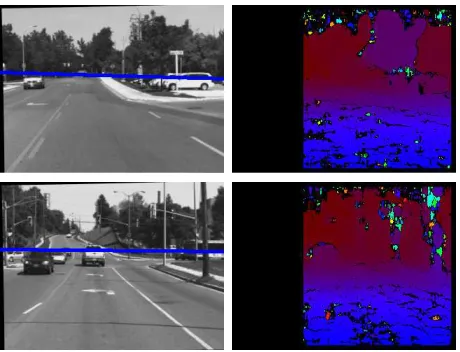
Figure 2.3: (left): Estimated horizon lines and (right): their corresponding depth maps.
2.3.1
Hypothesis Generation
The objective of HG is to identify candidate image areas likely to contain
vehicles, in order to disregard image areas not likely to contain such objects
(such as visible part of the sky, for instance). A considerable number of false
positives may be removed by the suppression of image areas in the HG stage
for which we know no vehicle can be present. One such powerful constraint
applied to the HG process is the fact that vehicles will appear in imagery within
a horizontal band centered around the horizon line (if we assume a relatively
flat landscape). Furthermore, since our interest is focused on vehicles within
an area around the 3D gaze of the driver, then the HG stage need only consider
the intersection of the band around the horizon line and the 3D gaze area of
the driver. This intersection constitutes a Region of Interest (RoI) within
which the HG stage operates. Figure 2.2 depicts the attentional gaze cone of
a driver. The radius of the circular gaze area depends on the distance between
The horizon line is approximated by intersecting the plane parallel to that
of the ground plane and passing through the focal point with the image plane
of the forward stereo scene system, and converting to image coordinates using
stereo calibration parameters. The ground plane estimation is performed by
grouping detected 3D ground points in areas of the imagery where no obstacle
is known to be present. These points are then used in a robust plane-fitting
computation to obtain the ground plane parameters (implementation details
for both the ground plane and the horizon line are provided in [23]).
Once provided with an estimate of the horizon line, the first RoI is given
by the horizontal band defined as
RoI1 :f(x) = mx+b±δ (2.1)
where m and b specify the horizon line and δ determines the vertical span of
the RoI around it. Vehicles are expected to be found within this image region.
Figure 2.3 shows the horizon line for two different frames from a test sequence.
The second RoI of interest consists of the circle formed by the intersection
of the visual cone of attention with the plane perpendicular to the 3D Line of
Gaze (LoG) and containing the 3D Point of Gaze (PoG) of the driver. The
hypothesis that visal attention operates as a spotlight within the visual field
is corroborated by an number of studies [3]. Additionally, it seems reasonable
to equate the span of this spotlight to ±6.5◦ from the pitch and yaw angles
of the gaze direction, as it corresponds to the human central field of view [1],
resulting in the attentional gaze cone depicted in Figure 2.2.
Once the 3D eye positione = (ex, ey, ez) from which the LoG is emanating,
and the 3D PoG g = (gx, gy, gz) have been transformed into the frame of
circular gaze area onto the plane perpendicular to the LoG and containing the
PoG (plane P) is obtained as
r= tan(θ)d(e,g) (2.2)
where θ= 6.5◦, andd is the Euclidean distance between e and g, defined as
d(e,g) =q(ex−gx)2+ (ey−gy)2+ (ez−gz)2 (2.3)
At this point, the circle defined by the PoG and radiusr, and contained in the
3D plane perpendicular to the LoG is reprojected onto the image plane of the
forward stereo scene system and delineates the 2D portion of the scene that
falls onto the attentional visual area of the driver. Since the plane
perpendic-ular to the LoG and containing the PoG is generally not parallel to the image
plane of the forward stereo scene system, the 3D attentional circle projects to
a 2D ellipsoid as illustrated in Figure 2.2. The 3D circle in parametric form
can be formulated as
X =gx+rcos(φ)ux+rsin(φ)vx
Y =gy +rcos(φ)uy +rsin(φ)vy
Z =gz+rcos(φ)uz+rsin(φ)vz
(2.4)
where u = (ux, uy, uz) and v= (vx, vy, vz) are two unit orthogonal vecters
in plane P and φ is the radian angle between 0 and 2π.
Usingx= XZ andy= YZ (perspective projection) and applying the intrinsic
calibration matrix of the stereo scene system presented in [21] yield 2D ellipsoid
on the image plane of the forward stereo scene system. The details of this
Figure 2.4: Displays of various LoGs, PoGs, and attentional gaze areas projected onto the forward stereo scene system of the vehicle.
The second region of interest RoI2 is thus defined as the image region
contained within the 2D circle as it reprojects onto the image plane of the
forward stereo scene system. The final RoI of interest for the HG mechanism is
consequently defined as the intersection of RoI1 and RoI2. Given image region
RoI = RoI1∩RoI2, the HG mechanism proceeds according to the algorithm
given in [23]. Figure 2.4 displays several Lines of Gaze (LoGs), Points of Gaze
(PoG), and attentional visual areas for selected frames.
2.3.2
Hypothesis Verification
AdaBoost, introduced by Freund and Schapire [24], is a method for choosing
and combining a set of weak classifiers to build a strong classifier. Adjoining
the concept of the integral image as an efficient way of computing Haar-like
fea-tures and cascaded AdaBoost, Viola and Jones introduced a powerful method
for object recognition [10]. We adopted this approach for the HG stage and
false-positive hypotheses. The Haar-training module from OpenCV is used to train
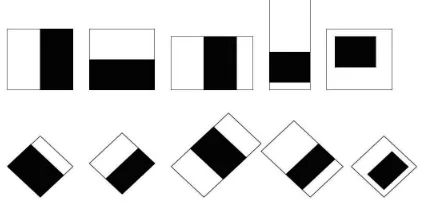
our classifiers. Figure 2.5 shows various Haar-like features. We used in excess
of two hundred vehicle images as positive samples for each classifier. For the
negative examples, a set of more than five hundred images randomly
down-loaded from the Internet was used.
Figure 2.5: A depiction of Haar-like features.
Figure 2.6: Detection results within the RoI, including false positives and negatives.
2.4
Experimental Results
The proposed method was tested on 3,326 randomly selected frames, in which
an-Table 2.1: Detection rates and false positives per frame for dif-ferent views and vehicles
FV RV FSV & BSV SV ALL
DR 0.9877 0.9890 0.8401 0.8118 0.9867
FP/F 0.25 0.22 0.30 0.31 0.24
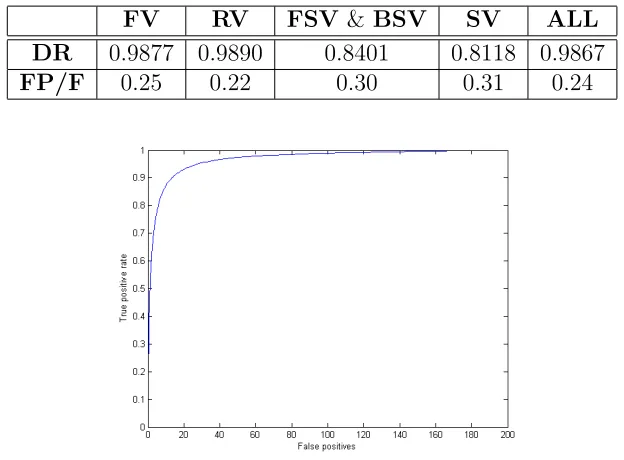
Figure 2.7: ROC curve obtained from experiments.
notated for the purpose of evaluating our method. Figure 2.6 shows a small
sample of our results where each green rectangular area within the RoI
indi-cates a vehicular detection. Rates of detection and false positives per frame for
various vehicle views are given Table 2.1, where FV, RV, FSV &BSV, and
SV, stand for Front View, Rear View, Front-Side and Back Side Views, and
Side View, respectively, while DR and FP/F are Detection Rate and False
Positives per Frame.
Figure 2.7 shows the performance of our method measured using a Receiver
Operating Characteristics (ROC) curve, characterizes the True Positive Ratio
(TPR) versus False Positives (FP). TPR is obtained by dividing True
Posi-tives by the number of vehicles. Table 2.2 compares various vehicle detection
Table 2.2: Comparison on frame rates, hit rates, and false posi-tives for various methods
Authors F/S HR FP
Chang and Cho [27] 5 99% 12%
Southall et al. [28] 16 99% 1.7% Bergmiller et al. [29] 83.12% 16.7%
Sun et al. [30] 10 98.5% 2%
Alonso et al. [31] 92.63% 3.63% Cheng et al. [32] 20 90% 10% Kowsari et al. [23] 25 98.6% 13%
Our Method 30 98.9% 11%
Hit Rate, and False Positives, respectively.
2.5
Conclusion
We presented a method for the detection of vehicles located within the
atten-tional visual area of drivers as an initial attempt at identifying which visual
stimuli elicit ocular responses from drivers. Our implementation is non-contact
and operated on-board an experimental vehicle at frame rate (30Hz). We
be-lieve this contribution could easily be extended to include other visual stimuli
drivers routinely encounter and attend to, such as pedestrians, cyclists,
traf-fic lights, signs, and more. Ultimately, such an augmented technique will be
integrated into i-ADAS as a means to identify objects drivers attend to, and
those that they do not, at frame rate.
Bibliography
[1] K. Takagi, H. Kawanaka, S. Bhuiyan, and K. Oguri,Estimation of a