Scholarship@Western
Scholarship@Western
Electronic Thesis and Dissertation Repository
8-22-2016 12:00 AM
Goal Alignment: Construct Development and Measurement of a
Goal Alignment: Construct Development and Measurement of a
Moderator of Commitment
Moderator of Commitment
Jose A. Espinoza
The University of Western Ontario
Supervisor John P. Meyer
The University of Western Ontario Graduate Program in Psychology
A thesis submitted in partial fulfillment of the requirements for the degree in Master of Science © Jose A. Espinoza 2016
Follow this and additional works at: https://ir.lib.uwo.ca/etd
Part of the Industrial and Organizational Psychology Commons
Recommended Citation Recommended Citation
Espinoza, Jose A., "Goal Alignment: Construct Development and Measurement of a Moderator of Commitment" (2016). Electronic Thesis and Dissertation Repository. 3966.
https://ir.lib.uwo.ca/etd/3966
This Dissertation/Thesis is brought to you for free and open access by Scholarship@Western. It has been accepted for inclusion in Electronic Thesis and Dissertation Repository by an authorized administrator of
i
Previous research has provided evidence that commitment to one target can have
implications for outcomes of relevance to another. In this research, I propose a construct,
goal alignment, to help explain these crossover effects. I also develop a scale to assess
goal alignment, the target-free Goal Alignment Measure (GAM), and investigate its
moderating effects as they pertain to organizational and occupational commitment. Two
studies were conducted in this research, an experimental vignette design with a student
population and a survey study with full-time employees. Results provide support for the
psychometric quality of the GAM but mixed support for goal alignment as a moderator.
However, goal alignment is found to act as a unique predictor of occupational
commitment, organizational commitment, and some outcomes. Implications for research,
organizations, and occupational groups are discussed.
Keywords: occupational commitment, professional commitment, organizational
ii
Acknowledgements
I’ve found that, as with anything worth being proud of, I can take little credit for
this document. The work presented here is the result of the incredible support and
patience of many people as much as it is the result of my own contribution. While I
cannot name and single out all of you, please know that I am not ignorant of everything
that it took to get me here, every gesture and word of encouragement is engraved in my
memories and they surface each time I think of you.
First, I’d like to thank my supervisor, Dr. John Meyer. It is no exaggeration that
without him the last four years of my life would have been entirely different.
Participating in Dr. Meyer’s class in the third year of my undergraduate degree was the
final piece that propelled my decision to further my studies in Industrial/Organizational
Psychology. Since then, he has time and time again surprised me, affording me
opportunity, trust, and confidence in my abilities. Dr. Meyer’s passion for his work, his
curiosity, and his dedication to his students and his research stand as examples of
everything I hope to become as an academic. His approval of this document and the ideas
herein are one of my greatest accomplishments. I look forward to continuing to learn
under his tutelage and hope that, someday, I am a teacher to someone in the same way
that he has been to me.
I also want to thank the members of my examination committee, Dr. Joan
Finegan, Dr. Richard Goffin, and Dr. Ann Peng. Their discussion and critical thought
have been valuable contributions to the production of this document. I am most thankful,
however, for their parts in making my defense an enjoyable, intriguing, and rewarding
iii
could have hoped and, whatever comes from these, their choice to engage with me
earnestly in discussion has given me a second wind just as I started to feel fatigued.
To my colleagues in the graduate program, I don’t know how to express my
appreciation for your part in making my time here wonderful. Your nonchalant
acceptance of me into the fold, as if I’ve always been and always belonged here, have
only been surpassed by your patience. As many of you, more than once, listened quietly
and politely to one of my long and convoluted trains of thought, each time responding
critically, thoughtfully, and with my best interests in mind.
Sam. My girlfriend, partner, and friend. On the surface, our tale is storybook. The
high school sweethearts who somehow survived the seemingly inevitable crash with
reality as each of you grows and changes. But I know better. You were and continue to be
one of the greatest things to waltz into my life and change it entirely. As you joke, you’ve
been waiting for me, forever. For me to get serious, for me to finish school, for us to get
on to the next thing, and I’ve never had to wait for you. You’ve always been right on
time. You let me wallow in my fears and anxieties long enough for me to recharge and
figure out what I need to do, but never long enough for them to swallow me whole. I love
you and I will always try my best to be to you what you are to me.
Finally, I’d like to thank my father, my mother, my sister, and my brother. I think
it is impossible for others to understand the bond that life has forged between us. Your
tenacity in the face of every conceivable obstacle has shown me what it takes to get what
you want in life. Much of my life has felt like we were stranded, surrounded by foreign
seas. Yet over the years I feel we’ve clawed and fought to make our little island into a
iv
reach. I credit you for that unbelievable feeling. I’ve never had to wonder who will stand
with me or who will create hell on Earth to help me. You are the only allies I’ve always
had and will ever need.
v
Table of Contents
Abstract...i
Acknowledgements...ii
Table of Contents...v
List of Tables...ix
List of Figures...x
List of Appendices...xii
Introduction...1
The Goal Alignment Construct...3
Developing a Measure of Goal Alignment...5
Goal Alignment and Commitment...7
Hypotheses...8
Research Strategy...10
Study 1...10
Methodology...11
Participants...11
Procedures...11
Vignettes...12
Measures...14
Goal Alignment...14
Affective Organizational and Occupational Commitment...14
Organizational and Professional Turnover Intentions... 14
vi
Work Engagement...15
Organizational Citizenship Behaviors...15
Counterproductive Work Behaviors...15
Purposeful Responding...16
Demographics...16
Results and Discussion...16
Data Cleaning and Descriptive Statistics...16
Evaluation of the Goal Alignment Measure...17
Manipulation Checks...17
Tests of Hypotheses...26
Job Satisfaction...26
Work Engagement...31
Organizational Citizenship Behaviors Directed at the Organization...33
Organizational Turnover Intentions...34
Counterproductive Work Behaviors Directed at the Organization...36
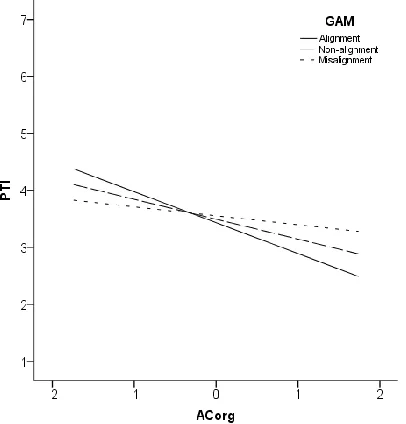
Professional Turnover Intentions...37
Organizational Citizenship Behaviors Directed at Individuals...38
Counterproductive Work Behaviors Directed at Individuals...40
vii
Exploratory Analyses...40
Goal Alignment as Antecedent to Commitment...40
Moderation of Relation between Affective Occupational Commitment and Affective Organizational Commitment...41
Contribution beyond Affective Organizational Commitment and Affective Occupational Commitment to Outcomes...42
Summary of Exploratory Analyses...45
Study 2...45
Methods...45
Participants and Procedures...45
Measures...46
Data Cleaning and Descriptive Statistics...47
Results and Discussion...48
Evaluation of the Goal Alignment Measure...48
Tests of Hypotheses...49
Exploratory Analyses...53
Goal Alignment as Antecedent to Commitment...53
Moderation of Relation between Affective Occupational Commitment and Affective Organizational Commitment...54
Contribution beyond Affective Organizational Commitment and Affective Occupational Commitment to Outcomes...54
Summary of Exploratory Analyses...57
viii
Evaluation of the Goal Alignment Measure...58
Moderation Role of Goal Alignment...58
Other Roles of Goal Alignment...60
Implications...60
Implications for Theory and Research...60
Implications for Practice...62
Implications for Occupational Groups...63
Limitations and Future Directions...63
Limitations of Study 1...63
Limitations of Study 2...65
Goal Alignment and Other Components of Commitment...65
Conclusion...66
References...68
Appendices...74
ix
List of Tables
Table 1: Scale-Level Statistics and Correlations among Variables in Study 1...18
Table 2: Results of Moderated Multiple Regression Analyses for Study 1....27
Table 3: Hierarchical Regression Models of Goal Alignment Predicting Outcomes Beyond Affective Organizational Commitment and Affective Occupational Commitment in Study 1...43
Table 4: Breakdown of Participants by Industry in Study 2...48
Table 5: Scale-Level Statistics and Correlations among Variables in Study 2...50
Table 6: Results of Moderated Multiple Regression Analyses for Study 2...51
x
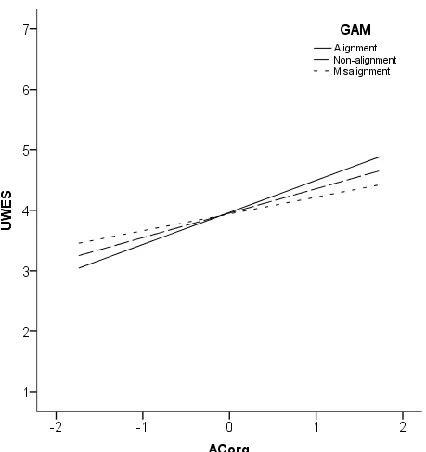
List of Figures
Figure 1. Effects of the affective commitment manipulation on Goal Alignment Measure
scores at each level of the affective organizational commitment
manipulation...24
Figure 2. Interaction of Goal Alignment Measure scores (GAM) with affective
occupational commitment (ACocc) on Michigan Organizational Questionnaire – Job
Satisfaction subscale (MOAQ-JS) ...31
Figure 3. Interaction of Goal Alignment Measure scores (GAM) with affective
occupational commitment (ACocc) on Utrecht Work Engagement Scale (UWES)...32
Figure 4. Interaction of Goal Alignment Measure scores (GAM) with affective
organizational commitment (ACorg) on Utrecht Work Engagement Scale (UWES)...33
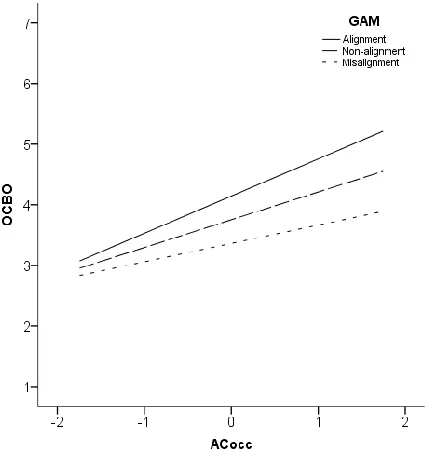
Figure 5. Interaction of Goal Alignment Measure scores (GAM) with affective
occupational commitment (ACocc) on organizational citizenship behavior - organization
(OCBO) ...34
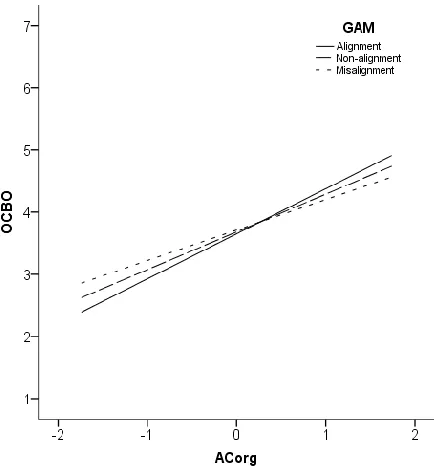
Figure 6. Interaction of Goal Alignment Measure scores (GAM) with affective
organizational commitment (ACorg) on organizational citizenship behavior -
organization (OCBO) ...35
Figure 7. Interaction of Goal Alignment Measure scores (GAM) with affective
occupational commitment (ACocc) on scores on organizational turnover intentions (OTI)
xi
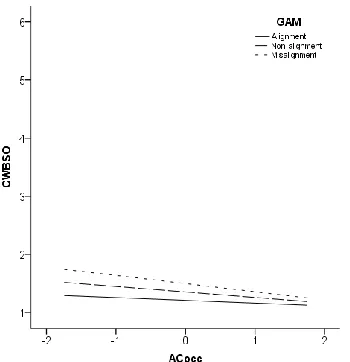
Figure 8. Interaction of Goal Alignment Measure scores (GAM) with affective
occupational commitment (ACocc) on scores on counterproductive work behavior -
organization (CWBSO)...37
Figure 9. Interaction of Goal Alignment Measure scores (GAM) with affective
organizational commitment (ACorg) on scores on professional turnover intentions (PTI)
...38
Figure 10. Interaction of Goal Alignment Measure scores (GAM) with affective
occupational commitment (ACocc) on scores on organizational citizenship behavior –
individual (OCBI) ...39
Figure 11. Interaction of Goal Alignment Measure scores (GAM) with affective
organizational commitment (ACorg) on scores on organizational citizenship behavior –
individual (OCBI) ...39
Figure 12. Interaction of Goal Alignment Measure scores (GAM) with affective
occupational commitment (ACocc) on affective organizational commitment scores
(ACorg) ...42
Figure 13. Interaction of Goal Alignment Measure scores (GAM) with affective
organizational commitment (ACorg) on Michigan Organizational Questionnaire – Job
Satisfaction Subscale (MOAQ-JS) ...53
Figure 14. Interaction of affective organizational commitment (ACorg) with Goal
Alignment Measure scores (GAM) on Michigan Organizational Questionnaire – Job
xii
List of Appendices
Appendix A: Goal Alignment Measure (GAM) ...74
Appendix B: Example Study 1 Vignettes...75
Appendix C: Letter of Information and Informed Consent for Study 1...78
Appendix D: Ethics Approval for Study 1...81
Appendix D: Letter of Information and Informed Consent for Study 2...82
Introduction
There is a longstanding understanding by researchers that individuals can form
commitments to multiple targets (e.g., Meyer & Allen, 1997; Reichers, 1985). Yet, the
majority of research on workplace commitment focuses on investigating relations with
commitment to only one of these targets, the organization. Organizational commitment
has proven to be a fruitful subject for research and a desirable construct for organizations
to foster, partly because of its association with organization-relevant outcomes, such as
employee turnover (for a meta-analytic review, see Meyer, Stanley, Herscovitch, &
Topolnytsky, 2002). However, in the face of the changing landscape of the workplace,
where mergers, layoffs, and other events that can disrupt the employee-organization
relationship are on the rise (Blau, 2001; Meyer, 2009), organizations find themselves in a
position where it can be difficult to foster organizational commitment. Employees,
instead, might establish their commitment to other targets, such as their current projects,
careers, clients, work teams, and occupations (Carson & Bedeian, 1994). In this regard,
because occupations can play a key role in individuals’ lives (Lee, Carswell, & Allen,
2000), occupational commitment is, potentially, one of the most important constructs to
investigate. Commitment to one’s occupation has also been found to be related to
outcomes relevant to organizations, occupational groups, and employees (for reviews of
these findings, see Lee et al., 2000, and Meyer & Espinoza, 2016).
To contribute to our understanding of commitment to targets other than the
organization, I investigated the role of a new construct, goal alignment, that I theorize
influences the relations between commitment and outcomes. Goal alignment is defined as
those of another (e.g., the occupation), such that the achievement of one target’s goals
aids, or provides the opportunity to contribute to, the achievement of the goals of other
targets. The research presented here focused on developing a measure of goal alignment
and conducting preliminary investigations into its potential role as a moderator between
occupational commitment and organization-relevant outcomes.
Goal alignment is likely to be important in situations where employees have
several options of how to behave and the course of action taken has implications for
multiple targets of commitment. Although there is a wide range of situations in which
goal alignment could be influential, for practical purposes, there are two scenarios of
particular interest, a) when an employee is highly committed to one target but weakly
committed to another and b) when an employee is highly committed to multiple targets.
These situations are of interest because they present instances in which goal alignment is
expected to have the greatest impact on the relations of commitment with behavior, and
ultimately, with outcomes.
In the present research, goal alignment was investigated in relation to
commitment to two targets, the occupation and the organization. Moreover, goal
alignment was approached from the perspective of the organization. That is, the focus
was on determining how employees might behave in relation to the attainment of
organizational goals under conditions of alignment, non-alignment, and misalignment of
organizational and occupational goals. For example, the first scenario described above
could entail a situation in which an employee is highly committed to his or her
occupation but weakly committed to the organization. Here, goal alignment could present
commitment to attain its own goals. However, capitalizing on an employee’s
occupational commitment could be impacted by whether the organization can present the
goals of the occupation and the organization as compatible, such that by aiding the
organization in attaining its goals, the employee also perceives he or she is contributing to
the goals of the occupation.
In addition to its practical implications, the present research also contributes to
commitment theory by helping to explain when and why commitments to different targets
are related, and exploring one avenue of how commitment to one target can have
implications for outcomes of relevance to another. In particular, it might help to explain
the findings linking occupational commitment to organization-relevant outcomes like job
involvement, job satisfaction, intentions to leave the organization, supervisor-rated
performance, knowledge sharing among employees, and increased employee creativity,
among others (Lee et al., 2000; Tsoumbris and Xenikou, 2010; Swart, Kinnie, van
Rossenberg, & Yalabik, 2014; Madjar, Greenberg, & Chen, 2011).
The Goal Alignment Construct
The notion of goals as key to motivating behavior has been well-established
within industrial/organizational psychology (e.g., Locke, 1991, 1997; Locke & Latham,
1990, 2002). Relatedly, Meyer, Becker, and Vandenberghe (2004) have proposed an
integrative model of motivation and commitment in which they argue that target-relevant
goals are a key mediating mechanism in the relation between commitment and support
behaviors. It follows, therefore, that when the goals of two targets of commitment are
aligned, commitment to one target can contribute to the attainment of outcomes of
employees see the goals of their organization and occupation as being aligned, their
commitment to the occupation can lead them to engage in behavior of benefit to the
organization even under conditions where they have no long-term commitment to the
organization.
It is important to note that goal alignment, as it is conceptualized for the purposes
of this research, is distinct from ‘goal congruence,’ as it is defined and measured in the
person-environment fit literature. Goal congruence was initially conceptualized as the
degree of agreement in managers’ and employees’ perceptions of organizational goals
(e.g., Jauch et al., 1980). More recently, goal congruence has been conceptualized as the
perceived consistency between an individual’s personal goals and the goals of the
organization (Supeli and Creed, 2014) based on work by Nadler and Tushman (1992)
defining congruence as ‘‘the degree to which the needs, demands, goals, and structures of
one component are consistent with the needs, demands, goals, and structures of another
component” (p. 51). In both cases, goal congruence has been investigated as an
antecedent of organizational commitment. In the first case, employees were expected to
experience greater organizational commitment stemming from the degree of fit between
managers’ and their own perceptions of organizational goals. In the second case,
employees who perceived greater goal congruence were expected to be more committed
to the organization based on the extent to which they perceived their personal goals and
the goals of the organization to be consistent.
Goal alignment is most similar to the second conceptualization of goal
congruence. However, the perceived degree of consistency between employees’ personal
Secondly, although there are similarities between goal congruence and goal alignment, I
propose that they are distinct in the roles they are meant to play in their relations with
commitment. Goal congruence is well-established as an antecedent to commitment
(Kristof, 1996; Kristof-Brown, Zimmerman, & Johnson, 2005), but has not been
proposed to have any implications for the relations between commitment to one target
and outcomes relevant to another. While goal alignment potentially serves as an
antecedent of commitment, it is also expected to act as a moderator between commitment
to an alternate target (e.g., occupation) and organization-relevant behavior.
Developing A Measure of Goal Alignment
Prior to developing a measure of goal alignment I established three objectives.
The first was to develop a measure of the construct with a maximum of five items, so that
it could be employed without unduly increasing the burden on respondents when
incorporated in surveys with other measures, including commitment to various targets. A
second goal was to develop a measure of goal alignment that could be easily adapted to
assess the perceived alignment of the goals of many different targets. The measure was
therefore to be ‘target-free’, such that researchers or practitioners using the scale could
easily place any targets of interest in the appropriate places within each item. A third goal
was to use simple and straightforward language to enhance readability.
Development of the measure proceeded as follows. First, the items in Supeli and
Creed’s (2014) measure were adapted to allow for the assessment of compatibility
between the goals of multiple targets. Following these modifications, I eliminated items
degree to which they are compatible (e.g., “Achieving this organization’s goals also
means attaining my personal goals”).
Additional items were then generated bringing the scale to 10 items. Equal
numbers of regular (goal alignment) and reversed coded (goal misalignment) items were
included. The inclusion of reverse-coded items was based on recommendations in Kam
and Meyer (2015) who cautioned that the exclusion of reverse-coded items can lead to
bias in construct correlations. That is, when only uniformly-coded items are included in a
scale, correlations with other constructs can reflect both the content and valence (e.g.,
desirability) of the items. They demonstrated that this bias can be minimized by using a
balance of regular and reverse-coded items. Balancing item direction can also help to
minimize the effects of acquiescence response bias (Jackson & Messick, 1958).
A balanced set of opposite-valenced items also allows for the interpretation of
mean scores as indicating alignment, non-alignment, or misalignment between targets’
goals. With the inclusion of an equal number of reverse-scored items, mean scores on the
measure at the high end of the scale (approx. 5.5-7) are proposed to reflect alignment,
means near the midpoint (approx. 3-5) are proposed to reflect non-alignment, while
means at the low end of the scale are proposed to reflect misalignment.
After calculating a readability score using Readibility-Score.com (Child, 2016),
items with scores greater than the cutoff score for the general public (8) were eliminated
from the scale. A final version of the Goal Alignment Measure (GAM) was then
compiled, containing four target-free items with response options ranging from strongly
disagree (1) to strongly agree (7). A copy of the complete scale can be found in Appendix
Goal Alignment and Commitment
In this research, I conducted preliminary investigations into a) the psychometric
properties of the GAM and b) the moderating role of goal alignment between
commitment to one target and outcomes most relevant to another. To investigate the
moderating effects of goal alignment, I focused on the affective component of the
dominant conceptualization of commitment, the Three-Component Model (TCM; Allen
& Meyer, 1990; Meyer & Allen, 1991; Meyer & Allen, 1997). The affective component
of commitment is characterized by feelings of attachment to and involvement with the
target (Meyer & Allen, 1991). As evidenced by the number of studies reported in
meta-analyses by Meyer et al. (2002) and Lee et al. (2000), affective commitment is the
component of the TCM most studied in the literature in relation to both organizational
and occupational commitment. Affective commitment is also, arguably, the most relevant
component to goal alignment as it is partly based in the internalization of the goals and
values of the commitment target (Allen & Meyer, 1990). Consequently, I investigated
goal alignment as it relates to affective organizational commitment (ACorg) and affective
occupational commitment (ACocc).
For the purposes of this investigation, I use the term ‘occupational commitment’
to refer to commitment to one’s line of work. Although related terms have been used in
the past, including career commitment (e.g., Blau, 1985; Hall, 1971) and professional
commitment (e.g., Wallace, 1993, 1995), the term occupational commitment is now
acknowledged as a more generic term that can apply to both professional and
with use of the term career to describe an individual’s personal trajectory of work-related
activities.
Hypotheses
As noted earlier, beyond development and evaluation of the GAM, a key
objective of the present research was to investigate the role(s) of goal alignment in the
context of multiple commitments. The primary role of goal alignment under investigation
is the moderation of the relation between commitment to one target and outcomes of
relevance to another. Moreover, I was particularly interested in the moderating role of
organization-occupation goal alignment on the implications of ACocc on outcomes of
relevance to the organization (e.g., turnover intentions, and organizational citizenship
behaviors). Of secondary interest was the moderating role of organization-occupation
goal alignment on the relation between ACorg and occupation-relevant outcomes
(occupational turnover intention). In both cases, I expected that the relation between
affective commitment to one target and outcomes of relevance to the other would be
greater under conditions of goal alignment than non-alignment, and under conditions of
non-alignment than misalignment.
Hypothesis 1. Goal alignment will positively moderate the relations between
ACocc and a) job satisfaction, b) work engagement, and c) organizational citizenship
behaviors directed at the organization. Goal alignment will negatively moderate the
relations between ACocc and d) organizational turnover intentions and e)
counterproductive work behaviors directed at the organization.
Hypothesis 2. Goal alignment will negatively moderate the relations between
As a complement to the tests of these hypotheses, I also conducted analyses to
determine whether organization-occupation goal alignment would moderate the relation
between commitment to a target and outcomes of relevance to that same target. I
expected that the relation between affective commitment to the target and the
target-relevant outcomes would be sufficiently strong that no moderating effect of goal
alignment would be observed. I also expected that goal alignment would not moderate the
relation between commitment to either target and organizational citizenship behaviors
directed at coworkers, as well as counterproductive work behaviors directed at
coworkers, because coworkers are not a target in the organization-occupation pairing
assessed in the GAM for this study.
Hypothesis 3. Goal alignment will not significantly moderate the relations
between ACorg and a) job satisfaction, b) work engagement, and c) organizational
citizenship behaviors directed at the organization, d) organizational turnover intentions,
e) counterproductive work behaviors directed at the organization, f) organizational
citizenship behaviors directed at coworkers, and g) counterproductive work behaviors
directed at coworkers.
Hypothesis 4. Goal alignment will not significantly moderate the relations
between ACocc and a) professional turnover intentions, b) organizational citizenship
behaviors directed at coworkers, and c) counterproductive work behaviors directed at
coworkers.
The strongest evidence for the importance of goal alignment as a vehicle for
will be found when all four hypotheses are supported; that is, if I can demonstrate
moderating effects for relations across targets but not within targets.
Although my main focus was on the moderating effects of goal alignment on
relations between commitment to one target and outcomes of relevance to another, I also
planned additional analyses to explore other possible implications of goal alignment.
These included whether goal alignment contributes directly to greater commitment to
either target, whether it moderates the relation between ACorg and ACocc, and whether it
has an incremental effect on outcomes beyond commitment to both targets.
Research Strategy
To evaluate the GAM and test the hypotheses above, I conducted two studies. The
first of these studies employed an experimental vignette design in which perceptions of
goal alignment, ACocc, and ACorg were manipulated. This study focused on
investigating the validity of the GAM by determining whether manipulations in the
vignettes influenced GAM scores as expected. The data from this study was then
employed as actual survey data for a preliminary investigation of all hypotheses. The
second study in this research gathered data from a sample of full-time employees from a
wide range of occupations and was conducted to provide a second examination of the
psychometric properties of the GAM and to test the hypotheses.
STUDY 1
The first study focused on assessing the psychometric properties of the GAM.
Participants in this study were asked to read one of 12 vignettes depicting an individual’s
work experiences and to respond to a series of items as they believed the individual in the
designed to depict the individual as experiencing a combination of high or low ACocc,
high or low ACorg, and the goals of the occupation and organization as aligned,
non-aligned, or misaligned. This study is modeled after Meyer and Allen’s (1984) study
investigating the construct validity of the continuance commitment scale of the TCM.
Meyer and Allen (1984) argued that scale scores reported by individuals on the
continuance commitment measure should differ according to the manipulation of
continuance commitment they were exposed to, and that the effective manipulation of
these scores could be interpreted as one piece of evidence concerning construct validity.
Methodology
Procedure
An on-line survey was used to collect data in this study. Participants were
provided with a website link that randomly presented them one of 12 vignettes prior to
the survey. Participants were then instructed to carefully read the vignette and to ‘take on
the role’ of the individual depicted. Following this, participants were asked to respond to
a series of measures as they believed the individual in the vignette would respond.
Finally, upon completing the ‘role-taking’ portion of the study, participants were
asked to respond to a few purposeful responding items and demographic questions.
Participants
Participants for the study were recruited from the Department of Psychology
research pool at Western University. All participants in this research pool were enrolled
in an introductory psychology course and participate in surveys for course credit.
Participants in the study were awarded one research credit for their participation. In total,
Vignettes
A set of 12 vignettes depicting a nurse’s experiences at her current job in a
hospital and attitudes toward her occupation and organization were generated. The
vignettes contained information on the goals of nursing as a profession and the goals of
the hospital at which the nurse was employed. The goals of the hospital and nursing were
depicted to be aligned, non-aligned, or misaligned, manipulating goal alignment at three
levels. Manipulations for ACorg at high and low levels were created based on potential
antecedents and indicators of ACorg, including the extent to which the individual freely
chose to work at the organization and the quality of this decision (Meyer, Bobocel, &
Allen, 1991), and perceptions of organizational support (Meyer et al., 2002). Similarly,
manipulations for the two levels of ACocc were created based on potential antecedents
and indicators, including personal identification with and freely choosing the occupation,
as well as engaging in reading materials related to the occupation in one’s spare time
(Blau, 1999).
To develop vignettes that depicted a realistic situation I conducted interviews with
nursing professionals with working experience. In total, three nurses were interviewed
with experience ranging from a nursing student within a year of graduation, to a nurse
with several years of experience across multiple settings in which nurses are employed.
Interviews were semi-structured, asking interviewees to respond to questions about their
perceptions of the goals of nursing as a profession; organizational goals that can be
perceived as compatible or conflicting with the goals of nursing; the possible
consequences of alignment or misalignment; and their opinions on what kind of situation
also prompted to elaborate on their answers by providing examples of their own
experiences or those of their colleagues.
After conducting interviews, I developed a series of manipulations using these
responses. I also developed a few personal details about the individual in the vignettes
that were not related to the variables being manipulated. These details were used in all
vignettes to present a more believable depiction of a nursing professional. The intention
was to mask the manipulation statements from participants by placing them within a
broader context using inconspicuous details. See Appendix B for examples of three
vignettes that, together, contain all of the manipulation statements.
Finally, a group of graduate students (N=12) enrolled in the nursing or
industrial/organizational psychology program at Western University were invited to
complete a survey to evaluate the vignettes. Graduate students were invited to provide
their judgment based on expertise with experiment design and statistical methods or
familiarity with the nursing profession. Participants were presented with the
manipulations for each variable side-by-side, then within the context of completed
vignettes. Participants rated the strength and realism of the manipulations on a 10-point
Likert-type scale ranging from very weak (1) to very strong (10). The average strength
and realism ratings for the ACocc manipulation were found to be acceptable (M = 8.75,
SD = .96, for strength; M = 9.00, SD = 1.13, for realism). Similar ratings were reported
for the average ratings of the strength and realism scales for the ACorg manipulation (M
= 8.67, SD = 1.30, for strength; M = 9.3, SD = .89, for realism). The average strength and
realism ratings for the goal alignment manipulation were also found to be acceptable (M
provided comments on the manipulations. Based on the average ratings of the strength
and realism for the manipulations and examination of the comments, no comments were
determined to provide improvements significant enough to merit the modification of the
vignettes.
Measures
Participants were asked to respond to various scales assessing the predictor
variables and outcomes. Unless otherwise stated, response options for each scale ranged
from strongly disagree (1) to strongly agree (7).
Goal alignment. The survey included the Goal Alignment Measure (GAM),
developed for this study, assessing alignment between organizational and occupational
goals. The GAM contains four items: 1) This organization’s goals are aligned with the
goals of my profession, 2) This organization’s goals conflict with the goals of my
profession (R), 3) Helping this organization succeeds in its goals hurts my chances to
succeed in the goals of my profession (R), 4) Working towards this organization’s goals
helps me achieve the goals of my profession.
Affective organizational and occupational commitment. These constructs
were measured using the affective commitment scales developed by Meyer, Allen, and
Smith (1993). These scales contain 6 items assessing ACorg (e.g., “I really feel as if this
organization's problems are my own”), and 6 items assessing ACocc (e.g., “Nursing is
important to my self-image”).
Organizational and professional turnover intentions. Organizational turnover
intentions (OTI) and professional turnover intentions (PTI) were assessed using 4 items
quitting this organization”; and “It is likely that I will actively look to change occupations
in the next year”).
Job satisfaction. This construct was assessed using the Michigan Organizational
Assessment Questionnaire – Job Satisfaction Subscale (MOAQ-JS; Cammann, Fichman,
Jenkins, & Klesh, 1983). The MOAQ-JS contains 3 items (e.g., “In general, I like
working here”).
WorkEngagement. The survey included the employee version of the Utrecht
Work Engagement Scale (UWES; Schaufeli, Salanova, González-Romá, & Bakker,
2002), which contains 17 items assessing three dimensions of work engagement, vigor (6
items; e.g., “At my work, I feel bursting with energy”), dedication (5 items; e.g., “My job
inspires me”), and absorption (6 items; e.g., “Time flies when I am working”). Response
options ranged from never (1) to always (7).
Organizational citizenship behaviors. This construct was assessed using Lee
and Allen’s (2002) scale which contains two subscales, one assessing organizational
citizenship behaviors directed at individuals (OCBI; e.g., “Help others who have been
absent”) and the other assessing organizational citizenship behaviors directed at the
organization (OCBO; e.g., “Express loyalty toward the organization”). Each subscale
includes 8 items. Response options ranged from never (1) to always (7).
Counterproductive work behaviors. Fox and Spector’s (1999) measure was
used to assess CWB. The measure includes four subscales: minor-organizational
(CWBMO; 11 items; e.g., “Purposely ignored your boss”); serious-organizational
(CWBSO; 5 items; e.g., “Tried to cheat your employer”); minor-personal (CWBMP; 6
nasty to a fellow worker”). Response options ranged from never (1) to extremely often
(6).
Purposeful Responding. Two items from Meade and Craig (2012) were used in
the survey. The first item asked respondents to provide an estimate of how much effort
they put forth in the study by choosing the most appropriate statement on a scale ranging
from almost no (1) to a lot of (5). The second item asked participants whether their data
should be used in the analyses for this research by selecting either yes or no.
Demographics. Finally, items were included asking participants about their
gender, age, ethnicity, and proficiency with the English language.
Results and Discussion
Data Cleaning & Descriptive Statistics
Prior to analyses, the data were examined for quality and to identify missing
cases. First, participants who responded no to the purposeful responding item asking
whether their data should be included in analyses were eliminated. Ten participants
responded in this manner and mostly identified reasons associated with not thinking
about their answers or not paying attention to the study (e.g., being in a hurry to be
elsewhere, feeling tired, or skimming the vignette).
Second, thirty-eight participants who responded to the ‘effort’ purposeful
responding item by indicating that they put in almost no (1) to some (3) effort were
eliminated from the sample. Due to the attentional demand required for participants to
immerse themselves in the role for the vignette, I only retained participants who indicated
Finally, less than one percent of missing data was identified per item for all scales
in the study. Missing data were imputed using the expectation maximization method.
After data cleaning, 411 participants remained in the sample, with 44% of
participants identifying as male, 55% as female, and 1 participant identifying as other and
using a blank box provided on the survey to self-identify as neutral. On average,
participants were approximately 18 years old. The largest ethnic groups in the sample
included Caucasians (53%), Chinese (15%), and South Asian (16%), with the remaining
participants identifying with various other ethnic groups (e.g., Filipino, Latin American,
Korean, Black, Aboriginal). Approximately 84% of the sample indicated English was
their first language and 98% indicated feeling a strong proficiency with English.
For means, standard deviations, and correlations between all scales, see Table 1.
Evaluation of the Goal Alignment Measure
The alpha coefficient of reliability for the GAM was found to be acceptable ( =
.90), and removing any item did not improve reliability. The items in the scale also
demonstrated acceptable corrected item-total correlations (r = .67-.82). The mean for the
GAM (M = 4.88) was approximately one point above the midpoint on the scale, but far
from extreme, suggesting that ceiling or floor effects that might affect correlations are
unlikely to be present. The standard deviation for scores on the GAM (SD = 1.54) was
sufficiently large to demonstrate that there was considerable range in scores on the
measure.
Manipulation Checks
Manipulation checks for ACocc, ACorg, and goal alignment were conducted
Table 1
Scale-Level Statistics and Correlations among Variables in Study 1
M SD 1 2 3 4 5 6 7 8 9 10 11 12 13
1. GAM 4.88 1.54 (.90)
2. ACorg 3.53 1.74 .57 (.94)
3. ACocc 4.81 1.75 .16 .42 (.95)
4. OTI 4.02 1.61 -.56 -.83 -.37 (.88)
5. PTI 3.30 1.60 -.24 -.45 -.85 .53 (.87)
6. MOAQ-JS 3.91 1.95 .54 .89 .50 -.85 -.55 (.94)
7. UWES 4.08 1.17 .34 .65 .78 -.59 -.73 .72 (.96)
8. OCBI 4.34 1.03 .22 .55 .54 -.47 -.50 .59 .72 (.93)
9. OCBO 3.80 1.45 .39 .75 .59 -.65 -.57 .76 .79 .71 (.95)
10. CWBMO 2.62 1.07 -.38 -.63 -.56 .65 .62 -.70 -.70 -.61 -.70 (.94)
11. CWBSO 1.37 .64 -.25 -.28 -.29 .35 .38 -.31 -.35 -.32 -.29 .59 (.89)
12. CWBMP 1.76 .75 -.18 -.29 -.34 .31 .39 -.31 -.38 -.39 -.36 .60 .66 (.86)
13. CWBSP 1.48 .68 -.19 -.31 -.32 .33 .38 -.33 -.36 -.37 -.35 .57 .67 .81 (.87)
Note. N = 411. GAM = Goal Alignment Measure; ACorg = Affective Organizational Commitment; ACocc = Affective Occupational Commitment; OTI = Organizational Turnover Intentions; PTI = Professional Turnover Intentions; MOAQ-JS = Michigan
ACorg, and ACocc scales were used as outcomes in these analyses. For all analyses in
relation to these manipulation checks, Levene’s test for homogeneity of variances was
found to be significant (GAM: F(11, 399) = 5.77, p < .001; ACorg: F(11,399) = 4.07, p <
.001; ACocc: F(11, 399) = 3.38, p < .001). While ANOVA is robust to violations of
homogeneity of variance, it is susceptible to inflation of Type I error when it is coupled
with unequal sample sizes (Milligan, Wong, & Thompson, 1987). Unfortunately, data
cleaning procedures resulted in different sample sizes across the 12 conditions ranging
from N = 30-37. Therefore, to cope with the potential for an inflated error rate I tested all
hypotheses using a more conservative significance level of .01 (Gardner & Tremblay,
2007).
The first ANOVA investigated the ACocc manipulation, wherein participants in
conditions depicting high ACocc were expected to report greater ACocc scores than those
in the low condition. A main effect for the ACocc manipulation was found as expected,
F(1, 399) = 1431.90, p < .001; partial η² = .782. However, a significant, albeit much
smaller, main effect for the ACorg manipulation, F(1, 399) = 138.05, p < .001, partial η²
= .257, as well as a significant and much smaller interaction for the ACocc and ACorg
manipulations, F(1, 399) = 23.55, p < .001, partial η² = .056, were found. Analyses of the
effects of the ACorg manipulation at each level of the ACocc manipulation were
conducted to determine the nature of the interaction. Overall, participants in the high
ACorg (M = 5.25) condition reported greater ACocc scores than those in the low ACorg
condition (M = 4.37). However, the difference in ACocc scores between participants in
4.01 vs. M = 2.71), t(205) = 11.91, p <.001, than it was in the high ACocc condition (M =
6.59 vs. M = 6.05), t(202) = 5.29, p < .001.
Previous meta-analytic research has reported moderate correlations between
ACocc and ACorg (rc = .45; Lee et al., 2000), suggesting that the experience of these
commitments are associated with each other. Potentially, being committed to the
organization also makes one more likely to be committed to the occupation. For example,
for some organization-occupation pairings, such as hospitals and nursing professionals,
commitment to one target might reinforce commitment to the other due to an assumed
level of compatibility in their values and objectives. However, a three-way interaction
between ACocc, ACorg, and goal alignment was not found to be significant, F(2, 399) =
.025, ns, suggesting that these relations did not differ depending on the level of goal
alignment presented, and the perceptions of compatibility are likely based on information
other than goals. In relation to the interaction, given the possible reinforcing nature of the
relation between occupational and organizational commitment, conditions that presented
participants with the low ACocc and high ACorg manipulations possibly constitute an
‘artificial’ conflict and influenced participants to rely more heavily on ACorg to make
inferences about the occupational commitment of the individual in the vignette. The need
to rely on ACorg was reduced when the high ACocc manipulation was present. Further,
the correlation found in this study between ACocc and ACorg is very close to the one
reported by Lee et al. (2000), suggesting that the significant main effects and interactions
found do not reflect relations contrary to those found in real world samples (e.g.,
The second ANOVA investigated the ACorg manipulation, wherein I expected
that scores on the ACorg measure would be significantly impacted by the ACorg-related
statements in the vignettes, such that participants in the high ACorg condition would
report greater scores than those in the low ACorg condition. A significant main effect for
the ACorg manipulation was found, F(1, 399) = 1256.63, p < .001, partial η² = .759. A
significant, albeit much smaller, main effect for the ACocc manipulation and a small but
significant effect for the interaction between ACorg and ACocc manipulations were also
found: F(1, 399) = 56.35, p <.001, partial η² = .124; F(1, 399) = 26.43, p < .001, partial η²
= .020; respectively. Investigation of the effects of the ACOcc manipulation at each level
of the ACorg manipulation were conducted. Overall, participants in the high ACocc
condition reported greater ACorg scores than those in the low ACocc condition (M = 3.82
vs. M = 3.25). However, in the low ACorg manipulation, there was no significant
difference between ACorg scores for participants in the high or low ACocc conditions (M
= 2.17 vs. M = 1.98), t(205) = 1.68, p = ns. When participants were exposed to the high
ACorg manipulation, there was a significant difference in ACorg scores based on which
level of the ACocc manipulation participants received (high ACocc: M = 5.55; low
ACocc: M = 4.51), t(202) = 8.87, p < .001. In this case, participants who were assigned to
the high ACocc manipulation reported greater ACorg scores than those who were
assigned to the low ACorg manipulation. These findings suggest an enhancing effect of
the high ACocc condition in the presence of the high ACorg manipulation and that the
ACocc manipulation had little influence on ACorg scores in the low ACorg manipulation.
Participants appear to have relied mostly on the information presented in the ACorg
results are in contrast with those found for ACocc scores which were significantly
influenced by the ACorg manipulation in the low ACocc condition. A three-way
interaction between ACocc, ACorg, and goal alignment manipulations on ACorg scores
was not found, F(2, 399) = 3.99, ns, suggesting that these results were not dependent on
which level of the goal alignment manipulation was present.
Finally, the goal alignment manipulation was investigated, wherein a significant
effect was expected on GAM scores based on the level of the goal alignment
manipulation that participants received. A significant main effect for the goal alignment
manipulation was found, F(2, 399) = 63.51, p < .001, partial η² = .241, and pairwise
comparisons were conducted to determine which means differed significantly across the
three levels of the manipulation. Pairwise comparisons revealed that GAM scores for
participants in the alignment condition (M = 5.44) were not significantly greater than
those of participants in the non-alignment condition (M = 5.17), but were significantly
greater than scores for those in the misalignment condition (M = 4.03): t(273) = 1.86, ns;
t(271) = 10.57, p < .001; respectively. GAM scores for those in the non-alignment
condition were found to be significantly greater than for participants assigned to the
misalignment condition t(272) = 8.73, p < .001. The results of these analysis suggests that
participants in the alignment and non-alignment conditions did not respond differently to
the GAM. This might be due to a natural tendency to perceive alignment in the absence
of information to the contrary or it might be a result of weaknesses in the non-alignment
manipulation. The non-alignment manipulation was designed to present organizational
goals as focused on effective administration and was expected to communicate that
organization’s attainment of its goals. However, this might not preclude a perception of
alignment between the organization’s goals and the goals of nursing. In the
non-alignment manipulation, effective administration included indicating to employees how
they are expected to behave. This information might be perceived as helping nurses
perform their jobs because it helps clarifies their duties and roles. Potentially, the
manipulation suggested that nurses in this situation are better aware of what client-care
choices are within their power. In this context, participants who were exposed to the
non-alignment condition might have interpreted the accompanying vignette to depict
alignment rather than non-alignment or misalignment.
A significant main effect for the ACorg manipulation on GAM scores was found,
F(1, 399) = 214.87, p < .001, partial η² = .350, where participants in the high ACorg
conditions reported greater GAM scores than those in the low ACocc conditions. In
contrast, no significant main effect was found for the ACocc manipulation, F(1, 399) =
2.28, ns, although a significant interaction between the ACocc and ACorg manipulations
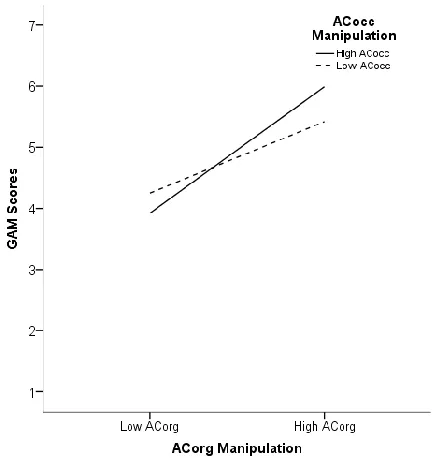
was present (see Figure 1), F(1, 399) = 15.59, p < . 001, partial η² = .038. It appears that
in the low ACorg condition, participants who were in the high ACocc (M = 3.99) or low
ACocc (M = 4.22) condition did not differ significantly on GAM scores, t(205) = 1.73,
ns. However, in the high ACorg condition participants who were also in the high ACocc
condition (M = 6.01) reported significantly greater scores on the GAM than participants
who were in the low ACocc condition (M = 5.41), t(202) = 3.84, p < .001. This
interaction suggests that high ACocc seems to enhance the influence of ACorg on GAM
scores when a high level of ACorg is also present. Being highly committed to two targets
compatible, further supporting arguments provided above on the positive relation
between ACocc and ACorg. Individuals experiencing high affective commitment to both
targets might perceive greater goal alignment, whether, in reality, these goals are aligned
or not, as there was no significant effect for a three-way interaction, wherein the
interaction between ACocc and ACorg with GAM scores was dependent upon the level
of the goal alignment manipulation presented, F(2, 399) = .90, p = ns. It is also possible
that in conditions where the individual in the vignette was highly committed to the
organization and to the occupation information denoting misalignment presented an
‘unnatural’ condition, because being highly committed to two targets with conflicting
goals is an unlikely occurrence. In these cases, participants potentially relied on the high
levels of ACocc and ACorg for their ratings of goal alignment regardless of the
information that was presented in the goal alignment manipulation.
Generally, the results of the ANOVAs provided support for the effectiveness of
the manipulations used in the study. Although significant interactions were found
between the ACocc and ACorg manipulations for ACorg, ACocc, and GAM scores, these
do not contradict existing research on the relations between these variables or theory
presented in this paper regarding goal alignment. As previously stated, potential
three-way interactions in all instances were not found to have a significant effect, pointing to
further evidence of the positive interplay between ACocc and ACorg. When paired, high
levels of ACocc and ACorg caused greater scores on measures of ACocc and ACorg than
did any other combination of levels. The effect of this interaction was found even for
scores on the GAM, suggesting that individual perceptions of goal alignment were
influenced such that they became more positive whether goals between the two targets
were described as aligned or not.
Finally, the results of the goal alignment manipulations on GAM scores revealed
that significant differences were found between alignment and misalignment, and
between non-alignment and misalignment, but that mean scores in the non-alignment
conditions were indistinguishable from alignment-induced scores. This might be caused
by weaknesses in the non-alignment manipulation, or might indicate that people have a
tendency to perceive alignment in the absence of information to the contrary, or that they
only distinguish between a general judgment of organizational and occupational goals as
aligned or misaligned. These results are interpreted as providing some evidence for the
construct validity of the GAM as the theoretically-derived manipulations caused
Tests of Hypotheses
The following moderation and correlation analyses were conducted using scores
on the ACocc, ACorg, and GAM to simulate the use of actual survey data. The
moderation analyses were executed using the PROCESS macro in SPSS (Hayes, 2013)
with mean scale scores, mean-centered product terms, bias-corrected bootstrapping with
1000 samples, and heteroscedasticity-consistent standard errors as recommended by
Hayes and Cai (2007). When interpreting these analyses, the differential implications for
alignment, non-alignment, and misalignment were investigated by visually inspecting
plots of the significant interactions with ACocc or ACorg in the X axis, the outcome
measure in the Y axis, and separate regression lines for GAM scores (for an example, see
Figure 2). Results for these analyses can be found in Table 2.
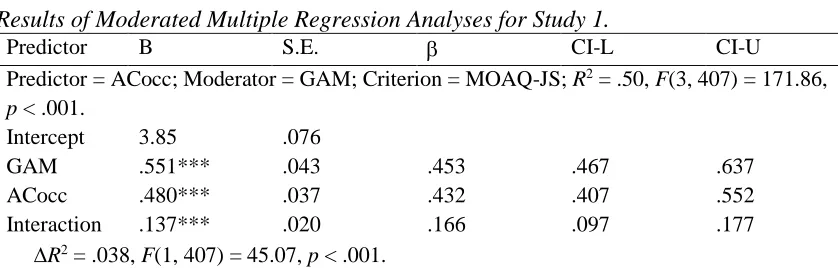
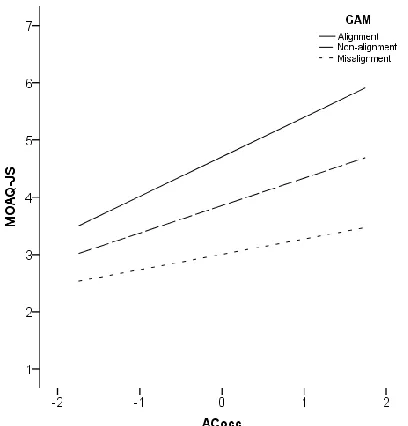
Job satisfaction. Results of the moderation analyses revealed that goal alignment
significantly moderated the relations between ACocc and job satisfaction, R2 = .038,
F[1, 407] = 45.07, p < .001. Inspection of this interaction suggested that the conditional
effect of ACocc on job satisfaction was greatest for participants who perceived alignment
between the goals of the organization and nursing (.690), followed by participants who
perceived non-alignment (.480), with the smallest effect for misalignment (.269). For a
plot of this interaction see Figure 2. Goal alignment was not found to be a moderator of
the relations between ACorg and job satisfaction, R2 = .000, F(1, 407) = .34, ns. These
Table 2
Results of Moderated Multiple Regression Analyses for Study 1.
Predictor B S.E. CI-L CI-U
Predictor = ACocc; Moderator = GAM; Criterion = MOAQ-JS; R2 = .50, F(3, 407) = 171.86,
p < .001.
Intercept 3.85 .076
GAM .551*** .043 .453 .467 .637
ACocc .480*** .037 .432 .407 .552
Interaction .137*** .020 .166 .097 .177
R2 = .038, F(1, 407) = 45.07, p < .001.
Predictor = ACorg; Moderator = GAM; Criterion = MOAQ-JS; R2 = .786, F(3, 407) = 665.99,
p < .001.
Intercept 3.897
GAM .062 .040 .061 -.017 .142
ACorg .956*** .034 .855 .890 1.022
Interaction .012 .020 .015 -.028 .052
R2 = .000, F(1, 407) = .34, ns.
Predictor = ACocc; Moderator = GAM; Criterion = UWES; R2 = .678, F(3, 407) = 369.74, p
< .001.
Intercept 4.046
GAM .149*** .024 .196 .101 .197
ACocc .500*** .020 .745 .461 .539
Interaction .073*** .013 .173 .046 .099
R2 = .029, F(1, 407) = 29.59, p < .001.
Predictor = ACorg; Moderator = GAM; Criterion = UWES; R2 = .450, F(3, 407) = 140.81, p <
.001.
Intercept 3.953
GAM .008 .037 .011 -.065 .082
ACorg .404*** .034 .600 .338 .470
Interaction .082** .021 .171 .041 .122
R2 = .025, F(1, 407) = 15.63, p < .001.
Predictor = ACocc; Moderator = GAM; Criterion = OCBO; R2 = .477, F(3, 407) = 134.53, p <
.001.
Intercept 3.753
GAM .253*** .033 .268 .188 .317
ACocc .458*** .030 .564 .399 .517
Interaction .101*** .017 .182 .068 .134
Predictor = ACorg; Moderator = GAM; Criterion = OCBO; R2 = .582, F(3, 407) = 235.55, p <
.001.
Intercept 3.681
GAM -.020 .039 -.029 -.096 .057
ACorg .607*** .034 .758 .550 .675
Interaction .076** .020 .120 .037 .115
R2 = .014, F(1, 400) = 14.57, p < .001.
Predictor B S.E. CI-L CI-U
Predictor = ACocc; Moderator = GAM; Criterion = OTI; R2 = .454, F(3, 407) = 137.75, p <
.001.
Intercept 4.088
GAM -.496*** .036 -.477 -.577 -.425
ACocc -.272*** .032 -.299 -.335 -.208
Interaction -.146*** .018 -.235 -.181 -.112
R2 = .063, F(1, 407) = 69.58, p < .001.
Predictor = ACorg; Moderator = GAM; Criterion = OTI; R2 = .705, F(3, 407) = 457.60, p <
.001.
Intercept 4.057
GAM -.140** .041 -.131 -.221 -.059
ACorg -.694*** .036 -.751 -.764 -.624
Interaction -.021 .019 -.040 -.058 .015
R2 = .001, F(1, 407) = 1.31, ns.
Predictor = ACocc; Moderator = GAM; Criterion = CWBMO; R2 = .403, F(3, 407) = 111.13,
p < .001.
Intercept 2.627
GAM -.196*** .026 -.273 -.248 -.145
ACocc -.318*** .025 -.528 -.367 -.268
Interaction -.024 .014 -.062 -.052 .004
R2 = .004, F(1, 407) = 2.84, ns.
Predictor = ACorg; Moderator = GAM; Criterion = CWBMO; R2 = .396; F(3, 407) = 137.11,
p < .001.
Intercept 2.597
GAM -.034 .035 -.048 -.102 .034
ACocc -.358*** .032 -.581 -.420 -.300
Interaction -.029 .018 -.065 -.063 .006
R2 = .004, F(1, 407) = 2.63, ns.
Predictor = ACocc; Moderator = GAM; Criterion = CWBSO (R2 = .144; F[3, 407] = 16.17, p
< .001)
Intercept 1.353
GAM -.093*** .022 -.224 -.137 -.050
ACocc -.094*** .019 -.250 -.132 -.056
R2 = .017, F(1, 407) = 4.65, p = .032.
Predictor B S.E. CI-L CI-U
Predictor = ACorg; Moderator = GAM; Criterion = CWBSO; R2 = .091, F(3, 407) = 16.72, p
< .001.
Intercept 1.349
GAM -.049* .025 -.103 -.097 -.0003
ACorg -.083*** .024 -.252 -.129 -.036
Interaction .011 .014 .062 -.015 .038
R2 = .002, F(1, 407) = .699, ns.
Predictor = ACocc; Moderator = GAM; Criterion = PTI; R2 = .738, F(3, 407) = 524.59, p <
.001.
Intercept 3.310
GAM -.106*** .029 -.113 -.164 -.049
ACocc -.766*** .022 -.824 -.809 -.724
Interaction -.016 .013 -.033 -.041 .010
R2 = .001, F(1, 407) = 1.41, ns.
Predictor = ACorg; Moderator = GAM; Criterion = PTI; R2 = .237, F(3, 407) = 64.11, p <
.001.
Intercept 3.494
GAM -.039 .060 -.050 -.157 .079
ACorg -.350*** .052 -.424 -.451 -.248
Interaction -.125** .031 -.139 -.186 -.065
R2 = .032, F(1, 407) = 16.57, p < .001.
Predictor = ACocc; Moderator = GAM; Criterion = OCBI; R2 = .322, F(3, 407) = 56.40, p <
.001.
Intercept 4.327
GAM .082** .028 .105 .027 .138
ACocc .309*** .027 .535 .256 .362
Interaction .035* .016 .088 .003 .066
R2 = .009, F(1, 407) = 4.62, p = .032.
Predictor = ACorg; Moderator = GAM; Criterion = OCBI; R2 = .335, F(3, 407) = 68.99, p <
.001.
Intercept 4.258
GAM -.065 .034 -.097 -.132 .002
ACorg .340*** .031 .575 .279 .401
Interaction .055** .018 .131 .020 .090
R2 = .015, F(1, 407) = 9.38, p = .002.
Predictor = ACocc; Moderator = GAM; Criterion = CWBMP; R2 = .140, F(3, 407) = 16.38, p
< .001.
Intercept 1.747
Note. ACocc = Affective Occupational Commitment, ACorg = Affective Organizational
Commitment, CWBMO = Counterproductive Work Behaviors (Minor Organizational), CWBSO = Counterproductive Work Behaviors (Serious Organizational), CWBMP = Counterproductive Work Behaviors (Minor Personal), CWBSP = Counter Productive Work Behaviors (Serious Personal), GAM = Goal Alignment Measure, MOAQ-JS = Michigan Organizational Assessment Questionnaire (Job Satisfaction Subscale), OTI = Organizational Turnover Intentions, PTI = Professional Turnover Intentions, OCBI = Organizational Citizenship Behaviors (Interpersonal), OCBO = Organizational Citizenship Behaviors (Organization), UWES = Utrecht Work
Engagement Scale, B = unstandardized regression weight, S.E.= standard error, = standardized regression weight, CI-L = lower bound of confidence interval for unstandardized regression weight, CI-U = upper bound of confidence interval for unstandardized regression weight. CIs based on bootstrapping = 1,000. R2 refers to change in R2after the inclusion of the interaction in
the model. * p < .05, ** p < .01, *** p < .001.
ACocc -.138*** .023 -.334 -.182 -.093
Interaction .022 .017 .137 -.009 .053
R2 = .007, F(1, 407) = 1.98, ns.
Predictor B S.E. CI-L CI-U
Predictor = ACorg; Moderator = GAM; Criterion = CWBMP; R2 = .083, F(3, 407) = 14.94, p
< .001.
Intercept 1.750
GAM -.009 .026 -.019 -.061 .043
ACocc -.121*** .027 -.279 -.173 -.068
Interaction .004 .016 .014 -.026 .035
R2 = .000, F(1, 407) = .08, ns.
Predictor = ACocc; Moderator = GAM; Criterion = CWBSP; R2 = .134, F(3, 407) = 16.64, p
< .001.
Intercept 1.464
GAM -.070** .023 -.181 -.114 -.025
ACocc -.122*** .021 -.303 -.153 -.077
Interaction .026 .015 .136 -.004 .056
R2 = .011, F(1, 407) = 2.94, ns.
Predictor = ACorg; Moderator = GAM; Criterion = CWBSP; R2 = .096, F(3, 407) = 18.875, p
< .001.
Intercept 1.459
GAM -.004 .022 -.010 -.048 .039
ACocc -.123*** .023 -.313 -.167 -.078
Interaction .011 .015 .039 -.019 .041
Figure 2. Interaction of Goal Alignment Measure scores (GAM) with affective occupational commitment (ACocc) on Michigan Organizational Questionnaire – Job Satisfaction subscale (MOAQ-JS). Affective occupational commitment is mean-centered, with 0 indicating the mean. Alignment = +1 SD above the mean, Non-alignment = Mean, Misalignment = -1 SD below the mean.
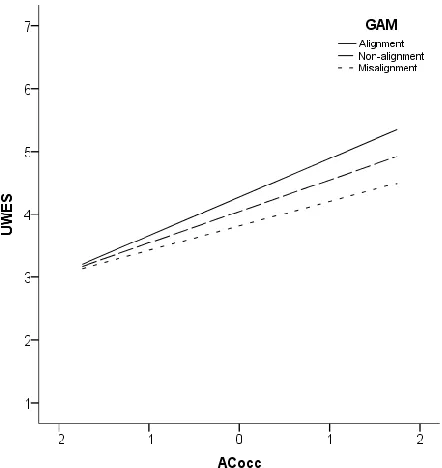
Work engagement. Goal alignment was found to be a significant moderator of
the relation between ACocc and work engagement, R2 = .029, F(1, 407) = 29.59, p <
.001. The greatest slope was found for alignment (.612), followed by non-alignment
(.500), with misalignment presenting the smallest slope (.388); see Figure 3. The results
of these analyses provided support for Hypothesis 1b.
Contrary to expectations, goal alignment was found to be a significant moderator
of the relations between ACorg and work engagement, R2 = .025, F(1, 407) = 15.63, p <
.001 (see Figure 4). The results of these analyses suggest that the greatest conditional
effect was found for alignment (.530), this was followed by non-alignment (.404), then
misalignment (.278). In considering this unexpected finding, I returned to the