Development and Initial Validation of the Role Strain Questionnaire for Junior Athletes (RSQ-JA)
Fleur E.C.A. van Rens, Erika Borkoles, Damian Farrow, Thomas Curran, Remco C.J. Polman
PII: S1469-0292(16)30022-X
DOI: 10.1016/j.psychsport.2016.02.004 Reference: PSYSPO 1076
To appear in: Psychology of Sport & Exercise
Received Date: 25 May 2015 Revised Date: 22 January 2016 Accepted Date: 2 February 2016
Please cite this article as: van Rens, F.E.C.A., Borkoles, E., Farrow, D., Curran, T., Polman, R.C.J., Development and Initial Validation of the Role Strain Questionnaire for Junior Athletes (RSQ-JA), Psychology of Sport & Exercise (2016), doi: 10.1016/j.psychsport.2016.02.004.
M
AN
US
CR
IP
T
AC
CE
PT
ED
(RSQ-JA)
Fleur E.C.A. van Rens, Erika Borkoles, Damian Farrow, Thomas Curran andRemco C.J.
Polman
Victoria University, University of Bath & Australian Institute of Sport
Author note
Fleur E.C.A. van Rens, Institute of Sport, Exercise and Active Living, Victoria University,
Melbourne, Australia; Erika Borkoles, Department of Sport and Physical Activity,
Bournemouth University, UK; Damian Farrow, Institute of Sport, Exercise and Active
Living, Victoria University, Melbourne, Australia and Australian Institute of Sport,
Movement Science, Belconnen, Canberra, Australia; Thomas Curran, Department for Health,
University of Bath; Remco C.J. Polman, Department of Psychology, Bournemouth
University, UK.
This study is part of The Sporting Success Project which is jointly funded by the
Australian Sports Commission, Gymnastics Australia and Institute of Sport, Exercise and
Active Living, Victoria University, Melbourne. Dr Erika Borkoles' work is supported through
the Australian Government’s Collaborative Research Networks (CRN) program.
Correspondence concerning this article should be addressed to Fleur ECA van Rens,
Institute of Sport, Exercise and Active Living, Victoria University, Melbourne, Australia,
M
AN
US
CR
IP
T
AC
CE
PT
ED
Abstract
1
In a series of related studies, the relevance of a role strain framework to interpret the
2
difficulties junior elite athletes experience in their multiple life domains was assessed.
3
Here, the Role Strain Questionnaire for Junior Athletes (RSQ-JA) was developed to
4
measure the role strain experienced by junior athletes. In Study 1, role strain was
5
explored via interviews with 20 elite junior athletes. Based on themes emerging from
6
these interviews, an initial 65-item pool for the RSQ-JA was created and subjected to an
7
exploratory factor analysis in Study 2. The factors derived in Study 2 were tested for
8
factorial validity using confirmatory factor analysis in Study 3. Results supported a
22-9
item five factor structure for the RSQ-JA. These factors reflected the salient sources of
10
role strain, namely; (i) overload in school, (ii) overload in sport and between roles, (iii)
11
between-role conflict, (iv) underload, and (v) ambiguity. The RSQ-JA therefore provides
12
the initial validation of the first measure of role strain experienced by junior elite athletes.
13
Keywords: talent, sport, school, dual career, stress, coping
14
15
M
AN
US
CR
IP
T
AC
CE
PT
ED
Development and Initial Validation of the Role Strain Questionnaire for Junior Athletes
1
(RSQ-JA)
2
Elite junior athletes fulfil dual careers (Wylleman & Lavallee, 2004). They are
3
athletes and students, and are therefore required to fulfil both training and school
4
commitments (Brettschneider, 1999; Dubois, Ledon, & Wylleman, 2014). Given only one
5
in three junior elite athletes progress to a senior elite level (Oldenziel, Gagné, & Gulbin,
6
2003), accomplishing good secondary education is critical for those who did not make it
7
to a professional level in their sport. Yet, school is typically perceived to conflict with
8
sport in terms of time commitment (Henriksen, Stambulova, & Roessler, 2010a, 2010b)
9
making balancing school and sport difficult (Blom & Duijvestijn, 2008; Dubois, et al.,
10
2014). Accordingly, better understanding the interplay between school and sport within
11
the lives of junior elite athletes is an important topic of research.
12
A number of studies have investigated the sport specific stressors that athletes
13
experience (Hanton, Fletcher, & Coughlan, 2005; Nicholls & Polman, 2007; Tamminen
14
& Holt, 2010). This work extends to the dual careers of athletes, and how the concurrent
15
demands from school and sport affect other life domains such family and friendships
16
(Christensen & Sørensen, 2009; Dubois et al., 2014). Notably, Christensen and
17
Sørensen’s (2009) research indicates that the pressures junior athletes experience in their
18
lives, and a lack of time for friends and leisure, are associated with dropping out of
19
school and choosing courses of lower cognitive burden. Dubois et al. (2014) similarly
20
emphasized dissatsifaction amongst athletes who were forced to make educational
21
decisions based on the toll the subjects would take on their time, instead of their
22
vocational preferences. Increasingly, professional sport organisations are beginning to
M
AN
US
CR
IP
T
AC
CE
PT
ED
recognise that a well balanced dual career will increase sport performance of elite junior
1
athletes (Pink, Saunders, & Stynes, 2014). Hence, the present study seeks to untangle the
2
interplay between school and sport by developing and validating a measure of athlete role
3
strain.
4
Role strain 5
Role strain emerged from research in the workplace where it was defined as “the
6
felt difficulty in fulfilling role obligations” (Goode, 1960, p. 483). This work extends to
7
both within-role obligations, as well as tension between role obligations. Elite junior
8
athletes experience role strain due to the sport role (e.g., training demands, performance
9
expectations; Brenner, 2007), but also as a result of competing, personally meaningful,
10
roles (e.g., friends, school, family; Christensen & Sørensen, 2009; Wylleman & Lavallee,
11
2004). Adopting this perspective, a model of role strain for adolescents was developed
12
which encapsulates four central components (Fenzel, 1989a; Holt, 1982).
13
The first component of role strain is ambiguity and is described as a lack of
14
understanding or clarity about one’s responsibilities in one or multiple roles (Holt, 1982;
15
Kahn, Wolfe, Quinn, Snoek, & Rosenthal, 1964). For example, a junior athlete might be
16
unsure about the training requirements associated with his/her sport and this uncertainty
17
might breed associated stresses. Ambiguity has been widely examined in relation to
18
fulfilment of the athlete role. In particular, studies employing the Role Ambiguity Scale
19
(Eys, Carron, Beauchamp & Bray, 2003) indicate that experiences of ambiguity are
20
associated with increased cognitive and state anxiety (Beauchamp, Bray, Eys, & Carron,
21
2003), lower athlete satisfaction (Eys, Carron, Bray, & Beauchamp, 2003), and less
22
confidence in coach competence (Bosselut, McLaren, Eys, & Heuzé, 2012).
M
AN
US
CR
IP
T
AC
CE
PT
ED
The second component of role strain model is conflict. Conflict consists of two
1
components. First, it refers to a discrepancy between the expected behaviours or
2
performance by others (e.g., coaches, parents) within a particular role (Fenzel, 1989a).
3
For instance, a sport coach might prefer a junior athlete to prioritize sport over school,
4
whilst a teacher might prefer this athlete to prioritize school over sport. Second, conflict
5
reflects the athletes’ personal schema of what constitutes acceptable behaviour or
6
performance (Fenzel, 1989a). Here, a junior athlete might be expected to show aggression
7
in his/her game, but dislike doing so. This internal discrepancy has a number of costs for
8
athletes’ performance and well-being. For instance, role conflict has been associated with
9
lower self-efficacy, and higher burnout in university and elite athletes (Beauchamp &
10
Bray, 2001; Kjormo & Halvari, 2002).
11
The third component of role strain model is overload. It refers to the perception
12
that the demands placed on athletes within and between roles exceed the personal
13
resources to meet them (Fenzel, 1989a). Overload can thus occur due to a depletion of
14
physical and mental vigour, self-efficacy, social-support and time. An example of
15
overload might be a perceived lack of time to fulfil both school and sport demands. Many
16
researchers have identified overload, or a lack of recovery time, as a critical risk factor of
17
stress and burnout amongst athletes (Brenner, 2007). This is similarly the case in school,
18
with deficits in self-efficacy being important to students’ development of burnout (Moen,
19
2013).
20
The final component of role strain model is underload. It refers to a perceived
21
underutilization of one’s resources (Holt, 1982). Underload therefore manifests when an
22
imbalance is perceived between high personal capabilities and a lack of challenge posed
M
AN
US
CR
IP
T
AC
CE
PT
ED
by the environment. A junior athlete in a rural area, for instance, might only have access
1
to lower level sport clubs and thus not be challenged to further develop his/her sporting
2
abilities. When perceived abilities outweigh perceived challenge in achievement domains,
3
apathy and boredom are expected to result (Fredricks, Alfeld, & Eccles, 2010). In sport,
4
boredom related to a lack of challenge has been identified as a significant antecedent to
5
dropout amongst promising athletes (Enoksen, 2011).
6
While the role strain framework is clearly applicable to sport, it has not been
7
applied in this context. To date, instruments have tapped into separate elements of role
8
strain to examine individual stressors, but no measure is available to capture the full array
9
of role strain dimensions. In domains other than sport, tools to directly measure role
10
strain have been developed (e.g., Early Adolescent Role Strain Inventory; Fenzel, 1989a).
11
Research using this tool has demonstrated that higher role strain is associated with poorer
12
school performance, lower global self-worth, lower self-esteem and lower perceived
13
competence (De Bruyn, 2005; Fenzel, 1989a, 1989b, 1992, 2000). The available evidence
14
therefore indicates that role strain is important for performance and health outcomes, and
15
it has potentially important implications for elite junior athletes.
16
The present set of studies 17
The role strain model provides a useful heuristic for the stressors that encapsulate
18
role stain. Therefore, we propose that this framework has utility to explain important
19
variability in athletes’ lived experiences in the way they balance the competing demands
20
of their relevant life domains (e.g., school, sport family and friendships). To test this
21
hypothesis, in Study 1, we investigated the experiences of athlete role strain in a series of
22
semi-structured interviews. Based on these experiences, in Studies 2 and 3, we developed
M
AN
US
CR
IP
T
AC
CE
PT
ED
and validated a measure of role strain in junior athletes. Overall, these studies sought to
1
advance the understanding of role strain in junior-elite sport, as well as to provide a
2
springboard for subsequent research into its antecedents and consequences.
3
Study 1 4
The purpose of Study 1 was to explore the role strain that junior elite athletes
5
experience in their relevant life domains and to inform the item generation for Study 2.
6
Method 7
Participants. Twenty Australian elite junior athletes who attended secondary 8
school at the time of the study, were interviewed (aged 13-17 years; Mage =15.5 years; SD
9
=.9). Athletes from one team sport (Australian Rules Football, ARF) and two individual
10
sports (Tennis and Gymnastics) were approached. Within each sport, participants were
11
sampled based on their current sport performance level. The gymnasts (N=5) and tennis
12
players (N=4) were identified by their respective sport federations as belonging to the
13
‘National Top’ in their age category. The ARF players were either identified by the
14
Australian Football League as belonging to the ‘National Top’ (ARF-AFL, N=5) or
15
scouted by a Sports Academy as talented players (ARF-SA, N=6). ARF is mainly played
16
competitively by males, therefore our sample predominantly consisted of male
17
adolescents (17 men, 3 women). The mean time spent in school, sport and travel varied
18
across participant groups. On average gymnasts spent the most time in school, sport and
19
travel (66 hours per week; see Table 1). Our sample included participants attending both
20
public and private schools.
21
Ethical approval was granted from the relevant institutional research ethics
22
committee and the Department of Education and Early Childhood Development in
M
AN
US
CR
IP
T
AC
CE
PT
ED
Victoria. Written consent was received from parents/guardians, and the participants prior
1
to commencement of the study.
2
Interview procedure. Participants were asked to record their age, sport 3
performance level and time commitments on a sheet to be returned to the researcher prior
4
to their interview. Each junior elite athlete was interviewed individually and agreed
5
verbally to audio recording of their interview (Olympus WS-812 digital audio recorder).
6
The interview times ranged from 22 to 46 minutes (Mtime = 35 minutes; SD = 8). 7
To ensure that the participants felt at ease, a site familiar to the participant was
8
chosen for the interview. For athletes classified as ‘National Top’, interviews were
9
conducted in a closed room at their training centre. The ARF-SA athletes were
10
interviewed in a closed room at their school.
11
The interviewer followed a semi-structured interview guide which included
12
background information, the roles the participant fulfilled, role expectations, challenges
13
in meeting role demands and in balancing multiple roles, and how successful the
14
participants perceived themselves to be at balancing their roles. Example questions were:
15
‘Which roles do you fulfil?’ and ‘What is your experience of balancing all of your
16
roles?’. In order to ensure that no life role was omitted, the participants were encouraged
17
to talk about all of their roles, such as school, sports, arts, family and religion (Marks &
18
MacDermid, 1996). The interviews were conducted by the first and second authors. For
19
confidentiality, all participants were coded (e.g., P1, P2 etc.) and their respective sports
20
were not mentioned.
21
Analysis. Interviews were transcribed verbatim and coded using the MAXQDA 22
11 software. A deductive approach was adopted for the initial thematic coding, as is
M
AN
US
CR
IP
T
AC
CE
PT
ED
recommended for qualitative analysis when existing theories are being tested (Elo &
1
Kyngäs, 2008). Specifically, the researchers initially coded the data using the definitions
2
of the four role stressors identified by Fenzel (1989a; 1989b; 1992; 2000). Only semantic
3
themes were identified. Two investigators, trained in qualitative research methods, were
4
involved in the coding process.
5
After this initial deductive approach, an inductive approach was taken to ensure
6
that additional higher order themes were not omitted, and to allow for lower-order themes
7
to emerge. Three random transcripts, one from each sport, were first coded by both
8
investigators. Differences were discussed and resolved until mutual agreement was
9
reached, this, for example led to the redefinitions of the stressors ‘role conflict’ and ‘role
10
ambiguity’. A new higher order theme ‘feeling misunderstood’ was added. A second set
11
of three interviews was coded by the two researchers in accordance with the new
12
definitions and the newly identified themes. Minimal differences between the
13
researchers’ coding results were noted. These differences were discussed and the
14
researchers agreed on the coding scheme. The researchers coded and compared two more
15
interviews and agreed that the coding scheme appeared to have reached saturation. The
16
primary researcher coded the remaining 12 interviews and did not identify any additional
17
higher or lower order themes.
18
Results 19
Participant identified roles and role stressors. All participants reported being 20
an athlete, student, family member and friend. In addition, some identified themselves
21
with other roles including; an athlete in another sport (n= 1 state level; n = 5 local
22
club/recreational); a part-time employee (n=2); and, a boyfriend (n=1). One ARF player
M
AN
US
CR
IP
T
AC
CE
PT
ED
identified multiple athlete roles due to his involvement in different teams (within the
1
same sport).
2
All participants in our sample mentioned experiences of overload at least once in
3
the interview, 95% of the athletes mentioned experiences of conflict, while experiences
4
of ambiguity were reported by 75% of the participants. Only one participant (5%)
5
reported an experience of underload.
6
Overload. All elite junior athletes reported experiences of role overload, instances 7
in which the athletes felt that role demands exceeded their resources. Often, these
8
experiences were not due to one specific role, rather it was the combination of roles that
9
exceeded the athletes’ resources. A perceived lack of time to fulfil all of their role
10
demands was frequently reported. For example, “I can get through the work no
11
problems, but making sure that I have enough time each day to do it, that’s the hardest
12
thing” (P14) and “I just get frustrated that there's so much to do, and I feel as if there's so
13
little time … and, not really much I can do to change that.” (P9). These experiences of
14
overload were not constantly present, but occurred periodically at times of high strain, for
15
instance when training camps clashed with exam periods in school.
16
Overload was, to a lesser extent, present in school, sport, friend and family roles.
17
For instance, some had difficulties concentrating long enough to complete all their
18
homework, others mentioned struggling to live up to their coaches’ expectations, and in
19
one case the divorce of parents taxed the athlete’s psychological and time resources.
20
Conflict. Due to the perceived lack of resources to fulfil all the roles the athlete 21
would like to fulfil (overload), the prioritization of one role over the other frequently
22
occurred. This process of role prioritization, which often involved a degree of sacrifice,
M
AN
US
CR
IP
T
AC
CE
PT
ED
forms the basis of the conflict experienced by the talented athletes. Almost half of the
1
athletes reported not being able to spend as much time as they would like with family and
2
friends because of other commitments. Strong feelings were associated with having to
3
prioritize school and sport over family and friends:
4
I was tempted to quit. Just because you don’t see mates, you don’t get to socialise
5
as much as what you’d normally do. It’s very difficult. Sometimes it is really
6
frustrating, because, you know, I get invited to go out and have something to eat
7
or have dinner with someone one night, and I have got training at night. And then
8
I think then what should I go to? And then I think I should go to gym, and then I
9
say we’ll do it another time. And then they ask me again. It is the same thing.
10
You know, I’ve got training that night. I can’t do it. . . . It is not really depressing,
11
but it’s sad, because I always just have to say no (P11).
12
However, not all of these prioritizations were made reluctantly. When the athletes
13
perceived that they were sacrificing an unfavourable activity, or sacrificing activities for
14
the greater good they experienced minimal, or no reluctance, “Growing up now, it’s
15
turning into a lot of mates going out drinking and smoking and all that sort of stuff. . . . I
16
don’t see anything beneficial in it, so sacrificing those sort of social occasions has been
17
good” (P11). Conflict was, to a lesser extent, also experienced distinct from overload.
18
The cause of these distinct experiences of conflict included the athletes’ unwillingness to
19
practice a certain drill, to study a certain subject at school or to do house chores. As such,
20
these experiences of conflict related to conflict of wishes between the elite junior athlete
21
and the role sender (coach, teacher, parent of peers).
M
AN
US
CR
IP
T
AC
CE
PT
ED
Being misunderstood. Some elite junior athletes experienced a different type of 1
discrepancy which could not be classified as conflict as it did not appear to relate to
2
feelings of sacrifice, reluctance, or generally not wanting to do something. Rather, some
3
athletes reported that others did not understand the full set of demands that were placed
4
on them. This included a negative attitude from some schoolteachers because they did not
5
appear to understand why the athletes were ‘only in school half of the time’, as well as
6
non-athlete peers and relatives who did not appear to understand the athlete’s
7
responsibilities and commitments. ‘Being misunderstood’ was reported by 20 percent of
8
the athletes in our sample.
9
Ambiguity. Three quarters of the interviewed athletes mentioned experiences of a 10
lack of clarity of what was expected of them. Frequently this lack of clarity was
11
associated with getting different and conflicting instructions from multiple role senders.
12
“You know like the club team might want you to do one thing and the school team might
13
want you to do another thing and they might be complete opposites and you do get
14
confused sometimes” (P3). In previous literature the different opinions of multiple
15
external role senders were considered instances of conflict (Fenzel 1989a; Hecht, 2001),
16
yet our findings indicate that these experiences of conflict are intertwined with ambiguity,
17
as they caused a lack of clarity regarding the role demands. Experiences of ambiguity
18
were most frequent in the sport role, only two athletes reported experiencing ambiguity in
19
the school role.
20
Underload. Only one experience of underload was mentioned by one ARF 21
player. As such, experiences of underload appear to be uncommon amongst junior
22
athletes. This particular instance of underload occurred in the sport role. The ARF player
M
AN
US
CR
IP
T
AC
CE
PT
ED
considered the competition at his age level was too easy, and thought that his physical
1
abilities were being under-utilized by his football team. To alleviate this experience of
2
underload, this athlete decided to join a higher age level team, despite his coach’s advice
3
against this decision.
4
Role strain as a whole. Overall, the interviews provided evidence for the four 5
components of role strain in a sample of elite junior athletes. From the perspectives of
6
competing resources, overload (especially the resource time) and conflict (especially
7
sacrificing) appear symbiotic. However, these two role stressors also existed independent
8
of each other. In addition, experienced of conflict caused by conflicting demands of two
9
or more different role senders were a contributor to experiences of ambiguity amongst the
10
junior athletes. Further, we observed interactions between the role strain experienced in
11
different life domains. As such, the role strain experienced in one role or between roles
12
could potentially lead to role strain in another role . Therefore, correlations between the
13
different components of role strain would be expected. In addition to the role strain
14
concept, the interview transcripts of this study were used in study 2 to create items from
15
verbatim quotes, which increased the items’ credibility and face validity (Dawis, 1991).
16
Taken together, the results of Study 1 indicate that role strain is a relevant
17
framework to investigate the difficulties elite junior athletes experience in their dual
18
careers. Although only one experience of underload was mentioned in the interviews, it
19
was decided to keep this factor as previous research has indicated that experiences of
20
underload are associated with boredom, decreased passion, and increased stress
21
(Fredricks, Alfeld, & Eccles, 2010).Study 2 aims to develop a questionnaire which can
22
be used to assess the role strain that junior athletes experience.
M
AN
US
CR
IP
T
AC
CE
PT
ED
Study 2 1
The purpose of Study 2 was twofold. First, an item pool capturing the role strain
2
experienced by junior athletes was created. Second, the factorial structure of the RSQ-JA
3
was analyzed using exploratory factor analysis.
4
Method 5
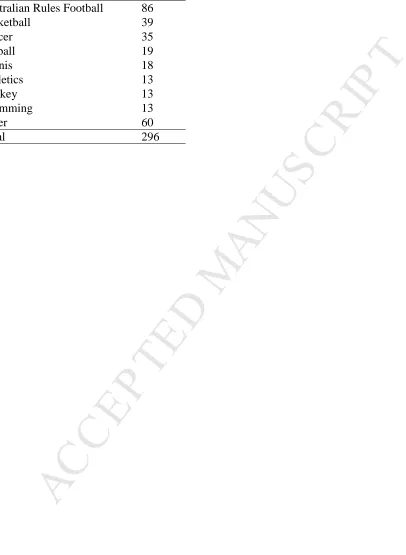
Participants. The sample consisted of 296 adolescents who participated in at 6
least one competitive sport and who were enrolled in a secondary school at the time of
7
measurement. The participants were recruited from year levels 7, 9 and 11 of a sport
8
school (N=116), a private school (N= 51), and year level 7 of a public school (N=68) in
9
Melbourne, Australia. Further, junior national level soccer players (N=10) and ARF
10
players (N=51) were recruited from the Australian Institute of Sport.
11
Our sample consisted predominantly of male (213 male, 83 female) team sport
12
players (see Table 2). The mean age of the participants was 14.4 years (SD = 1.8). The
13
sample included 16 athletes who were injured at the time of measurement. There were 89
14
athletes who competed at a basic junior competition level (local club/school competition),
15
106 competed at an advanced junior competition level (regional or state level), 27
16
competed in national junior competitions and 57 athletes competed at international junior
17
events.
18
Procedure. Support for this study was provided by 3 local secondary schools and 19
2 national talent development centers affiliated with the Australian Institute of Sport.
20
Ethical approval was granted from the Department of Education and Early Childhood
21
Learning of Victoria and relevant institutional research ethics committees. Parental
22
consent was provided by parents of the adolescent participants.
M
AN
US
CR
IP
T
AC
CE
PT
ED
Data collection procedures varied based on the preferences of the school and
1
sporting organizations. When the junior athletes had access to the internet during data
2
collection they completed the questionnaire online using laptops or tablets (N=170).
3
When access to the internet and/or electronic devices was not available the participants
4
completed a paper version of the questionnaire (N=126). Two schools agreed for the
5
completion of the questionnaire to be scheduled during class time (i.e. slots reserved in
6
either health or English), at the private school the adolescents were asked to complete the
7
questionnaire as part of their homework. The participants recruited via the sporting
8
organizations completed the questionnaire at a sport site. A researcher was present to help
9
athletes with any queries they had at all school and sport sites where data collection took
10
place.
11
Measures. 12
The Role Strain Questionnaire for Junior Athletes (RSQ-JA). The RSQ-JA was 13
developed for this study. The initial item pool consisted of 65-items. Items consisted of
14
statements and participants were asked to indicate to what extent they thought these
15
statements were ‘true for me’ over the past month. A 5-point Likert scale measured ‘how
16
true’ the statements were for the participants (‘not at all true’, ‘a little true’, ‘somewhat
17
true’, ‘mostly true’ and ‘very true’). The item pool reflected the four components of role
18
strain as per Fenzel’s (1989a) role strain model. Consistent with the findings of Study 1,
19
some items were created to capture ‘feeling misunderstood’. The interview transcripts of
20
Study 1 were used in Study 2 to inform the themes that the items should cover. Further,
21
as recommended by Dawis (1991), the interview transcripts were used to create items
22
from verbatim quotes to increase the items’ credibility and face validity. Finally, the Role
M
AN
US
CR
IP
T
AC
CE
PT
ED
Ambiguity Scale (Beauchamp, Bray, Eys, & Carron, 2002) and the Early Adolescent
1
Role Strain Inventory (Fenzel, 1989a) were used for wording of some items and
2
instructions to the questionnaire.
3
No reverse scored items were employed in our initial pool because ‘the
4
disadvantages of items worded in the opposite direction outweigh any benefits’
5
(DeVellis, 2003, p. 70). Following the guidelines of the Delphi Method (Dalkey &
6
Helmer, 1963), two external experts in psychological scale development and one external
7
expert in adolescent role strain were consulted. These consultations were completed to
8
improve face and content validity of the item pool. Based on their suggestions some items
9
were rephrased or removed.
10
To explore the face and content validity of the questionnaire for an adolescent
11
sample, two methods were used (Vogt, King, & King, 2004). First, the item pool was
12
piloted by two early adolescents. They were asked to read the items out loud to the
13
researcher and explain how they interpreted the items. Some minor changes in the
14
wording were made on the basis of adolescent piloting. Second, a Flesch-Kincaid Grade
15
Level Test was conducted to estimate the reading proficiency needed to understand the
16
items. This test was conducted in Microsoft Office Word (version 2010) and used a
17
formula which considers the difficulty of each sentence in a document based on sentence
18
length (SL) and the average number of syllables per word (SW). Items that required a
19
high reading proficiency level were rephrased. The final 65 item pool is, according to the
20
The Flesch-Kincaid Grade Level score, suitable for children in grade 4, which
21
corresponds with children who are about 10 years of age. As the participants of this study
22
were between 12 and 18 years old, the item pool was deemed appropriate for our
M
AN
US
CR
IP
T
AC
CE
PT
ED
participants’ reading levels. The final themes of the questionnaire were extracted using
1
explanatory factor analysis.
2
The Early Adolescent School Role Strain Inventory – R3 (EASRSI-R3). Role 3
strain in school was assessed using the EASRSI – R3 (Fenzel, 1993). The EASRSI – R3
4
is a third generation version of the previously developed EASRSI (Fenzel, 1989a) and
5
designed to address issues with the response format of the original EASRSI. The
6
EASRSI-R3 measures school role strain on four subscales similar to those of the
7
EASRSI: peer influences, school demands, parent control and teacher relations. The 32
8
items of the EASRSI-R3 are rated on a 4-point Likert-type scale anchored at 1 = none to
9
4 = extreme. The EARSRSI – R3 had an overall Cronbach’s Alpha value of .90, and a
10
test-retest reliability of .78 over a 15 month period in a sample of 8 to 16 year old
11
children (Fenzel, 1993). Example items of the EASRSI-R3 include ‘Teachers give too
12
much homework’, ‘Kids ignore me at school’ and ‘I don’t get enough time in school to
13
spend with my friends’. In personal communication with Fenzel (February 7, 2013), he
14
recommended the use of the EARSRSI-R3 over the use of the original EASRSI. This
15
EASRSI-R3 was used to assess the construct validity of the RSQ-JA.
16
The stress thermometer. The stress thermometer (Stanton, 1991) is a single item 17
scale which is used as an indicator of stress intensity. The item (How much stress did you
18
experience last month?) is answered on an 11 point scale, where 0 is anchored at ‘no
19
stress at all’ and 10 is anchored at ‘extreme stress’. The stress thermometer was used to
20
assess the construct validity of the RSQ-JA.
21
Data Analysis. Exploratory factor analysis was conducted on the 65 items of the 22
RSQ-JA using principal components analysis to extract the factors. The suitability of the
M
AN
US
CR
IP
T
AC
CE
PT
ED
data for factor analysis is confirmed by the presence of many coefficients of 0.30 and
1
above in the correlation matrix, as well as the Kaiser-Meyer-Oklin value of 0.91 (Kaiser,
2
1974) and a highly statistical significant score on the Bartlett’s Test of Sphericity
3
(Bartlett, 1954).
4
Principle components analysis revealed 16 components in the RSQ-JA exceeding
5
an eigenvalue of 1, explaining 65.1% of the variance in total, and 27.4% to 1.6%
6
individually. Breaks in the scree plot were apparent after the fourth and fifth component.
7
These fourth and fifth factors explained 40.6% and 43.3% of the cumulative variance
8
respectively. A four factor solution was supported by the Parallel Analysis, with four
9
eigenvalues exceeding the corresponding criterion values for a randomly generated data
10
matrix of the same size (65 items x 269 respondents). Four and five factor solutions were
11
examined, and ultimately a five factor solution was preferred. As it is expected that the
12
factors encapsulating role strain correlate, oblique (oblimin) rotation was used
13
(Tabachnick & Fidell, 2007). Incremental validity was calculated correlating the results
14
of the RSQ-JA to the EASRSI-R3 (Fenzel, 1993).
15
Results 16
In the first two iterations of the exploratory factor analysis requesting 5 factors, a
17
total of 17 items were eliminated because they failed to meet the minimum criteria of
18
having a primary factor loading of .30 or above, and no cross-loading of .30 (Tinsley &
19
Tinsley, 1987). The face validity of each factor was examined by interpreting the role
20
strain dimension that each factor captured. To improve face validity, another 20 items
21
were removed, after which a subsequent iteration was requested. In the following
22
iteration, 2 further items with a factor loading under .30 were removed. As well, at this
M
AN
US
CR
IP
T
AC
CE
PT
ED
stage, a further item was removed as its content reduced the face validity of the factor.
1
Following this, a last iteration was requested and, here, 2 items were deemed too similar
2
to stronger loading items on the same factor and, finally, a third item did not conceptually
3
fit on its loaded sub-scale.
4
The final, 25 item, 5-factor solution explained 54% of the variance in total, in
5
which each of the factors explained 29%; 9%; 7%; 5% and 5% of variance respectively.
6
The anti-image correlation matrix showed one correlation of .65 (‘I am not challenged at
7
school’), all others were ≥ 0.84. Additionally, the Kaiser-Meyer Olkin measure of
8
sampling was excellent (0.88) and the Bartlett’s test of sphericity highly significant (χ2 9
(300) = 2429.9; p = 0.001). Interpretation of these results indicated that the 5 factors were
10
underload, ambiguity, overload in sport and between roles, school overload, and conflict.
11
Construct reliability of the RSQ-JA was tested by calculating composite reliability
12
scores. Threshold values of 0.70 or more are indicative of acceptable composite
13
reliability (Hair, Andersen Tatham & Black, 1998). All factors exhibited composite
14
reliabilities exceeding .70 (see Table 3).
15
Correlational analyses. The construct validity of the 25-item RSQ-JA was 16
assessed by comparing the scale to an existing measure (Kilne, 1986). Role strain
17
measured by the RSQ-JA had a large positive correlation with role strain measured by the
18
EASRSI-R3 (r (294) = .64, p <.01), indicating that both scales measure a similar
19
underlying construct (i.e., role strain), but that differences existed between both scales.
20
Concurrent validity was assessed by examination of the correlation between role strain
21
measured by the RSQ-JA and stress. A moderate positive association between role strain
22
measured by the RSQ-JA and stress was found (r (294) = .45, p <.01), this correlation
M
AN
US
CR
IP
T
AC
CE
PT
ED
was larger than the relationship between role strain measured by the EASRSI-R3 and
1
stress (r (294) = .26, p <. 01).
2
Taken together the results from Study 2 indicate that the 25-item RSQ-JA has
3
promising psychometric properties. As such, Study 3 will further validate this scale using
4
confirmatory factor analysis with a different sample.
5
Study 3 6
The purpose of Study 3 was to cross-validate the findings of Study 2 by subjecting our
7
25-item RSQ-JA pool to a confirmative factor analysis to test the factorial structure of the
8
RSQ-JA. Further, the concurrent validity of the RSQ-JA (as validated by confirmatory
9
factor analysis) was explored.
10
Method 11
Participants. The sample consisted of 124 male elite junior ARF players who were 12
enrolled in secondary school at the time of measurement. The players were recruited from
13
the Australian Football League (AFL) talent academy (N=45) and the regional talent
14
development program of five ‘TAC cup’ teams (N=79). These TAC cup teams were
15
located in metropolitan, regional and rural Victoria and play in the peak competition for
16
adolescent ARF players. The AFL talent academy recruits its athletes from across
17
Australia. The mean age of the participants was 16.8 years (SD = 0.7). The participants
18
were following education in either in year 10 (N= 13), year 11 (N=65), or 12 (N= 46) of
19
secondary school.
20
Measures. 21
The RSQ-JA. The pool of 25-items emerging from the exploratory factor analysis 22
in Study 2 was used as the RSQ-JA.
M
AN
US
CR
IP
T
AC
CE
PT
ED
The stress thermometer. See Study 2 for a description of the stress thermometer. 1
This scale was used to assess the construct validity of the RSQ-JA.
2
The Adolescent Coping Scale II (ACSII) short version. The short version of the 3
Adolescent Coping Scale II (Frydenberg & Lewis, 2009a; Frydenberg & Lewis, 2009b)
4
was used to measure coping strategies that were adopted by the adolescents. This scale
5
consists of 20-items, each of which represents a specific coping strategy. The items of the
6
ACS II are rated on a 5-point Likert-type scale anchored at 1 = never to 5 = very often.
7
This short version of the ACS II consists of 2 main subscales; productive coping
8
strategies (α = .71; Frydenberg & Lewis, 2009a), and non-productive coping strategies (α 9
=.68; Frydenberg & Lewis, 2009a). In addition, 2 items measure a third dimension named
10
‘other’ coping strategies (using humour and seeking spiritual support). This scale was
11
used to assess the construct validity of the RSQ-JA.
12
Procedure. Support for the current study was provided by the AFL and the 13
Victorian Football League, as well as the five participating TAC cup clubs. Parental
14
consent was provided by parents of participants under 18 years of age, participants who
15
were 18 years of age at the time of measurement signed the consent form themselves.
16
Data collection procedures varied based on the preferences of the participating football
17
teams. Data from the AFL talent academy and the rural TAC cup team were collected
18
using paper versions of the questionnaire (N=64), data of the four other TAC cup teams
19
was collected using an online version of the questionnaire (N=60).
20
Data Analysis. The factorial structure of the 25-item RSQ-JA was examined with 21
confirmatory factor analysis using IBM SPSS Amos 20 (Arbuckle, 2011). One item from
22
each of the 5 factors was fixed to 1.0 for the purposes of latent variable scaling. There is
M
AN
US
CR
IP
T
AC
CE
PT
ED
some debate regarding the statistics that should be used for the assessment of model fit.
1
Recently, it has been argued that the overall fit of the model should be assessed using
2
values of several fit indices, rather than focusing on one statistic (Williams, Vandenberg
3
& Edwards, 2009). Furthermore, the cut-off values of these fit indices should be used as
4
guides rather than absolute values as these statistics are prone to misspecification,
5
dependent upon the sample size (Heene, Hilbert, Draxler, Ziegler, & Buhner, 2001).
6
Since the current study had a relatively low sample size, fit indices that are reasonably
7
robust to low sample size issues were selected.
8
The traditional measure for evaluation the overall model fit is the χ2 value (Hu &
9
Bentler, 1999). A good model fit would be indicated by a non-significant χ2 at a 0.05
10
threshold (Barrett, 2007). However, χ2 is sensitive to sample size, and does not
11
compensate for model complexity. Hence, we relied upon other indices of model fit
12
alongside the χ2. First, the Root Mean Square Error of Approximation (RMSEA) was
13
used to estimate how well the model implied covariance matrix replicates the population
14
covariance matrix (Byrne, 1998). Second, the Comparative Fit Index (CFI; Bentler,
15
1990), which provides an estimate of improvement in fit over the independence (null)
16
model, was used because it performs well with low sample sizes (Tabachnick & Fidell,
17
2007). Finally, the Standardized Root Mean Square Residual (SRMR) was used to
18
estimate the mean residual of the sample covariance matrix and the hypothesized
19
covariance matrix. Model fit was deemed adequate when; CFI > .90 and RMSEA and
20
SRMR < .10 (Marsh, Hau & Wen, 2004).
21
M
AN
US
CR
IP
T
AC
CE
PT
ED
Preliminary analyses. Only 0.003% of the possible data points were missing. As 1
such, the missing data was assumed to be missing at random. The expectation
2
maximization algorithm was used to impute missing values in SPSS. The univariate
3
skewness of the 25-items ranged from -.09 to 3.13 and the univariate kurtosis ranged
4
from -.92 to 9.4. Mardia’s normalized coefficient indicated significant multivariate 5
kurtosis (kurtosis = 106.358, critical ratio = 16.117). To address the non-normality, all
6
confirmatory factor analyses were conducted using the maximum likelihood (ML)
7
estimation with parameter estimate derived from 5,000 bootstrap resamples (Nevitt &
8
Hancock, 2001).
9
Confirmatory factor analysis. The initial confirmatory factor analysis, using the 5 10
factor structure, suggested that modifications to the 25-item RSQ-JA were required: χ2 11
(265) = 452.24, p =.07; RMSEA = .08; CFI = .82; SRMR = .08. In a sequence of
12
confirmatory factor analyses, 3 problematic items were removed as they either
cross-13
loaded on another factor, or did not load on any of the factors (see Table 3). The removal
14
of these items increased the model fit: χ2 (193) = 267.06, p =.32; RMSEA = .06; CFI =
15
.91; SRMR = .08. These values indicate that the model is acceptable fit in accordance
16
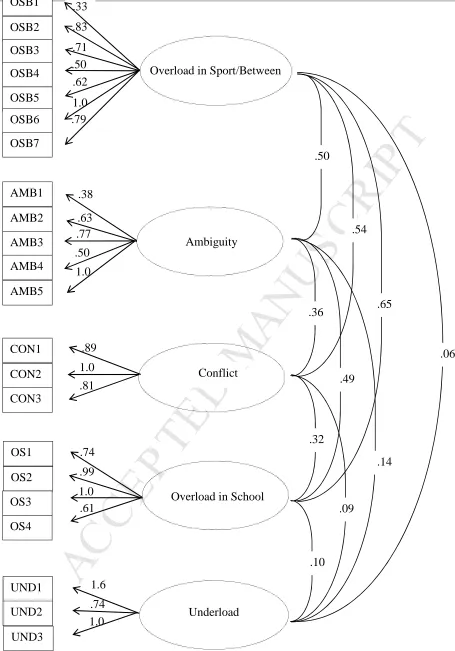
with the guidelines described above. The 5 factor structure of the RSQ-JA can be found
17
in Figure 1.
18
Construct reliability of the RSQ-JA was tested by calculating composite reliability
19
scores. Composite reliability values for overload in school (ρ = .88), overload in sport
20
and between roles (ρ = .84), ambiguity (ρ = .83) underload (ρ = .73) and conflict scales (ρ 21
= .79) indicated acceptable construct reliability. Subscale inter-correlations ranged from
M
AN
US
CR
IP
T
AC
CE
PT
ED
.17 to .59 and were all positive. Except for the correlation between underload and
1
overload in sport and between roles, all correlations were significant (p< .05).
2
Some alternative models were run to assess whether the 5 factor 22 item RSQ-JA
3
was the best fit to the observed data (Byrne, 2006; Jackson, Gillaspy & Parc-Stephenson,
4
2009). Firstly, consistent with Fenzel’s (1989)’s research on role strain, a four factor
5
structure was tested on all 25-items of the RSQ-JA, in which ‘overload in school’ and
6
‘overload in sport and between roles’ were encompassed in one ‘overload’ factor. The fit
7
of this four factor model was worse than the five factor model: χ2 (269) = 538.50, p
8
=.003, RMSEA = .09, CFI = .73, SRMR = .09). Secondly, a hierarchical model was tested 9
in which the 5 factor model was represented by one higher order ‘role strain’ factor (with
10
the 22-items). The fit of this hierarchical measurement was adequate: χ2 (199) = 297.74, p
11
=.183, RMSEA = .06, CFI = .88, SRMR = .08, with a low CFI score, indicating that this
12
model could have potential, but is not as good as the 5 factor first-order model. Finally, a
13
1-factor model was tested (with the 22-items), which produced a very poor fit to the data:
14
χ2 (204) = 419.81, p =.007, RMSEA = .09, CFI = .74, SRMR = .09.
15
Correlational Analyses. Concurrent validity was assessed by examining the 16
correlations of the 5-factor first-order RSQ-JA model with stress and coping strategies.
17
The results indicated that role strain measured by the RSQ-JA was positively associated
18
with stress (r (123) = .50, p <.01). Furthermore, the scores on the RSQ-JA were also
19
positively associated with the use of non-productive coping strategies (r (123) = .55, p
20
<.01).
21
M
AN
US
CR
IP
T
AC
CE
PT
ED
Across 3 studies, we sought to use role strain as a framework to develop and
1
validate an instrument assessing the role strain experienced by junior athletes. The first
2
study investigated the strain junior athletes experience from managing the concurrent
3
demands of their multiple life domains in 20 semi-structured interviews. Consistent with
4
the Lifespan Model, all junior athletes mentioned fulfilling school, sport, friend and
5
family roles (Wylleman & Lavallee, 2004). Results supported the applicability of the role
6
strain framework (Fenzel, 1989a, Holt, 1982) to investigate the stressors junior elite
7
athletes’ experience. Guided by these findings, Studies 2 and 3 focused on the second aim
8
of this paper: the development of the RSQ-JA, a measure to assess the levels of role strain
9
that elite junior athletes experience.The second and third study demonstrated that the
22-10
item RSQ-JA exhibited good psychometric properties and concurrent validity with
11
regards to stress and coping strategies of (a predominantly male sample of) junior
12
athletes.
13
The RSQ-JA measures role strain using five subscales: (a) overload in sport and
14
between roles, (b) conflict, (c) ambiguity, (d) underload, and (e) overload in school. The
15
components conflict, ambiguity and underload were consistent with previous
16
conceptualizations of role strain (Fenzel, 1989a; Holt 1982) as well as with the interviews
17
conducted in Study 1. In an extension to the existing literature, perceived overload
18
separated into two subcomponents, namely; overload in school, and overload in sport and
19
between roles. These findings indicate that overload in school causes a different kind of
20
strain in junior athletes than overload in sport and between roles. More research is needed
21
to investigate this.
M
AN
US
CR
IP
T
AC
CE
PT
ED
The fifth component of role strain ‘being misunderstood’, which emerged in Study
1
1, did not appear in the subsequent questionnaire validation via exploratory factor
2
analysis. The items that were created to measure ‘being misunderstood’ did not cluster
3
together, rather they appeared to be randomly distributed over several factors in the
4
exploratory factor analysis, and mostly loaded low on these factors (< 0.30). The reason
5
for this might be the difference in samples of Studies 1 and 2. Study 1 featured a high
6
proportion of (inter)national athletes in gymnastics and tennis compared to Study 2. It
7
might be that ‘being misunderstood’ is not as common in team sport players. Similarly, it
8
might be junior athletes at sport schools are less likely to feel ‘misunderstood’ by
9
teachers and peers compared to others. We would encourage future research aimed at
10
better understanding the prevalence of, and strain associated with being misunderstood’.
11
The concurrent validity of the RSQ-JA was assessed by examining its correlations
12
with stress. A significant correlation was found for both total role strain, and all 5
13
subscales. Overload in sport and between roles correlated strongly with stress (r >.50)
14
while the relationship between underload and stress was small (r <.30). This finding is
15
consistent with research by Shultz, Wang and Olsen (2010) that indicated significant
16
relationships between overload and underload and stress, where the relation between
17
underload and stress was weaker compared to the relationship between overload and
18
stress. Broadly, this finding indicates that overload is a greater contributor to stress
19
compared to underload. Further empirical research is needed to investigate the
20
relationship between the components of role strain and associated stress experienced by
21
elite junior athletes, as well as the associations between underload and boredom
22
(Fredricks et al., 2010). Due to the limitations of a single item stress measure, we
M
AN
US
CR
IP
T
AC
CE
PT
ED
encourage future research to further examine the relationship between role strain and
1
stress using a different stress measure, and we would like to encourage research on the
2
relationship between role strain and well-being of junior athletes.
3
The incremental validity of the scale was assessed by correlating the RSQ-JA and
4
the EASRSI-R3 with stress. Both scales significantly correlated with stress, however the
5
correlation between the EASRSI-R3 and stress was weaker. This suggests that stress
6
experienced by adolescent athletes is better predicted by a scale that considers all of the
7
roles elite junior athletes fulfil, compared to a scale that only measures role strain in
8
school. The RSQ-JA also correlated significantly with the use of non-productive and
9
productive coping strategies of the adolescent athletes. Specifically, higher levels of role
10
strain were associated with increased use of non-productive coping strategies. These
11
findings are congruent with past literature that suggest that adolescent athletes are not
12
able to increase the use of productive coping strategies when role strain increases, and
13
resort to coping strategies which are non-productive in dealing with the underlying issue
14
(Ebata & Moos, 1991; Galaif, Sussman, Chou, & Wills, 2003). Future studies could
15
explore how coping interventions might help adolescent athletes to better deal with role
16
strain and how such interventions might help functioning and performance in their
17
different roles.
18
Although this study successfully produced a measure of role strain in adolescent
19
athletes, some limitations need to be addressed. First, further validation of the RSQ-JA is
20
required. Additional validation studies should address the underrepresentation of female
21
athletes in the current sample. Based on the current series of studies, the RSQ-JA is
22
validated for a specific (AFL) sample of male Australian athletes. Future research is
M
AN
US
CR
IP
T
AC
CE
PT
ED
encouraged to contain a wider array of sports, and to investigate possible gender effects
1
on experiences of role strain and the RSQ-JA. Additional validation studies are also
2
encouraged to further develop the ‘underload’ scale of the RSQ-JA, as the present three
3
item scale is considered a little brief.
4
Second, this research relied solely on self-report data. Although this provides
5
insight in the adolescents’ perception of role strain, self-report of stressors can be
6
confounded (Spector, 1994). For instance, the ‘mental toughness’ culture that is prevalent
7
in ARF, could cause talented adolescent football players to indicate low scores on the
8
RSQ-JA, as admitting vulnerability and emotions is perceived as ‘weak’ (Tibbert,
9
Andersen & Morris, 2014). As a preventive measure, all participants were informed that
10
no individual responses would be reported. Additionally, research has suggested that the
11
AFL operates under the assumption that a balanced sport and off-field life will ensure not
12
only their players’ well-being, but also facilitates the players’ on-field performance (Pink,
13
Saunders & Stynes, 2014). All junior elite Australian rules football players received
14
support in their dual careers from ‘talent development managers’ who were specifically
15
appointed by the AFL to assist players with their pursuits outside of sport. This support
16
might decrease the role strain experienced by the players. As such, the findings of this
17
study might underestimate the amount of role strain experienced by a wider population of
18
junior elite athletes. Future research investigating the role strain experienced by elite
19
junior athletes in a wide range of sports should address this limitation.
20
Third, although role strain appears to be a suitable framework to assess the
21
relationship between stressors and their respective consequences, other strain theories
22
could also potentially be used. For example, General Strain Theory - which suggests that
M
AN
US
CR
IP
T
AC
CE
PT
ED
people experience strain when they lose something of value, when they are being treated
1
in a negative manner, or when they are unable to achieve certain goals (Agnew, 2001)
2
could also be used to interpret the stressors talented athletes experience. However, we
3
deem the applicability of role strain greater than General Strain Theory, as the latter does
4
not emphasize the different roles individuals occupy. For elite junior athletes it is crucial
5
to consider all roles they fulfil, therefore the role strain approach appears particularly
6
suitable for them.
7
Finally, like most research on expertise, issues with sample sizes were a recurrent
8
constraint in this series of studies. In particular, the sample size used in Study 3 was
9
considered low (N = 124). It was therefore decided to use fit indices that are reasonably
10
robust to issues with low sample size. Therefore, the sample sizes assembled for the
11
studies in this article were deemed adequate for the statistical analyses conducted.
12
Nonetheless, we would encourage future research to obtain larger sample sizes when
13
further validating the RSQ-JA.
14
To conclude, the current research confirmed the utility of role strain as a
15
framework to explain important variability in junior athletes’ lived experiences in the
16
difficulties they faced in fulfilling the concurrent demands of their dual careers, and
17
showed promising psychometric properties for the RSQ-JA. However, continued
18
validation should be conducted to confirm the factorial structure of the RSQ-JA. Further,
19
this research provided some preliminary evidence for the importance of measuring role
20
strain experienced by adolescent athletes in their sport, school, family and friend life
21
domains by showing that role strain correlates with stress. From an applied perspective,
22
the RSQ-JA may be a helpful tool for coaches and teachers to identify high and low strain
M
AN
US
CR
IP
T
AC
CE
PT
ED
periods, by tracking and monitoring role strain over time. Going forward, we hope that
1
the RSQ-JA will be used to advance our understanding of the effect of role strain on the
2
performance and well-being of junior athletes. Experiences of role strain in secondary
3
school have already been associated with decreased school performance, life satisfaction,
4
global self-worth, self-esteem and perceived competence in high school students (De
5
Bruyn, 2005; Fenzel, 1989a, 1989b, 1992, 2000). It is thus important to understand how
6
experiences of role strain in dual careers affect the well-being and school and sport
7
performance of junior athletes so that these youngsters can be better supported.
M
AN
US
CR
IP
T
AC
CE
PT
ED
References
Agnew, R. (2001). Building on the foundation of general strain theory: Specifying the
types of strain most likely to lead to crime and delinquency. Journal of research
in crime and delinquency, 38(4), 319-361.
Arbuckle, J. L. (2011). IBM® SPSS® AmosTM 20 Users Guide. Amos Development
Corporation, SPSS Inc.
Barrett, P. (2007). Structural equation modelling: Adjudging Model Fit. Personality and
individual differences, 42(5), 815-824.
Bartlett, M.S. (1954). A note on the multiplying factors for various chi-square
approximations. Journal of the Royal Statistical Society, Series B, 16, 296–298.
Beauchamp, M. R., Bray, S. R., Eys, M. A., & Carron, A. V. (2002). Role ambiguity, role
efficacy, and role performance: Multidimensional and mediational relationships
within interdependent sport teams. Group Dynamics: Theory, Research, and
Practice, 6 (3), 229-242.
Beauchamp, M. R., Bray, S. R., Eys, M. A., & Carron, A. V. (2003). The effect of role
ambiguity on competitive state anxiety. Journal of sport & exercise psychology,
25, 77-92.
Beauchamp, M. R., & Bray, S. R. (2001). Role ambiguity and role conflict within
interdependent teams. Small Group Research, 32(2), 133-157.
Bentler, P.M. (1990). Comparative fit indexes in structural models. Psychological
bulletin, 107(2), 238-246.
Bentler, P.M. (1992). On the fit of models to covariances and methodology to the
M
AN
US
CR
IP
T
AC
CE
PT
ED
Blom, S., & Duijvestijn, P. (2008). Combineren van topsport met studie, een
inventarisatie van situatie en knelpunten rond de combinatie topsport en onderwijs. Amsterdam: DSP groep.
Bosselut, G., McLaren, C. D., Eys, M. A., & Heuzé, J. P. (2012). Reciprocity of the
relationship between role ambiguity and group cohesion in youth interdependent
sport. Psychology of Sport and Exercise, 13 (3), 341-348.
Brenner, J.S. (2007). Overuse injuries, overtraining and burnout in child and adolescent
athletes. American Academy of Paediatrics, 119, 1242-1245.
Brettschneider, W. D. (1999). Risks and opportunities: Adolescents in top-level sport
growing up with the pressures of school and training. European Physical
Education Review, 5, 121-133.
Byrne, B.M. (1998). Structural equation modelling with LISREL, PRELIS and SIMPLIS:
Basic concepts, applications and programming. Mahwah, New Jersey: Lawrence
Erlbaum Associates.
Byrne, B.M. (2006). Structural equation modelling with EQS: Basic concepts,
applications and programming. London, UK: Lawrence Erlbaum.
Christensen, M. K., & Sørensen, J. K. (2009). Sport or school? Dreams and dilemmas for
talented young Danish football players. European Physical Education Review, 15,
115-133.
Dalkey, N. & Helmer, O. (1963). An Experimental Application of the Delphi Method to
the Use of Experts. Management Science, 9, 458-467.
Dawis, R.V. (1987). Scale construction. Journal of counselling Psychology, 34 (4),