R E S E A R C H
Open Access
Sparse multidimensional modal analysis using a
multigrid dictionary refinement
Souleymen Sahnoun
*, El-Hadi Djermoune, Charles Soussen and David Brie
Abstract
We address the problem of multidimensional modal estimation using sparse estimation techniques coupled with an efficient multigrid approach. Modal dictionaries are obtained by discretizing modal functions (damped complex exponentials). To get a good resolution, it is necessary to choose a fine discretization grid resulting in intractable computational problems due to the huge size of the dictionaries. The idea behind the multigrid approach amounts to refine the dictionary over several levels of resolution. The algorithm starts from a coarse grid and adaptively improves the resolution in dependence of the active set provided by sparse approximation methods. The proposed method is quite general in the sense that it allows one to process in the same way mono-and multidimensional signals. We show through simulations that, as compared to high-resolution modal estimation methods, the proposed sparse modal method can greatly enhance the estimation accuracy for noisy signals and shows good robustness with respect to the choice of the number of components.
Keywords:modal estimation, multidimensional damped sinusoids, adaptive sparse approximation, multi grid
1 Introduction
The topic of sparse signal representation has received con-siderable attention in the last decades since it can find application in a variety of problems, including mono-and multidimensional deconvolution [1], statistical regression [2], and radar imaging [3]. Sparse approximation consists of finding a decomposition of a signalyas a linear combi-nation of a limited number of elements from a dictionary
FÎℂM × N, i.e., finding a coefficient vectorxthat satisfies
y≈Fx, whereFis overcomplete (M < N). The sparsity condition onxensures that the underdetermined problem does not have an infinite number of solutions. The dic-tionaryFcan be chosen according to its ability to repre-sent the signal with a limited number of coefficients or it can be imposed by the inverse problem at hand. In the lat-ter case, we consider dictionaries whose atoms are func-tion of some parameters. The different atoms of the dictionary are then formed by evaluating this function over a grid which has to be very fine to achieve a certain degree of resolution. This is the case for the modal estima-tion problem in which the atoms are formed by discretiz-ing the frequency and dampdiscretiz-ing factor axes. In this
situation, the challenge is to get a good approximation without a prohibitive computational cost due to the huge size of the dictionary.
This study addresses the modal retrieval problem. This is an important topic in various applications including nuclear magnetic resonance (NMR) spectroscopy [4], wire-less communications, radar, and sonar [5]. A modal signal is modeled as a sum of damped complex sinusoids. Several methods have been developed to address the modal esti-mation problem such as maximum likelihood [6,7] and subspace-based methods [5,8-12]. A special case of modal estimation is the harmonic retrieval problem (null damping factor) which has been formulated as a sparse approxima-tion in a number of contribuapproxima-tions. In the case of 1-D har-monic retrieval problem, we can cite FOCUSS [13], the method of Moal and Fuchs [14], basis pursuit [15], adaptive weighted norm extrapolation [16]. Some other contribu-tions may be found in [17,18]. Nevertheless, only a few methods have been applied to the damped case. For instance, [19] presents a sparse estimation example of 1-D NMR (modal) data by using Lasso [20], LARS [21] and OMP [22]. Goodwin et al. [23] proposed a damped sinusoi-dal signal decomposition for 1-D signals using Matching Pursuit [24]. Similarly, regarding multigrid approaches associated with sparse approximation methods, only some * Correspondence: [email protected]
CRAN, Nancy-Université, CNRS, Boulevard des Aiguillettes, BP 70239, Vandoeuvre 54506, France
studies are considering the 1-D harmonic signals [25,26]. In the case of 2-D signals, an approach combining adaptive multigrid decomposition and TLS-Prony estimation was proposed in [27]. However, to authors knowledge, there is no study that deals with the problem of estimating para-meters of multidimensional (R-D) damped sinusoidal sig-nals by sparse approximation methods. This article provides a multidimensional generalization of the study presented in [28,29].
The goal of this article is to present an efficient approach that reduces the computational cost of sparse algorithms forR-D modal estimation problems. The main contributions of the article are as follows. (i) We propose a procedure which iteratively improves the set of atoms in the dictionary. The goal of this procedure is to improve resolution by avoiding computationally expensive opera-tions due to the processing of large matrices; we refer to this procedure as the multigrid approach. (ii) We show how the 1-D modal retrieval problem can be addressed using sparse estimation approach by building a dictionary whose atoms are calculated by sampling the modal func-tion over a 2-D grid (frequency and damping factor) in order to obtain all possible modes combinations. (iii) We show how to extend the sparse 1-D modal estimation pro-blem toR-D modal problems.
The article is organized as follows. In Section 2, we pro-vide background material and definitions for sparse signal representation. We present some known sparse methods and we recall the single best replacement (SBR) [30] algo-rithm and its advantages as compared to other algoalgo-rithms such as OMP, OLS, and CoSaMP, to name a few. In Sec-tion 3, we present the multigrid dicSec-tionary refinement approach and we discuss its usefulness to accelerate com-putation and to improve resolution. In Section 4, we see how the 1-D modal retrieval problem may be addressed using sparse approximations and how the multigrid approach can be applied. In Section 5, we extend the sparse multigrid approach to theR-D modal estimation problem. In Section 6, experimental results are presented first to compare SBR to a greedy algorithm (OMP) and a solver to the basis pursuit problem. Then, the effectiveness of the multigrid approach will be illustrated on simulated 1-D and 2-D modal signals. Conclusions are drawn in section 7.
Notations: Upper and lower bold face letters will be used for matrices and column vectors, respectively. AT denotes the transpose ofA.“⊙” will denote the Khatri-Rao product (column-wise Kronecker) and “⊗” will denote the Kronecker product.
2 Sparse approximations
2.1 Key ideas of sparse approximations
Consider an observation vectory ÎℂMwhich has to be approximated by a sum of vectors from a matrixFsuch
that y ≈Fx, where F = [j1..., jN] Î ℂM × N and x Î ℂNcontains coefficients that select and weight columns
jn. We refer toFas adictionaryand toxas a
represen-tationof the signaly with respect to the dictionary. To find an accurate approximation for any arbitrary signal
y, the dictionary has to be overcomplete, i.e., has to con-tain a large number of atoms. Therefore, we have to solve an underdetermined system whenM < N. Clearly, there is an infinite number of solutions that can be used to represent y. This is why additional conditions have to be imposed. Let us introduce the pseudo normℓ0, ||⋅||
0:ℂN®N, which counts the number of non-zero com-ponents in its arguments. We say that a vector x is s-sparse, when ||x||0 =s. In the case for an observed sig-nal corrupted with noise, the problem of estimating the sparsest vectorxsuch asFx approximatesyat best can be stated as an ℓ2 - ℓ0 minimization problem admitting two formulations:
- the constrained ℓ2 - ℓ0 problem whose goal is to seek the minimal error possible at a given level of sparsitys≥1:
arg min
x0≤s
{E(x)=y−x2} (1)
- the penalizedℓ2-ℓ0 problem:
arg min
x∈Cn {J
(x,λ) =E(x) +λx0}. (2)
The goal is to balance between the two objectives (fit-ting error and sparsity). Here, the solution sparsity level is controlled by thelparameter.
Theℓ2-ℓ0 problem is known to yield an NP complete combinatorial problem which is usually handled by using suboptimal search algorithm. Restricting our attention to greedy algorithms, the main advantage of theℓ2-ℓ0penalized form is to allow both insertion and removal of elements inx, while the constrained form only allows the insertion when optimization is carried through a descent approach [30,31].
A well known greedy method for sparse approxima-tion is orthogonal matching pursuit (OMP) [22]. It minimizes iteratively the error ℰ(x) until a stoping cri-terion is met. At each iteration the current estimate of the coefficient vectorx is refined by selecting one more atom to yield a substantial improvement of the signal approximation.
minx1subject toy−x< ε. (3)
This principle leads to approximation that can be sparse and this minimization problem can be solved via linear programming [32]. Instead of ℓ2 - ℓ1 penalized problem, FOCUSS algorithm [13] uses aℓ2-ℓppenalized criterion. Forp <1, the cost function is nonconvex, and the convergence to global minima is not guaranteed. It is indicated in [33], that the best results are obtained for
pclose to 1, whereas the convergence is also slowest for
p =1.
In this article, we will use the SBR algorithm together with the multigrid approach. This algorithm has very interesting performance particularly in the case where the dictionary elements are strongly correlated [30], this is precisely the case with modal atoms. The algorithm is briefly recalled in the following paragraph.
2.2 SBR algorithm for penalizedℓ2-ℓ0problem
The heuristic SBR algorithm (see, Table 1) was proposed in [30] to minimize the mixed ℓ2 - ℓ0 cost function J(x,λ) defined in (2) for a fixed parameter value l. It is a forward-backward algorithm inspired by the SMLR method [34]. It is an iterative search algorithm that addresses the penalized ℓ2-ℓ0 problem for fixed l. We denote byΩ• nthe insertion or removal of an indexn
into/from the active setΩ
•n=
∪ {n}ifn ∈/
\{n} otherwise. (4)
At each iteration, theNpossible single replacements
Ω • n(n = 1,...,N) are tested (i.e., Nleast square pro-blems are solved to compute the minimum squared errorℰΩ•nrelated to each supportΩ•n), then the repla-cement yielding the minimal value of the cost function J(x,λ), i.e., J•n(λ) :=ε•n+λCard(•n), is selected.
In Table 1, the replacement rule is formulated by“nkÎ...” in case several replacements yield the same value of J(x,λ). However, this special case is not likely to occur when dealing with real data. A detailed analysis and per-formance evaluation can be found in [30] where it is shown that SBR performs very well in the case of highly correlated dictionary atoms (which is the case here). We note that unlike many algorithms which require to fix
either a maximum number of iterations to be performed or a threshold on the squared error variation (OMP and OLS for instance), the SBR algorithm does not need any stopping condition since it stops when the cost function J(x,λ) does not decrease anymore. However it requires to tune the parameterlwhich is done empirically.
3 Multigrid dictionary refinement
As mentioned before, we restrict our attention to the case of modal dictionaries whose atoms are calculated by evalu-ating a function over a multidimensional grid, the grid dimension being equal to the number of unknown modal parameters. To achieve a high-resolution modal estima-tion, a possible way is to define a high resolution diction-ary often resulting in a prohibitive computational burden. Rather than defining a highly resoluted dictionary, we pro-pose to adaptively refine a coarse one through a multigrid scheme. This results in the algorithm sketched on Table 2, where the key step is the adaptation of the dictionary as a function of the previous dictionary and the estimated vec-torx. The algorithm amounts to insert (resp, remove) atoms in (resp, from)Fand to re-run the sparse approxi-mation algorithm. We propose two procedures to refine the dictionary. The first one consists in inserting new atoms in theFmatrix in the neighborhood of active ones. In other words, we first restore the signalx(l)related to the dictionaryF(l)by applying a sparse approximation method (SAM) at levell. Then we refine the dictionary by inserting atoms in between pairs ofF(l), in the neighborhood of each activated atom and we apply again the SAM at levell
+ 1 to restorex(l+1)with respect to the refined dictionary F(l+1). Thus we refine iteratively the dictionary until the maximum levell = L -1 is reached. This procedure is illu-strated on Figure 1a where the dictionary atoms depend on two parameters,fanda. The disadvantage of this pro-cedure is that the size of the dictionary is increasing as new atoms are constantly added between two resolution levels. Hence, the computational cost will be increasing. To cope with this limitation, we propose a second dure consisting in adding new atoms as in the first proce-dure and deleting remote non-active ones (Figure 1b). The later multigrid approach may suffer from one main short-coming. Indeed, removing non-active atoms excludes the possibility of further having active components in the
Table 1 SBR algorithm [30]
- Input. A signal yÎℂM, a matrixFÎℂM × Nand a scalarl
- Output. A sparse coefficient vector xÎℂN.
1.Initialize. Set the index setΩ1=∅, The coefficient vectorx1= [0,..., 0] T
and set the counter tok= 1. 2.Identify. Find the replacementnkofFthat most decreases the objective function:
nk∈arg min
n {Jk•n
(λ) :=E•n+λCard(•n)}
Jk•nk(λ)<Jk(λ)
neighborhood of already suppressed atoms. A possible way to overcome this problem consists in maintaining all the atoms from the initial dictionary in all theF(l)’s.
The multigrid dictionary refinement is proposed in the context of modal analysis. However, it is worth noticing that this idea can be straightforwardly extended to any dictionary obtained by sampling a continuous function over a grid.
4 Monodimensional modal estimation using sparse approximation and multigrid
4.1 1-D data model
A 1-D complex modal signal containingFmodes can be written as:
y(m) = F
i=1
ciami +e(m) (5)
form = 0,...,M - 1, where (ai=e(−αi+j2πfi)), with{αi}Fi=1 the damping factors and{fi}Fi=1the frequencies.{ci}Fi=1are complex amplitudes ande(m) is an additive noise. The problem is to estimate the set of parameters{ai,ci}Fi=1 from the observed sequencey(m). Equation (5) can be written under a matrix form as:
y=Ac+e (6)
= ⎡ ⎢ ⎢ ⎢ ⎢ ⎢ ⎣
1 1 · · · 1 1 · · · 1 · · · 1
φ1,1(1) φ1,2(1) · · · φ1,K(1) φ2,1(1) · · · φ2,K(1) · · · φp,K(1)
φ1,1(2) φ1,2(2) · · · φ1,K(2) φ2,1(2) · · · φ2,K(2) · · · φp,K(2) ..
. ...
φ1,1(M−1)φ1,2(M−1)· · ·φ1,K(M−1)φ2,1(M−1)· · ·φ2,K(M−1)· · ·φP,K(M−1) ⎤ ⎥ ⎥ ⎥ ⎥ ⎥ ⎦ N=PKatoms (7)
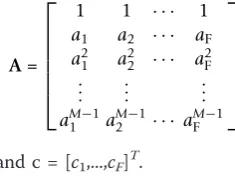
whereAis anM × FVandermonde matrix:
A= ⎡ ⎢ ⎢ ⎢ ⎢ ⎢ ⎣
1 1 · · · 1
a1 a2 · · · aF a21 a22 · · · a2F
..
. ... ...
aM1−1aM2−1· · · aMF−1 ⎤ ⎥ ⎥ ⎥ ⎥ ⎥ ⎦
and c = [c1,...,cF]T.
4.2 1-D sparse modal estimation
The problem of modal estimation is an inverse problem sinceyis given andA,c, andFare unknown. It can be for-mulated as a sparse signal estimation problem by defining the dictionaryFgathering all the possible modes obtained by sampling a(Psamples) andf(Ksamples) on a 2-D grid.Fis expressed in (7) withφp,k(m) =e(−αp+j2πfk)mand N = PKProvided thataandfare finely sampled, we can assume thatAis a submatrix ofFso thatccorrespond to the nonzero elements inx. Then the modal estimation problem can be formulated as a penalizedℓ2-ℓ0sparse signal estimation problem (2). The multigrid approach presented before can be used to that end.
5 Multidimensional modal estimation using sparse approximation and multigrid
5.1R-D data model
A multidimensional complex modal signal containingF
modes can be written as:
y(m1,. . .,mR) =
F i=1 ci R r=1 amr
i,r +e(m1,. . .,mR) (8)
wheremr=0,...,Mr -1 forr = 1,...,R. Mr denotes the sample support of therth dimension,ai,r=e(−αi,r+j2πfi,r)is
the ith mode in the rth dimension, with{αi,r}Fi=1,,Rr=1the damping factors and{fi,r}iF=1,,Rr=1the frequencies,{ci}Fi=1the complex amplitudes, and e(m1m2...,mR) stands for an additive observation noise. The problem is to estimate the set of parameters {αi,r}iF=1,,Rr=1and {ci}Fi=1from the samplesy(m1,...,mR).
In order to facilitate the presentation, we rewrite the data model using the Khatri-Rao product. Given (8), we define the vectoryas:
y= ⎡ ⎢ ⎢ ⎢ ⎢ ⎢ ⎢ ⎢ ⎢ ⎢ ⎢ ⎣
y(0, 0,. . ., 0)
y(0, 0,. . ., 1) .. .
y(0, 0,. . .,MR−1)
y(0, 0,. . ., 1, 0) .. .
y(M1−1,M2−1,. . .,MR−1)
⎤ ⎥ ⎥ ⎥ ⎥ ⎥ ⎥ ⎥ ⎥ ⎥ ⎥ ⎦ . Table 2 Sparse multigrid algorithm
- Input. A signal yÎℂM, a matrixFÎℂM × N, a scalerland an
integerL
- Output. A sparse coefficient vector xL-1ÎℂN
Forl= 0 up tol = L- 1
xl= SAM (l,y,λ)
l+1= ADAPT (l,xl),
End For.
Add
Add & remove
Φl: levell Φl+1: levell+ 1
f f
α α
(b) (a)
Then, we define RVandermonde matrices Ar∈CMr×F
with generators{ai,r}Fi=1such that
Ar=
⎡ ⎢ ⎢ ⎢ ⎢ ⎢ ⎣
1 1 · · · 1
a1,r a2,r · · · aF,r
a2
1,r a22,r · · · a2F,r ..
. ... ...
aMr−1 1,r a
Mr−1 2,r · · · a
Mr−1
F,r
⎤ ⎥ ⎥ ⎥ ⎥ ⎥ ⎦
,
withr =1,..., R. It can be checked that
y= (A1A2 · · · AR)c+e (9)
where c = [c1,c2,...,cF]T gathers the complex ampli-tudes and e is the noise vector.
5.2 E-D sparse modal estimation
Similar to the 1-D case, the R-D modal retrieval pro-blem can be formulated as a sparse signal estimation problem by defining a dictionary that gathers all possible combinations of 1-D modes obtained by sampling damping factors and frequencies for each dimension on 2-D grids. LetPrbe the number of damping factorsa1,r,
a2,r,...,aPr,randKr the number of frequenciesf1,r,f2,r,...,
fKr,r resulting from the sampling of therth dimension, then the corresponding dictionary is given by
(r)=φ(r)
1,1,. . .,φ (r) 1,Kr,φ
(r) 2,1,. . .,φ
(r) 2,Kr,. . .,φ
(r)
pr,Kr
,
where φp(r,k)=
φ(r)
p,k(0),. . .,φ
(r)
p,k(Mr−1)
T
and
φ(r)
p,k(mr) =e(−αp,r+j2πfk,r)mrfor p= 1,...,Pr and k = 1,...,Kr. Finally, the dictionary involved in theR-D sparse modal approximation is defined by:
=(1)⊗2⊗. . .(R), (20)
where the number of atoms isN=R
r=1Nr, withNr=
PrKr. Note that the dictionaryFcan be seen as a 2R -dimen-sional sampling of theR-dimensional modal function. Then theR-D modal retrieval problem can be formulated as a penalizedℓ2-ℓ0sparse signal estimation problem (2).
5.3 Multigrid approach forR-D modal estimation
According to (10), the dictionary is obtained by doing the Kronecker product ofR1-D modal dictionaries. Thus, we can still use the multigrid approach presented in section 3 to adapt each 1-D dictionary to form theR-D dictionary. This results in the algorithm sketched in Table 3.
6 Experimental results
In this section, we present some experimental results for the multigrid sparse modal estimation. First, we present two examples on 1-D simulated modal signals. Next, we
present and discuss results on a 2-D simulated signal and we compare them with those obtained by the sub-space method “2-D ESPRIT” [5]. We chose the 2-D ESPRIT method because a comparative performance study [35] has shown that among different subspace-based high resolution modal estimation techniques, it was the one which was giving the best results.
6.1 1-D modal estimation results
First, we compare the results achieved by SBR, OMP, and the primal-dual logarithmic barrier (log-barrier) algorithm for solving the BP problem [15]. Here we used the SparseLabaimplementations of OMP and
BP (SolveOMP and SolveBP). Then, we present the
results achieved using the multigrid SBR approach. The first dataset is a noise-free 1-D modal signal y composed ofM= 30 samples and made up of three 1-D superimposed damped complex sinusoids having the same amplitude. The 1-D modes are:
(f1,α1) = (0.2, 0.050);
(f2,α2) = (0.3, 0.025);
(f3,α3) = (0.9, 0.050).
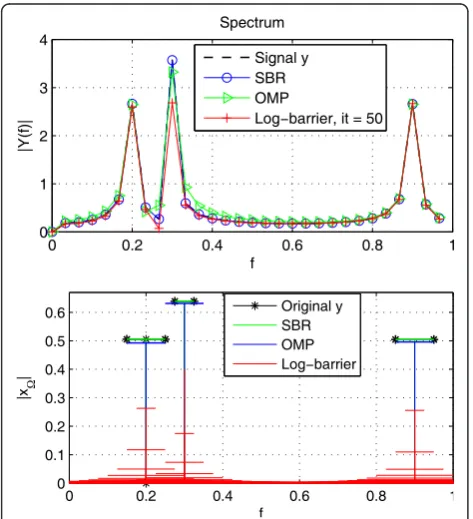
The dictionary is constructed using 20 equally spaced frequency points in the interval [0 1], where each fre-quency point is coupled with 20 points of damping factors in [0 0.5] and each atom represents a 1-D complex sinu-soid ofMsamples. Thus, the dictionaryFis of size 30 × 400. We notice that the simulated 1-D modes belong to the dictionary. Thus, in the noise free case, it is possible to have an exact representation of the signal.
We estimate the parameters ofyusing SBR, OMP, and log-barrier; the results are shown in Figure 2. The repre-sentation given at the bottom of Figure 2 plots the active modes in the frequency-magnitude plane: the vertical lines are located at the frequencies of the active setΩand their heights represent the corresponding estimated magnitudes
|xΩ|. The horizontal segments represent the damping
does not estimate correctly the parameters of 1-D modal signals and the solution is less sparse than the solutions provided by SBR and OMP.
In the second example, SBR algorithm coupled to multigrid approach is applied to estimate the 1-D modes from a simulated 1-D modal signal expressed in (5) with 30 samples embedded in additive Gaussian white noise such that the SNR is 23 dB. We start restoration using the same dictionary described in the
first example, then we refined it with the multigrid approach. The simulated modes are:
(f1,α1) = (0.19, 0.025),
(f2,α2) = (0.23, 0.050).
These modes are chosen in such a way that they can-not be separated by the Fourier transform (Figure 3)
Table 3R-Dsparse multigrid algorithm
- Input. A signaly∈CM1M2...MRRmatrices(r)
0 ∈CMr×Nr, a scalerland an integerL
- Output. A sparse coefficient vector xL-1ÎℂN
Forl= 0 up tol = L -1
l=(1)l ⊗(2)l ⊗ · · · ⊗(lR) xl= SAM(l,y,λ)
Forr= 1 up tor = R
(r)
l+1= ADAPT(
(r)
l ,xl)
End For End For.
0 0.2 0.4 0.6 0.8 1
0 1 2 3
4 Spectrum
f
|Y(f)|
Signal y SBR OMP
Log−barrier, it = 50
0 0.2 0.4 0.6 0.8 1 0
0.1 0.2 0.3 0.4 0.5 0.6
f
|x
|
Original y SBR OMP Log−barrier
Figure 2Spectrum of y and its estimates by SBR, OMP, and log-barrier (top), frequencies and damping factors of
estimated modes (bottom).
0 0.1 0.2 0.3 0.4 0.5 0
1 2 3
Spectrum
f
|Yi
(f)|
Original y Mode 1 Mode 2 Mode 3
(a) Level 1:fi= 0.15,0.2,0.25 andαi= 0.125,0.15,0.225 resp.
0 0.1 0.2 0.3 0.4 0.5 0
1 2 3
Spectrum
f
|Yi
(f)|
Original y Mode 1 Mode 2
(b) Level 7:fi= 0.1917,0.2302 andαi= 0.05,0.025 resp.
and they are not initially in the dictionaryF. Figure 3a shows the spectrum of each sinusoid activated in the first level. Using the second multigrid procedure pre-sented before, we see on Figure 3b that the two 1-D modes have been well separated in level 7, which proves the effectiveness of the approach. To give some figures about the efficiency of the multigrid approach, it is interesting to compare the size of the dictionary at the 7th degree of resolution to the uniform dictionary allow-ing the same resolution. For our example, F(7) is of dimension 30 × 520 while the uniform one achieving the same resolution would require a dictionary of size 30 × 6553600. This dramatic increase in the number of atoms is due to the bidimensional nature of the diction-ary. Obviously, this complexity becomes huge for bi-and multidimensional modal signals.
6.2 2-D modal estimation results
First, SBR is used in combination with the multigrid approach to estimate parameters of a 2-D simulated signal (ysim) of dimensions 20 × 20 which contain three modes
with parameters:
(f1,1,α1,1;f1,2,α1,2) = (0.100, 0.00; 0.2, 0.0),
(f2,1,α2,1;f2,2,α2,2) = (0.125, 0.00; 0.2, 0.0),
(f3,1,α3,1;f3,2,α3,2) = (0.125, 0.05; 0.3, 0.1).
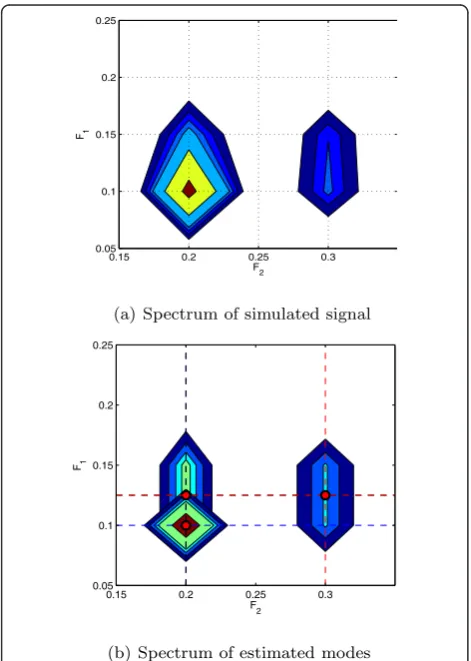
Note that the first two modes are not separated by 2-D Fourier transform. Amplitudes are (c1,c2,c3) = (1,1,3) and the additive white noise variance is such that the SNR of the first mode is 7 dB (SNR1= 7). In the following simula-tions we use this simulated 2-D signal (ysim) with the same modes and amplitudes, we only change the SNR value. The spectrum of the simulated signal is represented by contour lines in Figure 4a where it is verified that the first two peaks are not separable by Fourier transform. The SBR method coupled with the proposed multigrid approach detects well the three components at the third resolution level. Their respective spectras are shown in Figure 4b. To give an idea about the gain in computational cost, the size of the dictionary at the third level is equal to
F2
F1
0.15 0.2 0.25 0.3
0.05 0.1 0.15 0.2 0.25
(a) Spectrum of simulated signal
F2
F1
0.15 0.2 0.25 0.3
0.05 0.1 0.15 0.2 0.25
(b) Spectrum of estimated modes
Figure 4Frequency resolution of the proposed method with SNR1= 7dB. The position of simulated modes is presented by a circle.
0.15 0.2 0.25 0.3
0.05 0.1 0.15 0.2 0.25
f1 f2
estimated modes
(a) Modes estimated by 2-D ESPRIT
0.15 0.2 0.25 0.3
0.05 0.1 0.15 0.2 0.25
F1 F2
estimated modes
(b) Modes estimated by proposed algorithm
Figure 5Comparison between 2D-ESPRIT and the proposed
method with SNR1= 20 dB. (○) Frequencies of simulated 2-D
400 × 3136. The size of the uniform dictionary achieving the same resolution is 400 × 409600; the gain in term of size is a multiplicative factor 130.
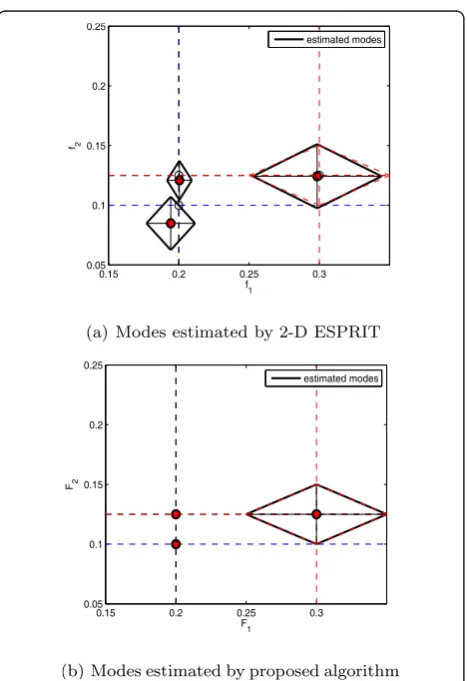
In Figure 5, we compare the estimated modes obtained by the 2-D ESPRIT [5] and our proposed tech-nique. We use the 2-D simulated signal (ysim) with the SNR set to 20 dB. Both our technique and 2-D ESPRIT are able to separate the three modes, whereas there is a slight error made by 2-D ESPRIT on the first and sec-ond modes. In Figure 6, we decrease the SNR to 7 dB, and only the proposed algorithm is still able to estimate the three modes with an accuracy similar to what was obtained when the SNR equals 20 dB. In that case, the 2-D ESPRIT performance decreases and the modal para-meters are biased.
In Figure 7, we test the sensitivity of our technique to the correct determination of the number of modes in the signal. In the previous examples, the parameterlof the penalized cost function in SBR algorithm was fixed to 0.01 and we did not give any constraint on the
number of modes to be estimated. However, in the example presented in Figure 7, we use the 2-D simu-lated signal with SNR equal to 20 dB, and we force 2-D ESPRIT and the proposed algorithm to estimate 5 modes (while the actual number of modes is 3). We observe that the proposed algorithm is not very sensitive to the correct determination of the number of existing modes in the sense that the true modes are activated and the other active atoms lies in the neighborhood of the true modes. On the contrary, the 2-D ESPRIT yields spurious modes located very far from the true ones.
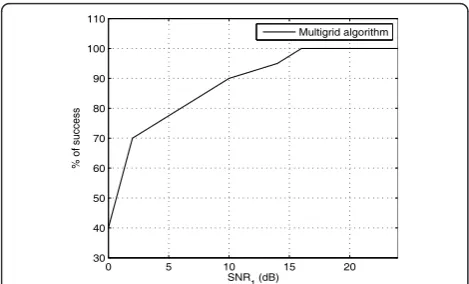
In Figure 8, we analyze the sensitivity of the multigrid algorithm to noise power. We use the same signal ysim with different noise levels SNR1. For each noise level we do 20 Monte Carlo trials and then we calculate the per-centage of successful estimations obtained after three multigrid levels. We can see that the proposed algorithm reconstruct exactly the signal with a rate upper than
0.15 0.2 0.25 0.3
0.05 0.1 0.15 0.2 0.25
f1 f2
estimated modes
(a) Modes estimated by 2-D ESPRIT
0.15 0.2 0.25 0.3
0.05 0.1 0.15 0.2 0.25
F1 F2
estimated modes
(b) Modes estimated by proposed algorithm
Figure 6Comparison between 2-D ESPRIT and the proposed
method with SNR1= 7 dB. (○) Frequencies of simulated 2-D
modes; (•) Frequencies of estimated 2-D modes; (⋄) The diagonals of the diamonds represent the 2-D damping factors.
F1
F2
0 0.2 0.4 0.6 0.8 1
0 0.1 0.2 0.3 0.4 0.5 0.6 0.7 0.8 0.9 1
(a) Spectrum of modes estimated by 2-D
ESPRIT
F1
F2
0 0.2 0.4 0.6 0.8 1
0 0.1 0.2 0.3 0.4 0.5 0.6 0.7 0.8 0.9 1
(b) Spectrum of modes estimated by
pro-posed algorithm
Figure 7Simulation results with number of estimated modes
forced to be 5 and SNR1= 20 dB (on the first mode). Estimated
80% for an SNR1 more than 6 dB; and the rate of suc-cess is 100% with an SNR1 upper than 15 dB.
7 Conclusion
We presented a multigrid technique that adaptively refines ordered dictionaries for sparse approximation. The algorithm may be associated with any sparse method, but clearly the accuracy of the final results will depend on the accuracy of the sparse approximation. Then sparse approximation associated to multigrid are used to tackle mono-and multidimensional modal (damped sinusoids) estimation problem. Thus, we applied the SBR algorithm which is shown, using simu-lation results, to perform better than OMP and Basis Pursuit for modal approximation. Finally, we examined performances of our proposed algorithm over existing
R-modal estimation algorithms. It allows one to separate modes that the Fourier transform cannot resolve with-out a huge increase in the computational cost, improves robustness to noise and does not require initialization. As perspectives, we will study possible improvements for the sparse multigrid approach in the case of multidi-mensional modal signals. In particular, we can envisage to used multiple 1-D modal estimation to get a low dimension initial dictionary for R-D modal estimation. We also are planning to study the convergence proper-ties of the multigrid approach and we will apply the method to the modal estimation of real NMR signals.
Endnote a
http://sparselab.stanford.edu.
Authors’contributions
All authors contributed to all aspects of the article. All authors read and approved the final manuscript.
Competing interests
The authors declare that they have no competing interests.
Received: 15 September 2011 Accepted: 8 March 2012 Published: 8 March 2012
References
1. FX Dupé, JM Fadili, JL Starck, A proximal iteration for deconvolving poisson noisy images using sparse representations. IEEE Trans Image Process.18(2), 310–321 (2009)
2. AJ Miller,Subset Selection in Regression, 2nd edn. (Chapman and Hall, London, UK, 2002)
3. M Cetin, W Karl, Feature-enhanced synthetic aperture radar image formation based on nonquadratic regularization. IEEE Trans Image Process.
10(4), 623–631 (2001). doi:10.1109/83.913596
4. JC Hoch, A Stern,NMR Data Processing(Wiley-Liss, NY, 1996)
5. S Rouquette, M Najim, Estimation of frequencies and damping factors by two-dimensional ESPRIT type methods. IEEE Trans Signal Process.49(1), 237–245 (2001). doi:10.1109/78.890367
6. Y Bresler, A Makovski, Exact maximum likelihood parameter estimation of superimposed exponential in noise. IEEE Trans Acoustics Speech Signal Process.35(5), 1081–1089 (1986)
7. MP Clark, LL Scharf, Two-dimensional modal anlysis based on maximum likelihood. IEEE Trans Signal Process.42(6), 1443–1451 (1994). doi:10.1109/ 78.286959
8. R Kumaresan, DW Tufts, Estimating the parameters of exponentially damped sinusoids and pole-zero modeling in noise. IEEE Trans Acoustics Speech Signal Process.30, 833–840 (1982). doi:10.1109/TASSP.1982.1163974 9. P Stoica, A Nehorai, MUSIC, maximum likelihood, and cramer-rao bound.
IEEE Trans Acoustic Speech Signal Process.37(5), 720–741 (1989). doi:10.1109/29.17564
10. R Roy, T Kailath, ESPRIT: Estimation of signal parameters via rotational invariance. IEEE Trans Acoustics Speech Signal Process.37(7), 984–995 (1989). doi:10.1109/29.32276
11. JJ Sacchini, WM Steedly, RL Moses, Two-dimensional Prony modeling and parameter estimation. IEEE Trans Signal Process.41(11), 3127–3137 (1993). doi:10.1109/78.257242
12. J Liu, X Liu, X Ma, Multidimensional frequency estimation with finite snapshots in the presence of identical frequencies. IEEE Trans Signal Process.55, 5179–5194 (2007)
13. IF Gorodnitsky, BD Rao, Sparse signal reconstruction from limited data using FOCUSS: a re-weighted minimum norm algorithm. IEEE Trans Signal Process.45(3), 600–616 (1997). doi:10.1109/78.558475
14. N Moal, J Fuchs, Sinusoids in white noise: a quadratic programming approach, inIEEE Proc ICASSP, (Seattle, WA, USA),4, 2221–2224 (1998) 15. SS Chen, DL Donoho, Application of basis pursuit in spectrum estimation,
inIEEE Proc ICASSP, (Seattle, WA, USA),3, 1865–1868 (1998)
16. S Cabrera, T Boonsri, AE Brito, Principal component separation in sparse signal recovery for harmonic retrieval, inProc of the IEEE SAM Workshop, 249–253 (2002)
17. S Bourguignon, H Carfantan, J Idier, A sparsity-based method for the estimation of spectral lines from irregularly sampled data. IEEE J Sel Topics Signal Process.1(4), 575–585 (2007)
18. J Fuchs, Convergence of a sparse representations algorithm applicable to real or complex data. IEEE J Sel Topics Signal Process.1(4), 598–605 (2007) 19. DL Donoho, Y Tsaig, Fast solution ofℓ1-norm minimization problems when
the solution may be sparse. IEEE Trans Inf. Theory54(11), 4789–4812 (2008) 20. R Tibshirani, Regression shrinkage and selection via the lasso. J Royal Stat
Soc, Series B (Methodol.)58(1), 267–288
21. B Efron, T Hastie, I Johnstone, R Tibshirani, Least angle regression. Ann Statist.32(2), 407–499 (2004). doi:10.1214/009053604000000067 22. YC Pati, R Rezaiifar, PS Krishnaprasad, Orthogonal matching pursuit:
recursive function approximation with applications to wavelet decomposition, in1993 Conference Record of The Twenty-Seventh Asilomar Conference on Signals, Systems and Computers, (Pacific Grove, CA, USA),1, 40–44 (1993)
23. M Goodwin, M Vetterli, Matching pursuit and atomic signal models based on recursive filter banks. IEEE Trans Signal Process.47(7), 1890–1902 (1999). doi:10.1109/78.771038
24. SG Mallat, Zhang Zhifeng, Matching pursuits with time-frequency dictionaries. IEEE Trans Signal Process.41(12), 3397–3415 (1993). doi:10.1109/78.258082
0 5 10 15 20
30 40 50 60 70 80 90 100 110
SNR1 (dB)
%
o
f success
Multigrid algorithm
25. S Cabrera, S Malladi, R Mulpuri, A Brito, Adaptive refinement in maximally sparse harmonic signal retrieval, inIEEE Digital Signal Processing Workshop
231–235 (2004)
26. D Malioutov, M Cetin, AS Willsky, A sparse signal recontruction perspective for source localization with sensor arrays. IEEE Trans Signal Process.53(8), 3010–3022 (2005)
27. EH Djermoune, G Kasalica, D Brie, Estimation of the parameters of two-dimensional NMR spectroscopy signals using an adapted subband decomposition, inProceedings of the IEEE International Conference on Acoustics, Speech and Signal Processing (ICASSP-2008), Las Vegas, USA), 3641–3644 (2008)
28. S Sahnoun, E Djermoune, C Soussen, D Brie, Analyse modale
bidimensionnelle par approximation parcimonieuse et multirésolution, in
GRETSI, Bordeaux, France, (2011)
29. S Sahnoun, E Djermoune, C Soussen, D Brie, Sparse multiresolution modal estimation, inProceedings of the IEEE Statistical Signal Processing Workshop (SSP-2011), France, 309–312 (2011)
30. C Soussen, J Idier, D Brie, J Duan, From Bernoulli-Gaussian deconvolution to sparse signal restoration. IEEE Trans Signal Process.56(10), 4572–4584 (2011) 31. C Herzet, A Drémeau, Bayesian pursuit algorithms, inProceedings of the
European Signal Processing Conference (EUSIPCO-2010), (Aalborg, Denmark, 2010), pp. 1474–1478
32. SS Chen, D Donoho, M Saunders, Atomic decomposition by basis pursuit. SIAM J SIAM J Sci Comput.20(1), 33–61 (1998). doi:10.1137/
S1064827596304010
33. B Rao, K Kreutz-Delgado, An affine scaling methodology for best basis selection. IEEE Trans Signal Process.47(1), 187–200 (1999). doi:10.1109/ 78.738251
34. J Kormylo, J Mendel, Maximum likelihood detection and estimation of Bernoulli-Gaussian processes. IEEE Trans Inf. Theory28(3), 482–488 (1982). doi:10.1109/TIT.1982.1056496
35. S Sahnoun, EH Djermoune, D Brie, A comparative study of subspace-based methods for 2-D nuclear magnetic resonance spectroscopy signals, Tech rep, CRAN, (2010)
doi:10.1186/1687-6180-2012-60
Cite this article as:Sahnounet al.:Sparse multidimensional modal analysis using a multigrid dictionary refinement.EURASIP Journal on Advances in Signal Processing20122012:60.
Submit your manuscript to a
journal and benefi t from:
7Convenient online submission 7Rigorous peer review
7Immediate publication on acceptance 7Open access: articles freely available online 7High visibility within the fi eld
7Retaining the copyright to your article