1328
Improving Named Entity Linking Corpora Quality
Albert Weichselbraun1,Adrian M.P. Bras¸oveanu2,Philipp Kuntschik1, andLyndon J.B. Nixon2
1Swiss Institute for Information Science, University of Applied Sciences, Chur, Switzerland
{albert.weichselbraun,philipp.kuntschik}@htwchur.ch
2MODUL Technology GmbH, Vienna, Austria
{adrian.brasoveanu,lyndon.nixon}@modul.ac.at
Abstract
Gold standard corpora and competitive evaluations play a key role in benchmark-ing named entity linkbenchmark-ing (NEL) perfor-mance and driving the development of more sophisticated NEL systems.
The quality of the used corpora and the used evaluation metrics are crucial in this process. We, therefore, assess the qual-ity of three popular evaluation corpora, identifying four major issues which af-fect these gold standards: (i) the use of different annotation styles, (ii) incorrect and missing annotations, (iii) Knowledge Base evolution, (iv) and differences in an-notating co-occurrences. This paper ad-dresses these issues by formalizing NEL annotations and corpus versioning which allows standardizing corpus creation, sup-ports corpus evolution, and paves the way for the use of lenses to automatically trans-form between different corpus configura-tions. In addition, the use of clearly de-fined scoring rules and evaluation metrics ensures a better comparability of evalua-tion results.
1 Introduction
Named Entity Linking (NEL) systems identify mentions of named entities and link them to Knowledge Bases (KBs) (Ji et al., 2017). Their evaluation heavily depends upon annotated gold standards and competitions such as TAC-KBP (Ji et al., 2017) or Open Knowledge Extraction (Nuz-zolese et al., 2016) which help drive research and advance the state of the art. Knowledge Bases, annotation guidelines and gold standards, NEL tools, as well as the evaluation systems them-selves, were found to introduce errors into NEL
evaluations (Bras¸oveanu et al., 2018). The most critical issues are related to corpora quality due to wrong, partial or insufficient annotations (van Erp et al., 2016; Jha et al., 2017). Annotation guidelines used to produce a gold standard come with different rules for describing whether the an-notation systems should take into account over-lapping mentions, co-references or general con-cepts mentioned in a KB (Rosales-M´endez et al., 2018). These guidelines are domain-specific and often depend on the application and task-specific context. Semantic search, for instance, would not require co-references, but they are relevant for relation extraction tasks (Rosales-M´endez et al., 2018).
The mentioned issues can be approached from various angles. General improvements such as a clear definition for NEL will affect multiple com-ponents of a NEL system. More specific sugges-tions, such as KB refinements typically affect only corpora that link entities to that particular KB. In all these cases the objective should be improving the quality and transparency of both the corpus and the evaluation processes.
The rest of the paper is organized as follows: Section 2 describes related work; Section 3 col-lects empirical evidence for common issues with NEL corpora and provides a concise problem de-scription; Section 4 presents our approach towards building flexible evaluation systems; whereas the final section discusses the conclusions.
2 Related Work
An early analysis on the effect entity overlap be-tween different data sets, confusability (the num-ber of meanings a surface form can take) and dom-inance in several data sets was performed in (van Erp et al., 2016). Most current gold standards are known to suffer fromannotation mistakes,lack of updates(typically due to the fact that there are no clear updating guidelines or funds for this oper-ation), popularity bias(tools return most popular candidates), small volume (only several hundred examples), and are typically focused on a small set of languages (Ngomo et al., 2018).
Early methods to improve the quality and speed of human annotations have included: dynamic sentence selection in combination with iterative pre-annotation and qualitative checks (Tsuruoka et al., 2008) or crowdsourcing (Sabou et al., 2014); whereas more recent techniques include hyper-graphs in order to highlight various name vari-ants (Katiyar and Cardie, 2018). Several recent linguistic-driven techniques for improving gold standard quality discussed in (Sakor et al., 2018) include effect of capitalization, of implicit/explicit entities, of number of words or hidden relations. Automatically generated benchmarks like those provided with BENGAL (Ngomo et al., 2018) can help improve annotation speed, but only if de-ployed together with advanced debugging and er-ror analysis tools, as otherwise there will be a risk of increasing bias.
A set of KB improvements can also be devised to aid domain experts and NEL systems in iden-tifying mentions of named entities. KBs, for ex-ample, can be used to expand upon the number of name variants from a corpus by including multi-ple annotations for each entity to cover cases of embeddings, overlap and extensions (Odoni et al., 2018). At the named entity disambiguation level, such techniques include collecting all name vari-ants from multiple Knowledge Graphs (Ehrmann et al., 2016) or using hypergraphs and multi-layer bi-LSTMS to detect the nested entities (Katiyar
and Cardie, 2018).
The lack of parallel language corpora like Eu-roparl (Koehn, 2005) for NEL (except for some smaller corpora like MeanTime (Minard et al., 2016)) is another serious issue that is rarely dis-cussed, though such corpora are available for NER (Agerri et al., 2018).
3 Lenses and Corpus Quality
Today’s NEL evaluation tools automatically com-pare the performance of multiple NEL systems on various data sets using a wide variety of ex-periments (e.g., NER - Named Entity Recogni-tion, Entity Typing, D2KB - matching entity men-tions to certain KB, etc) and indicators (e.g., pre-cision, recall, F1, accuracy, etc). GERBIL (R¨oder et al., 2018) and its extensions (Waitelonis et al., 2019) were designed to support multiple experi-ment types using black box evaluation techniques. The neleval system (Hachey et al., 2014) based on the TAC-KBP guidelines provides primary error explanations. As an alternative, visual evaluation systems such as Orbis (Odoni et al., 2018) and VEX (Heinzerling and Strube, 2015), also allow close inspection of the evaluation results and help designers improve system performance. Upon an-alyzing these packages, we came to the conclusion that none of them provides suitable tools for han-dling multiple annotation styles and updating gold standards. Therefore, reuse of old gold standards can lead to problematic results (e.g., entities de-clared NIL in the gold can currently exist in the current KB version and can be retrieved by anno-tator tools) or even unfair evaluations (e.g., tools that use an old KB should not be compared with those who use the latest updates).
3.1 Corpus Quality
Creating high quality gold standard data is a dif-ficult task due to: (i)incomplete annotation rules
- i.e. cases that have not been properly covered in the annotation rules; (ii)errors- present on mul-tiple levels, from human or automated annotation errors, to process errors (e.g., errors in the annota-tion guidelines) or KB errors; as well as (iii)decay
- KBs used for the annotation might become obso-lete or outdated, forcing the corpus maintainer to consider KB evolution or even KB migration.
In order to understand the extent to which a corpus may require updating, we have analyzed several well-known corpora from our field: (i)
OKE2016 Task 1 (Nuzzolese et al., 2016) - fo-cuses on short biographical sentences extracted from Wikipedia; (ii) Reuters128 (R¨oder et al., 2014) - a set of texts extracted from the classic Reuters corpora; and (iii) the English partition of the MeanTime (Minard et al., 2016) corpus that covers events extraction.
Table 1 illustrates several attributes related to the number of entities in a corpus that directly re-flect incomplete annotation rules, errors and de-cay: (i) the number of original annotations; (ii) the number of NIL annotations at publication date; (iii) updated NIL counts which indicate the impact of KB evolution; (iv) count of potential overlaps within the original annotations that need to be han-dled according to the used annotation guidelines; (v) potential missing entities based on the annota-tion the guideline (if such a document exists).
Empty columns (marked with -) were not filled due to lack of available data or guideline. Counts from rows (i) and (ii) were taken directly from the corpora; row (iii) count was estimated based on SPARQL queries that aim at linking NIL entities to the KB; and counts for columns (iv) and (v) were estimated based on annotating samples from each data set.
Two annotators have independently annotated a quarter of the documents that have been
se-lected using random sampling. Only the
enti-ties mentioned in the article or guideline related to a data set were used for the respective counts (e.g., Reuters128 was only annotated with Person (PER), Organization (ORG) and Location (LOC) based on (R¨oder et al., 2014)). The analysis only considers NIL entities that were marked as such (e.g., NIL or similar designation). Consequently, the OKE 2016 counts shows no NIL entities, since
they were not included in the original dataset. The updated NIL counts are obtained by using SPARQL queries that determine whether NIL en-tities have become available in new KB versions.
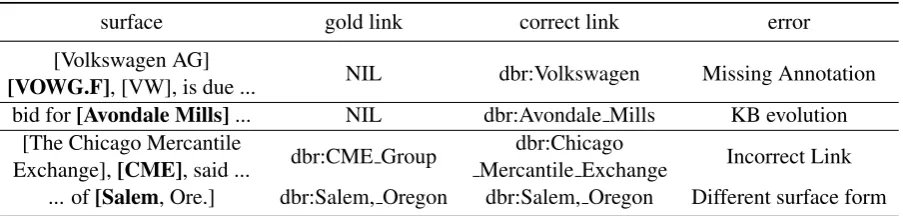
Table 2 examples were extracted from the Reuters128 corpus and illustrate (i) missing and wrong groundings, (ii) KB evolution, and (iii) sur-face forms deviations due to different annotation rules.
Overlaps tend to appear in cases related to LOC and ORG entities. Quite often, an overlap is
iden-tified in long names such as Chattanooga State
Technical CollegeorCity University of New York Graduate Center. In similar cases a surface form expansion that will contain the longest possible string should correctly match the entity from the gold standard. Complicated cases like the follow-ing: Loyola’s University in Belgium, Economics
(from OKE2016) can be interpreted in multiple
ways. This example can either be rendered as
(i) one long entity that corresponds to the whole string; (ii) one entity that describes the Univer-sity (Loyola’s University in Belgium); (iii) two entities (Loyola’s University and Belgium); (iv) two entities again (Loyola’s University in Bel-giumand a stringEconomics); even (v) three en-tities (Loyola’s UniversityandBelgiumand Eco-nomics). The phrasing of the examined sentence suggests that the fourth version is the correct one. Without a thorough text analysis such instances are extremely difficult to disambiguate for both humans and machines.
Even if we leave aside difficult cases that typi-cally show a low inter-rater agreement such as Po-tential Overlap (Table 1, row iv; e.g., agreement of 0.40 for Reuters128) orconfusability(van Erp et al., 2016), there are still many mentions that are not spotted in the original corpus such as those from theMissing Entities Guideline(Table 1, row v) for which experts also exhibit better inter-rater agreements (e.g., 0.61 for Reuters128).
No Rule OKE2016 Reuters128 MeanTime
i Original Annotation ALL 176 880 853
ii Original NIL Only - 230 554
iii Updated NIL Count - 175 465
iv Potential Overlap 84 104 221
v Missing Entities Guideline 76 180 272
Table 1: Estimated entity counts based on different criteria in three corpora. All data sets are in English.
surface gold link correct link error
[Volkswagen AG]
[VOWG.F], [VW], is due ... NIL dbr:Volkswagen Missing Annotation
bid for[Avondale Mills]... NIL dbr:Avondale Mills KB evolution
[The Chicago Mercantile
Exchange],[CME], said ... dbr:CME Group
dbr:Chicago
Mercantile Exchange Incorrect Link
... of[Salem, Ore.] dbr:Salem, Oregon dbr:Salem, Oregon Different surface form
Table 2: Examples of dataset errors. Gold entity spans are marked by parentheses. Errors are presented in bold. Abbreviations or tickers should be separate entities. Locations can include states.
3.2 Context-Specific and Application-Specific Transformation Rules for Lenses
A named entity linking system links a mention
mei,KB [si] orm
ei,KB
[xi,yi] of a named entity with surface formsiwithin a documentdto the corresponding
entity ei in a knowledge baseKB. The variable
xiindicates the mention’s start position within the
document andyi the corresponding end position.
Mentions may overlap and the specification of the knowledge baseKBcan be omitted, if it is not relevant for the application (e.g. if we do not con-sider different KB versions in the given use case).
The system distinguishes between
1. mei,KB
[si] surface formssi that were linked to an entityeiwithin a knowledge baseKB,
2. mnil[si]mentions of Named Entities (NEs) that are not available in theKB and, therefore, are not linked (i.e. NIL entities), and
3. m∅[si] candidate mentions with surface form
si that do not refer to a named entity.
3.2.1 Different Annotation Styles
Annotation styles specify rules that aid annotators in assessing if (i) a candidate mention should be considered a mention of a named entity, and (ii) the extent of the corresponding surface form.
Although a trivial design decision for isolated mentions, the consistent handling of nested men-tions requires more thought. For instance, the text
snippet University of Western Australia Cricket Clubmay contain, dependent on the applied anno-tation rule, up to four overlapping mentions ( Aus-tralia, Western Australia, University of Western Australia,University of Western Australia Cricket Club). In addition, annotation styles might be en-tity type specific even within a single corpus.
We consider the following three annotation styles, as illustrated based on the annotation of the text snippetVienna, VA:
1. 6OMIN disregards overlapping entities and tries to extract the minimum number of enti-ties:mdbr[Vienna, VA:V ienna, V irginia] , i.e. links the snip-pet to theVienna, VirginiaDBpedia entity.
2. The annotation style 6OMAX, in
con-trast, extracts the maximum number
of entities from a given text snippet:
mdbr[Vienna:V ienna, V irginia] , mdbr[VA:]V irginia
3. The style OMAX allows for overlaps and,
again, extracts the maximum number of en-tities:mdbr[Vienna, VA:V ienna, V irginia] , mdbr[VA:]V irginia
The presented rules only consider borderline cases, even though combinations of them can also
be used within a corpus. For instance, a
cor-pus might use the OMAX rule for LOC entities
mdbr[ETH Zurich:ET H Zurich] andmdbr[Zurich:Zurich] for the text snip-petETH Zurich.
Table 3 outlines transformation rules between different annotation styles.
3.2.2 Knowledge Base Evolution
Lenses are also able to capture KB evolution, i.e. the case where a KB evolves due to changes or extended coverage of the underlying domain. Changes to the KB may
1. introduce new entities (e.g. the company Al-phabet Inc. in October 2015),
2. lead to the deletion of entities that are no longer considered relevant, or
3. drive the introduction of a more fine grained or coarser mapping for existing entities.
Table 4 introduces the corresponding
transforma-tion rules. Newly introduced entities may
en-able the grounding ofNILentities to the extended knowledge base. The removal of an entity, in con-trast, may transform an existing grounding to a
NILentity since the corresponding KB entity is no longer available. Finally, changes in granularity may either lead to the introduction of additional entities, or to the deletion of links to the KB.
3.2.3 Knowledge Base Migration
KB migration is the case in which a corpus that has been initially annotated with one KB is used to evaluate a component that links mentions to another KB. Many well maintained knowledge bases such as DBpedia, GeoNames and Wiki-data contain links to indicate equivalent entities (e.g., owl:sameAs, skos:exactMatch, etc). These links and techniques such as ontology alignment may be used to automatize the transformation of a mentions mei,KB
[xi,yi] within a KB (KB) to the corresponding mentionmei,KB0
[xi,yi] in the target KB (KB0). KB migration draws at the same set of transformation rules as the KB evolution use case.
3.2.4 Co-references
Co-references play a crucial role in natural lan-guage processing tasks such as relation extraction. A co-reference is a mention with surface forms0i
that refers to the same entitieseij as other
men-tionsme[sijij]within the document. Its surface form often contains prepositions or noun-phrases that on their own do not provide enough context to
determine the referred entities eij. For anaphora
and cataphora the co-referencemei,KB
[si] points to a single entity, for split antecedents the co-reference refers to multiple NEs. For instance, in the text:
“Berlin, Rome and Paris are capitals of European countries. These cities are also popular tourist destinations.” the surface formThese citiesrefers to three previous named entities and is, there-fore, annotated as mdbr[These cities:Berlin], mdbr[These cities:Rome ] and
mdbr[These cities:P aris ]. Systems and corpora that do not sup-port co-reference resolution, therefore, consider co-references as candidate mentionsm∅[si] that do not link to any named entity.
3.3 Limitations of Corpus Transformation with Lenses
The rules outlined in the previous section can be used to translate between different corpus repre-sentations. Translations from expressive represen-tations to less expressive ones can be done auto-matically and exposed to users as lenses. For ex-ample, a transformation from the OMAX to the
6
OMIN annotation style, from a corpus with an-notated co-references to a corpus which does not considers them, and the KB migration use case for NIL entities may be performed automatically.
Otherwise, corpus versioning (Section 4.2) is required to record any changes added by manual or semi-automatic processes.
4 Method
This section discusses options for improving cor-pus quality by (i) introducing semi-automatic tools that support corpus creation and evaluation by au-tomatically spotting violations of the annotation style and suspicious entities (Section 4.1), and (ii) suggesting guidelines for versioning corpora en-suring that improvements and extensions are in-corporated in a meaningful and backward compat-ible way (Section 4.2).
4.1 Corpus Analysis Tools
Software developers frequently use static code analysis tools such as pylint1, findbugs2 and checkstyle3as part of the build pipeline to enforce coding style guidelines and to spot potential bugs in an early stage.
1
www.pylint.org
2
findbugs.sourceforge.net
Table 5: Lense transformation rules for co-reference resolution.
Task single split antecedents
co-reference
Corpus entity mei
[s0i] m[s0i]
ei1, . . . m
[s0
i]
ein
No co-reference resolution m∅[s0
i] m
∅
[s0i]
Table 6: Suggested corpus metadata
Metadata Description Example
corpus name A name that identifies the corpus. OKE2018
corpus url The corpus archive URL.
http://github.com/fhgr/oke2016-dbpedia-2019-02-01 v1.zip
creator A comma-separated list of persons or
organizations that created the corpus.
Sue May<[email protected]>
date The corpus’s publishing date. 2019-05-30
description A description of the current corpus
ver-sion.
Adapted OKE2016 to DBpedia 2019-02-01 and integrated bug fixes from 2018-03-07.
final Is it usable for official evaluations? false
parent corpus url The URL of the parent corpus (if any)
http://github.com/fhgr/oke2016-dbpedia-2018-09-03 v2.zip
considers corpus url A list of URLs pointing to related
cor-pus versions.
http://github.com/sue/oke2016-dbpedia-fixes-2018-03-07.zip
annotation style A list of annotation styles per
sup-ported named entity type.
PER: NOMIN, GEO: OMAX, ORG: OMIN
annotators per document Number of annotators per document. 3
annotator agreement Inter-rater-agreement between
annota-tors computed using the Fleiss’ kappa. 0.61
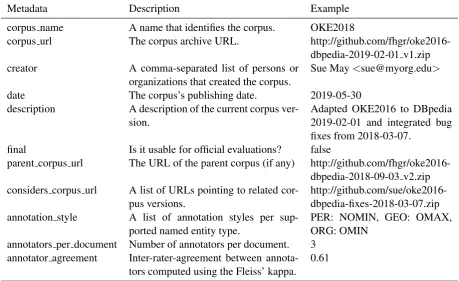
The key here is making evaluations easier to replicate and increase the benefit they provide to the community. Currently evaluations are of-ten tightly designed to a specific context such as a competition or an application domain. These kinds of results are helpful for determining the best performing system under tight restrictions, but they unnecessarily restrict the scope of the evaluation. For instance, such results do not pro-vide information on how systems cope with differ-ent annotation rules, settings and use cases. Au-tomatically performing evaluations with all avail-able lenses, corpus versions and scoring rules (Section 4.3) could address this issue. Scientists could still publish the results for their particu-lar application context in the research paper but would in addition provide a DOI to the full re-sults that cover also settings for which their sys-tem hasn’t been optimized. Ultimately such an
approach would improve the usefulness of evalua-tions since it would provide (i) much more context on the strengths and weaknesses of NEL systems, and (ii) broader insights into the effects of the sug-gested methods and design decisions.
4.2.1 Publishing a Corpus Version
We recommend a standardized directory structure for publishing corpora that contains:
1. a corpus directory containing all corpus
data and annotations in the NIF format.
2. a METADATA.yaml file that describes the
corpus based on the metadata introduced in Table 6.
3. aREADME.mdfile which provides additional
unstructured information.
in Computer and Information Science, pages 3–16. https://doi.org/10.1007/978-3-319-46565-4 1.
Fabian Odoni, Philipp Kuntschik, Adrian M. P. Bras¸oveanu, and Albert Weichselbraun. 2018. On the importance of drill-down analysis for assess-ing gold standards and named entity linkassess-ing
per-formance. In Anna Fensel, Victor de Boer,
Tas-silo Pellegrini, Elmar Kiesling, Bernhard Haslhofer, Laura Hollink, and Alexander Schindler, editors,
Proceedings of the 14th International Conference on Semantic Systems, SEMANTICS 2018, Vienna, Austria, September 10-13, 2018. Elsevier, volume
137 of Procedia Computer Science, pages 33–42.
https://doi.org/10.1016/j.procs.2018.09.004.
Michael R¨oder, Ricardo Usbeck, Sebastian Hellmann,
Daniel Gerber, and Andreas Both. 2014. N3 - A
collection of datasets for named entity recognition and disambiguation in the NLP interchange format. In Proceedings of the Ninth International Con-ference on Language Resources and Evaluation, LREC 2014. pages 3529–3533. http://www.lrec-conf.org/proceedings/lrec2014/summaries/856.html.
Michael R¨oder, Ricardo Usbeck, and
Axel-Cyrille Ngonga Ngomo. 2018. GERBIL
-benchmarking named entity recognition and
link-ing consistently. Semantic Web 9(5):605–625.
https://doi.org/10.3233/SW-170286.
Henry Rosales-M´endez, Barbara Poblete, and Aidan
Hogan. 2018. What should entity linking link?
In Dan Olteanu and Barbara Poblete, editors,
Pro-ceedings of the 12th Alberto Mendelzon Interna-tional Workshop on Foundations of Data Manage-ment, Cali, Colombia, May 21-25, 2018..
CEUR-WS.org, volume 2100 ofCEUR Workshop
Proceed-ings. http://ceur-ws.org/Vol-2100/paper10.pdf.
Marta Sabou, Kalina Bontcheva, Leon
Derczyn-ski, and Arno Scharl. 2014. Corpus
an-notation through crowdsourcing: Towards best
practice guidelines. In Proceedings of the
Ninth International Conference on Language Re-sources and Evaluation (LREC’14). European Language Resources Association (ELRA),
Reyk-javik, Iceland, pages 859–866.
http://www.lrec-conf.org/proceedings/lrec2014/pdf/497 Paper.pdf.
Ahmad Sakor, Saeedeh Shekarpour, Maria-Esther Vi-dal, Jens Lehmann, and S¨oren Auer. 2018. Old is gold: Linguistic driven approach for entity and rela-tion linking of short text pages 339–349.
Yoshimasa Tsuruoka, Jun’ichi Tsujii, and Sophia
Ananiadou. 2008. Accelerating the
annota-tion of sparse named entities by dynamic
sen-tence selection. In Proceedings of the
Work-shop on Current Trends in Biomedical Natural Language Processing. Association for Computa-tional Linguistics, Columbus, Ohio, pages 30–37. https://www.aclweb.org/anthology/W08-0605.
Marieke van Erp, Pablo N. Mendes, Heiko Paul-heim, Filip Ilievski, Julien Plu, Giuseppe Rizzo, and J¨org Waitelonis. 2016. Evaluating entity link-ing: An analysis of current benchmark datasets and
a roadmap for doing a better job. In Proceedings
of the Tenth International Conference on Language Resources and Evaluation LREC 2016, Portoroˇz, Slovenia, May 23-28, 2016.. pages 4373–4379.
J¨org Waitelonis, Henrik J¨urges, and Harald Sack. 2019. Remixing entity linking evaluation datasets for
fo-cused benchmarking.Semantic Web10(2):385–412.