Constructing Evaluation Corpora for Automated Clinical Named Entity
Recognition
Philip V. Ogren M.S., Guergana K. Savova Ph.D., Christopher G. Chute M.D. Dr.P.H.
Division of Biomedical Informatics, Mayo Clinic College of MedicineRochester, MN, USA
E-mail: [email protected], [email protected], [email protected]
Abstract
We report on the construction of a gold-standard dataset consisting of annotated clinical notes suitable for evaluating our biomedical named entity recognition system. The dataset is the result of consensus between four human annotators and contains 1,556 annotations on 160 clinical notes using 658 unique concept codes from SNOMED-CT corresponding to human disorders. Inter-annotator agreement was calculated on annotations from 100 of the documents for span (90.9%), concept code (81.7%), context (84.8%), and status (86.0%) agreement. Complete agreement for span, concept code, context, and status was 74.6%. We found that creating a consensus set based on annotations from two independently-created annotation sets can reduce inter-annotator disagreement by 32.3%. We found little benefit to pre-annotating the corpus with a third-party named entity recognizer.
1.
Introduction
The text analysis group at the Mayo Clinic has built and deployed a text analysis system that processes the entire repository of clinical notes in Mayo’s electronic medical record. The system identifies, among other things, mentions of disorders and the context and status of those mentions (Pakhomov, Buntrock et al. 2005; Savova, Kipper-Schuler et al. 2008). By creating a gold-standard dataset that represents complete and accurate system output, it becomes possible to measure the performance of actual system output in a way that is automated and comparable across multiple versions of the system. To this end, we have created a gold-standard corpus of annotated clinical notes for the disorder concepts that our system identifies. We describe the construction of this gold-standard corpus and evaluate its quality.
Cohen et al. (Cohen, Fox et al. 2005) provide a survey of gold-standard corpora that are available for the biomedical domain. They are few in number and vary widely in size and quality and none of them were designed with clinical data in mind. There have been no such publicly-available resources for the clinical domain until very recently1. This is due to the sensitive nature of patient data and the strict confidentiality laws designed to protect them2. Unfortunately, the development of gold-standard corpora is difficult and expensive because of the tedious and detailed nature of the work and the domain expertise required. Some of the well known challenges are outlined in Ananiadou and McNaught (Ananiadou and McNaught 2006). Absent shared community resources for the medical domain, we are faced with the choice of creating our own or doing without. As we took up the challenge to build our own gold-standard data set, a key consideration was to
1See https://www.i2b2.org/NLP/.
2 For this reason, our corpus will not be made publicly available
in its current form. Contact the second author for further information.
determine the feasibility of creating a very high quality corpus with our current resources. Thus, the process of building our gold standard was designed so that we could measure the expense of additional review of the annotations against gains in quality of the data set. We also explored one way to potentially speed up annotation, pre-annotation with a third party system.
2.
Materials and Methods
2.1.
Annotation Task
2.1.1.Clinical Notes Corpus
The Mayo Clinic has a repository of over twenty-five million clinical notes that consist of documents dictated by physicians that are subsequently transcribed and filed as part of the patient’s electronic medical record. The notes consist of sections such as Chief Complaint, Current Medications, and Impression/Plan among others. The repository contains outpatient notes, discharge summaries, and inpatient service notes. From this repository we randomly selected 160 notes for the corpus used for the gold-standard data set. The total number of words in the corpus is 47,975 with a median word count of 249 words per note.
2.1.2.Annotation Schema
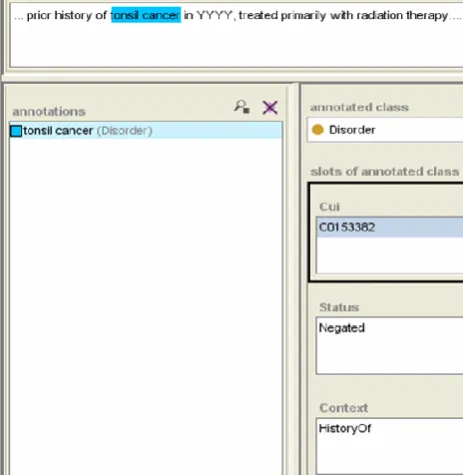
The context of an annotation is a string attribute selected from the following list: current, history of, and family history of. The context attribute provides a way to capture whether the mentioned disorder is being considered in the present for the patient or if it is found in the context of the patient’s personal or family medical history. The status of an annotation is a string attribute selected from the following list: confirmed, possible, and negated. The status value of an annotation is confirmed if the patient has the mentioned disorder, possible if it is undetermined whether the patient has the disorder, and negated if the patient does not have the disorder. Any combination of context and status values is permitted for an annotation. For example, the combination of the context family history of with the status negated means that the patient has no family history of the mentioned disorder. The following sentence serves to illustrate our annotation schema: “The patient returns with no complaints worrisome for recurrent metastatic oropharynx cancer.” The disorder mentioned by “metastatic oropharynx cancer” maps to the concept Stage IV Oropharyngeal Carcinoma
which has the concept unique identifier (CUI) of
C13784623. The disorder mention’s context is history of and its status is negated.
An annotation may also be flagged as unrelated to the patient. Many times a mentioned disorder in a clinical note has little or nothing to do with the patient’s health. For example, an unrelated disorder mention may appear in an organization’s name (e.g. “Diabetes Clinic”), patient education (e.g. “patient was given a pamphlet on diabetes”), or medication side effects (e.g. “hyponatremia is quite common while taking this medication”). When an annotation is flagged as unrelated to the patient, the context and status are both automatically given the value
unrelated to patient. The flag has no effect on the concept code assignment.
2.1.3.Disorder concepts in SNOMED-CT
We created a subset of SNOMED-CT that contains only those concepts corresponding to disorders by leveraging the Unified Medical Language System (UMLS)4 and its Semantic Network. The UMLS assigns to each concept in SNOMED-CT one or more semantic types defined in the Semantic Network. The subset of SNOMED-CT we used was created by selecting only those SNOMED-CT concepts assigned one of the semantic types shown in Table 1. This list was derived from (Bodenreider and McCray 2003)5. The resulting subset of SNOMED-CT consists of 82,813 concepts and was provided to the annotators via an interface that provides keyword search and hierarchical navigation6.
3For mapping to the concept unique identifier (CUI), consult http://kswebp2.nlm.nih.gov/UMLSKS/
4http://www.nlm.nih.gov/pubs/factsheets/umls.html. Version
2005AC
5 We excluded Finding and Signs and Symptoms to constrain our
task.
6 We used the RRF Browser which is documented at
2.2.
Gold Standard Corpus Construction
2.2.1.Annotators
Four clinical data retrieval experts performed the annotation task. At the time of corpus construction, each of them had been in their current work positions for more than four years in addition to having prior experience in medical coding of patient records. Each of the annotators has experience with various medical terminologies (e.g. ICD-9). However, none of them had prior experience with SNOMED-CT and no SNOMED-CT specific training was conducted.
2.2.2.Annotation Software
Knowtator7 is a general purpose text annotation tool for creating gold-standard training and evaluation corpora for Natural Language Processing (NLP) systems described in http://www.nlm.nih.gov/research/umls/meta6.html
7http://knowtator.sourceforge.net/ TUI Type Name
T019 Congenital abnormality
T020 Acquired abnormality
T037 Injury or Poisoning
T046 Pathologic Function
T047 Disease or Syndrome
T048 Mental or Behavioral Dysfunction T049 Cell or Molecular Dysfunction
T050 Experimental Model of Disease
T190 Anatomical Abnormality
T191 Neoplastic Process
Table 1. UMLS Semantic Types used to subset SNOMED-CT. The type unique identifier (TUI) and the name of the type are given for each of the types we used.
annotation set description
Count (number of
annotations) Hours
A1 pre-annotated with MMTx 1105 53.5
A2 not pre-annotated 1142 53
A3 pre-annotated with MMTx 1054 38
A4 not pre-annotated 1113 21
C1 consensus of A1 and A3 1125 8
C2 consensus of A2 and A4 1193 11
C3 consensus of C1 and C2 1164 13
MMTx annotations created by MMTx 664 <1
Table 2: The number of annotations for each annotation set created for the experimental set of notes is shown with the number of hours it took to create the annotation set.
Compared annotation sets
Compared attributes
spans exact
spans overlap
spans overlap +
concept context status
Concept + context + status
A1, A2, A3, A4 75.7% 87.9% 72.7% 79.0% 80.9% 62.5%
C1, C2 81.4% 90.9% 81.7% 84.8% 86.0% 74.6%
C1, MMTx 42.3% 47.0% 42.3% n/a n/a n/a
C2, MMTx 38.2% 44.1% 37.3% n/a n/a n/a
C3, MMTx 39.8% 45.7% 39.5% n/a n/a n/a
Table 3: IAA as percentage agreement on all annotations in compared sets. The overall agreement between C1 and C2 when the match criteria requires that the spans overlap and the concept, context, and status are the same is 74.6%. Comparison between A1, A2, A3, A4 is an average of 2-way agreement.
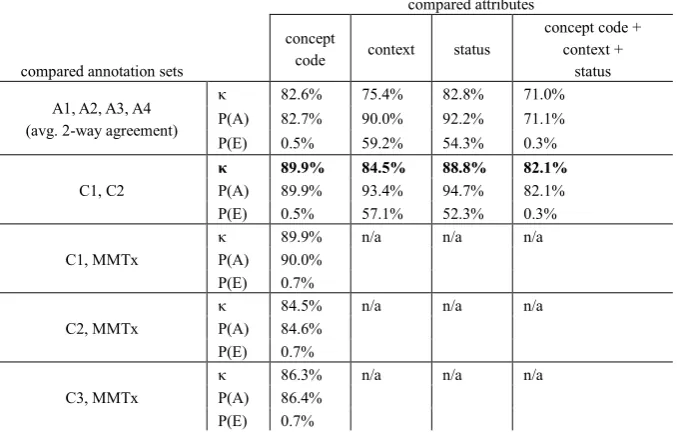
compared annotation sets
compared attributes
concept
code context status
concept code + context +
status
A1, A2, A3, A4 (avg. 2-way agreement)
κ 82.6% 75.4% 82.8% 71.0%
P(A) 82.7% 90.0% 92.2% 71.1%
P(E) 0.5% 59.2% 54.3% 0.3%
C1, C2
κ 89.9% 84.5% 88.8% 82.1%
P(A) 89.9% 93.4% 94.7% 82.1%
P(E) 0.5% 57.1% 52.3% 0.3%
C1, MMTx
κ 89.9% n/a n/a n/a
P(A) 90.0%
P(E) 0.7%
C2, MMTx
κ 84.5% n/a n/a n/a
P(A) 84.6%
P(E) 0.7%
C3, MMTx
κ 86.3% n/a n/a n/a
P(A) 86.4%
P(E) 0.7%
Meeting of the Association for Computational Linguistics, Ann Arbor, MI.
Poesio, M. and R. Vieira (1998). "A Corpus-based Investigation of Definite Description Use." Computational Linguistics 24(2): 183-216. Savova, G., K. Kipper-Schuler, et al. (2008).