Computational Linguistics and Chinese Language Processing
Vol. 8, No. 2 , August 2003, pp. 29-60 The Association for Computational Linguistics and Chinese Language Processing
Chinese Named Entity Recognition Using Role Model
1Hua-Ping ZHANG
*, Qun LIU
*+,
Hong-Kui YU
*,
Xue-Qi CHENG
*,
Shuo BAI
*Abstract
This paper presents a stochastic model to tackle the problem of Chinese named entity recognition. In this research, we unify component tokens of named entity and their contexts into a generalized role set, which is like part-of-speech (POS). The probabilities of role emission and transition are acquired after machine learning on a role-labeled data set, which is transformed from a hand-corrected corpus after word segmentation and POS tagging are performed. Given an original string, role Viterbi tagging is employed on tokens segmented in the initial process. Then named entities are identified and classified through maximum matching on the best role sequence. In addition, named entity recognition using role model is incorporated along with the unified class-based bigram model for word segmentation. Thus, named entity candidates can be further selected in the final process of Chinese lexical analysis. Various evaluations conducted using one
1
This research is supported by the national 973 fundamental research program under grants number G1998030507-4 and G1998030510 and the ICT Youth Fund under contract number 20026180-23. Hua-Ping Zhang (Kevin Zhang): born in February, 1978, a PhD candidate in the Institute of Computing Technology (ICT), Chinese Academy of Sciences. His research interests include computational linguistics, Chinese natural language processing and information extraction.
Qun Liu: born in October 1966, an associate professor at ICT and a PhD candidate at Peking University. His research interests include machine translation, computational linguistics and Chinese natural language processing.
Hong-KuiYu: born in November 1978, a visiting student at ICT from Beijing University of Chemical Technology. His research interests include natural language processing and named entity extraction. Xue-Qi Cheng: born in 1971, an associate professor and director of the software division of ICT. His research fields include computational linguistics, network and information security.
Shuo Bai: born in March 1956, a professor, PhD supervisor and principal scientist of the software division of ICT. His research fields include computational linguistics, network and information security.
*
Software Division, Institute of Computing Technology, The Chinese Academy of Sciences, Beijing, P.R. China, 100080 Email: zhanghp@ software.ict.ac.cn
+
Hua-Ping Zhang et al.
month of news from the People’s Daily and MET-2 data set demonstrate that the role modeled can achieve competitive performance in Chinese named entity recognition. We then survey the relationship between named entity recognition and Chinese lexical analysis via experiments on a 1,105,611-word corpus using comparative cases. It was found that: on one hand, Chinese named entity recognition substantially contributes to the performance of lexical analysis; on the other hand, the subsequent process of word segmentation greatly improves the precision of Chinese named entity recognition. We have applied the role model to named entity identification in our Chinese lexical analysis system, ICTCLAS, which is free software and available at the Open Platform of Chinese NLP
(
www.nlp.org.cn
). ICTCLAS ranked first with 97.58% in word segmentationprecision in a recent official evaluation, which was held by the National 973 Fundamental Research Program of China.
Keywords: Chinese named entity recognition, word segmentation, role model, ICTCLAS
1. Introduction
Named entities (NE) are broadly distributed in original texts from many domains, especially politics, sports, and economics. NE can answer for us many questions like “who”, “where”, “when”, “what”, “how much”, and “how long”. NE recognition (NER) is an essential process widely required in natural language understanding and many other text-based applications, such as question answering, information retrieval, and information extraction.
NER is also an important subtask of the Multilingual Entity Task (MET), which was established in the spring of 1996 and run in conjunction with the Message Understanding Conference (MUC). The entities defined in MET are divided into three categories: entities [organizations (ORG), persons (PER), locations (LOC)], times (dates and times), and quantities (monetary values and percentages) [N.A.Chinchor, 1998]. As for NE in Chinese, we further divide PER into two sub-classes: Chinese PER and transliterated PER on the basis of their distinct features. Similarly, LOC is split into Chinese LOC and transliterated LOC. In this work, we only focus on those more difficult but commonly used categories: PER, LOC and ORG. Other NE such as times (TIME) and quantities (QUAN), in a border sense, can be recognized simply via finite state automata.
Chinese Named Entity Recognition Using Role Model
boundaries and no explicit definitions of words in Chinese. Generally speaking, Chinese NER has two sub-tasks: locating the string of NE and identifying its category. NER is an intermediate step in Chinese word segmentation, and token sequences greatly influence the process of NER. Take “孙 ” (pronunciation: “sun jia zheng zai gong zuo”) as an example. “孙 ”(Sun Jia-Zheng) in “孙 / / /” (Sun Jia-Zheng is working) can be recognized as a Chinese PER, and “孙 ” is also an ORG in “孙 / / /”(The Sun family is working). Here, “孙 ” contains some ambiguous cases: “孙 ”(Sun Jia-Zheng, a PER name), “孙 ” (the Sun family, an ORG name), and “ ” (just now, a common word). Such problems are caused by Chinese character strings without word segmentation, and they are hard to solve in the process of NER. Sun et al. [2002] points out that “Chinese NE identification and word segmentation are interactional in nature.”
In this paper, we present a unified statistical approach, namely, a role model, to recognize Chinese NE. Here, roles are defined as some special token classes, including an NE component and its neighboring and remote contexts. The probabilities of role emission and transition in the NER model are trained on modified corpus, whose tags are converted from POS to roles according to the definition. To some extent, roles are POS-like tags. As in POS tagging, we can tag the global optimal role sequence to obtain tokens using the Viterbi algorithm. NE candidates can be recognized through pattern matching on the role sequence, not the original string or token sequence. NE candidates with credible probability are, furthermore, added into a class-based bigram model for Chinese word segmentation. In the generalized frame, any out-of-vocabulary NE is handled in the same way as known words listed in the segmentation lexicon. And improper NE candidates are eliminated if they fail in compete with other words, while correctly recognized NE are further confirmed in comparison with other cases. Thus, Chinese word segmentation improves the precision of NER. Moreover, NER using the role model optimizes the segmentation result, especially in unknown words identification. A survey on the relationship between NER and word segmentation supports this conclusion. NER evaluation was conducted on a large corpus from MET-2 and the People’s Daily. The precisions of PER, LOC, ORG on the 1,105,611-word news corpus were 94.90%, 79.75% and 76.06%, respectively; and the recall rate were is 95.88%, 95.23% and 89.76%, respectively.
Hua-Ping Zhang et al.
2. Problems in Chinese NER
NE appear frequently in real texts. After surveying a Chinese news corpus with 7,198,387 words from the People’s Daily (Jan.1-Jun.30, 1998), we found that the percentage of NE was 10.58%. The distributions of various NE is given in Table 1.
Table 1. Distributions of NE in a Chinese news corpus from the People’s Daily
(Jan.1-Jun.30, 1998).
NE Frequency Percentage in NE (%) Percentage in corpus (%)
Chinese PER 97,522 12.49 1.35
Transliterated PER 24,219 3.10 0.34
PER 121,741 15.59 1.69
Chinese LOC 157,083 20.11 2.18
Transliterated LOC 27,921 3.57 0.39
LOC 185,004 23.69 2.57
ORG 78,689 10.07 1.09
TIME 127,545 16.33 1.77
QUAN 268,063 34.43 3.72
Total 781,042 100.00 10.85
As mentioned above, Chinese sentences are made up of character strings, not word sequences. A single sentence often has many different tokenizations. In order to reduce the complexity and be more specific, it would be better to conduct NER on tokens after word segmentation rather than on an original sentence. However, word segmentation cannot achieve good performance without unknown word detection in the process of NER. Due to this a problem, Chinese NER has special difficulties.
Firstly, an NE component may be a known word inside the vocabulary; such as “ 国”(kingdom) in the PER “ 国维” (Wang Guo-Wei) or “联 ”(to associate) in the ORG “
联 团”(Beijing Legend Group). It's difficult to make decisions between common words and parts of NE. As far as we know, this has not been considered previously. Thus, NE containing known words are very likely to be missed in the final recognition results.
The second problem is ambiguity, and it is almost impossible to be solved only in NER. Ambiguities in NER can be categorized into segmentation and classification ambiguities. “孙
” (pronunciation: “sun jia zheng zai gong zuo”), presented in the Introduction, has segmentation ambiguity: “孙 / ”(Sun Jia-Zheng is at …) and “孙 / ” (The Sun family is doing something). Classification ambiguity means that an NE may be have one more class even if its position in the string is properly located. For instance, in the sentence “吕
Chinese Named Entity Recognition Using Role Model
Moreover, NE tends to stick to its neighboring contexts. There are also two types: head components of NE binding with their left neighboring tokens and those tail binding with their right tokens. This greatly increases the complexity of Chinese NER and word segmentation. In Figure 1, “内 亚 ”(Netanyahu) in “ 顿对内 亚 说”(pronunciation: “ke lin dun dui nei ta ni ya hu shuo”) is a transliterated PER. However its left token “对”(to) sticks to the head component “内”(Inside) and forms a common word “对内”(to one’s own side) ; similarly, the tail component “ ”(to) and right neighbor “说”(to say) become a common word, “ 说” (nonsense). Therefore, the most possible segmentation result would not be “ 顿/ 对/内 亚 /说”(Clinton said to Netanyahu) but “ 顿/对内/ 亚/ 说”(Clinton points to his own side and Tanya talks nonsense.), and then not “内 亚 ”(Netanyahu) but “ 亚”(Tanya) would be recognized as a PER. We can draw the conclusion that such a problem not only reduces the recall rate of Chinese NER, but also influences the segmentation of normal neighboring words like “对”(to) and “说”(to say). Appendix I provides more Chinese PER cases that were extracted from our corpus.
Figure 1: Head or tail of NE Binding with its neighbours.
1. Words within a solid square are tokens.
2. “内 亚 ”(Netanyahu) inside the dashed ellipse is a PER, and its head and tail stick to their neighbouring tokens.
3. Role model for Chinese NER
Considering the problems encountered in NER, we will introduce a role model to unify all possible NE and sentences. Our motivation is to classify similar tokens into some role categories according to their linguistic features, to assign a corresponding role to each token automatically, and to then perform NER based on the role sequence.
3.1 What Are Roles Like?
Given a sentence like “ 说 泽 访 间 总统发 请”(Kong
Quan said that President Jiang Ze-Min had invited President Bush while visiting the USA), the tokenization result without considering NER would be “ / /说/ / /泽/ / / /访/
/ 间/ / / /总统/发 / / 请”(shown in Figure 2a). Here “ ”(Kong Quan) and “ 泽 ”(Jiang Ze-Min) are Chinese PERs, while “ ”(USA) is an LOC and “ ”(Bush) is a transliterated PER.
Hua-Ping Zhang et al.
Figure 2a: Token sequence without detecting Chinese NE, which is in bold type
and italics.
(Kong Quan said that President Jiang Ze-Min had invited President Bush while visiting the USA).
When we consider the generation of NE, we find that different tokens play different roles in sentences. Here, the term “role” is referred to a generalized class of tokens with similar functions in forming a NE and its context. For instance, “ ” (pronunciation: “zeng”) and “张” (pronunciation: “zhang”) can both act as common Chinese surnames, while both “说”(to speak) and “ ”(chairman) may be right neighboring tokens following PER names. Relevant roles for the above example are explained in Figure 2b.
Tokens Role played in the token sequence
(pronunciation: “kong”);
( pronunciation: “jiang”) Surname of Chinese NER
(pronunciation: “quan”) Given name with a single Hanzi (Chinese character)
泽(pronunciation: “ze”) Head character of 2-Hanzi given name (pronunciation: “min”) Tail character of 2-Hanzi given name (pronunciation: “bu”);
(pronunciation: “shi”) Component of transliterated PER 说(say); (chairman); 总统(president) Right neighboring token following PER
(comma); (toward) Left neighboring token in front of PER
(USA) Component of LOC
访(visit) Left neighboring token in front of LOC
间(period) Right neighboring token following LOC (this year); 发 (put forward);
(have); 请(invite)
Remote context, which distance is more than one word. from NE
Figure 2b: Relevant roles of various tokens in
“ / /说/ / /泽/ / / /访/ / 间/ / / /总统/发 / / 请”
(Kong Quan said that President Jiang Ze-Min had invited President Bush while visiting the USA).
If NE is identified in a sentence, it is easy to extract the roles listed above through simple analysis on NE and other tokens. On the other hand, if we get the role sequence, can NE be identified properly? The answer to this question is clearly yes. Take a token-role segment like “ / Surname /Given-name 说/context /context /Surname 泽/first component of given-name /second component of given-name /context” as an example. If we either know that “ ”(pronunciation: “jiang”) is a surname while “泽”(pronunciation: “ze”) and “ ”
Chinese Named Entity Recognition Using Role Model
(pronunciation: “min”) are components of the given name, or if we know that “ ”(comma) and “ ”(chairman) are its left and right neighbours, then “ 泽 ”(Jiang Ze-Min) can be identified as a PER. Similarly, “ ”(Kong Quan) and “ ”(Bush) can be recognized as PERs , and at the same time, “ ”(an abbreviation of USA in Chinese) can be picked up as an LOC..
In other words, the NER problem can be solved with the correct role sequence on tokens, and many intricate character strings can be avoided. However, the question when applying the role model to NER is: “How can we define roles and assign roles to the tokens automatically?”
3.2 What Roles Are Defined?
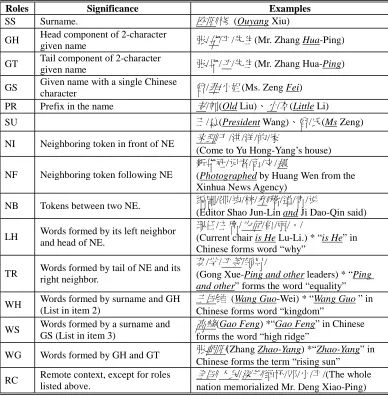
To some extent, a role is POS-like, and a role set can be viewed as a token tag collection. However, a POS tag is defined according to the part-of-speech of a word, while a role is defined based purely on linguistic features from the point of view of the NER. Similarly, like a POS tag, a role is a collection of similar tokens, and a token has one or more roles. In the Chinese PER role set shown in Table 2a, the role SS includes almost 900 single-Hanzi (Chinese character) surnames and 60 double-Hanzi surnames. Meanwhile, the token “ ”(pronunciation “ceng” or “zeng”) can play role SS in the sequence “ / / ”(Ms. Zeng Fei),play role GS in “记 / /师/ ”(Reporter Tang Shi-Ceng), play role NF in “ 锦 涛 视 ”(Hu Jin-Tao has surveyed Xi Bai Po), and also play some other roles.
If the size of a role set is too large, NER will suffer severely from the problem of data sparseness. Therefore, we do not attempt to set up a general role set for all NE categories. In order to reduce complexity, we build a specific role model using its own role set for each NE category. In another words, we apply the role model to PER, LOC, and ORG, respectively. Their role models are customized and trained individually. Finally, different recognized NE is all added into our unified class-based segmentation frame, which selects the global optimal result among all possible candidates.
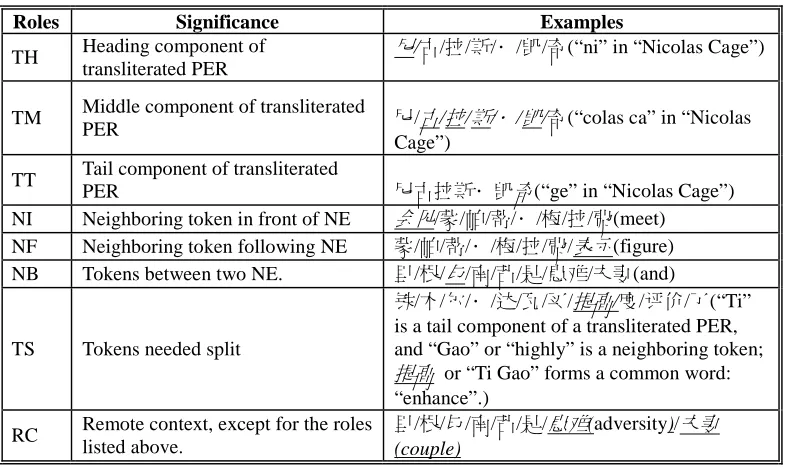
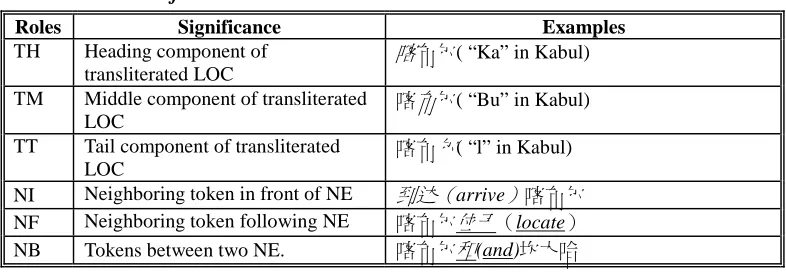
The role set for Chinese PER, Chinese LOC, ORG, transliterated PER, and transliterated LOC are defined in Table 2a, Table 2b, Table 2c, Table 2d, and Table 2e, respectively. Considering the possible segmentation ambiguity mentioned in Section 2, we introduce some special roles, such as LH and TR, in Chinese PER. Such roles indicate that the token should be split into two halves before NER. Such a policy can improve NER recall. The process will be demonstrated in detail in the following section.
Hua-Ping Zhang et al.
Table 2e. Role set for Transliterated LOC.
Roles Significance Examples
TH Heading component of transliterated LOC
尔( “Ka” in Kabul)
TM Middle component of transliterated LOC
尔( “Bu” in Kabul)
TT Tail component of transliterated LOC
尔( “l” in Kabul)
NI Neighboring token in front of NE 达 arrive 尔 NF Neighboring token following NE 尔 locate
NB Tokens between two NE. 尔 (and)
3.3 Role corpus
Since a role is self-defined and very different from a POS or other tag set, there is no special corpus that meets our requirement. How can we prepare the role corpus and extract role statistical information from it? Our strategy is to modify an available corpus by converting the POS tags to roles automatically.
We use a six-month news corpus from the People’s Daily. It was all manually checked after word segmentation and POS tagging were performed. The work was done at the Institute of Computational Linguistics, Peking University (PKU). It is a high-quality corpus and widely used for Chinese language processing. The POS standard used in the corpus is defined in PKU, and we call it the PKU-POS set. Figure 3a shows a segment of our corpus labelled PKU-POS. Though PKU-POS is refined, it is implicit and not large enough for Chinese NER. In Figure 3a, the Chinese PER “黄 ”(Huang Zhen-Zhong) is split into the surname“黄”(Huang) and given name“ ”(Zhen-Zhong), but both of them are assigned the same tag, “nr”. In addition, there are no tags to distinguish transliterated PERs or LOCs from Chinese ones. Moreover, some NE abbreviations are not tagged with the right NE category, but with an abbreviation label, “j”. Here, “ ”(abbreviation for “ ” or “Huai He River”) is a Chinese LOC and should be tagged with the location label “ns”.
Chinese Named Entity Recognition Using Role Model
19980101-02-009-002/m 报/r /ns /t /t 电/n 记 /n 黄/nr /nr /w /nr 剑 /nr 报 /v /w /t /u 钟声/n 刚刚/d 响 /v /we /m /q /ns 传来/v 讯/n /w /p /j 业/n
/n 实现/v 达标/v /v /w 减/v /v 负 /n /m /f /we /ns /v /Ng /m 战 /n /v /w correcting. Figure 3b shows the equivalent segment with ICTPOS.
Next, we converted our corpus labelled with ICTPOS into a role corpus. The conversion procedure included the following steps:
(1) Extract the sequence of words and their POS.
(2) According to the POS, locate the particular NE category under consideration. Here, we only locate words labelled ‘nf’ or ‘nl’ when considering Chinese PER.
(3) Convert the POS of the NE’s components, their neighbours, and remote contexts into corresponding roles in that role set of the particular category.
Figures 3c and 3d show the corresponding training data after label conversion from ICTPOS tags to roles of Chinese PER and Chinese LOC, respectively. What we should point out is that the PER role corpus is totally different from the LOC corpus and other ones. For instance, the first pronoun word “ 报”(this newspaper) in the PER role corpus is just a remote context, while it is a left neighboring context before “ ”(Feng Pu) when LOC roles are applied. Though we use the same symbol “NI” to tag NE left neighboring tokens in both Figures 3c and 3d, it has different meanings. The first is for Chinese PER left tokens, and the other is for LOC. In a word, each NE category has its own role definition, its own training corpus, and its own role parameters though they all make use of the role model.
Figure 3a: A segment of a corpus labeled with PKU-POS.
Hua-Ping Zhang et al.
19980101-02-009-002/RC 报/NI /LH /LT /NF /RC 电/RC 记 /RC 黄/RC /RC /RC /RC 剑 /RC 报 /RC /RC /RC /RC 钟声/RC 刚刚/RC 响/RC /RC /RC /NI /LH /LT 传来
/NF 讯/RC /RC /NI /LH 业/NF /RC 实现/RC 达标/RC /RC /RC 减/RC /RC 负 /RC /RC /RC /NI /LH /LT /NF /RC /RC 战 /RC /RC /RC
19980101-02-009-002/m 报/r /ns /t /t 电/n 记 /n 黄/nf /nl /we /nf 剑 /nl 报 /v /we /t /uj 钟声/n 刚刚/d 响/v /we /m /q /ns 传来/v 讯/n /we /p /ns 业/n
/n 实现/v 达标/v /v /we 减/v /v 负 /n /m /f /we /ns /v /Ng /m 战 /n /v /we
19980101-02-009-002/RC 报/RC /RC /RC /RC 电/RC 记
/NI 黄/SS /GH /GT /NM /SS 剑/GH /GT 报 /NF /RC /RC /RC 钟声/RC 刚刚/RC 响/RC /RC /RC /RC /RC 传来/RC 讯/RC /RC /RC /RC 业/RC /RC 实现/RC 达标 /RC /RC /RC 减/RC /RC 负 /RC /RC /RC /RC
/RC /RC /RC /RC 战 /RC /RC /RC
Figure 3b: The segment from our corpus labeled with our modified POS.
Figure 3c: The corresponding corpus labeled with Chinese PER roles.
Figure 3d: The corresponding corpus labeled with Chinese LOC roles.
3.4 Role tagging using the Viterbi Algorithm
Next, we prepared the role set and role corpus. Then, we could return to the key problem described in Section 3.1. That is: Given a token sequence, how can we tag a proper role sequence automatically?
Similar to POS tagging, we use the Viterbi algorithm [Rabiner and Juang, 1989] to select a global optimal role result from all the role sequences. The methodology and its calculation are given below:
Suppose that T is the token sequence after tokenization, R is the role sequence for T, and R# is the best choice with the maximum probability. That is,
T=(t1, t 2, … , t m),
R=(r1, r2, … , rm), m>0,
R#= R
max
Chinese Named Entity Recognition Using Role Model
(1) Tokenization on a sentence. In our work, we use a tokenization method called the “Model of Chinese Word Rough Segmentation Based on N-Shortest-Paths Method” [Zhang and Liu, 2002]. It aims to produce the top N results as required and to enhance the recall rates of right tokens.
(2) Tag token sequences with roles using the Viterbi algorithm. Get the role sequence R# with the maximum possibility.
(3) In R#, split the tokens whose roles are “LH” or “TR”. These roles indicate that the internal components stick to their contexts. Suppose R* is the final role sequence.
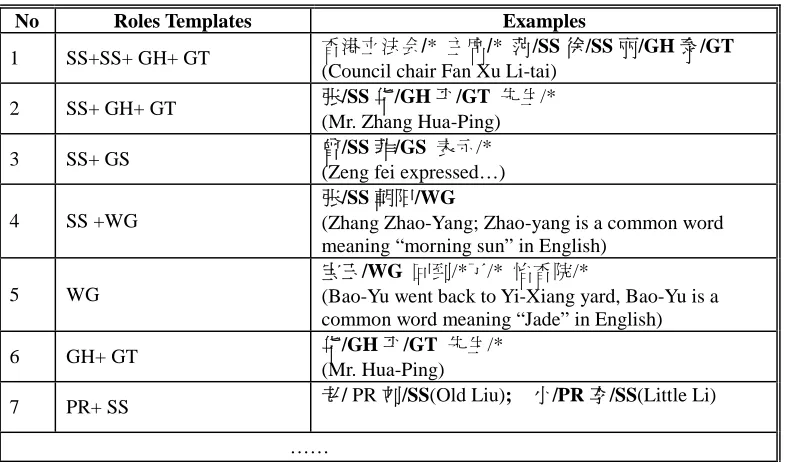
(4) NE recognized after maximum matching on R* with the particular NE templates. Templates of Chinese PER are shown in Table 3.
(5) Computing the possibilities of NE candidates using formula E8.
Table 3. Chinese PER Templates
No Roles Templates Examples
1 SS+SS+ GH+ GT 会/* /* /SS /SS丽/GH /GT
(Council chair Fan Xu Li-tai)
2 SS+ GH+ GT 张/SS华/GH /GT /*
(Mr. Zhang Hua-Ping)
3 SS+ GS /SS /GS /*
(Zeng fei expressed…)
4 SS +WG
张/SS 阳/WG
(Zhang Zhao-Yang; Zhao-yang is a common word meaning “morning sun” in English)
5 WG
宝 /WG /* /* /*
(Bao-Yu went back to Yi-Xiang yard, Bao-Yu is a common word meaning “Jade” in English)
6 GH+ GT 华/GH /GT /*
(Mr. Hua-Ping)
7 PR+ SS / PR刘/SS(Old Liu); /PR /SS(Little Li)
……
Note: “*” in the examples indicates any role.
Hua-Ping Zhang et al.
Chinese PER name.
4. Class-based Segmentation Model Integrated into NER
In section 3-2, we emphasized that each NE category uses an independent role model. Each NE candidate is the global optimum result in its role model. However, it has not competed with other models, and all the different models have not been combined together. One problem is as follows: If a word is recognized as a location name by the LOC role model, and as an ORG, PER or even a common word by another, which one should we choose in the end? Another problem is as follows: Although Chinese NER using role models can achieve higher recall rates than previous approaches (the recall rate of Chinese PER is nearly 100%), the precision result is not satisfactory because some NE candidates are common words or belong to other categories.
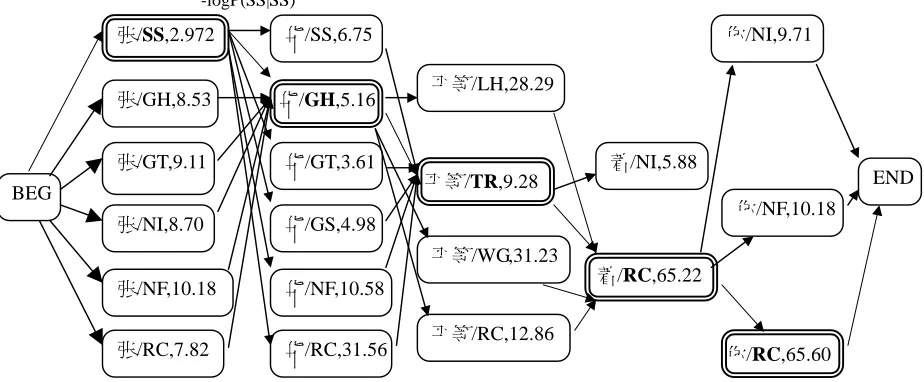
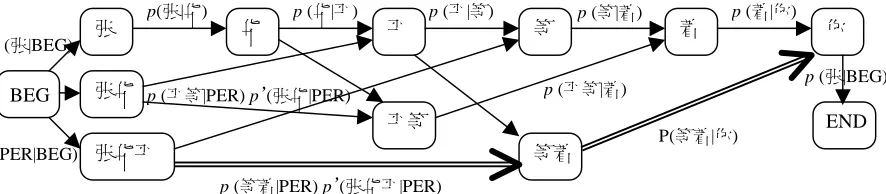
Here, we use a class-based word segmentation model that is integrated into NER. In the generalized segmentation frame, NE candidates from various role models can compete with common words and themselves.
Given a word wi, a word class ci is defined as shown in Figure 5a. Suppose |LEX| is the
lexicon size; then, the size of the word classes is |LEX|+9. In Figure 5b, we show the corresponding class sample based on Figure 3b.
Figure 5a: Class Definition of word
w
ic
i=
wi if wi is listed in the segmentation lexicon;
Chinese PER if wi is an unlisted *
Chinese PER; Transliterated PER if wi is an unlisted transliterated PER; Chinese LOC if wi is an unlisted Chinese LOC; TIME if wi is an unlisted time expression;
QUAN if wi is an unlisted numeric expression;
STR if wi is an unlisted symbol string;
BEG if wi is beginning of a sentence
END if wi is ending of a sentence
OTHER otherwise.
Hua-Ping Zhang et al.
Figure 6:Demonstration of segmentation on “
张华
着
” using the
class-based approach.
Note: “张华 ”(Zhang Hua-Ping) and “张华” are NE candidates from role models.
5. Comparison with Previous Works
Since MET came into existence, NER has received increasing attention, especially in research on written and spoken English. Some systems have been put into practice. The approaches tend to involve statistics mixed with rules, such as the hidden Markov model (HMM), the expectation maximum, transformation-based learning, etc. [Zhou and Su, 2002; Bikel et al. 1997; Borthwick et al. 1999 ]. Besides making use of a corpus with labels, Andrei et al. [1999] proposed another statistical method without Gazetteers.
Historically, much work has been done on Chinese NER, but the research is still in its early stages. Previous solutions can be broadly categorized into rule-based approaches [Luo, 2001; Ji, 2001; Song, 1993; Tan, 1999], statistics-based ones [Zhang et al. 2002; Sun et al. 2002; Sun, 1993] and approaches that are a combination of both [Ye, 2002, Lv et al. 2001]. Compared with our approach using the role model, previous works have some disadvantages. First of all, many researchers used handcrafted rules, which are mostly summarized by linguists through painful study on large corpuses and huge NE libraries [Luo, 2001]. This is time-consuming, expensive and inflexible. The NE categories are diverse, and the number of words for each category is huge. With the rapid development of the Internet, this situation is becoming more and more serious. Therefore, it is very difficult to summarize simple yet thorough rules for NE components and contexts. However, in the role model, the mapping from roles to entities is done based on by simple rules. Secondly, the recognition process in previous approaches could not be activated until some “indicator” tokens were scanned in. For instance, possible surnames or titles often trigger personal name recognition on the following 2 or more characters. In the case of place name recognition, postfixes such as “县”(county) and “ ”(city) activate recognition on previous characters. Furthermore, this trigger mechanism cannot resolve the ambiguity. For example, the unknown word “ ” (Fang Lin Shan) may be a personal name, “ / ”(Fang Linshan), or a place name, “ /
张华
张 华 着
张华
着 BEG
END
p ( 着|PER) p
’
(张华 |PER)P( 着| )
p(张|华) p (华| ) p ( | ) p ( |着) p (着| )
p ( |着)
p ( |PER) p
’
(张华|PER)p (张|BEG)
p (PER|BEG)
Chinese Named Entity Recognition Using Role Model
”(Fanglin Mountain). What’s more, previous approaches tended to work only on monosyllabic tokens, which are obvious fragments after tokenization [Luo, 2001; Lv et al. 2001]. This risks losing those NE that lack explicit features. On the other hand, the role model tries to select possible NE candidates based on the whole token sequence and then select the most promising ones using Viterbi tagging. Last but not least, to the best of our knowledge, some statistical works only focus on the frequency of characters or tokens in NE and their common contexts. Thus, it is harder to compute a reliable probability for a recognized NE. Unlike the role-based approach, previous works could not satisfy other requirements, such as NE candidate filtering and statistical lexical analysis.
In one sense, BBN' s name finder IdentiFinder [F. Kubala et al. 1998] is very close to our role model. Both the role model and IdentiFinder extract NE using a hidden Markov Model, which is also trained on a corpus. In addition, the authors claim that it can perform NER in multilingual languages, including Chinese. Now, we will explain how IdentiFinder and the role model differ.
(1) IdentiFinder uses general name-classes, which include all kinds of NE and Not-A-Names, while we build a different instance for each NE category with the same role model. As explained in Section 3, a general name-class will suffer from data sparseness. The role model does not require a large-scale corpus because we can transform the same corpuses into different role corpus, from which role probabilities can be extracted.
(2) IdentiFinder is applied to token sequences, but Chinese sentences are made up of character strings. It is impossible to apply the name-class HMM to Chinese original texts. Even if it is applied after tokenization, there is no more consideration on unification between tokenization and NER. Here, tokenization becomes an independent preprocessing step for Chinese NER.
(3) The name-classes used in IdentiFinder seem too simple for Chinese, a complicated language. IdentiFinder has only 10 classes: PER, ORG, five other named entities, Not-A-Name, start-of-sentences and end-of sentence. However, just for PER recognition, we use 16 roles to differentiate various tokens, such as component, left and right neighboring contexts and other helpful ones. Actually, they boost the recall rate of Chinese NER.
Chinese Named Entity Recognition Using Role Model
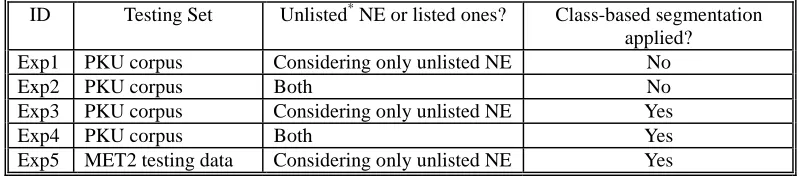
enough, Chinese NER will back to the problems of word segmentation and disambiguation. Undoubtedly, it is easier than a pure NER. Therefore, evaluation of unlisted NE, which is outside the lexicon, can reflect the actual performance of NER method. It approach will be more objective, informative and useful. Here, we will report our results both for unlisted and listed NE. In order to evaluate the function of class-based segmentation, we also give some contrast testing. We conducted the
five NER evaluation experiments listed in Table 4.
Table 4. Different evaluation experiments.
ID Testing Set Unlisted* NE or listed ones? Class-based segmentation applied?
Exp1 PKU corpus Considering only unlisted NE No
Exp2 PKU corpus Both No
Exp3 PKU corpus Considering only unlisted NE Yes
Exp4 PKU corpus Both Yes
Exp5 MET2 testing data Considering only unlisted NE Yes
* “Unlisted” means outside the segmentation lexicon
The PKU corpus is January 1998 news from the People’s Daily.
6.3.1 Exp1: individual NER conducted on unlisted names using a specific
role model
Exp1 includes 3 sub-experiments: personal name recognition with the PER role model, LOC recognition with its own model, and ORG. In Exp1, we evaluate the performance only on unlisted NE. The performance achieved is reported in Table 5.
Table 5. Performance achieved in Exp1.
NE Total Num Recognized Correct P (%) R (%) F (%)
PER 17,051 29,991 15,880 56.85 93.13 70.61
LOC 4,903 12,711 3,538 27.83 72.16 51.84
ORG 9,065 9,832 6,125 62.30 67.58 64.83
6.3.2 Exp2: Individual NER conducted on all names using a specific role
model
Hua-Ping Zhang et al.
Table 6. Performance achieved in Exp2.
NE Total Num Recognized Correct P (%) R (%) F (%)
PER 19,556 32,406 18,915 58.37 96.72 72.80
LOC 22,476 30,239 22,366 67.54 99.51 80.55
ORG 10,811 11,483 7,776 67.72 71.93 69.77
6.3.3 Exp3 and Exp4: Introducing Class-based Segmentation Model
Exp1 and Exp2 are conducted on PER, LOC and ORG candidates with their individual role models. They were not integrated into a complete frame. In Exp3 and Exp4, we used the class-based segmentation model to further filter all the NE candidates. As we explained in the Section 4, common words and recognized NE from various role models could be added to the class-based segmentation model. After they competed with each other, either the optimal segmentation or the NER result would be selected. From Table 7, it can be concluded that the word segmentation model greatly improved the performance of Chinese NER.
We also found an interesting phenomenon in that unlisted PER recognition was a little better than recognition of all personal names. The main reason was that unlisted PER recognition could achieve a good recall rate, but some listed PERs could not be recalled because of ambiguity. For instance, “ 泽 张…” (Jiang Ze-Min proposed ..) would produce the wrong tokenization result “ /泽/ /张” while the role model failed because “ 泽 ”(Jiang Ze-Min) was listed in the segmentation lexicon. On the other hand, if “ 泽
”(Jiang Ze-Min) was not listed in the core lexicon, then “ ” (democracy) would be tagged with role “TR”, and the token would be split before recognition. We provide more examples in Appendix II.
Table 7
.
Performance achieved in Exp3 and Exp4.
Unlisted NE in Exp3 All NE in Exp4 NE
P (%) R (%) F (%) P (%) R (%) F (%)
PER 95.18 96.50 95.84 95.49 95.66 95.57
LOC 71.83 74.67 73.23 92.64 95.38 93.99
ORG 66.06 81.76 73.08 75.83 88.39 81.63
6.3.4 Exp5: Evaluation of the MET2 Data
Chinese Named Entity Recognition Using Role Model
PKU corpus.
Table 8. Performance achieved in Exp 5.
NE Total Num
Recognized Correct P (%) R (%) F (%)
PER 162 231 150 64.94 92.59 76.34
LOC 751 882 661 74.94 88.02 80.96
ORG 378 366 313 85.52 82.80 84.14
6.4 A survey of on the relationship between NER and Chinese lexical
analysis
A good tokenization or lexical analysis approach provides a specific basis for role tagging; meanwhile, correctly recognized NE will modify the token sequence and improve the performance of the Chinese lexical analyser.
Next, we will survey the relationship between NER and Chinese lexical analysis based on a group of contrast experiments. On a 4MB news corpus, we conducted four experiments:
1) BASE: Chinese lexical analysis without any NER;
2) +PER: Adding the PER role model to BASE;
3) +LOC: Adding the LOC role model to +PER;
4) +ORG: Adding the ORG role model to +LOC.
Table 9. A survey of on the relationship between NER and Chinese lexical analysis.
CASE PER F-1 (%) LOC F-1 (%) ORG F-1 (%) SEG TAG1(%) TAG2(%)
BASE 27.86 83.67 51.13 96.55 93.92 91.72
+PER 95.40 83.84 53.14 97.96 95.34 93.09
+LOC 95.50 85.50 52.76 98.05 95.44 93.18
+ORG 95.57 93.99 81.63 98.38 95.76 93.52
Note:
1) PER F-1: F-1 rate of PER recognition; LOC F-1: F-1 rate of LOC recognition; ORG F-1: F-1 rate of ORG recognition;
2) SEG=#of correctly segmented words/ #of words;
3) TAG1=#of correctly tagged 24-tag POS/#of words;
4)
TAG2=#of correctly tagged 48-tag finer POS/#of words.Table 9 shows the performance achieved in the four experiments. Based on these results, we draw the following conclusions:
Hua-Ping Zhang et al.
increases from 96.55% to 97.96% after the PER role model is added. If all the role models are integrated, ICTCLAS achieves 98.38% SEG, 95.76% TAG1, and 93.52% TAG2.
Secondly, the preceding role model benefits from the succeeding one. We can find that after ORGs are recognized, Org F-1 increase by 25.91%; furthermore, the performance of PER and LOC also improve. It can be inferred that the ORG role model not only solves its own problem, but also helps exclude improper PER or LOC candidates in the segmentation model. Similarly, the LOC model aids PER recognition, too. Take “刘 ”(The water in Liu village is sweet) as an example, here, “刘 ”(Liu village) is very likely to be incorrectly recognized as a personal name. However, it will be recognized as a location name after HMM is added for location recognition.
6.2 Official evaluation of our lexical analyser ICTCLAS
We have developed our Chinese lexical analyser ICTCLAS (Institute of Computing Technology, Chinese Lexical Analysis System). ICTCLAS applies the role model to recognize unlisted NE names. We also integrate class-based word segmentation into the whole ICTCLAS frame. The full source code and documents of ICTCLAS are available at no cost for non-commercial use. Researchers and technical users are welcome to download ICTCLAS from the Open Platform of Chinese NLP (www.nlp.org.cn).
On July 6, 2002, ICTCLAS participated in the official evaluation, which was held by the National 973 Fundamental Research Program in China. The testing set consisted of 800KB of original news from six different domains. ICTCLAS achieved 97.58% in segmentation precision and ranked at the top. This proved that ICTCLAS is one of the best lexical analysers, and we are convinced that the role model is suitable for Chinese NER. Detailed information about the evaluation is given in Table 10.
Table 10. Official evaluation results for ICTCLAS.
Domain Words SEG TAG1 RTAG
Sport 33,348 97.01% 86.77% 89.31%
International 59,683 97.51% 88.55% 90.78%
Literature 20,524 96.40% 87.47% 90.59%
Law 14,668 98.44% 85.26% 86.59%
Theoretic 55,225 98.12% 87.29% 88.91%
Economics 24,765 97.80% 86.25% 88.16%
Total: 208,213 97.58% 87.32% 89.42%
Note:
1) RTAG=TAG1/SEG*100%
Chinese Named Entity Recognition Using Role Model
6.5 Discussion
Our approach is merely corpus-based. It is well known that, in any usual corpus, NE is sparsely distributed. If we depend solely on the corpus, the problem of sparseness inevitably be encountered. But by fine-tuning our system, we can alleviate this problem through some modifications described below:
Firstly, lexical knowledge from linguists can be incorporated into the system. This does not mean that we fall back to rule-based approaches. We just need some general and heuristic rules about NE formation to reduce some errors. As for Chinese PER recognition, there are several strict restrictions, such as the length of names and the order of surnames and given names.
Secondly, we can produce one more tokenization result. In this way, we can improve the recall rate at the expense of the precision rate. Precision can be improved in the class-based segmentation model. In this work, we only use the best tokenization result. We have tried rough word segmentation based on the N-Shortest-Paths method [Zhang and Liu, 2002]. When the top 3 token sequences are considered, the recall and precision of NER in ICTCLAS can be significantly enhanced.
Lastly, we can add some huge NE libraries besides the corpus. As is well known, it is easier and cheaper to get a personal name library or other special NE libraries than a segmented and tagged corpus. We can extract more precise component roles from NE libraries and then merge these data into the contextual roles obtained from the original corpus.
7. Conclusion
The main contributions of this study are as follows:
(1) We have propose the use of self-defined roles based on to linguistic features in named entity recognition. The roles consist of NE components, their neighboring tokens and remote contexts. Then, NER can be performed more easily on role sequences than on original character strings or token sequences.
(2) Different roles are integrated into a unified model, which is trained through an HMM. With emission and transitive probabilities, the global optimal role sequence is tagged through Viterbi selection.
(3) A class-based bigram word segmentation model has been presented. The segmentation frame can adopt common words and NE candidates from different role models. Then, the final segmentation result can be selected following competition among possible choices. Therefore, promising NE candidates can be reserved and others filtered out.
Hua-Ping Zhang et al.
analysis. It has been shown that the role model can enhance the performance of lexical analysis after NE are successfully recalled, while class-based word segmentation can improve the NER precision rate.
We have conducted various experiments to evaluate the performance of Chinese NER on the PKU corpus and MET-2 data. F-1 measurement of recognizing PER, LOC, ORG on the 1,105,611-word PKU corpus were 95.57%, 93.99%, and 81.63%, respectively.
In our future work, we will build a finely tuned role model by adding more linguistic knowledge into the role set, more tokenization results as further candidates, and more heuristic information for NE filtering.
Acknowledgements
The authors wish to thank Prof. Shiwen Yu of the Institute of Computational Linguistics, Peking University, for the corpus mentioned in section 3.2 and Gang Zou for his wonderful work in the evaluation of named entity recognition. We also acknowledge our debt to our colleagues: Associate Professor Wang Bin, Dr. Jian Sun, Hao Zhang, Ji-Feng Li, Guo-Dong Ding, Dan Deng, and De-Yi Xiong. Kevin Zhang especially thanks his graceful girl friend Feifei for her encouragement during this research. We also thank the three anonymous reviewers for their elaborate and helpful comments.
References
Andrei M., Marc M. and Claire G., “Named Entity Recognition using an HMM-based Chunk Tagger”, Proc. of EACL '99.
Bikel D., Schwarta R., Weischedel. R. “An algorithm that learns what’s in a name”. Machine Learning 34, 1997, pp. 211-231
Borthwick. A. “A Maximum Entropy Approach to Named Entity Recognition”. PhD Dissertation, 1999
Chen X. H. “One-for-all Solution for Unknown Word in Chinese Segmentation”. Application of Language and Character, 3. 1999
F. Kubala, R. Schwartz, R. Stone, and R. Weischedel, “Named entity extraction from speech”, in Proceedings of DARPA Broadcast News Transcription and Understanding Workshop, (Lansdowne, VA), February 1998.
L. R.Rabiner, “A Tutorial on Hidden Markov Models and Selected Applications in Speech Recognition”. Proceedings of IEEE 77(2): pp.257-286, 1989.
L.R. Rabiner and B.H. Juang, “An Introduction to Hidden Markov Models”. IEEE ASSP Mag., pp.4-166.
Chinese Named Entity Recognition Using Role Model
Luo Z. and Song R. “Integrated and Fast Recognition of Proper Noun in Modern Chinese Word Segmentation”. Proceedings of International Conference on Chinese Computing, 2001, Singapore, pp. 323-328.
Lv Y.J., Zhao T. J. “Levelled Unknown Chinese Words Resolution by Dynamic Programming”. Journal of Chinese Information Processing. 2001,15, 1, pp. 28-33. N.A. Chinchor , “MUC-7 Named Entity Task Definition”. In Proceedings of the Seventh
Message Understanding Conference, 1998
Song R., “Person Name Recognition Method Based on Corpus and Rule”. In Computational Language Research and Development, L. W. Chen & Q. Yuan, ed., Beijing Institute of Linguistic Press.1993
Sun H. L., “A content chunk parser for unrestricted Chinese text”, PhD Dissertation, 2001, pp 22-35
Sun J., Gao J. F., Zhang L., Zhou M Huang, C.N, “Chinese Named Entity Identification Using Class-based Language Model”, Proc. of the 19th International Conference on Computational Linguistics, Taipei, 2002,pp 967-973
Sun M.S. “English Transliteration Automatic Recognition”. In Computational Language Research and Development, L. W. Chen & Q. Yuan, ed., Beijing Institute of Linguistic Press.1993.
Tan H. Y. “Chinese Place Automatic Recognition Research”. In Proceedings of Computational Language, C. N. Huang & Z.D. Dong, ed., Tsinghua Univ. Press, Beijing, China. 1999
Ye S.R, Chua T.S., Liu J. M., “An Agent-based Approach to Chinese Named Entity Recognition”, Proc. of the 19th International Conference on Computational Linguistics, Taipei, Aug. 2002. pp 1149-1155
ZHANG Hua-Ping, LIU Qun, “Model of Chinese Words Rough Segmentation Based on N-Shortest-Paths Method”. Journal of Chinese Information Processing. Feb. 2002, 16, 5, pp.1-7.
ZHANG Hua-Ping, LIU Qun, “Automatic Recognition of Chinese Person based on Roles Taging”. Chinese Journal of Computer, 2003(To be published).
ZHANG Hua-Ping, LIU Qun, “Automatic Recognition of Chinese Person based on Roles Taging”. Proc. of 7th Graduate Conference on Computer Science in Chinese Academy of Sciences. Si Chuan, July, 2002.
ZHANG Hua-Ping, LIU Qun, Zhang Hao and Cheng Xue-Qi, “Automatic Recognition of Chinese Unknown Words Recognition”. Proc. of COLING 2002 workshop on SIGHAN, Aug. 2002 pp.71-77.
Hua-Ping Zhang et al.
Appendices
Appendix I. Cases that head or tail of Chinese PER binds with the neighboring tokens (Cases illustrated with the format: Known words: left neighbor/Chinese PER/right neighbor)
长(wave length) /陈 (Chen Chang-Bo)/长 (grow up)
长 ( Chang’An: an olden city of China) 会长(chairman)/ 伟(An Shi-Wei)/ (present)
长长(long) 长(director general)/长孙(Zhang Sun)/ 绍(introduce)
长发(long hair) 会长(chairman)/钱伟长(Qian Wei-Chang)/发(deliver)
长 (the Changjiang River) 长(dean)/ 泽 (Jiang Ze-Hui)/ (point out)
长孙(surname: “Zhang Sun”) 队长(captain)/孙 (Sun Wen)/门 (in front of goal)
长项(one's strong suit) 长(director general)/项 诚(Xiang Huai-Cheng)/ (‘s)
(over birth) (and)/邓颖 (Deng Ying-Chao)/ (before one's death) 陈说(state) / 陈(Xiao Chen)/说(say)
(ChengDu: a city of China) / (Tong Zhi-Cheng)/ (all) 为(become) 选举(elect)/ (Li Yu-Cheng)/为(become)
(deliberately ) / (Tong Zhi-Ch)/ (in one’s heart)
(primary) (chairman)/ (Dong Yin-Chu)/ (etc)
(kindly) 将(general)/ (Taishi Ci)/ (and)
时(on time) (go to)/时传 (Shi Chuan-Xiang)/ (old partner)
东 (master) (at)/赵 东(Zhao Xiao-Dong)/ (home)
队 (discipline) 队(Hebei team)/ 钟(Zhang Zhong)/
对 (dialogue) 对(toward)/ 晓 (Bai Xiao-yan)/绑 (kidnap)
(direction) /邓 (Deng Pu-Fang)/ (toward)
(expert) (hand in)/张 (Zhang Hong-Gao)/ (keep)
(sunshine) /苏 (Su Hong-Guang)/ (understand)
(energy of light) /苏 (Su Hong-Guang)/ (can) 国 (capital) / 国(Qiu Er-Guo)/ (all)
(thank to) 总 (president)/刘 (Liu Yong-Hao)/ (at)
门(the gate of a house) (everybody)/门 (Men Wen-Yuan)/ (occupy)
(family tree) (home)/ (Shi De-Cai)/ (household)
Chinese Named Entity Recognition Using Role Model
(always) (Hou Lao)/ (is) 总(master) 许 (Xu Lao)/总 (always)
(in woods) 荣(thrive)/ (Li Qing-Lin)/ (Chinese Communist) 说(say directly) 编(editor in chief)/ (Zhou Ming)/说(say)
(equality) (chairman)/吴 (Wu Xiu-Ping)/ (etc)
(gentle) (toward)/ (Xiao-Ping)/ (and)
(parallel) (toward)/ (Xiao-Ping)/ 礼(salute) 谦 (modesty) 吴学谦(Wu Xue-Qian)/ (and)
(future) (front)/ 强(Cheng Zeng-Qiang)/
(preexistence) (Wei Guang-Qian)/ (body)
请 (pay respects to) 请(invite)/ 鹏(An Jin-Peng)/ (winter vacation)
(if) /吕 (Lv He-Ruo)/ (is)
(“Shang” dynasty and “Zhou” dynasty) (Taiwan trader)/ 荣 顺(Zhou Rong-Shun)/ (mister)
(be born with) (director)/ (Xu Yin-Sheng)/ (toward) 来(be born with) 对 (toward)/吕 (Lv Jian-Sheng)/来说(toward)
帅 (person with marshal’s ability) /刘帅(Liu Shuai)/ (just)
(aquatic) / 长 (Li Chang-Shui)/ (take a post) 为 (why) 为(wei)/ 鲁丽(He Lu-Li)/
(in the text) (director)/陈 (Chen Zhen-Wen)/ (middle)
(west station) 发现(see)/张 (Zhang Hai-Xi)/ (stand) 学说(theory) 学(Pang Xin-Xue)/说(say)
(first class) /陆 (Lu Ding-Yi)/ (etc)
(mellowness) /张 (Zhang Yi)/ (and)
(never) 责备(accuse)/ (Zhong-Rong)/ (no) 关(about) (has)/关 (Guan Tian-Pei)/ (‘s)
远 (far away) 会长(chairman)/齐 远(Qi Huai-Ruan)/ (at)
(reasonable) (at)/ (Li Qi)/ 员(chief of staff) 说(ordinarily) 学 (student)/ (Mao Zhao)/说(say)
(quality goods) / (Zhu Nai-Zheng)/ 艺录(note)
Hua-Ping Zhang et al.
(summation) 会长(chairman)/ (Zhu Mu-Zhi)/ (and)
(counteract) (academician)/吴 (Wu Xian-Zhong)/ (and) 张(affirmation) 业 (owner)/张 (Zhang Hong-Fang)/ (by)
孙(offspring) (son)/孙 (Sun Zhan-Hai)/ (is)
Appendix II. Some error samples in ICTCLAS (Missing or error NE is italic and underlined) 1. [LOC:龙(dragon)/n (defeat)/v 镇(town)/n] [LOC: (rein in)/v 黄 (Huang
village)/ns] (village director)/n [PER: /nf /nl ](Liang Guang-Lin) Translation: Liang Guang-Lin, the village director of Long-Sheng town Le-Huang village.
2. [ORG: /ns 级/b /l](XiangTan city intermediate people’s court)nt (judge)/vn [ORG: (lake)/n (South)/s] (according to)/p 21.6%/m (of)/u (proportion)/n 赔偿(compensate)/v [ORG: (He Nan)/ns (just)/d ] 38 (380,000)/m (Yuan)/q /w [ORG: (river)/n (South)/s] (don’t)/d (agree)/v /w (but)/c [ORG: (HuNan)/ns (Fang)/nl ] 则(Ze)/nl 认为(consider)/v 应(ought)/v (according to)/p (law)/n
(judge)/vn 办(transact)/v /w
Translation: XiangTan intermediate people’s court sentence HuNan compensate HeNan 380,000 Yuan (21.6%), HeNan disgree while HuNan think it ought to judge by law.
3. (toward)/p (stand)/v 长 (Chang Jiang river)/ns (Xiu-Chen)/nr /w (right)/f (two)/m /w 赠 (present)/v 锦 (silk flag)/n /w
Translation: Donate silk flag towards stationmaster Jiang Xiu-Chen (the second from right)
4. (according)/p [ORG: 华 (Xin Hua She)/nt (NanJing)/ns] (Jan)/t (6th)/t 电(telegram)/n /wf (Fan)/nf (Chun)/nl (born)/v (power)/n
Translation: According to the report of Xin-Hua She from NanJing, Jan, 6th (Fan Chun-Sheng, Yu Li)
5. (fifty)/m (year)/q (before)/f (of)/u (Zhou)/nf (Gong-Zhi)/nl (and)/p 红 (Hong Ran)/nz /w
Translation: The Zhou Gong and Hong Ran of fifty years ago
6. (Zi-Yi)/nl (look over)/v 着(at)/u (Meng)/nf 远(De-Yuan)/nl (leave)/v (of)/u (a view of sb.'s back)/n /w
Translation: Zi-Yi look over Meng De-Yuan’s fading view of back
Chinese Named Entity Recognition Using Role Model
(happiness after happiness)/l
Translation: The peasants in Liu-Jia-Zhang village enjoy happiness after happiness.
8. 图(photo)/n 为(is)/p 乡(Da He Xiang)/ns 乡(Shui Xiang)/n (village)/n (65)/m 岁(age)/q (of)/u (Xi)/nr 顺(Xing-Shun)/nr 领 (draw)/v 毡(felt)/n