CSEIT1831258| Received:01 Feb2018 | Accepted:11Feb2018 | January-February-2018[(3) 1 : 867-874]
International Journal of Scientific Research in Computer Science, Engineering and Information Technology © 2018 IJSRCSEIT | Volume 3 | Issue1 | ISSN : 2456-3307
867
Secure Shell Tunneling and Secure Shell Port forwarding in
Network System
G. Pavan Venkata Naga Sai1, Dr. R. Murugadoss2
1PG Scholar, Department of MCA, St .Ann’s College of Engineering & Technology, Chirala, Andhra Pradesh, India
2Professor, Department of MCA, St .Ann’s College of Engineering & Technology, Chirala, Andhra Pradesh, India
ABSTRACT
Remote access to network resources is progressively a business prerequisite, yet outside system dangers must be killed. A Secure Shell (SSH) capacity called port sending permits nonsecure TCP/IP information to be tunneled crosswise over public and private systems through a protected, scrambled association. The advantages of port sending are shown by a progression of solid illustrations. VanDyke Software's Windows customers and servers give a conclusion to-end tunneling answer for secure customer/server applications, which may fill in as a lightweight contrasting option to a Virtual Private Network (VPN).
Keywords: Secure Shell, local area network, Virtual Private Network, Tunneling.
I.
INTRODUCTION
With the present progressively portable and conveyed workforce, giving remote access to voyagers and telecommuters is not any more a "decent to have" alternative. In numerous organizations, remote access to business applications has progressed toward becoming mission basic. In the meantime, Internet get to is presently modest, quick, and promptly accessible. Utilizing the Internet to local area network (LAN), give constant correspondences, and prompt record exchange and sharing is a versatile, financially savvy answer for corporate system remote access. Be that as it may, Internet-based remote access likewise includes noteworthy hazard. Delicate information can be caught, altered, or replayed anyplace between telecommuters and the corporate firewall. Communicate get to advancements like link and remote are particularly defenseless. At whatever point a PC is associated with the Internet, it turns into a potential focus for gatecrashers. "Always on"
broadband extraordinarily builds this presentation by giving gatecrashers a settled focus to attack more than once after some time. Unless suitable measures are taken, permitting remote access over the Internet can trade off client names, passwords, exclusive information, explorer workstations, telecommuter PCs – even the corporate system itself. Secure Shell (regularly alluded to as SSH) can kill these dangers and benefit as much as possible from secure Internet-based remote access. This standard convention utilizes validation and encryption to guarantee the security and uprightness of information traded amongst customers and servers.
cryptographic measures consulted for that association. Since a few applications can be multiplexed over a solitary Secure Shell association, firewall and switch channels can be fixed to only one inbound port: the Secure Shell port.
II.
RELATED WORK
The VanDyke Software VShell server for Windows and UNIX and the SecureCRT customer empower Secure Shell tunneling on Windows stages. Cross-stage tunneling is made conceivable by consistence to the SSH convention. VShell and SecureCRT can be utilized with PublicSSH servers on PublicBSD, Linux, AIX, HP-UX, Solaris, MacOS, and numerous other working frameworks. Secure Shell customers are even accessible for PalmOS and WinCE PDAs. This paper demonstrates how VanDyke's VShell server and SecureCRT give a thorough, end to-end answer for secure customer server applications. This paper:
Analyzes dangers tended to by tunneling over the general population Internet or an organization Intranet.
Clarifies how Secure Shell port-sending, verification, and access control highlights work. Outlines regular applications like email, record
sharing and screen-sharing as they are tunneled over dial-up, private broadband, and remote access systems.
Thinks about security suggestions and where tunneling is best utilized.
III.
TUNNELING WITH SECURE SHELL
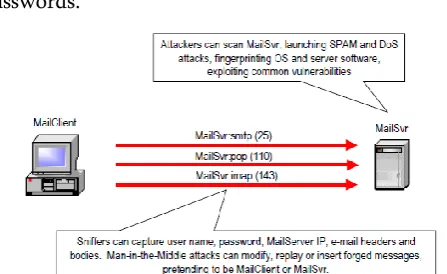
Tunneling over the Internet Conference attendees at public PCs. Travelers using a hotel or airport wireless LAN. Day extenders logging once more into work during the evening. Telecommuters directing business from home. These specialists can expand business effectiveness by utilizing people in general Internet to remain associated. Be that as it may, what are the dangers? Consider a telecommuter utilizing the Internet to get to email (Figure 1). At the point
when the specialist's customer sends letters, messages are handed-off to a SMTP server. At the point when the customer peruses mail, message headers and bodies are downloaded from a POP or IMAP server. Anybody anyplace in this way through the Internet can utilize a sniffer to catch clear text message bodies, as well as email addresses, client names, and passwords.
Figure 1. Typical Remote Access Security Risks
Tunneling over the Intranet Before, organizations tended to consider "us" and "them," utilizing firewalls to set up a safe edge between untrusted untouchables and put stock in insiders. This view is progressively offering approach to layered borders that authorize more granular security at workgroup, framework, and client levels. These strategies are normally actualized with working framework get to controls – for instance, record and printer sharing benefits reached out in a Windows NT® space, in light of login validation through the Primary Domain Controller. In any case, validation and access control alone are lacking. Intranet customer/server applications that trade delicate information – for instance, a finance framework – must be shielded from insider mishandle. Ethernet LANs are a communicated medium. Any PC on the LAN can catch activity inactively without discovery. Utilizing promptly accessible programmer apparatuses, insiders can undoubtedly perform MitM attacks on clear text LAN movement, changing and embeddings packets. Organizations that trust Ethernet LANs need to reconsider this approach while including remote LANs (WLANs). WLAN get to focuses are frequently inaccurately conveyed behind the corporate firewall, treating all stations on the WLAN as trusted. Doing as such is a sweeping welcome to interlopers. WLANs in light of IEEE 802.11b WiFi communicate radio signs many feet toward each path - even past the physical premises. Besides, WiFi shared key verification and Wired Equivalent Privacy (WEP) encryption regularly go unused in light of the fact that they are hard to manage and have genuine imperfections. Accordingly, guests in the anteroom or a "war driver" in the parking garage can undoubtedly utilize freeware like NetStumbler or AirSnort to find a WLAN. By recording bundles with WEPCrack, programmers can break WEP keys and unravel WLAN activity. By then, the WLAN winds up noticeably powerless against a similar Ethernet LAN attacks already examined. On the off chance that the remote access point is inside the firewall, nothing remains between the gatecrasher and the corporate system. Tunneling with Secure Shell can
ensure corporate Intranet movement by overcoming WLAN abuses like AirSnort, NetStumbler, and WEPCrack, and aloof listening in and dynamic MitM attacks that can be performed on any unprotected LAN. Besides, consolidating Secure Shell with appropriate arrangement of the remote access point and a solitary access lead on the corporate firewall can keep would-be interlopers from entering the corporate system.
NT/2000 Remote Desktop Protocol (RDP) customer, and Terminal Services. Unapproved remote control has for some time been a security worry for big business executives. Since these arrangements are free/reasonable and simple to convey, laborers introduce them for accommodation without first tending to the intrinsic hazard to their PCs and the system. Secure Shell tunneling can give solid uniform validation, get to control and protection for shared documents and work areas. Rather than leaving RDP or VNC ports public for misuse, tunneling multiplexes these nonsecure streams onto a solitary Secure Shell session. Client accreditations can be checked and get to conceded at the one place totally under the venture head's control: the Secure Shell server.
IV.
HOW SECURE SHELL TUNNELING WORKS
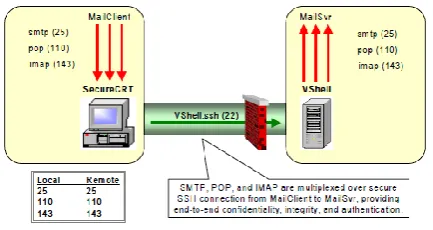
Application streams are tunneled over Secure Shell by sending singular TCP ports. In this paper, i concentrate on nearby port-sending: burrows started by the Secure Shell customer. This course is significantly more typical than remote port-sending: burrows started by the Secure Shell server (see Appendix A). At the point when a neighborhood port is sent, SecureCRT (the Secure Shell customer) tunes in to a predefined TCP port on the nearby host. VShell (the Secure Shell server) publics a TCP association with the remote host where the server application is really running. By tradition:
• The localhost alludes to the application customer's host; remotehost alludes to the application server's host. Commonly, if localhost isn't indicated, it defaults to the SecureCRT have. On the off chance that remotehost isn't determined, it defaults to the VShell have.
• The localport alludes to the port that the application customer sends to and SecureCRT tunes in to. The remoteport alludes to the port that VShell sends to and the application server tunes in to. Much of the time, the localport can be any self-assertive, unused port on the localhost. The remoteport must be the IAN assigned "surely understood" listening
port for the application being tunneled. To utilize the port-forward, the customer application must be reconfigured to interface with localhost:localport rather than remotehost:remoteport. Bundles sent by the customer to localhost:localport are captured by SecureCRT or another SSH customer, encoded, and tunneled through the Secure Shell association with VShell or another SSH server. On receipt, VShell unscrambles these bundles, handing-off them as clear text through the TCP association with the server at remotehost:remoteport. Local port-sending for email is represented in Figure 2.
Figure 2. Local Port-forwarding
Figure 3. Local Port-forwarding to Application on VShell Server
Local port-sending is appropriate when SecureCRT is running on an indistinguishable PC from the customer application, starting outbound TCP associations with the server application. Every so often, clients need to acknowledge TCP associations started in the turnaround heading by an application on the Secure Shell server-side. This can be refined with remote port-sending, portrayed in Appendix A. These cases delineate the expansive power and adaptability of Secure Shell tunneling. Be that as it may, it is additionally essential to tolerate as a top priority:
Secure Shell advances singular TCP associations, however not port extents. Multi-association applications like FTP that utilization transient ports don't loan themselves well to port-sending. To exchange documents safely finished Secure Shell, it is smarter to utilize SFTP or SCP conventions, upheld by VanDyke VShell server, SecureFX record exchange customer, and the SecureCRT VCP utility.
Although thoughtfully conceivable, standard Secure Shell does not forward UDP datagram administrations.
Be that as it may, RPC-based UDP conventions like NFS can be tunneled over Secure Shell utilizing uninhibitedly accessible expansions like SNFS.
Authentication And Access Control In each of these cases, a border firewall secures VShell. Leaving the Secure Shell port public on the firewall viably assigns control over tunneled applications to VShell. Doing
as such makes a solitary, coordinated purpose of control over remote client validation, asset get to rights, and tunneled applications. Before any tunneling can happen, the SecureCRT client is validated by VShell, joining solid two factor and public key strategies with Windows NT or Windows 2000® workgroups, PCs, and client accounts. It additionally implements verification retries and timeout limits. VShell channels can be made to permit or deny Secure Shell associations from singular IPs, has, subnets, or whole spaces. Windows clients and gatherings can be offered access to neighborhood or remote port-sending without giving charge shell or SFTP benefits. Sent has and ports can be controlled at more granular levels by making channels that permit or deny sending to IPs, has, subnets, spaces. For instance, sending can be permitted to/from *.corp.com, for any port or chose ports. Port-forward mappings are really characterized by each Secure Shell customer. At the point when a Secure Shell association is set up, VShell acknowledges or rejects the asked for port-advances, in view of the validated client's benefits and port-forward channels. As a matter of course, SecureCRT enables port-sending to and from the localhost, however these customer side Access Control Lists (ACLs) can likewise be altered. To all the more completely acknowledge how port-sending is arranged, where verification and encryption happen, and the dangers tended to by these measures, i should investigate some basic applications that can be tunneled over Secure Shell.
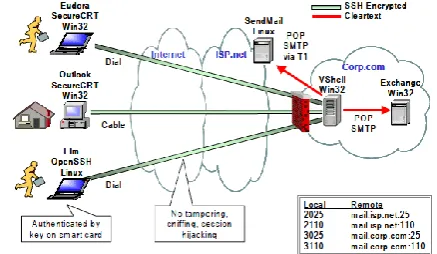
protection and respectability of all mail sent and got by validated laborers through organization POP, IMAP and SMTP servers. To burrow email, every specialist designs a SecureCRT or other Secure Shell customer with a nearby portforward; mapping ports on the localhost to the notable ports tuned in to via mail servers. Figure 4 delineates this, developing the neighborhood port-sending arrangement portrayed in Figure 2.
Figure 4. Secure E-Mail for Travelers, Teleworkers
Two choices are shown here. An outside Send Mail server that is situated at this current organization's ISP is come to through self-assertive neighborhood ports 2025 and 2110. An inside Exchange server inside the corporate system is come to through neighborhood ports 3025 and 3110. In the two cases, mail movement is secured on the general population Internet, however sent as clear text to the mail server. This counteracts listening in, change, and session commandeering as email goes through people in general Internet. Just verified clients can access these mail servers (in this case, scratch sets put away safely on shrewd cards). Clients should know VShell's host public key ahead of time to be sure that they are achieving a legitimate goal.
Secure Wireless Access to Corporate LANs Figure 5 develops a situation portrayed before in this paper: securing WLAN movement bound for intranet servers on the corporate LAN. Representatives utilizing WiFi-empowered workstations in a meeting room, cafeteria, or other public space can build business productivity by getting to their organization's inner system assets.
Figure 5. Secure Wireless Access to Corporate LANs
An IMail server with program based mail get to be come to with the URL http://localhost:3080. An IIS server is come to with the URL http://localhost:4080. In this case, diverse nearby ports are appointed to forward a similar application to various remote hosts. Since i have only one NNTP server, i can just guide nearby port 119 to remote port 119. As the client explores these server's site pages, just URLs in respect to sent hosts (webmail.corp.com and intranet.corp.com) will be public. Since HTTP can be encoded with SSL (443), why burrow this over Secure Shell? In this illustration, just clients with known public keys (counting those extricated from PC testaments) may get to these Intranet servers. The firewall between the 802.11b Wireless Access Point (WAP) and VShell shields the corporate LAN from the WLAN. Along these lines, the main remote movements that can enter this LAN are validated, approved applications tunneled over Secure Shell. Then again, essentially opening 443 on this firewall would give any application a free ride into the LAN through this port, achieving any goal without validation. At long last, multiplexing applications over Secure Shell diminishes the aggregate number of TCP associations, upgrading firewall execution.
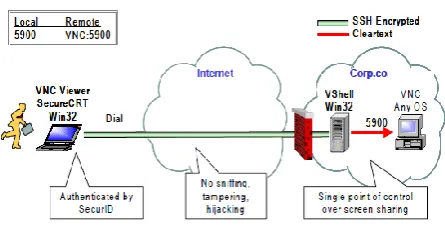
PC to remotely control his work area back at the workplace. To do as such, he makes a neighborhood port forward, mapping port 5900 on the localhost to 5900 on the remote work area running VNC.
Figure 6. Secure VPN Screen Sharing
Despite the fact that there are many projects that empower screen sharing, VNC is advantageous on the grounds that it keeps running on different stages: Win32, Linux, Solaris, Macintosh, DEC, and WinCE. Since VNC gives just frail logon secret key verification and no encryption, tunneling VNC over Secure Shell is basic. Utilizing Secure Shell items like SecureCRT and VShell give the system chairman granular control over remote screen sharing. Specialists can be emphatically confirmed with public keys, declarations, or two-factor verification techniques like SecurID. VShell channels control which work areas can be gotten to through VNC ports, and which laborers have consent to do as such. The firewall can piece VNC ports, while enabling Secure Shell to come to the VShell server. The VShell server goes about as a solitary purpose of control over VNC access to this corporate system.
Security Implications notwithstanding those advantages as of now examined, tunneling over encoded Secure Shell ensures against IP mocking (aggressors taking on the appearance of true blue has by utilizing a known IP address), DNS caricaturing (fashioned DNS records that trap customers into interfacing with an assailant's own particular server), and IP source steering (a technique utilized by programmers to imagine that arriving bundles start from somewhere else). No safety effort – including Secure Shell tunneling ensures against each conceivable attack. As these cases show, end-to-end
security includes not simply ensuring information in travel, but rather framework security at the passage endpoints (SecureCRT and VShell), firewalls, and on any trusted server accepting sent clear text. Thus, securing the Secure Shell server stage is fundamental. In the event that a programmer enters a misconfigured firewall, at that point misuses a frail director secret word to sign onto the Secure Shell server, secure tunneling can't keep application information from falling into the wrong hands. When furnishing voyagers, telecommuters, or accomplices with Secure Shell customers, archive "best practices" that must be utilized.
V.
CONCLUSION
Compared to other connection, system, and application safety efforts like IPsec, WEP, and PGP, introducing and arranging Secure Shell is moderately speedy and simple. By conveying VShell and SecureCRT, organizations make an extensive universally useful tunneling stage that can be utilized to actualize a wide assortment of security approaches, guaranteeing the protection, genuineness, and uprightness of a wide range of uses. This paper outlines a few regular business applications, however the potential outcomes are unfathomable.
VI.
REFERENCES
[1]. I. Cooper and J. Dilley, "Known HTTP proxy/caching problems," IETF, Fremont, CA, USA, Tech. Rep. Internet RFC 3143, Jun. 2001. [2]. R. Dingledine, N. Mathewson, and P. Syverson,
"Tor: The second- generation onion router," in Proc. USENIX Secur. Symp., 2004, pp. 21-37. [3]. J. Boyan, "The anonymizer: Protecting user
privacy on the Web," Comput.-Mediated Commun. Mag., vol. 4, no. 9, pp. 1-6, Sep. 1997.
[4]. DynaWeb, accessed on Jan. 7, 2017. Online]. Available:
[5]. R. Clayton, S. J. Murdoch, and R. N. M. Watson, "Ignoring the greatfirewall of China," in Proc. Int. Workshop Privacy Enhancing Technol., 2006, pp. 20-35.
[6]. Y. Sovran, A. Libonati, and J. Li, "Pass it on: Social networks stymie censors," in Proc. 7th Int. Conf. Peer-to-Peer Syst., Feb. 2008, p. 3.
Online]. Available:
http://www.iptps.org/papers-2008/73.pdf [7]. D. McCoy, J. A. Morales, and K. Levchenko,
"Proximax: A measure- ment based system for proxies dissemination," Financial Cryptogr. Data Secur., vol. 5, no. 9, pp. 1-10, 2011. [8]. N. Feamster, M. Balazinska, W. Wang, H.
Balakrishnan, and D. Karger, "Thwarting Web censorship with untrusted messenger discovery," in Int.Workshop Privacy Enhancing Technol., 2003, pp. 125-140.
[9]. J. Zittrain and B. Edelman, "Internet filtering in China," IEEE Internet Comput., vol. 7, no. 2, pp. 70-77, Mar. 2003.
[10]. (Nov. 2007). Defeat Internet Censorship: Overview ofAdvanced Technologies and Products. Online]. Available: http:// www.internetfreedom.org/archive/DefeatInter net Censorship White Paper.pd
[11]. C. S. Leberknight, M. Chiang, H. V. Poor, and F. Wong. (2010). A Taxonomy of Internet Censorship and Anti-Censorship. Online]. Available: http://www.princeton.edu/ chiangm/anticensorship.pdf
[12]. I. Clarke, S. G. Miller, T. W. Hong, O. Sandberg, and B. Wiley, "Protecting free expression online with freenet," IEEE Internet Comput., vol. 6, no. 1, pp. 40-49, Jan. 2002. [13]. Ultrasurf, accessed on Jan. 7, 2017. Online].
Available: https://ultrasurf.us/
[14]. J. Jia and P. Smith. (2004). Psiphon: Analysis and Estimation. Online]. Available: http://www.cdf.toronto.edu/
csc494h/reports/2004- fall/psiphon_ae.html.