Classification of Sonar Images Using Neural
Network Algorithm: A Review
Pallavi Ramawatar Partani
1, Hemant M. Baradkar
2P.G. Student, Department of E&TC Engineering, JCOET Engineering College, Yavatmal, Maharashtra, India1
Professor, Department of E&TC Engineering, JCOET Engineering College, Yavatmal, Maharashtra, India2
ABSTRACT: In many research areas, intelligent recognition and classification systems gained an important role. The reliability and the success of these systems are depend on the effectiveness of applied data pre-processing techniques and neural networks which can be used for efficient modeling of human’s visual system during the recognition or classification of patterns. In this purposed work, Sonar Image Classification System which was developed to simulate human experience in the recognition of underwater shapes by using Back Propagation Learning Algorithm, will be presented. Experimental results suggest that automatic intelligent classification of these shapes may provide more effective researches in oceanic engineering. There are 4 main phases in the proposed work .They are image pre-processing, feature extraction of Side scan Sonar Images, designing a network, classification of five type of Underwater Shape sonar images. For classification neural classifiers in FFT, WHT,and DCT transformations are used. The main aim of the method is to develop a more efficient technology for Sonar Image Classification and Recognition System which was developed to simulate human experience in the recognition of underwater shapes.
KEYWORDS: Neurosolution;Neural network; Transformed domain techniques;Matlab; Microsoft Office Excel;
I. INTRODUCTION
Discovering our world has gained an importance. Oceans are the biggest unknowns of our world. There is a history and treasure lying at the sea floor. In every part of the world, scientific developments have been performed to get more information about them. In oceanic engineering, one of the most important things is experience. Sonar Image Classification System had been developed to get a human experience and vision. Neural networks have an important part in the modelling of human decision making processes to computers. They have been applied in many applications
such as automotive, aerospace, medical, robotics etc. Because of its’ success in classification of images, back
propagation learning algorithm has been applied to Sonar Image Classification System. In many research areas, intelligent recognition and classification systems gained an important role.
One of the most popular tool for underwater researches is Side Scan Sonars. Side Scan Sonars are used to create an image of sea floor to provide an understanding of the differences in material and texture type of the seabed by using acoustic reflections of pulses. Sometimes, these images cannot provide an efficient information to researchers and scientists to easily recognize them. They are mostly in greyscale or in two colours, and additional noise, such as depth and water pollution of sea floor decrease the quality and visibility of sonar images. But, in spite of all these disadvantages, scientists are still performing researches and experiments to discover and recognize the depth of the oceans.
Fig.1: FiveTypes of Sonar Images.
The reliability and the success of these systems are depend on the effectiveness of applied data pre-processing
techniques and neural networks which can be used for efficient modelling of human’s visual system during the
recognition or classification of patterns. Neural networks have an important part in the modeling of human experience and decision making process into computers.
II. RELATED WORK
In [1] author suggest a novel classification system based on kernel-based extreme learning machine (KELM) and principle component analysis (PCA) is proposed. Experimental results demonstrate that the proposed method can get better stability and higher classification accuracy than traditional approaches such as support vector machine (SVM). Classification performance of KELM classifier can be improved using PCA with result KELM=93.27%. In [2] author shows for target classification in side-scan sonar, extra feature extraction and data engineering can result in better classification performance compared to parameter optimization alone. The largest distinguishing characteristic for identified targets is geometrical uniqueness amongst surrounding topology results C-SVC Sobel 92.7%. In [3] author discuss the use of automated classification algorithms and its efficiency on mapping marine mineral resources based on side scan sonar images. The conclusion is that after the appropriate image processing can automatically generate thematic textural maps of sea floor mineral resources, despite of its spatial and mineralogical complexities. In [4]author
presents a selection procedure for the regularization constant α of the robust exemplar-based imprinting algorithm in
the case of real SONAR images. However, for the majority of test images the best PSNR was obtained for α = 0.9.In
achieved in 0.08 seconds. SICS was trained with a training set that contains 10 images with 35 patterns, 20 human-made wreck, 15 natural underwater shapes, Totally, SICS reached to 47/54 of success that is 87%.
III.PROPOSED ALGORITHM
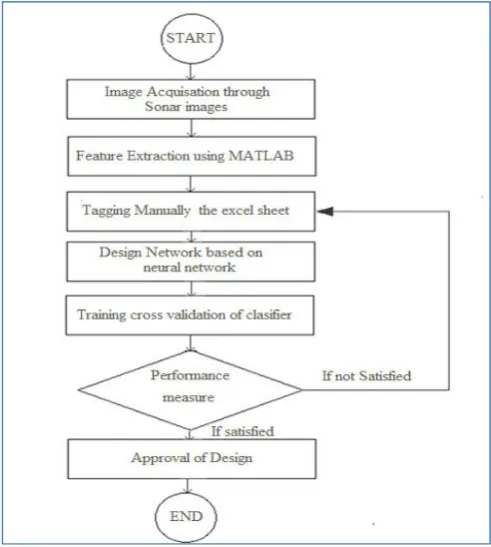
The present study has been mainly aimed to undertake side scan sonar images classification based on transform domain features. The broad requirements of the classification algorithm are to acquire high resolution side scan sonar images, extract features from the images and classify the images by applying the dataset to CI based classifier which classifies it to specific 5 type of images. With objective to increase performance in classifying and recognizing the side scan sonar images, the proposed strategy has 3 main phases and general flow chart of the process as shown in figure 2.
Fig. 2: Process Flow Chart.
Step 1: Feature Extraction Using Matlab:
For the purpose of classification, the feature dataset is formed with the help of WHT, DCT, FFT transform domain features along with parameters of image statistics, image texture and image morphology.
The feature set includes the following features:
A. Morphological/ Geometric feature: shape
B. Statistical features: Average, Standard Deviation, Entropy, Contrast, Correlation, Energy, Homogeneity
C. Transform domain features including Discrete Cosine Transform (DCT), Walsh-Hadamard Transform (WHT), and
Fast Fourier Transform (FFT).
D. Coefficients were extracted by using MATLAB (Mathworks Inc., USA)
Step 2: Network Design using Neural Network:
trained on the training dataset and tested on a different CV dataset to find out the classification accuracy and other performance measures.
Proposed paper uses two neural networks as classifier a) Multi-Layer Perceptron Neural Network b) Generalized Feed Forward Network.
a. Multilayer perceptron (MLP)
The most common neural network model is the multi-layer perceptron (MLP). This type of neural network is known as a supervised network because it requires a desired output in order to learn. The goal of this type of network is to create a model that correctly maps the input to the output using historical data so that the model can then be used to produce the output when the desired output is unknown.
b. Generalized Feed-forward networks:
Perceptrons are arranged in layers, with the first layer taking in inputs and the last layer producing outputs.
The middle layers have no connection with the external world, and hence are called hidden layers
Each perceptron in one layer is connected to every perceptron on the next layer. Hence information is
constantly "fed forward" from one layer to the next, and this explains why these networks are called feed-forward networks.
There is no connection among perceptrons in the same layer.
These two networks are trained using four learning rules, i) Momentum ii)Conjugate Gradient (CG) iii) Quick Propagation (QP) and iv) Delta bar delta (DBD).
Momentum
Momentum simply adds a fraction m of the previous weight update to the current one. The momentum parameter is used to prevent the system from converging to a local minimum or saddle point. A high momentum parameter can also help to increase the speed of convergence of the system. However, setting the momentum parameter too high can create a risk of overshooting the minimum, which can cause the system to become unstable. A momentum coefficient that is too low cannot reliably avoid local minima, and can also slow down the training of the system.
Conjugate Gradient
CG is the most popular iterative method for solving large systems of linear equations. These systems arise in many important settings, such as finite difference and finite element methods for solving partial differential equations, structural analysis, circuit analysis, and math homework.
Quickpropagation
Quick propagation (Quickprop) is one of the most effective and widely used adaptive learning rules. There is only one global parameter making a significant contribution to the result, the e-parameter. Quick-propagation uses a set of heuristics to optimize Back-propagation, the condition where e is used is when the sign for the current slope and previous slope for the weight is the same.
Delta bar Delta
The Delta-Bar-Delta (DBD) attempts to increase the speed of convergence by applying heuristics based upon the previous values of the gradients for inferring the curvature of the local error surface. The delta bar delta paradigm uses a learning method where each weight has its own self-adapting coefficient. It also does not use the momentum factor of the back propagation networks. The remaining operations of the network, such as feed forward recall, are same to the normal back-propagation networks. Delta-Bar-Delta is a heuristic approach in training neural networks, because the past error values can be used to infer future calculated error values.
Step 3: Testing of Network:
After training & retraining of the classifier, it is cross validated & tested on the basis of the following performance matrix.
ii) Normalized Mean Square Error iii) Classification accuracy
IV.RESEARCHOBJECTIVE
To develop an efficient classification algorithm based on computational intelligence approaches, with accuracy
similar to that achieved by experienced oceanicengineer.
To increase the classification accuracy use maximum number of side scan sonar images for classification.
To maintain the correctness & accuracy in the underwater object classification with sonar images characteristics even
though the input images are contaminated by known or unknown noise.
V. CONCLUSION AND FUTURE WORK
This paper demonstrated how using artificial neural networks (ANN) could be used to build accurate side scan sonar image classifier. Use of the proposed optimal classifier based on Computational Intelligence techniques will be result in more accurate and reliable.
REFERENCES
1. Mingcui Zhu, Yan Song, Jia Guo, Chen Feng, Guangliang Li, Tianhong Yan6, Bo He,' PCA and Kernel-based Extreme Learning Machine for Side-Scan Sonar Image Classification’,IEEE 2017.
2. Jason Rhinelander,' Feature Extraction and Target Classification of Side-Scan Sonar Images’, 978-1-5090-4240-1/16/$31.00 ©2016 IEEE. 3. Marcelo Sperle, Eduardo Negri,'Automatic Classification of Sidescan Sonar Images for Mapping Marine Mineral Resources’,
978-1-4673-7019-6/15/$31.00 ©2015 IEEE.
4. Cristina Stolojescu-Crisan,Alexandru Isar,'The improvement of the robust exemplar-based in painting algorithm for SONAR images’, 978-1-4799-7267-8/14/$31.00 ©2014 IEEE.
5. Olga Lopera, Yves Dupont,'Target classification from HR sonar image’, 978-1-4799-0002-2/13/$31.00 ©2013 IEEE.
6. Naveen Kumar, Qun Feng Tan, Shrikanth S. Narayanan,'object Classification in Sidescan Sonar Images with Sparse Representation Techniques’, 978-1-4673-0046-9/12/$26.00 ©2012 IEEE
7. Arnaud Martin,'Comparative study of information fusion methods for sonar images classification’, 0-7803-9286-8105l$20.00 ©2005 IEEE
8. Boran Sekeroglu,'Classification of Sonar Images Using Back Propagation Neural Network’, 0-7803-8742-2/04/$20.00 (C) 2004 IEEE. 9. Gerald J. Dobeck,'Algorithm Fusion for Automated Sea Mine Detection and Classification ”Proc.,IEEEO ceans 2001 , pp. 130-134,
Honolulu,HI,Nov5-8, 2001.
10. Esther Dura, Gerald J.Dobeck, et.al.,'Active Learning for Detection of Mine-Like Object sin Side- Scan Sonar Imagery.”IEEE Journal of Oceanic Engineering,vol.30,No.2,pp.360-371,April2005.