Noor Farhan Kapdi1, Shubham Sangnale2, Pramod Ralebhat3, Mandar Mokashi4
Students, Dept. of Computer Engineering, DY Patil School of Engineering, Maharashtra, India1,2,3 Assistant Professor, Dept. of Computer Engineering, DY Patil School of Engineering, Maharashtra, India4
Abstract: People always have difficulty with the interior designing of their house. They process of choosing which furniture is to be purchased that will be best suited for their room is hectic. Sometimes after purchasing furniture they may feel that the purchased furniture does not match with the environment. Thinking upon such problem we came up with a solution as our project which will help people to have virtual view of furniture in the real world before purchasing it using a technology augmented reality.
KEYWORDS: Augmented Reality, Marker based, Image Capturing Module, Image Processing Module, Tracking, Rendering
I. INTRODUCTION
Augmented reality is a technology which integrates user's digital information with the real world. Augmented reality technology is categorized into two types – marker-based and marker-less. Marker-based system is inexpensive and easy to use.
The user is required to install the application on his/her device. Then place the markers on the floor at required positions. Start the application which will allow to start the camera. Bring the marker into the view. The marker will be detected, the co-ordinates of marker will be calculated and 3D objects will be created dynamically. This application is able to detect multiple markers and create multiple virtual objects.
The objects are viewed virtually in the real world and the user can rotate it virtually. Also user can resize the object and select different colors for the object to select the best suitable furniture design for the house.
II. MOTIVATION
The main motivation behind this project idea is to allow people to have virtual view of furniture design before purchasing it.
III. RELATED WORK
Various existing systems are:
A. HEAD MOUNTED DISPLAY
Fig-1 Head Mounted Display B. ZOOBURST
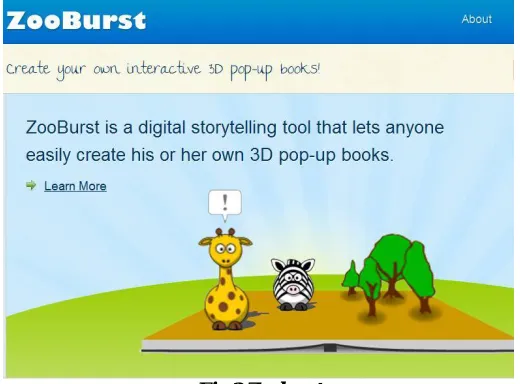
Zooburst is a digital storytelling tool which is used to create a 3D pop-up book. The books created using this tool are web based. It works with the augmented reality. It makes the use of a webcam. The book can have maximum 10 pages. It uses either images created by own or vector images created by open source tool that can be sized, rotated and coloured. To sign up for an account you’ll have to give your name, and email and explain why you would like to try Zooburst.
Fig 2 Zooburst
IV. PROPOSED WORK
Fig 3 System Architecture
1.1.1 Camera:
The camera will capture a continuous video frame in which the image will be displayed.
1.1.2 Image Capturing Module:
The input to Image Capturing Module is given via camera i.e. live video frame. This module analyses each frame in the video and generate the binary image consisting of only two values for each pixel i.e. 0 for black and 1 for white.
1.1.3 Image Processing Module:
The binary images generated by the Image Capturing Module are input to the Image Processing Module. This module process the binary images and detects the marker using image processing techniques. To place the object in the real world, marker position is determined.
1.1.4 Tracking Module:
Fig 4. Markers for tracking
1.1.5 Rendering Module:
The Rendering Module has 2 inputs. First is the calculated pose from the Tracking Module and other is the Virtual Object to be augmented. This module combines the original image and virtual components. It displays the augmented view on the screen of handset.
V. MATHEMATICAL MODEL
1. Let S be the Virtual Furniture Set S is divided into 6 modules S= S1, S2, S3, S4, S5,S6 S1= Camera
S2= Image Capturing Module (ICM) S3= Image Processing Module (IPM) S4= Tracking Module (TM)
S5= Rendering Module (R) S6= Display Module (D) 2. Identify the inputs. Inputs = X1, X2, X3, ..Xn X1= Video frame with marker X2= Video frame without marker 3. Identify the output as O. Outputs = Y1, Y2, Y3, ..Yn Y1= 3D Augmented View Y2= Table View
Success Conditions:
Virtual object is created in the real world Failure Conditions:
VI. CONCLUSIONS
ACKNOWLEDGMENTS
We would like to heartily acknowledge all the group members who put their heart and soul in it to make it a successful project. We would like to thank our guide Mr.Mandar Mokashi for guiding us on every possible juncture while making the project. It is due to his very crucial critics that molded the project into its finished form also a lot of thanks to all the near and dear ones who helped us with whatever small contributions that made this project possible.
REFERENCES
[1] Mr.Raviraj S. Patkar, Mr. S. Pratap Singh, Ms. Swati V. Birje, International Journal of Advanced Research in Computer Science and Software Engineering, May 2013
[2] Rencheng Sun , YiSui , RanLi , Fengjing Shao, The Design of a New Marker in Augmented Reality, 2011 International Conference on Economics and Finance Research , IPEDR vol.4 (2011) © (2011)IACSIT Press, Singapore/
[3] Si Jung Jun Kim, A User Study Trends in Augmented Reality and Virtual Reality Research, 2012 International Symposium on Ubiquitous Virtual Reality
[4] ZhiYing Zhou, Adrian David Cheok, JefryTedjokusumo and Gilani Syed Omer, wIzQubesTM- A Novel Tangible Interface for Interactive Storytelling in Mixed Reality, The International Journal of Virtual Reality, 2008, 7(4):9-15
[5] Suman Lata, Parul Preet Singh,A Review on Content Based Image Retrieval System ,International Journal of Advanced Research in Computer Science and Software Engineering, Volume 4, Issue 5,May 2014
[6] M. Venkat Dass, Mohammed Rahmath Ali, Mohammed Mahmood Ali,Image Retrieval Using Interactive Genetic Algorithm, International Conference on Computational Science and Computational Intelligence, 2014
[7] Meenakshi Shriuti Pal, Dr Sushil kumar Garg,Image retrieval: A Literature Review, international journals of advanced research in computer engineering and technology (IJARCET), Volume 2,Issue 6, June 2013
[8] M. Elhelw, M. Nicolaou, A. Chung, G.-Z. Yang, and M. S. Atkins. A gaze-based study for investigating the perception of visual realism in simulated scenes. ACM Trans. Appl. Percept., 5(1):3:1–3:20, Jan. 2008.
[9] J. L. Gabbard, J. E. Swan, II, and D. Hix. The effects of text drawing styles, background textures, and natural lighting on text legibility in outdoor augmented reality. Presence: Teleoper. Virtual Environ., 2006.
[10] P. Khanna, I. Yu, J. Mortensen, and M. Slater. Presence in response to dynamic visual realism: a preliminary report of an experiment study. In Proceedings of the ACM symposium on Virtual reality software and technology,VRST ’06,
[11] R. Azuma et al. Recent advances in augmented reality. IEEE Computer Graphics and Applications, 20-38, 2001.