Scholarship at UWindsor
Scholarship at UWindsor
Electronic Theses and Dissertations Theses, Dissertations, and Major Papers
2017
Robust Optimization Framework to Operating Room Planning and
Robust Optimization Framework to Operating Room Planning and
Scheduling in Stochastic Environment
Scheduling in Stochastic Environment
Morteza Lalmazloumian University of Windsor
Follow this and additional works at: https://scholar.uwindsor.ca/etd
Recommended Citation Recommended Citation
Lalmazloumian, Morteza, "Robust Optimization Framework to Operating Room Planning and Scheduling in Stochastic Environment" (2017). Electronic Theses and Dissertations. 5994.
https://scholar.uwindsor.ca/etd/5994
This online database contains the full-text of PhD dissertations and Masters’ theses of University of Windsor students from 1954 forward. These documents are made available for personal study and research purposes only, in accordance with the Canadian Copyright Act and the Creative Commons license—CC BY-NC-ND (Attribution, Non-Commercial, No Derivative Works). Under this license, works must always be attributed to the copyright holder (original author), cannot be used for any commercial purposes, and may not be altered. Any other use would require the permission of the copyright holder. Students may inquire about withdrawing their dissertation and/or thesis from this database. For additional inquiries, please contact the repository administrator via email
Robust Optimization Framework to Operating Room Planning and Scheduling in
Stochastic Environment
By
Morteza Lalmazloumian
A Dissertation
Submitted to the Faculty of Graduate Studies
through Industrial and Manufacturing Systems Engineering
in Partial Fulfillment of the Requirements for
the Degree of Doctor of Philosophy
at the University of Windsor
Windsor, Ontario, Canada
2017
Stochastic Environment
by
Morteza Lalmazloumian
APPROVED BY:
______________________________________________
S. Zolfaghari, External Examiner
Ryerson University
______________________________________________
A. Chaouch
Odette School of Business
______________________________________________
M. El-Masri
Faculty of Nursing
______________________________________________
A. Azab
Department of Mechanical, Automotive and Materials Engineering
______________________________________________
J. Urbanic
Department of Mechanical, Automotive and Materials Engineering
______________________________________________
M. Ahmadi, Co-Advisor
Department of Electrical and Computer Engineering
______________________________________________
F. Baki, Co-Advisor
Odette School of Business
iii
Declaration of Co-authorship and previous
publication
DECLARATION OF CO-AUTHORSHIP
I hereby declare that this dissertation incorporates material that is the result of
research conducted under the supervision of my supervisors, Dr. M. Ahmadi and Dr. Fazle
Baki. Results related to this research are reported in Chapters 2 through 5.
I am aware of the University of Windsor's Senate Policy on Authorship and I
certify that I have properly acknowledged the contributions of the other researchers to my
dissertation, and I have obtained written permission from my co-author to include the
aforementioned materials in my dissertation.
I certify that, with the above qualification, this dissertation, and the research to
which it refers, is the product of my own work.
iv
I declare that this dissertation includes three original papers that have been
previously submitted / will be submitted for publication in peer reviewed journals as
v
Dissertation Chapter Publication Title/full Citation Publication Status
Chapter 2 M. Lalmazloumian, F. Baki , M. Ahmadi, “A novel robust optimization transformation framework to operating room capacity allocation problem under uncertainty at a publically funded hospital” submitted to IEEE Transaction on Engineering Management, pp. 42, 2017.
Submitted
Part of Chapter 4 M. Lalmazloumian, F. Baki , M. Ahmadi, “A multi objective operating integrated operating room planning and advance scheduling under uncertainty” to be submitted to Computers and Industrial Engineering, pp. 21, 2017.
To be submitted
Part of Chapter 4 M. Lalmazloumian, F. Baki, M. Ahmadi, “A two-stage stochastic programming model to integrated operating room planning and advance scheduling problem under uncertainty at a publicly-funded hospital” IFORS
2017.
Accepted
Part of Chapter 4 M. Lalmazloumian, F. Baki, M. Ahmadi, “A novel robust optimization transformation framework to
integrated master surgery schedule and surgery case assignment problem under uncertainty at a publically funded hospital,” to be submitted to OMEGA, pp. 39, 2017.
vi
I certify that I have obtained a written permission from the copyright owner(s) to
include the above material(s) in my dissertation. I certify that the above material describes
work completed during my registration as graduate student at the University of Windsor.
I declare that, to the best of my knowledge, my dissertation does not infringe upon
anyone’s copyright nor violate any proprietary rights and that any ideas, techniques,
quotations, or any other material from the work of other people included in my
dissertation, published or otherwise, are fully acknowledged in accordance with the
standard referencing practices. Furthermore, to the extent that I have included copyrighted
material that surpasses the bounds of fair dealing within the meaning of the Canada
Copyright Act, I certify that I have obtained a written permission from the copyright
owner(s) to include such material(s) in my dissertation.
I declare that this is a true copy of my dissertation, including any final revisions,
as approved by my dissertation committee and the Graduate Studies office, and that this
dissertation has not been submitted for a higher degree to any other University or
vii
Abstract
Arrangement of surgical activities can be classified as a three-level process that
directly impacts the overall performance of a healthcare system. The goal of this
dissertation is to study hierarchical planning and scheduling problems of operating room
(OR) departments that arise in a publicly funded hospital. Uncertainty in surgery durations
and patient arrivals, the existence of multiple resources and competing performance
measures are among the important aspect of OR problems in practice. While planning can
be viewed as the compromise of supply and demand within the strategic and tactical
stages, scheduling is referred to the development of a detailed timetable that determines
operational daily assignment of individual cases. Therefore, it is worthwhile to put effort
in optimization of OR planning and surgical scheduling. We have considered several
extensions of previous models and described several real-world applications.
Firstly, we have developed a novel transformation framework for the robust
optimization (RO) method to be used as a generalized approach to overcome the drawback
of conventional RO approach owing to its difficulty in obtaining information regarding
viii
model in transforming deterministic models into the robust form. We have determined an
optimal case mix planning for a given set of specialties for a single operating room
department using the proposed standard RO framework. In this case-mix planning
problem, demands for elective and emergency surgery are considered to be random
variables realized over a set of probabilistic scenarios. A deterministic and a two-stage
stochastic recourse programming model is also developed for the uncertain surgery case
mix planning to demonstrate the applicability of the proposed RO models. The objective is
to minimize the expected total loss incurred due to postponed and unmet demand as well
as the underutilization costs. We have shown that the optimum solution can be found in
polynomial time.
Secondly, the tactical and operational level decision of OR block scheduling and
advance scheduling problems are considered simultaneously to overcome the drawback of
current literature in addressing these problems in isolation. We have focused on a hybrid
master surgery scheduling (MSS) and surgical case assignment (SCA) problem under the
assumption that both surgery durations and emergency arrivals follows probability
distributions defined over a discrete set of scenarios. We have developed an integrated
robust MSS and SCA model using the proposed standard transformation framework and
determined the allocation of surgical specialties to the ORs as well as the assignment of
surgeries within each specialty to the corresponding ORs in a coordinated way to
minimize the costs associated with patients waiting time and hospital resource utilization.
To demonstrate the usefulness and applicability of the two proposed models, a
simulation study is carried utilizing data provided by Windsor Regional Hospital (WRH).
The simulation results demonstrate that the two proposed models can mitigate the existing
variability in parameter uncertainty. This provides a more reliable decision tool for the OR
managers while limiting the negative impact of waiting time to the patients as well as
ix
Dedication
To my wife
x
Acknowledgement
There are several people whom I owe my sincere appreciation for their generous
help, guidance and contributions to completion of this doctoral dissertation.
First of all, I would like to gratefully and sincerely thank my advisors Dr. Majid
Ahmadi and Dr. Fazle Baki for their guidance, inspiration and commitment throughout the
course of this work. Their mentorship was paramount in providing a well-rounded
experience consistent with my career goals. I would also like to thank the members of my
doctoral committee, Dr. Ben Chaouch, Dr. Maher El-Masri, Dr. Ahmed Azab and Dr. Jill
Urbanic for their time and attention in reviewing my dissertation, and their helpful input,
constructive criticism, and feedback. I am also thankful to Dr. Esaignani Selvarajah for her
valuable comments during my Oral examination. A very special thanks to Ms. Lorraine
Grondin and Ms. Angela Heskell for helping me shape my wonderful experience and
making it a rich one.
I would also like to express my gratitude and thanks to all those who were behind
my success, my mom and dad and my friends for their word of encouragement and
xi
Finally, my deepest gratitude goes to my loving wife. Without her generous love,
support, and encouragement, this journey would have never come to a successful
xii
Table of content
Declaration of Co-authorship and previous publication
... iii
Abstract
... vii
Dedication
... ix
Acknowledgement
... x
List of table
... xvi
List of figure
... xviii
Nomenclature
... xix
Abbreviations
... xxii
Chapter 1
... 1
Introduction to Operating Room Planning and Scheduling
... 1
1.1 Healthcare Operations Management ... 1
1.2 Overview of the Thesis ... 13
1.2.1 Chapter 2: Standard Robust Optimization Transformation Framework ... 13
1.2.2 Chapter 3: Robust Surgery Mix Planning ... 16
1.2.3 Chapter 4: Robust integrated master surgery scheduling and surgical case assignment problem ... 18
1.3 Outline of the Thesis ... 21
References
... 22
xiii
A Transformation Framework for Robust Optimization
... 25
2.1 Introduction ... 25
2.2 Robust Optimization... 26
2.2.1 Conventional Robust Optimization Formulation ... 29
2.3 Robust Optimization vs Sensitivity Analysis and Stochastic Programming ... 36
2.4 Robust Optimization Transformation Framework ... 37
2.4.1 Two-stage stochastic recourse programming model ... 38
2.4.2 Robust optimization transformation framework for two-stage stochastic recourse program... 39
2.4.3 Proposed transformation framework for the RO model with solution robustness ... 41
2.4.4 Proposed transformation framework for RO model with model robustness ... 43
2.4.5 Proposed transformation framework for RO model with the trade-off between solution and model robustness ... 45
References
... 47
Chapter 3
... 48
A Novel Robust Optimization Transformation Framework to Operating Room
Case Mix and Capacity Planning under Uncertainty at a Publicly-Funded
Hospital
... 48
3.1 Introduction ... 48
3.2 Surgery capacity allocation process and specific characteristics ... 58
3.3. Proposed standard transformation framework for the robust optimization models 60 3.3.1 Two-stage stochastic recourse programming model ... 63
3.3.2 Robust optimization transformation framework for two-stage stochastic recourse program... 64
3.4 RO model for the surgery capacity allocation problems ... 71
3.4.1 Notations ... 75
3.4.2 Formulation of the surgery block allocation problems using proposed standard transformation framework ... 76
xiv
3.5.1 Case description ... 83
3.5.2.The first stage decisions ... 86
3.5.3 The second stage decisions ... 86
3.5.4 Robust optimization vs. stochastic recourse programming ... 88
3.5.5Analysis of the results ... 90
3.6 Conclusions ... 101
References
... 104
Chapter 4
... 107
A Novel Robust Optimization Transformation Framework for Multi-Objective
Integrated Master Surgery Schedule and Surgical Case Assignment Problems at
a Publicly-Funded Hospital
... 107
4.1 Introduction ... 107
4.2 Literature Review ... 110
4.2.1 Master Surgery Schedule ... 115
4.2.2 Advance Scheduling ... 120
4.3 Problem Statement ... 124
4.4 RO Model for Integrated MSS and SCA Problem ... 130
4.4.1 Notations ... 130
4.5 Formulation of Integrated MSS and SCA problems using proposed standard transformation framework ... 132
4.5.1 Formulation of the deterministic Integrated MSS and SCA problems ... 132
4.5.2 Formulation of the two-stage stochastic recourse programming model for Integrated MSS and SCA problems ... 135
4.5.3 The proposed formulation of the RO model with solution robustness (ROM-SR) for uncertain Integrated MSS and SCA problems ... 137
4.5.4 The proposed formulation of the RO model with model robustness (ROM-MR) for uncertain Integrated MSS and SCA problems ... 138
xv
4.7 Numerical example and computational analysis ... 142
4.7.1 Case description ... 143
4.7.2 Deterministic integrated MSS and SCA solution ... 149
4.7.3 Stochastic integrated MSS and SCA solution ... 152
4.7.4 Robust optimization integrated MSS and SCA solution ... 155
4.8 Discussion of the results and evaluations ... 158
4.9 Conclusions ... 165
References
... 168
Chapter 5
... 175
Conclusion and Future Work
... 175
5.1 Concluding remarks ... 175
5.2 Future directions ... 179
References
... 180
xvi
List of table
3.1
Summary of the main literature on OR planning and scheduling ... 55
3.2
OR capacity (hours) allocated to each specialty over the planning
horizon.... ... 90
3.3
Postponed / unmet surgery demands and idleness of ORs capacity per week
(hours) ... 91
3.4
Model size and computation characteristics... 92
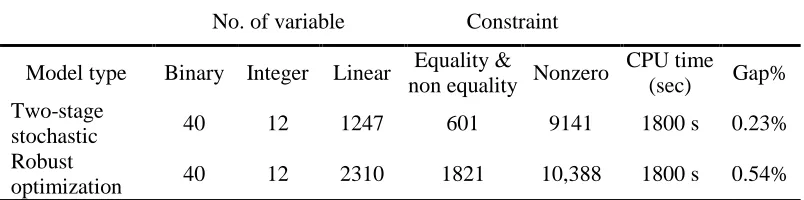
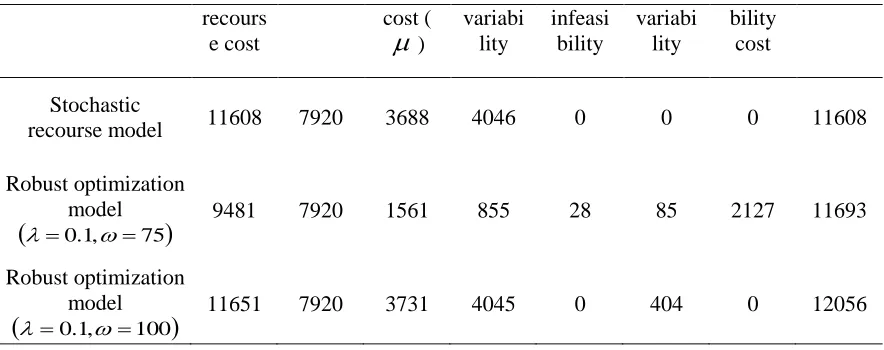
3.5
Comparison between the results of robust model and stochastic recourse
model ... 93
3.6
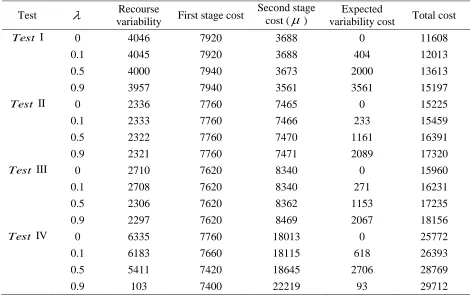
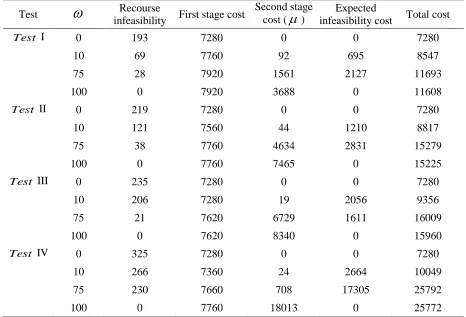
Test characteristics ... 94
3.7.
Variability analysis of the objective function in ROM-SR ... 95
3.8
Infeasibility analysis of the objective function in ROM-MR ... 97
4.1
Characteristics of the 200 patients waiting for surgery in elective surgery
department ... 150
4.2
Model size and computation characteristics... 151
4.3
Integrated MSS and SCA solution for deterministic model ... 153
4.4
Deterministic under (over) time of surgery hours to specialty (hours) ... 154
4.5
Deterministic under (over) utilization of OR capacity (hours) ... 155
4.6
Integrated MSS and SCA solution for stochastic model ... 156
4.7
Stochastic under (over) time of surgery hours to specialty (hours) ... 157
4.8
Stochastic under (over) utilization of OR capacity (hours) ... 157
xvii
4.10
Robust optimization under (over) time of surgery hours to specialty
(hours) ... 161
4.11
Robust optimization under (over) utilization of OR capacity (hours) ... 161
xviii
List of figure
1.1
Surgery durations by surgical specialty ... 2
1.2
Duration distribution of surgery operations ... 3
1.3
Decision hierarchy in surgery planning process ... 5
1.4
Effect of robust optimization model on total costs ... 11
3.1
Variability analysis over constant
... 100
3.2
Infeasibility analysis over constant
... 100
3.3
Total cost analysis over constant
... 100
3.4
Variability analysis over constant
... 102
3.5
Infeasibility analysis over constant
... 102
3.6
Total cost analysis over constant
. ... 102
3.7
Trade-off between solution robustness and model robustness ... 105
4.1
Average distribution of patient surgery durations in case study ... 149
4.2
Comparison Over (under) time hours of surgical specialty in different
models ... 163
4.3
Comparison of overutilization of OR capacity in different models (hours) 164
4.4
Trade-off between solution robustness and model robustness ... 167
xix
Nomenclature
h
Planned available operating rooms hours per day for surgery operationi
a
Number of operating room of typei
available in each dayst
k
Maximum capacity (i.e. number of surgeons) available for surgical specialtys
on dayt
1 is
c
Cost associated with allocating OR block times of typei
to specialty s 2tz
c
Cost of postponement of elective surgery demand from dayt
to day z3
c Penalty rate associated with the unmet elective surgery demand
4
c Cost of underutilization of operating room hours
Weighting penalty to measure trade-off between risk and expected outcome
Weighting penalty for the infeasibility of the random elective demand constraint st
e
Random parameter representing elective surgery demand for specialty s on dayt
under scenario
st
g
Random parameter representing emergency surgery demand for specialty s on dayt
under scenario
Probability of occurrence of scenario
ist
X
Number of operating rooms of typei
allocated to specialty son dayt
st
U
Amount of emergency surgery demand of specialty s met in a dedicated emergency room on dayt
stz
Y
Amount of elective surgery demand hours of specialty s postponed from dayt
to dayz
under scenario
xx
st Undersupply of operating room hours allocated to specialty s on dayt
under scenario
relative to its desired level
Expected value of the second stage cost being made after realization of the random variable is observed
d
Variability cost of deviation from the mean expected value of the objective function in each scenario
Deviational variable for violation of the mean objective function in each scenario
st
f
Deviation variable by which the random elective demand constraints of specialty s on dayt
can be violated under scenario
st Deviational variable for infeasibility of the random elective demand constraints of specialtys on day
t
under scenario
id
Elapsed days since referral of patienti
for surgeryi
Urgency coefficient of patienti
in dayss
B
Subset of patient belong to specialtys
s
o
Number of surgeon available for specialtys
in the planning horizonrt
k
Available capacity (hours) for surgery in ORron dayt
rt
Maximum available capacity (hours) for surgery in ORron dayt
max
V Maximum daily number of operating rooms that can reserve OR hours for emergency cases
t
Number of available ICU beds on dayt
N Subset of OR blocks not available for specialty
s
if
s,r Ni
1 if patienti
is expected to need ICU bed after operation; 0 otherwisert
1 if ORris not available on dayt
; 0 otherwise
w
Weights of the objective function
given by the decision makers /
Weighting factor for over (under) time of specialty /
Weighting factor for over (under) utilization of OR capacity
Weighting scale to measure the trade-off between risk and expected outcome2 1
,
Weighting penalty to trade-off solution for model robustness i
p
Stochastic elective surgery duration of patienti
under scenario
t
u
Stochastic emergency arrival time on dayt
under scenario
Otherwise t day on r OR to assigned is i patient If xirt 0 1 Otherwise t day on r OR to assigned is s specialty If
ysrt 0
xxi
rt
g
Operating room hours reserved for emergency surgery in ORron dayt
under scenario
srt Surgery demand of specialtys
that cannot be met in ORron dayt
under scenario
srt Undersupply of OR block times allocated to specialtys
in ORr on dayt
under scenario
relative to its desired level
rt Over-utilization hours of overall capacity of ORron dayt
under scenario
rt Under-utilization hours of overall capacity of ORron dayt
under scenario
Expected value of the second stage cost being made after realization of the random variable is observed
d
Variability cost of deviation from the mean expected value of the objective function in each scenario
Deviational variable for violation of the mean objective function in each scenario
1
srt
f
Deviation variable by which the allocated OR block to specialtys
in room ron dayt
canbe violated under scenario
2
rt
f
Deviation variable by which the OR capacity utilization in roomron dayt
can be violatedunder scenario
srt Deviational variable for infeasibility of the random allocated OR block constraint of specialtys
in roomron dayt
under scenario
xxii
Abbreviations
ECS
Elective case scheduling
FCFS
First come first serve
ICU
Intensive care unit
ILP
Integer linear programming
LOS
length of stay
MILP
mixed-integer linear programming model
MIP
mixed-integer programming
MSS
master surgery schedule
MSSP
master surgery schedule problem
OR
Operating room
ORP
Operating room planning
OT
Operating theatre
PACU
post anesthesia care units
PWTRL
Prioritized wait time related loss
RO
Robust optimization
RO-MR
Robust optimization with model robustness
RO-SR
Robust optimization with solution robustness
ROM-T
Robust optimization model with tradeoff
SAA
sample average approximation
SCA
Surgical case assignment
1
Chapter 1
Introduction to Operating Room Planning and
Scheduling
1.1 Healthcare Operations Management
Healthcare expenditure as a portion of gross domestic product (GDP) has grown
considerably in North America over the past few decades. The operating costs of surgery
departments contain a significant portion of the total cost of a healthcare system. Many healthcare
studies undertaken in Canada show a substantial growth in health spending during the past few
decades. The amount was close to 10.9% of the Canada’s GDP and reached to $219.1 billion in
2015 representing a 1.6% growth compared to the last year [1]. Along with the costs, demand for
healthcare services is increasing which makes maintaining healthcare services a challenging and
complicated process due to the limited resources. One way to overcome those challenges and
improve healthcare operations without increasing available resources or compromising required
demands is by improving the efficiency of the healthcare capacity [2].
Hospital managers typically face two types of variability in a health care facility that
impacts the efficiency and effectiveness of the facility. One is the natural variability, which is
2
durations. The other is artificial variability that originates from poor scheduling policy. For
example a poor operating room schedule could lead to a longer waiting time and lower service
level. While many studies in the literature have considered surgery operation durations and
capacity of available operating rooms as known and fixed parameters [3,4], others have argued
that uncertainty in surgery durations or resource availability may lead to a solution that is
infeasible [5,6]. In our model, we include uncertainty of surgery durations as well as patient
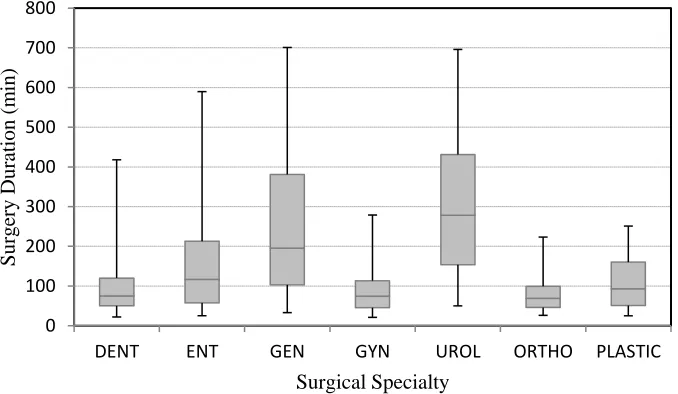
arrivals. Figure 1.1 and 1.2, for instance, depict the likely variability in surgery durations. Figure
1.1 shows the variation of surgery durations (in minutes) by surgical specialties and Figure 1.2
depicts the distribution of surgery operations in operating rooms (Figure 1.2 and 1.2 shows actual
data taken from the operating room department of a local hospital in Southwestern Ontario).
Figure 1.1: Surgery durations by surgical specialty
0 100 200 300 400 500 600 700 800
DENT ENT GEN GYN UROL ORTHO PLASTIC
Surge
ry
D
ur
at
ion
(m
in)
3
Figure 1.2: Duration distribution of surgery operations
Effective planning and scheduling of operating room (OR) operations within the surgery
department of a hospital becomes critical when uncertainty is present in the system. Sources of
uncertainty can be due to patient arrivals and emergency cases, resource availability, and surgery
durations. This uncertainty makes the planning and scheduling decisions more complex and
challenging for hospital managers. The capacity allocation decisions and the operating cost of
ORs are greatly impacted by this uncertainty. The decision for OR planning and scheduling
becomes even more complex when emergency patients are taken into account. Taking care of
emergencies is in fact one of the most important source of uncertainty that impacts the
availability of the resources as well as the performance of the healthcare services. In such an
environment, effective Operation Research tools can help decision makers in finding a balance in
the trade-off between capacity over-allocation and shorten patients waiting time at the cost of
higher idle time for resources or under-allocation and thus lower overtime at the cost of higher
waiting time for patients.
0.00% 5.00% 10.00% 15.00% 20.00% 25.00% <= 30
31_60 61_90 91_120 121_150 151_180 181_210 211_240 241_270 >= 271
4
Previous studies show that ORs and post-surgical units resources are amongst the most
costly bottleneck in a healthcare system [7]. The cost of running an OR with all the required staff
and a surgeon is estimated to be as high as $60.50 per minute [8]. Therefore, efficient OR
scheduling program is the key to success a healthcare operation. The OR planning and scheduling
literature generally focused on two major characteristics of the patients in the literature, namely
elective and non-elective patients. While the surgery operation is usually planned early in
advance for the former class, this surgical treatment is carried out within an urgent situation, and
consequently emergency, for the later one.
The surgical scheduling process in a medical facility is a complex and critical process
where the choice of schedules and availability of resources directly influence on the patient
throughput, the postponement or cancellation of surgeries, utilization of resources, wait times,
and the overall performance of the system [9]. Therefore, a systematic approach that takes into
account a variety of surgical specialties, priorities for service, post- surgical capacity, and the
combination of both scheduled (elective) and unscheduled (emergency) procedures could lead to
an improved capacity allocation among various specialties within the system and enhanced policy
implication that results in expanded effectiveness and patient throughput and reduced wait times.
Therefore, there is an increasing demand for an efficient operational research study to optimize
resources in the healthcare system and bridge the gap between surgeons and hospital managers
through the optimization approaches.
In general, the procedure for any scheduling of elective surgical processes is considered
as a three-level process [10,11]. These stages involve activities from allocation of the OR time
among surgical specialties to the actual assignment of individual cases within the allocated OR
blocks in a hospital and are usually classified as strategic, tactical, and operational levels of the
5
respect to the decision that is being made at each decision levels. The assignment of OR time to
the surgical specialties are the first decision that must be made, usually called case mix planning.
Figure 1.3: Decision hierarchy in surgery planning process
The allocation of surgical block schedules is developed at the second stage which simply
determines the surgery time for each specialty in ORs on each day on a cyclic timetable, usually
called master surgery schedule (MSS). Finally, the third level schedules individual cases on a
daily basis, normally known as advance scheduling.
Due to the inter dependence of the decisions at these three levels of planning, any
scheduling policy obtained in isolation can result in solutions that may not meet the requirements
set to the decisions made at the upstream stages. Therefore, it is crucial to address the concerns of
healthcare management regarding the influence of assumptions made about the surgical schedules
set at higher levels on downstream operations. These assumptions can be for instance the amount
of flexibility that planning decision of allocating surgical specialties to the OR blocks may
provide for the decision makers in their attempt to assign individual patients from the associated
waiting list of those specialties to the allocated blocks or which OR within the system has been
allocated to which specialty.
3.
Surgical caseassignment (SCA) 2. Master surgery
scheduling (MSS) 1. Surgery case
mix planning
Strategic
Tactical
6
This study is primarily motivated by surgical activities within the OR department of a
local hospital to develop a hierarchical planning and scheduling models over all three stages as
defined above when demand for both elective and emergency cases is considered stochastic and
surgery durations are not known.
The surgical scheduling process for elective patients involves a range of activities from
determining OR time to be allocated in a hospital to actual scheduling of individual cases. One of
the major activities within this process is to define and assign the OR time to the surgical
specialties. One main decision that needs to be addressed is: How many OR time in total is
allocated to each surgical specialty. At this stage the budget often determines the total OR time
available, also several factors such as waiting time can influence the amount of OR time required
by each surgical specialty. According to [9], there are several criteria that impact the required
number of OR time by each surgical specialty, including waiting times as it directly affects the
throughput of patients, fairness among all the specialties, and maximization of OR efficiency.
In the first stage, we determine optimal OR hours assigned to each surgical specialty
under uncertain elective and emergency surgery demands where the proportion of time allocated
to surgical specialties is subject to several factors such as limited OR capacity as well as underage
cost of idle resources and overage cost of surgical overtime. The solution at this hybrid stage aims
at finding an optimal OR allocation planning for surgical specialties that minimizes the postponed
and/or unmet surgeries resulting from variability in elective and emergency patients demand and
the expected total cost of resource underutilization and overtime.
A hybrid tactical and operational framework is developed to capture the integrated
allocation problem of surgical specialties with the assignment of individual surgery cases within
the assigned OR blocks by specifying the appointment schedule of each specialty at which the
7
Scheduling of surgical cases directly affects the amount of overtime and undertime of the
healthcare resources [13]. In OR department, any deviation from the staff scheduled hour can lead
to a huge staff overtime as well as additional overhead costs. On the contrary, the cost of idle time
is considered considerable as a result of the cost involved in underutilization of available
resources.
Due to the uncertainty in emergency arrivals and surgery durations, some surgeries may
take longer than planned and might go overtime or even postponed to the succeeding planning
horizon and start later than its original scheduled time which could trigger controversial social
issues related to the maximum allowed time for the patients in the waiting list. On the other hand,
some OR blocks may be under-utilized due to the difference between actual and planned duration
of surgery operations that could lead to expensive OR idle time. Therefore, there is always a
trade-off between under-and-overutilization of OR time, overtime, and patient waiting times. The
solution to this hybrid stage aims at finding an integrated schedule for surgical specialties and
surgery cases that minimizes the postponed surgeries resulting from patients stayed in the waiting
list beyond the determined durations and the expected total cost of underutilization and overtime
of resources.
In most of the publicly funded hospitals, the maximum patient waiting time before
receiving surgery operation is normally determined by the government. Hospital decision makers
must attempt to satisfy this requirements. Limited availability of the operating rooms directly
affects the number of patients admitted to a hospital within a time period and as a result can
violate the regulated waiting time. The desired service level of a healthcare provider is directly
influenced by that waiting factor, and hence, has to be incorporated in the decision making
8
Effective management of surgical planning and scheduling is an area that draws
considerable attention from the healthcare community to reduce costs and increase service level
[14,15]. The primary goal of the OR scheduling problem is to minimize the total fixed and
variable costs associated with the overall monthly or yearly schedule while maintaining the
service level. The operating cost of surgery departments contains a significant portion of the total
cost of a health care unit. It has been estimated that operating cost of the surgery units accounts
for more than 40% of the entire expenses of a hospital, [6,7,16,17]. Thus, substantial cost savings
can be achieved in surgery department. It is well-documented in the literature that operating
rooms are important revenue generators in a hospital, but also the largest cost centers in a hospital
[10]. Conflicting objectives of various stakeholders (e.g., patients, OR managers, surgeons,
anesthetists, and nurses) that need to be reconsidered makes the process of developing a surgical
plan and schedule a complex issue. Hence, an effective use of the operating rooms can lead to a
huge cost reduction in hospitals which is the ultimate goal of healthcare managers along with
optimal utilization of resources to deliver a surgery operation at a right time to the maximum
number of patients with a minimum amount of waiting [18].
Operating rooms normally represent a form of bottleneck factor constraining the overall
surgical throughput in a healthcare system. Thus, it is vital to develop an allocation program that
utilizes the available resources in an optimal way. The importance of developing a smooth
allocation program for ORs is not only because of its impact on the surgery operations that is
performed in a surgical center, but it also determines the amount of resources that are required to
be assigned to each operation along with the planning horizon. Hence, developing an effective
OR scheduling plan can assist managers in reducing cost and improving the resource usage.
The OR planning and scheduling process is strongly characterized by the uncertainty. In
the key variables impacting the system, some have serious impact on the patients’ satisfaction,
9
addressed. In previous literature on OR planning and scheduling, the inclusion of uncertainty was
mainly limited to either the uncertainty in arrival of the patients or the duration of the surgical
procedures [16]. However, the activities inside the OR have a significant impact on many other
activities within a hospital. For instance, patients waiting for surgery operations are expected to
be admitted in a certain period of time to comply with governmental regulations. The
consideration of other source of uncertainties, such as emergency cases is very crucial in
developing an efficient planning and scheduling program. Consequently, a successful operating
room schedule depends upon how various source of uncertainties are incorporated into the model.
Although the study of OR planning and scheduling problems has received extensive
attention in the literature during the past few decades, the majority of this research has either
considered unrealistic assumptions by overlooking the existing uncertainty or failing to
incorporate the impact of inherent variability in emergency arrivals and surgery durations when
dealing with elective surgery scheduling. In subsequent chapters, we survey the related work
about the problem under discussion in more details. Other stochastic researches have considered
isolated decision levels in their attempt to provide optimal plan for the surgery scheduling failed
to incorporate integrated approach that involves activities from determining allocations of OR
time blocks through to the actual assignment of individual cases.
Even though a lot of research has been done in accounting for uncertainty, application of
robust optimization model has been limited as compared to other stochastic approaches. In
general, a healthcare system can be called robust if the optimal acquired service level is feasible
regardless of how variable parameters resulting from inherent uncertainty in the system can
influence it. More specifically, according to [19], the “robust planning” approach addresses the
physically efficient system. It is aimed at recognizing and exploring the uncertainty that is
inherent in the system, and distilling from it planning decisions that will yield more predictable
10
arrivals and surgery durations) is considered in this thesis as the replacement of each random
variable by its expected value. Since costs are extremely important and lack of flexibility is
always a problem in many healthcare systems, one important factor of cost containment is
reduction of the number of schedule changes. However, the existing uncertainty will render
obsolete any medium-term plan based on deterministic numbers, forcing a re-planning cycle. The
use of risk assessment and risk planning techniques clarifies the effects of uncertainty on planning
performance. This in turn allows deciding on appropriate levels of resources, yielding schedules
that remain valid for a longer time period, hence the term “robust planning”. In order to quantify
this robustness, several approaches are possible. One approach tries to find the decision policy
that yields the most stable outcome, i.e. with low variability of the key performance measures
(such as postponed surgery or under-and overutilization of resources) which is called “solution
robust”. Another approach attempts to find a policy that reduces the number of changes to the
plan, while keeping the key performance measures fixed at their target level which is named
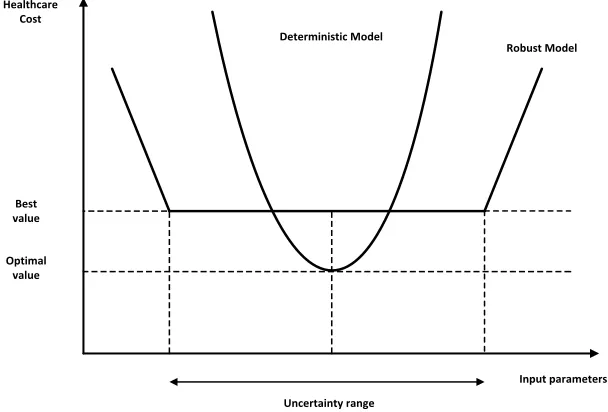
“model robust”. The conceptual meaning and advantages of robust planning is visualized in
Figure 1.4. As it is clearly shown, in deterministic approaches one “optimal” schedule is obtained
for a deterministic value of each variable (mostly the average or a “good guess”), while the robust
plan provides a “near optimal” solution, which stays valid over a range of variable values at a
predictable but higher cost.
Data uncertainties may lead to quality, optimality and feasibility problems when
deterministic models are used. Therefore, it is required to generate a solution which is immune to
data uncertainty. In other words, the solution should be robust [20]. A large portion of the
literature on OR planning and scheduling deals separately with either determining the number of
patients that need to be scheduled into a surgical suite or the sequence of cases within an
operating theatre on a certain day. Hierarchical OR planning and scheduling that includes all
11
allocation of available OR capacity among surgical specialty, development of surgical block
schedule and assignment of individual cases to the OR blocks in an integrated manner has not
been fully investigated in the literature. Most of the previous work on OR block allocation
problems have considered unrealistic assumptions such as the consideration of one type of
elective surgery demands. In this thesis, we develop a richer model by considering both elective
and emergency cases in the allocation of surgical OR time among specialties [21]. Furthermore,
most of the previous works have been developed based on a deterministic planning model and
hence, the effect of uncertainty has not been incorporated in those model. Moreover, the few
papers that considered stochastic dependence in the key variables are based on developing
complicated stochastic programing model that failed to incorporate the effect of emergency
uncertainty into the modeling framework or considered heuristic approaches with some
unrealistic assumptions that was unable to generate optimal solutions [16]. Finally, the concept of
incorporating different aspects of service level into the decision making framework through the
incorporation of maximum allowed waiting time has not been considered in previous literatures.
Optimal value
Best value Healthcare
Cost
Deterministic Model
Robust Model
Input parameters
Uncertainty range
12
The solution methods in the literature are diverse including deterministic mixed-integer
programming (MIP) model to allocate block times of operating room capacity to various
specialties’ emergency and non-emergency surgery [4,14,22], stochastic programming (SP)
approaches [6,16,23,24], Monte Carlo simulation method [24], stochastic dynamic programming
[25], and robust optimization [17, 25]. We refer the readers to [27] for details. The literature can
be classified by the different methodologies used and modelling aspects considered to evaluate
various performance measures [28–30]. The main conclusions are that the optimal solutions
provided by the existing literature are case-specific and cannot be generally applied to the case
where a systematic planning and scheduling approach is required to capture the hierarchical
impact of the solutions on the upstream stages. Moreover, robust optimization (RO) as a solution
methodology has not been fully investigated to account for the effect of inherent uncertainty in
the system.
The objective of this research is twofold: 1) To acquire the maximum service level for a
healthcare provider by developing a RO programming approach to allocate the optimal OR times
to surgery specialties that can meet the target number of operated patients, thereby minimizing
the loss incurred to the hospital due to the underutilized capacity of allocated resources while the
uncertain nature of emergency capacity is taken into consideration. The main trade-off includes
meeting the target number of patients and making efficient use of resources i.e. a high utilization
of resources. 2) To develop an integrated master surgery schedule with a surgical case assignment
problem that address hybrid planning and scheduling problem of the hospital in a systematic
hierarchical approach. The aim is to obtain an optimal surgery schedule that minimize patient
waiting times as a societal factor that is crucially important in the Canadian health care system as
well as the costs associated with underage and overage of OR resources. There is an important
13
Robust optimization techniques [30, 31] provide effective tools with regards to dealing
efficiently with the inherent uncertainty that often characterizes OR planning programs. In
Chapter 2, we introduce surgery planning and scheduling models developed in the literature with
a focus on their strength and weaknesses. We also relate our work to the literature and stress the
main differences. In Chapter 3, a brief description of the conventional RO methodology is
presented and the novel general transformation framework is developed to remedy the drawbacks
in complexity of using the conventional RO model and to reduce its computational difficulties. In
Chapter 4, a typical surgery allocation procedure is developed and solved using our proposed RO
transformation framework. In Chapter 5, the proposed RO transformation framework is applied
on a hybrid MSS and SCA problem to develop an integrated robust OR planning and scheduling
model. The model determines the optimal assignment of OR block among surgical specialties and
the allocation of individual cases to the OR blocks within the planning horizon. Furthermore, the
robust optimization model investigates the effects of uncertain emergency arrivals as well as
surgery durations. A numerical experiment is conducted to demonstrate the RO model and to
show that it captures the influence of uncertain parameters in a polynomial time. In Chapter 6, our
findings are summarized and some future research directions are pointed out.
1.2 Overview of the Thesis
1.2.1 Chapter 2: Standard Robust Optimization Transformation Framework
In Chapter two, we develop a novel standard framework to transform deterministic linear
programming models into the robust optimization forms. Deterministic models fail to capture all
aspects of the real world problems due to the variability in the input data. Facing noisy and
inaccurate data is an inevitable part of dealing with real-world optimization problems. Assuming
that all the parameters are known with certainty is a highly optimistic assumption in solving
optimization models [33]. In todays’ world, sources of uncertainty exist in various real world
problems. Therefore, failing to consider uncertain data can seriously degrade a system’s
14
unreliable data uncertainty into the model represents a challenge and requires sophisticated
knowledge and considerable time and efforts. Therefore, presenting an effective approach to
generalize transformation of deterministic model to the stochastic form that can handle the
uncertainty of the real world problems would be of great value.
Robust Optimization (RO) is a modelling approach that involves uncertainty and was
initially developed by [34] and [35] to handle the difficulty of unreliable data. RO is a general
stochastic formulation framework that was constructed based on integration of goal programming
formulation with a scenario-based description of a problem data to take the various decision
makers’ risk aversion into account. It is basically a proactive approach to mathematical
programming for producing solutions which are less sensitive to the input data. Hence, RO can be
applied in the optimization areas where the optimal solutions obtained through using other
optimization approaches are highly sensitive to small changes of the input parameters. In fact, this
methodology is an alternative approach to the stochastic linear programming (SLP) which applies
probabilistic input data when the probability distributions governing the data are known or can be
estimated.
RO is a relatively new approach to optimization under uncertainty when the uncertainty
does not have a stochastic background and/or that information on the underlying distribution is
not available, which is often the case in real-world optimization problems. Despite various
advantages of the RO technique in generating solutions that are relatively less sensitive to the
realization of noisy data and are immune to the anticipated uncertainty in the problem parameters,
there is no general framework in the literature that can facilitate the transformation of a
deterministic model into the RO form. We develop a generalizable RO transformation framework
to remove this barrier and expand application of RO models in solving stochastic problems. Our
aim is to provide a RO transformation framework for use as a tool in the context of operation
15
assist decision makers in solving complex optimization problem through providing an
instructional guideline that makes the transformation process more effective and at the same time
easier to implement. The proposed framework also reduces the formulation burden which has
always been an obstacle to application of RO in solving operation research problems [32]. The
proposed novel transformation framework is constructed based on the RO model developed by
[32]. Three different robust models are then formulated using the proposed transformation
framework to highlight the capability of the RO model in dealing with variability in stochastic
environments. The proposed formulation can be generally used as a standard framework to
transform any linear deterministic model into the stochastic robust form. We demonstrate the
effectiveness of the proposed framework by applying it on a surgery planning and scheduling
case of a healthcare problem in the following chapters. The randomness of the actual process is
captured by testing the proposed formulation on a realistic model from a real case. We elaborate
on the difference between our proposed framework and the SLP method to highlight the
advantage of our framework. We believe our proposed framework can assist decision makers in
solving complex optimization problem through providing an instructional guideline that makes
the transformation process more effective and also easier to implement while it reduces the
formulation burden which has always been an obstacle in applications of RO in solving operation
research problems. Using actual data from a local health care system we demonstrate that our RO
transformation framework is more efficient than the method presented in [5] as it works on a
predefined framework that requires less information about the original deterministic problem
while it is solved on a polynomial time. Our setting is quite general, thus it can be applied to
various real life situations, including but not limited to health care, production planning and
scheduling, and supply chain management while it is sufficiently generic to efficiently solve the
16
1.2.2 Chapter 3: Robust Surgery Mix Planning
In the current literature, OR planning and scheduling of healthcare systems is mostly
considered in a static environment where the bulk of the key variables are known for certain. To
compensate for the omission dedicated ORs to serve emergency patients or assign a fixed portion
of existing OR capacity to perform only the emergency surgeries. However, this can easily be
overlooked when addressing the emergency cases of patients who need to be served on the day of
arrival as it happens [24]. Uncertainty is always involved in the number of emergency cases a
hospital can get in a certain day, and hence, even a pre-determined portion of OR capacity may
not fully absorb the impact of stochastic emergency cases in a developed model. Most of the
previous work rely only on developing planning and scheduling models for elective patients.
In Chapter 3, we consider the problem of surgery capacity planning with discrete random
arrivals for elective and emergency patients under the assumption that surgery demands are
known only within certain bounds such that the probability distributions of the stochastic data are
not known. We apply the proposed RO framework to incorporate the uncertainty that in this
model. The majority of the earlier work on healthcare problems have been conducted under a
deterministic environment [37]. This demonstrates the importance of developing a stochastic
model that can capture the impact of the existing uncertainties of the healthcare services in order
to tackle the challenges of the real-world needs of the underlying healthcare problems.
We consider the problem of operating room (OR) block allocation planning for multiple
surgical specialties of a healthcare system on a given day, where possible mixtures of elective and
emergency patients require simultaneously various surgery teams and OR blocks. Since patient
arrivals are realized under uncertain circumstances, random characteristics in term of arrival time
will be observed in surgical demands of different specialties. We first develop a deterministic
surgery capacity allocation problem through a linear mixed-integer programming (MIP) approach
non-17
emergency surgeries. We then formulate a two-stage stochastic programming model for the
surgery capacity allocation problem and demonstrate its advantages over the deterministic model.
We finally use the RO transformation framework proposed in previous chapters to develop an
alternative approach that can efficiently handle the trade-off associated with the expected cost and
its variability in the objective function. The incompleteness of the elective surgery demand data
and the randomness arises in the emergency surgery demand is incorporated in the model to
develop robust allocation plans that efficiently utilize the resource capacities in order to maintain
the required service level. The main contribution of our work in this chapter is the proposed RO
transformation framework as a modelling tool for surgery block allocation problems. We also
consider emergency surgeries in allocation of surgery capacities in addition to a single class of
patient (i.e. elective patients), and introduce the patients length of stay (LOS) as a function of the
surgery postponements to manage the service level in the hospitals. Three RO models with
different variability measures are proposed: the RO model with solution robustness, the RO
model with model robustness, and the RO model with trade-off between solution robustness and
model robustness to evaluate the operational performance and to analyze the enhancement of the
trade-off between efficiency and health service delivery. A real case healthcare system is used to
illustrate the application of the model. The resulting combinatorial programming models are
conducted on AMPL optimization software and solved by CPLEX 12 in a reasonable amount of
time. A framework for analysis is also proposed to select among three RO models based on the
risk aversion levels and feasibility consideration of decision makers for the robustness of
postponed/unmet demand size (i.e. hospital’s service level) and the increased total cost. The
results of the two-stage stochastic programming and the robust optimization models are evaluated
to provide a comparison between the variability of output measures and infeasibility of the second
stage constraints. Finally, a trade-off between the variability of the performance measures and the
18
1.2.3 Chapter 4: Robust integrated master surgery scheduling and surgical case assignment problem
In chapter 4 we look at a different but related problem of integration of planning and
scheduling level in health care system with a focus on patient service level. We investigate the
integration between OR planning and advance scheduling in a robust optimization setting, present
experimental findings on OR allocation that hospitals can offer to surgical specialties and surgery
cases scheduling for patients on the waiting lists that increases patient service level as well as the
hospital’s throughput. Since management and development of surgical activities at ORs can
enormously impact the quality of surgery processes undergone by patients as well as patient
waiting times, effective management efforts to increase performance are always needed. In
particular, we investigate the commonly observed situation reported in the literature [27] where
surgery durations were assumed a known parameter causing canceled surgery operations due to
over scheduling of allotted OR block times by surgical specialties.
The efficient allocation of OR capacities to surgical specialties is a persistent problem in
hospitals, especially when flat rate payments for patients based on diagnosis-related groups
(DRGs) are taken into account [38]. Under the flat rate payment system, hospitals will only be
reimbursed based on a pre-defined model developed by the government to establish a formal link
between healthcare providers and quality. Introduction of DRG in the Canadian healthcare system
forced hospitals to allocate their resources more economically.
Making plans for ORs is considered to be a very challenging task due to a number of
different perspectives. The operating room department is
a
volatile environment where theuncertainty in
emergency
patient arrivals
and surgery durations
together with their impact onother departments in the hospital makes planning and scheduling a very complex decision [39].
According to a recent review made by [40] and [28] there are various conflicting objectives in OR
19
various resources greatly impacts the trade-off between a hospital’s desirability to reduce cost
against the quality of health services that coordinates to lower patients waiting time. Therefore,
there is a strong need for developing an efficient model the allocation of surgical disciplines to
available OR sessions and the assignment of surgical cases to the allocated operating room.
We
take a systematic look at this problem and provide an integrated model
that concurrentlysolves the master surgery schedule problem (MSSP) and the surgical case assignment problem
(SCAP) to acquire optimum allocation of surgical specialty (MSS) while the assignment of
patients to the OR blocks (SCA) is optimized to
identify and analyze a
combined tactical andoperational decision for the OR department with the aim of reducing costs associated with
patients waiting time, surgeons over (under) time and ORs capacity disruption. The integration of
planning and scheduling levels provide some stability, in terms of repeatability of personnel
schedules and predictability of bed occupancy pattern in post anesthesia care units (PACU) as
well as flexibility, in terms of adaptability of weekly plans to the changing waiting lists for the
decision makers. We also seek the trade-off between higher capacity, which will reduce the
waiting time as well as OR productivity due to under (over) utilization, and a lower capacity that
result in postponement as well as ORs overtime. We consider two types of patients: elective cases
with uncertain surgery durations and emergency patients with stochastic arrivals.
We also consider a weighted multi-objective RO approach, which integrates optimization
modules that take into account the number of surgeries scheduled, the waiting time and tardiness
of each patient associated with patient urgency factors, and weighted resource utilization rates.
The multi-criteria objective function is focused on conflicting resource perspective as well as
patient perspective at the same time. A regulated waiting time target for elective cases derived
from Ministry of Health and Long-Term Care in Ontario is utilized to manage patient admission
that weighs the chronological waiting time with the urgency coefficient of the corresponding
20
of clinical experts and serve as a method of accountability and provide a goal to achieve. These
targets include urgency classifications and are incorporated in the regulated Wait Times
Information System (WTIS).
A mixed-integer linear programming model is first developed where the uncertainty
considerations are excluded. The deterministic model is then transformed into a two stage
stochastic programming model as well as a robust optimization (RO) model to incorporate the
impact of uncertainty into the decision making process. A novel transformation framework,
presented in Chapter 2, is utilized to develop the robust counter part of the deterministic model.
The incompleteness of the random surgery durations and the randomness arising in the
emergency arrivals are considered using a discrete set of scenarios. The proposed RO framework
makes use of a linear programming model and does not require the specifications of the
probability density functions of the uncertain parameters. All three models are then analyzed over
a set of real life based instances to evaluate their behavior in terms of computational effort and
solution quality. Moreover, assuming lognormal distributions for the emergency arrivals and
surgery durations, a set of randomly generated scenarios is used in order to compare the proposed
solutions in terms of OR utilization rate and number of postponed patients. The compromised
allocation of OR blocks as well as the assignment of patients obtained from the RO framework is
able to handle the variability within the uncertain parameters through generating optimal
scenario-dependent solutions. The trade-off between the allocation plan’s robustness (i.e.
postponed/cancelled surgery) and underutilization of OR blocks for different values of robustness
is demonstrated that the proposed RO model is progressively less sensitive to the realization of
the variable input parameters, while generating more feasible solutions as compared with the
two-stage stochastic recourse programming model. Moreover, the impact of introducing overtime in
the model formulation is evaluated and a sensitivity analysis on the choice of the key parameters
21
prioritized weighted waiting times and improving health care efficiency by reducing overall
operation costs, and hence has more societal benefits for the hospitals.
1.3 Outline of the Thesis
The rest of this thesis, as discussed in section 1.2, is organized as a series of chapters. At
the beginning of each chapter, we outline the problem to be discussed, investigate the
motivations, and illustrate the significance of examining the related work. We then provide our
modelling approach followed by analysis of the results. We conclude each chapter with a
summary of the main findings. In addition to the chapters discussed in Section 1.2, Chapter 5
gives a summary of the thesis contributions and provides a brief discussion of future research