IJEDR1604026
International Journal of Engineering Development and Research (www.ijedr.org)142
Data Routing Using Water Wave Algorithm in WSN
1Nadeem Ashraf, 2Ms.Neha Pawar
Swami Devi Dyal Group Of Professional Institutions Kurukshetra University
________________________________________________________________________________________________________
Abstract - Routing in Wireless Sensor Networks (WSN) is the most researched issue in few years. Development a model for routing is a huge task that can detect an optimal route on the basis of various performance parameters. Several models have been employed and their benefits and shortcoming has been studied. In this work water-wave algorithm is used for optimal path selection for the transmission of data from source to destination. The proposed algorithm is rely on the shallow water wave models, when a wave travels from deep water to shallow water, its wave height increases and its wavelength decreases and vice versa.
Keywords - WSN, Routing Water Wave Algorithm
________________________________________________________________________________________________________
Introduction
Wireless Sensor Network is the most growing industries for research nowadays. With the betterment in technology and growth of industries, many consider WSN as the basic requirement for setting up the industries. The sensors are placed everywhere in the industry to retreive live data and to take correct decisions [1]. Wireless sensor networks are the sensors arranged in various monitoring environments which are managed by a central receiving unit called Base Station. Base Station is liable for the collection and processing of data collected from various distinct kinds of sensors. These sensors in the network are categorized as the heterogeneous and homogenous sensors. The sensors setup in the network is either the same type of sensors or of different kind relies on the application [3]. In the various applications for military and police investigation Wireless sensor networks can be used. Various developments within the hardware minimize the less-cost production or development in wireless communications technologies that have created probably various applications with the high numbers of sensors. In some another cases, the main purpose of the access space must be checked and thus a result to be Set up the sensor to locate then from craft network. When the positions are not located, the only way to contribute enough target coverage by sensors in order to use multiple sensors than the fastened variety. [4].
After the placement of the sensors in the network the second and the most important part is clustering. Clustering of the sensors in the network is either which is fixed and usually depends on the geographical location of the network or it is dynamic means the nodes in each cluster are dynamically distributed and there is some algorithm for the selection of the nodes in the cluster. The algorithm must either be energy efficient or bandwidth efficient or both [3]. There is commonly a basic problem in sensing networks which is named network lifespan. To keep the technology, the sensors area units are hopped-up with the battery [5]. The value and size constraints offer energy within the detector to sense the communication and globally have an effect on the lifespan of the node.
The sensors for area detector networks usually used in the police investigation are area unit distributed in the closed proximity to multiple objectives and transmit observance info to the central process node [9]. Each target must be monitored with detector or every detector has been able to monitor all targets inside operational vary. One method to increase detector network lifespan is that division of detector sets into disjoint sets like that every set completely covers all the targets. A target is lined if the active detector may vary on operational grounds.
Literature Review
Lo, Shou-Chih et al. [1] proposed a water wave based approach for delivering the messages in the vehicular ad-hoc network. Network congestion and detection protocols are used for the delivery of the information and to reduce the loss of packets in the network.
Rawat, Priyanka et al. [2] presented a survey on the recent approaches to solve various wireless sensor network related problems. They discussed both proactive and reactive routing approaches used for routing of data in WSN. The strategies used in recent years for solving the problem of congestion are also discussed in their work.
IJEDR1604026
International Journal of Engineering Development and Research (www.ijedr.org)143
Mao, Guoqian et al. [4] presented techniques for WSNs localization .The proposed approach provides an introduction of the measurement methods in sensor network localization or one-hop localization algorithms technique based on measurements. A detailed inspection on multi-hop connectivity-based and distance-based algorithms are discussed.Owojaiye et al. [5] proposed the cooperative operation of the WSNs to brings vital benefits over the ancient communication technologies for oil and gas pipeline monitoring, The recent advances of WSNs are discussed to understand the inexpensive embedded electrical utility observance and diagnostic system for monitoring underground pipelines and sensor deployment in sub-sea environments.
Imani et al. [6] proposed a mathematical model for solving the non linear equations based on the nature inspired travelling wave algorithm. The algorithm can be used to solve various solutions which requires iterative schemes to produce the solution. The equation is based on the propagation, breaking and refraction properties of the waves.
Gholamiet al. [7] proposed a neural network based approach to solve the problem of localization and optimum placement of wireless sensors in the network. They use Neural based approachesto find the optimum location in which the sensors must be placed to give the better results in terms of improvement in effectiveness and accuracy.
Plumeraultet al. [8] presented a mathematical equation to solve the problems which requires repetitive iterations to reach to the global best solution. The equation is based on the aerated water waves which flow down in the ocean. The major consideration related to these waves is their height. The equated can be formulated and used in order to get the optimum value of various parameters.
Domingo,Mari Carmen [9] proposed a congestion detection and avoidance algorithm to solve the problem of congestion in underwater wireless sensor network. In their approach, they work on the sonar waves for the communication between sensors and base station. The waves follow different rules and different set of methodologies to tackle the problem of congestion.
Marin-Perianu et al. [10] ]propose a wave monitoring method that is suitable for places with varying bathymetry, such as coral reefs.the result uses a densely deployed wireless sensor network, which allows for a high spatial resolution and 3D monitoring and analysis of the waves. The wireless sensor nodes are equipped with low-cost, low-power, MEMS-based inertial sensing.
Proposed Methodology
A fitness function is derived which is a combination of all the above considered factors and the few other performance parameters of Wireless Sensor Networks. The factors are:
Residual Energy of a node: Residual energy is the energy remaining in the node after the communication is processed. The energy is exhausted when a node transmits or receive the data in the network. Residual energy is
𝑅𝑒𝑠𝑖𝑑𝑢𝑎𝑙 𝐸𝑛𝑒𝑟𝑔𝑦 = 𝑇𝑜𝑡𝑎𝑙 𝐸𝑛𝑒𝑟𝑔𝑦 − 𝐸𝑛𝑒𝑟𝑔𝑦 𝑢𝑠𝑒𝑑
Distance between the Nodes in the network: Distance is an important parameter in the network. The distance is directly proportional to the energy consumed from a node. The more the distance the more energy required to transfer data from source to destination. Distance is calculated using the Euclidean Formula which is given by:
𝐷𝑖𝑠𝑡𝑎𝑛𝑐𝑒 = √(𝑥1− 𝑥2)2+ (𝑦1− 𝑦2)2
Packet Loss Ratio: While transferring of data from one node to the other node packets in the network are lost due to various reasons like collision of packets in the channel or the queue of a node. The packets lost in the network are due to mainly two reasons, the first one is the queue length of the node and the second reason is the packet collision in the network. This parameter must be optimized in order to improve the performance of the system.
The fitness function considered in the research work is a combination of the above written parameters along with the numerical weight given to each parameter. The numerical values must be given according to the contribution of each parameter in the optimum result of the algorithm.
Fitness Function:
𝐹𝑖𝑡𝑛𝑒𝑠𝑠 𝐹𝑢𝑛𝑐𝑡𝑖𝑜𝑛 (𝐹𝑗) = ∑( 𝑤1∗ (1 − 𝑃𝐿𝑖) + 𝑤2∗ 𝐸𝑖+ 𝑤3∗ 𝑑𝑖,𝑗 𝑛
𝑖=1
Where, 𝑤1, 𝑤2, 𝑤3 are the weights supplied to the algorithm,
i is the iteration which ranges from 1 to N (total number of nodes), 𝑃𝐿is the normalized Packet lost rate in the network
𝑑𝑖,𝑗is the distance between node 𝑖 𝑎𝑛𝑑 𝑗 and
𝐸 is the residual energy of each node in the network.
IJEDR1604026
International Journal of Engineering Development and Research (www.ijedr.org)144
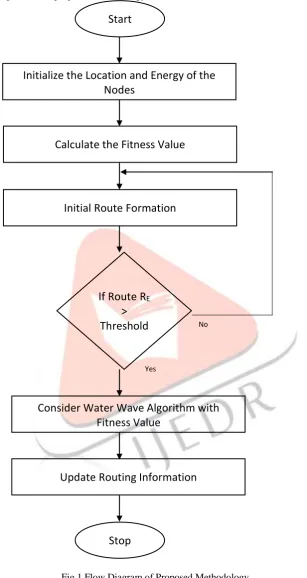
shorter the distance to the still water level, the higher the fitness 𝑓(𝑥) is. During the problem-solving process, we consider three types of operations on the waves: Propagation, Refraction, and Breaking.Figure 1 shows the flow diagram of the proposed methodology.
Fig 1 Flow Diagram of Proposed Methodology
Results and Discussions
The performance parameters for the comparison of basic and proposed approach are
Average End to End Delay: it is given by:
𝐷𝑒𝑙𝑎𝑦 = (𝑃𝑎𝑐𝑘𝑒𝑡 𝑟𝑒𝑐𝑒𝑖𝑣𝑒𝑑 𝑏𝑦 𝑟𝑒𝑐𝑒𝑖𝑣𝑒𝑟 𝑡𝑖𝑚𝑒 − 𝑔𝑒𝑛𝑒𝑟𝑎𝑡𝑒𝑑 𝑡𝑖𝑚𝑒)
Start
Initialize the Location and Energy of the
Nodes
Calculate the Fitness Value
Initial Route Formation
If Route R
E>
Threshold
Consider Water Wave Algorithm with
Fitness Value
Update Routing Information
Stop
No
IJEDR1604026
International Journal of Engineering Development and Research (www.ijedr.org)145
Figure 2 shows the Average End to End delay comparison between the basic and proposed approach. The delay in the proposed approach reduces because of the reduction in number of retransmissions.Fig 2 Average End to End Delay
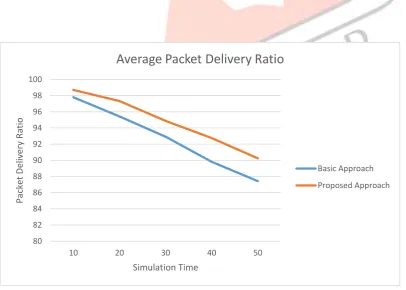
Average Packet Delivery Ratio: It is defined as follows:
𝑃𝑎𝑐𝑘𝑒𝑡 𝑑𝑒𝑙𝑖𝑣𝑒𝑟𝑦 𝑟𝑎𝑡𝑖𝑜 = 𝑡𝑜𝑡𝑎𝑙 𝑝𝑎𝑐𝑘𝑒𝑡𝑠 𝑟𝑒𝑐𝑒𝑖𝑣𝑒𝑑 𝑡𝑜𝑡𝑎𝑙 𝑝𝑎𝑐𝑘𝑒𝑡𝑠 𝑔𝑒𝑛𝑒𝑟𝑎𝑡𝑒𝑑
Figure 3 shows the packet delivery ratio comparison between the basic and the proposed approach. The packet delivery ratio for the proposed approach is better compared to the basic approach because the packet lost in the network reduces.
Fig 3 Average Packet Delivery Ratio
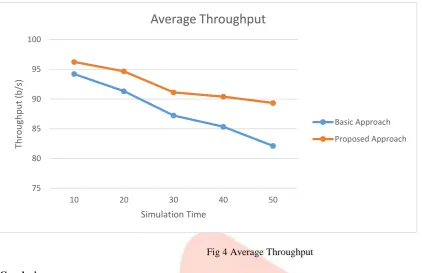
Throughput of the Network: Throughput is defined as the ratio of the packets received to the total time taken for the packets to travel in the network.
0 0.1 0.2 0.3 0.4 0.5 0.6
10 20 30 40 50
En
d
to
E
n
d
De
lay
Simulation Time
Average End to End Delay
Basic Approach
Proposed Approach
80 82 84 86 88 90 92 94 96 98 100
10 20 30 40 50
Packe
t
De
liv
ery
Ratio
Simulation Time
Average Packet Delivery Ratio
Basic Approach
IJEDR1604026
International Journal of Engineering Development and Research (www.ijedr.org)146
Figure 4 shows the average throughput of the network. The throughput is increased in case of proposed approach as the delay in the network is decreased.Fig 4 Average Throughput
Conclusion
The problem of routing in wireless sensor network is a problem of concern in recent times. Many approaches have been proposed and their merits and demerits are compared. In the present work waterwave algorithm is proposed and implemented for solving the problem of routing in wireless sensor networks. A fitness function is proposed based on the values of normalized packet loss rate, distance between the nodes and residual energy of the node in the network. The results also show that the proposed approach outperforms the basic approach on the basis of various performance parameters like throughput of the network, average packet delivery ratio and end to end delay. In future other machine learning algorithms must be implemented and their results must be compared with the present work.
References
[1] Lo, Shou-Chih, Jhih-SiaoGao, and Chih-Cheng Tseng, "A water-wave broadcast scheme for emergency messages in VANET" Wireless personal communications 71.1 (2013): 217-241.
[2] ARawat, Priyanka, "Wireless sensor networks: a survey on recent developments and potential synergies", The Journal of Supercomputing 68.1 (2014): 1-48.
[3] AlamBhuiyan, MdZakirul, "Energy and bandwidth-efficient wireless sensor networks for monitoring high-frequency events", Sensor, Mesh and Ad Hoc Communications and Networks (SECON), 2013 10th Annual IEEE Communications Society Conference on. IEEE, 2013.
[4] Mao, Guoqiang, BarışFidan, and Brian DO Anderson. "Wireless sensor network localization techniques." Computer networks 51.10 (2007): 2529-2553.
[5] Owojaiye, Gbenga, and Yichuang Sun, "Focal design issues affecting the deployment of wireless sensor networks for pipeline monitoring", Ad Hoc Networks 11.3 (2013): 1237-1253.
[6] Imani, A. A., "Approximate travelling wave solution for shallow water wave equation", Applied Mathematical Modelling 36.4 (2012): 1550-1557.
[7] Gholami, M., N. Cai, and R. W. Brennan, "An artificial neural network approach to the problem of wireless sensors network localization", Robotics and Computer-Integrated Manufacturing 29.1 (2013): 96-109.
[8] Plumerault, LCR, "A numerical model for aeratedwater wave breaking", International Journal for Numerical Methods in Fluids 69.12 (2012): 1851-1871.
[9] Domingo, Mari Carmen, "Marine communities based congestion control in underwater wireless sensor networks", Information Sciences 228 (2013): 203-221.
[10] Marin-Perianu, Mihai, Supriyo Chatterjea, Raluca Marin-Perianu, Stephan Bosch, Stefan Dulman, Stuart Kininmonth, and Paul Havinga. "Wave monitoring with wireless sensor networks." In Intelligent Sensors, Sensor Networks and Information Processing, 2008. ISSNIP 2008. International Conference on, pp. 611-616. IEEE, 2008.
75 80 85 90 95 100
10 20 30 40 50
Th
rou
ghp
u
t
(b/s
)
Simulation Time
Average Throughput
Basic Approach