Aus der Klinik für Physikalische Medizin und Rehabilitation
der Ludwig-Maximilians-Universität München
Direktor: Prof. Dr. med. Gerold Stucki
INTERNATIONAL CLASSIFICATION OF FUNCTIONING,
DISABILITY AND HEALTH (ICF) -
Validation of the ICF Comprehensive Set for Patients with Low Back Pain &
Basic Information for a Generic Comprehensive Set
Dissertation
zum Erweb des Doktorgrades der Humanbiologie
an der Medizinischen Fakultät der
Ludwig-Maximilians-Universität zu München
vorgelegt von
Petra Maier
aus
Mit Genehmigung der Medizinischen Fakultät
der Universität München
Berichterstatter:
Prof. Dr. med. Gerold Stucki
Mitberichterstatter:
Prof. Dr. Dr. H. E. Wichmann
Prof. Dr. Dr. h.c. Th. Brandt
Mitbetreuung durch den
promovierten Mitarbeiter:
Dr. Alarcos Cieza
Dekan:
Prof. Dr. med. Dr. h.c. K. Peter
Content
Validation of the ICF Comprehensive Set for Patients with Low Back Pain 5
Zusammenfassung 6
Abstract 8
Background 10
Materials and Methods 11
Results 15
Discussion 21 References 25
The Importance of ICF Categories for Patients’ Subjective Health Status -
Basic Information for a Generic Comprehensive Set 27
Zusammenfassung 28
Abstract 30
Background 32
Materials and Methods 33
Results 38
ZUSAMMENFASSUNG Hintergrund
Die International Classification of Functioning, Disability and Health (ICF) ist eine vielseitige Klassifikation zur Beschreibung von funktionaler Gesundheit. Aus Gründen der Praktikabilität wurde eine ICF Checkliste entwickelt, eine Kurzfassung der ICF, die die wichtigsten Kategorien unabhängig von der gegebenen Diagnose enthält. Zusätzlich wurden Comprehensive Sets entwickelt, die jeweils die wichtigsten Kategorien bezogen auf eine spezifische Erkrankung enthalten.
Zielsetzung
Ziel der vorliegenden Arbeit ist es, die Aussagekraft der ICF Checkliste für die Erklärung des PHI-Wertes (körperliche Summenskala) und des MHI-Wertes (psychische Summenskala) des SF-36 zu untersuchen. Dazu wurde 1) der Anteil der durch die Checkliste erklärten Varianz der SF-36-Parameter bestimmt, 2) die ICF Kategorien identifiziert, die den größten Varianzanteil der SF-36-Parameter erklären und 3) die Bedeutung der vier Komponenten der ICF für die SF-36-Parameter untersucht.
Methoden
Es wurde eine Querschnittsanalyse von n=200 Patienten mit Rückenschmerzen aus Rehabilitationseinrichtungen durchgeführt.
Die Checkliste der International Classification of Functioning, Disability and Health (ICF) gehört zur Familie der internationalen Klassifikationen der Weltgesundheitsorganisation (WHO). Aktuell enthält die ICF folgende Komponenten: 1) Körperfunktionen, 2) Körperstrukturen, 3) Aktivitäten/Partizipation und 4) Umweltfaktoren.
Der Short-Form (SF-36) Health Survey wurde zur Erfassung des funktionalen Gesundheitszustandes der Patienten ausgewählt. Die Analysen konzentrierten sich dabei auf die körperliche und die psychische Summenskala.
Ergebnisse
Das erste Regressionsmodell erklärt 44,6% der Varianz des PHI-Wertes (F=16,36; p<.0001). Der wichtigste Prädiktor ist die Kategorie Schmerzempfinden. Drei der fünf ausgewählten Variablen sind Aktivitäten/Partizipation, zwei Variablen sind Funktionen. Alle fünf Kategorien sind im Comprehensive Set für Patienten mit Rückenschmerzen enthalten.
Das zweite Regressionsmodell erklärt 31,1% der Varianz des MHI-Wertes (F=10,64; p<.0001). Der wichtigste Prädiktor ist die Kategorie Emotionen. Alle vier Komponenten der ICF sind im Modell abgebildet. Drei der vier Kategorien sind im Comprehensive Set für Rückenschmerzen enthalten.
Schlussfolgerungen
Die Ergebnisse sprechen für die Validität des ICF Comprehensive Set für Patienten mit Rückenschmerzen. Alle ICF Kategorien mit einer Ausnahme sind sowohl in den Regressionsmodellen als auch im Comprehensive Set enthalten. Bei der Bewertung der Ergebnisse muss berücksichtigt werden, dass die Analysen ausschließlich in der ICF Checkliste enthaltene Kategorien berücksichtigen.
Schlüsselwörter
ABSTRACT Background
The International Classification of Functioning, Disability and Health (ICF) is a multipurpose classification to describe functional states associated with health conditions. To ensure practicability the ICF Checklist was developed, a short form of the ICF which only contains the most important categories irrespective of the present diagnoses. Furthermore ICF Comprehensive Sets were developed which contain the most important categories concerning a specific disease.
Objective
The general objective is to examine the explanatory power of the ICF Checklist in order to explain the PHI-score and the MHI-score of the SF-36. The specific aims are 1) to explore the percentage of variance of the SF-36 parameters accounted for by the ICF categories, 2) to identify the ICF categories which explain most of the variance of the two SF-36 parameters, 3) to assess the importance of the four components of the ICF Checklist for the SF-36 parameters.
Methods
Cross sectional analysis of n=200 inpatients of rehabilitation centres suffering from low back pain.
The International Classification of Functioning, Disability and Health (ICF) belongs to the WHO family of international classifications. At present in the ICF the following components are included: 1) Body Functions 2) Body Structures 3) Activities and Participations 4) Environmental Factors.
Patients’ health status was assessed by the SF-36 Health Survey, a generic instrument to measure health status. Analyses were focused on the two summary measures Physical Health Index Score (PHI-score) and Mental Health Index Score (MHI-score).
Results
The first model accounts for 44.6% of the variance of the PHI-score with F= 16.36 (p<.0001). The most important predictor is sensation of pain. Three of the five selected variables are Activities/Participation, two variables are Body Functions. All five dependent variables are included in the ICF Comprehensive Set for patients with low back pain.
The second model accounts for 31.1% of the variance of the MHI-score with F= 10.64 (p<.0001). The most important predictor is the category emotional functions. All four components of the ICF are represented in the model. Three of the four dependent variables are also included in the ICF Comprehensive Set for patients with low back pain.
Conclusion
The results emphasize the validity of the ICF Comprehensive Set for patients with
low back pain. All categories except one are included in both the model and the ICF
Comprehensive Set. The results are limited by the fact that the analyses did only
account for categories included in the ICF Checklist.
Key Indexing Terms
BACKGROUND
The International Classification of Functioning, Disability and Health (ICF) is a multipurpose classification to describe functional states associated with health conditions especially used in the area of rehabilitation. The ICF is based on the bio-psycho-social model of health. Health is defined as physical, mental and social well-being according to the WHO definition of health1.
The ICF goes back to the ICIDH, the International Classification of Impairments, Disabilities and Handicaps whose development started in 19722. The ICIDH aimed to describe the
consequences of disease and to gather information on non-fatal health outcomes3. In a long
process of revision multiple changes were made until in 2001 the World Health Organization (WHO) passed the fist version of the International Classification of Functioning, Disability and Health4. By that way an extensive and systematic coding scheme to serve as scientific basis
for multiple kinds of research was elaborated. Furthermore the ICF offers a common language for the comparison of different countries as well as different disciplines and sciences.
The ICF is a very extensive instrument to describe patients’ functional states. To ensure practicability the ICF Checklist was developed, a short form of the ICF which only contains the most important categories irrespective of the present diagnoses5 . In a further project, so
called ICF Comprehensive Sets were selected on the basis of international expert ratings, empirical data collection and systematic literature reviews6. In these ICF Comprehensive
Sets the most important categories concerning a specific disease are included7. The number of categories is chosen as small as possible to be practical but as broad as required to be comprehensive to cover the prototypical spectrum of limitations in functioning and health concerning a specific diagnosis8. In accordance with the recommendations of the WHO,
The general objective is to examine the explanatory power of the ICF Checklist in order to explain the PHI-score and the MHI-score of the SF-36.
The specific aims are 1) to explore the percentage of variance of the SF-36 parameters accounted for by the ICF categories, 2) to identify the ICF categories which explain most of the variance of the two SF-36 parameters, 3) to assess the importance of the four components of the ICF Checklist for the SF-36 parameters.
MATERIALS AND METHODS Design
Analyses were performed within the framework of a multicenter, prospective cohort study with two time points of assessment. The first time point prior to rehabilitative treatment was used for analysis.
Patients
n=200 inpatients of 5 clinics and rehabilitation centres in Bavaria (Germany) suffering from low back pain were included in this part of the study. The inclusion criteria were 1) age ≥ 18,
2) main diagnosis of the patients is M54 Dorsalgia (ICD-10), 3) purpose and reason for the study have been understood and 4) signed informed consent has been provided. The exclusion criteria were given 1) if patients have had surgery and wound has not completely healed yet and 2) if patients have had surgery within the previous six months.
Data Collection Procedures
ICF Checklist was filled in by the health professionals in cooperation with the patients. To guarantee high quality of the data the health professionals took part in a special training for the use of the ICF Checklist.
Measures
The International Classification of Functioning, Disability and Health (ICF) belongs to the WHO family of international classifications. The extended version of the ICF includes 1494 categories to describe a patient’s the functional state in a systematic and exhaustive way4. The ICF Checklist contains 169 categories for reasons of practicability9. In this study
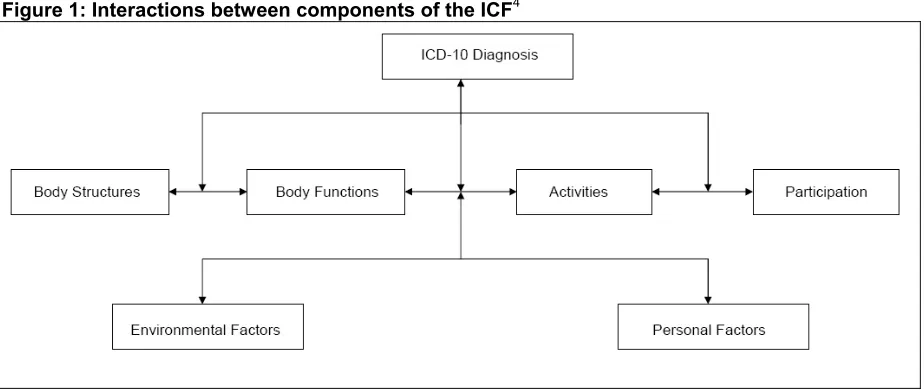
the ICF Checklist was used. The structure of the extended and the comprehensive version of the ICF is identical. The ICF has 2 parts including 2 components each. The first part is called Functioning and Disability and contains the components a) Body Functions and Structures and b) Activities and Participations. The second part deals with Contextual Factors which are c) Environmental Factors as well as d) Personal Factors. At present in the ICF the following components are included: 1) Body Functions 2) Body Structures 3) Activities and Participations 4) Environmental Factors.
Figure 1: Interactions between components of the ICF4
social and attitudinal environment in which people conduct their lives. These factors can have no influence, positive or negative influence on patients’ life.
The components 1 to 3 (Body Functions, Body Structures and Activities/Participation) have five answer possibilities each ranging from 0 to 4: no/mild/moderate/severe/complete impairment. The component Environmental Factors has nine answer possibilities ranging from –4 to +4: A specific Environmental Factor can be a barrier (-4 to –1), a facilitator (1 to 4) or have no influence (0) on the patient’s life. If the factor has an influence, the power of the influence (either positive or negative) can be coded with mild/moderate/severe/complete. Over and above that, the physician can choose for each component the answer not specified (8) or not applicable (9)4.
Patients’ health status was assessed by the SF-36 Health Survey, a generic instrument to measure health status10. The SF-36 is the short form of an instrument developed for the
Medical Outcome Study and then translated, psychometrically tested and normed for various countries including Germany. The SF-36 Health Survey is used for the assessment of the relative burden of different diagnoses as well as of health benefits resulting from different treatments11. It contains 36 items which can be aggregated to 8 scales. Furthermore the
Analysis
Statistical analysis was conducted in four steps: In step 1 a first selection of potential predictor variables was performed by the use of descriptive statistics. Each ICF category had to fulfil two criteria to be included in further analyses. First, the variables had to be important for at least 5% of the patients, i.e. at least 5% of the patients reported any kind of impairment or support (Environmental Factors) concerning the respective category. Secondly, there had to be a substantial relationship to functional health status. The relationship was analyzed by Spearman correlation coefficient. The correlation had to show a probability value lower than .15. The maximum number of variables selected of each ICF component was 10 for reasons of sample size (n=200). The variables selected in step 1 were included in analyses of regression in step 2.
Analysis of regression in this step was conducted for each component of the ICF, i.e. Functions, Structures, Activities/Participation and Environmental Factors. For these four analyses of regression a linear model with stepwise selection was used with p < .05 for inclusion as well as exclusion of a variable.
In step 3 the variables selected in the four analyses of regression in step 2 were integrated into one multiple linear regression model explaining the respective facet of health status, i.e. PHI-score, MHI-score. Like in step 2 stepwise selection with p < .05 for inclusion as well as exclusion of a variable was used.
diseases1 were taken into account to avoid distortion of the results and to integrate personal
factors which are not yet included in the ICF, but play an important role for patients’ health status.
Missing values in the ICF variables were replaced by the EM-algorithm, a maximum likelihood method. This method does not entail an underestimation of variance like replacement by mean. Nevertheless this conservative method was used to validate the results from the analyses with the EM-algorithm12. The conducted control analyses led to a
selection of identical variables.
RESULTS Subjects
Demographic Data and information on health status of the n=200 patients included are shown in Table 1 to Table 5.
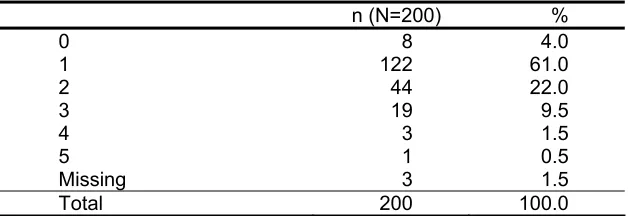
43.5% of the patients were female thus little less than half of the subjects. Patients were between 23 and 83 years old, the mean age was 51 years. 74.5% of the patients were in paid employment despite their illness, 13.0% were retired. Most of the subjects (61.0%) had one concomitant disease. The maximum number of concomitant diseases was 5.
Table 1: Gender
n (N=200) %
Female 87 43.5
Male 113 56.5
Total 200 100.0
Table 2: Age
N Min Max Mean SD
Age 200 23.0 83.0 51.3 10.4
Table 3: Current occupation
n (N=200) %
Paid Employment 148 74.0
Self-employed 6 3.0
Keeping House/ House-maker 7 3.5
Retired 26 13.0
Unemployed (Health Reason) 4 2.0
Unemployed (Other Reason) 7 3.5
N.A. 2 1.0
Total 200 100.0
Table 4: Number of concomitant diseases
n (N=200) %
0 8 4.0
1 122 61.0
2 44 22.0
3 19 9.5
4 3 1.5
5 1 0.5
Missing 3 1.5
Total 200 100.0
Table 5: Descriptive statistics SF-36 (scales and summary measures, N=200)
SF-36 N Min Max Mean Std Scales
Physical Functioning 197 0.0 100.0 63.5 24.7
Role Physical 195 0.0 100.0 35.7 38.3
Bodily Pain 199 0.0 100.0 35.6 19.1
General Health 195 0.0 87.0 51.2 17.2
Vitality 197 0.0 90.0 42.2 17.8
Social Functioning 199 0.0 100.0 69.8 26.7
Role Emotional 195 0.0 100.0 73.8 39.0
Mental Health 195 12.0 100.0 62.1 19.3
Summary Measures
Physical Health Index Score 190 7.2 57.2 35.3 9.8
Health status was assessed by the SF-36, which has eight scales as well as two summary measures. The most important impairment is reported for the scale Bodily Pain and for the scale Role Physical. This is in line with the central feature of the disease which inhibits patients to perform participations with physical challenges. Concerning the scales Role Emotional and Social Functioning patients reported the best health status. The social and emotional area of patients’ life is only little affected by their disease. Concerning the summary measures patients report stronger impairment in the Physical Health Index Score than in the Mental Health Index Score. Mental health is less affected by the disease than physical health.
To explore whether patients included in the study are representative for patients with low back pain, health status values will be compared to a sample of n=243 patients with back pain analyzed by Bullinger et al. in 199510. The comparison is based on the eight scales of
the SF-36. In all eight scales the sample of the present study reports little higher functional health status. Nevertheless the profile of the eight scales shows the same pattern in both samples.
Importance of Categories and Bivariate Associations
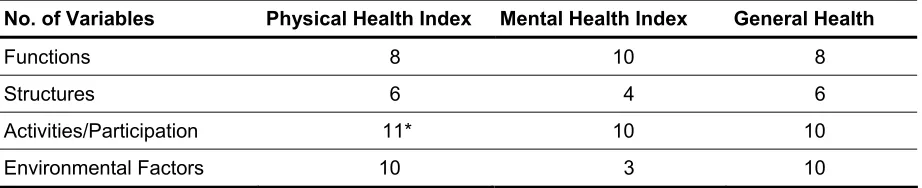
Table 6: Number of variables of each ICF component selected in step 1
No. of Variables Physical Health Index Mental Health Index General Health
Functions 8 10 8
Structures 6 4 6
Activities/Participation 11* 10 10
Environmental Factors 10 3 10
* The p-values for the 11 best items could not be differentiated. Therefore 11 variables were selected for further analyses.
In the component Functions eight ICF variables were selected as possible predictors of physical health and general health. Ten ICF categories were chosen as potential predictor variables for mental health. In the component Activities/Participation the maximum number of ICF categories was selected for all health status parameters. 4 to 6 variables achieved the selection criteria in the component Structures. The maximum number of variables was selected in the component Environmental Factors concerning physical health and general health. For the Mental Health Index Score only 3 ICF variables are correlated with p < .15 and are important for at least 5% of the patients.
Multivariate Model
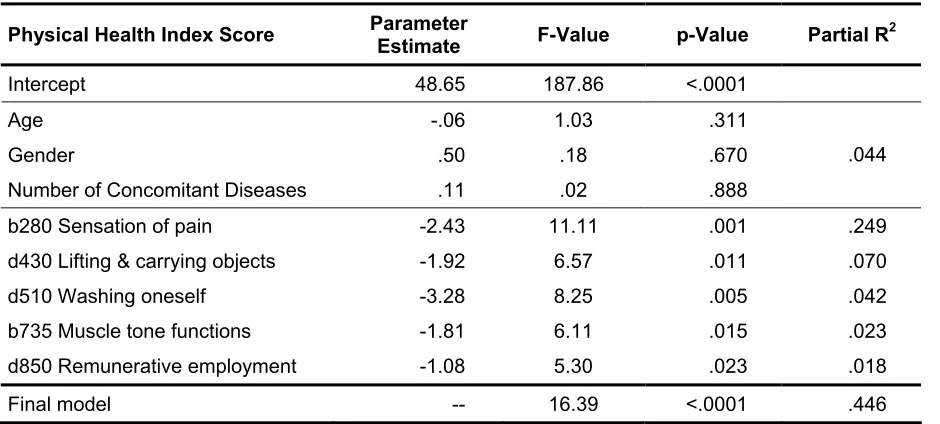
status. In total the model accounts for 44.6% of the variance of the PHI-score with F= 16.36 (p<.0001).
All five dependent variables explaining physical health in the final model are included in the ICF Comprehensive Set for patients with low back pain.
Table 7: Multivariate regression model for PHI-score
Physical Health Index Score Parameter Estimate F-Value p-Value Partial R2
Intercept 48.65 187.86 <.0001
Age -.06 1.03 .311
Gender .50 .18 .670
Number of Concomitant Diseases .11 .02 .888
.044
b280 Sensation of pain -2.43 11.11 .001 .249
d430 Lifting & carrying objects -1.92 6.57 .011 .070
d510 Washing oneself -3.28 8.25 .005 .042
b735 Muscle tone functions -1.81 6.11 .015 .023
d850 Remunerative employment -1.08 5.30 .023 .018
Final model -- 16.39 <.0001 .446
The final model to determine the Mental Health Index Score is presented in Table 8. The multivariate regression model consists of four independent variables along with the three control variables age, gender and number of concomitant diseases. The three control variables account for 8.1% of the variance in the MHI-score, but only the variable number of concomitant diseases shows a significant result (p=.002). The four variables selected as determinants of mental health are: emotional functions (7.9%), looking after one’s health (6.6%), general social support services, systems & policies (5.0%) and structure of head and neck region (3.4%). The most important predictor is the category emotional functions.
is positive, i.e. high impairment in this performance is accompanied by high functional health. In total the model accounts for 31.1% of the variance of the MHI-score with F= 10.64 (p<.0001).
Three of the four dependent variables explaining mental health in the final model are also included in the ICF Comprehensive Set for patients with low back pain. The category s710 structure of head and neck region is not included in the ICF Comprehensive Set for these patients.
Table 8: Multivariate regression model for MHI-score
Mental Health Index Score Parameter Estimate F-Value p-Value Partial R2
Intercept 46.57 103.49 <.0001
Age .15 3.94 .049
Gender -.09 0.00 .953
Number of Concomitant Diseases -3.14 10.49 .002
.081
b152 Emotional functions -6.27 20.36 <.0001 .079
d570 Looking after one’s health 3.44 14.12 <.001 .066
e575 General social support
services, systems & policies -2.28 9.88 .002 .050
s710 Structure of head and neck
region -3.17 8.21 .005 .034
DISCUSSION
Physical Health Index Score
The multivariate regression model for the explanation of the PHI-score for patients with low back pain accounts for 44.6% of the variance of this facet of health status. The model includes 5 selected variables and 3 control variables which did not reveal significant results. The most important determinant of physical health is the category sensation of pain which can explain 24.9% of the variance. This is more than half of the variance accounted for by the model as a whole. Furthermore lifting and carrying objects (7.0%), washing oneself (4.2%), muscle tone functions (2.3%) and remunerative employment (1.8%) play an important role for the PHI-score in patients with low back pain.
Sensation of pain is the central feature of the disease low back pain13, so it can be well
understood that it is the most important category selected. Patients with low back pain often report problems with lifting and carrying objects as well14, a major risk factor of low back
pain15 and the second determinant selected. Washing oneself is an activity that requires a
high level of freedom of movement, which is often impaired in patients with low back pain. In treatment of low back pain physical training or activity in daily life to improve the muscle functions and by that balancing the muscle tone play a very important role16. Furthermore the guidelines for drug therapy of back pain emphasize inter alia the use of analgetic and muscle-tone-normalizing agents17. The last determinant chosen is the category remunerative
employment. The ability to accomplish a job and by that earning one’s living is very important for patients’ independence. Furthermore this result is in line with the fact that low back pain is the main cause for work-related disability18.
the structures affected, and physical health status is not influenced by them. Patients with low back pain are restricted in many physical activities even basic ones like sitting (often associated with work), carrying objects, washing themselves. This impairment is very important for the subjective health status. Due to these basic restrictions Environmental Factors are not capable of facilitating patients’ health situation in a remarkable way.
The ICF Comprehensive Set includes all five variables of the multiple regression model for the PHI-score. This result confirms the validity of the ICF Comprehensive Set. The categories of regression model are in the ICF Comprehensive Set, too. Data analysis and expert rating did reveal corresponding outcomes.
Mental Health Index Score
The multivariate regression model to explain the MHI-score for patients with low back pain accounts for 31.1% of the variance of this facet of health status. The model includes 4 selected variables and 3 control variables. Concerning the control variables age and number of concomitant diseases have a significant importance for the MHI-score. Persons with higher age as well as patients with a lower number of concomitant diseases show higher values in physical health status. The importance of the determinants in this model does not show very immense differences. The most important predictor is the category emotional functions, but the performance to look after one’s health and general social support services, systems and policies each account for a comparable percentage of variance in the MHI-score. The category structure of head and neck region explains 3.4% of the variance of the MHI-score. It is a very interesting finding that the central feature of low back pain, the Function sensation of pain, does not play a role for patients’ mental health status in contrast to the physical health status.
components of the ICF. The fact that even two of the control variables (age, number of concomitant diseases) revealed significant results shows that personal factors are important for these patients as well.
Comparing these results and the ICF Comprehensive Set one can see that three of the four predictor variables are included in the ICF Comprehensive Set as well as in the model to explain mental health status. The category structure of head and neck region is not included in the ICF Comprehensive Set. Some patients with low back pain complain of vertigo19, a
symptom extremely influencing their mental well-being . This fact might explain that the structure head and neck region was selected for the model to explain the PHI-score. The fact that this symptom is not important for the majority of back pain patients presumably entailed that it was not included in the ICF Comprehensive Set. Perhaps this decision should be reconsidered in a further validation process.
For a deeper understanding of the presented results the relationship between the ICF and the SF-36 has to be taken into account. Cieza et al.20 describe a systematic and
In conclusion the results of the analyses presented validate the ICF Comprehensive Set for patients with low back pain. Concerning physical health status all categories of the regression model are included in the ICF Comprehensive Set. Concerning mental health three of four selected categories are included in the Comprehensive Set.
The generalization of these results to patients with low back pain does not contain greater problems. The patients in the study do not differ from patients with low back pain in general. Low back pain is most frequent in the working population 13. In the sample 80.5% are in
employment, 2.0% are unemployed due to health reasons and only 13.0% are retired. The mean age of the sample analyzed is 51 years. Men are only little more affected than women21. In the sample 56.5% of the patients are men, i.e. little more than half of the
patients analyzed. Concerning functional health status the sample examined is comparable to a sample of patients with back pain analyzed by Bullinger et al. in 199510. All these facts
support generalization of the data.
REFERENCES
1 World Health Organization Preamble to the Constitution of the World Health Organization
as adopted by the International Health Conference, New York, 19-22 June, 1946; signed on 22 July 1946 by the representatives of 61 States (Official Records of the World Health Organization, no. 2, p. 100) and entered into force on 7 April 1948.
2 World Health Organization [WHO]. Checklist International Classification of Impairment,
Disabilities and Handicaps. Geneva: WHO; 1980.
3 Üstün TB, Chatterji S, Bickenbach J, Kostanjsek N, Schneider M. The International
Classification of Functioning, Disability and Health: a new tool for understanding disability. Disability and Rehabilitation 2003; Vol. 25, No. 11-12: 565-571.
4 World Health Organization [WHO]. International Classification of Functioning, Disability and
Health: ICF. Geneva: WHO; 2001.
5 World Health Organization [WHO]. Checklist International Classification of Functioning and
Disability-2 Checklist Version 2.1a. Geneva: WHO; 1999.
6 Ewert T, Cieza A, Stucki G. Die ICF in der Rehabilitation. Physikalische Medizin,
Rehabilitationsmedizin, Kurortmedizin 2002; 12: 157-162.
7 Cieza A, Stucki G, Weigl M, Disler P, Jäckel W, van der Linden S, Bedirhan Üstün T, de Bie
R. ICF Core Set for Low Back Pain. Submitted.
8 Stucki G, Cieza A, Ewert T, Kostanjsek N, Chatterji S, Bedirhan Üstün T. Application of the
International Classification of Functioning, Disability and Health (ICF) in clinical practice. Disability and Rehabilitation 2002; Vol. 24, No. 5, 281-282.
9 Ewert T, Fuessl M, Cieza A, Andersen A, Chatterji S, Kostansjek N, Stucki G. Identification
of the most common patient problems in patients with chronic conditions using the ICF Checklist. Journal of Rehabilitation Medicine 2004; 2. In press.
10 Bullinger M, Kirchberger I. SF-36 Fragebogen zum Gesundheitszustand. Handanweisung.
11 Ware J, Gandek B. Overview of the SF-36 Health Survey and International Quality of Life
Assessment (IQOLA) Project. Journal of Clinical Epidemiology 1998; 51 (11): 903-912.
12 Little RJA, Rubin DB. Statistical analysis with missing data. New York u.a.: Wiley; 1987.
13 World Health Organization. WHO Technical Report Series. The burden of musculoskeletal
conditions at the start of the millennium. Geneva: WHO; 2003.
14 Walsh DA, Kelly SJ, Johnson PS, Rajkumar S, Bennetts K. Performance problems of
patients with chronic low back pain and the measurement of patient-centered outcome. Spine 2004; Vol. 29, No.1: 87-93.
15 Ehrlich GE. Low Back Pain. Bulletin of the World Health Organization 2003; 81(9):
671-676.
16 Chang WD, Wang YS, Chou CS, Chen WJ, Huang YS, Liaw SY. Functional approach to
treatment of back pain in primary care: a preliminary report. Zhonghua Yi Xue Za Zhi (Taipei) 1994 Jun; 53(6): 338-45.
17 Worz R, Muller-Schwefe G, Stroehmann I, Zeuner L, Zieglgansberger W, Zimmermann M.
Back pain: Guidelines for drug therapy. Utilize the therapeutic spectrum. MMW Fortschritte der Medizin 2000 May 11; 142(19):12.
18 Maetzel A, Li L. The economic burden of low back pain: a review of studies published
between 1996 and 2001. Best Practice & Research Clinical Rheumatology 2002 Jan; 16(1): 23-30.
19 Stucki G. Head of the Department of Physical Medicine and Rehabilitation. University of
Munich. Personal statement; 2003.
20 Cieza A, Brockow T, Ewert T, Amman E, Kollertis B, Chatterji S, Berdirhan Üstün T, Stucki
G. Linking health-status measurements to the International Classification of Functioning, Disability and Health. Journal of Rehabilitation Medicine 2002; 34: 205-210.
21 Woolf AD, Pfleger B. Burden of major musculoskeletal conditions. Bulletin of the World
The Importance of ICF Categories for Patients’ Subjective
Health Status
ZUSAMMENFASSUNG Hintergrund
Die International Classification of Functioning, Disability and Health (ICF) ist eine vielseitige Klassifikation zur Beschreibung von funktionaler Gesundheit. Aus Gründen der Praktikabilität wurde eine ICF Checkliste entwickelt, eine Kurzfassung der ICF, die die wichtigsten Kategorien unabhängig von der gegebenen Diagnose enthält.
Zielsetzung
Ziel der vorliegenden Arbeit ist es, die Aussagekraft der ICF Checkliste für die Erklärung des PHI-Wertes (körperliche Summenskala), des MHI-Wertes (psychische Summenskala) und des GH-Wertes (allgemeine Gesundheit) des SF-36 zu untersuchen. Dazu wurde 1) der Anteil der durch die Checkliste erklärten Varianz der SF-36-Parameter bestimmt, 2) die ICF Kategorien identifiziert, die den größten Varianzanteil der SF-36-Parameter erklären und 3) die Bedeutung der vier Komponenten der ICF für die SF-36-Parameter untersucht.
Methoden
Es wurde eine Querschnittsanalyse von n=1040 Patienten aus Rehabilitationseinrichtungen durchgeführt.
Die Checkliste der International Classification of Functioning, Disability and Health (ICF) gehört zur Familie der internationalen Klassifikationen der Weltgesundheitsorganisation (WHO). Aktuell enthält die ICF folgende Komponenten: 1) Körperfunktionen, 2) Körperstrukturen, 3) Aktivitäten/Partizipation und 4) Umweltfaktoren.
Der Short-Form (SF-36) Health Survey wurde zur Erfassung des funktionalen Gesundheitszustandes der Patienten ausgewählt. Die Analysen konzentrierten sich dabei auf die körperliche und die psychische Summenskala sowie auf das erste Item zur Erfassung der allgemeinen Gesundheit (GH-Wert).
Ergebnisse
Das Regressionsmodell zur Erklärung der körperlichen Summenskala erklärt 38,6% der Varianz (F=46,04; p<.0001). Der wichtigste Prädiktor ist die Kategorie Gehen (R2=16,4%).
Das Modell enthält vier Variablen der Komponente Aktivitäten/Partizipation und jeweils eine Variable aus der Komponente Funktionen und Umweltfaktoren.
Das Modell zur Erklärung der psychischen Summenskala erklärt 34,8% der Varianz (F=51,36; p<.0001). Der wichtigste Prädiktor ist die Diagnose Depressive Störung (R2=16,5%). Zwei der vier Komponenten der ICF sind im Modell repräsentiert, i.e.
Körperfunktionen und Aktivitäten/Partizipation.
Das Regressionsmodell zur Erklärung der allgemeinen Gesundheit erklärt 27,2% der Varianz (F=25,26; p<.0001). Der wichtigste Prädiktor ist die Kategorie Hausarbeiten erledigen (R2=11,9%). Das Modell enthält Variablen der Komponenten Körperfunktionen und
Aktivitäten/Partizipation. Schlussfolgerungen
Die Modelle zur Erklärung der funktionalen Gesundheit der untersuchten Patienten enthalten vorwiegend Körperfunktionen, Aktivitäten/Partizipation und die Kontrollvariable Anzahl der Begleiterkrankungen. Diese Ergebnisse sprechen dafür, dass ein Generic Comprehensive Set seinen Schwerpunkt auf Körperfunktionen, vor allem psychische Funktionen und Schmerzempfinden, sowie auf Aktivitäten/Partizipation, vor allem Aktivitäten des Alltags, legen sollte.
Schlüsselwörter
ABSTRACT Background
The International Classification of Functioning, Disability and Health (ICF) is a multipurpose classification to describe functional states associated with health conditions. To ensure practicability the ICF Checklist was developed, a short form of the ICF which only contains the most important categories irrespective of the present diagnoses.
Objectives
The general objective is to examine the explanatory power of the ICF Checklist in order to explain the PHI-score, the MHI-score and the GH-score of the SF-36. The specific aims are 1) to explore the percentage of variance of the SF-36 parameters accounted for by the ICF categories, 2) to identify the ICF categories which explain most of the variance of the three SF-36 parameters, 3) to assess the importance of the four components of the ICF Checklist for the SF-36 parameters.
Methods
Cross sectional analysis of n=1040 inpatients of rehabilitation centres.
The International Classification of Functioning, Disability and Health (ICF) belongs to the WHO family of international classifications. At present in the ICF the following components are included: 1) Body Functions 2) Body Structures 3) Activities and Participation 4) Environmental Factors.
Patients’ health status was assessed by the SF-36 Health Survey, a generic instrument to measure health status. Analyses were focused on Physical Health Index Score (PHI-score), Mental Health Index Score (MHI-score) and on General Health (Item1, GH-score).
multiple linear regression model. In the fourth step the model constructed in step 3 was verified and optimized. Finally three control variables were included into the model (gender, age and number of concomitant diseases).
Results
The regression model to explain the Physical Health Index Score in total accounts for 38.6% of its variance with F=46.04 (p<.0001). The most important predictor is the category walking (R2=16.4%). The model includes four variables of the component Activities/Participation, one
variable each of the component Functions and Environmental Factors as well as two diagnoses of the twelve diagnoses analyzed.
The model to determine the Mental Health Index Score explains 34.5% of its variance with F= 51.36 (p<.0001). The most important determinant of MHI-score is the variable depressive disorder accounting (R2=16.5%). Two of the four components of the ICF are represented in
the model, that is Functions and Activities/Participation.
The regression model to explain the General Health Score accounts for 27.2% of its variance with F=25.26 (p<.0001). The most important predictor is the category doing housework (R2=11.9%). The model includes variables of the components Functions and
Activities/Participation.
Conclusion
These results suggest that a generic Comprehensive Set should focus on Body Functions, especially psychological ones and pain, as well as on Activities/Participation, especially activities of every day life.
Key Indexing Terms
BACKGROUND
ICF- International Classification of Functioning, Disability and Health
The International Classification of Functioning, Disability and Health (ICF) is a multipurpose classification to describe functional states associated with health conditions especially used in the area of rehabilitation. The ICF is based on the bio-psycho-social model of health. Health is thereby understood as physical, mental and social well-being according to the WHO definition of health1.
The ICF goes back to the ICIDH, the International Classification of Impairments, Disabilities and Handicaps whose development started in 19722. The ICIDH aimed to describe the
consequences of disease. In a long process of revision multiple changes where made until in 2001 the World Health Organization (WHO) passed the first version of the International Classification of Functioning, Disability and Health3. By that way an extensive and systematic
coding scheme to serve as scientific basis for multiple kinds of research was elaborated. Furthermore, the ICF offers a common language and allows the comparison of different countries as well as different disciplines and sciences.
The ICF is a very extensive instrument to describe patients’ functional states. To ensure practicability the ICF Checklist was developed, a short form of the ICF which only contains the most important categories irrespective of the present diagnoses4. In a further project, so
called ICF Comprehensive Sets were selected on the basis of international expert ratings, empirical data collection and systematic literature reviews5. In these ICF Comprehensive
Sets the most important categories concerning a specific disease are included. The number of categories is chosen as small as possible to be practical but as broad as required to be comprehensive to cover the prototypical spectrum of limitations in functioning and health concerning a specific diagnosis6. In accordance with the recommendations of the WHO these categories should be rated in every multidisciplinary study on patients with a specific diagnosis7. To allow for comparison of health across diseases a generic Comprehensive Set
comprehensive to cover the general spectrum of limitations in functioning and health concerning the most diseases6. In this study information for a generic Comprehensive Set will be gathered by multiple regression modelling.
The general objective is to examine the explanatory power of the ICF Checklist in order to explain the PHI-score, the MHI-score and the GH-score of the SF-36.
The specific aims are 1) to explore the percentage of variance of the SF-36 parameters accounted for by the ICF categories, 2) to identify the ICF categories which explain most of the variance of the three SF-36 parameters, 3) to assess the importance of the four components of the ICF Checklist for the SF-36 parameters.
MATERIALS AND METHODS Design
Analyses were performed within the framework of a multicenter, prospective cohort study with two time points of assessment. The first time point prior to rehabilitative treatment was used for analysis
Patients
Table 9: Diagnoses
Disease ICD-10 Diagnosis
1. Low Back Pain M54 Dorsalgia
1. Osteoporosis M81-M82 Osteoporosis
1. Rheumatoid Arthritis M05-M06 Rheumatoid Arthritis
1. Osteoarthritis M19 Osteoarthritis
1. Coronary Heart Disease I21-I25 Myocardial Infarction
1. COPD & Asthma
J44 Other Chronic Obstructive Pulmonary Disease
J45 Asthma
1. Diabetes Mellitus E10-E14 Diabetes Mellitus
1. Breast Cancer C50 Malignant Neoplasm of Breast
1. Obesity E65-E68 Obesity
1. Pain Disorders
M79.1 Myalgia
R52 Pain, not elsewhere classified
F45.5 Somatoform Pain Disorder
1. Depressive Disorder F32 Depressive Episode
F33 Recurrent Depressive Disorder
1. Stroke
I64 Stroke, not specified as Haemorrhage
or Infarction
I69.4 Consequence of Stroke
The inclusion criteria were 1) age ≥ 18, 2) main diagnosis of the patients corresponds to one
of the ICD-10 diagnosis listed above, 3) purpose and reason for the study have been understood and 4) signed informed consent has been provided. The exclusion criteria were: 1) patients who have had surgery and wound has not completely healed yet and 2) patients who have had surgery within the previous six months.
Data Collection Procedures
ICF Checklist was filled in by the health professionals in cooperation with the patients. To guarantee high quality of the data the health professionals took part in a special training for the use of the ICF Checklist.
Measures
The International Classification of Functioning, Disability and Health (ICF) belongs to the WHO family of international classifications. The extended version of the ICF includes 1494 categories to describe a patient’s functional state in a systematic and exhaustive way3. The ICF Checklist contains 169 categories for reasons of practicability8. In this study the ICF
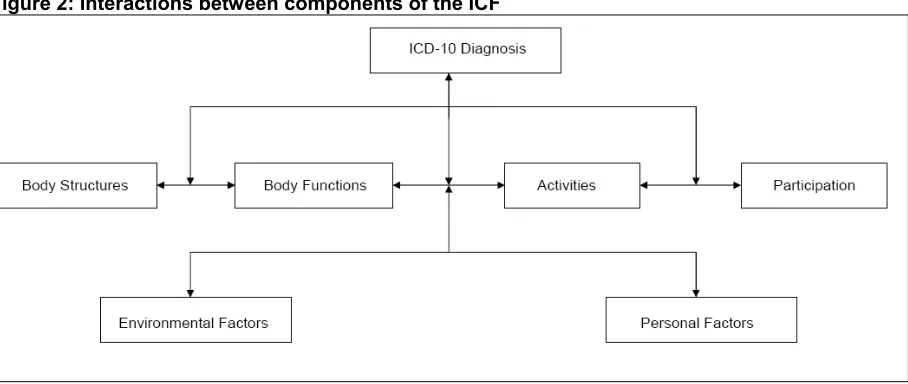
Checklist was used. The structure of the extended and the comprehensive version of the ICF is identical. The ICF has 2 parts including 2 components each. The first part is called Functioning and Disability and contains the components a) Body Functions and Structures and b) Activities and Participation. The second part deals with Contextual Factors which are c) Environmental Factors as well as d) Personal Factors. At present in the ICF the following components are included: 1) Body Functions 2) Body Structures 3) Activities and Participation 4) Environmental Factors.
Figure 2: Interactions between components of the ICF3
social and attitudinal environment in which people lead their lives. These factors can have no influence, positive or negative influence on patients’ life.
The components 1 to 3 (Body Functions, Body Structures and Activities/Participation) have five answers possibilities each ranging from 0 to 4: no/mild/moderate/severe/complete impairment. The component Environmental Factors has nine answer possibilities ranging from –4 to +4: A specific environmental factor can be a barrier (-4 to –1), a facilitator (1 to 4) or can have no influence (0) on the patient’s life. If the factor has an influence, the power of the influence (either positive or negative) can be coded with mild/moderate/severe/complete. Over and above that, the physician can choose for each component the answer not specified (8) or not applicable (9) 3.
Patients’ health status was assessed by the SF-36 Health Survey9, a generic instrument to
measure health status. The SF-36 is the short form of an instrument developed for the Medical Outcome Study and then translated, psychometrically tested and normed for 15 countries Germany included. The SF-36 Health Survey is used for the assessment of the relative burden of different diagnoses as well as of health benefits resulting from different treatments10. It contains 36 Items which are used to score eight scales. Furthermore the
SF-36 includes two summary measures, each aggregating four scales. The Physical Health Index Score (PHI-score) summarizes the scales Physical Functioning, Role-Physical, Bodily Pain and General Health. The scales Vitality, Social Functioning, Role-Emotional and Mental Health form the summary measure Mental Health Index Score (MHI-score). High values indicate high subjective health status, whereas low values indicate high impairment in functional health. In the present study the focus lies on these two summary measures. In Addition a single item assessing General Health was used as measure for a very general and direct assessment of patients’ health status. The item is the first in the survey an reads:
Analysis
Statistical Analysis was conducted in four steps: In step 1 a first selection of potential predictor variables of health status was performed by the use of descriptive statistics. Each ICF category had to fulfill two criteria to be included in further analyses. First, the variables had to be important for at least 10% of the patients, i.e. at least 10% of the patients reported any kind of impairment or support (Activities/Participation) concerning the respective category. Secondly, there had to be a substantial relationship to functional health status. The relationship was analyzed by Spearman correlation coefficient. The correlation had to show a probability value lower equal .01. The variables selected in step 1 were included in analyses of regression in step 2.
Analysis of regression in this step was conducted for each component of the ICF, i.e. Functions, Structures, Activities/Participation, and Environmental Factors. For these four analyses of regression a linear model with stepwise selection was used with p < .05 for inclusion as well as exclusion of a variable.
In step 3 the variables selected in the four analyses of regression in step 2 were integrated into one multiple linear regression model explaining the respective facet of health status, i.e. PHI-score, MHI-score, GH-score. Like in step 2 stepwise selection with p < .05 for inclusion as well as exclusion of a variable was used.
In the fourth step the model constructed in step 3 was verified and optimized. To understand the associations between ICF and health status in a better way, the three best determinants of a model were excluded one by one from the model. Emerging changes in the models were utilized to create a stable and highly informative final model. Finally three control variables were included into the model. Gender, age and number of concomitant diseases2 were taken into account to avoid distortion of the results and to integrate personal factors which are not yet included in the ICF, but play an important role for patients’ health status.
Missing values in the ICF variables were replaced by the EM-algorithm, a maximum likelihood method. This method does not entail an underestimation of variance like replacement by mean. Nevertheless this conservative method was used to validate the results from the analyses with the EM-algorithm11. The conducted control analyses led to the selection of identical variables.
RESULTS Subjects
Demographic Data and information on health status of the n=1040 patients included are shown in Table 2 to Table 7.
58.1% of the patients are female, thus little more than half of the subjects. Patients are between 17 and 84 years old, the mean age is 53 years. Two thirds of the patients (66.3%) are married. 62.4% of the patients are in working life despite their illness (paid/non-paid employment, self-employed, student, house-maker), 25.3% were retired and 7.6% unemployed.
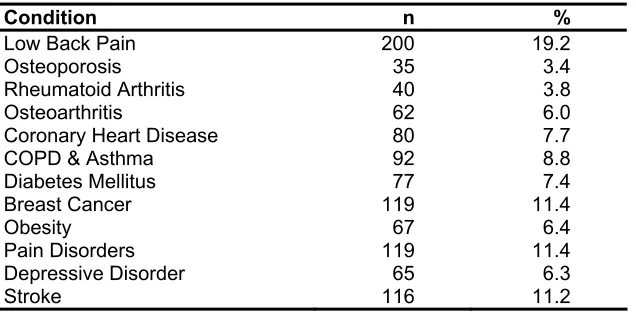
Patients with 12 different diagnoses were included in the study. At least one of the following diagnoses has to be given: low back pain, osteoporosis, rheumatoid arthritis, osteoarthritis, coronary heart disease, COPD & asthma, diabetes mellitus, breast cancer, obesity, pain disorders, depressive disorder, stroke. The largest patient group suffers from low back, that is 19.2% of the patients. 11.4% of the patients suffer from breast cancer. Pain disorders and stroke are equally frequent in the sample. Osteoporosis is the less frequent diagnosis with only 3.4% of the patients.
Table 10: Gender
n (N=1040) %
Female 604 58.1
Male 424 40.8
Missing 12 1.2
Sum 1040 100.0
Table 11: Age
N Min Max Mean SD
Age 1032 17.0 84.0 53.2 12.5
Table 12: Current occupation
n (N=1040) %
Paid Employment 524 50.4
Self-employed 38 3.7
Non-paid work (volunteer/charity) 2 0.2
Student 12 1.2
Keeping House/ House-maker 73 7.0
Retired 263 25.3
Unemployed (Health Reason) 47 4.5
Unemployed (Other Reason) 32 3.1
Missing 49 4.7
Sum 1040 100.0
Table 13: Diagnosis (multiple diagnoses possible)
Condition n %
Low Back Pain 200 19.2
Osteoporosis 35 3.4
Rheumatoid Arthritis 40 3.8
Osteoarthritis 62 6.0
Coronary Heart Disease 80 7.7
COPD & Asthma 92 8.8
Diabetes Mellitus 77 7.4
Breast Cancer 119 11.4
Obesity 67 6.4
Pain Disorders 119 11.4
Depressive Disorder 65 6.3
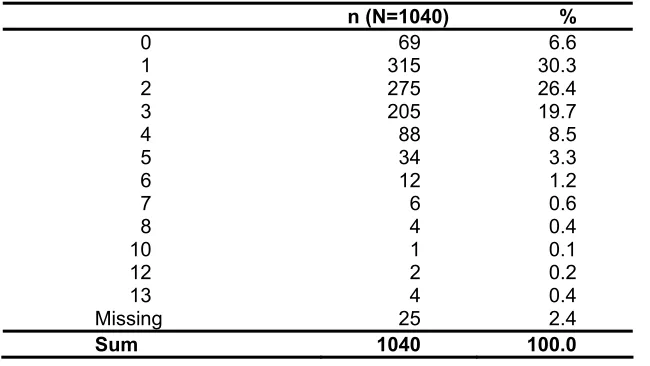
Table 14: Number of concomitant diseases
n (N=1040) %
0 69 6.6
1 315 30.3
2 275 26.4
3 205 19.7
4 88 8.5
5 34 3.3
6 12 1.2
7 6 0.6
8 4 0.4
10 1 0.1
12 2 0.2
13 4 0.4
Missing 25 2.4
Sum 1040 100.0
Table 15: Descriptive statistics SF-36 (scales and summary measures, N=1040) SF-36 N Min Max Mean Std Scales
Physical Functioning 1021 0.0 100.0 59.9 27.8
Role Physical 990 0.0 100.0 36.0 40.4
Bodily Pain 1019 0.0 100.0 47.2 29.5
General Health 999 0.0 100.0 48.4 19.3
Vitality 1005 0.0 100.0 41.9 20.9
Social Functioning 1023 0.0 100.0 66.0 28.5
Role Emotional 971 0.0 100.0 62.7 44.5
Mental Health 995 0.0 100.0 59.1 21.8
Summary Measures
Physical Health Index Score 933 7.2 70.0 37.2 11.0
Mental Health Index Score 933 9.0 73.8 44.5 13.1
Concerning the summary measures patients report stronger impairment in the Physical Health Index Score than in the Mental Health Index Score. Mental health is less affected by these diseases than physical health.
Importance of Categories and Bivariate Associations
In the first step categories with only minimal importance for patients with low back pain and variables which are not associated with the respective facet of patients’ Health status were excluded from the analyses. Only variables with importance (impairment/support) for at least 10% of the patients and with a correlation coefficient with p≤.01 were selected for further
analyses.
Table 16: Number of variables selected for each ICF component No. of Variables
(Range r) Physical Health Index Mental Health Index General Health
Functions 13 10 15
Structures 6 1 5
Activities/Participation 22 22 31
Environmental Factors 12 5 13
Multivariate Model
Table 17: Multivariate regression model for PHI-score
Physical Health Index Score Parameter Estimate F-Value p-Value Partial R2
Intercept 51.40 903.19 <.0001
Age -.05 3.10 .079
Gender -.63 1.01 .315
Number of Concomitant Diseases -.91 19.76 <.0001
. 071
d450 Walking -.90 36.78 <.0001 .164
d430 Lifting and carrying objects -.72 22.60 <.0001 .064
b280 Sensation of pain -.93 49.84 <.0001 .039
d630 Preparing meals -.65 15.92 <.0001 .021
Diagnosis diabetes mellitus 5.01 15.41 <.0001 .010
e150 Design, construction and building products and technology of buildings for public use
-.38 7.17 .008 .008
d850 Remunerative employment -.36 7.12 .008 .004
Diagnosis depressive disorder 3.17 6.25 .013 .005
Final model -- 46.04 <.0001 .386
Activities/Participation in the model is the variable design, construction and building products and technology of buildings for public use (0.8%), selected as sixth predictor.
The parameter estimate of all significant predictor variables of the ICF Checklist are negative, that is high impairment in this ICF category is accompanied by low functional health. The two diagnoses chosen as predictors have positive parameter estimates, that is patients report a higher health status, if the diagnosis is present.
In total the model includes four variables of the component Activities/Participation, one variable each of the component Functions and Environmental Factors as well as two diagnoses of the twelve diagnoses analyzed. The component Structures is not represented in the final model to explain physical health.
Table 18: Multivariate regression model for MHI-score
Mental Health Index Score Parameter Estimate F-Value p-Value Partial R2
Intercept 45.732 501.27 <.0001
Age .128 15.85 <.0001
Gender .987 1.58 .210
Number of Concomitant Diseases -1.715 37.28 <.0001
.079
Diagnosis depressive disorder -13.483 66.54 <.0001 .165
b152 Emotional functions -.787 12.56 <.001 .070
b130 Energy and drive functions -.648 9.22 .003 .015
b134 Sleep functions -.532 10.06 .002 .009
d760 Family relationships -.704 9.63 .002 .008
Final model 51.36 <.0001 .346
sleep functions (0.9%), family relationships (0.8%). The most important determinant of MHI-score is the variable depressive disorder accounting for 16.5% of its variance. Predictors 2 to 4 are Functions in total accounting for 9.4%. The last predictor selected is the Activity/Participation family relationships explaining 0.8% of the variance of the MHI-score. The parameter estimate of the five selected predictor variables and the forced variable number of concomitant diseases are negative, that is high impairment in this ICF category or existence of the diagnosis respectively is accompanied by low functional health. The parameter estimate of the variable age is positive. Patient of higher age reported a higher mental health status.
Two of the four components of the ICF (Functions, Structures, Activities/Participation and Environmental Factors) are represented in the model, that is Functions and Activities/Participation. The components Structures and Environmental Factors are not included in the model.
Table 19: Multivariate regression model for the GH-score
General Health Score Parameter Estimate F-Value p-Value Partial R2
Intercept 3.095 560.36 <.0001
Age -.003 1.90 .169
Gender .062 1.41 .236
Number of Concomitant Diseases .074 20.82 <.0001
.037
d640 Doing housework .057 23.49 <.0001 .119
b130 Energy and drive functions .037 10.66 .001 .038
b280 Sensation of pain .042 16.77 <.0001 .027
Diagnosis breast cancer -.212 6.98 .008 .018
d450 Walking .035 9.38 .002 .010
Diagnosis depressive disorder .267 7.57 .006 .008
Diagnosis pain disorder .196 6.07 .014 .007
d920 Recreation and leisure .024 4.65 .031 .004
Diagnosis osteoporosis -.276 4.42 .036 .004
In total the linear regression model to explain the General Health Score includes nine predictor variables along with the three fixed control variables age, gender and number of concomitant diseases (see Table 19). The model accounts for 27.2% of the variance of the GH-score with F=25.26 (p<.0001). The three control variables account for 3.7% of the variance in the GH-score, but only the variable number of concomitant diseases reveals a significant result (p<.0001). The most important predictor of the nine variables selected is the category doing housework accounting for 11.9% of the variance of the GH-score. Variable 2 and 3 are the Functions energy and drive functions (3.8%) and sensation of pain (2.7%). Two further Activities/Participation were selected: walking (1.0%) and recreation and leisure (0.4%). Four of the twelve diagnoses analyzed are important for the estimation of general health: breast cancer (1.8%), depressive disorder (0.8%), pain disorder (0.7%), osteoporosis (0.4%).
The diagnosis depressive as well as pain disorder have positive parameter estimates, that is patients who are diseased reported stronger impairments in the GH-score3. The diagnosis
breast cancer and osteoporosis have negative parameter estimates, that is patient of this diagnosis group reported higher general health status than patients of other diagnoses. The parameter estimate of other significant predictor variables of the ICF Checklist are positive , that is high impairment in this ICF category (high number of concomitant diseases respectively) is accompanied by low functional health.
Altogether four of the nine predictor variables selected are diagnosis in total accounting for 3.7% of the variance of the GH-score. Three of the selected variables are Activities/Participation explaining 13.3% of the variance of the GH-score, that is nearly half of the variance explained by the model as a whole. Two of the nine determinants of general health are Functions accounting for 6.5% of the variance of the GH-score.
In total the model includes variables of the components Functions and Activities/Participation as well as diagnoses. The components Structures and Environmental Factors are not represented in the final model to explain general health.
Table 20: Number of variables selected for final regression models
No. of Variables Physical Health Index Mental Health Index General Health
Sign. Control Variables 1 2 1
Diagnoses 2 1 4
Functions 1 3 2
Structures - - -
Activities/Participation 4 1 3
Environmental Factors 1 - -
Total No. of Variables
Selected 8 5 9
In Table 20 a summary of the final regression models is presented. The total number of variables selected for these models is given for each component of the ICF. The categories most often selected are the categories of the component Functions and Activities/Participation. The categories of the component Structures are not selected for the final regression models to explain patients‘ health status. Environmental Factors are only included in the model for the PHI-score (by one category), but not in the models to explain MHI-score or GH-score. In total they do not play an important role for functional health. In some cases the presence of certain diagnoses has an influence on patients‘ functional health status. Certain diseases imply a higher or lower health status than the group of the remaining other diseases as a whole.
Table 21: Partial R2 per ICF component for final regression models
Partial R2 Physical Health Index Mental Health Index General Health
Control Variables .071 .079 .037
Diagnoses .015 .165 .037
Functions .039 .094 .065
Structures - - -
Activities/Participation .253 .008 .133
Environmental Factors .008 - -
Table 21 shows the partial R2 for each component of the ICF, the control variables or the
diagnoses respectively for the three final regression models. The most important component concerning physical health and general health is the component Activities/Participation with the highest percentage of variance accounted for (PHI: 25.3%, GH:13.3%). Concerning mental health the diagnose depressive disorder explains most of the variance. The diagnose depressive disorder implies emotional functions disturbed. If the variable depressive disorder is not included in the analysis, the Function b152 emotional functions is selected instead. In total the component Functions plays a rather important role in explaining patients’ health status. The percentage of variance accounted for is not very large, but in all models Functions play a certain role. The components Structures and Environmental Factors have no predictive value for health status. Not a single category of the component Structures and only one category of the component Environmental Factors (R2 = 0.8%) was selected for the
final regression models.
DISCUSSION
Physical Health Index Score
The multivariate regression model to explain the PHI-score accounts for 38.6% of the variance of this SF-36 parameter. The model includes 8 selected variables and 3 control variables. Concerning the control variables only the variable number of concomitant diseases revealed a significant result. The most important determinant of physical health is the activity walking which can explain 16.4% of the variance that is nearly half of the variance accounted for by the model as a whole. Furthermore the following categories are important: lifting and carrying objects (6.4%), sensation of pain (3.9%), preparing meals (2.1%), the diagnosis diabetes mellitus (1.0%), aspects of buildings for public use (0.8%), remunerative employment (0.4%) and diagnosis depressive disorder.
diseases are represented, a condition where walking is a major problem12. Further
Activities/Participation of importance are lifting and carrying objects, preparing meals and remunerative employment. These are activities of daily life in which an impairment has great influence on patients’ life. Sensation of pain is the only function selected for the model. Pain is the connecting feature of many diseases, so it can be well understood that it is of importance for patients’ physical health status in general. The two diagnoses depressive disorder and diabetes mellitus, where pain does not play a central role, are the two diagnoses with higher scores in physical health. The only Environmental Factor included in the model to explain physical health is the category design, construction and building products and technology of buildings for public use, e.g. ramps, power-assisted doors, elevators. These products or technology constitute an individual’s indoor and outdoor human-made environment in public use and can facilitate daily life and thereby ameliorate patients’ subjective assessment of physical health.
Concerning the selection of the different ICF components the model to explain physical health status contains Functions, Activities/Participation and Environmental Factors. Not a single Structure was selected for the final model. Furthermore diagnoses were selected for the determination of patients’ health status. The most important component for patients’ subjective physical health is the component Activities/Participation, accounting for 25.3% of the variance of the PHI-score that is 65.5% of the variance explained by the model as a whole. The other components play a subordinate role. The mere presence of a diagnoses has little influence on patients physical health status. The location of the impairment in certain structures does not play an important role.
Mental Health Index Score
age as well as patients with a smaller number of concomitant disease show better mental health scores. The most important predictor is the diagnosis depressive disorder explaining even more variance (16.5%) than the three Functions selected for the model (emotional functions, energy and drive functions, sleep functions, 9.4%). The Activity/Participation recreation and leisure accounts for a small percentage of variance, but reveals a significant result. The most important predictor of mental health is the diagnosis depressive disorder, a disease with predominantly mental impairments. Beyond that emotional functions as well as energy and drive functions, thus further mental aspects of functioning, play an important role for patients. The selection of sleep functions as determinants of mental health is in line with findings that insomnia the most prevalent sleep disorder interferes with individual's work, physical and social performance as well as overall quality of life13. The ICF category family
relationships represents the social component of subjective mental health.
In this multivariate regression model two of the four components as well as a diagnoses are included. Functions, Activities/Participation and the presence of a depressive disorder play an important role for patients’ mental health status. Structures as well as Environmental Factors are not included in the model of mental health. The fact that even two of the control variables (age, number of concomitant diseases) show significant results, reveals the importance of personal factors for mental health.
General Health Score
cancer, walking, diagnosis depressive disorder and pain disorder, recreation and leisure, diagnosis osteoporosis.
The Activities/Participation selected as predictor of general health are activities of everyday life, like doing housework or walking. Unlike the model of physical health in which remunerative employment is chosen as predictor in the model of general health the Activity/Participation recreation and leisure determines patients’ health status. Like in the model of mental health the Body Function energy and drive functions is included in the model. Similar to the model of physical health the Body Function sensation of pain is included. The concept of general health covers both aspects of physical and mental health. Four diagnosis differ from the remaining other diagnoses either in a positive way (depressive disorder, pain disorder) or in a negative way (breast cancer, osteoporosis). The mere presence of these diagnoses is a predictor of patients’ general health.
The most important ICF component in this model, the component Activities/Participation accounts for 13.3% of the variance. The component Body Functions still accounts for 6.5%. Thus, the model is predominantly determined by these two components. The four selected diagnoses account for the least percentage of variance of the GH-score, i.e. 3.7% in total.
Concerning the percentage of variance of the SF-36 parameters explained by the ICF categories in the three regressions models, the following findings can be obtained. The model with the highest percentage of variance explained is the model of the PHI-score (R2=38.6%). The model of the MHI-score can explain 34.6% of the variance. The least percentage of variance can be explained by the model of general health (R2=.272). The higher percentage of variance explained by the models of the two summary measures PHI-score and MHI-PHI-score can be illuminated by the linkage between the ICF and the SF-36. Cieza et al.14 describe a systematic and standardized approach for linking health status
linked to items of the SF-36. Especially the Functions sensation of pain and emotional functions are included in several items of the SF-36. These items are either included in the PHI-score (sensation of pain) or in the MHI-score (emotional functions). The first item of SF-36 assessing general health can not be linked to the ICF.
The most important category to explain physical health is the Function walking. The predominant predictor of mental health is the diagnosis depressive disorder. The main determinant of general health is the Activity/Participation doing housework. The single variable included in all three models is the diagnosis depressive disorder, representing that fact that this diagnosis is the single mental disorder amongst physical disorders.
The most important component in the model to explain physical health is the component Activities/Participation. In the model to explain general health two components play a predominant role, i.e. Activities/Participation and Body Functions. Mental health can be best explained by the diagnosis depressive disorder or if this diagnosis is not available for the model by the component Body Functions. Physical health is represented by Activities/Participation, mental health by psychological Functions and general health is represented by a combination of both aspects. This finding only partly is in line with a statement made by Stucki et al. that a generic Comprehensive Set will aim at Activities/Participation as well as Environmental Factors6. The impact of the component
Environmental Factors in the three models presented is negligible.
These conclusions are limited by the fact that the analyses presented are based on the ICF Checklist, not on the extensive version of the ICF. It cannot be excluded that there are variables in the extensive version of the ICF, but not in the ICF Checklist that are important for patients’ health status. Further analyses are desirable to clean out this uncertainty.