Efficient Anchor Point Selection Based Data
Gathering in Cluster Wireless Sensor
Networks
J. Nithya
1, J. Shenbagam
21 Research Scholar, Dept. of Computer Science., Shri Sakthikailassh Women’s College, Salem, India
2 Assistant Professor, Dept. of Computer Science, Shri Sakthikailassh Women’s College, Salem, India
ABSTRACT: The sensor nodes near to the fixed sink node suffer from the quickly tired energy. For this, many existing methods have been researched to distribute the energy consumption into all wireless sensor nodes using a rechargeable mobile sink. Since the mobile sink changes its location in the network continuously, it has limited time to communicate with the sensor nodes and needs the time to move to each sensor node. Therefore, before the mobile sink approaches the sensor node, the node can collect huge data by event occurrence. It causes the memory overflow of the sensor node and then the data loss. The proposed solution works by cluster the network based on LEACH protocol such that the depth of each partition is bounded by k no of cluster Head. Then, in each cluster head, the minimum number of required caching anchor point’s selection algorithm is identified. The proposed experimental results show that our proposed scheme minimizes the data loss and has similar network lifetime over the existing scheme based on a mobile sink..
KEYWORDS: WSN; Anchor point selection; Cluster head; Network lifetime
I. INTRODUCTION
Wireless Sensor Networks (WSNs) composed of multifunctional miniature devices with sensing, computation and wireless communication capabilities. Such devices are normally battery operated. Thus, recharging a sensor node is impractical because they are typically designed for hostile environments; therefore, energy efficiency is critical. In typical static multi-hop data communication paradigm, the sensors around the sink are likely the first to run out of energy. This is due to the fact that these sensors carry heavier traffic loads. Once these sensor nodes fail, the operational lifetime of the networks ends and the network stops working because the entire network becomes unable to communicate with the sink. Therefore, reducing energy consumption in WSNs is becoming a major design challenge.
Basically, the sensor network has one or more sink node to deliver to a user by collecting sensing values by the sensor nodes. According to the data gathering method to collect the data in the sink nodes, the sensing values by the sensor nodes are delivered efficiently to a query node without any data-loss. Therefore, the data gathering method by the sink nodes is one of essential technologies. Various data gathering methods based on static sink nodes have been proposed. The sensor network based on static sink. It is classified into two categories such as cluster-based methods and tree-based methods. The cluster-based methods firstly select the header nodes based on certain conditions and then construct clusters that consist of nodes near to them. Because the cluster-based methods collect the sensing values from the member nodes and process the data in header nodes before sending the data to the sink node, they have the advantage that energy can be used equally.
II. RELATED WORK
Relay routing is a simple and effective approach to routing messages to the data sink in a multi-hop fashion. The construction of a maximum-lifetime data gathering tree by designing an algorithm that starts from an arbitrary tree and iteratively reduces the load on bottleneck nodes. Collection tree computes wireless routes adaptive to wireless link status and satisfies reliability, robustness, efficiency and hardware independence requirements. However, when some nodes on the critical paths are subject to energy depletion, data collection performance will be deteriorated. Compared with data collection via a static sink, introducing mobility for data collection enjoys the benefits of balancing energy consumptions in the network and connecting disconnected regions. The mobility under random walk where the mobile collector picks update from nearby sensors buffers and finally offloads data to the wired access point. However, random trajectory cannot guarantee latency bounds which are required in many applications.
An efficient moving path planning algorithm by determining some turning points on the straight lines, which is adaptive to the sensor distribution and can effectively avoid obstacles on the path. a single-hop data gathering scheme to pursue the perfect uniformity of energy consumption among sensors, where a mobile collector called mobile sink is optimized to stop at some locations to gather data from sensors in the proximity via single-hop transmission. The work was further extended to optimize the data gathering tour by exploring the tradeoff between the shortest moving tour of mobile sink and the full utilization of concurrent data uploading among sensors. Furthermore, the existing an algorithm to study the scheduling of mobile elements such that there is no data loss due to buffer overflow. Although these works consider utilizing mobile collectors, latency may be increased due to data transmission and mobile collector’s traveling time.
III.PROPOSED ALGORITHM
A. Network Model:
All sensor nodes are randomly distributed in 2D monitoring area. The sensor node locations are fixed. Mobile sink nodes can move.
The WSNs, when sink nodes are moving, they gather data from the cluster head. Thus, it is necessary to consider mobile gathering and static sink nodes.
When sensor nodes are not in the data gathering range of sink nodes, they store all sensing data in cache and basically are in sleep state. When sensor nodes are in the data gathering range of sink nodes, they are in work state and transmit data to one sink node by direct or multi-hop way.
All sensor nodes have the same performance (such as sensing rate, maximum communication radius, initial energy, and energy consumption parameter) and use the same energy consumption model.
B. LEACH Protocol Cluster Head Selection:
LEACH is representative cluster-based of routing protocols. It is also the first proposed in wireless sensor network and can reduce power consumption on avoiding the communication directly between sink and sensor nodes. In a sensor field, sensor node senses data and sends data to the sink that called n round. The working procedure for LEACH will be finished in a round. The huge number of sensor nodes will divide into several clusters and choose a cluster head randomly by self organization. Each cluster head is in charge of gather the sensed data from the sensor nodes in the cluster. The CHs gather the data and compress them and forward to the base station(sink). Every node uses the stochastic algorithm to find out the CH.
The threshold value is calculated based on the following equation,
𝑘 𝑠 = 𝑝
1 − 𝑝 𝑟 𝑚𝑜𝑑1𝑝
0 𝑜𝑡ℎ𝑒𝑟𝑤𝑖𝑠𝑒
Here, p is the desired percentage of CH, r denotes the count of present round, and G is the group of sensor nodes that are not CHs in the previous 1/p rounds.
Step1: The neighbor node information are sensed by broadcasting the beacon messages throughout the network.
Step 2: Perform sorting algorithm: The sorting algorithm is performed to retrieve the list of all neighbor nodes about its hop distance. The list is sorted into descending order.
Step 3: Candidate for cluster: When its two- hop neighbor node is not enclosed, analyze all the members of stage 2 one-by-one and crown any one two-hop neighbor for being as a candidate for the cluster.
Step 4: calculate the residual energy of neighbor nodes: Finally, the sorting algorithm is executed based on the residual energy of the neighbor nodes.
Step 5:CH selection: The computations are based on the following simplifications: assume that the intra cluster transmission stage is long. Hence all the data nodes can forward the data to their CH and inter cluster transmission is long enough; hence, all CH having data can forward their data to the BS. The CH needs to perform the data aggregation and compression before forwarding the data to the BS. The optimal probability of a sensor node is elected as a CH based on the function of spatial density. The clustering approach is optimal in the sense that overall energy utilization is minimum. Such optimal clustering is greatly dependent on the energy model.
IV.ANCHORPOINTSELECTIONALGORITHM
The selection of anchor points falls into following two aspects. First, the sensors located at the selected anchor points should be those with most urgent needs of energy supplement. Second, as the mobile sink moves over the anchor points back and forth for data gatherings during a time interval, the length of each migration tour, which implies the data gathering latency, is expected to be short. To better enjoy the benefit of the energy supply provided by the mobile sink, more anchor points should be selected such that more sensors can timely get recharged. However, this would adversely prolong the migration tour. Therefore, there is an inherent tradeoff between the number of sensors to be recharged and data gathering latency.
Based on this observation, the anchor point selection problem for a particular time interval k can be described as follows. Given the up-to-date energy states of sensors obtained by the mobile sink at the end of time interval k-1, find the maximum number of anchor points for time interval k such that the sensors located at these anchor points hold the least battery energy, and meanwhile by visiting these anchor points, the tour length of the mobile sink is no more than a threshold value. Considering that the possible candidate anchor points are the locations of all the sensors, this problem is equivalent to finding a target sensor. By visiting the locations of all the sensors whose battery energy is less than or equal to that of the target sensor, the length of the shortest migration tour among them is bounded by the threshold.
Anchor Point Selection Algorithm
Inputs: Sensor list N, battery status {bi}, and tour bound Ltsp;
Outputs: Anchor point list A;
Sort sensor list N in an ascending order according to battery status {bi} and record the result in S′; u = 1, v = |S′|, n = 0, m = 0;while true doif u > v then n = v; break; end if
m = 1
2 u + v , A = {s
′ 1 , s′ 2 , … … . s′ m , (2)
TSP-NN(A) denote its tour length; case
TSP-NN(A) < Ltsp: u = m + 1; TSP-NN(A) = Ltsp: n = m; break; TSP-NN(A) > Ltsp: u = m − 1; end case
end while
A = {S′(1), S′(2), …… , S′(n)}
After the anchor points and the sequence to visit them are determined, the remaining issue is how to gather data from sensors when the mobile sink migrates among the anchor points.
V. DATAGATHERING
The aim of data gathering is to transmit data that has been collected by the sensor nodes to the base station. Data gathering algorithms aim to maximize the amount of rounds of communication between nodes and the base station, one round means that the base station has collected data from all sensor nodes. Thus, data gathering algorithms try to minimize power consumption and delay of the gathering process. Data gathering may seem similar to data dissemination, but there are some differences. In data dissemination, also other nodes beside the base station can request the data while in data gathering all data is transmitted to the base station. In addition, in data gathering data can be transmitted periodically, while in data dissemination data is always transmitted on demand.
LEACH is a self -organizing, adaptive clustering protocol that uses randomization to distribute the energy load evenly among the sensors in the network. Looking back at the old algorithms, one could see how picking a random sensor and having it fixed to be the CH through the system lifetime that it would die very quickly cutting short the lifetime of all other nodes belonging to the cluster. LEACH changes this by randomly rotating among the various sensors in order to not drain the battery of a single sensor. Also, it reduces more energy dissipation and enhancing system lifetime by performing local data fusion to compress the amount of data being sent from the clusters to the base station. Sensors elect themselves to be local CHs at any given time with certain probability and these CH nodes broadcast their status to the other sensors in the network. The sensor nodes then chooses a cluster to be a part of by which CH requires the minimum communication energy. Although most of the time a sensor would choose the closest CH that connection could have a barrier interrupting the communication, so joining a cluster where the CH is further off would be much easier. When all of the sensors have been structured inside of each cluster, the CH creates a schedule for them in the cluster. This helps minimize the energy dissipated in the individual sensors, because it enables all non-CHs to shut off their radio components until their transmit time. Each sensor transmits its data to the CH and once the CH collects all of the data it aggregates it and transmits it to the BS. Normally the BS is a great distance away, so it will be high energy transmission.
VI.EXPERIMENTAL RESULTS
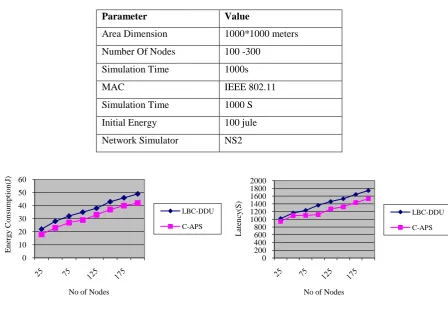
Table 1: Simulation Parameters
Parameter Value
Area Dimension 1000*1000 meters
Number Of Nodes 100 -300
Simulation Time 1000s
MAC IEEE 802.11
Simulation Time 1000 S
Initial Energy 100 jule
Network Simulator NS2
.
Fig.1.Comparsion of energy consumption with no of nodes Fig. 2. Comparison of latency s with no of nodes
Fig. 3.Comparison of Packet delivery Ratio with no of nodes Fig 4. Comparison of throughput with no of nodes
VII. CONCLUSION AND FUTURE WORK
The proposed scheme actively sends the stored data to the mobile sink by considering the amount of collected data in the cluster header and the mobile sink movement based anchor point selection algorithm of the sink node. By doing so, it minimizes the loss data of each sensor node. It has been shown through various experiments that the proposed scheme reduced the data loss by sending data toward the moving path of a mobile sink. In spite of the minimization of the data-loss, the network lifetime of the proposed scheme to the existing scheme based on a mobile sink. In the future work, here plan to extend our work to apply the proposed scheme to the dynamic clustering environment that considers the changes of the cluster headers.
0 10 20 30 40 50 60 En er g y C o n su mp ti o n (J)
No of Nodes
LBC-DDU C-APS 0 200 400 600 800 1000 1200 1400 1600 1800 2000 L at en cy (S )
No of Nodes
LBC-DDU C-APS 0 10 20 30 40 50 60 70 80 90 100 Packet Delivery Ratio(%)
No of Nodes
LBC-DDU C-APS 0 1 2 3 4 5 6 7 8 9
25 75 125 175
T h ro u g h p u t( K b p s)
No of Nodes
LBC-DDU
REFERENCES
[1] W. C. Cheng, C. Chou, L. Golubchik, S. Khuller, and Y. C. Wan, “A coordinated data collection approach: Design, evaluation, and comparison,” IEEE J. Sel. Areas Commun., vol. 22, no. 10, pp. 2004–2018, Dec. 2004.
[2] K. Xu, H. Hassanein, G. Takahara, and Q. Wang, “Relay node deployment strategies in heterogeneous wireless sensor networks,” IEEE Trans. Mobile Comput., vol. 9, no. 2, pp. 145–159, Feb. 2010.
[3] E. Lee, S. Park, F. Yu, and S.-H. Kim, “Data gathering mechanism with local sink in geographic routing for wireless sensor networks,” IEEE Trans. Consum. Electron., vol. 56, no. 3, pp. 1433–1441, Aug. 2010.
[4] X. Tang and J. Xu, “Adaptive data collection strategies for lifetime-constrained wireless sensor networks,” IEEE Trans. Parallel Distrib. Syst., vol. 19, no. 6, pp. 721–7314, Jun. 2008.
[5] Z. Zhang, M. Ma, and Y. Yang, “Energy efficient multi-hop polling in clusters of two-layered heterogeneous sensor networks,” IEEE Trans. Comput., vol. 57. no. 2, pp. 231–245, Feb. 2008.
[6] M. Ma and Y. Yang, “SenCar: An energy-efficient data gathering mechanism for large-scale multihop sensor networks,” IEEE Trans. Parallel Distrib. Syst., vol. 18, no. 10, pp. 1476–1488, Oct.2007.
[7] C. Liu, K. Wu, and J. Pei, “An energy-efficient data collection framework for wireless sensor networks by exploiting spatiotemporal correlation,” IEEE Trans. Parallel Distrib. Syst., vol. 18, no. 7,pp. 1010–1023, Jul. 2007.
[8] D. Jea, A. A. Somasundara, and M. B. Srivastava, “Multiple controlled mobile elements (data mules) for data collection in sensor networks,” in Proc. IEEE/ACM Int. Conf. Distrib. Comput. Sensor Syst., Jun. 2005, pp. 244–257.
[9] M. Ma, Y. Yang, and M. Zhao, “Tour planning for mobile data gathering mechanisms in wireless sensor networks,” IEEE Trans. Veh. Technol., vol. 62, no. 4, pp. 1472–1483, May 2013.
[10] M. Zhao, M. Ma, and Y. Yang, “Mobile data gathering with spacedivision multiple access in wireless sensor networks,” in Proc. IEEE Conf. Comput. Commun., 2008, pp. 1283–1291.
[11] M. Zhao, M. Ma, and Y. Yang, “Efficient data gathering with mobile collectors and space-division multiple access technique in wireless sensor networks,” IEEE Trans. Comput., vol. 60, no. 3,pp. 400–417, Mar. 2011.