ISSN (Online) : 2319 - 8753 ISSN (Print) : 2347 - 6710
I
nternationalJ
ournal ofI
nnovativeR
esearch inS
cience,E
ngineering andT
echnology Volume 3, Special Issue 3, March 20142014 International Conference on Innovations in Engineering and Technology (ICIET’14) On 21st & 22nd March Organized by
K.L.N. College of Engineering, Madurai, Tamil Nadu, India
Copyright to IJIRSET www.ijirset.com 208
Comparison of Buck-Boost and
CUK Converter Control Using
Fuzzy Logic Controller
Rajeswari R.V , Geetha A
Electronics and Instrumentation Department, National Engineering College, Kovilpatti, TamilNadu, India
Electronics and Instrumentation Department, National Engineering College, Kovilpatti, TamilNadu, India
ABSTRACT— DC-DC converters are used in many application such solar battery system, dc motor drives etc. DC-DC converters are used to convert the unregulated dc voltage into regulated dc voltage .The performance of these types of converters are best choice of control methods. Traditional methods require a mathematical model for a system but the fuzzy logic controller doesn’t require any mathematical model and very simple to implement .The main objective of this work to reduce the overshoot of these types of converters. This work concentrates on boost and cuk converter. The buck-boost and cuk converter is simulated for different R-Loads and their output voltage is settle at desired voltage .The performance of buck-boost and cuk converter are simulated using Matlab/Simulink and comparison study is performed.
KEYWORDS— Buck-boost converter,Cuk converter,
PWM , FLC, Matlab/Simulink.
I. INTRODUCTION
In recent year there has been an increasing in the development of DC-DC converter to improve the dynamic behavior [1-2]. The performance of power converters is the choice of control methods. Frequency domain analog methods predominantly used are based on an equivalent linear small signal model of the converter and this model has restricted validity especially for systems with strong non-linearity.
FLC is mostly used in industrial application and the main tool of FLC operation is membership function .It doesn’t require any mathematical model for a system. The FLC provides a faster transient response[3-4].
The fuzzy control theory gives an alternative approach for collecting human knowledge and dealing with nonlinearities. The fuzzy modeling and control methods have succeeded in controlling uncertain systems that cannot be easily handled by a conventional control methods[5-6] .The popularity of Fuzzy Logic Controllers was its logical resemblance to a human operator. It operates on the foundation of knowledge base which in turn rely upon the various if then rules, similar to the human operator.
In this paper the proposed converter is simulated in Matlab/Simulink with simple block. The converter is control with FLC .
II. BLOCKDIAGRAM
Figure 1. Block diagram of converters
The equation (1) shows a output voltage equation
(1)
Where = output voltage, = supply voltage, k= duty
cycle
The equation (2) and (3) shows the inductor and capacitor
(2)
Where L= inductance, R= resistance, f= switching frequency
(3)
where C=capacitance
A.Buck-boost converter
Buck-Boost converter can be obtained by the cascade connection of the two basic converters are the step-down converter and the step- up converter. In steady state, the output to input voltage conversion ratio was the product of the two converters in cascade
Fig. 2 Circuit diagram of buck-boost converter
The circuit arrangement of buck-boost converter is shown in Fig .2
B.Cuk converter
Cuk converter has several advantages over buck-boost converter .One of the advantage is the input current of cuk converter is continuous.
Fig. 3 Circuit diagram of cuk converter
The circuit arrangement of cuk converter is shown in the Fig. 3, the MOSFET use as a switch, the capacitor is uses as main energy storage .When input voltage is turned on and the MOSFET switch is turn off, diode is become forward bias and capacitor is charged.
III. DESIGN OF FUZZY LOGIC CONTROLLER
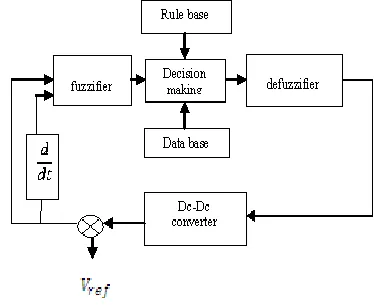
The FLC consist of three blocks they are fuzzifier, defuzzifier and inference system. Fig. 4. shows the block diagram of Fuzzy Logic Controller. The input of FLC are in the form of numerical variables are converted into a linguistic variables are done by fuzzifier [9]. The inference system consists of if-then rules. The defuzzification is conversion linguistic variable into a numerical values.
Fig. 4 Block diagram of fuzzy logic controller
The fuzzy logic controller consist of two input are error and change in error. For the system, V0 is the actual output voltage of dc-dc converter, Vref is the reference voltage then error is calculated.
E (k) = Vref - V0 (4) The change in error equation is given in below
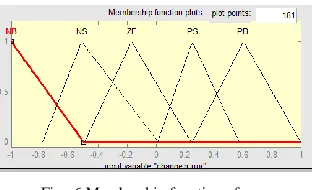
∆E (k) =e (k)-e (k-1) (5) The membership function for error and change in error are shown in the Fig 5 and 6
Fig. 5 Membership function of error
In the Fig NB stands for(Negative Big),NS stands for (Negative Small),ZE stands for (Zero),PS stands for (Postive Big) and PBstands for(Postive Big).
PWM FLC
e
Copyright to IJIRSET www.ijirset.com 210 Fig. 6 Membership function of error
The rules of fuzzy are listed below
(1) IF E (error) is NB (Negative Big) AND ∆E (Change in error) is Negative Big (NB) THEN Output is Negative Big (NB)
(2) IF E (error) is Zero AND ∆E (Change in error) is Negative Big (NB) THEN Output is Negative Big (NB) (3) IF E (error) is PB (Positive Big) AND ∆E (Change in error) is Positive Big (PB) THEN Output is Positive Big (PB)
TABLE 1. Rule base table
E
∆E
NB NS ZE PS PB
NB NB NB NB NS ZE
NS NB NB NS ZE PS
ZE NB NS ZE PS PB
PS NS ZE PS PB PB
PB ZE PS PB PB PB
IV. SIMULINK MODEL
A. Simulink model of buck-boost converter
The buck-boost converter is simulated in open loop are shown in Fig. 7 .The output voltage is measured in scope
Fig. 7 Simulink model of buck-boost converter
The actual output voltage is compared with a reference voltage generate an error signal is given as input to FLC.The output of FLC is compared with saw tooth generator it generates a pulse and given as input to MOSFET.
Fig. 8 Simulink model of buck-boost converter with FLC
B. Simulink model ofcuk converter
The simulink model of cuk converter are shown in the Fig.9
Fig. 9 Simulink model of cuk converter
The simulink model of cuk converter with FLC are shown in the Fig.10
Fig. 10 Simulink model of cuk converter with FLC
V. SIMULATIONRESULT
A. Simulink resultof buck-boost converter
The buck-boost converter is simulated in MATLAB 2012 .The output voltage is measured for different R-Loads are shown in Fig.11,12,13 and 14. The output voltage are measured by varying input voltage with constant duty cycle are shown in Table .2 and 3 . In Table. 4 the buck-boost converter with different R-Loads its settling time is shown.
time(sec) Fig. 11 Output of buck-boost converter for R- Load 50Ω
V
o
lt
ag
e
(V
)
V
o
lt
ag
e
time(sec)
Fig. 12 Output of buck-boost converter for R- Load 100Ω
time(sec) Fig. 13 Output of buck-boost converter with FLC at R- Load 50 Ω
time(sec) Fig. 14 Output of buck-boost converter with FLC at R- Load 100 Ω
TABLE 2. Buck-boost converter at duty cycle k=0.5
Input Voltage(V)
Output Voltage(V)
Theory Practical
5 5 4.92
7 7 7.037
10 10 10.22
12 12 12.34
Table 2. shows the comparison of theoretical and practical output voltage for different input
TABLE 3. Buck-boost converter at duty cycle k=0.3
Input Voltage(V)
Output Voltage(V)
Theory Practical
5 2.83 2.14
7 4.12 2.996
10 6.05 4.28
12 7.34 5.13
Table 3. shows the comparison of theoretical and practical output voltage for different input
TABLE 4. Settling time of buck-boost converter
R-Load Buck-boost converter without FLC
Buck-boost converter with
FLC
50 0.5 0.475
100 0.45 0.4
150 0.39 0.37
200 0.4 0.3
Table 3. shows the comparison of buck-boost converter with and without FLC at different R-Load
A. Simulink result of cuk converter
The cuk converter is stimulated for different R-Load and their waveform are shown in Fig 15 and 16.
time(sec) Fig. 15 Output of cuk converter for R- Load 50 Ω
time(sec) Fig. 16 Output of cuk converter for R- Load 100 Ω
The cuk converter converter with FLC used to improve the performance of cuk converter as well as it reduces the overshoot of an converter and settling time. The Fig 17 and 18 shows cuk converter with FLC for load R-50Ω and R-100 Ω and their settling time shown are shown in Table 7.
time(sec)
Fig. 17 Output of cuk converter with FLC at R- Load 50 Ω
V
o
lt
ag
e
(V)
V
o
lt
ag
e
(V)
V
o
lt
ag
e
(V)
V
o
lt
ag
e
(V)
V
o
lt
ag
e
Copyright to IJIRSET www.ijirset.com 212 time(sec)
Fig. 18 Output of cuk converter with FLC at R- Load 100 Ω
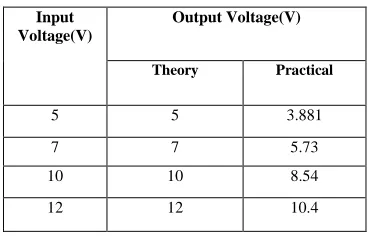
TABLE 5. Cuk converter at duty cycle k=0.5
Input Voltage(V)
Output Voltage(V)
Theory Practical
5 5 3.881
7 7 5.73
10 10 8.54
12 12 10.4
Table 5. shows the comparison of theoretical and practical output voltage for different input
V
o
lt
ag
e
(V)
TABLE 6. Cuk converter at duty cycle k=0.3
Input Voltage(V)
Output Voltage(V)
Theory Practical
5 2.14 1.282
7 2.996 2.101
10 4.28 3.331
12 5.13 4.151
Table 6. shows the comparison of theoretical and practical output voltage for different input
TABLE 7. Settling time of cuk converter
R-Load Cuk converter without FLC
Cuk converter with FLC
50 0.8 0.5
100 0.55 0.4
150 0.5 0.38
200 0.48 0.43
The stimulation result of buck-boost converter is compared with cuk converter. The buck-boost converter settles time is low.
[1] Sahin M.E, Okumus H.I .”Fuzzy Logic Controlled Buck-Boost DC-DC Converterfor Solar Energy-Battery System”,IEEE Conference ,pp.394-397. 2012
[2] HariPrasad K.V, UmaMaheswarRao C.H, SriHari A, “Design and simulation of a Fuzzy Logic Controller for Buck &Boost converters”, International Journal of Advanced Technology and Engineering, Vol. 2, pp. 218-224.2012
[3] Nittala S.K Sastry, SwapnajitPattnaik K, VarshaSingh, “Reduction of Ripple in a single phase buck converter by Fuzzy logic control”,International Journal of Research and Application,pp2202-2204.201, Vol.2 [4] Dr.T.Govindaraj, Rasila R,“Development of Fuzzy
Logic Controller for DC – DC Buck Converters” IJETS,pp.192-198, Vol.2.2011.
[5] Mohan, Undulant W.P Robins, “Power Electronics”. 1995
[6] Rashid M.H, “Power electronics handbook”, Academic Press. 2001
[7] Lee “Fuzzy logic in control systems: fuzzy logic controller, part I and part II”, IEEE trans. Syst. Man Cybern, vol 20, No. 2 , pp 404-435., 1990
[8] Taghvaee M.H and RadziH , “A current and future study on non-isolated DC–DC converters for photovoltaic application”, Renewable and Sustainable Energy Reviews, Elsevier, pp.216-225.2013
[9] Sousa G.C and BoseB.K , “A fuzzy set theory based control of a phase-controlled converter DC machine drive” , IEEE Transactions, Vol. 30, No. 1, pp. 34-44.1994