Allele Frequency-Based Analyses Robustly Map Sequence Sites Under Balancing
Selection in a Malaria Vaccine Candidate Antigen
Spencer D. Polley,*
,1Watcharee Chokejindachai*
,†and David J. Conway*
*Department of Infectious and Tropical Diseases, London School of Hygiene and Tropical Medicine, London WC1E 7HT, United Kingdom and†Faculty of Tropical Medicine, Mahidol University, Rajthewe, Bangkok 10400, Thailand
Manuscript received April 11, 2003 Accepted for publication June 17, 2003
ABSTRACT
ThePlasmodium falciparum apical membrane antigen 1 (AMA1) is a leading candidate for a malaria vaccine. Here, within-population analyses of alleles from 50 ThaiP. falciparumisolates yield significant evidence for balancing selection on polymorphisms within the disulfide-bonded domains I and III of the surface accessible ectodomain of AMA1, a result very similar to that seen previously in a Nigerian population. Studying the frequency of nucleotide polymorphisms in both populations shows that the between-popula-tion component of variance (FST) is significantly lower in domains I and III compared to the intervening domain II and compared to 11 unlinked microsatellite loci. A nucleotide site-by-site analysis shows that sites with exceptionally high or lowFSTvalues cluster significantly into serial runs, with four runs of low values in domain I and one in domain III. These runs may map the sequences that are consistently under the strongest balancing selection from naturally acquired immune responses.
E
VIDENCE of natural selection on gene sequences to control malaria in the future (Conwayet al.2000a; can lead to focused hypotheses on the functions Wootton et al. 2002). Naturally acquired, nonsterile of proteins and their existing alleles. Phylogenetic and immunity to P. falciparum is seen in highly endemic codon-based methods of analyzing homologous gene populations of Africa and Asia (MarshandSnow1997). sequences are powerful and are broadly used (Fitchet As antibody and T cell responses involve memory, para-al. 1991; Nielsen and Yang 1998; Yang et al. 2000; sites with rare antigenic types can have a frequency-depen-Jigginset al. 2002; Zhang et al. 2002), but they have dent selective advantage. Frequency-based methods limitations for some applications. First, phylogenetic re- could be applied to detect this type of selection (Tajima lationships among alleles within a species may not be 1989b; Fu and Li 1993; McDonald 1994). This ap-accurately derived if recombination occurs frequently proach offers the potential to identify targets of natu-(Holmeset al.1999;SchierupandHein2000). Second, rally acquired immunity (Conwayet al.2000a;Conway the probability of mutational changes between particu- and Polley 2002) and aid the design of a vaccine to lar codons (or overall summarized rates of synonymous induce immunity against each allelic component ( Con-and nonsynonymous changes among codons) may not way 1997).be correctly interpreted, if there are unusual constraints Apical membrane antigen 1 (AMA1) is a leading can-on codcan-on usage that are not completely known and didate in the search for a vaccine againstP. falciparum. accounted for (Akashi1995). The protein is located in the microneme organelles at One species that has both a high recombination rate the apical end of the merozoite, the stage of the parasite (Conwayet al.1999;Suet al.1999;PolleyandConway that invades erythrocytes (Healeret al.2002). It is en-2001) and an extreme bias in codon usage (Forsdyke coded by a single-locus gene that is essential for parasite 2002) is the human malaria parasite Plasmodium falci- growth in vitro(Triglia et al.2000). Immunization of parum. There is a great need to study selection on genes mice with AMA1 ofP. chabaudican protect against lethal of this species, as the causes of directional selection challenge in a strain-specific manner (Crewtheret al. (particularly due to drug resistance) and frequency- 1996), and antibodies toP. falciparumAMA1 have been dependent balancing selection (due to acquired im- shown to inhibit erythrocyte invasionin vitrowith a fairly mune responses) are important for understanding how high degree of strain specificity (Hodder et al. 2001;
Kennedy et al. 2002; Kocken et al. 2002). There is a strong predominance of nonsynonymous vs.
synony-Sequence data from this article have been deposited with the
mous polymorphisms (dN⬎ dS) amongama1alleles in
EMBL/GenBank Data Libraries under accession nos. AJ494866–
AJ494915 and ALIGN_000459. P. falciparum(Hughesand Hughes1995;Verra and
1Corresponding author:Department of Infectious and Tropical
Dis-Hughes2000), more so than for fixed differences with
eases, London School of Hygiene and Tropical Medicine, Keppel St.,
the closely related species P. reichenowi(Kocken et al.
London WC1E 7HT, United Kingdom.
E-mail: [email protected] 2000;PolleyandConway2001). Constraints on
occur in only one isolate) were verified by reamplification and ymous mutation inP. falciparum(Forsdyke2002) mean
resequencing from the genomic template. that an observation ofdN⬎dSis not interpretable simply
Genotyping of microsatellite loci in ThaiP. falciparum iso-as positive selection on amino acids, and even the valid- lates: Alleles at 11 microsatellite loci were typed in the 50 ity of the more robust comparison withP. reichenowiin ThaiP. falciparumisolates using the seminested PCR method described previously for other samples (Andersonet al.1999; the McDonald-Kreitman test (Kockenet al.2000;
Pol-Conwayet al.2001). The loci used (and their chromosomal
leyandConway2001) might be violated if constraints
positions) are as follows:POLYA(chr. 4),TA42(chr. 5),TA81 are different in that species (Akashi1995).
(chr. 5),TA1(chr. 6),TA87(chr. 6),TA109(chr. 6),ARA2 A recent study of ama1 single-nucleotide allele fre- (chr. 11),Pf PK2(chr. 12),Pfg377(chr. 12),TA102(chr. 12), quency distributions in a large sample of sequences from andTA60(chr. 13).
Analysis of sequence diversity and linkage disequilibrium: a Nigerian population indicates that polymorphisms are
Sequence diversity (, average pairwise nucleotide diversity) selectively maintained within domains I and III of the
was calculated for distinct domains of theama1gene (domains surface accessible ectodomain (Polley and Conway
I–III). Analysis of linkage disequilibrium was performed be-2001). These domains were previously defined on the tween nucleotide sites at which the frequency of the minority basis of the predicted secondary structure of AMA1 allele was⬎0.1 usingD⬘(Lewontin1964) andR2(Hilland Robertson1968) indices with Fisher’s exact test of signifi-(Hodderet al.1996), although their role in the function
cance, calculated via the DNASp3.53 program (Rozas and of AMA1 is currently unknown. It is important to know
Rozas1999). The recombination parameterC(equal to 4Nr, if these significant results can be generalized to other whereNis the effective population size andris the underlying populations ofP. falciparumand if the precision of the recombination rate) was estimated using an approximate-like-findings can be further increased. Asian populations of lihood coalescent method via thepairwiseprogram (part of the LDhat package downloadable from http://www.stats.ox.ac.uk/ P. falciparumhave been shown to be distinct from
Afri-mcvean/LDhat/LDhat.html), together with the correlation can populations on the basis of microsatellite allele
fre-coefficient of bothD⬘andR2with distance. A formal test for quencies (Andersonet al. 2000; Conwayet al. 2001) the presence of recombination was performed by a permuta-and mitochondrial haplotype frequencies (Conwayet tion test: 1000 randomly sampled data sets (in which the order al.2000b;Joyet al.2003). A large sample ofama1alleles of the polymorphicama1 loci was randomly shuffled) were produced and the proportion of these data sets showing a from Thailand has been sequenced so that independent
more extreme coefficient of correlation for D⬘and R2 with within-population and between-population analyses can
distance was recorded (McVeanet al.2002). A separate esti-be performed to evaluate signatures of balancing selec- mate of the population recombination parameterCwas calcu-tion. Results show that domains I and III of ama1 are lated according to the method ofHudson(1987) together under strong balancing selection in Asia, as well as in with the minimum number of recombination events (Hudson
andKaplan1985) using the DNASp3.53 program. Africa, and identify sequential runs of polymorphic sites
Within-population tests of neutrality:Tajima’sDtest ( Taj-within these domains that may be of particular
impor-ima1989b), which compares(nucleotide diversity predicted tance for the design of an AMA1-based vaccine. from the number of segregating sites) and(observed pair-wise nucleotide diversity), was used to investigate whether poly-morphic single-nucleotide alleles tended to occur at higher or lower frequencies than expected under neutral drift. Fu MATERIALS AND METHODS
and Li’s F test (Fu and Li1993) was used to compare the number of singleton nucleotides in theama1sequences with Sequencing ofama1from ThaiP. falciparumisolates:
Geno-mic DNA was extracted from blood collected from malaria the number predicted under neutrality given the average num-ber of nucleotide differences between pairs of alleles and patients participating in clinical studies at the Hospital for
Tropical Diseases (Mahidol University, Bangkok) with the ap- using theP. reichenowi ama1sequence as an outgroup (Kocken et al.2000). Critical values for the above tests were calculated proval of the institutional review board. Almost all cases were
in the Karen and Maun ethnic groups who had been infected by coalescent simulations with 10,000 replicates. As recombi-nation tends to make these tests conservative (Tajima1989b; in an endemic area of the Thai-Myanmar border. DNA
extrac-tions were performed using the QiAmp DNA blood mini kits FuandLi1993;Wall1999), an additional series of coalescent simulations were run to account for the level of recombination (QIAGEN, Chatsworth, CA). A 1371-nucleotide region of
ama1(codons 144–599, which include the ectodomain), lo- (C) observed in theama1 sequences. All of these tests were performed with the DNASp3.53 program.
cated on chromosome 11, was amplified and sequenced as
three overlapping PCR fragments from 50 clinical isolates Comparison of between-population divergence at different loci:Comparison of within- and between-population diversity using the exact methods described previously in a study of
a Nigerian population (Polleyand Conway 2001). These in theama1sequence data from the Thai population in this study and a Nigerian population (PolleyandConway2001) isolates were selected from a larger panel of 100 clinical
iso-lates because each contained a single-cloneP. falciparuminfec- was performed with the-estimator of Wright’s fixation index (FST) of interpopulation variance in allele frequencies (Weir tion, as determined by microsatellite typing, thus allowing
direct sequencing without cloning into bacterial plasmids. Any and Cockerham1984) using the FSTAT program (version 2.9.3.1;Goudet1995). Forama1, meanFSTvalues were calcu-regions sequenced in only one direction (including primer
sequences) were removed from each of the three fragments lated for the whole region sequenced, as well as each domain separately, together with a nucleotide site-by-site analysis. Of before their amalgamation into a single contiguous sequence
for each isolate. Raw sequence data were checked and align- the 65 single-nucleotide sites that were polymorphic in the combined data set, only the 48 sites at which the minority ments were performed using the Seqman II and MegAlign
TABLE 1
Within-population analysis ofama1nucleotide polymorphisms in Thailand
No. of No. of Average pairwise Tajima’s Fu and Li’s
polymorphic sites haplotypes diversity () Dvalue Fvalue
Total sequence 51 27 0.014 2.12* 1.95*
Domain I 32 18 0.025 1.92* 1.80*
Domain II 6 9 0.006 0.09 0.58
Domain III 6 8 0.014 2.73** 2.00*
Analyses are shown for the whole region sequenced (codons 148–582), domain I (codons 149–302), domain II (codons 320–418), and domain III (codons 443–509). Seven polymorphic sites lie outside the three domains. Three alternative single-nucleotide alleles exist at site 200b; hence the total number of mutations for the whole region and domain I is 52 and 33, respectively. For Tajima’sDtest and Fu and Li’sFtest, a value significantly different from zero is marked by an asterisk (*P⬍0.05; **P⬍0.01), as calculated by coalescent simulations with no recombination (C ⫽0). More highly significant results were obtained for domains I and III when recombination was accounted for (C⫽66).
values for individual sites within each domain ofama1and 1). ForD⬘andR2the coefficient of correlation with dis-theFSTvalues of 11 microsatellite loci were compared using tance was⫺0.275 and⫺0.261, respectively (none of the the nonparametric Wilcoxon’s rank sum test using the SPSS
1000 randomly sampled data sets produced more ex-11.01 program (SPSS, Chicago). The Thai microsatellite data
treme values). Using a maximum-likelihood approach were those obtained in this study, while the Nigerian
microsa-tellite data were those previously reported (Conway et al. (McVeanet al.2002), we estimated the recombination 2001). The distribution ofFSTvalues among theama1polymor- parameterCto be 60 for the whole sequence. A mini-phic sites (considered here as a simple spatial series of 48 mum of 16 recombination events were required to ar-sequential sites) was also analyzed with Moran’s Iindex of
global spatial autocorrelation (Moran 1950). The I index between neighboring sites was calculated using the ROOK-CASE visual basic add-in for Excel (Sawada1999) and statisti-cally analyzed by comparison with the number of 1000 Monte Carlo randomly sampled data sets (in which the order of the 48ama1sites was randomly rearranged) that gave a higher value ofI.
RESULTS
ama1 sequence polymorphism in Thai P. falciparum isolates: Double-stranded sequence was generated for a 1303-nucleotide portion of the ama1 gene (codons 148–582) from each of 50 single-cloneP. falciparum in-fections. Sequences are available individually (EMBL accession nos. AJ494866–AJ494915) or as an alignment (EMBL-Align database: ALIGN_000459). There were 51 polymorphic sites, 48 of which have been described in previously sequencedama1alleles (Kockenet al.2000; Escalanteet al.2001;PolleyandConway2001). The remaining three polymorphic sites each contain single-ton variants (where the rare nucleotide variant was found in only one individual), and these were all confirmed by repeat amplifications from genomic DNA and rese-quencing. Pairwise diversity among alleles () was 0.014
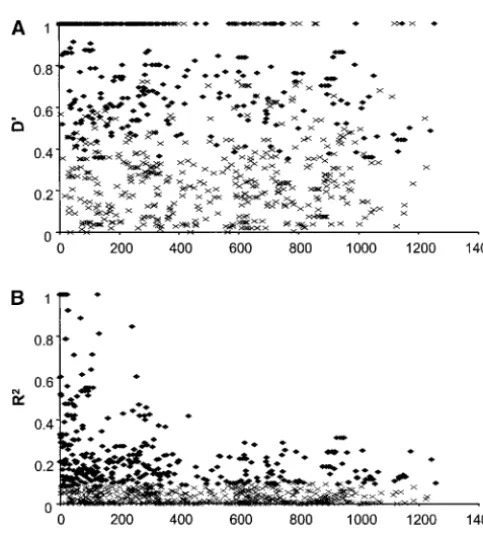
for the whole region sequenced and 0.025, 0.006, and Figure1.—Linkage disequilibrium acrossama1in the Thai 0.014 for domains I, II, and III, respectively (Table 1). population. The D⬘andR2indices (A and B, respectively) for pairs of sites are plotted against the distance between them.
Recombination and linkage disequilibrium: The
ef-Pairs of sites that show statistically significant linkage disequi-fects of recombination onama1alleles in the Thai
popu-librium are shown by solid diamonds (crosses mark those lation are shown graphically by the decline in levels of showing nonsignificant linkage disequilibrium). Only sites linkage disequilibrium (D⬘andR2indices) with
increas-containing a minority single-nucleotide allele with a frequency ⬎0.1 were included in the analysis.
proportion of polymorphisms in domains I and III that are likely to be more ancient than would be expected under neutrality (Table 1; Figure 2).
Between-population comparison of single-nucleotide allele frequencies:An analysis ofama1single-nucleotide allele frequencies in this Thai population, together with comparable data from a previously studied Nigerian population (PolleyandConway2001), shows that in-terpopulation divergence accounts for only 4.1% of total nucleotide diversity (mean FST ⫽ 0.041). A domain-by-domain analysis shows thatFSTvalues are lowest (i.e., single-nucleotide allele frequencies are most similar) in domain I (mean FST ⫽ 0.033) and domain III (mean FST ⫽ 0.032), whereas domain II has a much higher meanFSTvalue (0.113). As a comparison, the allele fre-quencies of 11 putatively neutral, unlinked microsatel-lite loci were studied in both populations. These had FSTvalues (meanFST⫽0.106) similar to those of domain II ofama1, but much higher than those of domains I and III (Figure 3). Wilcoxon’s rank sum test was applied to test for differences in the distribution ofFSTvalues for the microsatellite loci and the individual polymor-phic sites within each domain of ama1. This nonpara-metric analysis considers each site as an independent Figure 2.—Sliding-window plot of Tajima’s D index (A)
variable, although theFSTvalues of individual sites within and Fu and Li’sFindex (B) based onama1nucleotide
poly-ama1may not be truly independent variables due to the morphisms in the Thai population. A window size of 200
physical linkage of the sites. The difference between nucleotides was used with a step size of 25 nucleotides. The
three domains of AMA-1 are marked DI, DII, and DIII, respec- the microsatellite FST values and the ama1 nucleotide
tively. F
STvalues was significant in the case of domain I (P ⫽ 0.006) and of borderline significance in the case of domain III (P ⫽ 0.056), but no significant difference range the 51 polymorphic sites into the 27 haplotypes was seen with domain II (P⫽ 0.479).
seen (Hudson andKaplan 1985). Using the method The analysis of individual polymorphic sites inama1 of Hudson (1987), we calculated C to be 66 for the reveals a great heterogeneity in the FST values among whole sequence and 0.051 per adjacent site. sites along the gene (Figure 3). However, a significant
Within-population tests of neutrality:A highly positive spatial autocorrelation between neighboring sites is Tajima’s D value of 2.12 for the entire ama1 region seen when analyzed with Moran’sIindex (Moran’sI⫽ sequenced shows that single-nucleotide alleles in the 0.245;P ⫽ 0.036). This is due to clusters of sites with Thai population are present at intermediate frequencies highFSTvalues (e.g., polymorphic sites in codons 330– that cannot be accounted for by neutral evolution in a 395) and others with very low values (e.g., polymorphic constant-size panmictic population (D value is signifi- sites 162c–172b, 196a–197c, 206a–225b, 283b–308a, and cantly greater than zero,P ⬍0.05). 493b–512b). Despite this clustering, however, sites in This departure from neutrality indicates that balanc- adjacent codons can also have very differentFSTvalues ing selection is maintaining single-nucleotide alleles in (0 and 0.191 for sites 242a and 243a, respectively). the population. A sliding-window plot ofDshows highly
positive values for domains I and III and low values for
DISCUSSION domain II (Figure 2). There was significant evidence
Figure3.—A nucleotide site-by-site analysis of inter-population divergence be-tween Thai and Nigerian populations (FST) in the ama1 gene (A) and 11 un-linked microsatellites (B). Sites with an FST score sig-nificantly greater than zero are designated by asterisks (*P ⬍ 0.05; **P ⬍ 0.01; ***P⬍0.001). TheFST val-ues ofama1sites [labeled as per Hodder et al. (1996) with a, b, and c representing the first, second, and third codon positions, respec-tively] were calculated from sequence data of 50 Thai al-leles (obtained in this study) and 51 Nigerian alal-leles (PolleyandConway2001). Only sites with a minority single-nucleotide allele frequency⬎0.1 in the combined data set were included in the analysis. Microsatellite allele frequency data for the Thai population were obtained in this study (supplementary table at http://www.genetics.org/supplemental/), while microsatellite data for the Nigerian population are as published byConwayet al.(2001). The calculation ofFSTusing theindex here results in slightly negative values for some loci, which are not biologically meaningful and so were set to zero. MeanFSTvalues for the ama1ectodomain as a whole, domain I (DI), DII, and DIII are 0.041, 0.033, 0.113, and 0.032, respectively. The meanFSTvalue for the 11 microsatellite loci shown in B is 0.106.
indicating that balancing selection is occurring in these subsequent cross-fertilization and recombination in the mosquito stage of the life cycle (Walliker2000). different populations. The highly positive values of these
indices are unlikely to be due to confounding popula- Analysis of single-nucleotide allele frequencies be-tween the populations shows that domains I and III of tion effects, as populations ofP. falciparum are subject
to expansions (Joyet al. 2003) and will therefore tend ama1 have very low mean FST values, indicating that virtually all polymorphism is seen within each popula-to have negative values under neutrality (Tajima1989a)
and the endemic populations were each chosen to avoid tion. The FSTvalues of theseama1domains are signifi-cantly lower than theFSTvalues of 11 unlinked microsa-substructure (Tajima1989b). Neither would codon bias
be likely to lead to the positive values seen here, given tellite loci. In the absence of selection the high allelic diversity at microsatellite loci will generally result in that purifying selection leads to negative values of these
indices (Tajima1989b;FuandLi1993). lowerFSTvalues than those for single nucleotide poly-morphisms (SNPs;Hedrick1999), a point that under-Differences between the Thai and Nigerian P.
falci-parumpopulations are evident, however, in the amount scores the significance of this result. Thus polymorph-isms in domains I and III ofama1are apparently under of recombination seen inama1. The estimated
recombi-nation parameters of the Thai population are lower balancing selection, in concordance with the within-population analyses above.
than those of the Nigerian population, with values ofC
calculated at 66 and 207, respectively, using one method Analysis of the FSTvalues on a nucleotide site-by-site basis reveals that they are nonrandomly distributed (Hudson 1987) and 60 and⬎100, respectively, by
an-other (McVeanet al.2002). At 35 of the polymorphic among the polymorphic sites, and runs of sites with very low values occur within both domains I and III. The single-nucleotide sites inama1, the minority alleles are
present at frequencies⬎0.1 in both populations, and resulting fine-resolution map of values among sites may allow the identification of key sites under immune selec-these sites can be analyzed in 595 different pairwise
combinations for each data set. A significantly higher tion, although due to the effects of close physical linkage it is likely that not all the sites within a run are under proportion of these showed statistically significant
link-age disequilibrium in the Thai population (278 combi- selection. The variability in the FSTvalues also empha-sizes the importance of full sequence data for this kind nations) compared to the Nigerian population (154
combinations;P⬍0.001). The difference in recombina- of analysis. An analysis employing a limited subset of polymorphic sites sampled across the gene could easily tion rates of the two populations concurs with studies on
unlinked microsatellite loci, which indicate that AsianP. miss informative signatures of selection.
A previous study ofama1polymorphism in a Nigerian falciparumpopulations generally have a lower
recombi-nation rate than African populations (Andersonet al. population concluded with a prediction that there are protective human immune responses to domains I and 2000). This is probably because the endemicity is lower,
spectrum of population structures in the malaria parasite
Plasmo-that antibodies to polymorphic epitopes in AMA1 can
dium falciparum.Mol. Biol. Evol.17:1467–1482.
indeed inhibit invasion ofP. falciparum in vitro(Hodder Conway, D. J., 1997 Natural selection on polymorphic malaria
anti-gens and the search for a vaccine. Parasitol. Today13:26–29.
et al.2001;Kennedyet al.2002;Kockenet al.2002), and
Conway, D. J., andS. D. Polley, 2002 Measuring immune selection.
examination of sequence differences between cultured
Parasitology125:S3–S16.
parasite lines suggests that polymorphic sites within do- Conway, D. J., C. Roper, A. M. J. Oduola, D. E. Arnot, P. G.
Kremsneret al., 1999 High recombination rate in natural
popu-main I in particular are targets of inhibitory antibodies
lations ofPlasmodium falciparum.Proc. Natl. Acad. Sci. USA96:
(Hodderet al.2001). It may be suggested that
polymor-4506–4511.
phic changes in domain III have been selected due to Conway, D. J., D. R. Cavanagh, K. Tanabe, C. Roper, Z. S. Mikes
et al., 2000a A principal target of human immunity to malaria
their ability to compensate for some loss of function
identified by molecular population genetic and immunological
induced by changes within domain I (or vice versa).
analyses. Nat. Med.6:689–692.
However, no obvious patterns of linkage disequilibrium Conway, D. J., C. Fanello, J. M. Lloyd, B. M. A.-S. Al-Joubori, A. H.
Balochet al., 2000b Origin ofPlasmodium falciparummalaria
between sites in domains I and III exist, and there is
is traced by mitochondrial DNA. Mol. Biochem. Parasitol.111:
no significant correlation between the overall charge 163–171.
of the polymorphic residues within these two domains Conway, D. J., R. L. D. Machado, B. Singh, P. Dessert, Z. S. Mikes
et al., 2001 Extreme geographical fixation of variation in the
among the different alleles (Spearman’s rank
correla-Plasmodium falciparumgamete surface protein gene Pfs48/45
com-tion ⫽ 0.326; P ⫽ 0.097). It would appear, therefore, pared with microsatellite loci. Mol. Biochem. Parasitol.115:145– that both domains are independently under balancing 156.
Crewther, P. E., M. L. S. M. Matthew, R. H. FleggandR. F. Anders,
selection.
1996 Protective immune responses to apical membrane antigen
This study provides new data and analyses of a Thai 1 of Plasmodium chabaudiinvolve recognition of strain-specific population, together with a novel between-population epitopes. Infect. Immun.64:3310–3317.
Escalante, A. A., H. M. Grebert, S. C. Chaiyaroj, M. Magris, S.
analysis, which strongly support and extend the
evi-Biswaset al., 2001 Polymorphism in the gene encoding the
dence for balancing selection on particular sites in do- apical membrane antigen-1 (AMA-1) ofPlasmodium falciparum. mains I and III of theama1gene. Laboratory and field X. Asembo Bay Cohort Project. Mol. Biochem. Parasitol.113:
279–287.
studies of immune responses to AMA1 provide a means
Fitch, W. M., J. M. E. Leiter, X. LiandP. Palese, 1991 Positive
of assessing the relative importance of these sequences Darwinian evolution in human influenza A viruses. Proc. Natl. in acquired immunity. Such studies are intended to Acad. Sci. USA88:4270–4274.
Forsdyke, D. R., 2002 Selective pressures that decrease synonymous
allow the rational identification of AMA1 sequences to
mutations inPlasmodium falciparum.Trends Parasitol.18:411–
be represented in a multiallelic vaccine, which this study 417.
predicts would be relevant for use in different endemic Fu, Y.-X., andW.-H. Li, 1993 Statistical tests of neutrality of muta-tions. Genetics133:693–709.
populations. Thus allele frequency-based analyses offer
Fudyk, T. C., I. W. Maclean, J. N. Simonsen, E. N. Njagi, J. Kimani
a powerful and robust way of identifying sequences un- et al., 1999 Genetic diversity and mosaicism at the por locus of
Neisseria gonorrhoeae.J. Bacteriol.181:5591–5599.
der selection in vaccine candidate antigen genes of
ma-Goudet, J., 1995 FSTAT (Version 1.2): a computer program to
laria parasites and may be suitable for other endemic
calculate F statistics. J. Hered.86:485–486.
pathogens subject to recombination (Stothard et al. Gubbels, M.-J., F. Katzer, G. Hide, F. JongejanandB. R. Shiels,
2000 Generation of a mosaic pattern of diversity in the major
1998;Fudyket al. 1999;Gubbelset al.2000;Rannala
merozoite-piroplasm surface antigen ofTheileria annulata.Mol.
et al.2000;Suarez et al.2000). Such analyses can also
Biochem. Parasitol.110:23–32.
be applied to screen for signatures of selection on a Healer, J., S. Crawford, S. Ralph, G. McFaddenandA. F. Cowman,
2002 Independent translocation of two micronemal proteins in
genomic scale (Akeyet al.2002).
developingPlasmodium falciparummerozoites. Infect. Immun.70:
We thank colleagues from the Faculty of Tropical Medicine in 5751–5758.
Mahidol University, Bangkok, for sample collection and Neal Alexan- Hedrick, P. W., 1999 Highly variable loci and their interpretation in evolution and conservation. Evolution53:313–318. der for helpful discussions. This work was supported by the UK Medical
Hill, W. G., andA. Robertson, 1968 Linkage disequilibrium in
Research Council (grant G9803180) and the World Health
Organiza-finite populations. Theor. Appl. Genet.38:226–231. tion Special Program for Research and Training in Tropical Diseases
Hodder, A. N., P. E. Crewther, M. L. Matthew, G. E. Reid, R. L.
(WHO/TDR Research Training grant to W.C.).
Moritzet al., 1996 The disulfide bond structure of Plasmodium
apical membrane antigen-1. J. Biol. Chem.271:29446–29452.
Hodder, A. N., P. E. CrewtherandR. F. Anders, 2001 Specificity
of the protective antibody response to apical membrane antigen 1. Infect. Immun.69:3286–3294.
LITERATURE CITED
Holmes, E. C., R. UrwinandM. C. J. Maiden, 1999 The influence
Akashi, H., 1995 Inferring weak selection from patterns of polymor- of recombination on the population structure and evolution of
phism and divergence at “silent” sites in Drosophila DNA. Genet- the human pathogenNeisseria meningitidis. Mol. Biol. Evol.16:
ics139:1067–1076. 741–749.
Akey, J. M., G. Zhang, K. Zhang, L. JinandM. D. Shriver, 2002 Hudson, R. R., 1987 Estimating the recombination parameter of a
Interrogating a high-density SNP map for signatures of natural finite population model without selection. Genet. Res.50:245– selection. Genome Res.12:1805–1814. 250.
Anderson, T. J. C., X.-Z. Su, M. Bockaire, M. Lagogand K. P. Hudson, R. R., andN. L. Kaplan, 1985 Statistical properties of the
Day, 1999 Twelve microsatellite markers for characterisation number of recombination events in the history of a sample of ofPlasmodium falciparumfrom finger prick blood samples. Parasi- DNA sequences. Genetics111:147–164.
tology119:113–125. Hughes, M. K., andA. L. Hughes, 1995 Natural selection on
Plasmo-Anderson, T. J. C., B. Haubold, J. T. Williams, J. G. Estrada- dium surface proteins. Mol. Biochem. Parasitol.71:99–113.
Jiggins, F. M., G. D. HurstandZ. Yang, 2002 Host-symbiont
flicts: positive selection on an outer membrane protein of para- gram for molecular population genetics and molecular evolution analysis. Bioinformatics15:174–175.
sitic but not mutualistic Rickettsiaceae. Mol. Biol. Evol.19:1341–
Sawada, M., 1999 ROOKCASE: an Excel 97/2000 Visual Basic (VB)
1349.
add-in for exploring global and local spatial autocorrelation. Bull.
Joy, D. A., X. Feng, J. Mu, T. Furuya, K. Chotivanichet al., 2003
Ecol. Soc. Am.80:231–235. Early origin and recent expansion ofPlasmodium falciparum.
Sci-Schierup, M. H., andJ. Hein, 2000 Consequences of recombination
ence300:318–321.
on traditional phylogenetic analysis. Genetics156:879–891.
Kennedy, M. C., J. Wang, Y. Zhang, A. P. Miles, F. Chitsazet al.,
Stothard, D. R., G. BoguslawskiandR. B. Jones, 1998
Phyloge-2002 In vitro studies with recombinantPlasmodium falciparum
netic analysis of theChlamydia trachomatismajor outer membrane apical membrane antigen 1 (AMA1): production and activity of an
protein and examination of potential pathogenic determinants. AMA1 vaccine and generation of a multiallelic response. Infect.
Infect. Immun.66:3618–3625. Immun.70:6948–6960.
Su, X.-Z., M. T. Ferdig, Y. Huang, C. Q. Huynh, A. Liuet al., 1999
Kocken, C. H., D. L. Narum, A. Massougbodji, B. Ayivi, M. A.
A genetic map and recombination parameters of the human
Dubbeldet al., 2000 Molecular characterisation ofPlasmodium
malaria parasiteP. falciparum.Science286:1351–1353.
reichenowiapical membrane antigen-1 (AMA-1), comparison with
Suarez, C. E., M. Florin-Christensen, S. A. Hines, G. H. Palmer,
P. falciparum AMA-1, and antibody-mediated inhibition of red
W. C. Brownet al., 2000 Characterization of allelic variation
cell invasion. Mol. Biochem. Parasitol.109:147–156.
in theBabesia bovismerozoite surface antigen 1 (MSA-1) locus
Kocken, C. H. M., C. Withers-Martinez, M. A. Dubbeld, A. van and identification of a cross-reactive inhibition-sensitive MSA-1
der Wel, F. Hackettet al., 2002 High-level expression of the epitope. Infect. Immun.68:6865–6870.
malaria blood-stage vaccine candidatePlasmodium falciparumapi- Tajima, F., 1989a The effect of change in population size on DNA cal membrane antigen 1 and induction of antibodies that inhibit polymorphism. Genetics123:597–601.
erythrocyte invasion. Infect. Immun.70:4471–4476. Tajima, F., 1989b Statistical method for testing the neutral mutation
Lewontin, R. C., 1964 The interaction of selection and linkage. I. hypothesis by DNA polymorphism. Genetics123:585–595.
General considerations: heterotic models. Genetics49:49–67. Triglia, T., J. Healer, S. R. Caruana, A. N. Hodder, R. F. Anders
Marsh, K., andR. W. Snow, 1997 Host-parasite interaction and et al., 2000 Apical membrane antigen 1 plays a central role in
morbidity in malaria endemic areas. Philos. Trans. R. Soc. Lond. erythrocyte invasion by Plasmodium species. Mol. Microbiol.38:
B352:1385–1394. 706–718.
McDonald, J. H., 1994 Detecting natural selection by comparing Verra, F., andA. L. Hughes, 2000 Evidence for ancient balanced
polymorphism at the apical membrane antigen-1 (AMA-1) locus geographic variation in protein and DNA polymorphisms, pp.
ofPlasmodium falciparum.Mol. Biochem. Parasitol.105:149–153. 88–100 inNon-Neutral Evolution: Theories and Molecular Data, edited
Wall, J. D., 1999 Recombination and the power of statistical tests
by B.Golding. Chapman & Hall, New York.
of neutrality. Genet. Res.74:65–79.
McVean, G., P. AwadallaandP. Fearnhead, 2002 A
coalescent-Walliker, D., 2000 Malaria, pp. 93–114 inMolecular Epidemiology of
based method for detecting and estimating recombination from
Infectious Diseases, edited by R. C. A.Thompson. Arnold, London. gene sequences. Genetics160:1231–1241.
Weir, B. S., andC. C. Cockerham, 1984 Estimating F statistics for
Moran, P., 1950 Notes on continuous stochastic phenomena.
the analysis of population structure. Evolution38:1358–1370. Biometrika37:17–23.
Wootton, J. C., X. Feng, M. T. Ferdig, R. A. Cooper, J. Muet
Nielsen, R., and Z. Yang, 1998 Likelihood models for detecting
al., 2002 Genetic diversity and chloroquine selective sweeps in positively selected amino acid sites and applications to the HIV-1
Plasmodium falciparum.Nature418:320–323. envelope gene. Genetics148:929–936.
Yang, Z., R. Nielsen, N. GoldmanandA.-M. K. Pedersen, 2000
Polley, S. D., andD. J. Conway, 2001 Strong diversifying selection
Codon-substitution models for heterogeneous selection pressure on domains of thePlasmodium falciparumapical membrane anti- at amino acid sites. Genetics155:431–449.
gen 1(ama1) gene. Genetics158:1505–1512. Zhang, J., Y.-P. ZhangandH. F. Rosenberg, 2002 Adaptive
evolu-Rannala, B., W. G. QiuandD. E. Dykhuizen, 2000 Methods for tion of a duplicated pancreatic ribonuclease gene in a leaf-eating
estimating gene frequencies and detecting selection in bacterial monkey. Nat. Genet.30:411–415. populations. Genetics155:499–508.