Raspberry Pi Home Automation System Using
Mobile App to Control Devices
AyushKhare1, Jay Goel2, Nitish Bhatt3, Dr Naveen Kumar4
B.Tech Student, Department of Computer Science, Bharti Vidyapeeth Deemed University, Pune, India1 B.Tech Student, Department of Computer Science, Bharti Vidyapeeth Deemed University, Pune, India2 B.Tech Student, Department of Computer Science, Bharti Vidyapeeth Deemed University, Pune, India3
Project Mentor and Guide, Bharti Vidyapeeth Deemed University, Pune, India4
ABSTRACT: In modern era of advanced technology, many people have come to appreciate the efficiency, effectiveness, convenience and relatively inexpensiveness of using devices such as phones and computers to perform day-to-day activities. Every day, new innovations are made in technological world. The ultimate goal of these endeavours is to make life easier, ensure that there is maximum output and also to assist human in performing duties which are essential difficult or highly demanding. This project was conducted with the major being to find a most effective and cheaper way of detecting and reporting intrusion within home. Fundamentally, this will be the best way of solving insecurity problem which is rampant within the country. The owner of this device can easily monitor the state of his home without necessary having to be physically present. Compared to other devices available in the market, this device has been designed in a manner which makes it cheaper and convenient; therefore, most people will be able to afford. The fact that the app uses smartphone makes it easy to manage, primary on basis that many people own smart phones. Some of the most outstanding features of this device is that it is able to generate other related data such as usage per hour, number of times the device was used, the time of the day when the device was used and many more. In addition, the user can switch off and on the device from the smartphone using the app.
KEYWORDS: Home Automation, Mobile App, Raspberry Pi, Smartphone
I. INTRODUCTION
owner can easily monitor the security of his home, from the comfort of his bed or outside parameters of his compound. There are other features which enable the user switch on and off home devices such as TV, Radio, Wi-Fi, Lights and air conditioning system [1][2][14].
II. PROPERTIES
This mobile app in integrated with smartphone of the user. Wi-Fi router is also required in order for the app to operate. In addition, Raspberry Pi will link the home devices with the app and its major function is to send data to and from the two ends.
III.SMARTPHONE
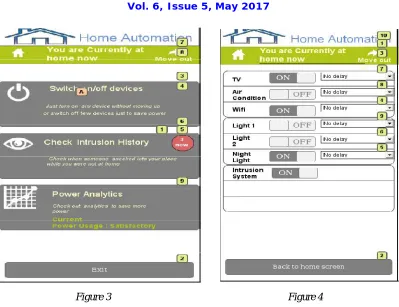
Smartphone is the most important component of the whole system. This is where the app will operate from. Most phones such as Androids, Windows and IPhone will accommodate the app. This app has been designed to showcase the information received from the Raspberry Pi, regarding the intrusion or control of home devices. Essentially, the app has various properties which showcase data. The app has ability to switch on and off devices such as television, air conditioning system and even lights. This is majorly through the assistance of Raspberry Pi. The Home screen appearance of the app; has shown in the smartphone have features such as: Home now or Moved Out,Switch on/off devices,Check intrusion History, Power Analytics and Exit.
IV. RASPBERRYPI
Raspberry board is a very important component in devising and operating this system. Any model can be used. Major function of this component is to provide and intermediate channel of transmitting information from the devices and mobile phone; which is fundamentally incorporated with the app.
V. WEBSERVER
The mobile app, through the smartphone is connected to the web server which rely data from the devices such as television, bulbs, air conditioners and intrusion alert system through Raspberry Pi and Wi-Fi router. A user with smartphone can easily control the devices through the existing internet relayed by the Wi-Fi router. This however, does not mean that the user should be near home in order to operate the devices; in contrary, devices can be operated from geographical locations which are far from home, as long as the smartphone has its own internet connection [4][8][13].
VI.SIMULATION&RESULTS
Experimental results show functioning features of app and how it operates in conjunction with other supporting components such as raspberry Pi, Wi-Fi router, and smartphone. Figure 3, 4 and 5 shows the images of the app when viewed smartphone. Some of them are:
Home Screen
Figure 3 Figure 4
Intrusion History
User of the smart phone can check the intrusion history of his home. The home screen of the mobile app has a feature where it shows the number of times when intrusions happened. This is besides the availability of information regarding the specific time of intrusion. Every time intrusion occurs, the app updates itself. By accessing this feature, user can easily see the number of times when someone intruded his or her home. Figure 3 shows intrusion history.
Switching on/Off Devices
The app has a page where the user can switch on and off the devices at his home. Delaying the switching off/on can be set on this page. Figure 4 above shows it
Power Analytics
Figure 5
VII. ADVANTAGESOFUSINGTHEMOBILEAPP
There are numerous advantages of using this mobile phone app in home automation. This gives it an edge over other existing devices which have been innovated or are in existence. This app is comprehensive in its application and encompasses multiple features; yet still flexible and convenient to majority of users. Some of these advantages are:-
It is convenient to use.
Many people own smartphones. Rather than using other devices such as computers to monitor home intrusion, this device offers a convenient way of doing so. In addition, user can monitor and control home devices regardless of his geographic location. It is possible to switch on and off televisions, Wi-Fi or lights from places other than home.
Offers security and protection against intruders.
User of this app can easily monitor what is happening at home through the phone. Updates on the number of intrusions and specific time of the same provide an insight of how and when intrusion happened. Unlike other devices such as CCTV, user of this device can be updated regarding intrusion while the latter is still happening. He can therefore, call the police or raise alarm. This is a form of anti-burglary device, however, not limited to such function. There are other places in which this app can be used.
It is cheaper and affordable
It can be easily operated
The app is easy to operate; and any person can quickly learn the basics. It lacks the complexities which hinders quick application of the app. Small children can understand the app and use it to manage the devices at home.
It offers Other Services such as Monitoring of Energy Consumption by Devices
User of this mobile app can monitor consumption of electricity by various devices connected to the phone. In addition, it provides a comparison between the level of consumption of energy in the preceding and the prevailing month. This analytical data, in form of diagraph presentation, is useful when determining the amount of energy being consumed by devices.
It Provides Data on Specific time of intrusion
This app provides specific time data and the same can be easily accessed by the user. It also update the user on the occurrence of intrusion; therefore, enables him, to take necessary actions accordingly.
VIII. LIMITATIONS
There are several limitations to usage of this app. Some of these limitations, however, can be fixed. Like in most applications used today, some of the limitations are:-
It Requires a Smartphone to operate it
This app, while managing home automation systems, will need a smartphone. Inasmuch as many people have smartphones today, that number does not represent the whole population. This limitation makes the app less applicable in most areas.
It only has a Feature of Switching On/Off
User of this app can only switch on/off devices. It lacks specific features such as increasing the volume of Television, changing the rate of functioning etc.
IX.CONCLUSION
In conclusion, it can be stated that the mobile app is revolutionary in enhancing the home automation systems. It is a hybrid of smartphone, computer and devices technology. The ultimate purpose of this app is to provide high quality services, enhance convenience and also an alternative to other devices which are mostly expensive. The fact that this app enables a person operate home devices regardless of his geographical location makes it the most convenient application for day-to-day activities.
X. ACKNOWLEDGEMENT
REFERENCES
[1] Salunkhe, R. and Jaykumar, N., 2016, June. Query Bound Application Offloading: Approach Towards Increase Performance of Big Data Computing. In Journal of Emerging Technologies and Innovative Research (Vol. 3, No. 6 (June-2016)). JETIR.
[2] BVDUCOE, B., 2011. Iris Image Pre-Processing and Minutiae Points Extraction. International Journal of Computer Science & Information Security.
[3] Archana, R.C., Naveenkumar, J. and Patil, S.H., 2011. Iris Image Pre-Processing And Minutiae Points Extraction. International Journal of Computer Science and Information Security, 9(6), p.171.
[4] Kumar, N., Angral, S. and Sharma, R., 2014. Integrating Intrusion Detection System with Network Monitoring. International Journal of Scientific and Research Publications, 4, pp.1-4.
[5] Jayakumar, M.N., Zaeimfar, M.F., Joshi, M.M. and Joshi, S.D., 2014. INTERNATIONAL JOURNAL OF COMPUTER ENGINEERING & TECHNOLOGY (IJCET). Journal Impact Factor, 5(1), pp.46-51.
[6] Kakamanshadi, G., Naveenkumar, J. and Patil, S.H., 2011. A Method to Find Shortest Reliable Path by Hardware Testing and Software Implementation. International Journal of Engineering Science and Technology (IJEST), ISSN, pp.0975-5462.
[7] Namdeo, J. and Jayakumar, N., 2014. Predicting Students Performance Using Data Mining Technique with Rough Set Theory Concepts. International Journal, 2(2).
[8] Jayakumar, N., Singh, S., Patil, S.H. and Joshi, S.D., 2015. Evaluation Parameters of Infrastructure Resources Required for Integrating Parallel Computing Algorithm and Distributed File System. IJSTE-Int. J. Sci. Technol. Eng, 1(12), pp.251-254.
[9] Salunkhe, R., Kadam, A.D., Jayakumar, N. and Thakore, D., 2016, March. In search of a scalable file system state-of-the-art file systems review and map view of new Scalable File system. In Electrical, Electronics, and Optimization Techniques (ICEEOT), International Conference on (pp. 364-371). IEEE.
[10] Naveenkumar, J., Makwana, R., Joshi, S.D. and Thakore, D.M., 2015. Offloading Compression and Decompression Logic Closer to Video Files Using Remote Procedure Call. Journal Impact Factor, 6(3), pp.37-45
[11] Jayakumar, N., 2014. Reducts and Discretization Concepts, tools for Predicting Student’s Performance. Int. J. Eng. Sci. Innov. Technol, 3(2), pp.7-15.
[12] Raval, K.S., Suryawanshi, R.S., Naveenkumar, J. and Thakore, D.M., 2011. The Anatomy of a Small-Scale Document Search Engine Tool: Incorporating a new Ranking Algorithm. International Journal of Engineering Science and Technology, 3(7).
[13] Jayakumar, D.T. and Naveenkumar, R., 2012. SDjoshi,“. International Journal of Advanced Research in Computer Science and Software Engineering,” Int. J, 2(9), pp.62-70.
[14] Jayakumar, N., Bhardwaj, T., Pant, K., Joshi, S.D. and Patil, S.H., 2015. A Holistic Approach for Performance Analysis of Embedded Storage Array. Int. J. Sci. Technol. Eng, 1(12), pp.247-250.
[15] Salunkhe, R., Kadam, A.D., Jayakumar, N. and Joshi, S., 2016, March. Luster a scalable architecture file system: A research implementation on active storage array framework with Luster file system. In Electrical, Electronics, and Optimization Techniques (ICEEOT), International Conference on (pp. 1073-1081). IEEE.
[16] Naveenkumar, J. and Joshi, S.D., 2015. Evaluation of Active Storage System Realized Through Hadoop. Int. J. Comput. Sci. Mob. Comput, 4(12), pp.67-73.
[17] Naveenkumar, J. and Raval, K.S., 2011. Clouds Explained Using Use-Case Scenarios. INDIACom-2011 Computing for Nation Development, 3 [18] Zaeimfar, S.N.J.F., 2014. Workload Characteristics Impacts on file System Benchmarking. Int. J. Adv, pp.39-44.
[19] Naveenkumar, J., Makwana, R., Joshi, S.D. and Thakore, D.M., 2015. Performance Impact Analysis of Application Implemented on Active Storage Framework. International Journal, 5(2).
[20] Naveenkumar, J., Keyword Extraction through Applying Rules of Association and Threshold Values. International Journal of Advanced Research in Computer and Communication Engineering (IJARCCE), ISSN, pp.2278-1021.