DOI: 10.1534/genetics.104.030031
Genotype-Environment Interactions of Spontaneous Mutations for Vegetative
Fitness in the Human Pathogenic Fungus
Cryptococcus neoformans
Jianping Xu
1Department of Biology, McMaster University, Hamilton, Ontario L8S 4K1, Canada Manuscript received April 14, 2004
Accepted for publication July 9, 2004
ABSTRACT
Spontaneous mutation is the ultimate source of all genetic variation. By interacting with environmental factors, genetic variation determines the phenotype and fitness of individuals in natural populations. However, except in a few model organisms, relatively little is known about the patterns of genotype-environment interactions of spontaneous mutations. Here I examine the rates of spontaneous mutation and the patterns of genotype-environment interaction of mutations affecting vegetative growth in the human fungal pathogenCryptococcus neoformans. Eight mutation accumulation (MA) lines were established from a single clone on the nutrient-rich medium YEPD for each of two temperatures, 25⬚and 37⬚. Cells from generations 100, 200, 400, and 600 for each of the 16 MA lines were stored and assayed for vegetative growth rates under each of four conditions: (i) 25⬚on SD (a synthetic dextrose minimal medium); (ii) 25⬚ on YEPD; (iii) 37⬚on SD; and (iv) 37⬚on YEPD. Both MA conditions and assay environments for vegetative growth showed significant influence on the estimates of genomic mutation rates, average effect per mu-tation, and mutational heritability. Significant genotype-environment interactions were detected among the newly accumulated spontaneous mutations. Overall, clones from MA lines maintained at 37⬚showed less decline in vegetative fitness than those maintained at 25⬚. The result suggests that a high-temperature environment might be very important for the maintenance of the ability to grow at a high temperature. Results from comparisons between clinical and environmental samples ofC. neoformanswere consistent with laboratory experimental population analyses. This study calls into question our long-standing view that warm-blooded mammals were only occasional and accidental hosts of this human fungal pathogen.
S
PONTANEOUS mutations can occur during every thaliana,Escherichia coli, Saccharomyces cerevisiae, mouse, cell division in all living organisms. These mutations and humans, very little is known about the patterns of are the ultimate source of genetic variation in natural spontaneous mutations in the vast majority of livingpopulations. Therefore, understanding the effect of organisms, including human pathogens (Lynch and
spontaneous mutations on individuals and populations Walsh1998). Even less is known about how
environ-of living organisms is environ-of fundamental biological impor- mental factors influence estimates of mutational param-tance. It has been demonstrated that most spontaneous eters. The objective of this study was to investigate the
mutations with an effect on the phenotype are typically patterns of spontaneous mutations and the
genotype-deleterious (Crow 1992). Many important biological environment interactions of these mutations in the
hu-phenomena are thought to be at least in part the out- man fungal pathogenCryptococcus neoformans.
comes of evolutionary responses to deleterious muta- Genotype-environment interactions are widespread
tions. These phenomena include: (i) the evolution and in natural populations. For example, studies in plants
maintenance of genetic recombination and sexual re- and animals have shown that the levels of inbreeding
production (e.g., Charlesworth and Barton 1996; depression and heterosis were greater under harsher
Kondrashov1997); (ii) the evolution of diploidy (Kon- conditions than those in more benign environments drashovandCrow1991); (iii) the evolution and main- (e.g., Mitton andGrant 1984; Dudash 1990). How-tenance of mating systems in fungi, plants, and animals ever, relatively little has been investigated on how spon-(Charlesworthet al.1990; ZeylandBell1997; Xu taneous mutations interact with environmental factors.
2002); (iv) aging (PartridgeandBarton1993); and So far, most data have come from the model organism
(v) the viability of fragmented or captive populations D. melanogaster (Fry et al. 1996; Kondrashov and
(Lande 1995). Except in a few model species such as Houle 1998;Mackayand Lyman1998). Kondrashov
Drosophila melanogaster,Caenorhabditis elegans,Arabidopsis andHoule(1998) demonstrated that spontaneous
mu-tations accumulated in D. melanogaster showed highly significant genotype-environment interactions on devel-1Address for correspondence:Department of Biology, McMaster
Univer-opment time and productivity. They found that reduced
sity, 1280 Main St. W., Hamilton, Ontario L8S 4K1, Canada.
E-mail: [email protected] nutrition and increased population density magnified
the deleterious effects of accumulated mutations (Kon- coccal infection, the most common form being crypto-coccal meningitis (CasadevallandPerfect1998). As
drashovandHoule1998). Similarly,Fryet al. (1996)
showed significant genotype-environment interactions a result, it has attracted significant medical attention. Despite the significant health burden on humans and
of spontaneous mutations for fitness. Mackay and
Lyman(1998) showed that spontaneous mutations af- other mammals, it is generally assumed that humans and other mammalian hosts are not an essential part fecting bristle numbers also exhibited significant
tem-perature-dependent effects. In each of these studies, muta- of the life cycle of this pathogenic fungus (Casadevall
and Perfect 1998). Its pathogenicity to mammals is tions were accumulated freely in a single environment
and tested over several environments. No study has ex- thought to have evolved as a by-product of interactions with soil protozoa and/or other soil organisms (
Steenber-amined how environments during mutation
accumula-tion (MA) could influence the patterns of spontaneous gen et al. 2001). One pathogenicity trait found in all human pathogens is their ability to grow vigorously at mutations and the directions of genotype-environment
interactions of these mutations. the mammalian body temperature of 37⬚. Because soil
environments typically have temperatures below that of Microbes are excellent organisms for the analysis of
the patterns and consequences of spontaneous muta- human hosts, how could human pathogens with soil or
nonmammalian hosts as the primary reservoir maintain tions. Large population sizes can be grown and
main-tained relatively easily in the laboratory, and cells at their ability to grow vigorously at 37⬚in humans? Using experimental approaches, this study investigated the in-various stages of an experiment can be stored
perma-nently in a freezer. In addition, because individual geno- fluence of temperature during mutation accumulation on mutational parameters and on genotype-environ-types can be clonally replicated, the same genotype can
be tested in a large number of environments, thus allowing ment interactions.
This study was designed to address the following ques-robust estimates of environmental influences on
exam-ined traits. These features make microbes ideal organ- tions. First, what are the estimates of genomic mutation rate per mitotic generation (U), the effects per mutation isms on which to perform experimental evolutionary
studies to test potential genotype-environment interac- (a), and the mutational heritability (h2
m) affecting
vege-tative growth in C. neoformans? Second, do test condi-tions of spontaneous mutacondi-tions. Surprisingly, little
infor-mation on microorganisms is available in this area. tions affect estimates of mutational parameters in C.
neoformans, similar to the observations forD.
melanogas-Spontaneous mutations can be obtained using
muta-tion accumulamuta-tion condimuta-tions (e.g.,Mukai1964;Kibota ter? If so, what are the patterns of genotype-environment interactions for spontaneous mutations inC. neoformans? andLynch1996;Zeylandde Visser2001;Xu2002).
In these experiments, spontaneous mutations are al- Third, under different mutation accumulation
condi-tions (25⬚and 37⬚, both on the same rich medium), do lowed to accumulate in replicate lines with severe
popu-lation bottlenecks to minimize selection. Estimates of estimated mutational parameters and the patterns of
genotype-environment interactions for spontaneous muta-mutational parameters for fitness traits rely on two
typi-cal assumptions. The first is that, in the absence of tions differ? If differences are found, how do they corre-spond to vegetative growth patterns of environmental selection, deleterious mutations will continuously
accu-mulate, leading to declined fitness for a given trait, and and clinical populations ofC. neoformans? And finally, how can the analysis shed light on the life history ofC.
the second is that divergence among replicate lines in
trait values should increase over time. The relative rates neoformans and on the evolution and maintenance of pathogenicity traits in human pathogens?
of decrease in fitness and among-line divergence in trait values allow estimations of the genomic mutation rate, the average mutation effect, and the mutational
herita-MATERIALS AND METHODS
bility of individual traits (LynchandWalsh1998).
C. neoformansis an encapsulated basidiomycetous yeast
Strains:Strain JEC21 was used to set up the MA lines. JEC21
and an emerging model organism for studying molecu- is serotype D and mating-type ␣(MAT␣). It was created in lar and evolutionary biology. Its natural reservoir is as- 1992 through genetic crossing (Kwon-Chunget al.1992). The parental strains for JEC21 were NIH433, a serotype D,MATa
sumed to be in soil and other habitats such as bird
environmental isolate from pigeon droppings in Denmark,
droppings and certain tree species (Casadevalland
Per-and NIH12, a serotype D,MAT␣clinical isolate from a patient
fect 1998). Two factors have contributed to our
in-in the United States. Therefore, strain-in JEC21contain-ins genetic
creased interest inC. neoformans. The first is that it has materials from both environmental (NIH433) and clinical a highly tractable genetic system for molecular and evo- (NIH12) sources. However, which sections of the JEC21 ge-nome came from which parental strains is unknown. JEC21
lutionary studies. Unlike many other basidiomycetes,
was chosen here because it was one of the most widely used C. neoformanshas a very well-characterized mating system
laboratory strains for genetic and molecular studies and its
and gene delivery system. The second factor is that
genome has been targeted for complete sequencing by the C. neoformansis a significant human pathogen. It is one Stanford DNA Sequencing and Technology Center and by of the leading causes of human fungal infection: up to The Institute of Genome Research. These features would make
potential follow-up studies (e.g., using microarrays to trace
crypto-Figure1.—Schematic of experimental design. A single colony of the standard laboratory strain JEC21 was used to establish eight MA lines under each of two incubation conditions (25⬚on YEPD and 37⬚on YEPD). For each of the 16 MA lines, subcultures were stored after 5, 10, 20, and 30 transfers, roughly corresponding to 100, 200, 400, and 600 mitotic generations, respectively. The founder clone and the 64 derived MA clones (16 lines⫻4 time points) were then tested for vegeta-tive fitness on two solid media (SD and YEPD) incubated under two different temperatures, 25⬚ and 37⬚.
gene expression changes) more effective and manageable. cell in each growth cycle, a small cluster of cells (ⵑ104–105) from a colony was resuspended in 1 ml sterile water by vigorous Forty-five environmental and 35 clinical strains ofC. neoformans
from the McMaster University Fungal Collection were also vortexing, and 1l of the suspension was streaked onto agar medium. Streaked single cells were confirmed by microscopy included for comparison. These 80 strains were isolated from
a variety of geographical locations in Europe, Asia, and North and one cell from each MA line was randomly marked for future transfers. Cells from generations 0, 100, 200, 400, and America over the last 10 years and were stored in freezers with
minimal laboratory propagation and no genetic manipulation. 600 (abbreviated G0, G100, G200, G400, and G600, respectively) were stored in 18% glycerol in a⫺80⬚freezer. This protocol
intensi-Mutation accumulation experiment : The overall
experi-mental design is shown in Figure 1. Briefly, a single colony fied genetic drift by forcing each line through one random cell in each growth cycle. Therefore, barring selection and (the founder colony) of strain JEC21 was picked and streaked
onto YEPD agar plates (1% yeast extract, 2% Bacto-peptone, competition within each colony during the clonal asexual growth, mutations were expected to accumulate freely in each 2% dextrose, and 2% Bacto-agar in distilled water) to establish
16 independent MA lines. Eight lines were incubated at 25⬚ line. Because different lines were maintained independently of each other, different numbers and types of mutations were and the other 8 at 37⬚. Each of the 16 MA lines was maintained
by repeating the picking-streaking-incubating procedure (called expected to accumulate in different lines.
Vegetative fitness : The vegetative fitness of the evolved a growth cycle) of a single colony, approximately every 72 hr
for lines maintained at 25⬚and every 48 hr for lines maintained clones relative to the original was determined in each of four environments: (i) 25⬚ on YEPD, the nutrient-rich medium at 37⬚. Within each growth cycle, each colony increased from
1 cell toⵑ106cells. This cell count was obtained by cutting originally used for MA; (ii) 37⬚on YEPD; (iii) 25⬚on SD with-out any organic nitrogen source (i.e., no amino acids and no agar pieces containing entire colonies and resuspending them
individually in 1 ml sterile water through vigorous vortexing. nucleotide bases); and (iv) 37⬚on SD. Here, colony size was used as the indicator of vegetative fitness. The use of colony The cell suspensions were then diluted and plated on YEPD
plates for viable cell counts. The growth from 1 cell toⵑ1 size to measure vegetative fitness in fungi has a long tradition dating back several decades (e.g., Simchen andJinks1964) million representedⵑ20 mitotic divisions (⫾1 cell division).
These 16 MA lines were maintained for 30 growth cycles, and has been extensively used in recent and current work (e.g., Xu 1995, 2002; Zeyl and Bell 1997; Xu et al. 1998; equivalent toⵑ600 mitotic divisions.
method, cell suspension and streaking were performed as mutational parameters were obtained for each of the two MA conditions and in each of the four testing environments. described above for colony transfers during MA. Immediately
after streaking, 10 well-separated cells were randomly marked Genotype-environment interaction of spontaneous muta-tions :The vegetative growth data of MA clones were analyzed for later measurement. Cells were incubated for 72 hr for the
two 25⬚environments and 48 hr for the two 37⬚environments. by three-way factorial analysis of variance (ANOVA). The three factors were MA line, incubation temperature, and me-The diameters of individual colonies were measured under
the microscope using an ocular scale. Ten random colonies dium. Sums of squares were partitioned into sources attribut-able to the three main effects, three pairwise two-way interac-were measured for each clone in each of the four
environ-ments. Because of the large number of colonies to be mea- tions, one three-way interaction, and the within-treatment sured, the evolved clones were divided into 16 sets with eight random error. The three-way ANOVA was done for the two MA MA clones in each set. The original clone was included in each conditions separately. Wilcoxon’s signed-rank test was used to set for standardization. No difference was observed between compare fitness among environments for the same MA lines. different sets for the original clone grown in each of the four These statistical tests followed the procedures inSokaland environments. Rohlf(1981), using the Microsoft Excel program.
To determine the vegetative growth for the 35 clinical and Comparison between clinical and environmental strains :
45 environmental strains, cells were first retrieved from⫺80⬚ The vegetative growth data of environmental and clinical sam-freezer stocks and incubated on YEPD plates at 25⬚ for 11⁄
2 ples were analyzed by two-way ANOVA with each strain as a days (ⵑ8–10 cell divisions) until visible colonies appeared replicate. The two factors were source of strain and incubation on the agar surface. One random colony from each of the temperature. Sums of squares were partitioned into sources 80 strains was then resuspended in 50 l sterile water and attributable to the two main effects and temperature-strain streaked onto solid media for vegetative fitness testing. The source interaction. The statistical test followed the procedures remaining steps were identical to those described above for inSokaland Rohlf(1981), using the Microsoft Excel pro-vegetative fitness determination of evolved clones. However, gram.
because there was no significant interaction between tempera-ture and medium independent of genotype on vegetative fit-ness (see below and Table 3), only the rich medium YEPD was
RESULTS used for these 80 strains. In addition, to make measurements
comparable for direct testing of the effects of strain source Reduced fitness among derived clones :To standard-(environmental vs. clinical) and temperature (25⬚ vs. 37⬚)
ize our comparisons, the relative vegetative fitness of
on vegetative fitness, all vegetative fitness measurements were
the original clone in each of the four environments was
made after 48 hr of incubation.
Estimates of mutational parameters :To standardize our scaled to 1 and those of all other evolved clones were
calculations and estimations, the vegetative fitness of the start- adjusted accordingly as a simple ratio of colony sizes ing clone in each of the four testing environments was defined
between the derived clone and the original clone (the
as one and the relative fitness of each evolved clone was
ex-denominator). The relative fitness for each of the
de-pressed accordingly as a simple ratio of colony size of the
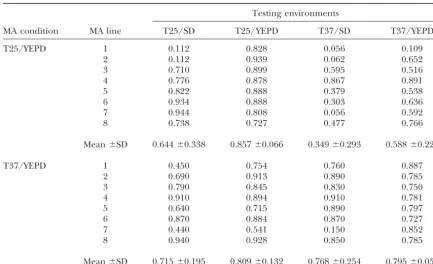
rived clones at generation 600 (G600) is presented in evolved clone over the starting clone. This adjustment was
necessary to eliminate intrinsic differences in vegetative fitness Table 1. As shown, after 600 asexual divisions, relative
ofC. neoformansin the four testing environments. The stan- to that of the starting clone, the fitness of all 16 clones dardization allows the comparison of vegetative fitness
differ-had decreased in all four environments (Table 1).
ences derived only from newly accumulated mutations. The
For MA lines maintained at temperature 25⬚(T25),
mean and standard deviation of relative vegetative fitness were
the highest mean fitness was observed in the same
envi-calculated for the starting clone and for each of the 64 evolved
clones in the four environments. ronment where mutations were accumulated (T25/ The data were then used to estimate the genomic mutation YEPD) and the lowest mean fitness was at a different rate per mitotic division (Uˆ), the average effect per mutation
temperature (37⬚) and on a different medium, SD (T37/
(aˆ), and the mutational heritability (h2
m). Since JEC21 is
hap-SD). At G600, the most significant drops occurred in MA loid, estimation procedures followed those for haploids as
described byLynchandWalsh(1998). Because phenotypic lines 1, 2, and 7. These clones had only one to two cell
changes in MA lines were products of both the mutation rate divisions under the T37/SD condition (i.e., approxi-and the effect per mutation, with a given phenotypic change, mately two to four cells per colony). These three clones mutation rate and mutational effects would be in inverse
rela-could be considered to have conditional lethal
muta-tionship. Current procedures provide estimates for minimum
tions in this environment. Lines 1 and 2 also showed a
mutation rate (Uˆmin) and maximum mutational effects (aˆmax)
(LynchandWalsh1998) in haploids: similar growth pattern in the T25/SD environment where only four to eight cells were observed per colony.
Uˆmin⫽(⌬M)2/[⌬V(1⫹C
⌬M)(1⫹C⌬V)]
Coupled to the decline in fitness was divergence among
and
lines. The standard deviation of fitness among MA lines
aˆmax⫽ ⌬V/[⌬M(1⫹C⌬M)], was lowest in the MA environment (T25/YEPD), and
much greater in the other three environments (Table 1).
where⌬Mand⌬Vdenote estimates of the rates of change of
Interestingly, for MA lines maintained at 37⬚(T37),
mean and variance, and C⌬M and C⌬V are squared
coeffici-ents of sampling variance (ratios of sampling variance to the highest mean fitness was observed in the T25/YEPD
squared estimates) of⌬Mand⌬V, respectively. The mutational environment, not in the original MA environment, heritability (h2
m) was obtained as mutational variance scaled T37/YEPD. Also different was the environment produc-by environmental variance. These functions have been used
ing the lowest mean fitness, T25/SD. Overall, the loss
in mutation accumulation studies in bacteria, plants, and
TABLE 1
Relative fitness of MA lines at generation 600 in various environments
Testing environments
MA condition MA line T25/SD T25/YEPD T37/SD T37/YEPD
T25/YEPD 1 0.112 0.828 0.056 0.109
2 0.112 0.939 0.062 0.652
3 0.710 0.899 0.595 0.516
4 0.776 0.878 0.867 0.891
5 0.822 0.888 0.379 0.538
6 0.934 0.888 0.303 0.636
7 0.944 0.808 0.056 0.592
8 0.738 0.727 0.477 0.766
Mean⫾SD 0.644⫾0.338 0.857⫾0.066 0.349⫾0.293 0.588⫾0.229
T37/YEPD 1 0.450 0.754 0.760 0.887
2 0.690 0.913 0.890 0.785
3 0.790 0.845 0.830 0.750
4 0.910 0.894 0.910 0.781
5 0.640 0.715 0.890 0.797
6 0.870 0.884 0.870 0.727
7 0.440 0.541 0.150 0.852
8 0.940 0.928 0.850 0.785
Mean⫾SD 0.715⫾0.195 0.809⫾0.132 0.768⫾0.254 0.795⫾0.052
Fitness of the original starting clone was scaled to 1 in each environment. Each data point represents the mean of 10 measurements
37⬚than for those maintained at 25⬚. Unlike the large fitness effect per mutation was lowest in the T25/YEPD (0.00656) environment, the highest was in T25/SD differences in mean fitness among testing environments
for MA lines maintained at T25/YEPD, testing condi- (0.25337), not in T37/SD (0.14669). The rank order
of mutational heritability estimates was similar to that tions had relatively minor effects on the average
vege-tative fitness for MA lines maintained at T37/YEPD. of mutational effects (Table 2).
For MA lines maintained at T37/YEPD, the estimated Similar to the conditional lethality of the spontaneous
mu-tations observed above, one line, line 7, from MA condi- mutation rate was highest (5.332 ⫻ 10⫺3) under the
T25/SD testing condition and lowest (0.702 ⫻ 10⫺3)
tion T37/YEPD had only a few (six to eight) cells per
colony, likely the result of conditional lethal muta- under T37/SD. However, the estimated mutational
ef-fect was largest in T37/SD. Similar to estimates from tion(s). The patterns of fitness divergence among MA
lines maintained in the T37/YEPD environment were MA lines maintained at T25/YEPD, both mutational
effects and mutational heritability for vegetative fitness similar to those from MA lines maintained at T25/
YEPD. The least divergence was observed in the original were lowest in the T37/YEPD environment where MA
lines were maintained (Table 2). MA environment (T37/YEPD). Greater divergences were
seen in the other three testing environments (Table 1). There are several noteworthy observations regarding
estimates from the two MA conditions. First, the testing
Differences in estimates of mutational parameters :
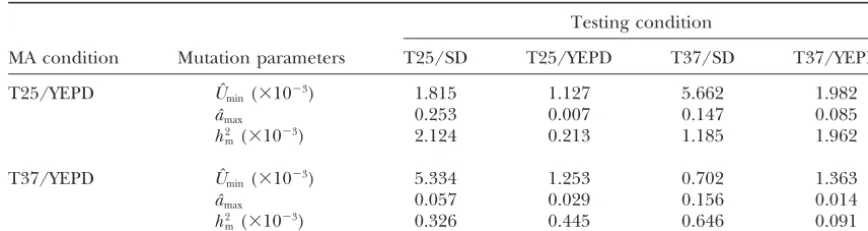
On the basis of the patterns of fitness decline and the environments exhibiting the highest estimates of muta-tion rates were the ones most dissimilar to the original among-line divergence, the genomic mutation rate
(Uˆmin), mutational effect (aˆmax), and mutational herita- MA conditions (T37/SD for MA lines maintained at
T25/YEPD and T25/SD for MA lines maintained at bility (h2
m) for fitness were estimated for the two MA
conditions in each of the four testing environments. A T37/YEPD). Second, the testing conditions exhibiting
the lowest mutational effects and mutational heritability summary of the results of these estimates is presented in
Table 2. Both MA conditions and testing environments were the environments where MA lines were originally
maintained. Third, except for MA lines maintained and showed influences on all three mutational parameters.
For MA lines maintained at T25/YEPD, the estimated tested in the T25/YEPD environment, all estimates of
mutational parameters were within a 10-fold range of mutation rate was highest (5.662 ⫻ 10⫺3) under the
T37/SD testing condition and lowest (1.127 ⫻ 10⫺3) each other. Fourth, except for MA lines maintained and
TABLE 2
Estimates of mutational parameters from two mutation accumulation conditions in four testing environments
Testing condition
MA condition Mutation parameters T25/SD T25/YEPD T37/SD T37/YEPD
T25/YEPD Uˆmin(⫻10⫺3) 1.815 1.127 5.662 1.982
aˆmax 0.253 0.007 0.147 0.085
h2
m(⫻10⫺3) 2.124 0.213 1.185 1.962
T37/YEPD Uˆmin(⫻10⫺3) 5.334 1.253 0.702 1.363
aˆmax 0.057 0.029 0.156 0.014
h2
m(⫻10⫺3) 0.326 0.445 0.646 0.091
The mutational parametersUˆmin,aˆmax, andh2mare defined inmaterials and methods.
tional effects and mutational heritability were smaller in spontaneous mutations, with cultures grown on the nu-trient-poor medium SD showing significantly lower fit-MA lines maintained at T37/YEPD than in those
main-tained at T25/YEPD. ness than those grown on the nutrient-rich medium
YEPD. Mutations accumulated under different MA
con-Genotype-environment interactions of spontaneous
mutations :The ability of a genotype to modify pheno- ditions reacted differently to testing temperatures. Spe-cifically, mutations accumulated at T25/YEPD showed typic expression in response to different environmental
conditions is referred to as phenotypic plasticity (Scheiner a significant contribution of temperature to the total fitness variance. However, no significant contribution 1993). Traditionally, phenotypic plasticity is described
by the norm of reaction—a plot of measurements for was observed for temperature for mutations
accumu-lated at T37/YEPD (Table 3). the same trait in different environments. The difference
between measurements in different environments is For bifactor analyses, statistically significant
interac-tions affecting vegetative fitness were observed between called environmental sensitivity. Not all genotypes
re-spond similarly to the same environmental signals. The MA lines and temperature and between MA lines and
medium (Table 3). Interactions between temperature variation in response among genotypes is termed
geno-type-environment interaction. In this study, the geno- and medium were not statistically significant for muta-tions accumulated in either MA environment. However, typic differences are caused exclusively by spontaneous
mutations accumulated during the course of the experi- mutations accumulated in both environments showed
significant three-way interactions among MA lines, tem-ment. Therefore, the genotypic components of
geno-type-environment interactions are from spontaneous perature, and medium (Table 3).
Comparison between environmental and clinical
mutations.
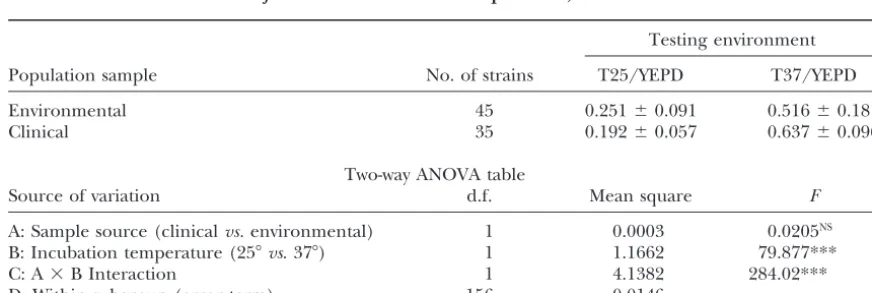
The representative norms of reaction among MA lines strains :A summary of statistics of vegetative fitness for clinical and environmental samples of C. neoformansis in the four environments are shown in Figure 2. Figure
2A shows the eight MA lines maintained at T25/YEPD presented in Table 4. Overall, strains in both samples
grew significantly faster at 37⬚ than at 25⬚. At 25⬚, the and Figure 2B shows those maintained at T37/YEPD.
If there were no genotype-environment interactions, the environmental sample showed a significantly higher veg-etative fitness (30.7% growth advantage) than the clini-MA clones should have parallel reaction norm lines and
the crossing of reaction norm lines should not occur. cal sample (t⫽3.358, d.f.⫽78,P⬍0.01). At 37⬚, while the clinical sample showed a mean advantage of 23.4% However, as shown in Figure 2, crossing of reaction
norm lines was common for MA clones derived from over the environmental sample, the difference was not
statistically significant (t⫽0.658, d.f.⫽78,P⬎ 0.10), both MA conditions. This result is consistent with the
presence of genotype-environment interactions of the due to large variations among strains within each
sam-ple. In both testing environments, the environmental spontaneous mutations accumulated in this study.
Statistical significances of genotype-environment in- sample showed a greater coefficient of variation (i.e., standard deviation/mean) than the clinical sample, with teractions of these spontaneous mutations were
deter-mined on the basis of three-way ANOVA tests. Results the smallest coefficient of variation found for the clinical
sample incubated at T37/YEPD (0.096/0.637 ⫽ 0.15)
of the ANOVA tests are summarized in Table 3. For
single-factor analysis, there was a significant contribu- and the largest for the environmental sample incubated
at T25/YEPD (0.091/0.251⫽ 0.36).
tion by MA lines under both MA conditions (Table 3).
Similarly, the two media (YEPD and SD) showed signifi- Due to the averaging effects of the two temperature
Figure2.—Relative mean fitness of mutation accumulation lines grown under four different conditions, shown on thex-axis from left to right: (i) 25⬚on SD medium; (ii) 25⬚on YEPD medium; (iii) 37⬚ on SD medium; (iv) 37⬚ on YEPD me-dium. Only clones from G600are shown here. (A) MA lines maintained at 25⬚ on YEPD medium. (B) MA lines maintained at 37⬚on YEPD medium. All MA lines correspond to those in Table 1.
ence was found between the clinical and the environ- tion, and among testing environments that differed in
temperature and medium. Significant genotype-envi-mental samples when results from the two temperatures
were combined in the analysis. In contrast, significant ronment interactions were detected for the newly accu-mulated spontaneous mutations. To my knowledge, this interaction was found between source of strain and
incu-bation temperature (Table 4). The analysis indicated study provides the first estimates of mutational parame-ters for vegetative fitness in human pathogenic fungi. that, overall, the sample from clinical sources grew faster
at 37⬚ but slower at 25⬚ than did the environmental This is also the first study demonstrating that mutation accumulation conditions can have a significant influ-strains.
ence on the types of spontaneous mutations being accu-mulated.
DISCUSSION
Estimates of mutational parameters:The estimated ge-nomic mutation rates (Uˆmin) of 0.702⫻10⫺3–5.662⫻10⫺3
In this study, an MA experiment was performed to
investigate mutational parameters and genotype-envi- (an approximately eightfold difference) for vegetative
fitness were similar to those determined using the same ronment interactions of spontaneous mutations for
fit-ness in the human pathogenic yeastC. neoformans. Six- mutation accumulation technique for a variety of fitness traits in microbes, plants, and animals (Mukai 1964; teen MA lines were maintained on the rich medium
YEPD, with 8 lines at each of two temperature conditions Keightley and Caballero 1997; Drake et al. 1998;
LynchandWalsh1998;VassilievaandLynch1999; (25⬚and 37⬚). Afterⵑ600 mitotic divisions, all 16 lines
showed reduced vegetative fitness. The degree and pat- Zeylandde Visser2001). For example,Uˆminwas 1.7⫻
10⫺4in the bacteriumE. coli(KibotaandLynch1996),
terns of reduction in vegetative growth varied between
TABLE 3
Three-way ANOVA for genotype-environment interactions of spontaneous mutations in experimental populations ofC.neoformans
MA condition
T25/YEPD T37/YEPD
Source of variation d.f. Mean square F Mean square F
MA lines (L) 7 0.1241 29.188*** 0.0618 15.096*** Temperature (T) 1 0.6362 149.70*** 0.0032 0.7805NS
Medium (M) 1 0.4084 96.104*** 0.0293 7.1543**
L⫻T 7 0.0396 9.3194*** 0.0139 3.4151**
L⫻M 7 0.0488 11.483*** 0.0274 6.6967***
T⫻M 1 0.0012 0.2858NS 0.0090 2.2015NS
L⫻T⫻M 7 0.0451 10.615*** 0.0197 4.8172***
Within treatment 288 0.0043 0.0041
Only data from G600were used in these analyses. **P⬍0.01; ***P⬍0.001; NS, not significant.
1964;Drakeet al.1998), 0.0024–0.054 for fitness traits above). The variation in estimates ofaˆmaxcan be attribut-able to differences in MA conditions and testing envi-in A. thaliana (Schultz et al. 1999), and 0.003–0.060
for various life-history traits in the model nematode ronments, with contributions from both testing temper-ature and medium (Table 2). Despite such a large
C. elegans(KeightleyandCaballero1997;Vassilieva
and Lynch1999). Unlike the present study, previous variation, the estimates here were generally similar to those in other species. For example, theaˆmaxfor viability
studies accumulated mutations under one
environmen-tal condition (typically a favorable environment) and ex- inD. melanogasterwas on average 0.06 in homozygotes (Mukaiet al. 1964), 0.1 for total fitness inA. thaliana
amined fitness components typically in the same
envi-ronment or a different envienvi-ronment that allowed greater (Schultzet al.1999), 0.012 for vegetative growth rate in
E. coli(KibotaandLynch1996), and 0.217 for overall sensitivity to detect deleterious mutations (e.g., Zeyl
andde Visser2001). In this study, two MA conditions vegetative fitness in S. cerevisiae (Zeyl and de Visser
2001). and four testing environments were used to estimate
mutational parameters. Mutational heritability (h2
m) estimates for vegetative
growth inC. neoformans(range 0.091–2.124, more than Variation in the average effect per mutation (aˆmax)
was also observed between MA conditions and among a 20-fold difference) are also similar to those for a variety of traits in several species (for a summary, see Houle
the four testing environments. The aˆmax estimates
showed a greater range (0.007–0.253, anⵑ36-fold differ- et al.1996). For example,h2
mranged from 0.38⫻10⫺3–
13.5⫻ 10⫺3 for abdominal bristle number and 0.13⫻
ence) than that of genomic mutation rate (8-fold; see
TABLE 4
Summary of vegetative fitness comparisons between clinical and environmental samples of
C. neoformansat two different temperatures, 25ⴗand 37ⴗ
Testing environment
Population sample No. of strains T25/YEPD T37/YEPD
Environmental 45 0.251⫾0.091 0.516⫾0.181
Clinical 35 0.192⫾0.057 0.637⫾0.096
Two-way ANOVA table
Source of variation d.f. Mean square F
A: Sample source (clinicalvs.environmental) 1 0.0003 0.0205NS B: Incubation temperature (25⬚vs. 37⬚) 1 1.1662 79.877***
C: A⫻B Interaction 1 4.1382 284.02***
D: Within subgroup (error term) 156 0.0146
10⫺3–0.54 ⫻ 10⫺3 for viability in D. melanogaster; and tion in vegetative fitness on SD medium than on YEPD
medium in six of the eight lines (Table 1, MA lines 1, 1.79⫻10⫺3–5.57⫻10⫺3for a variety of morphological
and life history traits in rice (Oryza sativa;Houleet al. 2, 3, 4, 5, and 8) was likely due to mutations deleterious to the synthesis of organic compounds such as amino 1996).
The decline of vegetative fitness in asexual clones acids and nucleotide bases. The remaining two lines, 6 and 7, had a slightly different pattern. Fitness reduction over time is consistent with the observation in fungi that
asexual clones cannot persist indefinitely. For ⬎20% in these two lines was greater in the T25/YEPD environ-ment than in the T25/SD environenviron-ment. This reversed of the 70,000 or so identified species of fungi, sexual
reproduction has not been found or detected. Interest- pattern could be due to mutations in transport of or-ganic compounds. While extensive transport systems ingly, limited phylogenetic studies have identified that
most of these “asexual” species have close relatives capa- were required for the acquisition of organic nitrogenous compounds from YEPD medium, such systems were not ble of sexual reproduction (e.g., Geiser et al. 1996).
This result is consistent with the rapid mutational melt- required for growth in SD medium as there were no
organic nitrogenous compounds in the SD medium. down of asexual fungal clones. The results here provide
quantitative estimates for the rates of fitness decline Similarly, the differences between T25/YEPD and T37/ YEPD in reduction of vegetative growth for MA lines and how environmental conditions can influence the
relative fitness of evolving asexual clones (see also were due to temperature differences. Lines from the
T25/YEPD MA condition showed significantly greater below).
Genotype-environment interactions of spontaneous reductions in vegetative growths on T37/YEPD than on T25/YEPD. Of the two parameters,Uˆmin andaˆmax,aˆmax
mutations accumulated at T25/YEPD :Significant
inter-actions were observed between spontaneous mutations was over 10 times greater in the T37/YEPD testing
envi-ronment than in the T25/YEPD envienvi-ronment whileUˆmin
accumulated in MA lines and the two testing
environ-mental factors, temperature and medium. In general, estimates were similar in these two environments (less
than a twofold difference). This pattern suggested that the MA lines had greater relative vegetative fitness in
the environment T25/YEPD where mutations were ac- aˆmax, the per mutation effect, had a greater contribution thanUˆmin, the genomic mutation rate, to the difference
cumulated. How did such differences arise? While the
exact mechanisms are not known, there are several pos- in fitness declines between T25/YEPD and T37/YEPD
environments. Large-scale gene expression analysis of sibilities. The first possibility is that strains of C.
neo-formansare typically cultured atⵑ25⬚in the laboratory. the evolved clones grown in different testing environ-ments could help identify the mutations that contrib-Such a practice may have allowed preadaptation of the
starting clone to the 25⬚environment. As described in uted the significant genotype-environment interactions. The third possibility is intracolony selection. In this
materials and methods, JEC21 was generated in the
early 1990s (Kwon-Chunget al.1992). Since then, be- scenario, the protocols of mutation accumulation are biased in favor of retaining mutations having little or cause of its superior mating ability, JEC21 and its
iso-genic mating partner JEC20 (MATa) have been passed no effect on the specific MA condition. This hypothesis implies that spontaneous mutations were not accumu-to many clinical and research laboraaccumu-tories as standard
tester strains for determining the mating types of un- lated freely and that selection within a colony must
operate during each growth cycle. Such intracolony se-knownC. neoformans cultures. The stock culture used
in this study was obtained from Joe Heitman and Tracy lection would reduce the frequency of mutations with
large deleterious effects on the MA condition. Moore of Duke University in 1997 and has since been
stored in a⫺80⬚freezer. Because the number of trans- It has been assumed that intensive genetic drift such as that applied here—one random individual colony fers and mitotic divisions for JEC21 in different
labora-tory environments is impossible to trace, the effects of per growth cycle—should minimize selection and allow mutations to accumulate freely. Given the significant this potential preadaptation to T25/YEPD on the
cur-rent results cannot be adequately assessed. differences in fitness among testing environments for
the same MA lines, and if intracolony selection was the The second possibility is that different environments
could detect different mutations with some environ- primary cause, current mutation accumulation
proto-cols must have led to significant underestimates in geno-ments detecting a larger number of mutations and/or
larger fitness effects of these mutations. For example, mic mutation rates, mutational effects, and/or muta-tional heritability. To correct such biases, different MA the differences in vegetative fitness between the two
en-vironments, T25/SD and T25/YEPD, were due to nutrient conditions and a variety of testing environments should be conducted for more robust estimates of mutational availability in the medium. SD medium contained only
an inorganic nitrogen source (ammonium sulfate) but parameters.
Differences between MA conditions and implications
no organic nitrogen source (no amino acids and
nucleo-tide bases) while YEPD medium had abundant organic for C. neoformanslife history : While large differences
in fitness reduction among testing environments were compounds, including all amino acids and nucleotide
those maintained at T37/YEPD showed relatively little fore, the data here suggest that extended exposure to high-temperature environments is essential for the evo-variation. In addition, both single-factor effects and
in-teraction effects were weaker for spontaneous mutations lution and maintenance of this pathogenicity trait inC. neoformans.
accumulated among MA lines maintained at 37⬚than
for those among MA lines maintained at 25⬚. How could There are two candidate high-temperature
environ-ments for C. neoformans: (i) in warm-blooded animals such differences arise and what are the implications for
the life history and pathogenicity traits inC. neoformans? and (ii) in microenvironmental niches in soil particles, bird droppings, trees, or other organic matter. These At present, the exact mechanisms for the observed
differences between the two MA conditions are not microenvironmental niches could periodically
experi-ence high temperatures due to heat generated by the known. One possibility is that genes related to growth
at high temperatures inC. neoformanshave epistatic and degradation of organic compounds. However, it is un-likely that such high temperatures could be sustained pleiotrophic effects on growth in lower temperature
environments and on nutrient acquisition and synthesis for long periods of time without exceeding 40⬚–41⬚and effectively killing theC. neoformanscells.
pathways. If so, selection pressure exerted by intracolony
competition during mutation accumulation at the 37⬚ The possibility that warm-blooded animals might play
a greater than expected role in the life history of patho-environment could help maintain the genetic
architec-ture for growth at lower temperaarchitec-tures and a variety of genic strains ofC. neoformansis supported by data from population genetic studies ofC. neoformans. Epidemio-nutrient environments. Interestingly, although
statisti-cally not significant, the T25/YEPD testing environ- logical surveys have identified a few clones or clonal
lineages that dominate the global clinical strains of ment, not the T37/YEPD environment, revealed the
least reduction in vegetative fitness of MA clones main- C. neoformansand have shown that clonal dispersals are
common over a wide geographic area (e.g., Brandt
tained at T37/ YEPD. This result is consistent with the
preadaptation hypothesis discussed in the previous sec- et al. 1996; Xu et al. 2000). If pathogenic strains of
C. neoformansspent most of their time in soil, trees, and tion (i.e., the first hypothesis discussed above).
The mutation accumulation experiments reported bird droppings and warm-blooded animals were only
accidental hosts, it would be expected that geographic here were performed under laboratory conditions
un-likely to be found in natural environments. Therefore, populations should diverge from each other rather rap-idly. Such divergences should lead to geographic struc-the mutational estimates are unlikely to correspond
ex-actly to those under clinical or environmental condi- turing and the lack of clonal dispersal over long dis-tances—phenomena not seen in clinical or environmental tions. In their natural habitats, most microorganisms,
including C. neoformans, likely experience fluctuations populations of C. neoformans(e.g.,Brandtet al. 1996;
Xuet al.2000). Indeed, current population genetic sur-in temperature and nutrient levels. Unfortunately, there
is no published estimate of the extent of such fluctua- veys are consistent with the hypothesis that
warm-blooded animals such as humans and/or other mamma-tions or their effects on generation times and vegetative
fitness in natural habitats. Despite these drawbacks, the lian hosts might act as important reservoirs and selective agents for pathogenic strains. Such a reservoir and the results here from laboratory populations of C.
neo-formansmight be relevant to our understanding of the selective pressure for growth at high temperatures could purge nonpathogenic or attenuated strains from human natural history of C. neoformansand, potentially, other
microbes as well. populations, leading to limited genetic diversity,
exten-sive clonality, and long-distance clonal dispersal (also
C. neoformans is considered an opportunistic
patho-gen. The assumed natural reservoirs of C. neoformans by humans) of these pathogenic strains.
The importance of a high-temperature environment are assumed to be in soil, trees, and bird droppings—
environments with temperatures typically well below 37⬚ for the maintenance of growth of C. neoformansat 37⬚ is also supported by vegetative fitness comparisons be-and most of the time probably below 25⬚(Casadevall
andPerfect1998). Unlike many other fungi, no strain tween clinical and environmental samples. Significant interactions between strain source and temperature ofC. neoformans has been found in large organic
com-posts where temperatures can reach 50⬚–60⬚. Indeed, a were observed. Overall, strains from clinical sources showed a greater vegetative fitness at 37⬚and a lower week-long exposure to 40⬚–41⬚environments would kill
most strains ofC. neoformans(CasadevallandPerfect fitness at 25⬚ than those from environmental sources. However, it should be noted that, while overall consis-1998). In contrast, most strains can grow and maintain
viability at 10⬚–15⬚. The experiments here showed that tent, the magnitude and statistical significance of differ-ences between laboratory populations (Tables 1 and 3) in low-temperature environments (such as 25⬚) the
abil-ity to grow at high temperature (such as 37⬚) could be were not identical to those between clinical and environ-mental populations (Table 4). The lack of statistically lost rather quickly. However, the ability to grow at 37⬚
is essential for pathogenesis in mammalian hosts and significant difference in vegetative fitness between the clinical and the environmental samples (Table 4) at indeed is the only consensus virulence factor among all
environment in humans and/or other mammals might tween environmental and clinical samples, the results here suggest that high-temperature environments likely be important for both samples. If the ancestors of the
environmental strains had lived only in the environment play a much greater role than previously thought in the natural history of pathogenic strains of C. neoformans. outside of human or other mammalian hosts, we should
expect the environmental strains to lose the ability to Further molecular analysis of mutations accumulated
here may help elucidate the nature of the spontaneous grow at high temperature rather quickly. This
expecta-tion was not met. Their vigorous growth at high temper- mutations influencing vegetative growth inC. neoformans. The approaches presented here may also be applicable ature suggests that the environmental strains may have
had significant exposure to humans or other mamma- for inferring the life history traits of other environmen-tal pathogens of humans and other mammals. At pres-lian hosts. Results from population genetic studies of
environmental samples are also consistent with this hy- ent, comparable experimental investigations are lacking for other human pathogens.
pothesis (see above). At present, aside from the sources
prior to the isolation of each strain (patientvs.environ- I thank Heather Yoell, two anonymous reviewers, and the Associate ment), their previous environments, selection pressure, Editor ofGenetics,Mimi Zolan, for comments on this manuscript. This work was supported by grants from the Natural Sciences and
and the lengths of time in their current environments
Engineering Research Council of Canada, the Premier’s Research
are unknown for any of these 80 natural strains. In
Excellence Award, Genome Canada, the Canadian Foundation for
contrast, the spontaneous mutations in laboratory
popu-Innovation, and the Ontario Innovation Trust.
lations were all accumulated under defined conditions over a defined period of time.
It should be emphasized that an extended exposure
LITERATURE CITED
to warm-blooded animals such as humans does not
sug-Brandt, M. E., L. C. Hutwagner, L. A. Klug, W. S. Baughman, D. gest human-to-human transmission of infectious
parti-Rimlandet al., 1996 Molecular subtype distribution of
Cryptococ-cles nor does it mean that environmental reservoirs are cus neoformansin four areas of the United States. J. Clin. Microbiol.
34:912–917.
insignificant. Indeed, natural environments with low
Casadevall, A., andJ. R. Perfect, 1998 Cryptococcus neoformans.
temperatures (such as 25⬚) and low nutrient levels (such
ASM Press, Washington, DC.
as SD with low nitrogen sources) are necessary for mat- Charlesworth, B., andN. H. Barton, 1996 Recombination load
associated with selection for increased recombination. Genet.
ing and sexual reproduction in C. neoformans (Kwon
-Res.67:27–41. Chung 1976). Laboratory studies identified that
en-Charlesworth, D., M. T. MorganandB. Charlesworth, 1990
vironments with high temperatures (such as 37⬚) or Inbreeding depression genetic load and the evolution of
outcross-ing rates in a multilocus system with no linkage. Evolution44:
nutrient-rich medium (such as YEPD) were not
condu-1469–1489.
cive for mating and sexual recombination in C.
neo-Crow, J. F., 1992 Mutation, mean fitness, and genetic load. Oxf.
formans. Sexual recombination in nature could generate Surv. Evol. Biol.9:3–42.
Drake, J. W., B. Charlesworth, D. CharlesworthandJ. F. Crow,
pools of genetically diverse offspring, some of which
1998 Rates of spontaneous mutation. Genetics148:1667–1686.
may have equivalent or greater fitness and pathogenicity
Dudash, M. R., 1990 Relative fitness of selfed and outcrossed
prog-than the parental strains. Indeed, sexual recombination eny in a self-compatible, protandrous species,Sabatia angularis
L. (Gentianaceae): a comparison in three environments.
Evolu-in natural environments could help avoid the
muta-tion44:1129–1139.
tional meltdown that can occur in asexual clones.
Re-Fry, J. D., S. L. HeinsohnandT. F. C. Mackay, 1996 The
contribu-cent studies have shown that rare sexual recombination tion of new mutations to genotype-environment interaction for
fitness inDrosophila melanogaster.Evolution50:2316–2327.
exists in environmental and clinical populations ofC.
Geiser, D. M., W. E. TimberlakeandM. L. Arnold, 1996 Loss of
neoformans (Xu et al. 2000; Xu and Mitchell 2003).
meiosis inAspergillus.Mol. Biol. Evol.13:809–817.
Given that strains ofC. neoformansdo not appear to mate Houle, D., B. MorikawaandM. Lynch, 1996 Comparing
muta-tional variabilities. Genetics143:1467–1483.
at 37⬚, the recombination events must have occurred in
Keightley, P. D., andA. Caballero, 1997 Genomic mutation rates
natural environments outside of warm-blooded hosts.
for lifetime reproductive output and lifespan inCaenorhabditis
Conclusion : Using an experimental population ap- elegans.Proc. Natl. Acad. Sci. USA94:3823–3827.
Kibota, T. T., andM. Lynch, 1996 Estimate of the genomic
proach, this study provided the first estimates of
muta-tion rate deleterious to overall fitness inEscherichia coli.Nature
tional parameters for vegetative growth in human fungal
381:694–696.
pathogens. The results showed that, with successive pop- Kondrashov, A. S., 1997 Evolutionary genetics of life cycles. Annu.
Rev. Ecol. Syst.28:391–435.
ulation bottlenecks, asexual populations ofC. neoformans
Kondrashov, A. S., and J. F. Crow, 1991 Haploidy or diploidy:
accumulated mutations deleterious to vegetative fitness.
Which is better? Nature351:314–315.
The accumulated spontaneous mutations showed sig- Kondrashov, A. S., andD. Houle, 1998 Genotype-environment
interactions and the estimation of the genomic mutation rate in
nificant genotype-environment interactions. In
addi-Drosophila melanogaster.Proc. R. Soc. Lond. Ser. B258:221–227.
tion, the two MA conditions (25⬚and 37⬚, both on rich
Kwon-Chung, K. J., 1976 Morphogenesis ofFilobasidiella neoformans,
medium YEPD) showed significant effects on estimates the sexual state ofCryptococcus neoformans.Mycologia67:821–833.
Kwon-Chung, K. J., J. C. EdmanandB. L. Wickes, 1992 Genetic
of mutational parameters, a result suggesting that
previ-association of mating types and virulence inCryptococcus neoformans.
ous MA experiments using a single MA condition might
Infect. Immun.60:602–605.
have produced biased estimates of mutational parame- Lande, R., 1995 Mutation and conservation. Conserv. Biol.9:782–
791.
be-Larraya, L. M., E. Idareta, D. Arana, E. Ritter, A. G. Pisabarro Sokal, R. R., andF. J. Rohlf, 1981 Biometry : The Principles and Prac-tices of Statistics in Biological Research, Ed. 2. Freeman, New York.
et al., 2002 Quantitative trait loci controlling vegetative growth
Steenbergen, J. N., H. A. ShumanandA. Casadevall, 2001
Crypto-rate in the edible basidiomycetePleurotus ostreatus.Appl. Environ.
coccus neoformansinteractions with amoebae suggest an explana-Microbiol.68:1109–1114.
tion for its virulence and intracellular pathogenic strategy in
Lynch, M., andB. Walsh, 1998 Genetics and Analysis of Quantitative
macrophages. Proc. Natl. Acad. Sci. USA98:15245–15250.
Traits. Sinauer Associates, Sunderland, MA.
Vassilieva, L. L., and M. Lynch, 1999 The rate of spontaneous
Mackay, T. F. C., andR. F. Lyman, 1998 Polygenic mutation in
mutation for life-history traits inCaenorhabditis elegans.Genetics
Drosophila melanogaster: genotype⫻environment interaction for
151:119–129. spontaneous mutations affecting bristle number. Genetica102/
Xu, J., 1995 Analysis of inbreeding depression inAgaricus bisporus.
103:199–215.
Genetics141:137–145.
Mitton, J. B., andM. C. Grant, 1984 Associations among protein
Xu, J., 2002 Estimating the spontaneous mutation rate of loss of sex
heterozygosity, growth rate, and developmental homeostasis.
in the human pathogenic fungusCryptococcus neoformans.Genetics Annu. Rev. Ecol. Syst.15:479–499.
162:1157–1167.
Mukai, T., 1964 The genetic structure of natural populations of
Xu, J., andT. G. Mitchell, 2003 Comparative gene genealogical
Drosophila melanogaster. I. Spontaneous mutation rate of polygenes
analyses of strains of serotype AD identify recombination in popu-controlling viability. Genetics50:1–19.
lations of serotypes A and D in the human pathogenic yeast
Mukai, T., S.Chigusaand I.Yoshikawa, 1964 The genetic
struc-Cryptococcus neoformans.Microbiology.149:2147–2154. ture of natural populations ofDrosophila melanogaster. II.
Over-Xu, J., R. VilgalysandT. G. Mitchell, 1998 Colony size can be
dominance of spontaneous mutant polygenes controlling viability
used to determine the minimum inhibitory concentration of in homozygous genetic background. Genetics50:711–715.
fluconazole for pathogenic yeasts. Journal of Clinical
Microbiol-Partridge, L., andN. H. Barton, 1993 Optimality, mutation and
ogy.36:2383–2385. the evolution of aging. Nature362:305–311.
Xu, J., R. J. Vilgalys andT. G. Mitchell, 2000 Multiple gene
Pringle, A., andJ. W. Taylor, 2002 The fitness of filamentous
genealogies reveal recent dispersion and hybridization in the fungi. Trends Microbiol.10:474–481. human pathogenic fungus Cryptococcus neoformans. Molecular
Scheiner, S. M., 1993 Genetics and evolution of phenotypic plastic- Ecology.9:1471–1481.
ity. Annu. Rev. Ecol. Syst.24:35–68. Zeyl, C., andG. Bell, 1997 The advantage of sex in evolving yeast
Schultz, S. T., M. Lynch andJ. H. Willis, 1999 Spontaneous populations. Nature.388:465–468.
deleterious mutations inArabidopsis thaliana.Proc. Natl. Acad. Zeyl, C., andJ. A. de Visser, 2001 Estimates of the rate and distribu-Sci. USA96:11393–11398. tion of fitness effects of spontaneous mutation inSaccharomyces
Simchen, G., andJ. L. Jinks, 1964 The determination of dikaryotic cerevisiae.Genetics157:53–61.
growth rate in the basidiomycete,Schizophyllum commune: a