DOI: 10.1534/genetics.105.049957
High Mobility Group Proteins HMGD and HMGZ Interact Genetically With
the Brahma Chromatin Remodeling Complex in Drosophila
Anan Ragab,
1Elizabeth C. Thompson and Andrew A. Travers
MRC Laboratory of Molecular Biology, Cambridge CB2 2QH, United Kingdom Manuscript received August 24, 2005
Accepted for publication November 1, 2005
ABSTRACT
Many pleiotropic roles have been ascribed to small abundant HMG–Box (HMGB) proteins in higher eukaryotes but their precise function has remained enigmatic. To investigate their function genetically we have generated a defined deficiency uncovering the functionally redundant genes encoding HMGD and HMGZ, the Drosophila counterparts of HMGB1–3 in mammals. The resulting mutant is a strong hy-pomorphic allele of HmgD/Z. Surprisingly this allele is viable and exhibits only minor morphological defects even when homozygous. However, this allele interacts strongly with mutants of the Brahma chro-matin remodeling complex, while no interaction was observed with mutant alleles of other remodeling complexes. We also observe genetic interactions between theHmgD/Zdeficiency and some, but not all, known Brahma targets. These include the homeotic genesSex combs reducedandAntennapedia, as well as the gene encoding the cell-signaling protein Rhomboid. In contrast to more general structural roles previously suggested for these proteins, we infer that a major function of the abundant HMGB proteins in Drosophila is to participate in dependent chromatin remodeling at a specific subset of Brahma-dependent promoters.
C
HROMATIN structure has important consequencesfor all nuclear processes, be they transcription regulation, replication, or DNA repair. In addition to histones, chromatin contains DNA-binding nonhistone proteins. One of the most abundant groups of chromatin-binding proteins are the high mobility group (HMG) proteins. These proteins make up several unrelated classes including the HMGA, HMGB, and HMGN pro-teins. HMGA are structurally flexible proteins that bind to A/T-rich DNA sequences and promote the binding of other transcription factors (Reeves 2003). HMGN proteins bind nucleosomes and promote chromatin de-condensation (Bustin2001).
The HMG–Box (HMGB) class of proteins is charac-terized by a DNA-binding domain or box, which binds DNA nonspecifically and induces sharp bends and consequently has a preference for distorted or prebent structures. This domain is utilized in many contexts,e.g., sequence-specific transcription factors and subunits of chromatin remodeling complexes (Thomasand Travers 2001; Travers 2003). However, a conserved group of small, highly abundant HMGB proteins remains, con-sisting of one or two HMGB domains followed by a stretch of basic residues and an acidic tail. The function of this group is poorly defined.
In vitro studies have examined the role of HMGB proteins in stimulating transcription factor binding to
their target DNA sequences (Thomas and Travers
2001). Increased rates of binding were observed, espe-cially in the case of factors requiring prebent DNA, such as TATA-binding protein (TBP). These observa-tions lead to the proposition that HMGB proteins act primarily as architectural chromatin factors.
The most abundant HMGB proteins in yeast are en-coded by the functionally redundant genesNhp6aand Nhp6b. Mutation of both genes results in a temperature-sensitive growth phenotype and misexpression of a
small percentage of genes (Moreira and Holmberg
2000). Genetic interactions with TBP and the SAGA com-plex, required for activation of theHOgene, have been observed (Yuet al.2000, 2003; Biswaset al.2004). In addi-tion, Nhp6a/b forms part of the yeast FACT complex that facilitates transcription elongation (Formosaet al. 2001).
Studies of HMGB proteins in mammals have been com-plicated by issues of redundancy. In mice three highly related HMGB proteins (HMGB1–3) exist, all ubiqui-tously expressed during embryogenesis, but with differ-ing spatial expression patterns in adults. Sdiffer-ingle mutants in Hmgb1 andHmgb2show no embryonic defects, but Hmgb1mutants die 24 hr after birth from hypoglycemia andHmgb2knockout mice exhibit reduced male fertil-ity (Calogeroet al.1999; Ronfaniet al.2001).Hmgb3 mutants are viable but exhibit erythrocythemia, with a 10% increase in the number of red blood cells (Nemeth et al.2003, 2005). Thus far, to our knowledge, no double or triple mutants of HMGB1-3 have been generated and
1Corresponding author:Deutsches Krebsforschungszentrum, Im
Neuen-heimer Feld 580, 69120 Heidelberg, Germany. E-mail: [email protected]
therefore it has not been possible to address the issue of redundancy in mice.
In Drosophila small, abundant, non-sequence-specific HMGB proteins include Dorsal switch protein 1 (Dsp1) (Mosrin-Huaman et al. 1998; Decoville et al. 2001),
HMGD and HMGZ (Wagner et al. 1992; Ner et al.
1993), and the products of two small, uncharacterized genes termed CG7045 and CG7046. Null mutants of Dsp1 exhibit homeotic transformations relating to downregulation of Sex combs reduced (Scr) expression (Decovilleet al. 2001). Biochemical studies have ob-served competition between HMGD and histone H1 in binding to chromatin, implying that there may be a global role for small abundant HMGB proteins in the regulation of chromatin structure (Nerand Travers 1994; Neret al.2001).
Using rearrangement screen (RS) P-elements avail-able from the DrosDel consortium, we have produced a defined deficiency ofHmgDandHmgZin flies, resulting in a strong hypomorphic allele of these genes. In conflict with the hypothesized role in chromatin archi-tecture, thisHmgD/Zmutant is viable and displays no defects in global chromatin organization. Instead we observe strong genetic interactions with members of the Brahma remodeling complex, providing evidence for a role in activation of two Hox genes,Antennapedia(Antp) andSex combs reduced(Scr), and also ofrhomboid(rho), which is involved in EGFR signaling.
MATERIALS AND METHODS
Fly stocks and crosses: All stocks were maintained on
standard medium at 25°. All alleles and stocks used are as described in FlyBase (http://flybase.bio.indiana.edu), with the following exceptions:Df(2R)ED3921andDf(2R)ED50000(this work) andDf(2R)ED3923 (DrosDel consortium, http://www. drosdel.org.uk). Stocks containing RS elements 5-HA-1624, 5-SZ-3389, CB-5352-3, and CB-0090-3 were obtained from Szeged stock center;Dsp11was kindly provided by D. Locker, Acf1alleles by J. Kadonaga, andNurf301[otherwise known as E(bx)] andIswialleles by P. Badenhorst.
Mounting fly wings:Wings from adult flies were dissected in ethanol and mounted in a 6:5 lactic acid:ethanol mixture.
Northern blot analysis and RT–PCR:Northern blot analysis was carried out using standard procedures. Total RNA was ex-tracted using Trizol and mRNA was purified using the Micro-FastTrack 2.0 mRNA isolation kit (Invitrogen, San Diego), according to manufacturers’ instructions. Blots were hybrid-ized with a radiolabeled full-length HMGZ cDNA clone, in ULTRAhyb hybridization buffer (Ambion, Austin, TX), ac-cording to manufacturer’s instructions, and bands were visu-alized using a phosphorimager. For RT–PCR, exon-flanking primers were designed for regions common to splice variants ofHmgDandHmgZ, and reactions were performed using the SuperScript III One-Step RT–PCR System (Invitrogen), ac-cording to manufacturer’s instructions. RT–PCR primer se-quences are as follows: Act5C 59-GACACCAAACCGAAAGA CTT, Act5C 39-ACCCACGTACGAGTCCTTCT, HMGD 59-CCC GCGAGTCGATCAAGC, HMGD 39-CGGACTCCTCCTTCTT GCTCT, HMGZ 59-AACGAGACCCGCGAACAG, HMGZ 39-CT TCTTGGCTGGCTTGGC, CG30403 59-TACCACCAGGAGCT
AAAGAAGA, and CG30403 39-AAATAAGGAAGAGGGTGTA GCAT.
Glycerol gradients: Nuclear extract was prepared from
an overnight collection of embryos as previously described (Kamakakaet al.1991). Nuclear extract (200ml) was fraction-ated using 30–5% glycerol gradients, by centrifugation at 48,000 rpm for 16 hr in a Beckman ultracentrifuge using a SW-60 rotor. Fractions (100ml) were collected and separated by SDS–PAGE. HMGD and HMGZ were detected by an antibody raised against the HMGB domain of HMGD (rat anti-HMGD-100, 1:250). Brahma was detected with a rabbit polyclonal antibody (gift from C. P. Verrijzer) described elsewhere (Kal et al.2000) (rabbit anti-Brm 1:2000).
RESULTS
Generation ofHmgDandHmgZdeficiency:TheHmgD andHmgZgenes are located on chromosome 2R, at 57F9 and 57F10,20 kbp apart. BothHmgDandHmgZ pro-duce alternatively spliced mRNA products (Wagneret al. 1992; Neret al. 1993). Between the two genes lies an uncharacterized ORF, CG30403. DrosDel RS elements within theHmgZandHmgDgenes were selected to pro-duce two deficiencies, as shown in Figure 1A. The first, Df(2R)ED3921, removes the first exon of HmgZ, the CG30403 gene, and the first exon of HmgD. This was generated using RS elements 5-HA-1624 and CB-5352-3.
The second deficiency, Df(2R)ED50000, removes
CG30403 and the first exon of HmgD. This was made
using RS elements 5-SZ-3389 and CB-0090-3 and was used as a control for all further experiments to rule out an effect of CG30403 in genetic interactions.
Flies homozygous forDf(2R)ED50000are viable and display no observable phenotype. No interaction with Df(2R)ED3921or a with larger deficiency spanningHmgZ
and HmgD [Df(2R)ED3923, breakpoints 57F6: 57F10]
was seen. Moreover, no genetic interactions between Df(2R)ED50000and other alleles were observed in any subsequent crosses.
Even though Df(2R)ED3921 removes the promoter
and first exon of both HmgD and HmgZ the HmgD/Z
deficiency is viable and exhibits no apparent growth impairment at either high or low temperatures. This phenotype would not be expected if HMGD/Z were involved in the organization of chromatin structure, since gross changes in chromatin would be expected to cause lethality. However, we observed that flies homo-zygous forDf(2R)ED3921have a distinctive phenotype, exhibiting loss of the distal portion of the L5 longitu-dinal vein (Figure 2B), with a penetrance of 80% in females and 50% in males. Full penetrance was seen in flies crossed to the larger deficiency [Df(2R)ED3923]. These observations imply that the deficiency is not a null allele of HmgD/Z, but do verify that the phenotype is due to altered levels of HMGD/Z protein and not the CG30403 gene product.
To verify the loss of CG30403 inDf(2R)ED50000we per-formed qualitative RT–PCR on mRNA isolated from these flies. As shown in Figure 1C we observed no prod-uct for CG30403 and HMGD, yet a band for HMGZ.
To examine the level of HMGZ expression in Df(2R)
ED50000we probed Western blots of mutant embryos with an antibody raised against the HMGB domain of HMGD, which also recognizes HMGZ. Figure 1B illus-trates that HMGZ levels in Df(2R)ED50000 are hardly reduced compared to wild-type expression, suggesting that HMGZ expression is upregulated to compensate for the loss ofHmgD.
To verify thatDf(2R)ED3921resulted in mutation of
the HmgD and HmgZ loci Western blots of embryo
extract were probed with the HMGD antibody. As shown in Figure 1B, very low levels of HMGD/Z were detected, accounting for,5% of the ECL signal in wild-type em-bryos. Given that the antibody may recognize other un-characterized HMGB proteins, we performed RT–PCR on adult flies. It should be stressed that this technique
provides only qualitative evidence for the absence or presence of HMGD/Z transcripts. In wild-type flies HMGD and HMGZ were detected, as illustrated in
Figure 1C. In Df(2R)ED3921 flies HMGD was not
detected, yet HMGZ transcript was present. To quantify the amount of HMGZ mRNA remaining in these flies, Northern blot analyses of larvae and adults were per-formed. Figure 1D shows that flies homozygous for Df(2R)ED3921 retain low levels of HMGZ transcripts (60% of the hybridization signal in larvae and 30% in adults compared with wild type). This agrees with the results obtained from the Western blot, and we con-clude that Df(2R)ED3921 can be considered a strong
hypomorph forHmgD/Z.
HMGB redundancy:The lack of a more severe
phe-notype in the HmgD/Z double mutants could perhaps
be due to redundancy with other HMGB proteins. Other non-sequence-specific HMGB proteins in Drosophila are Dsp1 and an uncharacterized gene pair, CG7045 and CG7046. These proteins share high sequence simi-larity with HMGD/Z in the HMGB domain, but this is not extended to residues flanking this domain. Dsp1 contains two HMGB domains and a C-terminal acidic tail, while both CG7045 and CG7046 contain one HMGB domain, yet the C termini are not enriched for acidic residues.
Mutation of Dsp1 results in homeotic transformation of the first leg to the third at a low frequency (Decoville et al. 2001). Flies homozygous forDsp11
(a null allele) and Df(2R)ED3921showed no enhancement of home-otic transformations of first leg to third or of an effect
on the wing phenotype observed in Df(2R)ED3921.
Null mutants do not exist for CG7045/6; therefore,
Df(2R)ED3921flies were crossed toDf(3R)Exel6191 (break-points 94A9; 94B2), a deficiency encompassing CG7045/6. No genetic interaction was observed inDf(2R)ED3921; Df(3R)Exel6191/1flies. This was also true for the triple mutantdsp11;Df(2R)ED3921;Df(3R)Exel6191/1. It was not feasible to generate a triple null for all four genes and therefore the possibility of redundancy cannot be excluded. Yet, if the hypothesis of a role for HMGB proteins in determining global chromatin architecture were valid, depletion of a substantial proportion of HMGB proteins would be expected to result in a more pronounced phenotype than that observed.
HMGD/Z interact specifically with the Brahma
complex: Small abundant HMGB proteins have been
implicated in chromatin remodelingin vitro with the ISWI-containing CHRAC complex (Bonaldiet al.2002). To test the biological relevance of this observation,Df(2R) ED3921flies were crossed to available mutants of chro-matin remodeling factors. We observed a strong in-teraction with thebrahmaamorphic allele,brm2, but not with alleles of domino (ATPase subunit of the NuA4 complex),Iswi(ATPase subunit of NURF, CHRAC, and
ACF complexes),Nurf301(member of the NURF
com-plex), Acf1 (member of the ACF complex), dMi-2
(ATPase subunit of the NURD complex),kismet(ATPase subunit, uncharacterized complex), orlodestar(ATPase
subunit, uncharacterized complex). Flies of genotype Df(2R)ED3921; brm2/ 1 have held out wings and loss of vein L5 up to the posterior cross-vein with 100% penetrance (Figure 2, D and G).
Since held out wings have also been observed in flies heterozygous for partially complementing brm alleles and inbrm/osa trans-heterozygotes (Tamkunet al.1992; Vazquezet al.1999), we tested the interaction ofDf(2R) ED3921with other members of the Brahma remodeling complex, summarized in Table 1. The same phenotypes were seen with alleles ofosa. Notably fliestrans-heterozyous for the HmgD/Z deficiency and the strong osa2
allele displayed held out wings at 65% penetrance, and a weaker allele,osa00090, at 35%. This provides evidence of
a function for HmgD/Z in the same pathway as the
Brahma complex. No significant frequency of held out wings was observed for selected alleles of Brahma complex membersmoira,Snr1, and deficiencies covering dalao(encodes Bap111) andBap60.
Interestingly the vein phenotype seen inDf(2R)ED3921 was also enhanced bybrmandosaalleles, resulting in loss of vein L5 up to the posterior cross-vein, but this was not observed with other members of the Brahma complex (Figure 2, C–E). When strong alleles ofosa were used and/or the levels ofHmgD/Zwere reduced further by crossing to a larger defined deficiency [Df(2R)ED3923],
Figure2.—Wing phenotypes of genetic interaction ofHmgD/ Z with the Brahma complex. (A) Wild-type wing showing longi-tudinal veins (L2, L3, L4, L5, and L6), anterior cross-vein (acv), and posterior cross-vein (pcv). (B) Ho-mozygous Df(2R)ED3921 wings show loss of the distal portion of L5. (C) brm2/1 flies display
partial loss of vein L2 was also seen (Figure 2E and data not shown).
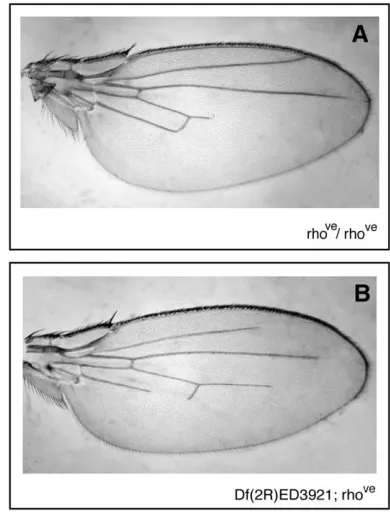
HMGD/Z in vein specification: The phenotype ob-tained inHmgD/Zandbrmdouble mutants is reminis-cent of the loss-of-function rhomboid allele, rhove. This allele results in loss of the distal portions of veins L2–L5, with L3 and L4 displaying the greatest variation in the extent of vein shortening (Sturtevantet al.1993). Pre-vious studies have examined Brahma complex function in wing vein formation. The complex was found to be required for the correct specification of both vein and nonvein cells. Overexpression of dominant negative Brahma resulted in loss of Rhomboid expression and loss of vein tissue, while mutation of the negatively reg-ulating Snr1 subunit resulted in ectopic vein formation (Marenda et al.2003, 2004; Zraly et al.2003). Muta-tions in brm were shown to enhance the loss of vein phenotype ofrhovemutants, specifically in the L5 region. As shown in Figure 3B, reducing the expression of HMGD/Z also enhances this phenotype and there is also a partial loss of L2. We also observed a mild enhancement of L3 vein loss and variation in the length of L4. It should be noted thatrhove
flies display variation in L4 length and we observed the same range of dif-ferent L4 lengths in bothrhove
andDf(2R)ED3921flies, as shown in Figure 3, A and B. We interpret this to mean thatDf(2R)ED3921 does not significantly enhance the loss of L4 and L3, but affects L2 and L5. The interaction with rhove provides additional evidence of a role for HMGD/Z involvement in gene activation, in specific contexts, as an accessory factor to the Brahma remodel-ing complex.
Regulation of homeotic genes:To examine HMGD/Z function in transcription regulation, we have made use of the visible phenotypes associated with Hox gene misregulation. This allowed us to ask whether HMGD/Z act as general transcription factors, since many Hox gene alleles show dominant phenotypes. We reasoned that if HMGD/Z acted as general regulators of tran-scription, we would see modification of the dominant
Hox gene phenotypes since these provide highly sensi-tized backgrounds. In addition, Brahma was originally isolated in a screen for proteins involved in Hox gene expression and we wanted to examine the effect of loss of HMGD/Z on Brahma-regulated promoters (Kennison and Tamkun1988; Tamkunet al.1992).
The held out wings phenotype observed in Df(2R) ED2921; brm2
/1is not uncommon, but notably has been observed in loss-of-function alleles of Antennapedia. Previous studies have linked Brahma complex function to correct expression of Antp (Tamkun et al. 1992;
Figure 3.—Interactions with rhomboid. (A) Homozygous rhoveflies show incomplete L3, L4, and L5 veins. (B) Reduc-tion in HMGD/Z levels enhances therhovephenotype in veins L2 and L5 and mildly so in L3. L4 length was variable in both rhoveandDf(2R)ED3921; rhoveflies. A is representative of the shortest length and B of the longest L4 length observed.
TABLE 1
Interactions with the Brahma remodeling complex
Genotype % held out wings N
Brahma brm2/1 0 170/170
Df(2R)ED3921; brm2/1 100 207/207
Osa osa000090/1 0 135/135
Df(2R)ED3921/1; osa000090/1 35 79/225
Df(2R)ED3921; osa000090/1 100 120/120
osa2/1 2 5/247
Df(2R)ED3921/1; osa2/1 65 166/256
Df(2R)ED3921; osa2/1 100 160/160
Moira Df(2R)ED3921; mor1/1 3 8/279
Bap111 Df(1)18.1.15/1; Df(2R)ED3921 0 0/315
Bap60 Df(1)C246/1; Df(2R)ED3921 0 0/327
Vazquezet al.1999). Vasquezet al.observed thatosaand brmalleles interacted with promoter-specific Antp mu-tants, both proteins being required for activation of Antpfrom the P2 promoter specifically (Vazquezet al. 1999). We decided to test whetherHmgD/Zwere needed for this specific activation, by crossingDf(2R)ED3921to the gain-of-function alleleAntpNs; this allele contains an internal partial duplication of the Antp gene plus insertion of two transposable elements and additional sequence (Talbertand Garber1994). This results in ectopic activation of Antp in eye-antennal discs, in-ducing transformation of antennae into leg tissue.
The HmgD/Zdeficiency was shown to partially sup-pressAntpNs
(see Table 2). The degree of suppression
was not as great as that observed with brm and osa mutations [21% forDf(2R)ED3921 vs.87% forosa2] and underscores the supporting role of HMGD/Z in gene activation.
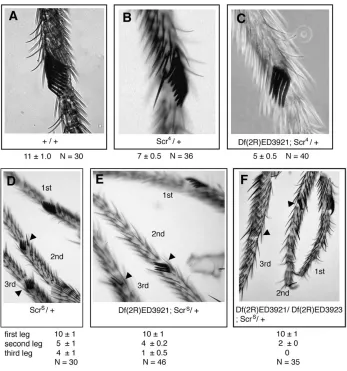
We have also examined the role of HMGD/Z with other Brahma-regulated homeotic genes. We observed an interaction withSex combs reduced. Df(2R)ED3921 en-hanced loss-of-function alleles ofScrand partially sup-pressed the gain-of-function alleleScrS
(see Figure 4). This is similar to the interactions observed between mutations in the Bramha complex andScr, where over-expression of dominant negative Brahma (DN-brm) in leg discs results in a reduced number of sex comb teeth (Elfringet al.1998).
The Brahma complex has also been shown to be re-quired for activation ofUltrabithorax, asbrm,osa, andmor mutations enhance loss-of-functionUbxalleles (Tamkun et al.1992). We did not observe an increase in haltere-to-wing transformation whenDf(2R)ED3921was crossed to Ubx alleles (see supplemental Table 1 at http://www. genetics.org/supplemental/). This result suggests that HMGD and HMGZ do not function as ubiquitous general transcriptional activators that promote gene activation and also that the interaction ofHmgD/Z with
TABLE 2
Interactions withAntennapedia
Genotype Transformed flies/total % penetrance
AntpNs 135/145 93
AntpNs/1 188/195 96
Df(2R)ED3921; AntpNs 96/132 72
osa2/ AntpNs 9/97 9
Figure 4.—Interactions with Sex combs reduced. The average number of sex comb teeth per sex comb is displayed for (A) wild type and (B) Scr4/1. These males show reduction in the number of sex comb teeth on the first leg compared to that in wild type. (C) Df(2R)ED3921; Scr4 / 1.
Brahma is required only at certain Brahma-regulated promoters.
Trithorax (trxG) and polycomb (PcG) group genes were originally characterized as opposing effectors of homeotic gene expression (see Kennisonand Tamkun 1988 and references therein). Subsequent studies showed that many PcG and trxG proteins have roles in chroma-tin modulation. To further assess the role of HMGD/Z in chromatin regulation and to look for interactions with this group of genes we crossed Df(2R)ED3921 to alleles ofPc(Polycomb),Psc(Posterior sex combs),Sce(Sex combs extra),ph-p(polyhomeotic proximal), andesc(extra sex combs). No interactions were observed with any PcG mutants or with ash1(absent, small, or homeotic discs 1) and trx (trithorax) of the trithorax group of proteins (see supplemental Table 1 at http://www.genetics.org/ supplemental/). This result indicates that HMGD/Z do not act as typical trxG or PcG proteins, but interact specifically withBrahma.
Proteins that modulate chromatin structure have also been isolated in screens for genes that affect position effect variegation (PEV). If theHmgD/Zdeficiency had an effect on PEV it could imply a role in global mod-ulation of chromatin structure, as seen, for example, in Su(var)3-9 or Su(var)205 (heterochromatin protein 1) mutations. HMGB proteins have been hypothesized to promote a more open chromatin conformation and would therefore be expected to act as enhancers of PEV. Df(2R)ED3921 did not suppress or enhance the varie-gated phenotype of rst3 (roughest) and
y3P (yellow) inversions, providing further evidence against the pro-posed role of HMGD/Z in global chromatin architecture (see supplemental Table 1 at http://www.genetics.org/ supplemental/).
HMGD and HMGZ are not integral components
of the Brahma complex: We next wanted to examine
whether HMGD and HMGZ are directly associated with the Brahma complexin vivo. Nuclear extract prepared from Drosophila embryos was separated on 15–35% glycerol gradients. Both purified Brahma complexes are
2 MDa in size and sediment in the bottom fractions of the gradient (Mohrmannet al.2004); see Figure 5. As shown in Figure 5, there was no overlap between the Brahma-containing fractions and HMGD/Z, which was located in fractions ranging from1 MDa (estimated from markers) to the top fractions, corresponding to HMGD/Z bound to sheared chromatin.
DISCUSSION
The HMGB domain is found in many proteins, from sequence-specific transcription factors to members of chromatin remodeling complexes. The DNA-binding and bending properties of HMGB proteins are clearly important, yet defining a function for small, abun-dant chromatin-associated HMGB proteins has proven difficult.
We have investigated the role of HMGD and HMGZ in Drosophila and have observed a strong genetic inter-action with the Brahma remodeling complex, the first genetic link observed in multicellular organisms. We have also provided evidence for a role of HMGD and HMGZ in aiding the Brahma complex in activation of certain target genes. The genetic interaction ofHmgD/Z with brm andosa alleles results in held out wings and loss of wing veins. The held out wings phenotype is at-tributed to decreased levels of Antp, through loss of transcription activation at the P2 promoter. Further-more, reduction ofHmgD/Zlevels partially suppresses theAntpNsgain-of-function mutation, caused by ectopic activation of the P2 promoter (Vazquez et al. 1999). These results indicate thatHmgDandHmgZcooperate with the Brahma complex in activating transcription of Antp.
Another gene regulated by the Brahma complex is rhomboid, a gene required for vein specification in the Drosophila wing. Loss of HMGD/Z enhances the rhove phenotype in a similar way to brmmutants (Marenda et al.2004). We observe loss of both L2 and L5 veins in Df(2R)ED3921; rhove
flies; a similar phenotype is ob-served for combinations of theHmgD/Zdeficiency with brmandosa. This strengthens the concept that HMGD/Z aid the Brahma complex in activation of its targets.
In examining whether HMGD/Z were involved in chromatin remodelingin vivo, we have observed a ge-netic interaction of these proteins with a SWI/SNF-like remodeler (Brahma) but not with an ISWI type (NURF, CHRAC, and ACF) althoughin vitroexperiments have previously shown that HMGB1 can facilitate remodeling by the ACF complex (Bonaldiet al.2002). The modes of nucleosome remodeling effected by these two types of complex are thought to be different, where SWI/SNF, but not ISWI, remodelers are able to alter DNaseI cleavage periodicity in nucleosomes and release super-coils (Flausand Owen-Hughes2004).
It is interesting to note that the Brahma complex contains a protein, Bap111 (encoded bydalao), with an
HMGB domain (Papoulas et al. 2001). One might therefore expect that loss of HMGD/Z would not affect Brahma complex function, since it already contains an HMGB protein. We did not observe an interaction in flies heterozygous for a deficiency coveringdalao. How-ever, in brm mutants, reduced amounts of functional Brahma complex may render certain promoters more dependent on small HMGB proteins such as HMGD/Z, and it is possible that HMGD/Z and Bap111 have dif-ferent functions in Brahma-mediated transcriptional activation.
We observed stronger genetic interactions between osamutants andDf(2R)ED3921than with other Brahma complex members. Osa is able to bind DNA, and HMGD/Z could possibly facilitate Osa binding to nucleosomes, thereby enhancing the rate of association of the remod-eling complex to nucleosomes. A recent study of the interaction between HMGB1 and the glucocorticoid re-ceptor (GR) found that the residence time of GR bound to chromatin was increased in the presence of HMGB1 (Agrestiet al.2005).
We have attempted to look for redundancy between Drosophila HMGB proteins, but are limited by the lack of available mutants for CG7045/6. The developing wing is particularly sensitive to perturbation. If there was any functional redundancy between HMGD/Z and CG7045/6 or Dsp1, modification of the phenotype would have most likely been observed in this tissue. However, until CG7045/6 mutants are made the issue of redun-dancy cannot be completely discarded. In examining HmgD/Z function in transcription regulation, we made use of the visible phenotypes associated with Hox gene misregulation. These phenotypes are known to be sen-sitive to changes in the activity of chromatin regulators such as Brahma and Polycomb (Kennisonand Tamkun 1988; Tamkunet al.1992). In a manner similar to that ofbrahmaHmgD/Z were found to facilitate activation of AntpandScr. In contrast,brmmutants enhance loss-of-function Ubx mutations, yet we observe no effect for theHmgD/Z deficiency. We infer thatHmgD/Z may be functionally necessary only at some Brahma-regulated promoters.
Interestingly both Dsp1 and HmgD/Z play a role in the activation of Scr. Dsp1 suppresses the extra sex combs phenotype ofPc, but shows no interactions with brm(Decovilleet al.2001). The opposite is true for the HmgD/Z deficiency, suggesting that these proteins act in independent pathways to activateScr. Dsp1 has recently also been shown to promote the association of PcG group proteins to PREs (PcG response elements) by binding to a G(A) sequence motif, suggesting a role in tran-scription repression for this HMGB protein (Dejardin et al.2005).
Our observations in Drosophila have interesting par-allels to studies inSaccharomyces cerevisiae. Mutation of bothnhp6aandnhp6b genes results in a temperature-sensitive growth phenotype. Synthetic lethal
pheno-types with SWI/SNF mutants have been observed for snf5and more recently forswi2(Yuet al.2000; Biswas et al. 2004). In addition Nhp6a/b has been shown to be required for repression of the CHA1 locus, and an interaction with the RSC remodeling complex has been inferred (Moreira and Holmberg 2000). Similarly Nhp6a/b have been connected with the INO80 re-modeling complex; overexpression of Nhp6a rescues the phenotypes associated with mutations in arp6 and arp7 (nuclear actin-related protein, Arp), which are components of the INO80 complex (Szerlong et al. 2003).
HMGB proteins are widely thought of as architectural chromatin proteins. This implies a global chromatin role, and mutation of such proteins should have dra-matic effects on chromatin structure if removed.
Previous work by Nerand Travers(1994) hypothe-sized a role for HMGD in chromatin structure in the syncytial blastoderm. HMGD was proposed to act as an early embryonic linker binding protein, producing a more open chromatin conformation to facilitate rapid nuclear divisions in the absence of H1. Embryos
con-taining the HmgD/Z deficiency have normal nuclear
morphology and no abnormal nuclear divisions were observed (A. Ragab, unpublished observations). This argues against an ‘‘early embryonic linker’’ role for HMGD/Z and suggests that other factors, or the lack or histone H1, are responsible for the decondensed chro-matin state during these stages. In addition, no alter-ation either in micrococcal nuclease digestion kinetics of embryonic chromatin or in the morphology of mitotic and polytene chromosomes of these mutants was seen (E. C. Thompsonand A. Ragab, unpublished observations).
Recently an additional role for yeast Nhp6a/b and mammalian HMGB1 in genome stability has been pro-posed (Giavaraet al.2005). Increased sensitivity to UV irradiation was seen inhmgb1ÿ/ÿprimary embryonic fibroblasts and in nhp6a/b double-mutant yeast. In addition, sensitivity to hydrogen peroxide and methyl methanesulphonate (MMS) was also observed in the yeast mutants. We have not observed any enhanced sensitivity to UV irradiation, X irradiation, or MMS in theHmgD/Zdeficiency (E. C. Thompson, unpublished observations). We therefore infer that a major role for the abundant HMGB proteins in Drosophila is cooper-ation with the Brahma complex.
by the complex to propagate nucleosome sliding (Bonaldi et al.2002) or promote association of tran-scription factors (Agrestiet al.2005). Significantly the region where DNA accessibility is increased is immedi-ately adjacent to the binding site for the motor poly-peptide of the SWI/SNF complex (Saha et al. 2005). HMGB proteins are known to bind chromatin with high on/off rates, which would result in rapid transient ex-posure of target sites and perhaps in more readily rec-ognized and remodeled nucleosomes. This may afford organisms an advantage in the control of gene tran-scription and would explain the conservation of these small HMGB proteins from yeast to man.
We acknowledge D. Locker, P. Badenhorst, and J. Kadonaga for providing fly stocks; C. P. Verrijzer for the Brm antibody; and J. Brennecke, K. Brown, and A. Buscaino for valuable discussions and critical reading of the manuscript. A. Ragab was supported by a Medical Research Council (MRC) studentship. E. C. Thompson is supported by an MRC studentship.
LITERATURE CITED
Agresti, A., P. Scaffidi, A. Riva, V. R. Caiolfaand M. E. Bianchi,
2005 GR and HMGB1 interact only within chromatin and influ-ence each other’s residinflu-ence time. Mol. Cell18:109–121. An, W., K.vanHoldeand J. Zlatanova, 1998 The non-histone
chromatin protein HMG1 protects linker DNA on the side oppo-site to that protected by linker histones. J. Biol. Chem. 273:
26289–26291.
Biswas, D., A. N. Imbalzano, P. Eriksson, Y. Yuand D. J. Stillman,
2004 Role for Nhp6, Gcn5, and the Swi/Snf complex in stimu-lating formation of the TATA-binding protein-TFIIA-DNA com-plex. Mol. Cell. Biol.24:8312–8321.
Bonaldi, T., G. Langst, R. Strohner, P. B. Becker and M. E.
Bianchi, 2002 The DNA chaperone HMGB1 facilitates ACF/
CHRAC-dependent nucleosome sliding. EMBO J.21:6865–6873. Bustin, M., 2001 Chromatin unfolding and activation by HMGN
chromosomal proteins. Trends Biochem. Sci.26:431–437. Calogero, S., F. Grassi, A. Aguzzi, T. Voigtlander, P. Ferrieret al.,
1999 The lack of chromosomal protein Hmg1 does not disrupt cell growth but causes lethal hypoglycaemia in newborn mice. Nat. Genet.22:276–280.
Decoville, M., E. Giacomello, M. Lengand D. Locker, 2001 DSP1,
an HMG-like protein, is involved in the regulation of homeotic genes. Genetics157:237–244.
Dejardin, J., A. Rappailles, O. Cuvier, C. Grimaud, M. Decoville
et al., 2005 Recruitment of Drosophila Polycomb group pro-teins to chromatin by DSP1. Nature434:533–538.
Elfring, L. K., C. Daniel, O. Papoulas, R. Deuring, M. Sarteet al.,
1998 Genetic analysis ofbrahma: the Drosophila homolog of the yeast chromatin remodeling factor SWI2/SNF2. Genetics 148:
251–265.
Flaus, A., and T. Owen-Hughes, 2004 Mechanisms for ATP-dependent
chromatin remodelling: farewell to the tuna-can octamer? Curr. Opin. Genet. Dev.14:165–173.
Formosa, T., P. Eriksson, J. Wittmeyer, J. Ginn, Y. Yu et al.,
2001 Spt16-Pob3 and the HMG protein Nhp6 combine to form the nucleosome-binding factor SPN. EMBO J.20:3506–3517. Giavara, S., E. Kosmidou, M. P. Hande, M. E. Bianchi, A. Morgan
et al., 2005 Yeast Nhp6A/B and mammalian Hmgb1 facilitate the maintenance of genome stability. Curr. Biol.15:68–72. Golic, K. G., and M. M. Golic, 1996 Engineering the Drosophila
genome: chromosome rearrangements by design. Genetics
144:1693–1711.
Kal, A. J., T. Mahmoudi, N. B. Zakand C. P. Verrijzer, 2000 The
Drosophila Brahma complex is an essential coactivator for the trithorax group protein Zeste. Genes Dev.14:1058–1071. Kamakaka, R. T., C. M. Tyreeand J. T. Kadonaga, 1991 Accurate
and efficient RNA polymerase II transcription with a soluble
nuclear fraction derived from Drosophila embryos. Proc. Natl. Acad. Sci. USA88:1024–1028.
Kennison, J. A., and J. W. Tamkun, 1988 Dosage-dependent
modi-fiers of polycomb and antennapedia mutations in Drosophila. Proc. Natl. Acad. Sci. USA85:8136–8140.
Marenda, D. R., C. B. Zraly, Y. Feng, S. Eganand A. K. Dingwall,
2003 The Drosophila SNR1 (SNF5/INI1) subunit directs essen-tial developmental functions of the Brahma chromatin remodel-ing complex. Mol. Cell. Biol.23:289–305.
Marenda, D. R., C. B. Zralyand A. K. Dingwall, 2004 The
Dro-sophila Brahma (SWI/SNF) chromatin remodeling complex ex-hibits cell-type specific activation and repression functions. Dev. Biol.267:279–293.
Mohrmann, L., K. Langenberg, J. Krijgsveld, A. J. Kal, A. J. Heck
et al., 2004 Differential targeting of two distinct SWI/SNF-related Drosophila chromatin-remodeling complexes. Mol. Cell. Biol.24:3077–3088.
Moreira, J. M., and S. Holmberg, 2000 Chromatin-mediated
tran-scriptional regulation by the yeast architectural factors NHP6A and NHP6B. EMBO J.19:6804–6813.
Mosrin-Huaman, C., L. Canaple, D. Locker and M. Decoville,
1998 DSP1gene of Drosophila melanogasterencodes an HMG-domain protein that plays multiple roles in development. Dev. Genet.23:324–334.
Nemeth, M. J., D. J. Curtis, M. R. Kirby, L. J. Garrett-Beal, N. E.
Seidelet al., 2003 Hmgb3: an HMG-box family member
ex-pressed in primitive hematopoietic cells that inhibits myeloid and B-cell differentiation. Blood102:1298–1306.
Nemeth, M. J., A. P. Cline, S. M. Anderson, L. J. Garrett-Bealand
D. M. Bodine, 2005 Hmgb3 deficiency deregulates
prolifera-tion and differentiaprolifera-tion of common lymphoid and myeloid pro-genitors. Blood105:627–634.
Ner, S. S., and A. A. Travers, 1994 HMG-D, the Drosophila
mela-nogaster homologue of HMG 1 protein, is associated with early embryonic chromatin in the absence of histone H1. EMBO J.13:
1817–1822.
Ner, S. S., M. E. A. Churchill, M. A. Searlesand A. A. Travers,
1993 dHMG-Z, a second HMG-1-related protein in Drosophila melanogaster. Nucleic Acids Res.21:4369–4371.
Ner, S. S., T. Blank, M. L. Perez-Paralle, T. A. Grigliatti, P. B.
Beckeret al., 2001 HMG-D and histone H1 interplay during
chromatin assembly and early embryogenesis. J. Biol. Chem.
276:37569–37576.
Papoulas, O., G. Daubresse, J. A. Armstrong, J. Jin, M. P. Scott
et al., 2001 The HMG-domain protein BAP111 is important for the function of the BRM chromatin-remodeling complex in vivo. Proc. Natl. Acad. Sci. USA98:5728–5733.
Ragab, A., and A. Travers, 2003 HMG-D and histone H1 alter the
local accessibility of nucleosomal DNA. Nucleic Acids Res.31:
7083–7089.
Reeves, R., 2003 HMGA proteins: Flexibility finds a nuclear niche?
Biochem. Cell Biol.81:185–195.
Ronfani, L., M. Ferraguti, L. Croci, C. E. Ovitt, H. R. Scholeret al.,
2001 Reduced fertility and spermatogenesis defects in mice lack-ing chromosomal protein Hmgb2. Development128:1265–1273. Ryder, E., F. Blows, M. Ashburner, R. Bautista-Llacer,
D. Coulson et al., 2004 The DrosDel collection: a set of
P-element insertions for generating custom chromosomal aber-rations inDrosophila melanogaster.Genetics167:797–813. Saha, A., J. Wittmeyerand B. R. Cairns, 2005 Chromatin
remod-eling through directional DNA translocation from an internal nucleosomal site. Nat. Struct. Mol. Biol.12:747–755.
Sturtevant, M. A., M. Roarkand E. Bier, 1993 The Drosophila
rhomboid gene mediates the localized formation of wing veins and interacts genetically with components of the EGF-R signaling pathway. Genes Dev.7:961–973.
Szerlong, H., A. Sahaand B. R. Cairns, 2003 The nuclear
actin-related proteins Arp7 and Arp9: a dimeric module that cooper-ates with architectural proteins for chromatin remodeling. EMBO J.22:3175–3187.
Talbert, P. B., and R. L. Garber, 1994 The Drosophila homeotic
mutation Nasobemia (AntpNs)and its revertants: an analysis of mutational reversion. Genetics138:709–720.
Tamkun, J. W., R. Deuring, M. P. Scott, M. Kissinger, A. M. Pattatucci
structurally related to the yeast transcriptional activator SNF2/SWI2. Cell68:561–572.
Thomas, J. O., and A. A. Travers, 2001 HMG1 and 2, and related
‘architectural’ DNA-binding proteins. Trends Biochem. Sci.26:
167–174.
Travers, A, A., 2003 Priming the nucleosome: A role for HMGB
proteins? EMBO Rep.4:131–136.
Vazquez, M., L. Mooreand J. A. Kennison, 1999 The trithorax
group geneosaencodes an ARID-domain protein that genetically interacts with the brahma chromatin-remodeling factor to regu-late transcription. Development126:733–742.
Wagner, C. R., K. Hamanaand S. C. Elgin, 1992 A
high-mobility-group protein and its cDNAs from Drosophila melanogaster. Mol. Cell. Biol.12:1915–1923.
Yu, Y., P. Erikssonand D. J. Stillman, 2000 Architectural
transcrip-tion factors and the SAGA complex functranscrip-tion in parallel pathways to activate transcription. Mol. Cell. Biol.20:2350–2357. Yu, Y., P. Eriksson, L. T. Bhoiteand D. J. Stillman, 2003 Regulation
of TATA-binding protein binding by the SAGA complex and the Nhp6 high-mobility group protein. Mol. Cell. Biol. 23:
1910–1921.
Zraly, C. B., D. R. Marenda, R. Nanchal, G. Cavalli, C. Muchardt
et al., 2003 SNR1 is an essential subunit in a subset ofDrosophila
brm complexes, targeting specific functions during develop-ment. Dev. Biol.253:291–308.