R E S E A R C H
Open Access
Multiple-RAT selection for reducing call blocking/
dropping probability in cooperative
heterogeneous wireless networks
Olabisi E Falowo
*and H Anthony Chan
Abstract
There is an increasing demand for high bandwidth-consuming services such as real-time video and video streaming over wireless access networks. A single radio access technology (RAT) in a heterogeneous wireless network may not always have enough radio resource to admit high bandwidth-consuming calls, such as video calls. Existing joint call admission control (JCAC) algorithms designed for heterogeneous wireless networks block/drop an incoming call when none of the available individual RATs in the network has enough bandwidth to admit the incoming call. Consequently, video calls experience high call blocking/dropping probability in the network. However, some calls such as multi-layer coded (scalable) video can be transmitted/ received over one or multiple RATs. This article proposes a JCAC algorithm that selects a single or multiple RATs for scalable video calls in heterogeneous wireless networks, depending on availability of radio resources in available RATs. Non scalable calls are always admitted into a single RAT by the algorithm. The aim of the proposed algorithm is to reduce call blocking/dropping probability for both scalable and non-scalable calls. An analytical model is developed for the proposed JCAC algorithm, and its performance is evaluated. Simulation results show that the proposed algorithm reduces call blocking/dropping probability in heterogeneous wireless networks.
Keywords: Heterogeneous wireless network, Joint radio resource management, Joint call admission control, Radio access technology, Markov chain, Mobile terminal
Introduction
There is an increasing demand for high bandwidth-consuming services such as real-time video and video streaming over wireless access networks [1,2]. Video calls generally consume high bandwidth in wireless net-works. Consequently, video compression and bandwidth adaptation techniques have been used to reduce video call blocking/dropping probability in homogenous wire-less networks, at the expense of the video quality at the receiver. The higher the video-compression ratio, the poorer the video quality at the receiver. Moreover, high frequency of bandwidth adaptation has also led to poor quality of service at the receiver.
However, multiple radio access technologies (RATs) are being deployed in the same geographical area, which
is referred to as heterogeneous wireless network envir-onment. Consequently, the coexistence of different RATs in the same area has necessitated joint radio resource management (JRRM) for enhanced QoS provisioning and efficient radio resource utilization.
A multi-homed heterogeneous wireless network gives multimode terminals (MTs) the flexibility to be taneously connected to more than one RAT. Such simul-taneous connections entails that packet stream of a scalable call will be split among multiple RATs in the heterogeneous wireless network. This flexibility can be exploited to improve connection-level QoS (call block-ing/dropping probability) for high-bandwidth consuming applications such as multi-layer video.
A scalable video bit stream consists of one base layer and one or more enhancement layers, and therefore can provide better flexibility and efficiency [3]. By transmit-ting the layers of a scalable video over different RATs in * Correspondence:[email protected]
Department of Electrical Engineering, University of Cape Town, Cape Town, South Africa
cooperative heterogeneous wireless networks, call block-ing/dropping probability can be reduced in the net-works. The foregoing is the focus of this article.
In cooperative heterogeneous wireless networks, a joint call admission control (JCAC) algorithm is used for making call admission decisions. A number of JCAC algorithms have been proposed for heterogeneous wire-less networks, and a review of these JCAC algorithms given in [4]. However, these JCAC algorithms block/drop an incoming call when none of the available individual RATs in the heterogeneous network has enough band-width to support the call. Consequently, high bandwidth-demanding calls are easily blocked or dropped in the network, especially during the peak hours.
Sachs et al. [5] presented a framework for integrating different access systems into a multi-access system and for selecting the best suitable access network for users. They proposed a utility-based approach for evaluating different access allocation choices, which is based on user and network policies, the performance of access bearers, and the availability of access resources.
Hasib and Fapojuwo [6] presented an analysis of com-mon radio resource management scheme for end-to-end QoS support in heterogeneous wireless networks.
Gelabert et al. [7] presented a Markovian approach to RAT selection in heterogeneous wireless networks. They developed an analytical model for RAT selection algo-rithms in a heterogeneous wireless network comprising GSM/EGDE and UMTS. The proposed algorithm selects just one RAT for each call.
Song and Zhuang [8] proposed a losharing call ad-mission control scheme for voice and data services in an integrated cellular/WLAN network. In the proposed scheme, voice calls are preferably admitted to the cellu-lar network, whereas data calls are admitted into both cellular and WLAN.
Falowo and Chan [9] proposed an adaptive JCAC and bandwidth management scheme for heterogeneous wire-less networks with collocated cells. They developed an analytical model for the proposed scheme and evaluated its performance in terms of new call blocking probability (NCBP), handoff call dropping probability, and resource utilization.
In the JCAC schemes reviewed above, the possibility of splitting scalable calls and selecting multiple RATs for scalable calls in heterogeneous wireless networks were not considered. Therefore, this article focuses on the above topic.
The article proposes a JCAC scheme that reduces call blocking/dropping probability by selecting multiple RATs for an incoming call when none of the available single RATs has enough bandwidth to accommodate the incoming call. The JCAC algorithm is designed to
simultaneously achieve the following objectives in het-erogeneous wireless networks.
(1) Select a single RAT or multiple RATs for each call in the heterogeneous wireless.
(2) Degrade ongoing adaptive call(s) to the allowable minimum basic bandwidth unit (bbu), if necessary, to admit an incoming call.
(3) Reduce call blocking/dropping probability through multiple RAT selection.
(4) Prioritize handoff calls over new calls, and (5) Guarantee the QoS requirement of all admitted
calls.
In wireless networks, dropping an ongoing call is more annoying to users than blocking a new call. Therefore, handoff calls are usually prioritized over new calls. The proposed JCAC algorithm prioritizes handoff calls over new calls by using different rejection thresholds for new and handoff calls.
The contributions of this article are twofold. First, a JCAC algorithm for reducing call blocking/dropping probability in heterogeneous wireless networks is pro-posed. Second, an analytical model is developed for the proposed scheme, and its performance is evaluated in terms of NCBP and handoff call dropping probability.
To the best of authors’ knowledge, this is the first JCAC scheme using multiple RAT selection and scalable call splitting for reducing call blocking/dropping prob-ability in heterogeneous wireless networks.
The rest of this article is organized as follows. Section 2 discusses transmission of multi-layer video in hetero-geneous wireless networks. In Section 3, the proposed JCAC algorithm is described. Section 4 presents the sys-tem model for the scheme. A Markov model is devel-oped for the JCAC algorithm in Section 5. In Section 6, the performance of the proposed JCAC algorithm is evaluated through numerical simulations.
Transmission of multi-layer video in heterogeneous wireless networks
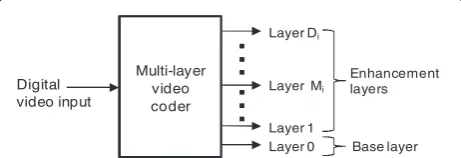
whereas layers 1 to Di are enhancement layers whereDi is the maximum number of enhancement layers, andMi is the minimum number of the enhancement layers required by the scalable class-icalls.
As shown in Figure 1, a scalable class-icall with mini-mum requested layers (Mi+ 1) and maximum requested layers (Di+ 1) can be admitted into one or more RATs. For a scalable class-i call, let bi,0 and bi,d denote the bandwidth requirements for the layer-0 and layer-d, re-spectively, where 0<d≤Di. The total minimum band-width requirement of a scalable class-icall is given as
bi;min¼ XMi
x¼0
bi;d ð1Þ
The total maximum bandwidth requirement of a scal-able class-icall is given as
bi;max ¼ XDi
x¼0
bi;d ð2Þ
For non-scalable, the bandwidth requirement is simply
bi,min=bi,max=bi,.
In a cooperative J-RAT heterogeneous wireless net-work, the requested bandwidth of an adaptive class-i
call, which varies between bi,minand bi,max, can be allo-cated from a single RAT. However, if no single RAT has enough bbu to admit the incoming scalable call, with at least the minimum bandwidth requirement, bi,min, some ongoing scalable calls can be degraded (to the allowable minimum bbu) to free up some resources to accommo-date the incoming call. However, if all scalable calls have be degraded to the allowable minimum, and yet, there is not a single RAT that has enough bbu to admit the in-coming call (for example during the peak hour), the call is blocked of dropped.
To reduce blocking/dropping probability in heteroge-neous wireless network, this article proposes a JCAC al-gorithm for transmission of multiple layers of scalable calls over multiple RATs, when it is not possible to admit the call, with requested minimum number of layers, over a single RAT.
For example, in a two-RAT heterogeneous wireless net-work where no single RAT has enough bbu to admit, a
scalable class-i call, requesting a minimum of (1 +Mi) layers, the layers can be split into two groups of layers (group- and group-2 layers): group-1 layers comprising layer-0 to layer-ri, and group-2 comprising layer-(ri+ 1) to layer-Mi, where 0≤r<Mi. Then, layers in group-1 can be admitted into one RAT and layers in group two can be admitted into the other RAT provided that the two RATs support the scalable class-icalls, and have enough radio resources to accommodate the group of layers. At the re-ceiver, the two groups of layers are then combined.
Generally, in a J-RAT heterogeneous wireless net-works, anMi-layer class-i call from a MT can be admit-ted into a single RAT or T number of RATs, where
T≤J and T≤ðMiþ1Þprovided that up to T-RATs over-lap and support the scalable class-icall.
It is important to note that there are a number of chal-lenges associated with transmission of multiple layers over two or more RATs in heterogeneous wireless net-works. These challenges include synchronization of packets at the receiver, and combination of call different layers at the receiver. Buffering of packet stream of indi-vidual layer at the receiver before delivering them to the transport layer in the protocol stack can reduce some of the problems stated above. However, the above stated challenges are outside the scope of this article. The focus of this article is to develop a JCAC algorithm for select-ing sselect-ingle or multiple RATs for incomselect-ing calls in hetero-geneous wireless networks and investigates the effect of transmission of multi-layer video over multiple RATs on call blocking/dropping probability in heterogeneous wireless networks.
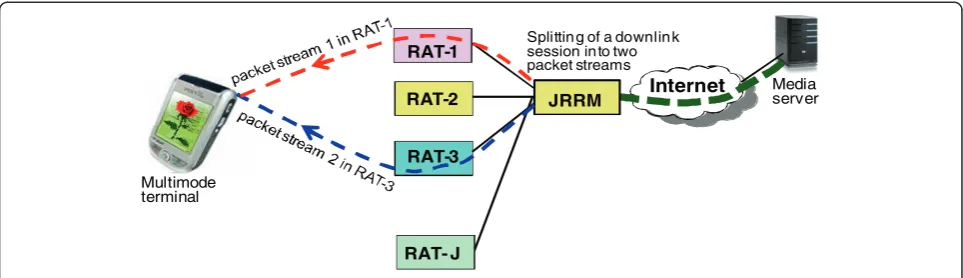
Proposed JCAC for heterogeneous wireless networks The proposed JCAC scheme always selects a single RAT for non-scalable calls but selects a single or multiple RAT(s) for scalable calls, depending on availability of radio resources in the available RATs, and thereby reduces call blocking/dropping probability in heteroge-neous wireless networks. Figure 2 illustrates the principle of multiple RAT selection and call layer split-ting in aJ-RAT heterogeneous wireless network, whereJ
is the number of RATs in the network.
As shown in Figure 2, an MT is requesting a scalable video-streaming session from a media server. None of the individual RATs in theJ-RAT heterogeneous wireless networks has enough bbu to admit the incoming call (with the minimum bbu) because of the current load in each of the RATs. However, a combination of residual bbu in RAT 1 and RAT 3 will be sufficient to support the video streaming. Therefore, the proposed JCAC al-gorithm selects RAT 1 and RAT 3 for the call. The video layers are split between the two selected RATs and com-bined at the MT. The MT buffers the packet stream of individual group of layers for synchronization purposes
Multi-layer video coder Digital
video input
Layer 0 Layer 1
Layer Mi
Layer Di
Enhancement layers
Base layer
before delivering them to the transport layer in the protocol stack.
When a new call (session) is to be admitted, the pro-posed JCAC scheme decides the following: (1) whether the call can be admitted into the heterogeneous network or not, (2) whether some ongoing scalable call(s) should be degraded to accommodate the call or not, (3) whether the call should be split among multiple RATs or not (note that splitting is only allowed for scalable calls), and (4) what RAT(s) will be most suitable for admitting the in-coming call. The JCAC scheme makes the above deci-sions based on the class of calls, bandwidth requirement of the call, and current load in each of the available RATs. As shown in Figure 2, the JRRM module contains the JCAC algorithm. An MT wanting to make a call (initiate a session) sends a service request to the JRRM module. The JCAC algorithm in JRRM module then selects for the incoming call, a set of T RATs (0≤T≤J) from the available RATs in the heterogeneous network, whereTis the number of RATs selected. T= 0 implies that the in-coming call cannot be admitted into the heterogeneous network. Therefore, the call is blocked or dropped.T= 1 implies that the incoming call can be admitted into just one of the available RATs. Hence, there is no layer split-ting.T>1 implies that the incoming call is scalable and it will be admitted into more than one RAT.
Figure 3 shows the stages of the proposed JCAC algo-rithm. As shown in Figure 3, for a non-adaptive call, the proposed JCAC algorithm attempts to admit the call into a single RAT (Figure 3, 1(a)). If the call cannot be admitted into any of the available RATs because of insuf-ficient bbu, the JCAC algorithm attempts to degrade some ongoing adaptive call(s) (to the allowable mini-mum bbu) in order to free some bbu for the incoming call (Figure 3, 2(a)). If there is no sufficient bbu to ac-commodate the incoming call in any of the available RATs after degrading the ongoing new calls to the allow-able minimum bbu, the JCAC algorithm rejects the in-coming call (Figure 3, 3(a)).
For an adaptive call, the proposed JCAC algorithm attempts to admit the call into a single RAT (Figure 3, 1(b)) with the requested bbu. If the call cannot be admitted into any of the available RATs because of insufficient bbu, the JCAC algorithm attempts to admit the adaptive call with the minimum bbu (Figure 3, 2(b)). If the call cannot be admitted into any of the available RATs be-cause of insufficient bbu, the JCAC algorithm attempts to degrade some ongoing adaptive call(s) (to the allow-able minimum bbu) in order to free some bbu for the in-coming call (Figure 3, 3(b)). If the call cannot be admitted into any of the available RATs because of insufficient bbu, the JCAC algorithm attempts to admit the call
Admit incoming call with requested bbu into
one RAT without bandwidth adaptation
Admit incoming call with minimum bbu into
one RAT without bandwidth adaptation
Admit incoming call with minimum bbu into
one RAT with bandwidth adaptation
Admit incoming call with minimum bbu into
more than one RAT
Admit incoming call into one RAT without bandwidth adaptation of
some ongoing adaptive call(s)
Admit incoming call into one RAT with bandwidth adaptation
Incoming call Non adaptive
adaptive
Reject incoming
call
1(a) 2(a) 3(a)
1(b) 2(b) 3(b) 4(b)
Reject incoming
call 5(b)
Figure 3Stages of the proposed JCAC algorithm.
Internet Internet
Internet
RAT-2 RAT-1
RAT-3
JRRM
Multimode terminal
Splittin g of a downlin k session in to two packet streams
Media server
RAT- J
into more than one RAT (Figure 3, 4(b)). If there is no sufficient bbu to accommodate the incoming call in multiple RATs, the JCAC algorithm rejects the incoming call (Figure 3, 5(b)).
Figure 4 shows the proposed JCAC procedure, where,
xi,j and yi,j denote the residual bandwidth available for
new and handoff class-i calls in RAT j. hi,j is the set of indices of RATjthat support class-icalls in the hetero-geneous wireless networks. Ni is the number of RATs that support class-i calls in the heterogeneous wireless networks. bi;reqand bi;min are the total bandwidth requested and the minimum the bandwidth required by
New call? Arrival of class-i call
So rt RATjfo r all j ∈hiin
d ecreasing o rder o f residual cap acity, yi,j, an d set n =1
bi,req≤yi j
Select th e nthRAT
Admi t class-i call in to th e nthRAT an d
allocate bi,req
(no sessio n sp litting) yes
n o
no (Han d off call)
Ap p ly session splitting bi ,min= (bi1+ …+ bin )
bi1 ≥ … ≥ bin
n > Ni
yes n ++
Select th e 1stto nthRATs
Reject class-i call
yes
Ad mit class-i call in to 1 to nthRATs and
all ocate bi1, …, bin
bbu
resp ectively yes
Po ssible splitting combinations
exh austed ? Real lo cate bi1, …, bin
bi,min= (bi1+ …+ bin )
bi1 ≥ … ≥ bin
yes n o
n o
So rt RATjfor all j ∈hiin
d ecreasing o rder o f residual capacity, xi,j, an d set n =1
Select th e nthRAT
bi , req≤xi j
yes
n > Ni
yes
yes n ++
n o
Ap ply session splitting bi,min= (bi1+ …+ bin )
bi1 ≥ … ≥ bin
Select th e 1stto nthRATs
yes
n o
Po ssible sp litting combinations
exh austed ? Reallo cate bi1, …, bin
bi,mi n= (bi1+ …+ bin )
bi1 ≥ … ≥ bin
yes no bi1≤yi j fo r 1stRAT
bin≤yi jfo r nthRAT
bi1≤xi j fo r 1stRAT
bin≤xi jfo r nthRAT
Sessio n splitting allo wed?
Session splitting allo wed? n o
n o
n o
n o
n o
no yes
n o
yes yes
bi,m in≤yi j bi ,min≤xi j
n o Ap p ly bandwidth
ad ap tation alg orithm
Ap ply ban dwi dth ad ap tation algorithm
n o yes yes
bi,m in≤yi j bi ,min≤xi j
n o Ad mit class-i
call i n to th e nthRAT and
allocate bi,min
(no session sp litting)
class-i call, respectively. bij is the fraction of bandwidth allocated to class-icall in RATj, respectively.
In order to maintain lower handoff dropping probabil-ity over NCBP, different threshold are used for rejecting new and handoff calls. In RAT j, Bj,1 and Bj,0 are the threshold for rejecting handoff calls and new calls, re-spectively. Figure 5 shows the accessible bandwidth for new and handoff calls.
System model and assumptions
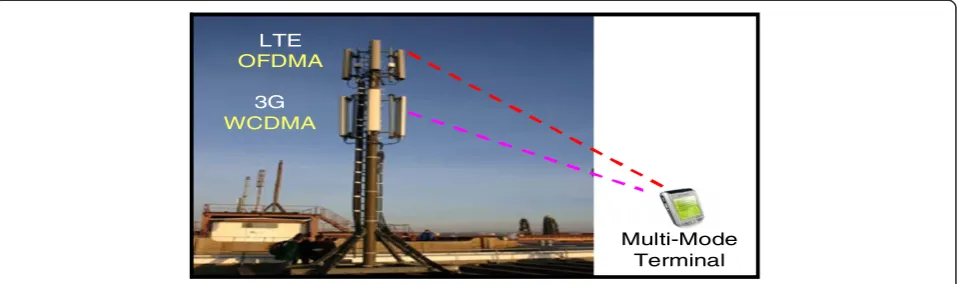
This article considers a heterogeneous wireless net-work, which consists of J number of RATs with co-located cells, similar. Cellular networks such as GSM, GPRS, UMTS, EV-DO, LTE, etc. can have the same and fully overlapped coverage, which is technically feasible, and may also save installation cost [10,11]. Figures 6 and 7 illustrate a two-RAT heterogeneous cellular network. Figure 6, adapted from [12], is a typical heterogeneous cellular network comprising 3 G-WCDMA and LTE OFDMA. Figure 6 shows the co-located cells of the two-RAT heterogeneous wireless networks.
In heterogeneous cellular networks, radio resources can independently be or jointly managed. A situation where radio resources are jointly managed in the hetero-geneous network and each cell in RATj(j= 1,…,J) has a
total ofBj,0bbu is considered. The physical meaning of a unit of radio resources (such as time slots, code se-quence, etc.) is dependent on the specific technological implementation of the radio interface. However, no mat-ter which multiple access technology (FDMA, TDMA, CDMA, or OFDMA) is used, system capacity could be interpreted in terms of effective or equivalent band-width. Therefore, in this article, bandwidth required by a call is denoted by bbu, which is similar to the approach used for wireless networks in [13].
Our approach is based on decomposing a heteroge-neous cellular network into groups of co-located cells. As shown in Figure 7, cells 1a and 2a form a group of co-located cells. Similarly, cells 1b and 2b form another group of co-located cells, and so on.
A newly arriving call will be admitted into one or mul-tiple cells in the group of co-located cells where the call is located. For example, in the two-RAT heterogeneous wireless network shown in Figure 7, an incoming call from an MT can be admitted into either of the two RATs (cell 1b or cell 2b) in the group of collocated cells. Alter-natively, the call can be admitted into both RATs (cells 1b and 2b), with session splitting. Otherwise the call is blocked.
The correlation between the groups of co-located cells results from handoff connections between the cells of
New calls Hand calls
Access networks Available
ban dwidth
RAT J
RAT 1 RAT 2
BJ,0 BJ,1 B 2,1
B2,0 B1,1
B1,0
Figure 5JCAC procedure.
LTE
OFDMA
3G
WCDMA
Multi-Mode Terminal
corresponding groups. Under this formulation, each group of co-located cells can be modeled and analyzed individually. Therefore, this article focuses attention on a single group of co-located cells.
The heterogeneous network supportsIclasses of calls. Each class-i call (which can be scalable or non-scalable) requires a discrete bandwidth value, bi. Each class is characterized by bandwidth requirements, arrival distri-bution, and channel holding time. Some classes of calls (e.g., video streaming) may support session splitting whereas some other classes of call (e.g., voice) may not support or require session splitting.
Following the general assumption in cellular networks, new and handoff class-i calls arrive in the group of co-located cells according to Poisson process with rate λin and λih, respectively [14]. Note that the arrival rates of a split Poisson process are also Poisson [15].
The channel holding time for class-icalls is exponen-tially distributed with mean 1/μi[14]. Note that this set of assumptions has been used for heterogeneous wireless networks in the literature, and is found to be generally applicable in the environment where the number of mo-bile users is larger than the number of channels [13,14].
Markov model
The JCAC policy described in Section 3 can be modeled as a multi-dimensional Markov chain. The state space of the group of co-located cells can be represented by a (2*I*J*K)-dimensional vector given as
Ω¼ ðmi;j;k;ni;j;k:i¼1;…;I; j¼1;…;J;
k¼1;…;KÞ ð2Þ
The non-negative integer mi,j,kdenotes the number of ongoing new class-icalls (or sub-streams of class-icalls) allocated k bbu in RAT j, and the non-negative integer
ni,j,kdenotes the number of ongoing handoff class-icalls (or sub streams of handoff class-i calls) allocated k bbu in RATj. Let S denote the state space of all admissible states of the group of co-located cells as it evolves over time. An admissible state s is a combination of the
numbers of users in each class that can be supported simultaneously in the group of co-located cells while maintaining adequate QoS and meeting resource con-straints.kð1≤k≤KÞis an integer and it is the number of bbu allocated to call or substream of a call in a particular RAT. K is the maximum number of bbu that can be allocated to any class-i call (i.e., without session splitting).
The stateSof all admissible states in the group of co-located cells is given as
S¼ Ω¼ ðmi;j;k;ni;j;k:i¼1;…;I; j¼1;…;J;
Joint call admission decisions are taken in the arrival epoch. Every time a new or handoff class-icall arrives in the group of co-located cells, the JCAC algorithm deci-des whether or not to admit the call, and in which set of RAT(s) to admit it. Note that a call admission decision is made only at the arrival of a call, and no call admission decision is made in the group of co-located cells when a call departs. When the system is in state s, an accept/ reject decision must be made for each type of possible arrival, i.e., an arrival of a new class-i call, or the arrival of a handoff class-icall in the group of co-located cells. For an incoming class-i call, the following are the pos-sible JCAC decisions in the arrival epoch.
(1) Reject the class-icall (new or handoff ) in the group of collocated cells, in which case the statesdoes not evolve.
(2) Admit the class-icall into only one RATs (no session splitting) in which case the statesevolves. (3) Admit the class-icall into a set of RATs (with
session splitting) in which case the statesevolves.
RAT 1
Thus, the call admission action space A can be expressed as follows:
A¼ fa¼ ðan
1;...;anI;ah1;...;ahIÞ:
an
i;ahi 2fA0; A1; A2;…;AJg
A0¼f g0 ; number of elements in A0;
nðA0Þ ¼JC0 ¼1
A1¼f1; 2;…;Jg; nðA1Þ ¼JC1 ¼J
A2¼ ðf 1&2Þ;…;ð1&JÞ;ð2&3Þ;…;ð2&JÞ;…; ððJ1Þ&JÞg;nðA2Þ ¼JC2
AJ ¼ fð1&2&…&ðJ1Þ&JÞg; nðAJÞ ¼JCJ ¼1 ð4Þ
where ain denotes the action taken on arrival of a new class-i call within the group of co-located cells, and aih denotes the action taken on arrival of a handoff class-i
call from an adjacent group of co-located cells. ain (or
aih)2A0means no RAT is selected for an incoming new (or handoff ) class-i call, therefore, the new (or handoff ) class-icall is rejected in the heterogeneous wireless net-work.ain(oraih)2A1means one RAT is selected for the call, therefore, there is no session splitting and the new (or handoff ) class-icall is accepted into the selected sin-gle RAT. ain (oraih) 2A2means two RATs are selected for the call, therefore, there is session splitting and the new (or handoff ) class-icall is split into two substreams and admitted into the selected two RATs.ain(oraih)2Aj means j RATs are selected for the incoming call. Thus, there is session splitting and the new (or handoff ) class-i
call is split into j substreams and admitted into the selectedjRATs.
For example, in a 3-RAT heterogeneous wireless net-work, it follows that
A0¼f g0 ; A1¼f1; 2; 3g;
A2¼ ðf 1&2Þ;ð1&3Þ;ð2&3Þg;A3¼ ðf 1&2&3Þg;
ani;ahi 2f0;1;2;3;ð1&2Þ;ð1&3Þ;ð2&3Þ;ð1&2&3Þg
where ain (or aih) = 0 means reject the new (or handoff ) class-i call. ain (or aih) = 1 means accept the new (or handoff ) class-i call into RAT-1. ain (or aih) = (1&2) means split the scalable call session into two substreams and accept the new (or handoff ) class-i call subsreams into RAT-1 and RAT-2.ain(oraih) = (1&2&3) means split the call session into three substreams and accept the new (or handoff ) class-i call subsreams into RAT-1, RAT-2, and RAT-3.
Based on its Markovian property, the JCAC algorithm can be model as a (2*I*J*K)-dimensional Markov chain. Letρnew
i;j;k and ρhani;j;k denote the load generated by new
class-i calls and handoff class-i calls, respectively, in RAT-j. Let 1/μin and 1/μih denote the channel holding time of new class-i call and handoff class-i call, respect-ively, and let λin,j,k and λih,j,k denote the arrival rates of new class-i call (or sub-stream of new class-i call) and handoff class-icall (or sub-stream of handoff class-icall) allocatedkbbu in RATj, respectively, then
ρnewi;j¼
λn i;j;k μn
i
8i;j;k ð5Þ
ρhani;j ¼
λh i;j;k μh
i
8i;j;k ð6Þ
From the steady-state solution of the Markov model, performance measures of interest can be determined by summing up appropriate state probabilities. Let P(s) denotes the steady-state probability that system is in state s(s2S). From the detailed balance equation,P(s) is obtained as
PðsÞ ¼ 1 G
YI
i¼1 YJ
j¼1 YK
k¼1 ðρnew
i;j;kÞ
mi;j;k
mi;j;k!
ðρhan
i;j;kÞ
ni;j;k
ni;j;k!
8s2S
ð7Þ
whereGis a normalization constant given by
G¼X
s2S YI
i¼1 YJ
j¼1 YK
k¼1
ðρnewi;j;kÞmi;j;k
mi;j;k!
ðρhani;j;kÞni;j;k
ni;j;k!
ð8Þ
NCBP
Sbi¼ fs2S
whereNiis the number of RATs that support class-icalls andrp,qis the indices ofqth RAT of the selectedpRATs for an incoming class-i call. αip,q,c is the fraction of bbu allocated to an incoming class-i call in the qth RAT of the selectedpRATs with session splitting combinationc.
Thus, the NCBP, Pbi, for a class-i call in the group of
co-located cells is given by
Pbi ¼
X
s2Sbi
PðsÞ ð10Þ
Handoff call dropping probability
A handoff class-i call is dropped in the group of co-located cells if the selected RAT(s) do not have enough bbu to accommodate the handoff call. Let Sdi⊂S denote
the set of states in which a handoff class-i call is dropped in the group of co-located cells.
Sdi¼ fs2S:
Thus, the handoff class-i call dropping probability (HCDP) for a class-icall, Pdi, in the group of co-located
cells is given by
Pdi ¼
X
s2Sdi
PðsÞ ð12Þ
Simulation results
In this section, the performance of the proposed JCAC scheme is evaluated via numerical simulation, using as an example of heterogeneous wireless network, a two-RAT heterogeneous cellular network supporting two classes of calls namely scalable video streaming calls (designated as class-1 calls) and voice calls (designated as class-2 calls). In the example, class-1 calls allows layer splitting whereas class-2 calls do not allow splitting. Class-1 calls can be admitted into a single RAT or split into two groups of layers, and then admitted into the two available RATs (i.e., an
1;ah12f0;1;2;ð1&2Þg). Class-2 calls can be admitted into a single RAT (i.e., an
2;ah22 0;1;2
f g). The system parameters used are as follows:
shown in Table 1), b2,req= 3bbu, μ1= 0.5μ2= 0.5. Table 1 shows the total bbu of class-1 calls and splitting propor-tions allowed in each scenario. For example, in scenario 1, total bbu required by class-1 calls is 6. If none of the two RATs has 6 bbu to admit an incoming class-1 call. The 6 bbu required by the incoming call can be split into two equal proportions (3:3). The call can then be admitted into the two RATs, given that the remaining bbu in each of the RATs is up to 3 bbu. In scenario 4, the total bbu required by class-1 calls is 6; session split-ting is not allowed, and an incoming scalable call can only be admitted into a single RAT.
As shown in Table 1, nine scenarios are considered in the performance evaluation of the proposed JCAC scheme through numerical simulations conducted in MATLAB. For comparison purposes, the nine scenarios are grouped into two: scenarios 1–4 and 5–9.
Effect of layer splitting on NCBP and HCDP (scenarios 1–4)
Figures 8, 9, 10, and 11 show the effect layer splitting on NCBP (Pb1 and Pb2) and HCDP (Pd1 and Pd2) for class-1 and class-2 calls, whenb1= 6 andb2= 3.
As showed in Figure 8, the NCBP (Pb1) increases with increase in call arrival rate for the four scenarios. How-ever, the Pb1 of scenarios 1–3 are much less than the Pb1 of scenario 4. The reason is that in scenarios 1–3, layer splitting is allowed for scalable calls. Therefore, if a new class-1 call cannot be admitted into a single RAT, it can be split into two groups of layers, and then be ad-mitted into the two RATs. Thus, layer splitting reduces NCBP in heterogeneous wireless networks.
Similarly, as shown in Figure 9, the HCDP (Pd1) increases with increase in call arrival rate for the four scenarios. However, the Pd1 of scenarios 1–3 are much less than the Pb1 of scenario 4. The reason is that in sce-narios 1–3, layer splitting is allowed for scalable calls. Therefore, if a handoff class-1 call cannot be admitted into a single RAT, it can be split into two groups of layers, and then be admitted into the two RATs. Thus, layer splitting reduces handoff call dropping probability in heterogeneous wireless networks.
Figure 10 shows the NCBP for class-2 calls. It can also be seen that NCBP (Pb2) increases with increase in call arrival rate for the four scenarios. However, the Pb2 of scenarios 1–3 are much less than the Pb2 of scenario 4. Note that session splitting is not allowed
0.00 Pd1 nono splilitttting
Figure 9HCDP (Pd1) for class-1 calls,b1= 6,b2= 3. Table 1 Total bbu of class-1 calls and allowed splitting
proportions
Scenario b1,min Splitting proportion
1 6 3:3
2 6 4:2
3 6 5:1
4 6 No splitting
5 8 4:4
6 8 5:3
7 8 6:2
8 8 7:1
9 8 No splitting
0.00
for class two calls. The splitting proportions indicated in Figure 10 are applied to class-1 calls. However, they have positive effect on both new class-1 calls (Figure 8) and new class-2 calls (Figure 10). In other words, splitting of class-1 calls in the heterogeneous wireless network reduces NCBP for both class-1 and class-2 calls.
Figure 11 shows the HCDP for class-2 calls. It can also be seen that NCBP (Pd2) increases with increase in call arrival rate for the four scenarios. However, the Pd2 of scenarios 1–3 are much less than the Pd2 of scenario 4. Splitting of class-1 calls reduces handoff call dropping probability for both handoff class-1 calls (Figure 9) and handoff calss-2 calls (Figure 11).
Effect of layer splitting on NCBP and HCDP (scenarios 5–9)
Figures 12, 13, 14, and 15 show the effect layer splitting on NCBP (Pb1 and Pb2) and HCDP (Pd1 and Pd2) for class-1 and class-2 calls, whenb1= 8 andb2= 3.
As showed in Figure 12, the NCBP (Pb1) increases with increase in call arrival rate for the four scenarios. However, the Pb1 of scenarios 5–8 are much less than the Pb1 of scenario 9. Thus, layer splitting reduces NCBP in heterogeneous wireless networks.
Similarly, as shown in Figure 13, the HCDP (Pd1) increases with increase in call arrival rate for the four scenarios. However, the Pd1 of scenarios 5–8 are much less than the Pd1 of scenario 9. Thus, layer splitting reduces handoff call dropping probability in heteroge-neous wireless networks.
Figure 14 shows the NCBP for class-2 calls. It can also be seen that NCBP (Pb2) increases with increase in call arrival rate for the four scenarios. However, the Pb2 of scenarios 5–8 are much less than the Pb2 of sce-nario 9. Thus, splitting of class-1 calls reduces NCBP for both new class-1 (Figure 11) and class-2 calls (Figure 14).
Figure 15 shows the HCDP for class-2 calls. It can also be seen that NCBP (Pd2) increases with increase in call arrival rate for the four scenarios. However, the Pd2 of scenarios 5–8 are much less than the Pd2 of scenario 9.
Thus, splitting of class-1 calls reduces handoff call dropping probability for both handoff class-1 and class-2 calls.
Conclusion
In this article, a JCAC scheme for reducing call block-ing/dropping probability in cooperative heterogeneous wireless networks has been developed. The algorithm uses multiple RAT selection and splitting of scalable call to reduce call blocking/dropping probability in heteroge-neous wireless networks. An analytical model has been developed for the proposed JCAC scheme and two per-formance metrics namely call blocking probability and call dropping probability have been derived. Perform-ance of the proposed JCAC scheme is evaluated and compared with that of a JCAC scheme that does not support layer splitting. Simulation results show that the proposed JCAC scheme reduces call blocking/dropping probability for both scalable and non-scalable calls in heterogeneous wireless networks.
Competing interests
The authors declare that they have no competing interests.
Received: 17 June 2011 Accepted: 18 May 2012 Published: 17 July 2012
References
1. E Maani, Y Luo, P Pahalawatta, A Katsaggelos, Packet scheduling for scalable video streaming over lossy packet access networks, inProceedings of 16th International Conference on Computer Communications and Networks, Turtle Bay Resort(16th International Conference on Computer Communications and Networks, Honolulu, Hawaii, USA, 2007), pp. 591–596
2. P Li, H Zhang, B Zhao, S Rangarajan, Fast optimal resource allocation for scalable video multicast in broadband wireless networks. Proceedings of the IEEE International Conference on Communications, 1–6 (2010). Cape Town, South Africa
3. Z Chen, M Li, Y Tan, Perception-aware multiple scalable video streaming over WLANs. IEEE Signal Processing Letters17(7), 675–678 (2010) 4. OE Falowo, HA Chan, Joint call admission control algorithms: requirements,
approaches, and design considerations. Elsevier J.: Computer. Communications31(6), 1200–1217 (2008). doi:10.1016/j. comcom.2008.10.044. 2008
5. J Sachs, M Prytz, J Gebert, Multi-access management in heterogeneous networks. Int. J. Wirel. Personal Communications48(1), 7–32 (2009). January
6. A Hasib, AO Fapojuwo, Analysis of common radio resource management scheme for end-to-end QoS support in multiservice heterogeneous wireless networks. IEEE Trans. Veh. Technology57(4), 2426–2439 (2008)
7. X Gelabert, J Perez-Romero, O Sallent, R Agustı, A Markovian approach to radio access technology selection in heterogeneous multiaccess/ multiservice wireless networks. IEEE Trans. Mob. Computing7(10), 1257–1270 (2008). October
8. W Song, W Zhuang, Multi-service load sharing for resource management in the cellular/WLAN integrated network. IEEE Trans. Wireless Communication
8(2), 725–735 (February 2009)
9. OE Falowo, HA Chan, Adaptive bandwidth management and joint call admission control to enhance system utilization and QoS in heterogeneous wireless networks. EURASIP J. Wireless Communications and Networking (11) (2007). doi:10.1155/2007/34378.July2007
10. W Zhang, Performance of real-time and data traffic in heterogeneous overlay wireless networks, inProceedings of the 19th International Teletraffic Congress (ITC 19), Beijing, 2005, ed. by X.J. Liang, Z.H. Xin, V.B. Iversen, G.S. Kuo (Beijing University of Posts and Telecommunications Press, Beijing, China, 2005), pp. 859–868
11. H Holma, A. Toskala,WCDMA for UMTS, 2nd edn. (John Wiley & Sons, New York, 2001)
12. G Fettweis, Current frontiers in wireless communications: fast & green & dirty,keynote presentation, inIEEE Wireless Communications & Networking Conference (WCNC)(, Budapest, Hungary, 2009). 5–8 April 2009; http://www. ieee-wcnc.org/2009/downloads/Gerhard.pdf
13. N Nasser, H Hassanein, Dynamic threshold-based call admission framework for prioritized multimedia traffic in wireless cellular networks. Proceedings of the IEEE Global Telecommunications Conference (GLOBECOM 2004)2, 644–649 (2004)
14. W Ni, W Li, M Alam, Determination of optimal call admission control policy in wireless networks. IEEE Trans. Wirel. Commun.8(2), 1038–1044 (2009) 15. DP Bertsekas, JN Tsitsiklis,Introduction to Probability (Athena Scientific
(Belmont, MA, 2002)
doi:10.1186/1687-1499-2012-221
Cite this article as:Falowo and Chan:Multiple-RAT selection for reducing call blocking/dropping probability in cooperative heterogeneous wireless networks.EURASIP Journal on Wireless Communications and Networking20122012:221.
Submit your manuscript to a
journal and benefi t from:
7Convenient online submission
7Rigorous peer review
7Immediate publication on acceptance
7Open access: articles freely available online
7High visibility within the fi eld
7Retaining the copyright to your article
Submit your next manuscript at 7 springeropen.com 0
0.01 0.02 0.03 0.04 0.05 0.06
0.1 0.2 0.3 0.4 0.5 0.6 0.7 0.8 0.9 1 Call arrival rate
H
a
n
d
o
ff
c
a
ll d
ro
p
p
in
g
p
ro
b
a
b
ilit
y Pd2 with SP 4:4 Pd2 with SP 5:3 Pd2 with SP 6:2 Pd2 with SP 7:1 Pd2 no splitting