R E S E A R C H
Open Access
Irregular 8PSK mapping for variable length
codes with small blocks in a BICM-ID system
Jing Dai
*, Can Zhang, Shaoshuai Gao and Lei Hou
Abstract
Iterative decoding is an effective technique to approach the channel capacity for very large block sizes with enough iterations. However, due to the limitation of bandwidth and delay, small blocks of data are much more commonly applied in practical communications, and low iteration counts are usually preferred for both decoding complexity and delay consideration. In such cases, the design rules of near capacity decoding—which is generally asymptotic with respect to the block size—may cause inferior performance. To overcome this problem for 8-phase shift keying (8PSK) modulated variable length codes (VLCs), an irregular mapping scheme for the transmission system of bit-interleaved coded modulation with iterative decoding (BICM-ID) is studied in this paper. A submapping searching algorithm and an irregular mapping optimization algorithm are proposed aiming at maximizing the extrinsic mutual information after a target number of iterations. Simulation results show that for small data block size with a low iteration count, our scheme has advantages with respect to the existing near capacity systems optimized by the asymptotic tools.
Keywords: Bit-interleaved coded modulation; Irregular codes; Variable length codes; Iterative source–channel decoding
1 Introduction
Variable length codes (VLCs) were originally proposed for entropy coding, and have been widely applied in a variety of audio and video compression standards. While pro-viding higher data rates than fixed length codes (FLCs), they are sensitive to error propagations due to channel noises. Even a single bit mistake can cause a loss of syn-chronization, resulting in an invalid packet. Especially when bandwidth-efficient modulations, e.g., 8-phase shift keying (8PSK) or M-ary quadrature amplitude modu-lation (QAM), are used for communication, the noise-susceptible characteristic of these high-order modulations will be adverse to correct decoding of variable length data. To improve the robustness of VLCs, reversible variable length codes (RVLCs) [1-3] were proposed and studied to mitigate the impact of synchronization loss by bidirec-tional decoding. Another class of robust VLCs focus on the free distance of the codewords, just like the channel codes do, and that is why they are called variable length error-correcting codes (VLECs) [2,4,5]. In addition, soft
*Correspondence: [email protected]
School of Electronic, Electrical and Communication Engineering, University of Chinese Academy of Sciences, 19(A) Yuquan Road, 100049 Beijing, China
VLC decoding, e.g., BCJR decoding [6] based on the bit-level [7] or symbol-bit-level [8] VLC trellis, was introduced to achieve a better performance than hard instant decoding, especially when involving iterative decoding [8,9].
Besides, from the perspective of high-order modulation, bit-interleaved coded modulation with iterative decod-ing (BICM-ID) [10] is an effective technique to approach the channel capacity. With the aid of extrinsic informa-tion transfer (EXIT) charts [11,12], near capacity iterative decoding could be achieved through EXIT curve match-ing, under the assumption of large block size. The EXIT curves can be optimized by adjusting the mapping of bits to symbol constellation [13,14]. Yet another impor-tant series of EXIT optimization techniques are irregu-lar codes, such as irreguirregu-lar convolutional codes (IrCCs) [15], irregular VLCs (IrVLCs) [9], and irregular map-pings/modulations [16-18].
The iterative decoding behaviors analyzed in [9,14-18] are all asymptotic with respect to block size, where large interleavers together with enough iterations are assumed. However, the asymptotically good performance cannot be guaranteed with small blocks.
In this paper, we derive an irregular mapping scheme for 8PSK modulated VLC in a small block BICM-ID system,
and show its coding gain over the existing near capac-ity systems optimized by standard asymptotic tools. Our design criterion is to maximize the extrinsic mutual infor-mation at a targetEb/N0after a fixed and low number of iterations, which is modified from the algorithm in [19]. Besides, a simplified sub mapping searching algorithm is proposed, based on the work of [20].
The remainder of this paper is organized as follows. Section 2 gives an overview of the transmission system. After a short introduction about the classification of 8PSK mappings in Section 3, our scheme of irregular mapping optimization is illustrated in Section 4. Simulation results are shown in Section 5, and Section 6 concludes this paper.
2 System overview
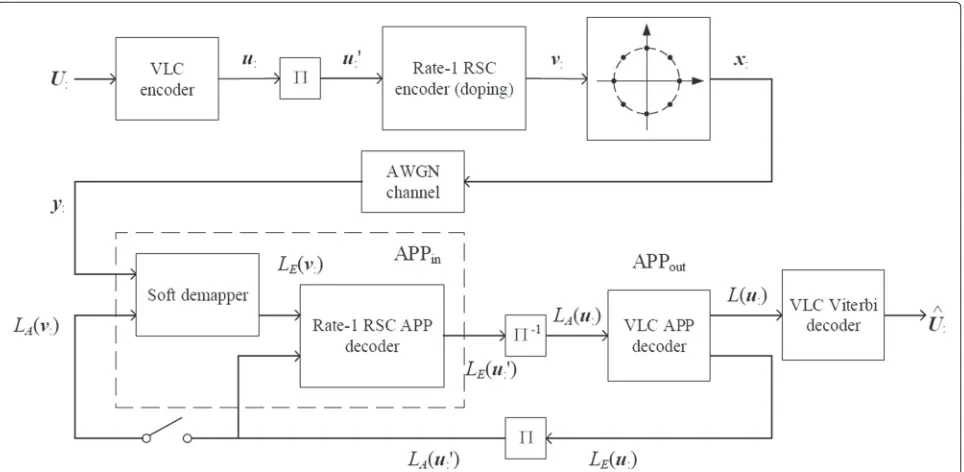
Our transmission system is depicted in Figure 1. We considered a source of discrete symbols from the finite alphabetA. A source symbol at time indexk is denoted by Uk ∈ A. One packet U1:K = [U1,U2,. . .,UK] (or written as U: for simplicity) consists of K source sym-bols. The VLC encoder maps a symbolUk to a variable length codewordC(Uk), and outputs a bit streamu1:N = [C(U1),C(U2),. . .,C(UK)] = [u1,u2,. . .,uN] with bit lengthN =Kk=1 (Uk). Here,(·)denotes the length of a specific word. The VLC packetization rule follows:
N≤Npacket<N+ (UK+1) (1)
In this way, a constant size Npacket can be maintained for VLC packets with dynamic K and N. When N <
Npacket, zero bits are padded. Possible values of the zero-padding lengthpaddingbelongs to set{0, 1,max−1}, and the average value ofNis:
N = Npacket−padding (2)
= Npacket−
max−1
i=0 i·Pr{(U) >i}
max−1
i=0 Pr{(U) >i}
where max is the longest word length. The proof of Equation 2 is in Appendix A. Here, we suppose bit-level VLC trellis [7] is applied in the VLC soft decoding, which implies the decoder does not necessarily have to knowK.
A random interleaver with sizeP·Npacket(P=1, 2,. . .) permutes the bit stream u: to u:. The interleaved u: is then encoded by a rate-1 recursive systematic convolu-tional (RSC) code, producing bit stream v:. This rate-1 RSC coding is also called ‘doping’ [21] since the output bits are doped with both info-bits and parity-bits. Then after the mapping of bits v: to 8PSK constellation, the signal is transmitted over the additive white Gaussian noise (AWGN) channel. Dependencies between the mod-ulated symbols are introduced by the inner RSC code, for the purpose of reaching EXIT point(1, 1)[21], which corresponds to error-floor removed iterative decoding.
In this paper, the rate-1 RSC code in Figure 1, we choose is a simple repeat-accumulate (RA) code with transfer function 1/(1 +D)and memory length 1. The ‘doping’ rate is set to be 1/60, i.e., 59 info-bits and 1 parity-bit within a doping period [21]. The packetization rule is set asNpacket=600.
At the receiver side, bit-level extrinsic information is exchanged between the inner a posteriori probabil-ity (APP) demapper/decoder and the outer VLC APP decoder. It can be categorized into a sub field of itera-tive source–channel decoding (ISCD). The inner decoder APPin consists of a soft demapper and the concatenated rate-1 RSC decoder. Thea prioriinformationLA
unof the RSC decoder is also input to the soft demapper as LA(vn) only if nis the info-bit index of the RSC code. Finally, after a fixed number of iterations, the original source symbols are recovered using a soft-input VLC Viterbi decoder.
3 Backgrounds on the classification of mappings for 8PSK
Consider the rotational symmetric feature, there are a total of 7!= 5040 different mappings for 8PSK, which are systematically classified in [20]. The classification is based on the bitwise distance spectra, in the situations of no prior information,W0, and full prior information,W1. For anM-ary modulation (M=2Q,Q≥3),W represents the total Hamming distance for theith bitvi between constellation symbolsm(m=0,· · ·,M−1) and all the other symbols at Euclidian distance dj, averaged over allsm∈S.
smj, respectively, and the operator ‘⊕’ denotes xor oper-ation between these two bits. The set Smj contains the constellation symbols at Euclidian distancedjfromsm,
Smj=
s∈S:d(s,sm)=dj
(5)
whered(·,·)denotes the Euclidian distance between two constellation symbol. An example for 8PSK constellation symbol set partitioned by Euclidian distance is shown in Figure 2.
W1, the distance spectrum with full prior informa-tion, has an identical structure as W0 in Equation 3. Under this full prior information condition, the other bits v[i] = v1,· · ·,vi−1,vi+1,· · ·,vQ within the same Q-bit tuple are assumed to be already perfectly known when demapping bit vi. Let sv[i],vi be the mapped
Figure 28PSK constellation divided by Euclidian distances.
constellation symbol of the Q-bit tuple v[i],vi = entries ofW1is determined as
wi1(j)= 1 the indicator function that returns 1 when the event is true, otherwise 0 is returned.
It is observed that only pairwise constellation symbols with a single different bit need to be taken into consid-eration when calculating the entries ofW1in Equation 6 since only one bit is not known yet under full prior mation assumption. On the contrary, with no prior infor-mation, the calculation the entries ofW0 in Equation 4 involves every pair of symbols.
The 5040 mappings of 8PSK are divided into 86 classes with unique [W0,W1], and listed in Table IV of [20]. Thanks to this systematic classification work, the mapping optimization of 8PSK is much more simplified.
4 Irregular mapping optimization
4.1 Optimization target setting
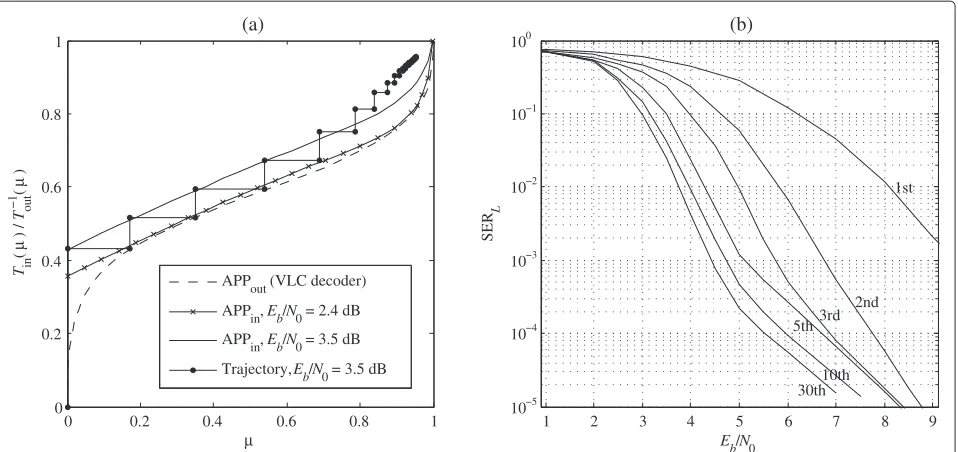
For a certain VLC, its EXIT curve as outer decoder can be obtained by Monte Carlo simulation, like the dash line in Figure 3a as an example. By searching among the EXIT curves of all 86 classes of APPindecoders (86 classes of demappers [20] followed by a doping rate 1/60 RA decoder, as in Figure 1), it is found that among the 86 map-pings, the EXIT curve of the APPin decoder ofmapper 50converges best with that of the VLC decoder APPout: A narrow open tunnel of EXIT curves can be observed at Eb/N0 = 2.4 dB. The principle of this exhaustive search is consistent with the asymptotic near capacity design cri-terion [12]. Thus, mapper 50is treated as a basic and benchmark mapping, based on which our optimization target is set.
Our goal is to maximize μF, which is the expected extrinsic mutual information after a target number ofF iterations. Figure 3b shows the symbol error rates (SERs) of mapper 50 for different iterations, under small block condition (P·Npacket =600). From the SER chart, decod-ing with around 5 iterations is attractive for a good trade-off between performance and complexity. The ‘waterfall’ region of 5-iteration SER curve starts at aboutEb/N0 = 3.5 dB. At this signal to noise ratio (SNR), the decoding trajectory of average mutual information for 30 iterations is depicted in Figure 3a. All the extrinsic mutual infor-mation measurements of the EXIT curves and the trace-points were obtained using the histogram-based approx-imation of the LA or LE probability density functions (PDFs) [11].
It is observed in Figure 3a that the trajectory deviates from the EXIT curves as the iteration count increases, which is due to the increase of correlations between the decoded soft bits, especially under the circumstances of small block size. Since our optimization is based on EXIT analysis, to avoid excessive inaccuracy,Fshould better be low, here no more than 5 is a necessary limit. Then our optimization target is set as maximizingμ5at Eb/N0 = 3.5 dB.
Moreover, the detailed simulation parameters here in this sub section can be found in Section 5.1.
4.2 Sub mapping searching
We use the difference between the extrinsic mutual infor-mation with full and no prior inforinfor-mation input as mea-surement to characterize a specific mapping.
Cj=Tj(1)−Tj(0), j=1, 2,· · ·, 86 (7)
whereTj(·)is the soft demapper EXIT function of thejth mapping from Table IV of [20], AWGN channel assumed. Tj(1) andTj(0) can either be calculated by EXIT simu-lations, or directly using Equations 60 and 65 from [20],
which is determined by the bitwise distance spectrumW1 andW0, respectively. The main feature of the sub inner decoder (with a concatenated doping RA decoder) can be roughly estimated by considering the mapping alone since the doping rate is very low. For example, the sub demapper EXIT functionsTin,j(μ)in Figure 4 (upper) are similar as the EXIT curves of the corresponding sub inner decoders (Tj(μ), down), except that the latter ones ‘bends up’ to point(1, 1)at the region very close toμ = 1. This phe-nomenon is also an intuitive explanation to the role of the RA code doping [21].
The process of searching for 8PSK sub (de)mappings with diverse EXIT features is summarized in Algorithm 1. Assume the target sub mapping number J0 = 2l + 1(l∈N+). The measurements{Cj}are sorted in ascend-ing order before the beginnascend-ing of the algorithm, thus we haveC1=min
j CjandC86=maxj Cj. These two mappings with the minimum and the maximum measurement are selected as the initial sub mappings. By the way, the two mappings corresponds to Gray and anti-Gray mapping, respectively.
Algorithm 18PSK sub mapping search. Initialize:
Allocate a cleared memory space for submapper_index_buffer;
Sort the 86 measurements{Cj}in ascending order;
submapper_index_buffer[ 1]=1, submapper_index_buffer[J0]=86;
J=2;
1: fori=1 :ldo
2: j1=submapper_index_buffer[ 1];
3: j2=submapper_index_buffer[ 1+2l+1−i];
15: returnthe available indexes in the
submapper_index_buffer, and the total numberJ.
1 2 3 4 5 6 7 8 9
10−5
10−4
10−3
10−2
10−1
100
1st
2nd 3rd 5th
10th 30th
Eb/N0
SER
L
(b)
0 0.2 0.4 0.6 0.8 1
0 0.2 0.4 0.6 0.8 1
µ Tin
(
µ
) /
T
−1 out
(
µ
)
(a)
APPout (VLC decoder)
APPin,Eb/N0 = 2.4 dB
APPin,Eb/N0 = 3.5 dB
Trajectory,Eb/N0 = 3.5 dB
Figure 3Heuristic experiments for target setting.(a)EXIT curves of the corresponding outer/inner APP decoder and decoding trajectory for 30 iterations;(b)SERLvs.Eb/N0curves for different iterations. The outer VLC is from [5], and the inner mapper is themapper 50of the 8PSK mapping
classification in [20].P=1,Npacket=600, RA doping rate 1/60, and AWGN channel assumed.
is done in a way like binary search. In the algorithm, the mapping with measurement closest to Cj1 +Cj2
/2 is treated as the one with ‘middle feature’ of two already-selected mappingsj1 andj2. This procedure is repeated byl = log2(J0−1)times. After the algorithm, a set ofJ (J ≤J0) mappings are selected from the 86 classes as sub mappings for the irregular inner code.
Figure 4 shows the example curves forJ = 3, 5, 9 and 16 (J0 = 3, 5, 9, and 17, respectively), at signal to noise
ratio (SNR) of 5.0 dB. Generally speaking, a largerJ pro-vides a more flexible weighted sum of sub code EXIT functions, i.e., more possible shapes for the EXIT func-tion of the irregular code, and which means more accu-rately matched for the optimization purpose. However, a larger J also means more memory requirement for the mapping table of course, and also more complicated opti-mization for the irregular code (see Section 4.3), thus we do not want it to be too big. Later in our simulation,
we choose an empirical value J = 9, since a higher one brings barely any improvements to the optimization results.
4.3 Maximization of the extrinsic mutual information
For iterative decoding, the correlations between the decoded bits increase with the number of iterations. With small block sizes, there would be a rapid degradation for the effectiveness of iteration after only the first few ones. In [19], the design criteria aims at maximizing the extrin-sic information after a fixed number of iterations, and its advantages are shown with small blocks. With some mod-ifications, the optimization algorithm of [19] can also be applied to our scheme.
Let αj(j = 1, 2,· · ·,J) be the percentages of the bits mapped by sub mapperj. Unlike the irregular outer code in [19], irregular inner code is utilized in our scheme, and its EXIT function is optimization problem of maximizing the expected extrin-sic mutual information afterFiterations can be summa-rized as
After theith iteration of the decoding process,
μi=Tout approach proposed in [19] is applied to optimize the weighting vectorα=α1,· · ·,αJ
T .
αn+1=αn+δn· ∇μi, n=0, 1,· · · (10)
where δn is the step size of the nth recursion, and the gradient
where the partial derivatives can be recursively expressed as
with an initial value ∂μ1
∂αj = T
out(Tin(0))·Tin,j(0)for all
j=1, 2,· · ·,J. Equation 12 is the main difference between our irregular inner code situation and the irregular outer code situation. By substituting Equation 12 into 10, a steepest gradient algorithm similar as that in [19] can be applied to irregular inner codes, e.g., irregular mapping (with RA doping) in this paper. Other than this, the rest of the optimization algorithm is like that in Appendix A of [19].
5 Simulation
In this section, the effectiveness of our method is dis-cussed with two kinds of sources. The source used in Section 5.1 is so-called ‘English Alphabet’ [4], which is a common subject for comparing VLC/VLEC/RVLC schemes [1-5]. In Section 5.2, we employ a source of 16-level Lloyd-Max quantized [22] Gaussian independent identical distributed (i.i.d.) samples. In both cases, the per-formance of our method is compared with the asymptotic near capacity design.
5.1 Simulation with ‘English Alphabet’ source symbol
‘English Alphabet’ is a theoretical source of independent symbols distributed at the probabilities of the 26 let-ters (with entropy H(U) = 4.176). We use the joint source–channel (JSC) VLC from [5] with an average code-word length¯JSC-VLC = 7.338 to encode the source. For
Table 1 8PSK sub mappings of the irregularly mapped BICM-ISCD system with ‘English Alphabet’ source symbols
Index Constellation mapping Index in [20] Weight factorαj
1 0,1,3,2,6,7,5,4 72 (Gray) 0.145
2 0,1,3,2,5,7,6,4 71 0.065
3 0,1,3,2,4,5,7,6 69 0.035
4 0,1,2,3,4,5,7,6 2 0.015
5 0,1,2,3,4,5,6,7 1 0.355
6 0,1,2,7,4,5,6,3 66 0
7 0,1,6,3,5,4,2,7 81 0
8 0,1,6,3,5,2,4,7 80 0.385
9 0,3,4,1,6,5,2,7 84 (anti-Gray) 0
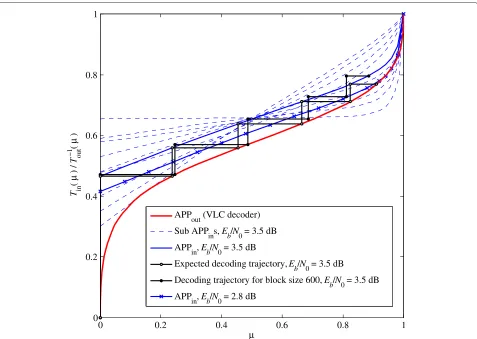
Compare the EXIT curves in Figure 5 with that of the basic benchmark mapper 50 in Figure 3a. At Eb/N0=3.5 dB, the optimized irregular mapper obtains a larger μ5, i.e., the extrinsic mutual information after 5 iterations. The cost is a higher convergence threshold:
2.8 dB, and 0.4 dB lost in Eb/N0 is observed compared with that of mapper 50. However, this threshold only rep-resents the asymptotic iterative decoding behavior, and has no direct connection with the performance under the circumstances of small blocks.
Figure 6 shows the performance of SER measured by Levenshtein distance [23]. Other than the bench-mark mapper 50, some famous mapping scheme such as Gray, anti-Gray, and maximum squared Euclidian weight (MSEW) [24] are also presented as reference mappings. Around the optimization targeted spotEb/N0 = 3.5 dB, the proposed scheme gains at most 0.3 dB compared with the benchmark mapper 50. Besides, it is worth noting that less obvious ‘waterfall’ region is observed by looking at the SERL curve of the proposed irregu-lar mapping scheme, which generally means superiorities for smaller SNRs. Additionally by comparing with other heuristic mappings in Figure 6a, we can say the proposed scheme beats these mappings on the overall performance under this very condition of block size 600 with 5 iterations.
0 0.2 0.4 0.6 0.8 1
0 0.2 0.4 0.6 0.8 1
µ
T in
(
µ
) /
T
−1 out
(
µ
)
APP
out (VLC decoder)
Sub APP
ins,Eb/N0 = 3.5 dB
APP
in,Eb/N0 = 3.5 dB
Expected decoding trajectory, E
b/N0 = 3.5 dB
Decoding trajectory for block size 600, E
b/N0 = 3.5 dB
APP
in,Eb/N0 = 2.8 dB
1 2 3 4 5 6 7 8 9
10−5
10−4
10−3
10−2
10−1
100
E
b/N0
SER
L
(a)
Proposed Mapper 50 Gray Anti−Gray MSEW [23] Separated
1 2 3
theoretical limit
E
b/N0
(b)
Figure 6SER related simulation results with ‘English Alphabet.’ SERLvs.Eb/N0for data blocks withP=1 in(a)andP=500 in(b), respectively, i.e.,
the block sizes are 600 in(a)and 3×10⁵in(b). And the iteration counts are 5 in(a)and 50 in(b).
Another reference system is a classic separated sys-tem concatenated by Huffman VLC, IrCC and anti-Gray mapping (with 1/60 RA doping too). Its overall coding rate is adjusted to the same as other JSC systems. This sep-arated system obtains the ‘waterfall’ region at the lowest SNR (at about Eb/N0 = 2.2 dB) with a large interleaver and enough iterations in Figure 6b, but shows the worst performance when the block size is diminished as in Figure 6a. This is an example to show that the design rules of asymptotically near capacity decoding can sometimes cause really inferior performance with small blocks and low iteration counts. Besides, in Figure 6b, the proposed irregular mapping scheme shows its ‘waterfall’ atEb/N0= 2.8 dB, consistent with the EXIT convergence analysis in Figure 5.
5.2 Simulation with Gaussian i.i.d. source sample
In order to verify the robustness of our method over source statistics, an additional simulation with 16-level Lloyd-Max quantized Gaussian i.i.d source samples is presented in this sub section. Gaussian distribution has widespread applications owning to the wide applicability of the central limit theorem, which makes it a practical source.
The entropy of the 16-level quantized source isH(U)= 3.747. The VLEC we use is constructed employing the algorithm in [2] and with average length¯VLEC = 8.271. Continuing to simulate withNpacket = 600, we obtain an overall coding rate R = 1.45 bits per channel use and a theoretical limit of Eb/N0 = 0.89 dB. Figure 7 shows
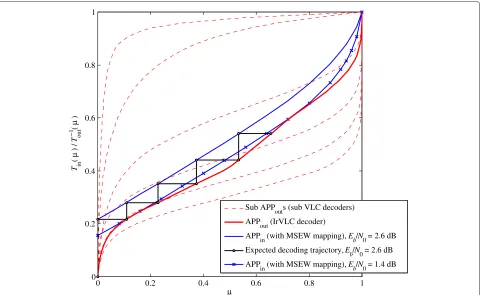
the EXIT curves of irregular mapping by maximizing μ5 at Eb/N0 = 2.6 dB. Sub mappings and their corre-sponding percentages are listed in Table 2. In addition to that, the convergence at large block size analyzed by EXIT chart isEb/N0 = 1.6 dB, which is also depicted in Figure 7.
The performance of our method is compared with an existing near capacity method in [9], which employs IrVLC for the optimization of EXIT curves. The param-eters of sub VLCs are shown in Table 3. By the way, the fourth sub VLC is the same as the VLC used in our pro-posed design. The mapper for this reference system is MSEW from [24], which results in the lowest decoding convergence with large interleaver assumed. As depicted in Figure 8, a narrow tunnel is observed atEb/N0=1.4 dB, which is 0.2 dB gain with respect to the proposed method in Figure 7. However, the observed extrinsic mutual infor-mation μ5 at the targetEb/N0 = 2.6 dB is much lower, which makes it unfit for the situation of small block with 5 iteration.
0 0.2 0.4 0.6 0.8 1 0
0.2 0.4 0.6 0.8 1
µ
T in
(
µ
) /
T
−1 out
(
µ
)
APP
out (VLC decoder)
Sub APP
ins,Eb/N0 = 2.6 dB
APP
in,Eb/N0 = 2.6 dB
Expected decoding trajectory, E
b/N0 = 2.6 dB
APP
in,Eb/N0 = 1.6 dB
Figure 7EXIT related simulation results with quantized Gaussian sample and irregular mapping. EXIT curves and expected decoding trajectory of the VLC-BICM-ID system with the proposed irregular mapping.
6 Conclusions
An irregularly mapped BICM-ID scheme for VLCs modu-lated with 8PSK is proposed in this paper. The complexity of the encoding part is very low. Other than a simple RA code, only lookup operations are needed (for VLC
Table 2 8PSK sub mappings of the irregularly mapped BICM-ISCD system with 16-level Lloyd-Max quantized i.i.d. Gaussian source samples
Index Constellation mapping Index in [20] Weight factorαj
1 0,1,3,2,6,7,5,4 72 (Gray) 0.100
2 0,1,2,3,7,6,5,4 15 0.075
3 0,1,2,6,7,3,5,4 62 0.030
4 0,1,2,5,4,6,7,3 44 0
5 0,1,2,3,4,6,5,7 3 0.540
6 0,1,2,4,7,6,5,3 35 0.025
7 0,1,2,4,3,5,6,7 16 0
8 0,1,2,5,6,3,4,7 46 0.220
9 0,3,4,7,1,2,5,6 86 (MSEW) 0.010
encoding, interleaving, and mapping). It can be applied to circumstances where the energy of the transmitter is a critical resource. The encoding complexity is in a way shifted to the receiver, since the decoding of the less com-pressed VLC with greater average word length requires more computations.
The scheme in this paper concentrates on the iterative decoding performance for small block sizes
Table 3 Sub VLCs of the asymptotic near capacity IrVLC system [9]
Index Average word length Rate Weight factor
1 3.912 0.96 0
2 4.271 0.88 0
3 6.193 0.61 0.490
4 8.271 0.45 0.004
5 10.21 0.37 0
6 12.26 0.31 0.506
0 0.2 0.4 0.6 0.8 1 0
0.2 0.4 0.6 0.8 1
µ T in
(
µ
) /
T
−1 out
(
µ
)
Sub APP
outs (sub VLC decoders) APP
out (IrVLC decoder) APP
in (with MSEW mapping), Eb/N0 = 2.6 dB Expected decoding trajectory, E
b/N0 = 2.6 dB APPin (with MSEW mapping), Eb/N0 = 1.4 dB
Figure 8EXIT related simulation results with quantized Gaussian sample and IrVLC. EXIT curves and expected decoding trajectory of the IrVLC-BICM-ID system proposed in [9].
with low iterations, which is more practical in band-width and delay sensitive communications. By set-ting an optimization target, selecset-ting a set of sub mappings with diverse-shaped EXIT curves and then optimizing their percentages, irregular mapping with
maximum extrinsic mutual information after a target number of iterations is derived. For small interleaving depths, our scheme exhibits better performance with respect to the existing asymptotic capacity-approaching system.
0 1 2 3 4 5 6 7 8 9
0 5 10 15 20
E
b/N0
RSNR(dB)
(a)
Proposed Gray Anti−Gray MSEW [23] IrVLC [9]
0 1 2 3
theoretical limit
E
b/N0
(b)
Figure 9RSNR related simulation results with quantized Gaussian sample. RSNR vs.Eb/N0for data blocks withP=1 in(a)andP=500 in(b),
A Appendix: Proof of Equation 2
Possible values of the zero-padding lengthpaddingbelongs to set{0, 1,. . .,max−1}, and the probabilities forpadding with the values in that set is
Pr{padding=i} = Pr{ (U1:K)=Npacket−i} ·Pr{ (UK+1) >i}, (13) 0 ≤ i≤max−1
For sufficient long packet length Npacket (much larger thanmax), the values of Pr{ (U1:K)=Npacket−i}for dif-ferenti ∈ {0, 1,. . .,max−1}are almost equal with each other, which thus can be treated as a constant normaliza-tion factorω, i.e., Pr{padding = i} = ω·Pr{ (UK+1) >
The average value forpaddingis
padding = is derived, which is exactly Equation 2.
Competing interests
The authors declare that they have no competing interests.
Acknowledgements
The authors would like to thank the anonymous reviewers and the editor for their valuable comments. This research work was supported by the State Key Program of National Natural Science Foundation of China (Grant No. 61032006) and the National Science Foundation of China (Grant No. 61271282 and 60172045).
Received: 15 October 2014 Accepted: 6 April 2015
References
1. Y Takishima, M Wada, H Murakami, Reversible variable length codes. IEEE Trans. Commun.43(234), 158–162 (1995)
2. J Wang, L-L Yang, L Hanzo, Iterative construction of reversible variable-length codes and variable-length error-correcting codes. IEEE Commun. Lett.8(11), 671–673 (2004)
3. Y-M Huang, T-Y Wu, YS Han, An A*-based algorithm for constructing reversible variable length codes with minimum average codeword length. IEEE Trans. Commun.58(11), 3175–3185 (2010)
4. V Buttigieg, PG Farrell, Variable-length error-correcting codes. IEE Proc. Commun.147(4), 211–215 (2000)
5. A Diallo, C Weidmann, M Kieffer, New free distance bounds and design techniques for joint source-channel variable-length codes. IEEE Trans. Commun.60(10), 3080–3090 (2012)
6. L Bahl, J Cocke, F Jelinek, J Raviv, Optimal decoding of linear codes for minimizing symbol error rate (corresp.) IEEE Trans. Inform. Theory.20(2), 284–287 (1974)
7. VB Balakirsky, inProceedings of IEEE International Symposium on Information Theory (ISIT ’97): June-July 1997. Joint source-channel coding with variable length codes (Ulm, Germany, 1997), p. 419
8. R Bauer, J Hagenauer, inProceedings of the 3rd ITG Conference on Source and Channel Coding (CSCC ’00): January 2000. Symbol-by-symbol MAP decoding of variable length codes (Munich, Germany, 2000), pp. 111–116 9. RG Maunder, J Wang, SX Ng, L-L Yang, L Hanzo, On the performance and
complexity of irregular variable length codes for near-capacity joint source and channel coding. IEEE Trans. Wireless Commun.7(4), 1338–1347 (2008) 10. X Li, JA Ritcey, Bit-interleaved coded modulation with iterative decoding.
IEEE Commun. Lett.1(6), 169–171 (1997)
11. S ten Brink, Convergence behavior of iteratively decoded parallel concatenated codes. IEEE Trans. Commun.49(10), 1727–1737 (2001) 12. A Ashikhmin, G Kramer, S ten Brink, Extrinsic information transfer
functions: model and erasure channel properties. IEEE Trans. Inform. Theory.50(11), 2657–2673 (2004)
13. F Schreckenbach, N Görtz, J Hagenauer, G Bauch, inProc. IEEE GLOBECOM 2003. Optimized symbol mappings for bit-interleaved coded modulation with iterative decoding (San Francisco, CA, 2003), pp. 3316–3320 14. Z Yang, Q Xie, K Peng, J Song, Labeling optimization for BICM-ID systems.
IEEE Commun. Lett.14(11), 1047–1049 (2010)
15. M Tüchler, J Hagenauer, inProc. 2002 Conf. Information Sciences and Systems. EXIT charts of irregular codes (Princeton, NJ, 2002), pp. 748–753 16. F Schreckenbach, G Bauch, Bit-interleaved coded irregular modulation.
European Trans. Telecommun.17(2), 269–282 (2006)
17. R Tee, RG Maunder, L Hanzo, EXIT-chart aided near-capacity irregular bit-interleaved coded modulation design. IEEE Trans. Wireless Commun. 8(1), 32–37 (2009)
18. C Cheng, G Tu, C Zhang, J Dai, Optimization of irregular mapping for error floor removed bit-interleaved coded modulation with iterative decoding and 8psk. EURASIP J. Wireless Commun. Netw.2014(1), 31–45 (2014) 19. M Tüchler, Design of serially concatenated systems depending on the
block length. IEEE Trans. Commun.52(2), 209–218 (2004)
20. F Brännström, LK Rasmussen, Classification of unique mappings for 8PSK based on bit-wise distance spectra. IEEE Trans. Inform. Theory.55(3), 1131–1145 (2009)
21. S Pfletschinger, F Sanzi, Error floor removal for bit-interleaved coded modulation with iterative detection. IEEE Trans. Wireless Commun.5(11), 3174–3181 (2006)
22. S Lloyd, Least squares quantization in PCM. IEEE Trans. Info. Theory.28(2), 129–137 (1982)
23. VI Levenshtein, Binary codes capable of correcting deletions, insertions and reversals. Soviet Physics Doklady.10, 707 (1966)
24. J Tan, G Stüber, Analysis and design of symbol mappers for iteratively decoded BICM. IEEE Trans. Wireless Commun.4(2), 662–672 (2005)
Submit your manuscript to a
journal and benefi t from:
7Convenient online submission 7Rigorous peer review
7Immediate publication on acceptance 7Open access: articles freely available online 7High visibility within the fi eld
7Retaining the copyright to your article
![Figure 2.W 1, the distance spectrum with full prior informa-tion, has an identical structure as W 0 in Equation 3.Under this full prior information condition, the otherbits v[i] =�v1, · · · , vi−1, vi+1, · · · , vQ�within the sameQ-bit tuple are assumed to](https://thumb-us.123doks.com/thumbv2/123dok_us/950070.1116066/3.595.306.540.87.308/distance-spectrum-identical-structure-equation-information-condition-otherbits.webp)

![Table 3 Sub VLCs of the asymptotic near capacity IrVLCsystem [9]](https://thumb-us.123doks.com/thumbv2/123dok_us/950070.1116066/9.595.60.540.84.425/table-sub-vlcs-asymptotic-near-capacity-irvlcsystem.webp)