R E S E A R C H
Open Access
Energy efficient coordinated precoding design
for a multicell system with RF energy
harvesting
Shiwen He
*, Yongming Huang, Wenyang Chen, Shi Jin, Haiming Wang and Luxi Yang
Abstract
This paper investigates multicell multiuser downlink systems with simultaneous wireless information and power transfer. We study the energy efficient transmission design for maximizing the system energy efficiency of data transmission (bits/Joule delivered to the receivers) which is defined as the ratio of the weighted sum rate to the total power consumption. In particular, we focus on the energy efficient coordinated precoding for the downlink of multicell system using the power splitting technique where each receiver divides the received signal into two power streams for concurrent information decoding and energy harvesting. To solve the non-convex optimization problem under consideration, first, we transform the primal optimization problem in fractional form into a tractable
parameterized subtractive form optimization problem. Then, the tractable problem is solved by applying the technique of the Lagrangian optimization technique and semidefinite relaxation. An efficient solution to the considered optimization problem is finally developed. Numerical results validate the effectiveness of the proposed algorithm and reveal that the proposed algorithm can achieve better energy efficiency performance than the traditional energy efficient transmission.
Keywords: Energy harvesting; Power splitting; Energy efficient optimization; Coordinated multicell precoding; Non-convex optimization
1 Introduction
With explosive growth of high-data-rate applications, rapidly increasing energy is consumed in wireless net-works to guarantee quality of service. Driven by this obser-vation, energy-efficient communications have attracted increasing attention in both industry and academia [1]. In [2], the authors discussed the models of current energy consumption in base station (BS) devices. A survey of energy-efficient wireless communications can be found in [3] where several different energy efficiency metrics have been described, with ‘bits per Joule’ as the most popular one, which is defined as the system through-put achieved with unit-energy consumption. Later, [4] provided a general framework for obtaining the energy-efficient power allocation strategy in fading channels.
*Correspondence: [email protected]
School of Information Science and Engineering, Southeast University, Nanjing 210096, China
Particularly, it was revealed that as the rate of the sys-tem is a concave function of the transmission power, a unique global maximum energy efficiency exists that can be achieved through an optimum power allocation strat-egy using fractional programming. The Pareto boundary of the achievable energy efficiency region of theK-links interference channels was characterized by maximizing the per-user energy efficiency which is defined as the achievable data rate at the user divided by the total power consumption of the transmitter [5]. Recently, the energy efficient coordinated beamforming optimization problem was investigated for multicell downlink systems [6-8]. In addition, considering nakagami-mflat-fading channels with a delay-outage probability constraint, an energy-efficient power allocation scheme was proposed in [9].
It is worth noting that all algorithm obtained in the mentioned references only focus on the energy effi-ciency optimization without taking the energy harvesting
into account. On the other hand, wireless power trans-fer technology, which enables the receivers to scavenge energy from propagating electromagnetic waves (EM) in radio frequency (RF), has recently gained much atten-tion in both industry and academia [10-17]. A uni-fied study on simultaneous wireless information and power transfer (SWIPT) was presented for multiple-input multiple-output (MIMO) wireless broadcast system [10]. A SWIPT algorithm was developed for multiuser mul-tiple input single ouptut (MISO) broadcast systems in which each of which implements information decoding (ID) or energy harvesting (EH) [11]. The authors in [12] proposed a dynamic power splitting (DPS) scheme to achieve SWIPT. Recently, the power minimization prob-lem for simultaneous wireless information and power transfer was addressed for MISO downlink transmission systems [13,14]. In addition, resource allocation strate-gies were also investigated for a point-to-point wireless communications system with hybrid energy sources con-sisting of an energy harvester and a conventional energy source [15]. More recently, the resource allocation prob-lem was solved for a point-to-point single user system with power splitting receiver in ergodic fading chan-nels [16]. In addition, a resource allocation scheme for maximizing the energy efficiency of data transmission was developed for single input single output (SISO) frequency division multiple access (OFDMA) system with simul-taneous wireless information and power transfer [17]. Whereas, it was solved based on the assumption of high signal to interference ratio and ignoring the inter-user interference. It is worth mentioning that most of the work in the literature focuses on the power mini-mization problem with simultaneous wireless information and power transfer or the energy efficiency optimization problem for single cell SISO OFDMA communication systems. There are few work investigating the transmis-sion design for the more complex multi-antenna multicell system.
In this paper, we investigate coordinated beamform-ing design for simultaneous wireless information and power transfer in multicell multiuser MIMO (MU-MIMO) downlink systems. Particularly, we focus on maximizing the system energy efficiency of data trans-mission (bits/Joule delivered to the receivers), which is defined as the ratio of the weighted sum rate to the total power consumption, by splitting the received sig-nal power into two parts for concurrent information decoding and EH. The considered optimization is non-convex and hard to tackle; to solve it, we first trans-form the original objective function in fractional trans-form into a parameterized subtractive form optimization prob-lem [18,19]. Then, we develop an iterative algorithm to reach its solution by alternating optimization. The con-vergence of the proposed algorithm is guaranteed by
the monotonic boundary theorem [20]. Finally, numerical results validate the effectiveness of the proposed algo-rithm and show that the optimal energy efficiency and spectral efficiency can be achieved simultaneously in the low SNR region; while in the middle-high SNR region, the maximization of spectral efficiency usually cannot bring optimal energy efficiency at the same time and vice versa. Compared to the energy efficiency performance achieved by the traditional energy efficient transmission [6-8], the proposed algorithm can achieve better energy efficiency performance.
The rest of this paper is organized as follows. The sys-tem model and problem formulation are described in Section 2. In Section 3, a useful transformation of objec-tive function is given by using jointly the relation between the minimum mean square error and the fractional pro-gramming method. Then an energy efficient precoding method with energy harvesting is developed in Section 4. The simulation results are shown in Section 5 and conclu-sions are finally provided in Section 6.
The following notations are used throughout this paper. Bold lowercase and uppercase letters represent column vectors and matrices, respectively.|A|denotes the deter-minant of matrix A. The superscripts (·)H, and (·)−1 represent the conjugate transpose operator, and the matrix inverse, respectively. Tr(A) represents the trace of matrix A, and log(·) is the logarithm with base e. The probability density function (pdf ) of circular com-plex Gaussian random vector with mean μ and covari-ance matrix is denoted asCN(μ,).E[·] andCare the statistical expectation and the complex number field, respectively.
2 System model and problem formulation
Consider a K-cell MU-MIMO downlink system where each cell includes one multiple antenna BS and a plu-rality of multiple antenna users. This paper focuses on a coordinated beamforming design under the assumption of perfect channel state information (CSI) knowledge at BS. We denote thekth user in cell-jas User-j,kand the BS in cell-mas BS-m. BS-jis equipped withMjtransmit
anten-nas and servesIjusers in cell-j.
j,kis equipped with
Nj,k antennas. The received signal of including both the large scale fading and the small scale fading,Wj,k ∈ CMj×dj,k denotes the beamforming matrix
User-j,k, xj,k ∈ Cdj,k×1denotes the information signal
intended for User-j,k with pdf pxj,k
=CN(0,I), and zj,k ∈ CNj,k×1denotes the additive white Gaussian noise
(AWGN) with distributionCN0,σj2,kI. We assume that the signals for different users are independent from each other and the receiver noise. For notational convenience, let Wj =
Wj,1,· · ·,Wj,Ij
denote the multiuser pre-coder set of BS-jand letW = {W1,· · ·,WK}denote the
collection of all the precoders.
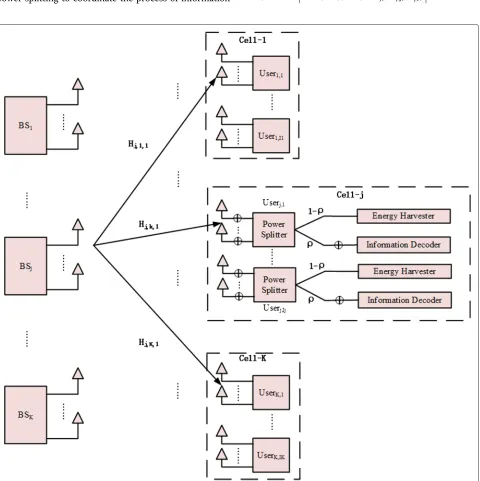
In this paper, we assume that each user applies power splitting to coordinate the process of information
decoding and energy harvesting from the receive sig-nal [10,12]. In particular, as shown in Figure 1, the received signal at each user is split to the information decoder and the energy harvester by a power spitter. Letρj,k ∈ (0, 1)
denote the power splitting parameter for User-j,k, this means that 100ρj,k% of the received power is used for data
detection while the remaining amount is the input to the RF-EH circuity. As a result, the instantaneous raterj,k of
User-j,kcan be calculated as
rj,k =log I+ρj,kHj,j,kWj,kWHj,kHHj,j,kR−j,k1 (2)
Figure 1A multicell multiuser downlink system, where each user coordinates information decoding and energy harvesting via power
where Rj,k denotes the interference-plus-noise which
includes the inter-user interference, the inter-cell interfer-ence and the AWGN, given by
Rj,k=ρj,k
j,kthat is because additional circuit noise is present due to phase offsets and non-linearities which is usually mod-eled as AWGN with zero mean and varianceσs2,j,k. In order to obtain a tradeoff between the sum rate and the total power consumption, we adopt a new energy efficiency optimization criterion defined asa
max
which specifies the minimum required power transfer to User-j,k and j,k > 0, ∀j,k. In other words, in this paper, we consider a general case where all users have no-zero harvested power targetb. The weightj,k is used to
represent the priority of User-j,k, giving a larger value to the user with a higher rate requirement. The term
Ij processing circuit power consumption in the transmit-ters, caused by the transmit filter, the mixer, the frequency synthesizer, and the digital-to-analog converter, which are independent of the actual transmitted power. PCR denotes the circuit power consumption in the receivers.
pcj,k denotes the power dissipation in the power amplifier at transmitter for User-j,kwhich is defined as
whereϑj ≥1 is a constant which accounts for the
ineffi-ciency of the power amplifier [17].pEj,kdenotes the energy harvested at User-j,kand is expressed as ability of harvesting energy from signal, interference and noise powers.
It is easy to see that the coupling of optimization vari-ables leads to that problem (4) is non-convex and is therefore difficult to solve directly, which is the main drawback for the beamforming algorithm design. More-over, the sum-of-ratio form in the objective function (4) makes the problem more intractable. In the rest of this paper, we focus on finding solution to the optimization problems (4).
3 Transformation of the objective function In this section, we reformulate firstly the original problem into a tractable form by transforming the objective func-tion into an optimizafunc-tion problem based on the minimum mean square errors (MMSE) receiver. In what follows, we treat interference as noise and consider linear receive beamforming strategy so that the estimated signal is given by
more factors, such as the power splitter factorρj,kand the
signal processing noise item. Fixing all the transmit beam-formersW and minimizing MSE lead to the well-known MMSE receiver:
Ummsej,k =ρj,kWHj,kHHj,j,kT−j,k1 (10)
whereTj,k is the covariance matrix of the total received
signal at User-j,kand is calculated by
Using this MMSE receiver, the corresponding MSE matrix is given by
Emmsej,k =I−ρj,kWHj,kHHj,j,kT−j,k1Hj,j,kWj,k (12)
According to the Woodbury matrix identity ([23], pp. 124, 3.8.3), we have
Emmsej,k
−1
= I+ρj,kHj,j,kWj,kWHj,kHHj,j,kR−j,k1 (13)
Combining (2) with (13) and applying the conclusion given in [21,22], problem (4) can be reformulated as fol-lows
the linear equalizers andUj =
Uj,1,· · ·,Uj,Ij
denotes the collection of all the linear equalizers in cell-j. = {1,· · ·,K} denotes the collection of all the auxiliary of all the auxiliary variables in cell-j. Note that the equiv-alence relation implies that the weighted sum-rate can be replaced with a optimization form with some additional auxiliary variables, see (14). The latter problem is in the space of(W,U,)and is easier to handle since optimiz-ing each variable while holdoptimiz-ing others fixed is convex and easy (e.g., closed form). In the following section, this prop-erty will be exploited to design an effective energy efficient transmission method with taking energy harvesting into account.
4 Energy-efficient optimization algorithm with energy harvesting
4.1 Algorithm design
It is easy to see that the function given by the numera-tor in the objective function (14) is concave in each of the optimization variablesW,U, and, but the function given by the numerator in the objective function (14) is jointly non-concave with respect to variablesW,U, and
. In the sequel, we propose to use the block coordinate optimization method to solve (14). In particular, we opti-mize the problem by sequentially fixing two of the three variables W, U, and updating the third. The results in ([17], Theorem 1) has revealed that there exists an equivalent optimization problem with an objective func-tion in subtractive form for an optimizafunc-tion problem with an objective function in fractional form. It also means that we need to search a value ofqsuch that the optimal value of the objective function of the following problem (15) is zero.
It is easily known that for fixedq, andW, the optimal solution ofUoptj,k is given by (10) and the optimal solution ofj,kis calculated as
opt j,k =E
−1
j,k (16)
In what follows, we focus on solving problem (15) with fixedq,Uandwhich can be reformulated as
min
Then, the Lagrangian of problem (17) is given by
whereκandλdenote the Lagrange multipliers associated with the power constraints and the individual minimum required power transfer constraints. Thus, the dual prob-lem for the primal probprob-lem (17) is given by
max
κ,λ minW L(W,κ,λ) (19) By plugging (5) and (9) into (18) and using the standard convex optimization techniques and the KKT conditions, the optimal solution ofWto problem (17) is given by
Wj,k =j,kρj,kj−1HHj,j,kUHj,kj,k (20)
wherejis calculated as
j=
In addition, the outer optimization of problem (19) can be achieved by using the gradient method which leads to the following Lagrange multiplier update equations:
κ(μ+1)
step size. Here, it should be pointed out that the initial-ization of the precodersWcan be achieved by solving the following optimization problem.
can be further expressed in standard semidefined pro-gramming (SDP) form with linear matrix inequalities (see [24] Equation (1)) as formulation (25).
min
To make problem (25) tractable, we first ignore the rank constraints and focus on problem (25) without rank
constraints named as relaxed problem. The relaxed prob-lem is convex and belongs to the class of SDP, as it is composed of cones of positive semdefinite matrices and linear matrix inequalities involving W. The numerical solution can be found by using SDP solvers. SupposeW∗ is the optimal solution to the relaxed problem, due to the relaxation, Rank
W∗j,k
may not satisfy the corre-sponding rank constraint in general. To address the issues, the randomization technique is adopted here to solve the rank constraint problem. In the randomization technique, we eigendecompose W∗j,k = Uj,kj,kU
matrix whose entries satisfy uniform or Gaussian distribu-tion [25]. Then the initializadistribu-tion ofWj,kcan be obtained
asWj,k =Uj,kj1,/k2j,k. To summarize, one algorithm for
solving problem (14) is described as Algorithm 1.
Algorithm 1 Energy efficient precoding transmission with energy harvesting
1: Setq=0;
2: InitializeW(ν)withν=0, lethdenote the objective value of (15) and leth(ν)=0;
3: UpdateUandwith (10), (14), andW(ν), and obtain U(ν)and(ν);
4: Letν=ν+1, updateWby solving problem (17) with fixedU(ν−1)and(ν−1), and obtainW(μ);
5: Compute the objective value of (15) with W(μ),U(ν−1), and(ν−1), and obtainh(ν). If
(ν−1)meets the following inequality
then stop the iteration, otherwise go to step 2.
users have the same power splitter factors, namely,ρj,k =
ρ, ∀j,k. LetEE(ρ) denote the objective value of prob-lem (4) with givenρ. It is easy to see thatEE(1)denote the maximum energy efficiency value of problem (4) that only aims to maximize the system energy efficiency with-out taking the energy harvesting into account. Based on this results, we further develop Algorithm 2 as below to numerically search the optimal value ofρ.
Algorithm 2Power splitter factor optimization
1: Solve problem (4) withρ = 1, and obtainEE(1). Let
ρmin=0,ρmax=1, andρprev=1.
2: Letρmid = ρmin+2ρmax. Solve problem (4) withρmid,
and obtainEE(ρmid).
3: If |ρmin−ρmax| ≤ ζ, where ζ is an arbitrary small
positive number, then output the EE(ρmid) and the
corresponding solution to problem (4) withρmid. If EE(ρmid) ≥EE(ρmax), then letρpre = ρmax,ρmax =
ρmidandEE(ρmax)=EE(ρmid), otherwise letρmax=
ρpre,ρmin=ρmid, then to step 2.
4.2 Algorithm analysis
In this subsection, we briefly analyze the convergence and the computational complexity of Algorithm 1.
Lemma 1. The sequence generated by the step 3 to step 4 of Algorithm 1 guarantees to converge to a stationary point of problem (15). Furthermore, the convergence of Algorithm 1 also can be guaranteed.
Proof.It is easily seen that the updates of step 3 to step 4 in Algorithm 1 all aim to increase the sum rate so that an increasing sequence is generated while the itera-tion running. Since the achievable SINR region under the transmit power constraint is bounded, the sum rate is also bounded. The convergence of Algorithm 1 is guaranteed by the monotonic convergence theorem [26,27]. Note that the optimization problem (15) has a differentiable objec-tive function and the transmit power constraints only work for variableW. It follows from the general optimiza-tion theory [26,27] that steps 3 to 4 in Algorithm 1, which is a block coordinate ascent method applied to prob-lem (15), converge to a stationary point of probprob-lem (15). Based on these analyses, the convergence of Algorithm 1 can be guaranteed with the fractional theorem obtained in [18,19].
It is easily found that the computational complexity of Algorithm 1 mainly arise from the matrix inversion oper-ation which is used to calculate the optimal linear equal-izer given by (10), the optimal auxiliary variable obtained
by (16) and the optimal beamformer based on (20), respec-tively. Assume thatMj = M,Nj,k = N,Ij = I,dj,k = d,
∀j,k,d≤NandId≤min(IN,M). We count the floating point operations (flops) to indicate the complexity. A flop corresponds to a real floating-point operation. Therefore, a real addition, multiplication, or division is counted as one flop while a complex addition and multiplication have two flops and six flops, respectively. Similar to [28,29], the complexity of some basic matrix calculations are approxi-mately counted as follows: Multiplication of twom×pand
p×qcomplex matrices involves 8mpqflops; inversion of anm×mHermite matrix involves4m33 flops; Inversion of anm×mreal matrix involves 2m33 flops; inversion of an
m×mreal symmetric matrix involves m33 flops. Based on these references, the computation required for each active User-j,kis as follows:
• Inversion ofjneeds about4M
3
3 +8dMKI(M+N)
flops. Therefore, the update of the beamforming
matrixWj,kneeds about
4M3
3 +8dM(KIM+KIN+d)flops. We also note
that matrixjcan be calculated only once for all
beamformingWj,k,∀k.
• The calculation ofT−j,k1needs about
4N3
3 +8dNKI(M+N)flops. Therefore, the
calculation ofUj,kneeds about
4N3
3 +8dNKI(M+N)+8dN2flops.
• The calculation ofj,kneeds about4d
3
3 +8d2Nflops.
Therefore, one execution of steps 3 to 4 in Algo-rithm 1 takes approximately 43KIM3+N3+d3 +
8dK2I2(M+N) (M+2N) + 8dMKI(KIN+d) = O37K2I2τ3flops, whereτ =max(M,N).
5 Numerical results
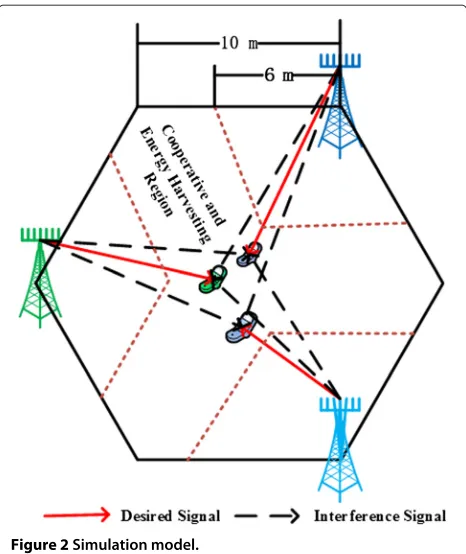
In this section, we numerically evaluate the performance of the proposed energy efficient transmission algorithm in multicell multiuser downlink systems. We consider a small cell communication systems withK = 3 coordi-nated BSs, and assume that all users have the same set of parameters, i.e.,dj,k = d,ηj,k = η, ρj,k = ρ, j,k = ,
σ2
Figure 2Simulation model.
to model the channel [30]. Specially, Hm,j,k is expressed
as
Hm,j,k =
KR
1+KR
HLOSm,j,k+
1 1+KR
HNLOSm,j,k (26)
where HNLOSm,j,k denotes the Rayleigh fading component with each element being a circularly symmetric com-plex Gaussian random variable with zero mean and cova-riance−8dˆm,j,k dB,KRis the Rician factor set to be 6 dB,
andHLOSm,j,k ∈ CN×Mis the LOS deterministic component and is given asc
HLOSm,j,k =10−√dm,j,k
⎡ ⎢ ⎣
ejφ1,1 · · · ejφ1,M ..
. . .. ...
ejφN,1 · · · ejφN,M
⎤ ⎥
⎦ (27)
where ejφn,m are the elements of the fixed LOS matrix
HLOSm,j,k with φn,m = −2πιsinλ(n,m), where ι is the
spac-ing between successive antenna elements at BS, λis the carrier wavelength, andn,mis derived from the angle of
arrival/departure of the LOS component. For the sake of simplify, following [31],φn,mis set to be zero in all
simu-lations,∀n,m. In addition, a 12 dB effective antenna gain was also considered in our simulation.
For the sake of illustration, the performance curves of Algorithm 1 with fixed power splitting factorρ=0.8 and Algorithm 1 with optimized power splitting factorρare labeled as ‘proposed algorithm I’ and ‘proposed algorithm
II’ in our simulation figures, respectively. For baseline I, we maximize the weighted sum rate (bit/s/Hz) with respect to W subject to per-BS power constraint, instead of the energy efficiency. On the other hand, baseline II maxi-mizes the weighted energy efficiency of the system with respect to W and without taking into account the min-imum energy harvesting constraint in the optimization problem. The average energy efficiency of the system is computed according to (4) and averaged over 1,000 inde-pendent random realizations of multipath fading and path loss attenuation.
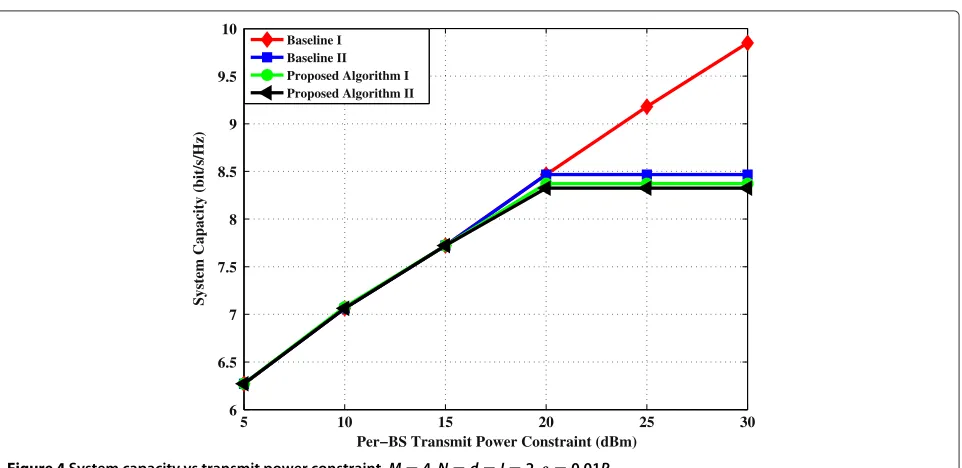
Figure 3 shows the average system energy efficiency ver-sus the maximum transmit power allowance for different algorithms. It can be seen that the average system energy efficiency of our proposed algorithms and baseline II is a monotonically non-decreasing function of the maximum transmit power constraintP. In particular, the energy effi-ciency first quickly increases with an increasing P and then saturates whenP>20 dBm due to the fact that a bal-ance between the system energy efficiency and the power consumption of the system is obtained. In the lower trans-mit power constraint region, such as 5<P<15 dBm, all algorithms achieve the same performance in terms of the system energy efficiency criterion. It is also observed that in the low transmit power regime, the system with power splitting receivers achieves a small performance gain com-pared to the system without energy harvesting receivers since the received power of the desired signal at the receivers may not be sufficiently large for simultaneous information decoding and energy harvesting. However in the high transmit power region, proposed algorithm II outperforms the proposed algorithm I due to the fact that the former is designed based on the optimization of the power splitting factor. Compared to baseline II, about a 6% gain in terms of energy efficiency can be achieved by algo-rithm II. In addition, baseline I which aims to maximize the weighted sum rate with respect to the beamformersW achieves a very low energy efficiency due to the fact that the gain of system sum rate cannot compensate the con-sumption of the transmit power. From the comparison in terms of system capacity as illustrated in Figure 4, some opposite conclusions are obtained.
Figure 3Energy efficiency vs transmit power constraint,M=4,N=d=I=2, =0.01P.
important affection of the performance of system energy efficiency.
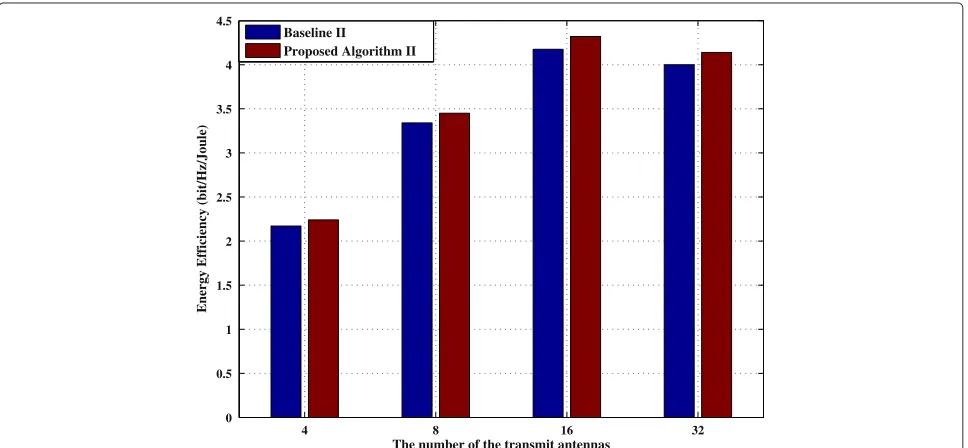
Figure 6 illustrates the average system energy efficiency versus the transmit antenna for proposed algorithm II with a fixed ratio ofM: I. It can be seen that the system energy efficiency increases with an increasing number of transmit antennas. It also means that the system energy efficiency can be benefited from the user diversity of mul-tiple users. It is interesting to note that these observations
are similar to the results obtained in [32], i.e., multiplex-ing to many users rather than beamformmultiplex-ing to a smultiplex-ingle user and increasing the number of service antennas can simultaneously benefit both the spectral efficiency and the energy efficiency. However, when the number of the transmit antennas is greater than a certain value, i.e., the number of the served users is greater than certain value, the energy efficiency decreases with an increasing number of transmit antennas with a fixed ratio ofM:Idue to the
Figure 5Energy efficiency vs minimum power transfer,M=4,N=d=I=2.
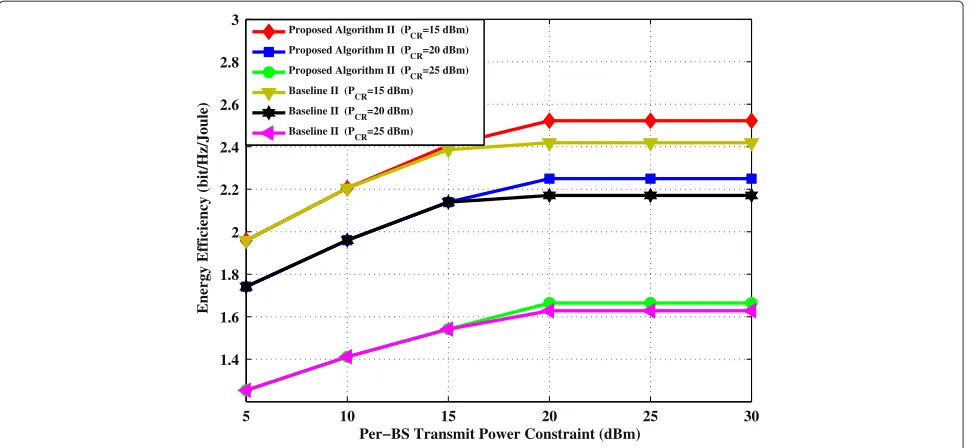
fact that the fixed power consumption of the terminal also increases rapidly resulting in a lower energy efficiency. As shown in Figure 7, the energy efficiency of the simulated two algorithms decreases with an increasing fixed receiver power consumptionPCR.
6 Conclusions
In this paper, the transmit beamforming optimization problem was studied for simultaneous wireless
infor-mation and power transfer in coordinated multicell mul-tiuser downlink system. Particularly, we focused on the energy efficient precoding design by using the power split-ting technique where each receiver divides the received signal into two power streams for concurrent information decoding and energy harvesting. An iterative algorithm to reach its solution was developed by suing the alternat-ing optimization method. Numerical results validate the effectiveness of the proposed algorithm and show that the
Figure 7Energy efficiency vs minimum power transfer,M=4,N=d=I=2, =0.01P.
optimal energy efficiency and spectral efficiency can be achieved simultaneously in the low SNR region; while in the middle-high SNR region, the maximization of spec-tral efficiency usually cannot bring optimal energy effi-ciency at the same time and vice versa. Compared to the energy efficiency performance achieved by the traditional energy efficient transmission, the proposed algorithm can achieve better energy efficiency performance.
Endnotes
aNote that by imposing the power splitting factors
ρj,k =1,∀j,k, then problem (4) reduces to the traditional
energy efficient transmission optimization problem. In our paper, the values ofρ, whereρdenote the collection of allρj,k, is first assumed to be fixed in order to obtain an
effective solution to the energy efficient precoding problem. We then considered then the power splitting faction optimization for a special case where all users have the same ability to harvest energy. It should be pointed out that the considered problem formulation is also applicable to the case with time-switching receivers (or, under the given time instant, each receiver is either for energy harvesting or information decoding) by adjusting the power splitting factor of each user [11].
bWe would like to point out that our developed energy
efficient transmission algorithm with energy harvesting can also apply to the special case where the value ofj,kis
zero,∀j,k.
cNote that for LOS component, we use the far-field
uniform linear antenna array model [30].
Competing interests
The authors declare that they have no competing interests.
Acknowledgements
This work was supported by National Science and Technology Major Project of China under Grant 2012ZX03004005-003, National Basic Research Program of China under Grant 2013CB329002, National Natural Science Foundation of China under Grants 61471120, 61271018, 61422105, and 61372101, and Research Project of Jiangsu Province under Grants BK20130019 and BK2012021.
Received: 21 October 2014 Accepted: 16 February 2015
References
1. Z Xu, C Xiong, C Yang, S Zhang, Y Chen, S Xu, Energy efficient wireless communications: tutorial, survey, and open issues. IEEE Wireless Commun. Mag.18(6), 28–35 (2011)
2. C Han, T Harrold, S Armour, I Krikidis, S Videv, P Grant, H Haas, J Thompson, I Ku, C Wang, T Le, M Nakhai, J Zhang, L Hanzo, Green radio: Radio techniques to enable energy-efficient wireless networks. IEEE Commun. Mag.49(6), 46–54 (2011)
3. D Feng, C Jiang, G Lim, L Cimini Jr, G Feng, G Li, A survey of
energy-efficient wireless communications. IEEE Commun. Surv. Tutorials.
15(1), 167–178 (2013)
4. C Isheden, Z Chong, E Jorswieck, G Fettweis, Framework for link-level energy efficiency optimization with informed transmitter. IEEE Trans. Wireless Commun.11(8), 2946–2957 (2012)
5. Y Huang, J Xu, L Qiu, Energy efficient coordinated Beamforming for multi-cell MISO systems. IEEE Globecom, 2526–2531 (2013) 6. S He, Y Huang, S Jin, L Yang, Coordinated beamforming for energy
efficient transmission in multicell multiuser systems. IEEE Trans. Commun.
61(12), 4961–4971 (2013)
7. S He, Y Huang, L Yang, B Ottersten, Coordinated multicell multiuser precoding for maximizing weighted sum energy efficiency. IEEE Trans. Sig. Proc.62(3), 741–751 (2014)
8. S He, Y Huang, H Wang, S Jin, L Yang, Leakage-aware energy-efficient beamforming for heterogeneous multicell multiuser systems. EEE J. Sel. Commun. Area.32(6), 1268–1281 (2014)
9. L Musavian, T Le-Ngoc, Energy-efficient power allocation over nakagami-m fading channels under delay-outage constraints. IEEE J. Sel. Areas Commun.13(80), 4081–4091 (2014)
10. R Zhang, CK Ho, MIMO broadcasting for simultaneous wireless information and power transfer. IEEE Trans. Wireless Commun.
11. J Xu, L Liu, R Zhang, Multiuser MISO beamforming for simultaneous wireless information and power transfer. IEEE Trans. Signal Process.
62(18), 4798–4810 (2014)
12. L Liu, R Zhang, K Chua, Wireless information and power transfer: a dynamic power splitting approach. IEEE Trans. Commun.61(9), 3990–4001 (2013) 13. S Timotheou, I Krikidis, G Zheng, B Ottersten, Beamforming for MISO
interference channels with QoS and RF energy transfer. IEEE Trans. Wireless Commun.13(5), 2646–2658 (2014)
14. Q Shi, WXu L Liu, R Zhang, Joint transmit beamforming and receive power splitting for MISO SWIPT systems. IEEE Trans. Wireless Commun.
13(60), 3269–3280 (2014)
15. X Kang, Y Chia, C Ho, S Sun, Cost minimization for fading channels with energy harvesting and conventional energy. IEEE Trans. Wireless Commun.13(8), 4586–4598 (2014)
16. X Zhou, R Zhang, CK Ho, Wireless information and power transfer: architecture design and rate-energy tradeoff. IEEE Trans. Commun.
61(11), 4757–4767 (2013)
17. D Ng, E Lo, R Schober, Wireless information and power transfer: Energy efficiency optimization in OFDMA systems. IEEE Trans. Wireless Commun.
12(12), 6352–6370 (2013)
18. R Jagannathan, On some properties of programming problems in parametric form pertaining to fractional programming.Manage. Sci.
12(7), 609–615 (1966)
19. W Dinkelbach, On nonlinear fractional programming. Bull. Aust. Math. Soc.13(3), 492–498 (1967)
20. J Borwein, A Lewis,Convex analysis and nonlinear optimization: Theory and examples. (Canadian Mathematical Society, Springer Verlag, 2006) 21. S Christensen, R Agarwal, E Carvalho, J Cioffi, Weighted sum rate
maximization using weighted MMSE for MIMO-BC beamforming design. IEEE Trans. Wireless Commun.7(12), 4792–4799 (2008)
22. Q Shi, M Razaviyayn, Z Luo, C He, An iteratively weighted MMSE approach to distributed sum-utility maximization for a MIMO interfering broadcast channel. IEEE Trans. Sig. Proc.59(9), 4331–4340 (2011)
23. C Meyer,Matrix Analysis and Applied Linear Algebra. (Siam, Society for Industrial and Applied Mathematics Philadelphia, PA, USA, 2000) 24. L Vandenberghe, S Boyd, Semidefinite programming. SIAM Rev.
38(1), 49–95 (1996)
25. H Yu, V Lau, Rank-constrained schur-convex optimization with multiple trace/log-det constraints. IEEE Trans. Signal Process.59(1), 304–314 (2011) 26. M Solodov, On the convergence of constrained parallel variable
distribution algorithm. SIAM J. Optim.8(1), 187–1969 (1998) 27. J Bibby, Axiomatisations of the average and a further generalisation of
monotonic sequences. Glasgow Math. J.15, 63–65 (1974)
28. G Golub, C Van Loan,Matrix Computations,3rd ed. (The John Hopkins Univ. Press, Baltimore, MD, 1996)
29. X Zhang, J Lee, Low complexity MIMO scheduling with channel decomposition using capacity upperbound. IEEE Trans. Commun.
56(6), 871–876 (2008)
30. E Karipidis, N Sidiropoulos, Z Luo, Far-field multicast beamforming for uniform linear antenna arrays. IEEE Trans. Signal Process.
55(10), 4916–4927 (2007)
31. S Jafar, A Goldsmith, Transmitter optimization and optimality of beamforming for multiple antenna systems. IEEE Trans. Wireless Commun.3(4), 1165–1175 (2004)
32. H Ngo, E Larsson, T Marzetta, Energy and spectral efficiency of very large multiuser MIMO systems. IEEE Trans. Commun.61(4), 1436–1449 (2013)
Submit your manuscript to a
journal and benefi t from:
7Convenient online submission
7 Rigorous peer review
7Immediate publication on acceptance
7 Open access: articles freely available online
7High visibility within the fi eld
7 Retaining the copyright to your article