Volume 2010, Article ID 142921,7pages doi:10.1155/2010/142921
Research Article
Efficient Scheduling of Pigeons for a Constrained Delay
Tolerant Application
Jiazhen Zhou, Jiang Li, and Legand Burge
Department of Systems and Computer Science, Howard University, Washington, DC 20059, USA
Correspondence should be addressed to Jiazhen Zhou,[email protected]
Received 2 September 2009; Accepted 10 September 2009
Academic Editor: Benyuan Liu
Copyright © 2010 Jiazhen Zhou et al. This is an open access article distributed under the Creative Commons Attribution License, which permits unrestricted use, distribution, and reproduction in any medium, provided the original work is properly cited.
Information collection in the disaster area is an important application of pigeon networks—a special type of delay tolerant networks (DTNs) that borrows the ancient idea of using pigeons as the telecommunication method. The aim of this paper is to explore highly efficient scheduling strategies of pigeons for such applications. The upper bound of traffic that can be supported under the deadline constraints for the basic on-demand strategy is given through the analysis. Based on the analysis, a waiting-based packing strategy is introduced. Although the latter strategy could not change the maximum traffic rate that a pigeon can support, it improves the efficiency of a pigeon largely. The analytical results are verified by the simulations.
1. Introduction
After disasters (e.g., earthquakes, fires, tornadoes) happen, it is urgent to rescue people and protect property. To ensure the rescuing work timely and correctly executed, accurate live information (e.g., in the format of videos) is needed by the commanding headquarter. As the instant communications of large amount of message is usually unrealistic, especially after the disasters which probably destroy the communi-cation infrastructure, a feasible solution is to send special vehicles (like helicopters) to the disaster areas to collect the information. This special type of communication belongs to the range of delay tolerant communications.
Pigeon networks [1, 2], which borrow the ancient idea of employing pigeons as the communication tool, can be viewed as a special type of delay tolerant networks (DTNs) [3] that use special-purpose message carriers. Of course, the “pigeons” used here are not the real pigeons. Instead, they are vehicles that are equipped with much better moving ability and partial instant wireless communication ability. For instance, it can be an unmanned aviation vehicle or a robotic insect.
The communication in a DTN is achieved through the mobility of nodes since two nodes can only communicate when they are close enough. This mobility has two modes: random mobility and controlled mobility. Examples of
random mobility include epidemic routing [4] and the naturally mobile sensor networks [5]. For the controlled mobility mode, usually special purpose message carriers like message ferries [6] are used and they can follow desired routes to pick up or deliver messages.
The mobility of a pigeon can be controlled, which is similar to the message ferry [6]. However, the difference is that a pigeon network has the character of being private and secure [1,2], which is especially suitable for the purpose of disaster rescue and recovery. Thus, in the remained part of this paper, pigeon is used in place of the vehicle mentioned above.
Although the rescuing task has to be time tolerant due to the long time (compared with instant communications) needed by the travel of pigeons, the delay that can be tolerated is still limited. For example, the best time to rescuing people in an earthquake disaster should be within 48 hours, and this limit is largely shortened (two hours) if someone is wounded or if the buildings that people are locked in are in dangerous situation. In conclusion, this becomes aconstrained delay tolerant problem, and the delay is the most important metric to be considered for this type of problems.
demands in that area can be satisfied. However, another fact is that the pigeons available for the disaster rescue and recovery tasks are also limited. If the pigeons can be schedule more efficiently, more disaster areas can be covered. As a result, more lives and properties can be saved if the pigeons are scheduled more efficiently.
The problem presented in this paper is very close to the dynamic vehicle routing problem (VRP) [7–9]. The arrival of new demands is stochastic, and there is no ending of time horizon. Thus, a complete solution of routing and scheduling plan like in the static vehicle routing problem is impossible. This character makes policies rather than the solution the primary goal to pursue in the area of dynamic VRP. The representative works include those by Bertsimas and van Ryzin [10,11] and extended work by Swihart and Papastavrou [12].
While this paper borrows the important results from Bertsimas and van Ryzin [10,11] and Swihart and Papas-tavrou [12], it is also obviously different.
(1) The problem in this paper is more like a dynamic traveling salesman problem (TSP) rather than a dynamic VRP. The main reason is that essentially there is no capacity constraints. The amount of information that can be picked up by a pigeon is very large due to the advanced storage technique. Thus, it can be viewed as if there is no limit.
(2) There is only one destination node, which is the headquarter. All pigeons must start from the headquarter and deliver all information to the headquarter rather than random destinations like in [12]. This difference makes the delay considered here totally different from what are in [10,12].
(3) Messages to be picked up have their deadlines that should not be violated. In contrast, in [10,12], the only goal is to minimize the average delay.
The rest of this paper is organized as follows. The basic model is described inSection 2, and the analyses on the two main strategies—the on-demand strategy and the waiting-based packing strategy—are presented in Sections3and4, respectively. In Section 5, the numerical results are shown, andSection 6concludes this paper.
2. Model Description
Due to the consideration of safety for emergency staffand the availability of resources, the headquarter for information precessing and rescue commanding is usually far away from the disaster area. As shown inFigure 1,tr is the travel time
for a pigeon between the headquarter and the disaster area with the assumption that the velocity of a pigeon is constant. The pigeon has enough communication ability to know the arrivals of messages on the information collectors in the disaster area immediately. For the facility of analysis, the disaster area is assumed to be a square with the size being A, which is similar to most study on dynamic vehicle routing problem like in [10,12]. The demands are generated in the disaster area with average rate beingλ, and the time spent on picking up each message iss. For each demand generated, it must be delivered to the headquarter within timeTD.TD is
Headquarter
tr
Pigeon Pigeon
Disaster area A
Figure1: System view of headquarter and disaster area.
also called the deadline of a message in the following part of this paper.
A key question here is how a pigeon should be scheduled to pickup and deliver messages. If the goal is merely guaranteeing minimum delay for each message as in [10,12], it is often beneficial to let the pigeon start picking up the messages whenever they are available. This approach can be viewed as anon-demandstrategy.
However, there is a big disadvantage of the on-demand strategy in the scenario considered in this paper. As the headquarter is far away from the disaster area, if the message rate is not high, then the number of messages picked up on each trip is very limited. In other words, the throughput that can be achieved compared with the travel cost, which is defined asefficiency inSection 4.2, can be very low for the low-load case. In fact, a high-efficient scheduling scheme can allow a pigeon to be shared among different disaster areas. Based on this fact, a waiting-based scheduling is introduced. In the following part of this paper, these two strategies are evaluated. The main performance metrics studied include the maximum throughput of the system, the maximum number of messages allowed to be picked up on each trip, and the comparison of efficiency of these two strategies under different load cases.
3. On-Demand Strategy
Denote the time point that the message demands firstly generated as time 0; a pigeon is sent out to the disaster area right away. The dynamic flow of traveling and pickup is described inFigure 2.
tk−tr tk
Tripk Tripk+ 1
tk+ tripk tk+ tripk+ tripk+ 1
Pickup time tr tr Pickup time tr tr
Headquarter Disaster
area Headquarter Disasterarea Headquarter Disasterarea Figure2: The trips of a pigeon.
(DTSP) [7]. As shown by Bertsimas and van Ryzin [10], possible strategies include Shortest TSP, Nearest Neighbor, andSpace Fill Curve. Since the focus of this paper is analysis of the scheduling of the pigeon, only the Shortest TSP policy is considered due to its tractability on analysis.
With theShortest TSPstrategy applied, a shortest route will be formed after the messages for the current trip have been determined. Then the pigeon will go through those sites according to the shortest tour to pick up their messages.
3.1. Basic Scenario—A Single Pickup Point. To facilitate the analysis and get better insight, a simpler scenario with a single pickup point is firstly considered. For example, there is a sensor network and a collector in the disaster area . The pigeon just needs to pick up messages from the collector. For this simple case, there is no additional travel cost involved with picking up messages.
Denote the number of messages picked up atkth trip bynk; the total time spent on each trip (calculated as from
the moment that start pickup to the moment that the pigeon returns to the disaster area for next pickup) is the summation of the time spent on pickup (nks) and the travel time back
and forth between the headquarter and the disaster area (2tr):
TripTimek=nks+ 2tr. (1)
The total number of messages picked up during (k+ 1)th
trip is generated duringkthtrip, which is the product of the
average arrival rate and thekthtrip time:
nk+1=λ(nks+ 2tr). (2)
For a stable system, the number of messages picked up at each trip should converge to a value. Letk → ∞and denote the steady-state solution fornkasn∗, and (2) becomes
n∗=λsn∗+ 2λtr=ρn∗+ 2λtr. (3)
Thus,
n∗= 2λtr
1−ρ. (4)
Note that in the above equation,ρ = λs is the system utilization, which is surely ≤1. As to be shown later, the allowed value ofρ could be much lower with the deadline constraint considered.
Theorem 1. The upper bound of system utilization without violating the deadlines of messages can be approximated as (TD−3tr)/(TD+tr).
Proof. For the scenarios considered here, if the deadline of the message at the head of each trip can be met, the deadlines of all other messages can also be met.
Denote the delay of the message at the head of (k+ 1)th
trip asDk+1. As can be seen fromFigure 2, the starting point
of pickup forkthtrip is between the time points of the arrival
of the tail message ofkthtrip and the head message of (k+
1)thtrip. It is reasonable to estimate that the waiting of the
head message of the (k+ 1)th trip starts at 1/(2λ) after the starting ofkthtrip. Thus the waiting time before being picked
up isnks+ 2tr−1/(2λ), and the time spent on picking up the
messages on the (k+ 1)thtrip isnk+1s. Also consider the time
returning to the headquarter (tr),Dk+1can be expressed as
Dk+1=nks+ 2tr− 1
(2λ)+nk+1s+tr. (5)
Similar to the derivation for the number of messages on each trip, the steady-state solution for (5) can be obtained by lettingk → ∞. The resulting expression of delay for the head message, denoted asD∗, is confined by the deadline:
D∗=2n∗s+ 3tr−
1
(2λ)TD. (6)
As the goal is to get the maximum allowed message rate, which means that λ should be quite high, it is reasonable to omit the 1/(2λ) part to make the expression neater. As a result, the inequality (6) becomes
4trλs
1−ρ+ 3trTD. (7)
Note thatρ=λs, after solving above inequality, it can be obtained that
ρMax=TD−3tr
TD+tr . (8)
(2) To make sure this scheme to be useful, it is necessary thatTD−3tr >0. Thus, the time spent on single-trip travel
between the headquarter and the disaster area should be< TD/3.
3.2. Scenario with Multiple Pickup Locations. As a more general case, there are multiple information collectors in a disaster area, and a Shortest TSP algorithm is to be employed. It is assumed thatnmessages to be picked up are located on nsites, one for each.
As a classical problem, the shortest travel cost for going thoughnlocations in a square area in the Euclidean plane can be approximated as [13]
TrvCst≈βTSP
An, (9)
in whichβTSP ≈0.72 [14]. Using normalized velocity of the
pigeon (=1), the time spent on travel for picking up messages isβTSP
The steady-state solution can be obtained as
n∗= 2λtr
The delay of the head message is
D∗=2n∗s+ 2βTSP
Solving above inequality (with the 1/(2λ) part omitted), the highest system utilization that will ensure no violation of deadline is
4. Waiting-Based Packing Strategy
The on-demand strategy studied above has at least two disadvantages: (1) the pigeon might never get any rest; (2) the number of messages picked up on each trip can be quite limited, which causes low efficiency of the pigeon. To avoid these shortcomings, awaiting-based packing strategyis introduced and analyzed in this section.
As shown inSection 3.1, the number of messages picked up on each trip for the on-demand strategy is n∗. If the pigeon waits some additional time in the disaster area (or the headquarter), more demands can be formed during the pigeon’s waiting (can be for taking a rest, or going to other areas for a trip). Thus, the amount of messages to be picked up is more than n∗. In the practical operation, a fixed amount of messagesN (or say abatchwith sizeN) can be packed for the pigeon to pick up. An important constraint, however, is that the deadlines of messages should not be violated.
4.1. Maximum Number of Messages That Can Be Picked Up. Since there is a deadline associated with each message, the number of messages picked up at each trip is limited. As the pigeon chooses to wait before starting pickup, the waiting time for the head message before the pickup process isN/λ. For the single pickup point scenario, the travel time for picking up and delivery isNs+tr. As a result, the total delay
for the head message (denoted asDw) is
Dw=N
λ +Ns+tr≤TD. (14)
It can be derived that
N≤λ(TD−tr)
1 +ρ =N
∗. (15)
For the multiple pickup point case, the delay for the head message is
Dw=N
λ +Ns+βTSP
AN+tr. (16)
With the deadline constraint applied, the maximum message that can be packed on a trip is
N∗=λ(TD−tr)
4.2. Comparison of Efficiency. Efficiency measures the amount of message that can be picked up by a round trip of the pigeon. To facilitate the comparison, it is defined asthe ratio of time spent on serving customers compared with the total time spent on the trip. Here the waiting time is not counted as the time in a trip since the pigeon can use this time period for resting or picking up messages from other areas.
According to the above definition, the efficiency of on-demand strategy, denoted as Effod, is
Effod= n∗s
n∗s+ 2tr =ρ. (18)
For the waiting-based packing strategy, the highest efficiency can be achieved whenN=N∗:
EffMaxpacking= N∗s
N∗s+ 2tr =
ρ(TD−tr)
ρ(TD+tr) + 2tr. (19)
For the multiple pickup scenarios, the efficiency can be computed similarly using the results of (11) and (17).
5. Numerical Results
80
Arrival rate of messages Simulation result
(a) Single pickup point
60
Arrival rate of messages Simulation result
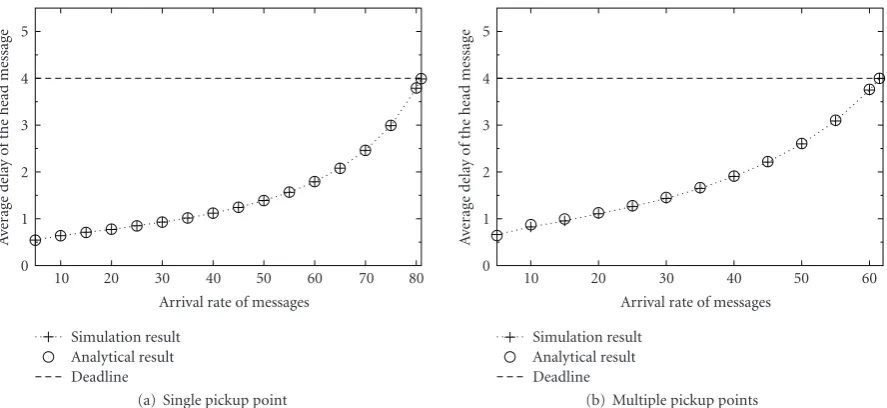
(b) Multiple pickup points Figure3: Comparison of delay for on-demand strategy.
90
Number of messages picked up on each trip Simulation result
(a) Single pickup point
80
Number of messages picked up on each trip Simulation result
(b) Multiple pickup points Figure4: Comparison of delay with different packing size.
improvement of efficiency by the waiting-based packing scheme is shown.
The main parameters used here are the following: the time spent on picking up a message iss = 0.01 hour (36 seconds), the single trip time between the headquarter and the disaster area is tr = 0.2 hour (12 minutes), and the
deadline for a message is 4 hours. The travel time of a side of the disaster area, which is normalized as√A, is 0.05 hour (3 minutes).
5.1. Comparison of Simulation and Analytical Results. In
Figure 3, the change of delay according to the arrival rate is shown for the on-demand scheduling. For both the single pickup point and multiple pickup points cases, the analytical
results match the simulation results very well. From thex -axis of two graphs it can be observed that the maximum supported traffic isλMax=80.95 for the single pickup point
case, and it isλMax = 61.47 for the multiple pickup points
case due to additional travel costs needed for picking up the messages.
For the waiting-based packing strategy, the effect of batch size on the delay of head message is shown inFigure 4. Here λ = 30, andn∗ < N < N∗,n∗ andN∗ can be computed using (4), (11), (15), and (17). For single pickup point case, the rounded values aren∗ =18,N∗ =88. For the multiple pickup location case, it isn∗=25,N∗=80.
10
Deadline of messages (hours) 0 Figure5: Effects of parameters on maximum throughput.
80
Arrival rate of messages On-demand strategy
(a) Single pickup point
60
Arrival rate of messages On-demand strategy
(b) Multiple pickup points Figure6: Comparison of efficiency for the two strategies.
costs associated with pickup. In addition, the simulation results show that the analytical results are very accurate.
5.2. Effects of Deadline and Disaster Area on the Maximum Throughput. As shown in (13), the maximum throughput that can be achieved is determined by the deadlines of messages, the travel time between the headquarter and the disaster area, and the size of the disaster area. Here tr is
assumed to be fixed at 0.2 (hour). InFigure 5(a),Ais close to 0 so that we can observe the effect of deadline. It can be observed that the normalized throughput is very low when TD is close to the minimum allowed value (3tr) but can be
close to 1 when TD is very high, which means almost no
deadline constraints.
InFigure 5(b),TD is fixed at 4 hours and the effect of
size of disaster area is shown. When the disaster area is very
small, ρMax can be as large as 0.81; as the size of disaster
area increases, the incurred travel cost also increases, which reduce the traffic that can be supported drastically. When the travel time along a single side of the disaster area is as large as 10 times of the travel distance between the headquarter and the disaster area, the maximum system utilization can be achieved is close to 0.
5.3. Comparison of Efficiency. As shown in Figure 6, the efficiency of the waiting-based scheme is obviously higher (as much as 500% higher) than the on-demand strategy, especially when the load is not heavy. However, the difference of the two strategies disappears asρ → ρMax. In fact, this is
without violating the deadline, and the two schemes become the same whenρ=ρMax.
Another benefit of the waiting-based packing strategy is that the efficiency of the pigeon is not so sensitive to the arrival rate as the on-demand strategy. For example, for the single pick up point case (Figure 6(a)), the efficiency of the pigeon under the waiting-based strategy when λ = 20 is 0.61, and it becomes 0.81 whenλ=81, which is about 30% percent higher. In contrast, with the on-demand strategy the efficiency increases from 0.2 to 0.8 asλincreases from 20 to 8, which is 300% higher.
6. Conclusion
The dynamic scheduling strategies of pigeons for informa-tion pickup and delivery in the disaster area is analyzed. The upper bound of traffic that can be supported under the deadline constraints for the basic on-demand strategy is given through the analysis and verified by the simulations. Based on the analysis of the basic on-demand scheduling strategy, a waiting-based packing strategy is introduced. Although the latter strategy could not improve the maximum traffic rate that a pigeon can support, it improves the efficiency of the pigeon largely.
Possible future works include more detailed investiga-tions of the dynamic routing strategies other than the short-est TSP policy and the effect of the different distributions of the arrival rate, service rate, deadlines on the conclusion, and bounds obtained in this paper.
Acknowledgments
The authors would like to thank the funding support from NSF under Grant CNS-0832000 and the Mordecai Wyatt Johnson Program of Howard University.
References
[1] H. Guo, J. Li, and Y. Qian, “HoP: pigeon-assisted forward-ing in partitioned wireless networks,” in Processings of the International Conference on Wireless Algorithms, Systems and Applications (WASA ’08), pp. 72–83, 2008.
[2] H. Guo, J. Li, Y. Qian, and Y. Tian, “A practical routing strategy in delay tolerant networks using multiple pigeons,” in Proceedings of the IEEE Military Communications Conference (MILCOM ’08), San Diego, Calif, USA, November 2008. [3] K. Fall, “A delay-tolerant network architecture for challenged
internets,” in Proceedings of the Computer Communication Review (SIGCOMM ’03), vol. 33, pp. 27–34, August 2003. [4] A. Vahdat and D. Becker, “Epidemic routing for
partially-connected ad-hoc networks,” Tech. Rep. CS-200006, Duke University, Durham, NC, USA, 2000.
[5] D. Deng and Q. Li, “Communication in naturally mobile sen-sor networks,” inProceedings of the International Conference on Wireless Algorithms, Systems and Applications (WASA ’09), Boston, Mass, USA, August 2009.
[6] W. Zhao and M. Ammar, “Message ferrying: proactive routing in highlypartitioned wireless ad hoc networks,” inProceedings of the 9th IEEE Workshop on Future Trends of Distributed
Computing Systems, pp. 308–314, San Juan, Puerto Rico, USA, May 2003.
[7] H. N. Psaraftis, “Dynamic vehicle routing problems,” in Vehicle Routing: Methods and Studies, B. L. Golden and A. A. Assad, Eds., pp. 223–248, North-Holland, Amsterdam, The Netherlands, 1988.
[8] H. N. Psaraftis, “Dynamic vehicle routing: status and prospects,”Annals of Operations Research, vol. 61, no. 1, pp. 143–164, 1995.
[9] A. Larsen,The dynamic vehicle routing problem, dissertation, Technical University of Denmark, 2000.
[10] D. Bertsimas and G. van Ryzin, “A stochastic and dynamic vehicle routing problem in the Euclidean plane,”Operation Researches, vol. 39, pp. 601–615, 1991.
[11] D. Bertsimas and G. Ryzin, “Stochastic and dynamic vehicle routing with general demand and interarrival time distribu-tion,”Advanced Applied Probability, vol. 25, pp. 947–978, 1993. [12] M. Swihart and J. Papastavrou, “A stochastic and dynamic model for the singlevehicle pick-up and delivery problem,” European Journal of Operational Research, vol. 114, no. 3, pp. 447–464, 1999.
[13] J. Beardwood, J. Halton, and J. Hammersley, “The shortest path through many points,” Proceedings of the Cambridge Philosophical Society, vol. 55, pp. 299–327, 1959.
[14] D. Johnson, “Local Optimization and the Traveling Salesman Problem,” inProceedings of the 17th International Colloquium on Automata, languages and programming, pp. 446–461, 1990. [15] Mesquite Software, Inc., “CSIM19 User’s Guide,” Austin, Tex,