R E S E A R C H
Open Access
Joint power and feedback bit allocation for
energy- efficient design in limited-feedback
coordinated beamforming systems
Fang Yuan
*and Chenyang Yang
Abstract
Energy efficiency (EE) has become an important design goal for future cellular systems. In this paper, we study the EE problem for limited-feedback coordinated beamforming systems providing real-time services with constant date rate. To maximize the EE, we jointly optimize the transmit power among users and the feedback bits of each user to quantize the desired and interfering channel directions, subject to the constraints of outage probability and number of feedback bits. An iterative optimization algorithm is proposed for alternating power and bit allocation by
employing Yates’ framework. To further reduce the computational complexity, a suboptimal algorithm is proposed in closed form by decoupling the problem into subproblems under asymptotical analysis. Simulation results show that the suboptimal algorithm performs closely to the iterative optimization algorithm under high-quantization resolution. Moreover, the proposed two algorithms provide substantial EE gain over existing schemes with equal power and bit allocation, and the EE depends on the target data rate and outage probability of each user as well as the circuit power consumption at the base stations.
1 Introduction
Explosive growth of high-quality wireless services prefig-ures that energy saving has become a critical issue [1,2]. As a result, it is an urgent task to design energy-efficient communication systems.
Coordinated multi-point transmission with coordinated beamforming (CoMP-CB) can improve spectral efficiency (SE) of cellular networks by avoiding inter-cell interfer-ence (ICI), whose performance largely depends on the quality of channel direction information (CDI) available at the base station (BS) [3]. When the CDI cannot be estimated at the BS, e.g., in frequency division duplex sys-tems [4], limited-feedback techniques are often applied, where the CDI is quantized with finite number of bits by each users and fed back to the BS [5,6]. Limited-feedback techniques have been extensively studied for various multi-input multi-output (MIMO) systems [7-9]. In multi-cell systems, equally allocating the bits to quan-tize the CDIs from multiple BSs is not efficient. Therefore,
*Correspondence: [email protected]
School of Electronics and Information Engineering, Beihang University, XueYuan Road No.37, 100191, Beijing, China
the bit allocation for quantizing multiple CDIs becomes an important issue in multi-cell systems [5,6,10], which differs from the single-cell systems. Various bit allocation schemes were proposed for CoMP-CB systems to mini-mize the rate loss led by the quantized CDI [5,6] or to maximize the lower bound of per-user rate [10]. These schemes are designed toward maximizing SE, which do not necessarily provide high energy efficiency (EE) [1].
The EE of downlink system is defined as the ratio of system’s rate to the power consumption, where the power consumption includes the circuit power and the trans-mit power [1]. An EE-oriented design needs to consider the feature of the specific traffic in system. As revealed in [11-13], three major capacity measures for system’s rate have been defined in the literature to differentiate real-time services from non-real-real-time services in the physi-cal layer: ergodic capacity, delay-limited capacity [13,14], and outage capacity [15]. Ergodic capacity is suitable for the best-effort services with no delay constraint, and the EE problems for different systems with ergodic capac-ity were considered in [1,16]. The delay-limited capaccapac-ity characterizes the impact of coding length [15] or the
queueing length [13], and the EE problems for differ-ent systems with delay-limited capacity were considered in [17,18]. In this paper, we study the energy-efficient limited-feedback CoMP-CB systems with real-time ser-vices measured by the outage capacity, where each user has a required quality-of-service (QoS) on the data rate and outage probability. As revealed in [12], the deep fades in wireless channels can be detrimental to real-time ser-vices in wireless systems. Compared to the other two capacity measures, the outage capacity is more suitable for constant-rate real-time services under a block-fading channel model [15]. In multi-user limited-feedback sys-tems, each user may need different number of bits for feeding back the CDI, since the feedback channel con-ditions differ from user to user [19]. These motivate to maximize the EE for limited-feedback CoMP-CB under the constraints on the number of feedback bits for each user in addition to the QoS.
For the considered constant-rate systems, by the defi-nition of EE, maximizing the EE amounts to minimizing the total power consumption at the coordinated BSs [20]. When the circuit power is fixed, minimizing the total power consumption is further equivalent to minimizing the total transmit power. Transmit power minimization problems have been extensively studied in literature under perfect CDI [21]. For example, the works in [22,23] stud-ied the power minimization problems under individual signal-to-interference-and-noise ratio (SINR) constraint. Moreover, the work in [24-26] considered the power min-imization problems with outage probability constraints. However, all these works are developed assuming per-fect CDI, which do not perform well in practical system with quantized CDI. In limited-feedback systems, the power minimization problems become more challeng-ing, because the impact of imperfect CDI on the system performance should be properly evaluated. The imper-fect CDI not only results in many difficulties to analyze the system performances, e.g., outage probability [10,27], but also may make the optimization problems nonlin-ear even in single-cell systems [28]. In [28], a power allocation algorithm is proposed to minimize the total transmit power for limited-feedback multi-user MIMO systems under individual outage probability constraints. Nevertheless, only the inter-user interference (MUI) is considered in single-cell systems and the impact of ICI is ignored. In addition, the proposed algorithm is given by semi-definite programming (SDP), which is of high complexity [29].
As far as the authors know, no previous work has con-sidered the joint power and feedback bit allocation to improve the system’s EE for limited-feedback CoMP-CB under constant date rate services. The EE performance of CoMP-CB is severely limited by two types of resid-ual interferences, i.e., MUI and ICI, which results from
the inaccurate coordinated beamforming led by imper-fect CDI. The residual interferences can be reduced by allocating more feedback bits for quanting the corre-sponding CDI or less transmit power to the correspond-ing interferer. Therefore, allocatcorrespond-ing the feedback bits and transmit powers in an efficient way eventually improves the system’s EE. Motivated by this, we jointly optimize the allocation of transmit powers among multiple users and the feedback bits of each user between quantizing the desired and interfering channels under the constraints on individual feedback overhead and outage probability. To find the optimal solution for the problem, we derive an iterative algorithm using Yates’ framework [22]. Since high computational complexity will cause high circuit power consumption, a suboptimal algorithm is developed for the system with high-quantization resolution, where both the power and bit allocation are with closed form expressions of low complexity.
The rest of this paper is organized as follows. We first present the system model in Section 2. In Section 3, we formulate the EE maximization problem and find the optimal solution. Then, in Section 4, a low complexity algorithm is derived. Simulation results are provided in Section 5, and the paper is concluded in the last section.
Notations:( )T and( )H are respectively the transpose and transpose-conjugate operation.| | denotes the mag-nitude, is the two-norm, [x]+= max{0,x}, xxx yyy (xxx yyy) means the vectorxxx is element-wise larger (no less) than the vectoryyy, and Exp(c)means the exponential distribution with mean of 1/c.
2 System model 2.1 Signal model
Consider a cluster ofNbBSs each equipped withNt
anten-nas to cooperatively serveKsingle antenna users in each cell with CoMP-CB [6].
For the kth user served by BS b, userbk, the received
signal is expressed as
ybk =αb,bkhhh
power, unit-norm precoder, transmit data, and receiver noise,αb,bkis the large-scale fading channel gain between
BSband userbk, andhhhb,bk is the small-scale fading
chan-nel vector. Without loss of generalities, we assume sbk
and nbk are with unit variance, and hhhb,bk is subject to
The SINR at userbkis
1 such that both MUI and ICI exist.
In the following, we callhhhb,bk andhhhc,bk respectively as
the desired and interfering channels for userbk(c=b).
2.2 Limited-feedback transmission model
We assume that the users have perfect CDI after channel estimation. The CDI is quantized through a given code-book with proper size known by both the BSs and users. Then the codebook indices representing the quantized CDIs of desired and interfering channels of each user are fed back to its serving BS in uplink, after which the CDIs are shared among the BSs for coordinated beamforming.
Take the desired channelhhhb,bk as an example. Denote the perfect CDI ashhh¯b,bk = ¯hhhb,bk/hhhb,bkandhhhˆb,bk as the
quantized CDI with unit-norm. The relation between the perfect CDI and quantized CDI can be modeled as [9]
¯
The average CDI distortion led by quantization is defined as E{sin2θb,bk} = 1 − E{|¯hhh
H b,bkhhhˆb,bk|
2} in [8],
whose value depends on the employed codebooks, which is intractable for analysis. We therefore consider a quan-tization cell approximation method used in [9], whose average CDI quantization distortion is
Esin2θb,bk
whereBb,bk is the number of bits for quantizing the CDI
of the desired channelhhhb,bk. It was shown in [9] via
sim-ulation that Eq. 2 provides an accurate approximation for other codebooks designed for i.i.d. Rayleigh fading channels.
Similarly, we can obtain the average CDI quanti-zation distortion for the interfering channel hhhc,bk as
E{sin2θc,bk} =
As in most limited-feedback literature [6,8,19], we con-sider the zero-forcing beamforming (ZFBF) at the BSs which is low complexity but suboptimal and consider full multiplexing, i.e.,Nt =NbK, due to its analytic
tractabil-ity. Extra transmit antennas at the BSs, i.e.,Nt > NbK,
do not necessarily provide higher EE for limited-feedback systems. On one hand, the case Nt > NbK introduces
extra circuit powers because of extra radio-frequency (RF) chains at the BSs [30]. On the other hand, the quantiza-tion distorquantiza-tion in (2) grows exponentially as the number of antennas increases, which can greatly degrade the user SINR [31] and eventually bring down the system EE. Therefore, in this work, we consider only the case of full multiplexing. pause
3 EE optimization for limited-feedback CoMP-CB system
In this section, we study the bit and power allocation problem to maximize the downlink EE of the CoMP-CB system, where the total number of feedback bits of each user is given. We consider the system providing real-time services under a block fading channel, where each user requires a constant data rate. Since the data rate require-ment of each user may not be supported under fading channel with imperfect CDI, to guarantee the QoS, a constraint on outage probability is considered, which is assumed less than a target value.
3.1 Problem formulation
Denoteγbkas the targeted SINR of userbkfor the constant
data rate in downlink. Then, the outage probability of user bkis defined as
Pout(γbk)=Pr{SINRbk < γbk}.
Considering the outage probability is required less than a target valueObk, i.e., Pout(γbk) ≤ Obk, the required data
rate by userbk, i.e., outage capacity, is given as
Rbk =log(1+γbk)(1−Obk).
The EE of downlink CoMP-CB system is defined as the ratio of the system’s sum rate to the total power consumption in downlink [32,33], which is,
EE=
wherepc is the circuit power at each BS. The modeling
of circuit power can be found in [34], which includes the power consumed by RF chain, signal processing, cooling, etc. at each BS as well as that by the backhaul links for channel sharing.
With zero-forcing beamforming (ZFBF), it was shown in [35] that the interference powers |hhhHb,bkvvvbm|2 and
probability density distribution (PDF) of Exp(1/δb,bk)and
distributed with PDF of Exp(1)[9]. Then, the outage prob-ability of user bk under given transmit powers is [10]
Pout(γbk)=1−
which depends on the transmit power, average CDI quan-tization distortion and target SINR of the user.
By observing (5), we can find that limited feedback has a large impact on the outage probability. The impact of MUI and ICI is conveyed by the denominator of (5). Given the transmit powers, the larger average CDI distortion δb,bk
orδc,bk is, the larger MUI or ICI the userbk experiences,
and the larger the outage probability becomes. In contrast, under perfect CDI, the MUI and ICI become zero and the denominator of (5) is unit, which means the bit allocation is not necessary.
To maximize the EE of downlink CoMP-CB, the prob-lem of jointly allocating the transmit powers among mul-tiple users and the total number of bits of each user between quantizing its desired and interfering CDIs can be formulated as
T is the bit allocation
profile of userbkfor quantizing the CDIs from desired and
interfering BSs,Bbkis the total number of feedback bits of
userbk, 111 and 000 are respectively the all-one and all-zero
vectors. The QoS requirement parametersγbkandObkare
constant and pre-specified by the system. In the constraint (6b), as shown in (4), allocating more bits forBb,bk inBBBbk
can lower down the average MUI, while allocating more bits forBc,bk(c=b) inBBBbkcan lower down thecth average
ICI. Therefore, the bit allocation in (6) is to improve the system EE by considering both the impact of MUI and ICI.
The optimization problem in (6) does not associate with the instantaneous channel information. As a result, the power and bit allocation does not need a frequent design, which will not causing too much signaling overhead. Nonetheless, if we consider the maximum transmit power constraint at each BS, the problem will become infeasible when the target date rate is high, even with perfect CDI. To demonstrate the EE potential of the CoMP-CB sys-tem and differentiate the infeasibility led by the transmit power and imperfect CDI, we do not take into account the maximum transmit power constraint.
3.2 Optimal solution of joint power and bit allocation
Since each user’s date rateRbk is constant in the
numer-ator of EE and the circuit power does not depend on the variables to be optimized, problem (6) is equivalent to the following joint power and bit allocation problem that minimizes the total transmit power
min
It should be noted that although the equivalence between the problems (6) and (7) is applied here to reduce the com-plexity of optimization problem, the work in this paper is motivated by improving the system EE as defined in (3). Moreover, to show the impact of proposed algorithms for joint power and bit allocation, and the other impacts such as circuit power and outage probability, the system EE in (3) rather than total transmit power in (7) will be mainly evaluated in the simulation section.
The optimization problem in (7) is nonlinear. To see this, from (5), we can rewrite the constraint (6a) as
pbk ≥
the power profile for allKNbusers. All the variables in (8),
including the transmit powers and the bits conveyed in average CDI distortions, are nonlinear in the constraint.
The nonlinear optimization problem (7) is equivalent to
mization of bit allocation
T
The equivalence comes from the fact that the bit allo-cation profileBBBbkof userbkonly affectsTTTbk(ppp,BBBbk).
Con-sidering the inequality (8), the minimum value ofpbk is
the one satisfying the constraint in (10a) among all the possible values ofTTTbk(ppp,BBBbk)with different bit allocation profileBBBbk for userbk. Therefore, the two problems are equivalent in the sense that they have the same globally optimal solution.
The optimal solution to problem (10) can be found by alternatively optimizing the bit and power allocation.
3.2.1 Bit allocation with given power allocation
In each iteration with given transmit powers, the bit allo-cation for quantizing the desired and interfering CDIs of user bk can be found from the following problem (i.e., (11)),
Therefore, the optimal solution can be obtained by using standard convex optimization tools [29].
3.2.2 Power allocation with given bit allocation
When the bit allocation for each user is obtained, the power allocation for multiple users can be optimized by using Yates’ framework [22], which is a fixed-point itera-tion problem. To show the convergence of the proposed iterative algorithm, we provide the following proposition.
Proposition 1.TTTbk(ppp)is a standard interference func-tion of the vector ppp, i.e., it satisfies the following three properties:
The proposition can be proved using a similar method as that in [25].
Yates found that for any function used for iteration, if the function satisfies all the properties of a standard interference function [22], the iteration will converge to the globally optimal solution. Using Yates’ framework, we can update the transmit powers with the solution of bit allocation obtained from problem (12) as
pbk =TTTbk(ppp) (13)
The iterative algorithm to solve problem (10) is summa-rized in Algorithm 1, which converges to optimal solution and provides a performance baseline. However, the iter-ation in the algorithm increases the computiter-ational com-plexity for signal processing and thus may increase the circuit power consumption. Therefore, we further pro-pose a non-iterative algorithm with lower complexity in the sequel.
Algorithm 1 Iterative algorithm for finding optimal solution
Initialize:i=0,ppp0b
k,BBB 0 bk0 Iterate for each userbk
1. updatei=i+1;
2. update bit allocationBBBi
bkfor userbkby solving problem (12) with givenpppib−1
k ;
3. update power allocationpppib
kby (13) with givenBBB
i bkandppp
i−1 bk ; Terminate until convergence or reaching maximum number of iter-ations.
4 Low complexity algorithm
In this section, we propose a suboptimal but low complex-ity algorithm to solve problem (10). By using asymptotical analysis and introducing upper bound, we decouple the joint bit and power allocation problem into two sub-problems: 1) optimizing power allocation with given bit allocation, and 2) optimizing bit allocation with opti-mized power allocation. The two subproblems are solved without the need for iteration.
4.1 Power allocation with given bit allocation
We first optimize the power allocation with given bit allocation for each user.
Using the inequality (14) in [36], we can obtain a upper bound for outage probability in (5) as
With this upper bound, we formulate a power allocation problem with given bit allocation as
min
whose solution is suboptimal for the original problem (10). Specially, we can rewrite the constraint (16a) as
pbk ≥γ
Now both the objective function and constraints in (16) are expressed as linear functions of the optimization vari-ables, i.e., the elements inppp. Define a constant matrixAAAof of the variables (e.g., transmit powers) in the constraint (17). The vectorwwwdescribes the constants irrespective of variables in the constraint (17). Therefore, with the upper bound in (14), problem (16) becomes a linear program-ming problem for the transmit powers, which has a much lower complexity than the problem (7).
With the definition of AAA andwww, we can immediately write the problem (16) into a standard linear program-ming problem, which is
min
From [29], the optimal solution of problem (20) can be obtained with closed form as
ppp=(III−AAA)−1www (21)
and the corresponding minimum sum transmit power of all the BSs becomes
pS=111T(III−AAA)−1www. (22)
There are two benefits of the solution in (21). One is that linear programming is desirable for low complexity in computation. The other is that the solution is of explicit
form, which is desirable for the performance analysis in the following.
4.2 Bit allocation with optimized power allocation
We then optimize the bit allocation between the desired and interfering CDIs to further reduce the minimum total transmit powerpS. Unfortunately, the optimal bit
alloca-tion that minimizespSis hard to find because the
expres-sion ofpS in (22) is complicated and nonlinear with the
CDI quantization distortion. In the sequel, we study the bit allocation problem resorting to asymptotic analysis.
Proposition 2.The minimum total transmit power in (22) satisfies using the Taylor series, we obtain the equivalent infinites-imal of(III−AAA)−1 from the first order expansion as [37]
(III−AAA)−1≈III+AAA. (24)
Using the equivalent infinitesimal replacement in the limit operation and the definition ofAAAandwww, we have
Now, we complete the proof for the proposition.
The condition δ → 0 requires that the system is
with high-quantization resolution for each CDI. With perfect CDI, it is easy to show that the minimum total transmit power is pCDI = Nb=b1ps,b. When the CDI
is imperfect, the transmit power will increase in order to achieve the same target SINR and outage probability under the residual MUI and ICI, which leads to the term
Nb
in the dominator in (25). This
frac-tion of transmit power reduces with the improved CDI quantization accuracy, and thereby can be minimized by the bit allocation.
minimizeNb
. Considering the individual
constraint imposed on the number of bits for each user, and considering that onlybk is related with the bit
allo-cation of userbk, the power allocation problem can be
formulated as
This is a convex optimization problem. First, the con-straints are linear and thus convex. Second, the objective function is a weighted sum of exponential functions with positive weights, which is also convex. The solution can be found from the Karush-Kuhun-Tucker (KKT) conditions, which turns into a water-filling algorithm with the unique solution as follows:
The result in (27) shows that the allocated number of bits for quantizing the CDI from theth BS to userbknot only increases with the large-scale fading gain α2,b
k but
also grows with the parametergs,defined in (23), which
is associated with the QoS requirements (i.e.,γkandOk)
for the users served in theth cell.
To illustrate this, we consider the case that the QoS requirements for users in the same cell are identical, i.e.,
γr
It means that the parametersgs, are linear with its own
QoS requirementγrin theth cell. Consequently, we can find that (27) tends to allocate more bits to the cell with larger QoS requirement. By contrast, the bit allocation algorithm for improving SE proposed in [5,6] only exploits the receive powers in the desired and interfering channels but does not consider the different QoS requirements, and thus cannot be applied in this work.
For general setting of QoS requirementγr
k, the
param-etergs,measures the interference condition from theth BS to the userbk quantitatively. Observegs, defined in
(23): when = b, it equals to gs,b = Km=1,m=k
coming from the ICI of K users served by the th BS.
Therefore, both impacts of MUI and ICI are reflected in the bit allocation (27).
The low complexity algorithm is summarized in Algorithm 2, where the power allocation (21) depends on the bit allocation algorithm (27). It will be shown in the simulation section that under high-quantization resolu-tion, the performance of suboptimal algorithm is close to that of optimal algorithm.
Algorithm 2 Low complexity algorithm
For each userbk,
1. bit allocation: obtainBBBbkwith (27);
2. power allocation with the bit allocation in (27): obtainpbkwith (21).
4.3 Feasibility of the proposed algorithms
The bit and power allocation algorithms are derived under the implicit assumption that the optimal problems in (10) and (20) are feasible, i.e., the allocated powers are nei-ther negative nor infinity. However, as indicated by [22], in some cases with strong interference, the optimal solutions are not feasible.
A sufficient and necessary condition for the feasibility of problem (20) is that the maximum eigenvalue ofAAAshould be less than one [22]. Therefore, the solution in (21) is applicable only when the maximum eigenvalue ofAAAis less than one.
This is also a sufficient condition for the feasibility of problem (10) (equivalently, original problem (6)), since the solution of problem (20) is an upper bound of the solution of problem (10). The exact sufficient and necessary condi-tion for problem (10) is generally unknown. As a result, in some cases the suboptimal power allocation in (21) may not be feasible when the optimal power allocation in (13) is feasible.
5 Simulation results
In this section, we evaluate the performance of the pro-posed algorithms through simulations.
5.1 Simulation setup
We consider a CoMP-CB system with a cooperative clus-ter size of three, i.e.,Nb=3. The inter-cluster interference
is modeled as noise, which is reflected in the noise power set as−104 dBm. The cell radius is 250 m, the path loss factor is 3.76, and the downlink transmission bandwidth is 10 Mhz. The small-scaling fading channels are subject to i.i.d. Rayleigh flat fading. Random vector quantization (RVQ) codebooks are applied for quantizing each CDI.
Nt = 6. It means each user experiences one MUI
inter-ference from the other user in the same cell and four ICI interferences from the users in two neighboring cells.
The system topology is shown in Figure 1, where two scenarios about user locations are studied. The first sce-nario is with fixed user location, which is applied in Figures 2, 3, 4, 5, 6, 7. In this scenario, two users in each cell are located on the line between their serving BS and the point Oand with a distanced to their serv-ing BS and a distancedIto the other two interfering BSs.
Moreover, the users in three cells are symmetrically dis-tributed. The major benefit of this scenario is that we only need to employ one single parameter d to reflect user location, which determines the large-scale channel gains of desired and interfering channels. When changing the distance d to the serving BS, the large-scale chan-nel gains of desired and interfering chanchan-nels are changed simultaneously which are unequal except for the user locationd=250 m. The different impacts of desired and interfering channels are reflected by the heterogeneous large-scale channel gains from desired and interfering BSs, which are exploited in the power and bit allocation by the two proposed algorithms. The second scenario is with random user locations, which is applied in Figure 8 to show the impact of general user locations. In the second scenario, each user is randomly dropped in the CoMP region shown in Figure 1. The CoMP region is defined as the cell-edge region, where the inter-cell interference is strong and coordinated beamforming is necessary.
To reflect different data rate requirements of each user, we set the data rate constraint in the three cells asR11 = R12 = ρ1R(1−O),R21 = R22 = ρ2R(1−O), andR31 = R32 =ρ3R(1−O)bps/hz, where
3
i=1ρi =1. Then, the
total date rate of all the six users is 2R(1−O). Unless other-wise specified, the target outage probability for each user isO=0.1.
Similar simulation results can be observed for more complex cases with arbitrary size of cluster, random located users and arbitrary data rate requirement, which are not shown for conciseness.
For simplicity, in the following, we refer to the opti-mal power and bit allocation obtained from the iterative algorithm in Algorithm 1 as ‘OPA+OBA’, and the sub-optimal power and bit allocation obtained from the low complexity algorithm in Algorithm 2 as ‘SPA+SBA’, both in the main text and in the legend. The obtained bit allo-cation results in the optimization problems are rounded into nearest integers as the number of allocated bits.
We assume that the total number of feedback bits for each user is conveyed via Ns slots in uplink. The
num-ber of feedback bits in each slot is adaptive to the average uplink signal-to-noise ratio (SNR), which is determined by the constraint Pr
log2(1+SNRub
k)≤
Bbk Ns
≤ 0.1, where
SNRub
k is the instantaneous receive SNR at the BSbfrom
user bk. We set Ns = 3(Nt −1) in Subsection 5.2 and
the impact of the value ofNson the uplink and downlink
energy consumptions will be investigated in Subsection 5.3. It is worthy to note that when the value ofNschanges,
the total number of feedback bits for each user changes. Denote uplink transmit power aspu, which is set as 26 dBm (approximately 400 mw). Lethhhub,b
k be the
instanta-neous uplink small-scale fading channel vector. Then, the uplink receiving SNR is SNRub
k = p
uα2 b,bkhhh
u b,bk
2. The
large-scale fading gains of the uplink and downlink chan-nels are equal and the small-scaling fading uplink chanchan-nels are subject to i.i.d. Rayleigh flat fading and independent with the downlink channels.
5.2 Validation of upper bound and asymptotic analysis
To validate the upper bound and asymptotic analysis, we compare the total transmit power at all coordinated BSs obtained from the iterative algorithm in Algorithm 1, the low complexity algorithm in Algorithm 2, and the asymp-totical analysis in Proposition 2 using the bit allocation in (27).
As shown in Figure 2, the low complexity algorithm per-forms close to the iterative optimization algorithm as the number of feedback bits for each user increases, which indicates that using the upper bound of outage probability in (14) leads to minor performance loss. Moreover, as the number of bits increases, the performance of both algo-rithms converge to the limit result of asymptotic analysis in Proposition 2.
5.3 Performance evaluation of the proposed algorithms 5.3.1 Convergence of the optimal algorithm
Figure 3 shows the total transmit power obtained from the iterative algorithm in Algorithm 1 and the low complexity algorithm in Algorithm 2 versus the number of iterations. It is shown that the total transmit power obtained by the iterative algorithm converges to the optimality rapidly in the iteration, and the low complexity algorithm per-forms close to the iterative algorithm. Moreover, the total transmit power increases with the data rate requirement.
5.3.2 Comparison with other schemes
BS 3
BS 2
Interferi ng
channel
0
BS 1
Desired channel CoMP region
Figure 1Topology of the simulated CoMP-CB systems.
30 35 40 45 50 55 60
10 12 14 16 18 20 22 24
Number of bits per user
Total transmit powers (dBm)
OPA+OBA SPA+SBA Asymp. analysis
d = 250 m R = 0.5 bps/hz
d = 200 m R = 0.5 bps/hz
d = 200 m R = 0.75 bps/hz
0 5 10 15 20 11
12 13 14 15 16 17 18 19 20
Iteration Number
Total transmit powers (dBm)
OPA+OBA SPA+SBA d = 200 m
R = 0.75 bps/hz
d = 200 m R = 0.5 bps/hz d = 250 m
R = 0.5 bps/hz
Figure 3Convergence of the iterative algorithm.
for user bk ( = 1, 2, 3). To implement the scheme of
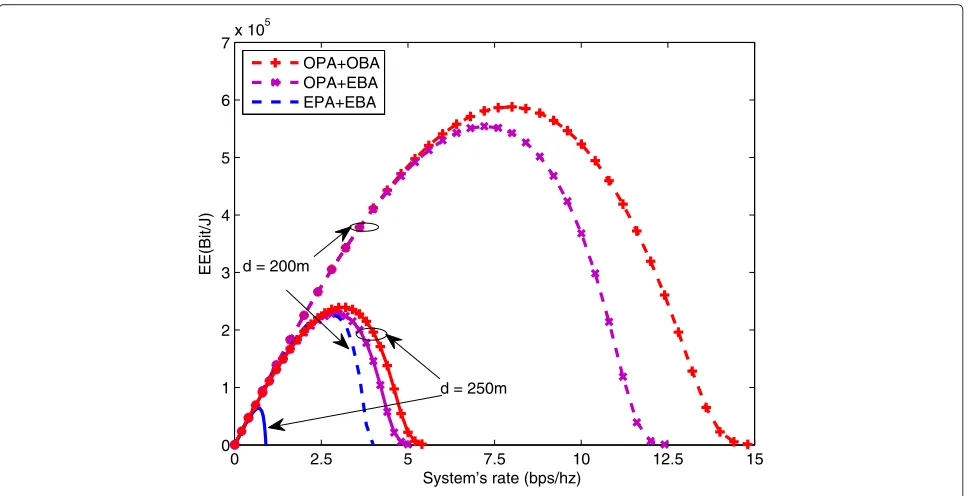
‘OPA+EBA,’ we fix the equal bit allocation in the algorithm of Algorithm 1, and iterate the transmit powers only. The scheme of ‘OPA+EBA’ provides the optimal solution for power allocation when the bit allocation is fixed, which can serve as the performance upper bound for any other power allocation algorithms [21,25].
The simulation results show that with equal bit allo-cation, the optimal power allocation can remarkably improve EE in spite of user locations. Moreover, the EE can be further improved by using the optimal bit
allo-cation. From d = 250 to d = 200 m, the EE gain
of the optimal bit allocation over equal bit allocation increases significantly, since it is more beneficial to use
0 2.5 5 7.5 10 12.5 15
0 1 2 3 4 5 6 7x 10
System’s rate (bps/hz)
EE(Bit/J)
OPA+OBA OPA+EBA EPA+EBA
d = 250m d = 200m
0 2.5 5 7.5 10 12.5 15 0
1 2 3 4 5 6 7x 10
System’s rate (bps/hz)
EE(Bit/J)
OPA+OBA: Unequal QoS SPA+SBA: Unequal QoS OPA+OBA: Equal QoS SPA+SBA: Equal QoS OPA+EBA: Unequal QoS OPA+EBA: Equal QoS
Figure 5EE of optimal and suboptimal algorithms,pc=50 W,d=200 m. Equal QoS:ρ1=ρ2=ρ3=1/3; unequal QoS:ρ1=1/2,ρ2=ρ3= 14.
the bit allocation for exploiting the heterogeneity of large-scale channel gains from desired and interfering BSs. The results highlight the importance of joint power and bit allocation to improve the EE in limited feedback CoMP system.
The EE achieved by the proposed iterative algorithm (OPA+OBA) and low complexity algorithm (SPA+SBA)
versus the system’s rate is shown in Figure 5, wherepc=
50 W andd=200 m. We consider two QoS requirements
for the users: the equal QoS, whereρ1=ρ2=ρ3 =1/3;
the unequal QoS, whereρ1=1/2 andρ2=ρ3= 14.
The results show that the EE gap between the iterative and low complexity algorithms is small for low system’s rate but large for high system’s rate. For the case of high
0 5 10 15
0 2 4 6 8 10 12 14x 10
System’s rate (bps/hz)
EE(Bit/J)
p
c = 10 W, O=0.1 pc = 50 W, O=0.1 pc = 50 W, O=0.05 p
c = 150 W, O=0.1
4 5 6 7 8 9 10 11 12 0
0.5 1 1.5 2 2.5 3 3.5 4 4.5 5 5.5x 10
Uplink energy consumption (mJ/feedback)
Downlink energy consumption (mJ)
pu = 400 mW, pu c = 30 mW pu = 200 mW, pu
c = 20 mW pu = 400 mW, puc = 20 mW
Ns = 17
N s = 14
Figure 7Trade-off between the downlink and uplink energy consumptions. Equal QoS:ρ1=ρ2=ρ3=1/3.
system’s rate under equal QoS, the users with high data rate requirement are with large elements inAAAas defined in (23). This makes the maximum eigenvalue ofAAAclose to 1 and results in the infeasibility for power allocation in (21) as analyzed in Section 4.3. The infeasibility events occur more frequently for the case with unequal QoS, since the users in the first cell with ρ1Rare with even larger
ele-ments inAAA. As shown in the figure, the performance gain
of the optimal bit allocation over the equal bit alloca-tion is larger under unequal QoS requirement than under equal QoS requirement. Moreover, under equal bit allo-cation, we can find that the optimal bit allocation under unequal QoS is inferior to that under equal QoS. This is because unequal QoS makes the interference among the users more heterogeneous, such that equal bit allocation becomes more improper.
0 2.5 5 7.5 10 12.5 15
0 1 2 3 4 5 6x 10
System’s rate (bps/hz)
EE(Bit/J)
OPA+OBA OPA+EBA EPA+EBA
Random Drop Instance 1−>5
Random Drop Instance 1−>5
Random Drop Instance 1−>5
5.3.3 Impact of circuit power consumption and outage probability
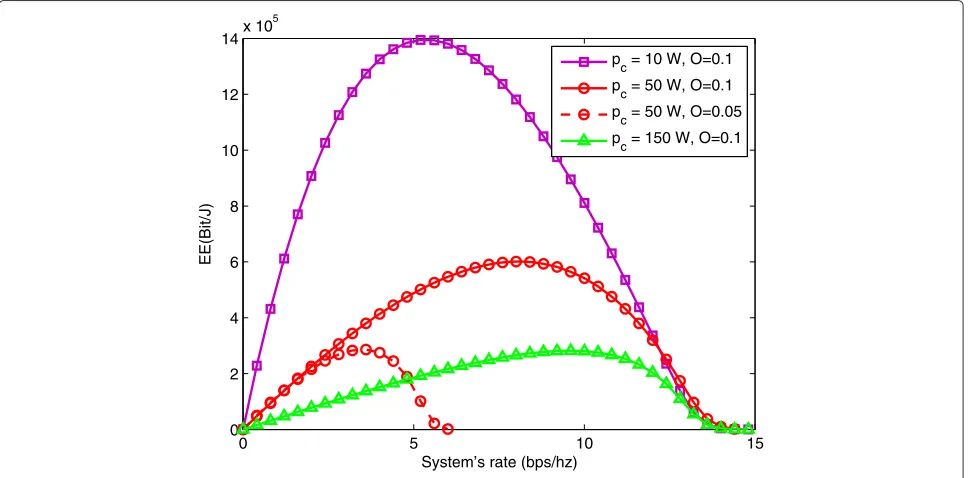
In Figure 6, we present the EE achieved by the proposed optimal algorithm under different circuit power and out-age probability for the case with equal QoS requirement whered = 200 m. In addition topc = 50 W, two other
circuit power consumptions are considered: low circuit power case wherepc=10 W and high circuit power case
wherepc = 150 W [2]. Two target outage probabilities
are considered: 0.1 and 0.05. The simulation results show that the EE decreases with the outage probability. When the outage probability is the same, the EE decreases as the circuit power consumption increases. Since the circuit power consumption does not affect the feasibility of the proposed algorithm, the EE with the same outage proba-bility under different circuit power consumptions drops to zero at the same value of system’s rate.
5.4 Trade-off between downlink and uplink energy consumptions
In Figure 7, we show the downlink and uplink energy con-sumptions, where the iterative algorithm in Algorithm 1 is used. We assume that there areT =100 slots in downlink transmission per uplink feedback and considerd = 250 m and individual data rate requirement of 0.5 bps/hz. Since in the uplink the BSs receive the CDI feedback from the users, we also consider the circuit power consumed at the BS for reception. The downlink circuit power for transmission and reception are respectivelypc = 50 W
and pc = 42 W. The energy consumption in uplink is
the energy consumed by the circuit powerpuc and trans-mit powerpu in theNsfeedback slots at each user. The
circuit power consumption for users are from [39]. We set the duration of each slot as 1 ms for both downlink transmission and uplink feedback.
As shown in the figure, for the same values ofpu c and
pu, the more energy are consumed at each user, the less
energy are consumed at the BSs. The energy consumption in downlink whenpuc =20 mW,pu = 200 mW andNs=
17 is approximately equal to that whenpuc =20 mW,pu= 400 mW, andNs =14. This is because with higher uplink
transmit power more bits can be fed back in each time slot and thereby the number of the time slots reduces.
In all three cases, the downlink energy consumption first drops dramatically and then remains constant as the uplink energy consumption increases. This is because when the uplink energy consumption is low, the total number of bits of each user is small such that the MUI and ICI in the system severely degrades the EE performance. The nonlinear impact of the number of bits for feedback on the downlink performance leads to a dramatic change on the downlink energy consumption. However, as the uplink energy consumption increases, the total number of
bits of each user becomes large such that the MUI and ICI in the system approaches zero, then the downlink energy consumption becomes unchanged.
In practice, we can judiciously select the number of feedback slotsNs, i.e., the total number of feedback bits
for each user, to trade-off the downlink and uplink energy consumptions.
5.5 Performance evaluation for general user locations
We investigate the impact of general user locations on the performance of the proposed algorithm in Figure 8. The second scenario for random user locations in Figure 1 is considered. We consider equal QoS requirement and assume that each user is randomly dropped in the CoMP region with a minimum distance of 200 m to their serving BSs in the cell-edge.
Figure 8 provides five instances of EE performance under different date rates for CoMP system with ran-domly distributed users, where the schemes of ‘EPA+EBA,’ ‘OPA+EBA,’ and ‘OPA+OBA’ are evaluated. The five instances are selected randomly, and in each instance six users are dropped independently and uniformly in the CoMP region. As shown in Figure 8, simi-lar to Figure 4 where users are symmetrically dis-tributed at fixed locations, it is also of significance to improve the EE performance for limited feedback CoMP-CB system with users at general user locations by using the proposed joint power and bit allocation algorithm.
6 Conclusions
Competing interests
The authors declare that they have no competing interests.
Acknowledgements
This work is supported by the National Natural Science Foundation of China (NSFC) under Grant 61120106002, the National Basic Research Program of China, 973 Program 2012CB316003 and the National High Technology Research and Development Program of China (No. 2014AA01A703).
Received: 10 July 2014 Accepted: 30 March 2015
References
1. GY Li, Z Xu, C Xiong, C Yang, S Zhang, Y Chen, S Xu, Energy-efficient wireless communications: tutorial, survey, and open issues. IEEE Wireless Commun. Mag.18(6), 28–35 (2011)
2. ICT-EARTH, Energy Efficiency Analysis of the reference systems, areas of improvements and target breakdown (2011). https://www.ict-earth.eu 3. C Yang, S Han, X Hou, AF Molisch, How to design CoMP to achieve its
promised potential?. IEEE, Wireless Commun. Mag. (invited paper).
20(1), 67–74 (2013)
4. DJ Love, RW Heath Jr, Equal gain transmission in multiple-input multiple-output wireless systems. IEEE, Trans. Commun.51(7), 1102–1110 (2003)
5. R Bhagavatula, RW Heath, Adaptive limited feedback for sum-rate maximizing beamforming in cooperative multicell systems. IEEE, Trans. Signal Process.59(2) (2011)
6. N Lee, W Shin, Adaptive feedback scheme on K-cell MISO interfering broadcast channel with limited feedback. IEEE Trans. Wireless Commun.
10(2), 401–406 (2011)
7. DJ Love, RW Heath Jr, T Strohmer, inProc. IEEE Int. Communi. Conf. (ICC). Grassmannian beamforming for multiple-input multiple-output wireless systems (Alaska, US, 2003)
8. N Jindal, MIMO broadcast channels with finite-rate feedback. IEEE, Trans. Inform. Theory.52(11), 5045–5060 (2006)
9. T Yoo, N Jindal, A Goldsmith, Multi-antenna downlink channels with limited feedback and user selection. IEEE J. Select. Areas Commun.
25(7), 1478–1491 (2007)
10. F Yuan, C Yang, G Wang, M Lei, Adaptive channel feedback for coordinated beamforming in heterogeneous networks. IEEE Trans. Wireless Commun.12(8), 3980–3994 (2013)
11. E Biglieri, J Proakis, S Shamai, Fading channels: information-theoretic and communications aspects. IEEE, Trans. Inform. Theory.44(6), 1998 12. J Luo, R Yates, P Spasojevic, Service outage based power and rate
allocation for parallel fading channels. IEEE Trans. Inform. Theory.
51(7), 2594–2611 (2005)
13. D Wu, R Negi, Effective capacity: a wireless link model for support of quality of service. IEEE Trans. Wireless Commun.2(4), 630–643 (2003) 14. SV Hanly, DNC Tse, Multiaccess fading channels part II: delay-limited
capacities. IEEE Trans. Inform. Theory.44(7), 2816–2831 (1998) 15. G Caire, G Taricco, E Biglieri, Optimum power control over fading
channels. IEEE Trans. Inform. Theory.45(5), 1468–1489 (1999)
16. C Jiang, LJ Cimini, inProc. IEEE Wireless Communi. and Netw. Conf. (WCNC). Energy-efficient transmission for MIMO interference channels (Paris, FR, 2012)
17. MC Gursoy, D Qiao, S Velipasalar, Analysis of energy efficiency in fading channels under QoS constraints. IEEE Trans. Wireless Commun.
8(8), 4252–4263 (2009)
18. A Helmy, L Musavian, T Le-Ngoc, inIEEE Int. Conf. Communi. (ICC). Energy-efficient power allocation for multicarrier systems with delay-outage probability constraints (Budapest, HU, 2013)
19. G Caire, N Jindal, M Kobayashi, N Ravindran, Multiuser MIMO downlink achievable rates with downlink training and channel state feedback. IEEE Trans. Inform. Theory.56(6), 1478–1491 (2010)
20. Z Xu, C Yang, GY Li, Y Liu, S Xu, Energy-efficient CoMP precoding in heterogeneous networks. IEEE Trans. Signal Process.62(4), 1005–1017 (2014)
21. M Chiang, P Hande, T Lan, CW Tan,Power Control in Wireless Cellular Networks, vol. 2. (Now publishers, US, 2008)
22. Yates RD, A framework for uplink power control in cellular radio systems. IEEE J. Sel. Areas Commun.13(7), 1341–1347 (1995)
23. H Dahrouj, W Yu, Coordinated beamforming for the multicell multi-antenna wireless system. IEEE, Trans. Wireless Commun.
9(5), 1748–1759 (2010)
24. S Kandukuri, S Boyd, Optimal power control in interference limited fading wireless channels with outage-probability specifications. IEEE Trans. Wireless Commun.1(1), 46–55 (2002)
25. J Papandriopoulos, J Evans, S Dey, Optimal power control for Rayleigh-faded multiuser systems with outage constraints. IEEE Trans. Wireless Commun.4(6), 2705–2715 (2005)
26. CW Tan, inProc. IEEE INFOCOM. Optimal power control in Rayleigh-fading heterogeneous networks (Shanghai, CN, 2011), pp. 2552–2560 27. D Jaramillo-Ramirez, M Kountouris, E Hardouin, inProc. IEEE Int. Symp. on
Pers., Indoor and Mobile Radio Communi.(PIMRC). Coordinated multi-point transmission with imperfect channel knowledge and other-cell interference (Sydney, AU, 2012)
28. B Khoshnevis, W Yu, Bit allocation laws for multi-antenna channel quantization: multi-user case. IEEE Trans. Signal Process.59(5), 2270–2283 (2011)
29. S Boyd, L Vandenberghe,Convex Optimization. (Cambridge University Press, New York, NY, US, 2004)
30. Z Xu, C Yang, GY Li, S Zhang, Y Chen, S Xu, Energy-efficient configuration of spatial and frequency resources in MIMO-OFDMA systems. IEEE Trans. Commun.61(2), 564–575 (2013)
31. Y Zhang, RS Cheng, inProc. IEEE Wireless Communi. and Netw. Conf. (WCNC). High SNR performance of antenna selection in MISO interference channel with zero-forcing and limited feedback (Paris, FR, 2012) 32. C Li, J Zhang, KB Letaief, inProc. IEEE Int. Conf. Commun. (ICC). Energy
efficiency analysis of small cell networks (Budapest, HU, 2013) 33. JB Rao, AO Fapojuwo, On the tradeoff between spectral efficiency and
energy efficiency of homogeneous cellular networks with outage constraint. IEEE Trans. Vehi. Technol.62(4), 1801–1814 (2013) 34. S Han, C Yang, AF Molisch, Spectrum and energy efficient cooperative
base station doze. IEEE J. Select. Areas Commun.32(2), 285–296 (2013) 35. M Kountouris, JG Andrews, Downlink SDMA with limited feedback in
interference-limited wireless networks. IEEE Trans. Wireless Commun.
11(8), 2730–2741 (2012)
36. Y Huang, CW Tan, BD Rao, inProc. IEEE Globe Telcommun. Conf.(GLOBECOM). Outage balancing in multiuser MISO networks: network duality and algorithms (California, US
37. J-C Kuang,Applied Inequalities (Chinese), 3rd edn. (Hunan Education Press, Hunan, CN, 1993)
38. G Auer, V Giannini, C Desset, I Godor, P Skillermark, M Olsson, MA Imran, D Sabella, MJ Gonzalez, O Blume, A Fehske, How much energy is needed to run a wireless network?. IEEE Wireless Commun. Mag.18(5), 40–49 (2011) 39. G Miao, Energy-efficient uplink multi-user MIMO. IEEE, Trans. Wireless
Commun.12(5), 2302–2313 (2013)
Submit your manuscript to a
journal and benefi t from:
7Convenient online submission
7Rigorous peer review
7Immediate publication on acceptance
7Open access: articles freely available online
7High visibility within the fi eld
7Retaining the copyright to your article