E-LEARNING ENVIRONMENT
FOR DEAF STUDENTS IN
LEARNING SCIENCE: A
THEORETICAL FRAMEWORK
MOHD HISYAMUDDIN MOHD HASHIM ZAIDATUN TASIR
1.1 INTRODUCTION
E-learning is one of the most popular platforms that have been used for distributing information in educational departments for many years. It makes the activities for both parties particularly the teachers and students easier in terms of giving and achieving the knowledge needed in their teaching and studying routine by using some alternate approaches. Both teachers and students could collaborate with each other in structuring knowledge based environment, and the latter could benefit from it without any external control particularly from the former (Singh, 2003).
specially formulated for them. Therefore, in order to help them overcome these difficulties while using the e-learning, an added feature must be included within the developed e-learning in order to help them using it in the best possible way.
This added feature is mainly focusing on the implementation of sign language within an e-learning environment. It is also hoping to help them getting the information needed in the most accurate way as possible. This is needed because most of the information out there could not be fully accessible by the deaf students themselves such as some videos or movies that include audio for it to be fully understood. The developed e-learning environment might also be able to be helpful in motivating the deaf students in their studies hence would give them better opportunities in the future life
The Science subject is one of the major subjects taught to the students in schools, both primary and secondary. The Science knowledge is very important since pretty much all the things around us are related to Science, either directly or indirectly. Manifestly, statistics show that the result of Science subject during major exams
1.2 CONSTRUCTIVISM
First of all, it has to be known that the primary idea of constructivism is mainly focusing on conceptualizing knowledge as well as the acquirement of it. In this particular matter, most constructivists view the nature of the knowledge itself and how it can be developed into certain level, based on certain philosophical theories. The world of academic literature is somewhat not complete without the mentioning of the term constructivism, particularly to be used in many academic papers or journals and as well as in books that are widely used for teaching, learning, assessment, curriculum development and training for various types of courses and subjects. This includes the Science subject.
In Science education literature, the concept of constructivism is viewed by the constructivist in multiple versions in terms of students’ learning (Good, Wandersee, and Julien, 1993). Even though these constructivists have distinguished philosophical point of view, they still share the same constructivist core. The most common constructivist core among them is "the view of human knowledge as a process of personal cognitive construction, or invention, undertaken by the individual who is trying, for whatever purpose, to make sense of their social or natural environment
thoughts, instead students will construct their own ideas and meaning of anything, for example words, images, sound etc that they see or hear. Therefore, the learner can be said as an active knowledge constructor instead of simply being a passive knowledge receiver.
Hence, in order to encourage students to be an active constructor, learning strategies that will be used must allow students to be an active learner. One of the learning strategies that seems suitable is problem solving.
1.3 PROBLEM SOLVING
Bransford and Stein (1984) stated problem solving strategies as a set of steps required in order to solve problems that are occurred within the way to achieve a certain objective. Alternatively, it also can be defined as "problem-solving cycle". Some of the steps needed within this particular cycle are such identify the problem, specify the problem, design a series of steps needed to solve the problem, classify any knowledge known or unknown from the problem, and finally assess the most appropriate solution for the problem. In addition, Blanchard-Fields (2007) claims that problem solving can be seen in two sides, rather than just a single side. One side focusing on the types of problems which can have only a single possible solution that can be accepted, such as those of math questions or questions that are based on mere facts. The other side of it is focusing on problems which can have multiple solutions, or a dynamic solution that can keep changing from time to time, regards of its current situation.
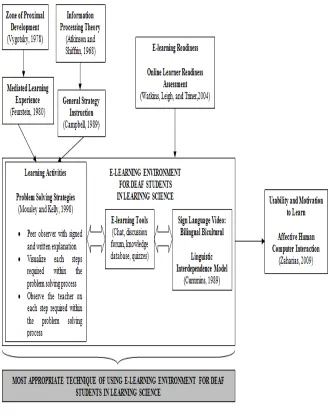
particular understanding of the certain topic that has been acquired will then be transformed into a solution in a written form. Two main purposes of this strategy is to show that the deaf students clearly understand the problem solving rules through the explanations and to evaluate whether the deaf students’ reading levels would influence the explanations made through sign language as well as the written form. Based on Pau (1995), it is said that the problem solving performance of deaf individuals are somehow related to their reading ability. The two explanation methods, sign language and written form, were found based on the technique suggested by Woditsch (1991) in assisting the deaf students in enhancing their thinking ability through a process, in this matter, problem solving process. The second problem solving strategy required them to visualize what is to happen within the problem solving process, from start to finish. This style is vital in making sure that the students will be able in developing a thoughtful strategy required in solving the problem given to them. Appropriate series of steps are necessary in order for the students to acquire the best solution possible to the certain problem, and not only merely solve the problem. The last strategy required the deaf students to observe their teacher on each and every step needed within the problem solving process for each problem given to them. This particular strategy encourages the deaf students in translating the sign language instruction given by their teachers into the actual steps needed in solving the problem, instead of simply writing it down.
Besides learning strategies, since this research is focusing on the use of e-learning in learning Science, therefore interaction among students and students and students and teacher must be based on certain human computer interaction principles.
Within an e-learning context, affect has acquired some new level of certain attention. Affect can be said as something which is brought by the learners into the e-learning environment, which subsequently will connect them to the purpose of their learning in general. Some latest developments within learning theories have emphasized the importance of affective in learning. Learners’ internal priorities and drives, also known as their motivation to learn, has been stressed out within the learning theory and practice fields. Schunk (2002) described motivation to learn as the most vital affective learning factor which can define the interaction occurred between the users and the e-learning environment itself.
In the field of Human Computer Interaction (HCI), the term addressing affective may contribute to various meanings, depends on that particular affective roles and functions within the HCI. Some of the meanings are such recognizing user affect, adapting to the user's affective state, generating affective behavior, modeling user's affective state, or perhaps generating affective states within an agent's cognitive structure (Hudlicka, 2003). Some degree of user affective modeling may be involved within the recognition process of users’ affective state, which can be the subset of users’ motivational-behavior across different types of contexts. The emotion effects of the users’ affective state can be classified into four categories, which are somatic-physiological, cognitive-interpretive, motivational-behavioral, and experiential-subjective (Clore and Ortony, 2002).
self-assessment and learns ability, and motivation to learn seemed appropriated based on the objective of this particular study.
1.5 ONLINE LEARNER READINESS ASSESSMENT
The evaluation of the e-learning readiness can be defined as the ability in pursuing any chances produces by the usage of the e-resources available (Choucri et al., 2003). Hence, the assessment is needed to explore the exact capacity acquired by the users in pursuing knowledge in any specific context. E-learning readiness can be defined as the level of readiness of certain institution or organization towards various aspects of the technology of e-learning, before the whole e-learning environment being applied for various purposes. Therefore, any e-learning readiness will be conducted prior to the introduction of the e-learning technology itself to the prospects users, whom will be the respondents to the e-learning readiness assessment. The typical e-e-learning readiness assessment will measure the users' ability in adapting to technological challenges, collaborative learning and training as well as the synchronous and asynchronous self-paced learning and training.
The online learner readiness questionnaire developed by Watkins, Leigh, and Triner (2004) will be used as the instrument to assess the students’ e-learning readiness. This particular questionnaire consists of six different dimensions, mainly are technology access, online skills and relationships, motivation, online video, internet discussions, and importance to your success.
1.6 LINGUISTIC INTERDEPENDENCE MODEL
proficiency. This model argues that deaf individuals which have solid foundation of their native sign language can use this advantage in supporting the usage of other majority languages in a written form during their learning activities. This allows the knowledge to be transferred without any occurrence of language barrier. Nevertheless, the knowledge transferred are mainly on academic and literacy skills rather than all types of skills.
The existence of linguistic interdependence within the deaf education world is rather clear, in very defined and specific ways. A very strong and firm correlation has been identified between the reading as well as the writing skills in the native language and mastering the same skills for other language (Treger and Wong, 1984). Hence, the usage of this model is vital in making sure that the deaf students could master the literacy skills in multiple languages, rather than the native language alone.
1.7 CONCLUSION
technique identified could be a guideline in developing any other e-learning environment not only for the Science subject but perhaps for other subjects that seem appropriate.
REFERENCES
Blanchard-Fields, F. (2007). Everyday Problem Solving and Emotion: An Adult Development Perspective. Journal of the Association for Psychological Science, 16(1), 26-31. Bransford, J. D., and Stein, B. S. (1984) The Ideal Problem Solver:
A Guide to Improving Thinking, Learning, and Creativity. New York: William Freeman and Company.
Choucri, N., Maugis, V., Madnick, S., and Siegel, M. (2003). Global E-Readiness-for what?. Retrieved from http://ebusiness.mit.edu/research/papers/177_choucri_globa l_ereadiness.pdf on 15 July 2012.
Cummins, J. (1989). A Theoretical Framework of Bilingual Special Educaiton. Exceptional Children, 56, 111-119. Good, R., Wandersee, J., and Julien, J. S. (1993). Cautionary Notes
on the Appeal of the New "Isms" (constructivisms) in Science Education. In Tobin, K. (Ed.), The Practice of Constructivism in Science Education. Washington: Advancing Science Serving Society Press.
Hudlicka, E. (2003). To Feel or Not to Feel: The Role of Affect in Human-Computer Interaction. International Journal of Human-Computer Studies, 59, 1-32.
Mousley, K., and Kelly, R. R. (1998) Problem Solving Strategies for Teaching Mathematics to Deaf Students. American Annals of the Deaf, 143(4), 325-336.
Pau, C. S. (1995). The Deaf Child and Solving Problems of Arithmetic: The Importance of Comprehensive Reading.
American Annals of the Deaf, 140, 287-294.
Reddy, V. (2004). Those Who Understand, Knowledge Growth in Teaching. Educational Researcher, 15, 4-14.
(Ed.), Development of Achievement Motivation. San Diego: Academic Press.
Taylor, P. (1993). Collaborating to Reconstruct Teaching: Influence of Researcher Beliefs. In Tobin, K. (Ed.), The Practice of Constructivism in Science Education. New Jersey: Lawrence Erlbaum.
Treger, B., and Wong, B. K. (1984). The Relationship between Native and Second Language Reading Comprehension and Second Language Oral Ability. In Rivera, C. (Ed.),
Placement Procedures in Bilingual Education: Educaiton and Policy Issues. Clevedon: Multilingual Matters.
von Glasersfeld, E. (1983). Learning as a Constructive Activity.
Proceedings of the 5thAnnual Meeting of the North American Group of Psychology in Mathematics Education. Montreal, Cuebec.
Watkins, R., Leigh, D., and Triner, D. (2004). Assessing Readiness for E-Learning. Performance Improvement Quarterly, 17(4), 66-79.
Woditsch, G. A. (1991). The Thoughtful Teachers' Guide to Thinking Skills. New Jersey: Erlbaum.
Wu, C-hsien., Chiu, Y-hsien., and Guo, C-shiang. (2004). Text Generation from Taiwanese Sign Language Using a PST-Based Language Model for Augmentative Communication.
Neural System and Rehabilitation Engineering, 12(4), 441-454.