Image Compression Using Extended Golomb
Code Vector Quantization And Block
Truncation Coding
Vinay Kumar
1, Prof. Neha Malviya
2M. Tech. Scholar, Department of Electronics and Communication, Swami Vivekanand College of Science &
Technology, Bhopal, India1
Assistant Professor, Department of Electronics and Communication, Swami Vivekanand College of Science &
Technology, Bhopal, India 2
ABSTRACT: Text and image data are important elements for information processing almost in all the computer
applications. Uncompressed image or text data require high transmission bandwidth and significant storage capacity. Designing an efficient compression scheme is more critical with the recent growth of computer applications.
Extended Golomb code, for integer representation is proposed and used as a part of Burrows-Wheeler compression algorithm to compress text data. The other four schemes are designed for image compression. Out of four, three schemes are based on Vector Quantization (VQ) method and the fourth scheme is based on Absolute Moment Block Truncation Coding (AMBTC).
The proposed scheme is block prediction-residual block coding AMBTC (BP-RBCAMBTC). In this scheme an image is divided into non-overlapping image blocks of small size (4x4 pixels) each. Each image block is encoded using neighboring image blocks which have high correlation among IX them. BP-RBCAMBTC obtains better image quality and low bit rate than the recently proposed method based on BTC.
KEYWORDS: Block Truncation Code (BTC), Vector Quantization, Golomb Code Vector
I. INTRODUCTION
In an HDTV video format, for a 1920 x 1080 line of 30 frames per second with 8 bit color depth of three colors requires 1.5 Gb storage space and requires 1.5 Gbps transmission medium to transfer these frames within a second. A 19.2 Mbps channel needs to reduce the size of this video file by 83 times for better transmission in one second. Applications such as digital photography, medical imaging, document imaging and remote sensing also face such storage and transmission problem. Therefore these applications are in need of methods to reduce the storage space and transmission time for a fast and profitable business. Compression of text, image, audio and video files are essential for reducing the storage space of these files to increase the storage capacity of the storage media and sending these files in low bandwidth communication channel in least time. Data compression seems to be one of the solutions to reduce the file size. Data compression is the process of converting an input file from its normal representation to another form of representation with reduced file size. There are two types of data compression, lossless and lossy. In lossless data compression, decompression produces data that exactly match the original data whereas in lossy data compression the decompression reproduces data which is an approximation of the original data. Lossy data compression may be suitable for image, audio and video and not be suitable for financial data, program source files and medical images. There are many compression algorithms for data compression.
unbalanced probability distribution of symbols in the possible input data. Text compression algorithms work based on the assumption that there are some characters that are often occurring than others in the input data. Compressing text data is achieved by exploiting two types of redundancies, called alphabetic redundancy and contextual redundancy, in the input text data. Often occurrence of characters and combination of characters (patterns) in the input data are called as alphabetic redundancy and contextual redundancy respectively. Characters in the text file are represented by commonly known formats: ASCII (American Standard Code for Information Interchange) and EBCDIC (Extended Binary Coded Decimal Interchange Code). In ASCII format, characters are represented by fixed-size 7- bit codes and 8th most significant bit is used for error checking. Thus, 128 different characters are used in ASCII format representation. 8-bit codes are used to represent characters in EBCDIC format, which allows 256 different characters to use and EBCDIC has a wider range of control characters than ASCII. Fixed length code, representing a symbol (character or pixel), is usually longer than what is absolutely required, and it is easy to work with.
II. IMAGE COMPRESSION
All the image compression methods work based on the assumption that there exists correlation among the neighboring pixels in the input image. Compression can be achieved by utilizing the correlation. Vector Quantization (VQ) [Gersho and Gray, 1992], Block Truncation Coding (BTC) [Delp and Mitchell, 1979], JPEG [Rao and Yip, 1990; Pennebaker et al., 1992; Andrew, 1994] and JPEG2000 [Skodras et al., 2000; Skodras et al., 2001] are the popular lossy image compression techniques. Unlike JPEG and JPEG2000, the VQ and BTC based methods are very popular in terms of lower implementation complexity. Vector Quantization technique is composed of two components: an encoder and a decoder. Both the encoder and the decoder have the same codebook. After the encoder takes an input vector, it makes a full search in the codebook to find the closest matching codeword with a minimum Euclidean distance to the input vector. Once the closest codeword is found, the index of that codeword is output for storage or transmission. Since the decoder has a same codebook as the encoder, it is able to look up the codebook for each incoming index and retrieve the corresponding codeword. Compression is achieved because only the index sequence needs to be stored or transmitted. Block Truncation Coding was introduced by Delp and Mitchell in 1979. It is a simple and lossy image compression technique. BTC has the advantage of being easy to implement compared to any other techniques. The BTC method preserves the block mean and the block standard deviation of the pixels of the images before encoding and after decoding. In the encoding procedure of BTC the image is first partitioned into a set of non-overlapping blocks, and hen the first two statistical moments and the bit plane are computed. In the decoder, each of the encoded image blocks is reconstructed using the bit.
The only disadvantage of VQ method is the time complexity involved in VQ encoding procedures and it was improved by many research works [Huang et al., 1991; Ra and Kim, 1993; Lee and Chen, 1994; Baek et al., 1997; Pan et al., 2003], The compression ratio achieved by the traditional VQ has been improved by the finite-state VQ (FSVQ) techniques [Kim, 1980; Foster et.al., 1985; Lu et al., 2000; Lu et al., 2002; Chia-Hung Yeh, 2004; Yang, 2005] and VQ index coding methods [Hsieh and Tsai, 1996; Chun-Yang Ho et al., 1999; Hu et al. 1999; Shen et al., 1999; Chen, 2004; Chen et al., 2003; Chen and Yu, 2005], which exploit the correlation among the neighboring blocks in an image and remove the redundancy to achieve a lower bit rate. FSVQ techniques increase the compression ratio at the cost of either quality degradation or a large amount of computation/complexity. At first, Hsieh proposed the search-order coding (SOC) to alleviate the problems. SOC [Hsieh and Tsai, 1996; Chun-Yang Ho et al., 1999] is an efficient technique for further coding the output indices of the memory less VQ system to achieve low bit rate. It does not give extra distortion and requires small computation. But both the SOC schemes need large amount of memory during the encoding of VQ indices. Further, many lossless index coding schemes [Hu et al. 1999; Shen et al., 1999; Chen, 2004; Chen et al., 2003; Chen and Yu, 2005] have been developed to obtain better coding efficiency.
III. LOSSY IMAGE COMPRESSION SYSTEM
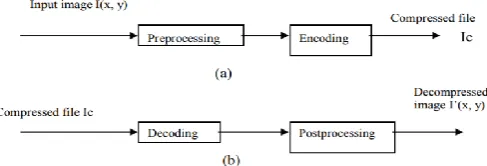
A compression system (Fig. 1) consists of two distinct structural blocks: an encoder and decoder. An input image I(x, y) fed into the encoder creates a compressed image Ic. After transmission over the channel, the compressed image Ic is fed into the encoder, where, an output image I’(x, y), is generated. In general, I’(x, y) may or may not be an exact replica of I(x, y).
Figure 1: Compression system model: (a) Encoder (b) Decoder
Each type of image may have a feature of redundancy, but they may occur in different ways. Therefore there is no compression method that is good for all types of images. In this thesis, we deal with methods to compress gray scale images, because it is the basic image type. All other image types can be illustrated as a gray scale or a set of gray scale of images. In principle, the image processing methods designed for gray scale images can be directly applied to colour and video images by processing each colour plane or image frames separately. By taking advantage of the physiological aspects of the human visual system, still image can be reduced to 50 times from its original size. The amount of compression and the quality expected form the compressed image fully depends on the application.
IV. PARAMETER MEASURES
A good image compression algorithm results in a high compression ratio and high fidelity. Unfortunately, both requirements cannot be achieved simultaneously. Although many metrics exist for quantifying distortion, it is most commonly expressed in terms of means squared error (MSE) or peak-signal-to-noise ratio (PSNR). The performance of image compression systems is measured by the metric defined in equations (1) and (2). It is based on the assumption that the digital image is represented as
N
1
N
2matrix, whereN
1andN
2denote the number of rows and columns ofMean Square Error (MSE)
2 11 1 2 2 1
))
,
(
)
,
(
(
1
N j N ij
i
g
j
i
f
N
N
(1)Peak Signal to Noise Ratio (PSNR) in dB
10
log
(
255
)
2
10
MSE
(2)Evidently, smaller MSE and larger PSNR values correspond to lower levels of distortion. Although these metrics are frequently employed, it can be observed that the MSE and PSNR metrics do not always correlate well with image quality as perceived by the human visual system.
Sometimes compression is quantified by stating the Bit Rate (BR) achieved by compression algorithm expressed in bpp (bits per pixel). Another parameter that measures the amount of compression is the Compression Ratio (CR) which is defined as
size
image
Compressed
size
image
Original
CR
(3)IV. PROPOSED METHODOLOGY
An efficient representation of integers is essential in many applications such as text compression, image compression, fast query evaluation, fast searching, and fast file access, In all these applications, one of the simple algorithms such as Golomb coding, Elias coding, Fibonacci coding etc, is used to represent an arbitrary integer compactly. The selection of the algorithm depends on the type of application and the probability distribution of the integers in that application. We can also construct variable length codes using the above mentioned simple algorithms without knowing the probability of the integers in advance. While many different representations have been developed, it is not always obvious in which circumstances a particular code is to be preferred.
The proposed new variable length code, called Extended Golomb Code (EGC), is presented to code the given non-negative integer N. In EGC, a divisor (d) is selected and the integer N to be coded is divided successively M times by d until the quotient q becomes zero. In each division, the remainders ri (i = 1 to M) are retained. The integer N is then
coded by coding M and the M remainders as
Code (M) = Code (rM, rM-1 …r1)
M is coded in unary and the remainders (rM, rM-1 …r1) are coding using a unique coding scheme. The bit length bl of
EGC follows the inequality:
1
)
*
(
1
)
log
log
(
2 10 10d
Log
d
N
bl
In general, when an integer N is divided by a divisor d, there are d possible remainders when the quotient (q) is greater than 0, and d-1 possible remainders when q is equal to 0.
Algorithm for Encoding
2. Divide each integer N successively by d, until the quotient (q) becomes zero. Count the number of divisions made as M. Retain the remainders in each division as r1, r2, r3… rM. Code r1, r2, r3… rM-1 in log2d bits, and rM in
log2 (d-1) bits.
Algorithm for Decoding
The following steps are used to decode the data in the compressed file.
1. Read the next bit 0 until bit 1 is encountered and count the no. of reads made so far including the bit 1 as M. 2. Read the bits further and decode M remainders as per the code given for the given divisor d and reconstruct ri.
3. Then obtain the integer N using the following procedure
If d > 2 {
Set N = 0 For i = M to 1 N = N*d + ri }
Else {
Set N=1 For i = M-1 to 1 N = N*d + ri
}
Repeat the steps 1 and 2 to obtain all Ns in the compressed file.
V. SIMULATION RESULT
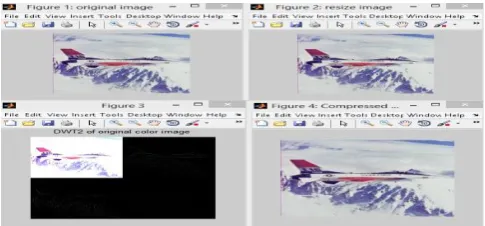
Implementation of the proposed methodology has been carried out for different color images and their performance has been evaluated. Different block size has been chosen for this lossy compression techniques i.e. 4×4, 8×8, 16×16 and 32×32 pixel block. PSNR and MSE have been evaluated for performance analysis. In color image for RGB format there are three values of PSNR and MSE for each image. To evaluate a common PSNR and MSE, the average value of Red, Green, and Blue component has been taken and results have been analyzed.
Figure 3: Experiment Result for House Image
Table I: Experimental MSE Results for Different Types of Image
Image of Size 512×512 4×4 Block Pixel 8×8 Block Pixel 16×16 Block Pixel 32×32 Block Pixel Airplane Image
9.431 17.338 29.672 44.543
House Image
4.929 6.136 15.342 23.953
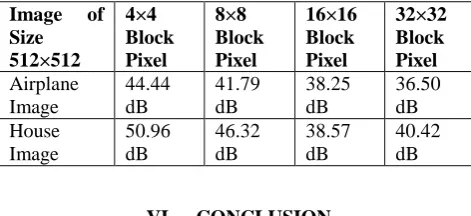
Table II: Experimental PSNR Results for Different Types of Image
Image of
Size 512×512 4×4 Block Pixel 8×8 Block Pixel 16×16 Block Pixel 32×32 Block Pixel Airplane Image 44.44 dB 41.79 dB 38.25 dB 36.50 dB House Image 50.96 dB 46.32 dB 38.57 dB 40.42 dB VI. CONCLUSION
All the proposed methods in this thesis involve less computational complexity. The simple and ordered codebook techniques took only less time when compared to other existing techniques. The enhanced PNN method in this thesis produces an initial codebook that gives better quality of the reconstructed images after optimization using iterative clustering method. All these methods can be extended to color images and video images. Even for gray scale images, the proposed methods can still be enhanced to reduce the bit-rate further. Though JPEG is accepted as an international standard, the complexity involved in coding the images is heavy. The proposed methods are simple and can generate the images with the acceptable quality. These techniques are simple and can be implemented in small hand held devices such as mobile phone, video phone, digital photo albums and video conferencing system.
REFERENCES
1. Shuyuan Zhu, Zhiying He, Xiandong Meng, Jiantao Zhou and Bing Zeng, “Compression-dependent Transform Domain Downward Conversion for Block-based Image Coding”, IEEE Transactions on Image Processing, Volume: 27, Issue: 6, June 2018.
3. C. Senthil kumar, “Color and Multispectral Image Compression using Enhanced Block Truncation Coding [E-BTC] Scheme”, accepted to be presented at the IEEE WiSPNET, PP. 01-06, 2016 IEEE.
4. Jing-Ming Guo and Yun-Fu Liu, “Improved Block Truncation Coding Using Optimized Dot Diffusion”, IEEE Transactions on Image Processing, Vol. 23, No. 3, PP. 3423-3429, March 2014
5. Ki-Won Oh and Kang-Sun Choi, “Parallel implementation of hybrid vector quantizer-based block truncation coding for mobile display stream compression”, the 18th IEEE International Symposium, PP. 01-06 28 August 2014 IEEE.
6. Jing-Ming Guo and Heri Prasetyo, “Content Based Image Retrieval using Features Extracted from Halftoning Based Block Truncation Coding”, IEEE Transactions on Image Processing, Vol. 78, No. 05, PP. 9898-1006, Jan. 2014.
7. Dr. Ghadah Al-Khafaji, “Hybrid image compression based on polynomial and block truncation code”, Electrical, Communication, Computer, Power, and Control Engineering (ICECCPCE), PP. 01-06, 2014 IEEE.
8. Jing-Ming Guo and Heri Prasetyo, “Content-Based Image Retrieval Using Error Diffusion Block Truncation Coding Features”, IEEE Transactions on Circuits and Systems for Video Technology, Volume: 25, Issue: 3, PP. 3421-3429, March 2014.
9. Seddeq E. Ghrare and Ahmed R. Khobaiz, “Digital Image Compression using Block Truncation Coding and Walsh Hadamard Transform Hybrid Technique”, International Conference on Computer, Communication, and Control Technology (I4CT 2014), PP. 01-06, September 2 - 4, 2014. 10. Jayamol Mathews and Madhu S. Nair, “Modified BTC Algorithm for Gray Scale Images using max-min Quantizer”, Automation, Computing,
Communication, Control and Compressed Sensing (iMac4s), PP. 01-05, 2013 IEEE.