Article
Securing IoT Based RFID Systems: A Robust
Authentication Protocol Using Symmetric
Cryptography
Khwaja Mansoor1,‡, Anwar Ghani2,‡ , Shehzad Ashraf Ch.2,‡, Shahaboddin Shamshirband
3,‡,∗, Shahbaz Ahmed Khan Ghayyur2,‡, and Ely Salwana4,‡
1 College of Signals, National University Science & Technology Islambad; [email protected]
2 Department of Computer Science & Software Engineering, International Islamic University Islamabad;
[email protected], [email protected], [email protected]
3 Department for Management of Science and Technology Development, Ton Duc Thang University, Viet
Nam; [email protected]
4 Institute of Visual Informatics, Universiti Kebangsaan Malaysia Bangi, Selangor, Malaysia;
* Correspondence:[email protected] ‡ These authors contributed equally to this work.
1
2
3
4
5
6
7
8
9
10
11
12
13
14
15
16
Abstract: Radio Frequency Identification( RFID)d evicesu ser adiow avest or elayidentifying information to an electronic reader using low-cost RFID Tag. RFID isexpected to replace the conventional bar-codeidentifications ystemd uet oi tsa dvantagel iker eal-timer ecognitiono fa considerablenumberofobjects. However,inRFIDsystemsan attackercangetthetagthatmay leadtovarioussecuritythreats,andthelimitedcomputationpowerofRFIDtagscancausedelay. Lightweight authentication protocols proposedusing cryptographic algorithms (one-way hash function, symmetric keyencryption/decryption, andexclusive-OR)in ordertocopewiththese problems.OnesuchlightweightcryptographicprotocolhasbeenpresentedbyGopeandHwang usingRFIDsystems.However,itanalyzedinthisarticlethattheirprotocolisinfeasibleandvulnerable to CollisionAttack, Denial-of-service(DoS),andStolenverifierA ttacks.Ar ealistic,lightweight authenticationprotocolhasbeenpresentedinthisarticletoensureprotectionagainstthementioned attacksforIoTbasedRFIDsystem.TheproposedprotocolhasbeenformallyanalyzedusingBAN logicandProVerifaswellasalsoanalyzedinformallyusingsecurityrequirement.Theresultsshow thattheproposedprotocoloutperformstheexistingprotocolsnotonlyinsecurityenhancementsbut alsointermsofcomputationandcommunicationcomplexity.Furthermore,theproposedprotocol hasalsobeenanalyzedforstoragecomplexity.
Keywords:authenticationprotocol;IoTSecurity;RFIDsecurity;symmetriccryptography;
17
1. Introduction 18
Internet of things (IoT) is based on the Internetwork connectivity of daily use objects. It consists
19
devices(such as sensors) with Internet connectivity capable of communication and interaction with
20
others and be controlled and monitored remotely [1,2]. The conventional bar code system suffer from
21
various issues like line of sight communication, scanning one at time, prone to physical damage, and
22
limited storage of information, is rapidly being replaced by the emerging IoT based RFID systems. Due
23
to the scares resource of RFID Tags, an RFID based could be an attractive target for attacker. Therefore,
24
it is very important to pay a special attention to the security and authentication of such systems. The
25
overall RFID system architecture has been depicted in Figure1.
26
Server
RFID Cluster
RFID Cluster
Tag
Reader
Figure 1.RFID System Architecture
RFID technology is most simple form of pervasive sensor networks that are commonly used for
27
identification of different physical objects [3,4]. It uses a two way radio signals receiver and transmitter
28
called reader or the interrogators. Radio signals is sent to the tag attached to the physical object and
29
the interrogator or reader is responsible to respond [5,6]. RFID reader device is a network connected
30
device (mobile or fixed) along with an antenna which is responsible to transmit power, data as well as
31
commands to the objects tags [7–9]. RFID reader device is an access point for the RFID-Tags clusters
32
that is responsible for the availability of the tag information to different System application. Tags are
33
of two types, passive tags in which energy is transferred using radio frequency from reader device and
34
active tags they have internal energy source like power batteries. Different features are described in
35
Table1.
36
Table 1.RFID-Tag Features
Features Passive Tags Active Tags
Data Storage 128 bytes 128 bytes
Tag Power Energy transferred through Radio Frequency from Reader Internal source to Tag
Tag Battery No Yes
Availability of Source Power Only in range of Radar Continuous
Signal Strength required to Tag Very High Very Low
Range Upto 3-5 M Upto 100 M
Multiple Tag Reading less then thousand Tags within 3 M of Reader range More then 1000 tags recognized upto 100mph
RFID technology is system having identification device which use small radio signals for object
37
tracking and identification purpose. RFID tagging system contain the tags, read and write device
38
and the system application for data processing, transmission and collection of data. RFID technology
39
has a very broad application domain and can be used in high value innovative solutions assisting in
40
the areas of IT Asset Tracking, Race Timing, E-Passport, Transportation, Payments, Human Implants,
41
Supply-Chain-Management, Fleet and Asset-Management, Security Access-Control, E-Commerce, and
42
Traffic Analysis and Management[8,10–13].
43
A low cost method to identify objects is to used RFID device that uses radio waves. These
44
devices relays identifying information to an electronic reader using RFID Tags [2]. However, reliable
45
identification of various objects is a great challenge especially if there are various object present at the
46
same time. In some applications, it is very important to identify objects for example, vehicle tracking
47
system, entry and exit of a free way, and smart parking etc. Vehicle tracking is specifically crucial in
48
security and law and order applications [10]. Therefore, an authentication process suitable for RFID
based system is very crucial to ensure authenticity of the information exchanged between different
50
RFID enabled devices [8].
51
As IoT based RFID systems remains an emerging technology consisting of limited resource
52
devices, it is vulnerable to various security threats like data threats, authentication, and security threats
53
[14–16]. Due to the broad application domain, RFID must be more secure and protected to meet the
54
industrial standards. For reliable security of RFID, different types of features in security protocols
55
should be considered; 1) security schemes of RFID must provide user friendliness, 2) user anonymity
56
must be ensured to protect the identity of legitimate users, 3) there should be a provision for change
57
moreover, update of tag data at any time securely, 4) ensure backward and forward secrecy in RFID
58
tag reading-writing process, 5) protection of an RFID system from malicious system users to prevent
59
insider attacks, 6) having capabilities to endure replay attacks, 7) having capabilities to withstand the
60
impersonation and forgery attacks, 8) having capabilities to achieve secure mutual authentication, and
61
8) having capabilities to endure man-in-middle attacks.
62
Different technological solutions are available to overcome the issues of reliable identification of
63
different objects, however, all such technological solutions have their specific limitations. For example,
64
using bar code for identification of objects is the most prevalent technology used today. However,
65
reading the bar code required manual and physical contact in the line of sight between the bar code
66
reading device and the tag [13,17]. It makes the bar code based process slow and inefficient in real
67
time applications.
68
Different secure authentication protocols proposed by different researchers to achieve the above
69
mentioned Security features. However, the security of RFID system is still inadequate and facing
70
various security issues like spoofing, RFID counterfeiting, tracking, sniffing, denial of service,
71
repudiation, and replay attacks [18]. Recently, a lightweight cryptographic protocol has been presented
72
by Gope and Hwang [19] using RFID systems. However, after analysis it is clear that their protocol is
73
unfeasible and vulnerable to Collision Attack, Denial-of-service (DoS), and Stolen verifier Attacks.
74
In this article, an improved and robust authentication protocol based on symmetric cryptography
75
has been presented for IoT based RFID system to overcome the issues in Gope and Hwang [19] protocol.
76
The general contributions of this article include the following:
77
• To perform cryptanalysis of the baseline protocol for possible security loopholes and
78
vulnerabilities.
79
• To propose an improved authentication protocol for the same scenario to overcome the security
80
issues of the baseline protocol.
81
• To formally and informally analyze the proposed protocol for possible security lapses.
82
• To compare the proposed protocol in terms of the security requirements with existing protocols.
83
Furthermore, to comparatively analyze the proposed protocol with the existing protocol in terms
84
of computation and communication cost (complexity).
85
Rest of the article organized in various sections. In section2a brief overview of the literature has
86
been presented followed by a detailed review of Gope and Hwang [19] that is base of the proposed
87
protocol which the base of this research work. Section 3presents the proposed protocol whereas
88
section4presents the detail security analysis of the proposed protocol. Section5presents a comparative
89
analysis of the proposed protocol with existing protocols and finally section6concludes the article.
90
2. Literature Survey 91
In literature, authentication in RFID based system has been rigorously investigated. Recently,
92
various anonymous mutual authentication security schemes/protocols have been proposed for
93
RFID Systems [11,12,19–31]. The protocols in literature have been categorized into non-public
94
key-cryptosystem (NPKC) and public-key-crypto system (PKC) security protocol. Also, other
95
researchers came up with Asymmetric/public key cryptosystem (PKC) solution based on elliptic
96
curve cryptosystem (ECC). Due to the modular exponential operations having very high computation
cost, the elliptic curve cryptosystem (ECC) based security protocols are infeasible for low-powered
98
RFID systems. However, using the symmetric key cryptosystem (NPKC) solution – hash based RFID
99
Systems may be a feasible solution due to their equitable computational overhead.
100
In 2005, the authors in [23] proposed a symmetric public key crypto (PKC) based protocol
101
for RFID Systems that was mainly designed using exclusive-OR and a one-way Hashing function.
102
The authors claimed that their protocol addresses various security issues faced by the RFID-Tag
103
System. Unfortunately, their scheme is vulnerable to different security threats including forgery attack,
104
man-in-the-middle attack, and traceability issue. subsequently, various security protocols including;
105
[26], [30], and [21] were designed using hash function encryption, and exclusive-OR encryption.
106
However, they proved to be exposed to various security attacks like DoS attack, forgery attack [28].
107
Yang et al. [23] in 2005 presented a mutual authentication protocol for RFID-System which utilizes
108
a hash function and symmetric-key cryptography. The protocol successfully achieved low-cost mutual
109
authentication between FRID-Tags and RFID-Server. This mutual authentication between an RFID-Tag
110
and a server have been achieved in a total of six messages. Message 1 and 2 are used for sharing a
111
secret key between a Tag and a Server while the messages 3 to 6 are responsible for session-specific
112
parameters. Two new and secure shared keys used between two participants for each session. The
113
correctness of the proposed protocol has been verified using GNY logic [32]. Furthermore, the authors
114
claimed that their protocol is secured and resistant to all known attacks. However, their protocol still
115
has various vulnerabilities like exposure to forgery attack, man-in-the-middle attack, and traceability
116
problems.
117
Tan et al. [30] proposed a server-less authentication scheme for RFID-System in 2008. In the
118
scheme, they put forward a secure searching technique for Tag. In their scheme authentication occurred
119
in between only two participants Tag and Reader. A trusted certificate authority is used to deploy
120
Tags and authorize reader devices. Communication takes place on secure channel among certificate
121
authority, Tag and RFID reader in deploying Phase. While mutual authentication is done over a public
122
channel between RFID-Tag and RFID Reader only. However, their scheme has scalability issue and
123
also vulnerable to different attacks such as forgery attacks, untraceability, de-synchronization, and
124
DoS attacks.
125
Cai et al. [21] proposed a security scheme for RFID System. They improved a secure extension of
126
the previous security schemes for RFID Systems. The designed architecture was based on XOR
127
operation and Hash encryption to overcome the RFID-Tag impersonation attack. RFID-Reader
128
impersonation attack and resist adversary to manipulate legitimate RFID-Tag, and Reader. They came
129
up with the solution of ownership transfer issue of RFID tags moreover, preserve synchronization
130
issue among RFID-Tags and server. Five communication messages used by Cai et al. scheme to
131
complete mutual authentication Between participants. They claim that their security scheme resists
132
server impersonation attack, Tag impersonation attack, and de-synchronization attack. However, their
133
scheme cannot resist forwarding secrecy and DoS attack. .
134
Authors in [29] put forward an authentication protocol designed for RFID based systems. The
135
main focus of their proposal is to overcome brute force attack and to keep retrieval cost minimum. The
136
authors claimed that their proposed protocol is resistant to different attacks like DoS attack, replay
137
attack, man-in-the-middle attack and successfully achieved mutual authentication between RFID-Tag
138
and the server. They also claimed that their scheme preserves Confidentiality, indistinguishability,
139
forward secrecy and mutual authentication.
140
Gope and Hwang [19] performed cryptanalysis of [31] security protocol and proved that it is
141
vulnerable to reader impersonation attack, DoS attack, and Tag impersonation attack. Gope and
142
Hwang presented a lightweight authentication protocol. This article examined and found that their
143
scheme contains some vulnerabilities like Collision Attack, Stolen verifier Attack and Denial-Of-Service
144
(DoS). Furthermore, Gope and Hwang presented their protocol and claimed to be a more secure scheme
145
then [31] scheme.
Table 2.Notation Guide
Notations Description
T RFID-tag
R Reader Device
S Database Server System
IDT−i ith Tag identity
AIDT One-time Tag alias identity
SID Shadow identity
Rj jth Reader identity
Nt Tag Random number
Nr Reader Random number
Kts Shared key of server and tag
Kemg Shared emergency key of server and tag
Krs server and tag secret key
Trseq Track sequence number (used by both S and T)
rj Randomly derived from Shadow-ID and Emergency Key
h(.) Hash function
⊕ The exclusive XOR operation
|| concatenation
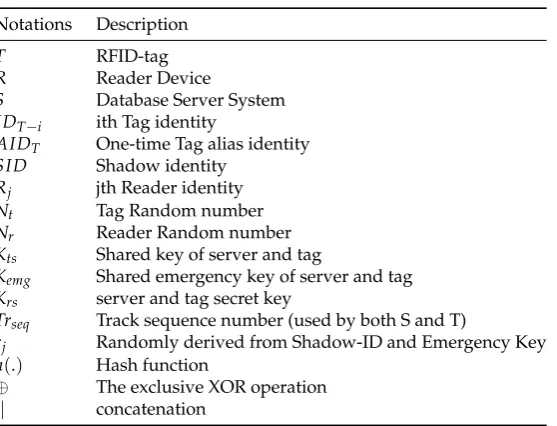
The Gope and Hwang [19] protocol has been investigated in the following subsection in detail
147
and its cryptanalysis has been performed to check it for vulnerabilities. From now on this protocol will
148
be referred to as the baseline protocol. Different symbols used in designing the proposed protocol has
149
been presented in Table2.
150
2.1. Adversarial Model 151
The proposed protocol has been designed keeping in mind the following adversarial model where
152
assumptions may be common as pointed out in [33]. As per mentioned adversaryA, the following
153
assumptions are considered.
154
1. The public channel is under full control ofA, so that theAhas the ability to intercept, reply,
155
modify, revert or even resend fresh fabricated message.
156
2. Ahas the capability to extract the RFID-Tag by power analysis of the information or leak the
157
same information.
158
3. There is a chance thatAmight be an unauthorized user or a malicious user of the system.
159
4. The insider has access to the identities of legitimate users and server information as these are
160
public and available to the system’s users.
161
5. The servers are assumed to be under protection, however,Acannot break the protection of server
162
as well as the system.
163
6. TheAdoes not have any access to the secret key of the server.
164
2.2. Review of Baseline Protocol 165
The proposed baseline protocol designed for RFID has three main entities; 1) Database Server,
166
2) Reader Device, and 3) RFID Tags. The network layout of RFID System divided into several RFID
167
clusters. Every cluster consists of a Reader and many Tags. Tags can shift from one cluster to another.
168
Every RFID Reader of the cluster is required to authenticate RFID Tags through Database server where
169
the RFID-Tags need to be registered. Each cluster and database server share a symmetric key Krs [19].
170
Gope and Hwang [19] authentication scheme consist of two main phases; 1) Tag Registration Phase, 2)
171
Tags Authentication Phase.
172
2.3. Baseline Protocol Registration Phase 173
Step-1:Every RFID Tag submit itsIDTi to the RFID DatabaseS.
174
Step-2:Database Server generates random numbernsand computesKts =h(IDTikns⊕IDs). 176
177
Step-3: S generates set of unlikeable shadow IDs, and SID = {sid1,sid2· · · }, where the
178
sidj ∈ SID. Database Server computessidj =h(IDTikrjkKts). Then it generates a set of emergency 179
keysKemg={kemg1,kemg2· · · }, each of the key corresponding tosidj∈SIDwhere eachkemgi ∈Kemg. 180
Sthen computeskemgi =h(IDTiksidjkrj). 181
182
Step-4: The Database Server S generates a 32-bit random sequence number Trseq. Then S
183
generates random numbermand matches it withTrseq,Trseq=m, and send theTrseqto the RFID Tag
184
through ReaderRby maintaining the copy ofTrseqin its database for speeding up the authentication
185
process.
186
187
Step-5:The RFID ServerSauthenticates the validity of RFID TagIDTi based onTRseq. IfTRseq
188
does not have a match within the record of RFID ServerS, then the ServerSdoes not authenticate
189
RFID Tag and terminate the process. In this case the RFID Tag IDTi will use one of its fresh pair 190
of the emergency keykemgj ∈ Kemg and shadow IDsidj ∈ SID. The used pair of shadow ID and 191
emergency ID (SID,Kemg) must be deleted from both, the Database ServerSand the RFID TagIDti. 192
Database ServerSagain updates and send{Kts,(SID,Kemg),Trseq,h(.)}through secure channel for
193
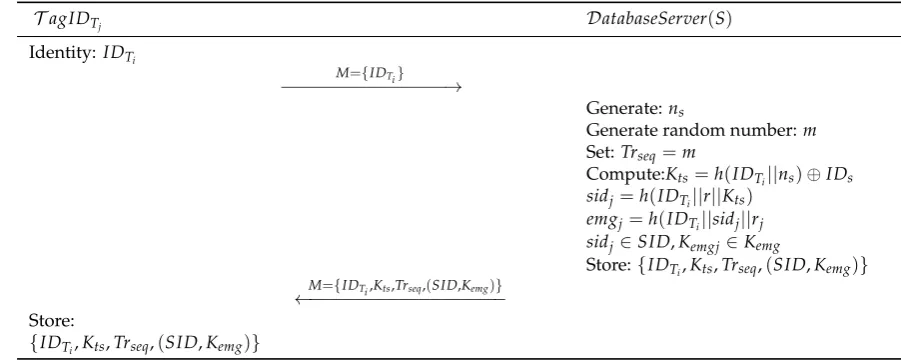
further communication. The registration phase of the baseline protocol has be shown in Figure2.
194
TagIDTj DatabaseServer(S)
Identity:IDTi
M={IDTi}
−−−−−−−−−−−−−−−→
Generate:ns
Generate random number:m
Set:Trseq=m
Compute:Kts=h(IDTi||ns)⊕IDs
sidj=h(IDTi||r||Kts)
emgj=h(IDTi||sidj||rj
sidj∈SID,Kemgj∈Kemg
Store:{IDTi,Kts,Trseq,(SID,Kemg)}
M={IDTi,Kts,Trseq,(SID,Kemg)}
←−−−−−−−−−−−−−−−−−−
Store:
{IDTi,Kts,Trseq,(SID,Kemg)}
Figure 2.Gope-Hwang’s proposed registration scheme
2.4. Baseline Protocol Tag Authentication Phase 195
After the registration of RFID Tags with the Database ServerS, mutual authentication of RFID
196
Tags with the Database ServerSthrough ReaderRstarts that is described in the following Steps.
197
Step-1:RFID TagIDTi generates random numberNt, then derivesAIDT =h(IDTikKtskNtkTrseq),
198
Nx=Kts⊕Ntand computesV1=h(AIDtikKtskNxkRi). RFID Tag sends a message request asMA1
199
to the Reader deviceRiand the ReaderRialso receives a recently used sequence number from the
200
ServerSfor mutual authentication. In the case of synchronization loss, the RFID Tag uses one of its
201
fresh pair(sidj,Kemgj). Subsequently, assign to thesidjasAIDTand thenkemgj asKts. RFID Tag sends 202
a message to the ReaderRasMA1 :{AIDT,Nx,Trseq,V1}.
203
Step-2: Upon receiving request from RFID Tag, reader of the cluster (in which Tag is located)
204
generates random numberNrand computesNy=Krs⊕Nr,V2=h(MA1kNrkKrs). ReaderRisends a
205
message to the Database ServerSfor verification.MA2 :Ri→S{Ny,Ri,V2,MA1}.
206
Step-3:When the Database serverSreceives a request from the ReaderR, first it validate track
207
sequence numberTrseq by computingV1 = h(AIDTkKtskNxkRi). Database ServerS then derives
TagIDTi ReaderRi DatabaseServer(S)
Generate:Nt
Compute:Nx=Kts⊕Nt
AIDT=h(IDTi||KtskNtkTrseq)
V1=h(IDT||KtskNxkRi) or
sidj∈SID,Kemgj∈Kemg
AIDT=sidj,Kts=Kemg
MA1={,AIDT,Nx,Trseq,V1} −−−−−−−−−−−−−−−−−−−−−−→
Generate:Nr
Decieve:Ny=Krs⊕Nr Computes:V2={MA1kNrkKrs}
MA2={Ny,Ri,V2,MA1} −−−−−−−−−−−−−−−−−−−→
Verify:Trseq
Derive:Nt=Kts⊕Nx,Nr=Krs⊕Ny Compute and verify:V2?,V1?,AIDT? Generate: m
Compute:Trseqnew=m
Tr=h(KtskIDTikNt)⊕Trseqnew
V4=h(TrkKtskIDTikNt)
V3=h(RikNrkKrs) Update:
Ktsnew=h(KtskIDTikTrseqnew)
Trseq=Trseqnew,Kts=Ktsnew
or
GenerateKtsnew
Computex=h(IDTikkemgj)⊕Ktsnew GenerateKts=Ktsnew
MA3={Tr,V3,V4,x(i f req.)} ←−−−−−−−−−−−−−−−−−−
Compute and Check:
V3∗=? h(RikNrkKrs)
MA4={Tr,V4,x(i f req.)} ←−−−−−−−−−−−−−−−−−−−−−−
Compute and Verify:
V4∗=? h(TrkKtskIDTikNt) Compute and update:
Trseqnew=h(KtskIDTikNt)⊕Tr
Ktsnew=h(KtskIDTikTrseqnew
Trseq=Trseqnew,Kts=Ktsnew
Or
Ktsnew=h(IDTikkemgj)⊕x,
Kts=Ktsnew
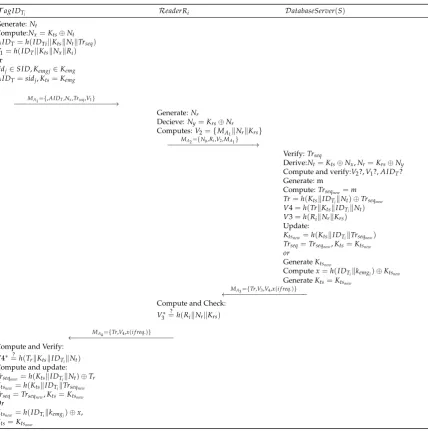
Figure 3.Gope-Hwang’s proposed authentication scheme
Nt = Kts⊕Nx and verify AIDT. Upon successful verification of AIDT, the Database Server S
209
generates a random numbermand assigns it toTrseq =m. It also computesTr=h(KtskIDTikNt)⊕Trseq, 210
V4= h(TrkKtskIDTikNt),V3= h(RikNrkKrs)to creates a MessageMA3 and send it to the ReaderR.
211
Finally, the Database ServerScomputesKTsnew =h(KtskIDTikTrseqnew)and updatesKTsnew andTrseqnew. 212
In case the message MA1 dose not contain Trseq, then the Database Server S randomly generates 213
a new shared key KTSnew using the emergency key Kemgj and real identity of the RFID Tag IDTi. 214
x=Ktsnew⊕h(IDTikKemgj)is computed andxis sent within the messageMA4. WhereV4is calculated
215
asV4=h(NtkTrkxkKemgj).MA3 :S→Ri:{Tr,V3,V4,x(i f req.)}.
216
Step-4The ReaderRreceives MA3 and computesh(RikNrkKrs)and validates if it is equal to
217
V3. If it is equal RFID ReaderR sends MA4 to the Tag. Contrarily, the Reader R terminates the
218
established connection. RFID Tag receives the messageMA4 and computesh(TrkKtskIDTikNt)and 219
verifies whether it is equal toV4or not. RFID Tag derivesKtsnew = h(KtskIDTikTrseqnew)and stores 220
Kts = Ktsnew,Trseq = Trseqnew for future communication. MA4 : Ri → IDTi : {Tr,V4,x(i f req.)}. The 221
detailed stepwise representation of the baseline protocol has been shown in Figure3.
2.5. Cryptanalysis of Baseline Protocol 223
The baseline protocol [19] provides authentication for RFID system in a distributed environment,
224
and the entire protocol is based on the verification of Track sequence number. In the registration phase,
225
the Database Server generates an auto-generated a random number, save it in its database and sends
226
its copy to the RFID Tag through a secure channel.During the authentication phase, the RFID Tag
227
sendsMA1 ={AIDT,Nx,Trseq,V1}to the Reader(Ri).
228
The Database Server receives the messageMA2 from the reader that contains different information
229
of a particular RFID Tag likeMA2 ={MA1,Ny,Ri,V2}for authentication. The first step of the Database
230
Server(S)for authenticating the particular RFID Tag is to check itsTrseqnumber. If the receivedTrseq
231
number of RFID Tag does not matches, the authentication process terminates, otherwise it undergoes
232
further computation. Here the proposed protocol in [19] is totally dependent on theTrseqnumber and
233
theTrseqnumber is generated randomly.
234
2.5.1. Vulnerable to Collision Attack
235
In baseline protocol [19] verification is done in the very first step of the Login phase. If collision
236
occurs in generating theTrseqfor different RFID Tag, there is no provision for handling such situation.
237
The Database Server can cannot handle such situation. Therefore, it will rather terminate the
238
authentication process.
239
2.5.2. Vulnerable to Stolen Verifier Attack
240
An adversary A can steal verified data from the server during the current or any past
241
authentication session. The verified data does not have the secret keys with XOR or any other
242
encryption. An Adversary is capable of generating communication data using the stolen data and
243
resend it to the server. If this operation has been successful, the Adversary impersonates a legal user in
244
the next communication and authentication section. In Gope and Hwang [19] schemeTrseqnumber is
245
saved unencrypted on the server’s verifier table. It leads to the exposure of verifier table to become a
246
victim of Stolen Verifier Attack.
247
2.5.3. Vulnerable to Denial-Of-Service (DoS) Attack
248
In baseline proposal [19]an adversary can launch DoS attack by continuously generating 32 bits
249
randomTrseqnumbers and send it to the Database Server. It will keep the Database Server busy in
250
verification of dummy random numbers thus avoiding it to serve a legitimate request.
251
3. Proposed Scheme 252
The proposed protocol for RFID Tag System consists of three main entities; 1) Database Server, 2)
253
Reader Device, and 3) RFID Tags. RFID system is divided into different clusters where every cluster
254
consists of RFID Reader and many tags. RFID Tags can move from one cluster to another. Every
255
Reader of the cluster is required to authenticate RFID Tags through the Database server where RFID
256
Tags need to register itself. Each cluster and the Database Server share a keyKtsin a symmetric way.
257
The proposed mutual authentication protocol consists of two main phases: 1) Tags Registration Phase,
258
2) Tags Authentication Phase.
259
3.1. Tags Registration Phase 260
In this phase, the Database Server issues security credentials to RFID Tags using a secure channel.
261
This process takes place in the following steps.
262
Step-1:Every RFID Tag submits itsIDTito the RFID ServerS.M={IDTi} 263
Step-2: The Database Server Generates a random number ns and computes Kts =
265
h(IDTikns⊕IDs). 266
267
Step-3:The Database ServerSalso computes one-time alias Tag identityAIDTby encrypting it
268
with the Secret Key of Database Server asAID=Esx(IDTikrTi). Hereriis a random number. 269
270
Step-4: The Database Server S authenticates the RFID Tag IDTi based on AIDT in Tags 271
authentication Phase by checking if a request is valid or not.
272
273
Step-5: The Database Server stores and sends a messageMto the RFID Tag through a secure
274
channel. M={IDTi,Kts,AID}. Upon receiving the message from database serverS, the RFID Tag 275
stores the information in its memory.
276
277
The detailed steps of the proposed registration phase have been shown in Figure4.
278
TagIDTj DatabaseServer(S)
Identity:IDTi
M={IDTi,}
−−−−−−−−−−−−−−−−→
Generate:ns
Compute:Kts=h(IDTi||ns)⊕IDs
AID=Esx(IDTikrTi) Store:{IDTi,Kts,AID}
M={IDTi,Kts,AID}
←−−−−−−−−−−−−−−−−
Store:{IDTi,Kts,AID}
Figure 4.Registration phase of the proposed protocol
3.2. Tags Authentication Phase 279
Once registered with the Database ServerS, the RFID Tags undergoes a mutual authentication
280
process with the Database ServerSthrough the ReaderR. This process described in the following
281
Steps.
282
Step-1: RFID Tag IDTi generates a random number Nt, then derives Nx = Kts ⊕Nt and 283
V1=h(AIDtkKtskNxkRi). RFID Tag makes a request through the messageMA1 :{AIDT,Nx,T1,V1}
284
to Reader deviceRifor mutual authentication.
285
286
Step-2:Upon receiving the request from RFID Tag, reader of the cluster (in which Tag is located)
287
first verifies and checks the freshness of the message as(T2−T1)≤∆T. Then the Reader generates
288
a random numberNr and computesNy = Krs⊕Nr,V2 = h(MA1kNrkKrskT2). ReaderRi sends a
289
message to the Database ServerSfor verification.MA2 :Ri→S{Ny,Ri,V2,MA1,T2}.
290
291
Step-3: When the Database Server Sreceives the request from the Reader R, first it verifies
292
(T3−T2) ≤ ∆T, then derives Nt = Kts⊕Nx and Nr = Krs⊕Ny. Further, the Database Server
293
computes and verifiesV1 =h(AIDTkKtskNxkRi),V2=h(MA1kNrkKrskT2). The Database ServerS
294
then verifiesAIDTi by decrypting it asAIDTi =DSx(IDTikri). After verification ofAIDTthe Database 295
Server computesV3=h(RikNrkKrskT3)andV4=h(KtskIDTikNtkT3). Upon successful verification 296
the server then updatesAIDTi(new)=ESx(IDTikri(new))and derivesZT=AIDTnew⊕KTsand creates 297
a messageMA3and sends it to the ReaderR.MA3 :S→Ri:{V3,V4,ZT,T3}
298
299
Step-4:The ReaderRreceivesMA3and checks the freshness of the message as(T4−T3)≤∆Tand
300
computesh(RikNrkKrs)and verifies if it is equal toV3. If true then RFID ReaderRsendsMA4to RFID
Tag otherwise the ReaderRterminates the established connection.MA4 :Ri →IDTi :{V4,T4,ZT} 302
303
Step-5:The RFID Tag receives a messageMA4and checks its freshness. After that the message
304
is verified asV4∗ =? h(KtskIDTikNt). After that RFID Tag computes and updates AIDTi(new) = 305
(ZT⊕KTs), AIDTi = AIDTi(new) and save the information for next authentication process. Else 306
freshness check get unsuccessful then Tag will not updateAIDTi asAIDTi(new). 307
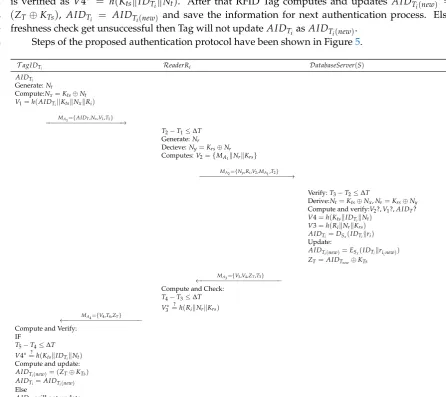
Steps of the proposed authentication protocol have been shown in Figure5.
308
TagIDTi ReaderRi DatabaseServer(S)
AIDTi
Generate:Nt
Compute:Nx=Kts⊕Nt
V1=h(AIDTi||KtskNxkRi)
MA1={AIDT,Nx,V1,T1}
−−−−−−−−−−−−−−−−−−−→
T2−T1≤∆T
Generate:Nr Decieve:Ny=Krs⊕Nr Computes:V2={MA1kNrkKrs}
MA2={Ny,Ri,V2,MA1,T2}
−−−−−−−−−−−−−−−−−−−−−−→
Verify:T3−T2≤∆T
Derive:Nt=Kts⊕Nx,Nr=Krs⊕Ny Compute and verify:V2?,V1?,AIDT?
V4=h(KtskIDTikNt) V3=h(RikNrkKrs)
AIDTi=DSx(IDTikri) Update:
AIDTi(new)=ESx(IDTikri(new))
ZT=AIDTnew⊕KTs
MA3={V3,V4,ZT,T3}
←−−−−−−−−−−−−−−−−−−−− Compute and Check:
T4−T3≤∆T V3∗=? h(RikNrkKrs) MA4={V4,T4,ZT}
←−−−−−−−−−−−−−−−−−−− Compute and Verify:
IF
T5−T4≤∆T V4∗=? h(KtskIDTikNt)
Compute and update:
AIDTi(new)= (ZT⊕KTs)
AIDTi=AIDTi(new)
Else
AIDTiwill not update
Figure 5.Proposed authentication protocol
4. Security Analysis 309
In this section, the security features and robustness of the improved proposed authentication
310
protocol has been analyzed in the light of the adversarial model that has been discussed in subsection
311
I-A. Here, the security strength of the proposed protocol against all known security attacks that an
312
adversary can launch examined. This task has established in multiple steps; 1) Formal analysis, 2)
313
Informal analysis, and 3) Comparative analysis. Formal analysis of the proposed protocol has been
314
performed using two methods; a) BAN logic, and b) ProVerif simulation. Informal analysis performed
315
by launching various attacks on the proposed protocol and analyzing it for possible loopholes. Finally,
316
the proposed protocol has also been comparatively analyzed for computation and communication
317
complexity (cost or time) with existing state-of-the-art protocols.
318
4.1. Security Analysis with BAN-logic 319
Burrows Abadi-Needham (BAN) logic consists of a set of rules that can be used to analyzed
320
information exchange protocols. It specifically determines if a the information exchanged in a protocol
Table 3.BAN logic Notations
Notations Description
P| ≡X P Believes that X
PCX P Sees that X
P| ∼X P once said X
P⇒X P have total jurisdiction on X #(X) X is updated and fresh
(X,Y) X, Y is component of formula(X,Y)
<X>Y X is combine with Y
(X)K Hash of message X using a key K
P←→K Q P and Q share key K for communication
AIDTi AIDTiis one time session key P|≡P←→K Q.pC<X>K
P|≡Q|∼X Message-Meaning rule P|≡#(X)
P|≡#(X,Y) Freshness-conjuncatenation rule
P|≡#(X),P|≡Q|∼X
P|≡Q|≡X Nonce-verification rule P|≡Q⇒X,P|≡Q|≡X
P|≡X Jurisdiction rule
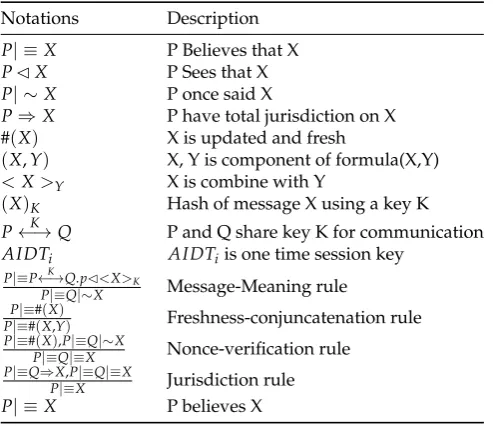
P| ≡X P believes X
is resistant against eavesdropping and trustworthy and secured. The mutual authentication of the
322
proposed protocol has been checked using the BAN logic [34]. Different rules of BAN logic including
323
idealized form, assumptions, and proofs are shown in Table3.
324
To analyzed the security a protocol using BAN logic, different goals have to be determined. In
325
case of the proposed protocol, eight different goals have been determine based on BAN Logic. These
326
goals have been shown in the following list.
327
• Goal 1:Ri| ≡Tag
AIDT
←→Ri
328
• Goal 2:Ri| ≡Tag| ≡Tag
AIDT
←→Ri
329
• Goal 3:Sj| ≡Ri AIDt ←→Sj
330
• Goal 4:Sj| ≡Ri| ≡Ri
AIDT
←→Sj
331
• Goal 5:Ri| ≡Sj
AIDT
←→Ri
332
• Goal 6:Ri| ≡Sj| ≡Sj
AIDT
←→Ri
333
• Goal 7:Tag| ≡Ri
AIDT
←→Tag
334
• Goal 8:Tag| ≡Ri| ≡Ri
AIDT
←→Tag
335
The achieve the goals listed above, the security analysis using BAN logic has been divided into
336
two parts; part1 and part2. Part1 shows the idealized form of the protocol that has been proved in
337
Part3 whereas Part2 uses assumptions to analyzed the proposed protocol.
338
Part1:The idealized form for the proposed protocol has been discussed as follows:
339
• M1:Tag→Ri: AIDT,Nx:<Nt>Kts,V1,T1 340
• M2:Ri→Sj: M1,Ny:<Nr >Krs,Ri,V2,T2, 341
• M3:Sj →Ri: V3,V4,Zt:<AIDTi>∗Kts,T3 342
• M4:Ri→Tag:V4,T4,Zt:<AIDTi >Kts 343
Part2:The assumptions used for analyzing the proposed protocol using BAN logic have been
344
shown below:
345
• A1:Tag| ≡#(Nt)
346
• A2:Ri| ≡#(Nr)
347
• A3:Sj| ≡#(AIDTi)(ri)
348
• A4:Ri| ≡Sj⇒ri
349
• A5:Ri| ≡Tag⇒Nt
350
• A6:Sj| ≡Ri ⇒Nr
351
• A7:Sj| ≡Tag⇒Nt
352
• A8:Tag| ≡Sj⇒ri
353
• A9:Tag| ≡Ri⇒Nr
354
Part 3:Analysis of Idealized form of the proposed protocol that has been derived on the basis of
355
BAN logic assumptions and rules are described as follow:
M1:Tag→Ri:AIDTi,Nx:<Nt>Kts,T1 is time-stamp ofTag 357
Using seeing rule, the following can be achieved
358
• S1:RiCAIDTi,SID,Nx:<Nt>Kts,T1 359
According to message-meaning rule and S1, the following can be obtained
360
• S2:Ri| ≡Tag| ∼Nt
361
Using Freshness-conjuncatenation rule and S2 to achieve the following
362
• S3:Ri| ≡Tag| ≡Nt
363
Using jurisdiction rule and S3, the following can be achieved
364
• S4:Ri| ≡Nt
365
Using S4 and session key rule, the following can be achieved
366
• S5:Ri| ≡Tag AIDT←→i
Ri(Goal 1) 367
Using nonce-verification rule, the following is obtained
368
• S6:Ri| ≡Tag| ≡Tag AIDTi
←→ Ri (Goal 2) 369
M2:Ri →Sj:M1,Ny:<Nr >Krs,T2,V2. Where,T2 is time-stamp ofRi 370
By using the seeing rule, we achieve
371
• S7:SjCM1,Ny:<Nr >Krs,T2,V2 372
By message-meaning rule and S7, the following can be achieved
373
• S8:Sj| ≡Ri| ∼Nr
374
By Freshness-conjuncatenation rule and S8, the following can be computed
375
• S9:Sj| ≡Ri| ≡Nr
376
By applying the jurisdiction rule and S9, the following can be obtained
377
• S10:Sj| ≡Nr
378
Using S10 and the SK rule, the following can achieved
379
• S11:Sj| ≡Ri AIDTi
←→ Sj(Goal 3) 380
Using nonce-verification rule and S11, the following can be achieved
381
• S12:Sj| ≡Ri| ≡Ri AIDT←→i
Sj.(Goal 4) 382
M3:Sj→Ri:V3,V4,Zt<AIDTinew >
∗
Kts,T3,T3 is time-stamp ofSj 383
By seeing-rule, the following can be achieved
384
• S13:RiCV3,V4,Zt< AIDTinew >
∗ Kts,T3 385
By message-meaning rule and S13, the following can be obtained
386
• S14:Ri| ≡Sj| ∼AIDTinew 387
By S14 and the Freshness-conjuncatenation rule, the following can achieved
388
By the assumption S15 and jurisdiction rule, the following can be achieved
390
• S16:Ri| ≡AIDTinew 391
Using S16 and session-key rule, the following can be achieved
392
• S17:Ri| ≡Sj
AIDTinew
←→ Ri.(Goal 5) 393
And applying nonce-verification rule, the following can be computed
394
• S18:Ri| ≡Sj| ≡Sj
AIDTinew
←→ Ri.(Goal 6) 395
M4:Ri →Tag:V4,Zt<AIDTinew >Kts,T4,T4 is timestamp ofRi 396
Using seeing rule, the following can be computed
397
• S19:TagCV4,Zt<AIDTinew ≥>ts,T4 398
Using message-meaning rule and S19, the following is achieved
399
• S20:Tag| ≡Ri| ∼AIDTi0new 400
Using S20 and Freshness-conjuncatenation rule, the following can be obtained
401
• S21:Tag| ≡Ri| ≡AIDTinew 402
Using the jurisdiction rule and S21, the following can be achieved
403
• S22:Tag| ≡ AIDTinew 404
Using session-key rule, the following can be obtained
405
• S23:Tag| ≡Ri
AIDTinew
←→ Tag(Goal 7) 406
Finally, using nonce-verification rule, the following can be achieved that also the final goal of the
407
proposed protocol.
408
• S24:Tag| ≡Ri| ≡Ri
AIDTinew
←→ Tag(Goal 8) 409
Consequently, using the BAN logic it has been shown thatTag,RiandSjachieve mutual authentication
410
successfully and securely attain the session key agreement.
411
4.2. Security Analysis with ProVerif 412
ProVerif software uses automated reasoning to test the security features of cryptographic and
413
authentication protocols. It specifically checks the reachability, correspondence, and observational
414
equivalence and supports primitive cryptographic operations [35]. The supported cryptographic
415
functions include message authentication code MAC, digital signatures, encryption/decryption,
416
elliptic curve cryptographic function hash functions and different other functions [36]. Furthermore, it
417
is widely accepted tool for verification of security protocol in the research community.
418
In the proposed authentication protocol two main channels have been considered for
419
communication, i.e., ChSec: Private channel, and ChPub: public channel. ChSec is a secure channel
420
used for registration of RFID TagIDTiwith RFID ServerSithrough RFID Reader deviceRi. ChPub is
421
a public and insecure channel between RFID TagIDTi, RFID-Reader deviceRiand RFID ServerSi.
422
ChPub is a public and insecure channel between RFID TagIDTi, RFID-Reader deviceRiand RFID
423
ServerSi. ChPub used for authenticating RFID TagIDTiwith the RFID ServerSi. All the participant
424
including RFID TagIDTi, ReaderRiand ServerSicompute and verify session KeyIDTi.Nt,Nrandri
425
are different nonce generated by each participant. KtsandKrsshared keys among the participants.
426
Different function including XOR, Hash, Concatenation encryption and decryption function declared
427
as constructors. The results obtained from ProVerif prove the correctness of the proposed protocol and
428
the code is given below.
(* --- Channels ---*) 430
free ChSec:channel [private]. (*secure channel between Tag and S*) 431
free ChPub:channel. (*public channel between Tag,R and S*)
432
(*--- Constants and Variables ---*) 433
free IDTi :bitstring. 434
free IDs :bitstring. 435
free Ri:bitstring. 436
free Kts : bitstring [private]. 437
(*========Constructors=======*) 438
fun h(bitstring):bitstring. 439
fun Inverse(bitstring):bitstring. 440
fun Concat(bitstring,bitstring):bitstring. 441
fun XOR(bitstring,bitstring):bitstring. 442
fun enc(bitstring,bitstring): bitstring. 443
fun dec(bitstring,bitstring): bitstring. 444
(*======Equations=======*) 445
equation forall a:bitstring; Inverse(Inverse(a))=a. 446
equation forall a:bitstring, b:bitstring; XOR(XOR(a,b),b)=a. 447
equation forall x: bitstring, y: bitstring; dec(enc(x,y),y) = x. 448
equation forall x: bitstring, y: bitstring; enc(dec(x,y),y) = x. 449
In ProVerif, the Tag process starts with the registration phase, where the Tag selects its identity
450
IDTiand sends it to the server. The detailed code of this process is given as under.
451
(*---RFID TAG---*) 452
(*=====*registration*======*) 453
let pTag= 454
(* Registration *) 455
out(ChSec,(IDTi)); 456
in (ChSec,(IDTi:bitstring,Kts:bitstring,AIDTi:bitstring)); 457
(*---TAG login---*) 458
event start_Tag(IDTi); 459
new Nt:bitstring; 460
new T1:bitstring; 461
let Nx=XOR(Kts,Nt) in 462
let V1=h(Concat(AIDTi, (Kts,Nx, Ri)))in 463
out(ChPub,(AIDTi,Nx,V1,T1)); 464
in (ChPub,(V4:bitstring,T4:bitstring,Zt:bitstring)); 465
let V4=h(Concat(Kts,(IDTi, Nt))) in 466
if V4=h(Concat(Kts,(IDTi, Nt))) then 467
let xAIDTinew = XOR(Zt,Kts) in 468
let AIDTi = AIDTinew in 469
event end_Tag(IDTi) 470
else 471
0. 472
(*---RFID-Reader---*) 473
let pR= 474
event start_R(Ri); 475
new Nr:bitstring; 476
new T2:bitstring; 477
new Krs:bitstring; 478
new Dj:bitstring; 479
new Ts:bitstring; 480
new MA1:bitstring; 481
483
484
485
486
487
488
489
490
491
492
493
494
495
496
497
498
499
500
501
502
503
504
505
506
507
508
509
510
511
512
513
514
515
516
517
518
519
520
521
let Ny=XOR(Krs,Nr) in
let V2=Concat(MA1, (Nr,Krs)) in out(ChPub,(Ny,Ri,V2,MA1,T2));
in (ChPub,(V3:bitstring,V4:bitstring,Zt:bitstring,T3:bitstring)); new ZT:bitstring;
new T4:bitstring;
if V3=h((Concat(Ri,(Nr,Krs)))) then out(ChPub,(V4,T4,ZT));
event end_R(Ri) else
0.
(*---RFID Server---*) let pS=
(*---Registration phase---*) in (ChSec,(IDTi:bitstring));
new ns:bitstring; new rti:bitstring; new S:bitstring;
let Kts=XOR(h(Concat(IDTi, ns)),IDs) in (*let AIDTi=enc(Concat(IDTi,rti),S) in*) out(ChSec,(IDTi,Kts));
(*---login-authentication---*) event start_S(IDs);
in (ChPub,(Ny:bitstring,Ri:bitstring,V2:bitstring,MA1:bitstring,T2:bitstring)); new Nx: bitstring;
new Krs: bitstring; let Nt=Concat(Kts, Nx)in let Nr=Concat(Krs, Ny)in new T3: bitstring;
let V4= h(Concat(Kts,( IDTi,Nt))) in let V3=h(Concat(Ri,( Nr, Krs))) in new ri: bitstring;
let AIDTi=dec(Sx,(Concat(IDTi, ri))) in new rinew: bitstring;
let AIDTinew= enc(Concat(IDTi,rinew),Sx)in let ZT =XOR(AIDTinew, Kts) in
out(ChPub,(V3,V4,ZT,T3)); event end_S(IDs)
else 0. 522
The proposed protocol has been executed in parallel as shown below:
523
process ((!pS) | (!pR) | (!pTag) ) 524
Authentication properties are verified for the proposed protocol with the help of following
525
Queries:
526
(*---queries---*) 527
free AIDTinew:bitstring [private]. 528
query attacker(AIDTinew). 529
query id:bitstring; inj-event(end_Tag(IDTi)) ==> inj-event(start_Tag(IDTi)). 530
query id:bitstring; inj-event(end_R(Ri)) ==> inj-event(start_R(Ri)). 531
query id:bitstring; inj-event(end_S(IDs)) ==> inj-event(start_S(IDs)). 532
Six different events have been used in implementation of the proposed protocol for code including
533
theTag’s event (begin/end), Reader’sRevent (begin/end) and Server’sSevent (begin/end).
535
536
537
538
539
540
(*=====*Events*=====*) event start_Tag(bitstring). event end_Tag(bitstring). event start_R(bitstring). event end_R(bitstring). event start_S(bitstring). event end_S(bitstring). 541
After the compilation of the proposed protocol, ProVerif code the following result has been obtained:
542
1-- Query inj-event(end_S(IDs[])) ==> inj-event(start_S(IDs[])) 543
Completing... 544
Starting query inj-event(end_S(IDs[])) ==> inj-event(start_S(IDs[])) 545
RESULT inj-event(end_S(IDs[])) ==> inj-event(start_S(IDs[])) is true. 546
2-- Query inj-event(end_R(Ri[])) ==> inj-event(start_R(Ri[])) 547
Completing... 548
Starting query inj-event(end_R(Ri[])) ==> inj-event(start_R(Ri[])) 549
RESULT inj-event(end_R(Ri[])) ==> inj-event(start_R(Ri[])) is true. 550
3-- Query inj-event(end_Tag(IDTi[])) ==> inj-event(start_Tag(IDTi[])) 551
Completing... 552
Starting query inj-event(end_Tag(IDTi[])) ==> inj-event(start_Tag(IDTi[])) 553
RESULT inj-event(end_Tag(IDTi[])) ==> inj-event(start_Tag(IDTi[])) is true. 554
4-- Query not attacker(AIDTinew[]) 555
Completing... 556
Starting query not attacker(AIDTinew[]) 557
RESULT not attacker(AIDTinew[]) is true. 558
On the basis of the above description of results 1, 2, and 3, all the three main processes of the
559
proposed protocol have successfully been started and terminated. Result 4 shows that the session key
560
AIDTi is safe from any adversary attack. Using ProVerif, it has been shown that the proposed protocol 561
for RFID system preserves the secrecy and attains secure authentication.
562
4.3. Informal Security Analysis 563
The proposed protocol for RFID System has been analyzed for security loopholes against all
564
known attacks. The list of attacks has been shown as follows:
565
1. Mutual Authentication between Tag and
566
Server
567
2. Anonymity
568
3. Untraceability
569
4. Backward/Forward secrecy
570
5. Scalability
571
6. Collision attack
572
7. Denial of Service (DoS) attack
573
8. Replay attacks
574
9. Location tracking attack
575
10. Impersonation attack (Forgery attack)
576
11. Stolen-verifier attack
577
The proposed protocol has been analyzed against each of the above listed attacks. A brief
578
description of each is presented in the following subsections.
579
4.3.1. Mutual Authentication Between Tag And Server
580
In the proposed authentication protocol, RFID server authenticates RFID Tag by verifying a one
581
time alias AIDTi andV1 in the message M1. Only legitimate RFID Tag can make a valid request 582
message M2 in M1. On other side, RFID Tag can authenticate the legitimacy of the server using
583
parametersV4and messageM3inM4. This way the proposed protocol achieves mutual authentication 584
property.
4.3.2. Anonymity
586
One of the basic principles of security is that an authentication protocol must not reveal the
587
identity information of any participant (user or device) to an adversary. Anonymity is an essential
588
factor of a secure protocol. Secure scheme guards personal information of a user so that an adversary
589
or intruder cannot access any information that may lead to a security breach of the system. In the
590
proposed protocol strong anonymity has been achieved. In the registration phase, RFID Tag registered
591
itself with the ServerSthrough RFID-reader using a secure channel.M={IDTi,Kts,AID}. 592
In Login and authentication phase of the proposed protocol, messageMA1 ={AIDTi,Nx,V1,T1} 593
has been sent to the serverSusing public channel. Here if an adversary gets the messageM1still the 594
adversary cannot know identity of the RFID Tag, becauseAIDTi is a one-time alias identity of the 595
Tag. The original identity is kept encrypted inAIDTi and can only be decrypted by the server using a 596
shared secret KeyKts. Thus, an adversary cannot reveal the RFID Tag’s actual identity and hence the
597
proposed protocol achieves anonymity.
598
4.3.3. Traceability
599
A genuinely secure protocol must not reveal any identifying information of the participants to
600
an illegitimate user. The identifying information may lead to the traceability of the RFID Tag. The
601
proposed protocol does not reveal any Login information of the current of or any previous sessions that
602
lead to a security attack on RFID system. It is achieved through the use of different random numbers
603
at different levels likeNt,Nr,ri. Furthermore, a new one-time-alias identity for the RFID TagAIDTi
604
has been used. Making it impossible for an adversary to guess any random number and launch an
605
attack on the RFID system. Consequently, it can be been claimed that the proposed protocol makes
606
RFID Tag untraceable.
607
4.3.4. Backward/Forward Secrecy
608
It is essential for security protocols that the information transmitted in a session must not be
609
compromised as well as traced or used by an adversary to create vulnerabilities in the current, previous
610
or future authentication session between RFID Tag and RFID ServerS. In the proposed protocol it
611
has been assumed that even if an attacker gets messagesM1,M2, it still must not allow the attacker to
612
extract any useful information that can be used to compromise next authentication session and create
613
any vulnerability in the RFID System. It has been ensured through the use of encryptedAIDTithat has
614
been updated for every new session. In this way the proposed protocol for RFID System guarantees
615
backward and forward secrecy.
616
4.3.5. Scalability
617
In the proposed protocol for RFID System, the RFID ServerSdoes not perform an exhaustive
618
process to authenticate any RFID-Tag. Instead the RFID-ServerSprocessAIDTito validate the RFID
619
Tag and responds back quickly to the RFID Tag. This makes the proposed protocol more scalable.
620
4.3.6. Collision Attack
621
If RFID-Tags share the same credentials for authentication to access the RFID server may leave
622
the protocol vulnerable to collision attack. In the proposed protocol every RFID Tag uses different
623
parameters i.eNy,Ri,V2,MA1 for authentication that makes it impossible for collision attack to take
624
place.
625
4.3.7. Denial Of Service (DoS) Attack
626
Since the protocol is not based on any random key that is responsible for authentication or
627
verification of the RFID Tag. Rather it is based onAIDTithat is well encrypted and updated for every
628
transaction. Therefore, the proposed scheme resists any DoS attack.
4.3.8. Replay Attacks
630
In a replay attack the attacker may delay or repeats the transmitted information for authentication
631
with the serverS. The proposed protocol for RFID systems has three participants including; Tag, Reader,
632
and Server. For authentication, four messages are exchanged among each pair i.e,{M1,M2,M3,M4} 633
using public channel. Having access to the messages, an adversaryAattempts to launch a replay
634
attack form RFID-Tag to ServerS. However, this attempt will fail as every message has been sent with
635
a fresh time-stampT. In case the time-stamp is invalid, the adversaryArequest will be rejected each
636
time. Furthermore, if an adversaryAcan not compute other parameters of the message, the adversary
637
still cannot launch the attack as all message parameters are updated for every new session by the
638
participants of RFID System. Therefore, the proposed protocol for RFID systems is resistant to replay
639
attack.
640
4.3.9. Location Tracking Attack
641
As the real identity of the RFID Tag is not sent directly in the message for authentication between
642
the RFID-Tag and Server S, but it has been sent in an encrypted form that only the server can decrypt
643
using its secret key. Moreover, the messages exchanged among the participants are constantly updated
644
on every new session that provides unpredictability. Hence, an adversary cannot find location and any
645
attempts of finding the location will ultimately fail.
646
4.3.10. Impersonation Attacks(Forgery Attacks)
647
An adversaryAmay intercept the messages of the previous legitimate RFID Tag and modify
648
that for authentication with the RFID ServerS. In this case the adversary Aneeds to make a valid
649
message request that includes different parameters likeNy,Ri,V2,MA1,AIDTi. To do so the adversary
650
Amust computeAIDTithat is well encrypted and impossible to be computed or forged. Moreover,
651
the adversary A also needs different other parameters and timestamps to put valid request for
652
authentication as legitimate RFID Tag. It is impossible for the adversary Awithout knowing the
653
actual parameters of the Message used for authentication and hence the adversaryAcannot prove
654
his legitimacy as RFID Tag to the RFID ServerS. Resultantly, the proposed protocol for RFID System
655
resists any forgery attack.
656
4.3.11. Stolen-Verifier Attacks
657
The proposed protocol resists stolen-verifier-attack. All the verification and validation keys are
658
stored encrypted in the RFID Database ServerS. If the data and keys are stolen form the RFID database
659
ServerS, still the adversary Acannot decrypt and extract them. Also, the adversaryAcannot alter or
660
modify the original data saved in the RFID Database ServerS. Hence, the proposed protocol resists
661
any stolen-verifier attack.
662
5. Comparative Analysis 663
This section presents a comprehensive comparative analysis of the proposed protocol with the
664
existing protocols. Firstly, the proposed protocol has been compared with the existing protocols
665
in terms of security requirements. Secondly, a comparison of the proposed protocol with existing
666
protocols based on computation cost(running time or execution time) and thirdly, a comparison based
667
on communication cost has been presented. Furthermore, the proposed protocol has also been analyzed
668
for storage complexity. Each of these comparison has been elaborated in the following subsections one
669
by one.
670
5.1. Security Requirements 671
Security requirements are the features expected from an authentication protocol. Every
672
authentication protocol must be able to ensure these features or requirements. By these requirements,
the proposed protocol compared with the existing protocols. Following is the list of features/
674
requirements considered for comparative analysis.
675
• SR1: Mutual authentication.
676
• SR2: Tag untraceability.
677
• SR3: Tag anonymity.
678
• SR4: Backward/Forward secrecy.
679
• SR5: Scalability.
680
• SR6: Collision attacks.
681
• SR7: DoS attacks.
682
• SR8: Replay attacks.
683
• SR9: Location tracking attack.
684
• SR10: Forgery attack.
685
• SR11: Stolen-verifier attacks.
686
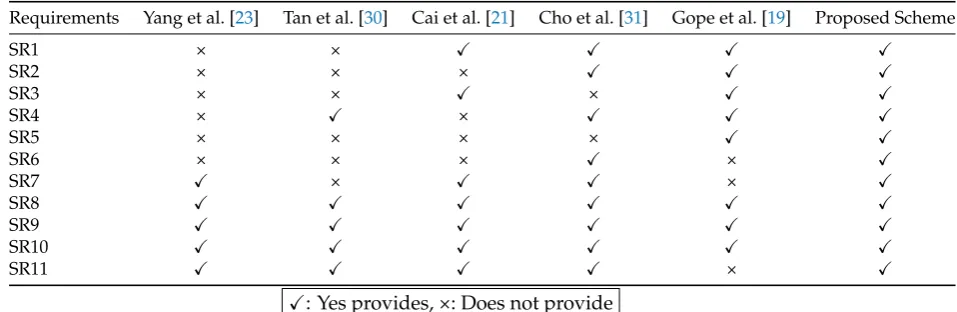
The proposed protocol compared with existing protocols from the above-listed requirements.The
687
existing protocols considered for comparison proposed in various articles including [19,21,23,30,
688
31].Note that SR is a security requirement, so SR1 is the security requirement number 1 in the list and
689
so on. Comparison based on the security requirements shown in Table4.
690
Table 4.Security requirements table
Requirements Yang et al. [23] Tan et al. [30] Cai et al. [21] Cho et al. [31] Gope et al. [19] Proposed Scheme
SR1 × × X X X X
SR2 × × × X X X
SR3 × × X × X X
SR4 × X × X X X
SR5 × × × × X X
SR6 × × × X × X
SR7 X × X X × X
SR8 X X X X X X
SR9 X X X X X X
SR10 X X X X X X
SR11 X X X X × X
X: Yes provides, ×: Does not provide
It is clear from Table4that the proposed protocol is successful in providing all the requirements
691
in comparison to the existing protocols.
692
5.2. Computation Cost Analysis 693
The computation complexity/ cost is basically the time required by a protocol to execute one
694
time. It is computed by multiplying the significant operations by their respective frequencies and then
695
sum the costs of all operations. Some operation with significantly low execution time for example the
696
concatenations, and XOR operations have been neglected [37]. So the computation cost is computed
697
only in terms of operations with significant execution time requirements for example cryptographic
698
functions and operations that theTag,RiandSjneed to execute. Operations at three main participants
699
Tag,RiandSjhave been considered. The list of operation with description has been listed as follows;
700
• CC:Computation cost
701
• Th: CC of single hash function;
702
• Tme: CC of modular exponentiation;
703
• Tse: CC of symmetric encryption;
704
• Tsd: CC of symmetric decryption;
705
• CCmbu: Computation-cost ofTag
706
• CCH A: Computation-cost ofReaderRi
707
• CCFA: Computation-cost ofServerS
708
• CCtotal: Total computation-cost.
709
The proposed protocol has been compared with the protocols presented recently in [19,21,23,30,31].
710
The detailed comparative analysis has been presented in Table5. From the table it can be seen that the
Table 5.Comparison of computation cost and running time
Computation Cost Yang et al. [23] Tan et al. [30] Cai et al. [21] Cho et al. [31] Gope and Hwang [19] Proposed Scheme
CCTag 2Th 2Th 4Th 3Th 5Th 2Th+1Tse
CCRi 3Th 2Th 2Th 2Th 2Th 1Th
CCS 5Th 3Th 6Th 5Th 7Th 3Th+1Tse
CCTotal 10Th 7Th 12Th 10Th 14Th 6Th+2Tse
CCTime 0.023ms 0.0161ms 0.0276ms 0.023ms 0.0322ms 0.023ms
computation cost of protocol in [23] is 2Th+3Th+5Th, that in total is equal to 10Th. The computational
712
cost of protocol presented in [30] is 2Th+2Th+3Th, that is equal to 7Th. Similarly, the computation
713
cost of the protocol presented in [21] is 4Th+2Th+6Ththat in total is 12Th, and the computation cost
714
of Gope and Hwang protocol presented in [19] is 5Th+2Th+7Thin total that is equal to 14Th. While
715
the computation cost of the proposed protocol uses 2Th+1Tse+1Th+3Th+1Tsehash function, and
716
in total the computational cost of the proposed is equal to 6Th.
717
The calculated running time is recorded using an Intel Pentium dual-core PC with processor 2.20
718
GHz (E2200) possessing 2048 MB of RAM. The operating system is a 32-bit Ubuntu version 12.04.1
719
is utilized. Running time of the protocols is in milliseconds (ms). The total time for all protocols in
720
Table5have also been computed in millisecond (ms) following the Kilinc and Yanik [38] experiments.
721
According to [38], a singleThcost 0.0023ms, Tecmp cost 2.226ms, Tecpa cost 0.0288ms,Tmecost 3.8500ms.
722
Therefore, based on [38], the total computational time of the proposed protocol is 0.023ms, whereas
723
the total cost of the protocol presented in [23] is 0.0230ms, the cost of protocol in [30] is proximately
724
0.0161ms, the cost of the proposal in [19] is 0.0322ms, and the proposal in [21] takes a total of 0.0276ms.
725
It has been observed that the proposed protocol is very efficient and outperforms some of the existing
726
protocols in terms of computation cost. In some cases, however, it achieves either less efficiency or
727
equal efficiency to some existing protocols. In such case, it must also be noted that the existing protocol
728
though having equal or more effective than the proposed protocol, but at the same time those protocols
729
are vulnerable to various security threats/attacks whereas the proposed protocol is secured against all
730
known attacks. This comparative analysis has been depicted in Figure6.
731
It can be clearly observed from Figure6that the proposed protocol out performs the baseline
732
protocol in terms of computation cost. The proposed protocol not only overcomes the security
733
shortcomings of the baseline protocol but also it is 28.57% more efficient computationally in comparison
734
to the baseline protocol.
5.3. Communication and Storage Cost Analysis 736
Communication cost presented in term of the total number of messages exchanged, or the total
737
number of bits exchanged during one transaction of the protocol. For communication cost of the
738
proposed protocol again the three main participants; RFID Tag, Database Server, and the Reader have
739
been considered. All the messages exchanged among the three participants during one transaction of
740
the protocol have been considered. In the proposed protocol, the RFIDTagtransmits four parameters
741
inM1to RFID ReaderRithat is equal to 416bitsand receives 384bitsfrom the RFID readerRi. Similarly,
742
the RFID ReaderRitransmits 736bitsand receives 416bitsfrom RFID ServerSwhile RFID ServerS
743
transmits 416bitsand receives 736bits. The communication cost of security protocol has been computed
744
considering a total number of exchanged messages or the total number of bit in both directions. As in
745
terms of messages, a total of four messages have been exchanged during a successful authentication
746
by the proposed protocol among all participants. The communication cost comparison of the proposed
747
protocol with other existing protocols presented in Table6.
748
The storage cost is represented by length Value L. The proposed protocol uses SHA-1 hash
749
function to implementh(.), then each of the length value is 160-bit long. In the proposed scheme each
750
of the Tag storedIDTi,Kts,AIDparameters. Therefore, the cost of storage in the Tag is 3L. Whereas on 751
server sideIDTi,Kts,AIDnew,AIDoldare being stored, hence the storage cost on server side is 4Lper
752
Tag.
753
Table 6.Communication Cost of Proposed and other Protocols
Schemes Tag Reader Server Total Bits Messages
Yang et al. [23] 256 512 640 1408 5 Tan et al. [30] 896 768 768 2432 4 Cai et al. [21] 256 544 256 1056 5 Cho et al. [31] 512 512 256 1280 5 Gope and Hwang [19] 416 1180 288 1888 4 Proposed Protocol 416 736 416 1568 4
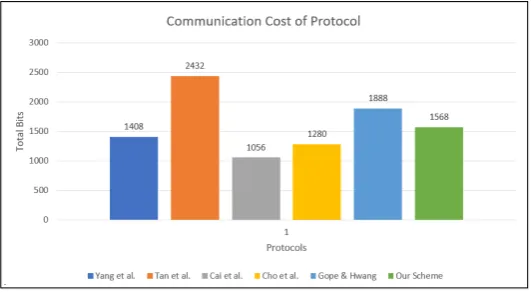
It can be clearly observed from the table that the proposed protocol performs better than most
754
of the existing protocols. However, some of the existing protocol also have the same communication
755
cost as the proposed protocol. However, it must be remembered that the proposed protocol protects
756
against all known attacks with the same communication cost whereas the existing protocols are still
757
vulnerable to various security threats. The behavior in terms of the communication cost of protocol
758
along with the existing protocols has been depicted in Figure7.
759
Figure 7.Communication Cost
Figure7indicates that the proposed protocol is efficient than the baseline protocol in terms of
760
communication cost. Specifically, the proposed protocol not only overcomes the security flaws of the