Design of Maximum Power Extraction Algorithm for Sepic Converter
Based Variable Speed Wind Energy Conversion Systems
J.Kishore & P. Manikanta. 1
M.Tech Student, Dept of EEE, SRIT, Ananthapuramu, Affiliated to JNTUA, 2
Assistant Professor, Dept of EEE, SRIT, Ananthapuramu, Affiliated to JNTUA
ABSTRACT
The conventional energy sources are limited and have pollution to the environment. Hence, more attention and interest have been paid to the utilization of renewable energy sources such as wind energy, fuel cell and solar energy etc. Wind energy is the fastest growing and most promising renewable energy source among them due to economically feasible. Harnessing wind energy for electric power generation is an area of research interest and at present, the emphasis is given to the cost-effective utilization of this energy resource for quality and reliable power supply. In this paper we implement an adaptive maximum power point tracking (MPPT)method for small-scale wind energy conversion systems (WECSs) to gather more energy from turbulent wind using buck boost featured single ended primary inductor converter to extract maximum power from full range of wind velocity summary. Matlab Simulation results show that tracking capability of the proposed method under sudden and gradual fluctuating wind conditions is efficient and effective.
Index Term: Maximum power point tracking, hill climb search algorithm, tip speed ratio algorithm, power signal feedback algorithm, single-ended primary inductor converter (SEPIC) dc-dc converter.
.
I. INTRODUCTION
Renewable energy resources, especially wind energy, are attracting great attention with the depletion of existing fossil fuel deposits and increasing concerns about CO2 emissions. Since the late 1990s, variable speed constant frequency (VSCF) wind energy conversion systems (WECS) have been widely adopted in order to maximize wind energy utilization. The doubly-fed induction generator (DFIG) and direct-drive permanent magnet synchronous generator (PMSG) are the most popular systems for VSCF wind
energy conversion. The direct-drive PMSG has attracted more and more attention due to its advantages of high efficiency and high reliability. The PMSG converts the mechanical power from the wind turbine into AC electrical power, which is then converted to dc power through a converter with a dc link to supply the dc load. By using an additional inverter, the PMSG can supply the ac electrical power with constant voltage and frequency to the power grid. To maximize the use of wind energy when the wind speed is below the rated speed, the maximum power point tracking (MPPT) of the system is indispensable. The MPPT is realized by controlling the inverter which is connected to the generator. Previous research has focused on several types of MPPT methods, namely optimum tip speed ratio (TSR) control, hill climb searching (HCS) control, power feedback control and fuzzy-logic-based control. The TSR method regulates the generator speed to maintain the optimum TSR. The control is easy to understand but hard to achieve due to the need to know the exact wind speed and wind turbine characteristics. HCS control on the other hand does not require any prior knowledge about the system and is absolutely independent of the turbine, generator and wind characteristics. However, two serious problems with the HCS method are the speed-efficiency tradeoff and the wrong directionality under rapid wind change. The HCS strategy is optimized in some papers but the algorithm and control procedure are commonly complex, which make it difficult to execute.
single-ended primary inductor converter (SEPIC) dc– dc converter has been used to extract maximum power from total range of wind velocity profile.
II. LITERATURE SURVEY
Q. Wang and L. Chang, “An intelligent maximum power extraction algorithm for inverter-based variable speed wind turbine systems,” focuses on the development of maximum wind power extraction algorithms for inverter-based variable speed wind power generation systems. A review of existing maximum wind power extraction algorithms is presented in this paper, based on which an intelligent maximum power extraction algorithm is developed by the authors to improve the system performance and to facilitate the control implementation. As an integral part of the max-power extraction algorithm, advanced hill-climb searching method has been developed to take into account the wind turbine inertia. The intelligent memory method with an on-line training process is described in this paper. The developed maximum wind power extraction algorithm has the capability of providing initial power demand based on error driven control, searching for the maximum wind turbine power at variable wind speeds, constructing an intelligent memory, and applying the intelligent memory data to control the inverter for maximum wind power extraction, without the need for either knowledge of wind turbine characteristics or the measurements of mechanical quantities such as wind speed and turbine rotor speed. System simulation results and test results have confirmed the functionality and performance of this method.
S.M.R.Kazmi, H.Goto, H.-J.Guo and O.Ichinokura, “A novel algorithm for fast and efficient speed-sensorless maximum power point tracking in wind energy conversion systems,” proposes a novel solution to the problems that exist in the conventional hill climb searching (HCS) maximum power point tracking (MPPT) algorithm for the wind energy conversion system. The presented solution not only solves the tracking speed versus control efficiency tradeoff problem of HCS but also makes sure that the changing wind conditions do not lead HCS in the wrong direction. It intelligently adapts the variable step size to keep up with the rapid changes in the wind and seizes the perturbation at the maxima to yield 100% control efficiency. For this purpose, a novel peak detection capability has been devised which, in contrast with conventional peak detection, can work
robustly under changing wind conditions. The proposed MPPT performs self-tuning to cope with the non constant efficiencies of the generator-converter subsystems-a phenomenon quite rarely discussed in research papers so far. In addition, a smart speed-sensorless scheme has been developed to avoid the use of mechanical sensors. The experimental results confirm that the proposed algorithm is remarkably faster and more efficient than the conventional HCS.
Z. M. Dalala, Z. U. Zahid, W. Yu, Y. Cho, and J.-S. Lai, “Design and analysis of an MPPT technique for small-scale wind energy conversion systems,” proposes a maximum power point tracking (MPPT) algorithm for small-scale wind energy conversion systems. The proposed algorithm uses the dc current as the perturbing variable. The algorithm detects sudden wind speed changes indirectly through the dc-link voltage slope. The voltage slope is also used to enhance the tracking speed of the algorithm and to prevent the generator from stalling under rapid wind speed slowdown conditions. The proposed method uses two modes of operation: A perturb and observe (P&O) mode with adaptive step size under slow wind speed fluctuation conditions, and a prediction mode employed under fast wind speed change conditions. The dc-link capacitor voltage slope reflects the acceleration information of the generator, which is then used to predict the next step size and direction of the current command. The proposed algorithm shows enhanced stability and fast tracking capability under both high and low rate of change wind speed conditions and is verified using a 1.5 kW prototype hardware setup.
III. EXISTING SYSTEM
Among the popular renewable energy sources, wind energy is gaining more support due to its less space occupancy and zero-carbon emission during operation. Variable speed wind energy conversion systems (WECSs) can harness more electrical energy than fixed speed WECSs by controlling their speed according to the variations in wind velocity. Maximum power point tracking (MPPT) algorithms are used to extract maximum power from the available wind energy and they are classified into three categories, namely Tip speed ratio (TSR) control, Power signal feedback (PSF) control and Hill climb search (HCS) control.
In PSF control method, wind turbine operates at optimal operating point by using the prior knowledge of turbine’s maximum power curve.
In HCS control method, an arbitrary small perturbation is given to one of the independent variables of the system and next perturbation is decided based on the changes in output power due to preceding perturbation.
DISADVANTAGES OF EXISTING SYSTEM:
1) Implementation of TSR algorithm requires the knowledge of optimal TRS λopt of the turbine and is system dependent.
2) Implementation of PSF method requires the prior knowledge of maximum power curves which can be obtained through off-line experiments or system simulations.
3) Drawbacks of this algorithm are, slow tracking response, especially for high inertia systems.
IV.PROPOSED WORK
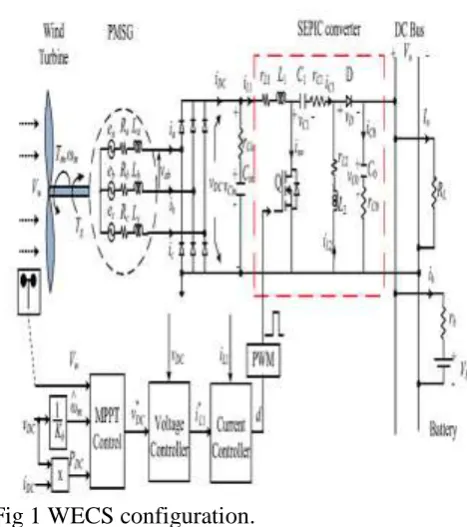
1) In small-scale WECSs, power conditioning converter’s control is most frequently adapting strategy to extract maximum power since pitch angle control is impractical due to their mechanical structure. In this work buck–boost featured single-ended primary inductor converter (SEPIC) dc–dc converter has been used to extract maximum power from total range of wind velocity profile.
2) In this paper, a hybrid nature of MPPT control algorithm which combines the computational behavior of HCS-TSR-PSF algorithms for system independent adaptivity and fast tracking capability of MPP is presented.
WECS CONFIGURATION BLOCK DIAGRAM
Fig 1 WECS configuration.
A. Wind Turbine Aerodynamic Model
Mechanical output power Pm extracted from wind by the wind turbine and corresponding torque Tm
imparted onto WG can be modeled as
where ρ is air density (kg/m3 ), Cp is power coefficient which is function of TSR λ and pitch angle
β. The coefficient, Cp can be modeled by using rotor blades aerodynamic design principles
B. PMSG-Diode Rectifier Model
Induced Emf, es(V), in stator winding of PMSG,
when it is subjected to a constant flux, φ (Wb), while rotating with a speed, ωm(rad/s), is given by
where k (V·s/rad) is machine induced voltage constant, P is total number of rotor pole pairs and ωe is electrical angular frequency of PMSG stator induced voltage.
Vt , can be related as,
where Vt is RMS value of line-to-line voltage of PMSG. By ignoring the power loss during diode circuit rectification, output power of WECS Pg can be equated to
PMSG output power Pg and electromagnetic torque
Tg can be expressed as function of diode rectifier output current IDC by using, and are given as
Wind turbine rotor speed can be controlled by controlling the generator torque as follows
C. Small-Signal Modeling of SEPIC DC–DC Converter.
Among the conventional dc–dc converters, boost converter is one of the frequently used dc–dc converters in distributed generation systems, because of its higher efficiency in energy transfer. However, it can able to transfer energy only when its output stage voltage is higher than the input stage voltage. This situation still becomes worse during sudden wind gusts. To extract wind energy from total range of wind velocity profile, a buck–boost featured dc–dc converter is preferable than boost converter as a universal converter. Among the various buck–boost converters, SEPIC dc–dc converter is better choice for WECSs, because it possesses the merits of non inverting polarity, easy-to drive switch, and low input-current pulsations, which mitigate the generator’s torque pulsations.
Fig. 2. Equivalent circuit of plant.
D. ADAPTIVE MPPT CONTROL ALGORITHM
At constant wind velocity, wind turbine output power becomes function of power coefficient, and at constant pitch angle, power coefficient becomes function of rotor speed.
Relation between turbine output power and rectifier output voltage is shown in Fig. 3. It is observed that this relation has a corresponding single optimal VDC value for every wind velocity and objective of the proposed algorithm is to search for this optimal operating point
V
DCopt .Fig.3. MPPT converter input voltage and turbine power characteristics.
Turbine rotor radius R and electro motive force (Emf) constant Kb (V·s/rad) can be obtained from wind turbine specifications report and open circuit characteristics of WG respectively. Implementation of the algorithm requires a dynamically programmable memory to store system’s optimal characteristics in the form of a lookup table and a single dimensional array.
During steady wind based on the changes in output power with respect to the changes in control variable, algorithm provides reference signal by implementing HCS control algorithm.
During turbulent wind conditions, algorithm provides reference signal by implementing either PSF or TSR algorithmic computations.
If the entry of vDCo p t at vwin d ex is nonzero, PSF control algorithm will be implemented by giving this entry as reference value vDCr e f (k + 1) for the next iteration. If the value of vDCo p t at vwin d ex is zero, algorithm implements TSR control.
facilitates the proposed algorithm to improve the dynamic response of the system. Moreover self learning of system specific characteristics makes this algorithm adaptive in nature. The adaptability of the algorithm allows the system to extract as much available wind power as possible under turbulent wind conditions.
V. SIMULATION RESULTS
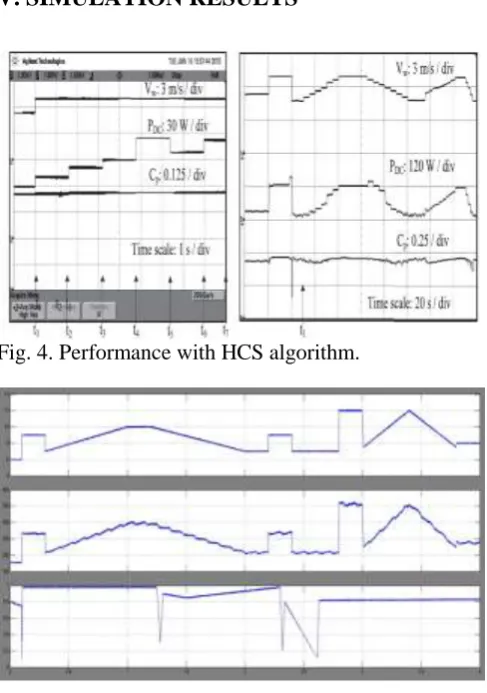
Fig. 4. Performance with HCS algorithm.
Fig. 5. Performance with Proposed algorithm
VI. CONCLUSION
In this Paper An adaptive MPPT control method is Implemented for the fast tracking of MPP under turbulent wind conditions for small-scale WECSs. System behaviour with adaptive MPPT control method under fast changing wind conditions has been observed and it is evident that the proposed control method can put the system at optimal operating point promptly against random variations in the wind velocity. System performance with proposed method is compared with the HCS algorithm and experimental results proved that WECS with proposed algorithm harvests more energy than with HCS algorithm.
Matlab Simulation results show that tracking capability of the proposed method under sudden and gradual fluctuating wind conditions is efficient and effective.
FUTURE WORK:
PI controller along with PR controller can be used in control techniques of hybrid wind battery hybrid system to modify the error signal and to improve the efficiency of system or PI controller can be replaced by Artificial Neural Networks (ANN) to improve the efficiency of the system.
REFERENCES
[1] D. S. Zinger and E. Muljadi, “Annualized wind energy improvement using variable speeds,” IEEE Trans. Ind. Appl., vol. 33, no. 6, pp. 1444–1447, Nov./Dec. 1997. [2] A. Miller, E. Muljadi, and D. Zinger, “A variable speed wind turbine power control,” IEEE Trans. Energy Convers., vol. 12, no. 2, pp. 181–186, Jun. 1997.
[3] R. Chedid, F. Mrad, and M. Basma, “Intelligent control of a class of wind energy conversion systems,” IEEE Trans. Energy Convers., vol. 14, no. 4, pp. 1597–1604, Dec. 1999. [4] H. Li, K. Shi, and P. McLaren, “Neural-network-based sensorless maximum wind energy capture with compensated power coefficient,” IEEE Trans. Ind. Appl., vol. 41, no. 6, pp. 1548–1556, Nov./Dec. 2005.
[5] A. S. Satpathy, N. Kishore, D. Kastha, and N. Sahoo, “Control scheme for a stand-alone wind energy conversion system,” IEEE Trans. Energy Convers., vol. 29, no. 2, pp. 418–425, Jun. 2014.
[6] S. Morimoto, H. Nakayama, M. Sanada, andY. Takeda, “Sensorless output maximization control for variable-speed wind generation system using ipmsg,” in Proc. IEEE 38th Ind. Appl. Annu. Meeting Conf. Rec., 2003, vol. 3, pp. 1464–1471.
[7] R. M. Hilloowala and A. M. Sharaf, “A rule-based fuzzy logic controller for a pwm inverter in a standalone wind energy conversion scheme,” in Proc. IEEE Ind. Appl. Soc. Annu. Meeting Conf. Rec., 1993, pp. 2066–2073. [8] V. Galdi, A. Piccolo, and P. Siano, “Designing an adaptive fuzzy controller for maximum wind energy extraction,” IEEE Trans. Energy Convers., vol. 23, no. 2, pp. 559–569, Jun. 2008.
[9] A. Raju, B. Fernandes, and K. Chatterjee, “A upf power conditioner with maximum power point tracker for grid connected variable speed wind energy conversion system,” in Proc. IEEE 1st Int. Conf. Power Electron. Syst. Appl., 2004, pp. 107–112.