Cheating Human Vision in Visual Secret
Sharing
Yu-Chi Chen
1,∗, Gwoboa Horng
1and Du-Shiau Tsai
2 1Department of Computer Science and Engineering
National Chung Hsing University, Taiwan
2
Department of Information and Networking Technology
Hsiuping University of Science and Technology, Taiwan
∗
email: [email protected]
Abstract
Visual Secret Sharing (VSS), first introduced by Naor and Shamir, is a variant form of secret sharing; especially, secret decoding is stack-ing shares together without performstack-ing any complicated cryptographic computation. The recovered secret is visible by human vision sys-tem (HVS). However, Horng et al. showed cheating is possible in VSS, which is inspired from cheating in secret sharing. Since then many cheating activities and cheating immune schemes have been proposed, whereas all presented cheating activities only take cheat-ing in any pixel as a unit into consideration. In this paper, we ana-lyze some presented cheating activities, and we propose a new kind of cheating:Region Cheating Attack(RCA) as a result of the properties of HVS. Differently, RCA involves with cheating in a region which is several adjacent pixels as a unit. We therefore use RCA to enhance effect of several attacks which has been proposed. Moreover, a new attack, deterministic white-to-black attack (DWtBA), is proposed to point out that a well-known cheating immune scheme, proposed by De Prisco and De Santis, will suffer from RCA and DWtBA. Finally, we propose a remedy to overcome the problem of the scheme.
1 Introduction
are xeroxed onto transparencies. The participants in
X
can visually re-cover the secret image by stacking their transparencies together without performing any complicated cryptographic computation ifX
is an autho-rized subset. More generically, in the k-out-of-nvisual secret sharing (forshort, (k,n)-VSS), there are totally n participants, and any k participants
in
X
can obtain the secret image by stacking their transparencies. A VSS scheme is usually composed of three phases: (1) encoding (2) distributing (3) decoding. Encoding is performed by the dealer to get all transparen-cies, then he distributes those transparencies to participants. Finally, the participants inX
can decode the secret image by stacking their transparen-cies.However, the security of VSS is achieved by loosing the contrast and the resolution of the secret image is a special property to differ VSS from secret sharing [12]; indeed, the quality of the reconstructed secret image is inferior to the original secret image. Many applications and techniques have been proposed, including visual authentication and identification, steganography, and image encryption which are attributed to the inven-tion of VSS.
Related work.Horng et al. [9] showed that cheating is possible in(k,n)
-VSS, according to the cheaters in traditional secret sharing [14]. The cheat-ing activity can cause unpredictable damage to victims, when victims ac-cept a fake secret image different from the actual secret image as authentic. De Prisco and De Santis also considered the problem of cheating, and they proved that in (2,n)-VSS, cheating is successful byn−1collusive cheaters,
and in (n,n)-VSS, by 1 cheater. The collusive cheaters want to fool the
victim for some reasons. The authors gave the definition for determin-istic cheating, and presented two cheating immune threshold visual secret sharing (CIVSS) schemes: 1) the simple scheme and 2) the better scheme. They also declare the better scheme is cheating immune to deterministic cheating in any black or white pixel, and based on the security model, it is provably secure in theory. In particular, the better scheme can be used without relying on the complementary image to improve the security as compared to 2-out-of-(n+l) method [9].
Contribution and organization. There are four significant contributions of this paper as follows.
at-tack(RCA) in which we consider cheating in several adjacent pixels, whereas a region is composed of several adjacent pixels. Moreover, we also give the formal definition of security of RCA.
2. ENHANCEMENT. The well-know attacks, CA-1 and CA-2, are easy to be detected by HVS in some cases. For improving this disad-vantage, we enhance effect of CA-1 and CA-2 upon cheating, which combines CA-1/CA-2 with the proposed RCA.
3. CRYPTANALYSIS. We find the better scheme, proposed by De Prisco and De Santis, is not as secure as the authors claimed. Therefore, we present another cheating attack, nameddeterministic white-to-black attack (DWtBA). The cryptanalysis and experimental result are at-tached to demonstrate that the better scheme suffers from DWtBA and RCA undoubtedly.
4. REMEDY. Cryptanalysis is used to point out potential weaknesses in a cryptographic scheme, while, straightly, it can help us to present an improvement. Thus, we give a remedy to overcome the problem of the insecure better scheme.
The rest of the paper is organized as follows. Section 2 provides pre-liminaries with respect of the model of VSS and the definition of cheat-ing. Section 3 presents a new cheating activity with HVS, then illustrates the results with experiments of human’s vision. Section 4 briefly reviews De Prisco and De Santis’s better (2,n)-VSS scheme, and shows the
deter-ministic white-to-black attack and the cryptanalysis of the better scheme. Finally, conclusions are given in Section 5.
2 Visual Secret Sharing (VSS)
In this section, we will briefly review the model of VSS and describe the formal definition of cheating in VSS.
2.1 Model
A VSS scheme is a special variant of a k-out-of-n secret sharing scheme,
where the shares given to participants are xeroxed onto transparencies. A share in VSS is always called a “transparency”. The participants in
X
the secret image (SI). To generate the transparencies, each pixel of SI is
handled separately. It appears as a collection ofmblack and white
subpix-els in each of thentransparencies. Themsubpixels are denoted by ablock.
One pixel of the secret image corresponds tonmsubpixels, and then thenm
subpixels are denoted by an×mboolean matrix, called abase matrix. Let S= [Si j]be the base matrix, whileSi j =1if and only if the jth subpixel of
theithshare is black andSi j=0if and only if the jthsubpixel of theithshare
is white. The grey level of the stack of k shared blocks is determined by
the Hamming weightH(V)of the “or”edm-vectorV of the corresponding krows inS. This grey level is interpreted by the visual system of the users
as black ifH(V)≥dand as while ifH(V)≤d−α∗mfor some fixed
thresh-old d and relative difference α. Here,α is the contrast and mis the pixel
expansion. We hope m to be as small as possible and α to be as large as
possible. Formally, a solution to the (k,n)-VSS consists of two collections C0 andC1 ofn×m base matrices. To share a white pixel, the dealer
ran-domly chooses one of the matrices fromC0, and to share a black pixel, the
dealer randomly chooses one of the matrices fromC1. The chosen matrix
determines themsubpixels in each one of thentransparencies [11].
Definition 1. A solution to the(k,n)-VSS is composed of two collectionsC0and C1 of n×m base matrices. The solution would considered valid if the following
conditions are hold: Contrast conditions:
1. For any matrixS0inC0, the “or”V of anykof thenrows satisfiesH(V)≤ d−α∗m.
2. For any matrixS1inC1, the “or”V of anykof thenrows satisfiesH(V)≥ d.
Security condition:
3. For any subset{i1,i2, . . . ,iq}of{1,2, . . . ,n}withq<k, the two collections
D0,D1ofq×mmatrices obtained by restricting eachn×mmatrix inC0,C1
to rows i1,i2, . . . ,iq are indistinguishable in the sense that they contain the same matrices with the same frequencies.
For convenience, letWV be an integer whichWV ≤d−α∗mandBV be
an integer which BV ≥d. WV and BV are used to judge a stacking block
Figure 1: The stacking results in Naor-Shamir’s (2,3)-VSS
Example 1. In (2,3)-VSS,C0is all the matrices obtained by permuting the columns
of
1 0 01 0 0 1 0 0
, andC1 is all the matrices obtained by permuting the columns
of
1 0 00 1 0 0 0 1
. Conveniently, we always write C0 =
1 0 01 0 0 1 0 0
andC1=
1 0 00 1 0 0 0 1
. In (3,3)-VSS, the base matrices are
C0=
1 1 0 00 1 1 0 1 0 1 0
andC1=
1 1 0 01 0 1 0 1 0 0 1
.
2.2 Cheating for a Block
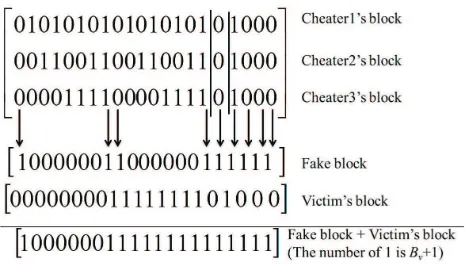
Cheating is possible in (k,n)-VSS [9]. We take a (2,3)-VSS scheme as an
example. A secret image is encoded into three distinct transparencies, de-notedT1,T2 and T3. Then, the three transparencies are respectively
assumed to be collusive cheaters and Carol is the victim.1 In cheating,T1
and T2to create forged transparency/cheating transparencyCT, whereas
superimposingCT and T3 will visually recover the cheating image.
Pre-cisely, by observing the following collections of 3×3 matrices which are
used to generate transparencies [11], collusive cheaters can predict the ac-tual structure of the victim’s transparency so as to create CT. C0 is all
the matrices obtained by permuting the columns of
1 0 01 0 0 1 0 0
, andC1
is all the matrices obtained by permuting the columns of
1 0 00 1 0 0 0 1
. By
observing the above matrices, two rows of aboveC0 orC1 matrix are
de-termined by collusive cheaters, therefore, the structure of each block ofT3
is exact the remaining row. For presenting a white pixel of cheating image, the block ofCT is set to be the same structure ofT3. For presenting a black
pixel of cheating image, the block ofCT is set to be the different structure
ofT3. For example, if the block ofT3 is [0 1 0],CT is set to be [0 1 0] for a
white pixel or [0 0 1] for a black pixel. Formally, the cheaters can construct a sub-base matrix (SBM) by T1 and T2, and then infer T3. Here, we give
another example as Fig 2, and show the generalization of this cheating activity below.
1. n−1cheaters stack their transparencies to recover the secret image.
2. According to the reconstructed secret image, the cheaters will infer the victim’s transparency.
3. Taking a cheating image (CI) as an input, they can generate several
cheating transparencies to the victim. TheCTs and the victim’s
trans-parency will recoverCI, notSI.
4. Finally, the victim will be fooled if he accept the reconstructed cheat-ing image asSI.
Practically, De Prisco and De Santis gave the following definitions of cheat-ing in VSS [7].
Definition 2. A cheating attack (activity) is denoted as the deterministic cheat-ing if the probability of successful cheatcheat-ing for the cheaters is 1 for each pixel/block.
Figure 2: Cheating in (2,3)-VSS for a block
Definition 3. A VSS scheme is cheating immune to deterministic cheating if the probability of successful cheating in any pixel is less than 1.
These definitions are reasonable [7] for a block, and then make re-searchers more easily to consider the security for cheating immune VSS schemes for a block (pixel).
2.2.1 CA-1 and CA-2
In 2007, Hu and Tzeng showed three cheating activities: CA-1, CA-2, and CA-3 [10]. We first give a definition about “perfect black”, and then briefly describes CA-1 and CA-2. CA-3 is omitted to show, because it is a ex-tended method for exex-tended VSS.
Definition 4. A block in a stacking result is perfect black if and only if all sub-pixels of the block are black.
Example 2. A block of a stacking result is [1 1 1 1] is perfect black, but the block is [1 1 1 0] is not. The block of [1 0 0 0] or [1 1 0 0] is also not perfect black.
CA-1 and CA-2 are performed by a malicious participant (MP) and a malicious outsider (MO), respectively. MP or MO sets a cheating im-age and generatesCTs, whereas the stacking result of the victim’s
trans-parency andCTs reveals the cheating image.
In CA-1, with the MP’s transparency T1, we assume that each block
inT1 has xblack andy white subpixels. The MP then chooses a cheating
image and preparesrfake transparencies,CT1, ...,CTr, wherer=dmxe −1.
Example 3. In a (3,3)-VSS scheme with3×4base matrices, MP creates only one
Figure 3: An example of complementary images
block in theCT is set to be [1 0 1 0]. For each black pixel of the cheating image,
the MP randomly assigns 2 black and 2 white subpixels to theCT, whereas the
block in the stacking ofCT andT1isperfect black. We assume the block is [1 0 1
0] inT1when the MP wants to form a black pixel of the cheating image, therefore,
the corresponding block in theCT is set to be [0 1 0 1].
In CA-2, with the same scenario, the MO only knows the share con-struction algorithm, and it does not hold any transparency. In a (3,3)-VSS scheme, the MO can generate two fake transparencies,CT1 andCT2, and
then makes the stacking result ofCT1,CT2, andTv be black.
Example 4. For each white pixel of the cheating image, the corresponding sub-pixels of the block inCT1 andCT2 is set to be the same. Assume the block inCT1
is [1 0 1 0], then the block in theCT2 will be [1 0 1 0]. For each black pixel of the
cheating image, the corresponding subpixels of the block inCT1andCT2 is set to
be complement. Assume the block inCT1is [1 0 1 0], then the block inCT2is [0 1
0 1].
2.3 Cheating Immune Visual Secret Sharing
Cheating would be prevented if participants find out or detect some trans-parencies or the reconstructed secret images are not genuine. Based on this intuition, there are two approaches for designing CIVSS schemes, first in-troduced by Horng et al. [9]. One is based on share authentication where another additional transparency (verification transparency) is used to au-thenticate transparencies from other participants. The other is based on blind authentication, where cheaters infer the structure of transparencies of other participants is hard. The goal of share authentication is to provide the participants the ability to verify the integrity of the shares before re-constructing secret images and the goal of blind authentication is to make it harder for the cheaters to predict the structure of the shares of the other participants.
verification transparency is used to check the integrity of the transparen-cies held by other participants. Hu and Tzeng’s scheme is share authenti-cation, but this scheme is insecure [5].
In a blind authentication based CIVSS scheme, the transparencies must be inherently immune to cheating. In (k,n)-VSS,k<n, because the
struc-tures of black block and white block are different, a participant must hold two transparencies. One is the original transparency (referred to as T1),
and the other is the complementary transparency (referred to asT¯1). Thus,
T1+T2displays the secret image, whileT¯1+T¯2will display the
complemen-tary secret image. As known, two results ofT1+T2andT¯1+T¯2are given in
Fig. 3.
2.3.1 Review of De Prisco and De Santis’s Better Scheme
De Prisco and De Santis proposed two CIVSS schemes: the simple scheme and the better scheme. The simple scheme has been showed some inherent weaknesses by the authors, as well as the white pixels are not protected without the complementary image. So they proposed a better scheme which is provably secure. They claimed this scheme for each black or white block/pixel is cheating immune to deterministic cheating.
In the better scheme, one pixel will be expanded to2n+n+1subpixels.
The base matrices areC0 andC1. Each of them is consisted of three parts: Cbin, Call0, Cns. Cbin is all the possible 2n binary column vectors of length
n. Call0 is a column of all 0. Cns is the Naor-Shamir’s base matrix [11]. We
expressC0= [Cbin|Call0|C0ns]andC1= [Cbin|Call0|Cns1].
For example,C0 andC1 of the better(2,3) scheme are showed as
fol-lows:
C0=
0 1 0 1 0 1 0 1 0 1 0 00 0 1 1 0 0 1 1 0 1 0 0 0 0 0 0 1 1 1 1 0 1 0 0
(1)
C1=
0 1 0 1 0 1 0 1 0 1 0 00 0 1 1 0 0 1 1 0 0 1 0 0 0 0 0 1 1 1 1 0 0 0 1
(2)
C0andC1of the better(2,4)scheme are showed as follows:
C0=
0 1 0 1 0 1 0 1 0 1 0 1 0 1 0 1 0 1 0 0 0
0 0 1 1 0 0 1 1 0 0 1 1 0 0 1 1 0 1 0 0 0
0 0 0 0 1 1 1 1 0 0 0 0 1 1 1 1 0 1 0 0 0
0 0 0 0 0 0 0 0 1 1 1 1 1 1 1 1 0 1 0 0 0
Figure 4: The stacking result for 1×1 black pixel, 2×2 black pixels, . . ., 7×7black pixels
Figure 5: A region composed of one black block and eight white blacks andm=3
C1=
0 1 0 1 0 1 0 1 0 1 0 1 0 1 0 1 0 1 0 0 0
0 0 1 1 0 0 1 1 0 0 1 1 0 0 1 1 0 0 1 0 0
0 0 0 0 1 1 1 1 0 0 0 0 1 1 1 1 0 0 0 1 0
0 0 0 0 0 0 0 0 1 1 1 1 1 1 1 1 0 0 0 0 1
(4)
It is clarified thatBV =2n−1+2n−2+2andWV =2n−1+2n−2+1. The pixel
expansion, m, is 2n+n+1 and the contrast, α, is 1/m. Moreover, the
au-thors have proven the better scheme is cheating immune to deterministic cheating. For any black or white pixel, the cheaters cannot infer the actual value of victim’s blocks. The proof is definitely correct.
3 Region Cheating Attack
Previous cheating for a block in VSS has been discussed by the papers of Horng et al., Hu and Tzeng, and De Prisco and De Santis [7, 9, 10]. They presented different cheating activities, where those kinds of cheating activities are for a block. However, in practical, many published papers used a set of blocks instead of one block for increasing visibility of secret. Fig 4 illustrates how to increase visibility of one secret pixel by a set of
Figure 6: A region,m=12
blocks a region. Fig. 4 evidences the following definition.
Definition 5. For a VSS scheme, HVS does not observe the secret image on each block. It observes on regions.
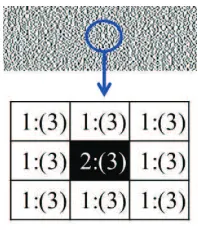
In addition, Fig. 4 shows the stacking result for1×1black pixel,2×2
black pixels,. . .,7×7black pixels in (2,3)-VSS.
3.1 RCA: Region Cheating Attack
We denote that a black block consists of µB 1s and m−µB 0s in a stacking
result, while a white block consists ofµW 1s andm−µW 0s. In Fig 5,ρ:(m)
is used to recognize the block is black or white, whereρ∈ {µW,µB}andmis
the pixel expansion. In Fig 5, the region is composed one black block and eight white blocks, but we cannot observe any black block in the stacking result. This experiment confirms that HVS observes the secret image on regions.
Let dµ =µB−µW. We define a “black plus block” is a block which is
composed ofµB+t×dµ1s in the stacking result for an integert. The new
cheating activity with human vision system (RCA: White-to-Black) per-forms as follows.2
RCA: White-to-Black
1. The cheaters replace a white block (ofµW 1s) with a black plus block
(ofµB+t×dµ1s).
2. Thet adjacent white blocks near the black plus block do not change.
3. Finally, in HVS, a cheating region, composed of t white blocks and
one black plus block, looks like a black region, composed of t+1
black blocks.
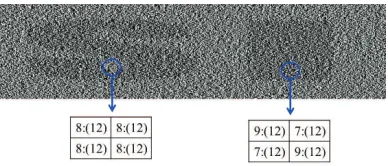
For HVS, the presented RCA is actually existing as well as Fig. 6 shows a stacking result withm=12which consists of different kinds of regions: S
is for all 8:(12), butIis for 9:(12) and 7:(12). If a victim cannot observeIis not in the true secret in HVS, he will accept the secret image,S I.
However, on the contrary, we also have RCA: Black-to-White. Let
dµ =µB−µW. We define a “white plus block” is a block which is
com-posed ofµW−t×dµ1s in the stacking result for an integert. This cheating
activity performs as follows.
RCA: Black-to-White
1. The cheaters replace a black block (ofµB 1s) with a white plus block
(ofµW−t×dµ1s).
2. Thet adjacent black blocks near the white plus block do not change.
3. Finally, in HVS, a cheating region, composed of t black blocks and
one white plus block, looks like a white region, composed of t+1
white blocks.
Definition 6. A scheme is not cheating immune to RCA if and only if the prob-ability of RCA is 1 where cheaters find a correct integert.
Example 5. If the cheaters consider t =1 withPr[t =1] =5/6 andt =2with
Pr[t=2] =1/6, the scheme is cheating immune to RCA; Otherwise, the cheaters considert =1withPr[t=1] =1, the scheme is not.
3.2 Enhancing CA-1 and CA-2
Cheaters can make the victim to accept the fake secret by setting perfect black blocks in CA-1 and CA-2 [10]. Except (n,n)-VSS schemes, other
Accordingly, we can use the above concept of RCA with 1 and CA-2. Let CA-1 or CA-2 be the cheating method for Step 1 of RCA: White-to-Black. Other steps are the same as before. Finally, even the stacking result contains the perfect black blocks, HVS does not detect them, because these blocks are interfered with the adjacent blocks (not perfect black blocks) in a sense.
4 Cryptanalysis of a Cheating Immune Visual
Se-cret Sharing Scheme
In Section 2.3.1, we have described the better (2,n)-threshold scheme (for
short, the better scheme). Now we propose deterministic white-to-black attack (DBtWA) in Section 4.1, and further, we also give the cryptanaly-sis to indicate how to cheat HVS for this scheme by DBtWA and RCA in Section 4.2.
4.1 Deterministic White-to-Black Attack (DWtBA)
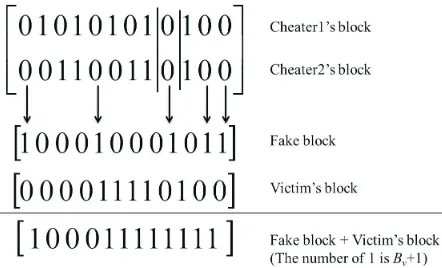
This attack, named “Deterministic White-to-Black Attack” (for short, DWtBA), only occurs in a white pixel for the better scheme. Collusive cheaters gen-erate a fake block (f b) according to the attack for creating a fake black
pixel. The victim will get a black one by stacking f bandTvwhereTvis the
victim’s corresponding block. We illustrate this attack as follows for more details.
(1) First, cheaters reconstruct the sub-base matrix (SBM) collusively.
(2) They compute the numbers of different kinds of columns within the SBM, respectively.
(3) Initially, let f b= [a1,a2, ...,az] = [0,0, ...,0], wherez=2n+1+n.
(4) If n is odd such as n=3, modify ai=1when ai corresponds to the
columns of all 0 in SBM (Fig. 8); otherwise, smodifyai=1when ai
corresponds to the columns of all 0 or all 1 in SBM (Fig. 9).
(5) If ∑z
j=1aj =2n−1+1, the attack is done. Otherwise, in the case of
∑z
j=1aj<2n−1+1, the cheaters randomly choosexkinds of columns
whose numbers are 2 where∑z
j=1aj+2x=2n
−1+1, and then seta
i=1
Figure 8: The process of this attack for the (2,3) better scheme.
total number of x kinds of columns is 2x). Finally, ensure∑zj=1aj= 2n−1+1after inserting 1s into2xsubpxiels.
Let the stacking block of f b+Tvbe[b1,b2, ...,bz](z=2n+1+n). The cheater
can make sure∑z
j=1bj=BV+ywherey>0is an integer and letX =BV+y
as the number of subpixels of 1 in the stacking block, so the victim will accept the fake black block.
Definition 7. A scheme is not cheating immune to the deterministic white-to-black attack if and only if the probability of the attack is 1 where the cheaters can generate a fake black block.
We straightly conclude that DWtBA is the deterministic cheating as a result of Definition 2 and 7.
4.2 Cryptanalysis
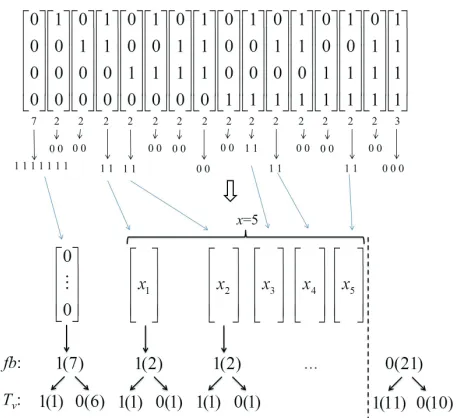
The processes of DWtBA with respect to n=3,4are showed in Fig. 8 and
9, separately. We know the attack forn=3and 4 is very simple.
We have to further discuss cases ofn≥5. We take n=5 as example,
where BV =25−1+24−1+2=26andWV =25−1+24−1+1=25. First, the
cheaters reconstruct the SBM and compute the numbers of different kinds of columns within SBM, and they can obtain the following result as Fig 10.
• The number of the columns of all 1s is 3. This column we called the all 1 column.
Figure 9: The process of this attack for the (2,4) better scheme.
Table 1: The presented attack forn=3,4, ...,8(y=X−BV)
n:odd BV X y n:even BV X y
3 8 9 1 4 14 15 1
5 26 28 2 6 50 52 2
7 98 101 3 8 194 197 3
• The number of each other kind of columns is 2 (not all 0 and all 1).
n=5is odd, thus they set ai =1 when ai corresponds to the columns of
all 0s. Now, we know∑z
j=1aj<2n−1+1. The cheaters continue to choose x=5kinds of columns (not all 0 and all 1 columns,2x=25−1+1−∑zj=1aj),
and setai=1whenaicorresponds to the columns of the2xcolumns. This
is, they ensure∑z
j=1aj=25−1+1=17.
From the fake block f b, we notice that2xcolumns correspond tox
sub-pixels of the victim’s block are 1 andx subpixels of the victim’s block are
0. And we also observe that 7 all 0 columns correspond to that 1 subpixel of the victim’s block is 1 and the other 6 subpixels are 0. We thus can in-fer that25−1+1−(x+1) =25−1+1−(5+1) =11subpixels of the victim’s
block are 1 correspond to 11 subpixels of f b are 0. Finally, the number
of subpixels of 1 in the stacking block is X =17+11=28=BV +2>BV,
hence DWtBA is successful without violating Definition 1. Fig. 10 shows the result of this attack for the (2,5) better scheme with respect of the corre-spondence of subpixels, where 1(7) denotes that the number of subpixels of 1 is 7, andx1, ...,x5denotes five different kinds of columns except the all
Figure 10: The result of this attack for the (2,5) better scheme.
In terms of Table 1, ifX =BV +y>2n+n+1, the attack will fail.
How-ever,y>2n+n+1−2n−1−2=2n−1+n−1(n≥3) is impossible. DWtBA
is deterministic cheating, because the probability of the attack is 1. The cheaters absolutely know an integer,t, to generate a region which is
com-posed of a fake black block andt normal white blocks. As a result, we can
have the following theorem.
Theorem 1. The better scheme is not cheating immune to the deterministic white-to-black attack and RCA.
The generic result from the collusive cheaters’ SBM is given as follows.
• The number of the all 1 columns is 3 for anyn.
• The number of the all 0 columns isn+2for anyn.
• The number of each other kind of columns, except all 0 and all 1 columns, is 2 for anyn.
Nevertheless, this attack is only suitable to the (2,n) better scheme,
be-cause the expansion of the better scheme is much bigger than other schemes such as Naor-Shamir’s VSS scheme [11].
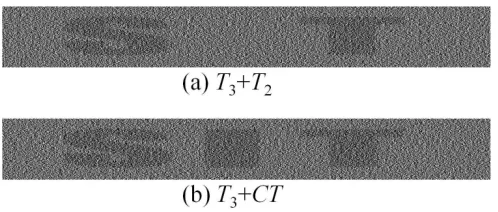
Figure 11: The results ofT3+T2andT3+CT.
adjacent fake black blocks, only one of the corresponding two blocks is changed by the attack and the other block is remained unchanged. The above method can ensure the reconstructed cheating image is normal, and Fig. 11 shows the experiment results that we can modify “S T” into “SIT”, where T3 is the victim’s transparency andCT is the fake transparency for
cheating.
For example of (2,3) better scheme [7], the proof of the scheme only en-sures that cheaters cannot change 8 fromWV =7. Indeed, cheaters cannot
change 9 from 7. A block of 9 and an adjacent block of 7 looks like two block of 8 (Fig. 6 and 11).
4.3 Remedy
In the paper of De Prisco and De Santis [7], the base matrices of the better scheme,C0 andC1, are proven to be an optimal structure, thus we cannot
decrease the number of columns ofC0andC1. Based on the better scheme,
we attempt to find an improvement via increasing the number of columns ofC0andC1.
According to the attack, the cheaters usually choose the subpixels of the fake block and set them as 1s which correspond to all 0 columns in SBM. The main idea of the improvement is to add all 0 columns to the original base matrices (described as Section 2.3.1). Unfortunately, we find the improvement is still impossible to withstand DWtBA, but it can resist RCA partially.
We have known that, in SBM, the number of the all 1 columns is 3, whereas the number of the all 0 columns is n+2for any ndue to the
in-ference in Section 4.2. In addition, the number of 1s of a block is2n−1+1
(referred to as w=2n−1+1), and the pixel expansion ism=2n+1+n; for
following, we give a possible improved (2,3) scheme. The improved
bet-ter scheme holds the following base matrices,C0=
00 010101010100001100110100 0 000011110100
andC1=
00 010101010100001100110010 0 000011110001
. Now we show how the cheaters perform
DWtBA.
T1: [0 0 1 0 1 0 1 0 1 0 1 0 0] .Cheater1 T2: [0 0 0 1 1 0 0 1 1 0 1 0 0] .Cheater2
Case 1
CT 1 : [1 1 0 0 0 1 0 0 0 1 0 1 0] Pr[CT 1] =5
6
T3: [0 0 0 0 0 1 1 1 1 0 1 0 0] .Victim Stack: [1 1 0 0 0 1 1 1 1 1 1 1 0]
Case 2
CT 2 : [1 1 0 0 0 0 0 0 0 1 0 1 1] Pr[CT 2] =1
6
T3: [0 0 0 0 0 1 1 1 1 0 1 0 0]
Stack: [1 1 0 0 0 1 1 1 1 1 1 1 1]
The improved scheme can resist RCA, because the cheaters do not know how many normal white blocks should be collocated with the fake block. As the above, we know the probability of Case 1 is 5/6, and the probability of Case 1 is 1/6. In Case 1, the cheaters should set a normal white block with a fake block, whereas in Case 2, they should set two nor-mal white block with a fake block.
For more general, the base matrices must beC0=
0. . .0
... C0dd
0. . .0
and
C1=
0. . .0
... Cdd1
0. . .0
, whereCdd0 andCdd1 are the base matrices of the
origi-nal better scheme. Here, the number of added all 0 columns is more than
w−(n+2) = (2n−1+1)−(n+2). We would like the number of added all 0
columns isw−(n+2)+1= (2n−1+1)−(n+2)+1=2n−1−n+4for minimal
Theorem 2. This scheme is insecure against the deterministic white-to-black at-tack, but it resists RCA.
Proof. For a block, according to the structure of SBM, there are totally
2n−1+2all 0 columns in the(2,n)improved better scheme, where(2n−1+2)
is denoted by W. Particularly, one of all 0 columns corresponds to 1 of
subpixels of the victim’s block, and the other 2n−1+1 correspond to 0s.
Therefore, as the above two cases, the cheaters should set a normal white block with a fake block withPr[CT 1] =WW−1in Case 1, whereas they should
set two normal white block with a fake block with Pr[CT 2] =W1 in Case
2. However, this scheme attributes to that the number of normal white blocks is unknown, because the cheaters do not infer that the stacking re-sult is Case 1 or Case 2. The correct integert may be one of two cases, and
the probability is less than 1.
To the best of our knowledge, the presented blind authentication cheat-ing immune schemes (Horng et al.’s and De Prisco and De Santis’s) are insecure to protect black and white pixels at the same time without us-ing the complementary image. The better scheme is also insecure due to DWtBA and RCA. Our improved better scheme is only one scheme can be cheating immune to the presented attack and RCA without using the complementary image, whereas the pixel expansion of our scheme is
m=2n+2n−1=3(2n−1).
5 Conclusions
Seeing is not believing that, in visual secret sharing, we see a black region, then we cannot ensure that it is made up of all black blocks. We are de-voted of a new kind of cheating activities: RCA based on the properties of HVS. With the main concept of it, the previous cheating methods will bring better results. Additionally, we have analyzed De Prisco and De Santis’s better scheme suffers from the deterministic white-to-black attack (DWtBA) and RCA. Even this scheme is provably secure based on its secu-rity model in theory, which does not imply being secure for HVS. Finally, we attach a remedy to withstand RCA.
References
vol. 16, pp. 224-261, 2003.
[2] C.C. Chang, C.C. Lin, T.H.N. Le, and H.B. Le, “Self-verifying visual secret sharing using error diffusion and interpolation techniques,”
IEEE Trans. Inf. Forensic Secur., vol. 4, pp. 790-801, 2009.
[3] T.H. Chen and K.H. Tsao, “Visual secret sharing by random grids re-visited,”Pattern Recognit., vol. 42, pp. 2203-2217, 2009.
[4] Y.C. Chen, G. Horng, and D.S. Tsai, “Cheating prevention in visual cryptography,” In Cimato, S. and Yang, C.N. (eds), Visual Cryptogra-phy and Secret Image Sharing, 2011. CRC Press / Taylor & Francis, Boca Raton, FL.
[5] Y.C. Chen, G. Horng, and D.S. Tsai, “Comment on “Cheating Preven-tion in Visual Cryptography”,” IEEE TransacPreven-tions on Image Process-ing (Accepted), 2012.
[6] S. Cimato, R. De Prisco, and A. De Santis, “Probabilistic visual cryp-tography schemes,”Comput. J., vol. 49, pp. 97-107, 2006
[7] R. De Prisco and A. De Santis, “Cheating Immune Threshold Visual Secret Sharing,”Comput. J., vol. 53, pp. 1485-1496, 2010.
[8] T. Hofmeister, M. Krause, and H. U. Simon, “Contrast-optimalk out
of n secret sharing schemes in visual cryptography,” Theor. Comput.
Sci., vol. 240, pp. 471-485, 2000.
[9] G. Horng, T.H. Chen, and D.S. Tsai, “Cheating in visual cryptogra-phy,”Des. Codes Cryptogr., vol. 38, pp. 219-236, 2006.
[10] C.M. Hu and W.G. Tzeng, “Cheating prevention in visual cryptogra-phy,”IEEE Trans. Image Process., vol. 16, pp. 36-45, 2007.
[11] M. Naor and A. Shamir, “Visual cryptography,” Proc. EUROCRYPT’ 94, Perugia, Italy, May 9-12, Lecture Notes in Computer Science, Vol. 950, pp. 1-12, 1994.
[12] A. Shamir, “How to share a secret,”Commun. ACM, vol. 22, pp. 612-613, 1979.
[14] M. Tompa and H. Woll, “How to share a secret with cheaters,”J. Cryp-tology, vol. 1, pp. 133-138, 1989.
[15] D.S. Tsai, T.H. Chen, and G. Horng, “A cheating prevention scheme for binary visual cryptography with homogeneous secret images,”
Pattern Recognit., vol. 40, pp. 2356-2366, 2007.
[16] C.N. Yang and T.H. Chung, “A general multi-secret visual cryptogra-phy scheme,”Opt. Commun., vol. 283, pp. 4949-4962, 2010.
[17] C.N. Yang, A.G. Peng, and T.S. Chen, “MTVSS: (M)isalignment (T)olerant (V)isual (S)ecret (S)haring on resolving alignment diffi-culty,”Signal Process., vol. 89, pp. 1602-1624, 2009.