Efficient SIMD arithmetic modulo a Mersenne number
Joppe W. Bos, Thorsten Kleinjung, Arjen K. Lenstra EPFL IC LACAL
Station 14, CH-1015 Lausanne, Switzerland Peter L. Montgomery
Microsoft Research, One Microsoft Way, Redmond, WA 98052, USA
Abstract—This paper describes carry-less arithmetic opera-tions modulo an integer 2M −1 in the thousand-bit range, targeted at single instruction multiple data platforms and applications where overall throughput is the main performance criterion. Using an implementation on a cluster of PlayStation 3 game consoles a new record was set for the elliptic curve method for integer factorization.
Keywords-Mersenne number, Single Instruction Multiple Data, Cell processor, Elliptic curve method, Integer factoriza-tion
I. INTRODUCTION
Numbers of a special form often allow faster modular arithmetic operations than generic moduli. This is exploited in a variety of applications and has led to a substantial body of literature on the subject of fast special arithmetic. Speeding up calculations using special moduli was already proposed in the mid 1960s by Merrill [40] in the setting of residue number systems (RNS) [25]. Other applica-tions range from speeding up fast Fourier transform based multiplication [19], enhancing the performance of digital signal processing [54], [50], [23], to faster elliptic curve cryptography (ECC; [32], [41]), such as in [3].
Another application area of special moduli is in factoriza-tion attempts of so-called Cunningham numbers, numbers of the formbn±1forb= 2,3,5,6,7,10,11,12up to high pow-ers. This long term factorization project, originally reported in the Cunningham tables [21] and still continuing in [15], has a long and distinguished record of inspiring algorithmic developments and large-scale computational projects [34], [42], [14], [46], [37], [13]. Factorizations from [15] with
b= 2are used in formal correctness proofs of floating point division methods [27]. Several of these developments [36] turned out to be applicable beyond special form moduli, and are relevant for security assessment of various common public-key cryptosystems.
This paper concerns efficient arithmetic modulo a Mersenne number, an integer of the form 2M −1. These numbers, and a larger family of numbers called general-ized Mersenne numbers [51], [17], [1], have found many arithmetic applications ranging from number theoretic trans-forms [12] to cryptography. In the latter they are used to run calculations concurrently using RNS [2] or to improve the
speed of finite field arithmetic in ECC based schemes [51], [55]. The great internet Mersenne prime search project [26] is based on an implementation of the Lucas-Lehmer primal-ity test [39], [33] for Mersenne numbers in the many million bit range. Hence, efficient arithmetic modulo a Mersenne number is a widely studied subject, not just of interest in its own right but with many applications.
Our interest in arithmetic modulo a Mersenne number was triggered by a potential (special) number field sieve (NFS) project [36], for which we need a list of composites dividing 2M−1for exponentsMin the range from 1000 to 1200. The Cunningham tables contain at least 20 composite Mersenne numbers (or composite factors thereof) in the desired range that have not been fully factored yet. It may be expected that some of these composites are not suitable candidates for our list because they can be factored faster using the elliptic curve method (ECM) for integer factorization [38] than by means of special NFS (SNFS). The only way to find out if ECM is indeed preferable, is by subjecting each candidate to an extensive ECM effort (which, though it may be substantial, is small compared to the effort that would be required by SNFS): only candidates that ECM failed to factor should be included on the list.
results, including a new ECM record factorization.
While the new ECM factorizations removed some of the easy cases from our list of candidate Mersenne numbers, the further practical implications of ECM records are limited to their consequence for two variants of the RSA cryp-tosystem [47], namely RSA multiprime [47] and unbalanced RSA [48]. The former gains a speedup by a factor of r2
or r42 for the private operation in vanilla RSA or CRT-RSA, respectively, by selecting RSA moduli (of appropriate size to be out of reach of NFS) consisting of the product of
r >2 primes of about the same size. In unbalanced RSA, the RSA modulus has two factors as usual, but one is chosen much smaller than the other. In these variants, r and the smallest factor must be chosen in such a way that ECM has a sufficiently low probability to find the resulting relatively small prime factor(s). Our ECM findings affirm that 1024-bit RSA moduli withr≥4should be avoided [35] and may give practitioners of these variants some guidance how small the factors may be chosen.
II. THECELL PROCESSOR AND ITS ARCHITECTURE
The Cell processor, the main processor of the PS3 and thus mainly targeted at the gaming market, is a powerful general purpose processor. On the first generation PS3s it can be accessed using Sony’s hypervisor, a feature that has been disabled in current versions. This made the PS3 a relatively inexpensive and also flexible source of processing power, as witnessed by a variety of cryptanalytic projects: chosen prefix collisions for the cryptographic hash function MD5 [52], [53], the solution of a 112-bit prime field elliptic curve discrete logarithm problem [9], and implementation of elliptic curve group arithmetic over a degree-130 binary extension field [10].
The architecture of the Cell processor is quite different from that of regular server or desktop processors. Taking full advantage of it requires designing new software. It is worthwhile doing so, because architectures similar to the Cell’s will soon be mainstream [44]. It not only helps us to take advantage of the Cell’s inexpensive processing power, it also helps to prepare for future generations of processors. See Section IV-A for the rationale why the Cell processor was chosen as the platform for our ECM attempts.
The Cell has a Power Processing Element (PPE), a dual-threaded Power architecture-based 64-bit processor with access to a 128-bit AltiVec/VMX SIMD unit. Its main processing power, however, comes from eight Synergistic Processing Elements (SPEs). When running Linux, six SPEs can be used: one is disabled, and one is reserved by the hypervisor. It is conceivable that this last one becomes accessible too [28]. Each SPE runs independently from the others at 3.192GHz, using its own 256 kilobyte of fast local memory for instructions and data. It has 128 registers of 128 bits each, allowing SIMD operations on sixteen 8-bit, eight
16-bit, or four 32-bit integers. An SPE has no32×32→64 -bit or64×64→128-bit integer multiplier, but has several 4-way SIMD16×16→32-bit integer multipliers including multiply-and-add instructions.
There is an odd and an even pipeline: in ideal cir-cumstances an SPE can dispatch one odd and one even instruction per clock cycle. Most arithmetic instructions are even. Because the SPE lacks smart branch prediction, branching is best avoided (as usual in SIMD). Multiple SIMD processes may be interleaved, filling both pipelines to increase throughput, while possibly increasing per process latency. Here we took advantage of interleaving in another manner.
The Cell processor has also been made available to the supercomputing community by placing two Cell chips in a single blade server. They come with more memory than in the PS3 and on each Cell all eight SPEs are accessible. For high-performing blade servers a newer derivative of the Cell, the PowerXCell 8i, offers enhanced double-precision floating-point capabilities. Due to their significantly higher price these compute nodes come at a price performance ratio quite different from the relatively inexpensive PS3.
III. ARITHMETIC MODULO2M−1ON THESPE
In this section we describe the SPE-arithmetic that we developed for arithmetic moduloN = 2M−1, forM in the range from 1000 to 1200 (allowing larger values as well). Assume thatM <13·96−2 = 1246(largerM-values can be accommodated by puttingM < u·v−2withv·(2u−1)2< 231). Our approach aims to optimize overall throughput as opposed to minimize per process latency. Two variants are presented: a first approach where addition and subtraction are fast at the cost of a radix conversion before and after the multiplication, and an alternative approach where radix conversions are avoided at the cost of slower addition and subtraction. This second variant turns out to be faster for our ECM application. In applications with a different balance between the various operations the first approach could be preferable, so it is described as well. All our methods are particularly suited to SPE-implementation, but the approach may have broader applicability.
For k ∈ Z>0 a k-bit integer is an integer w with 0 ≤ w <2k. A signed k-bit integer is an integer w with
−2k−1≤w <2k−1. Forr∈Z
>1 a radix-rrepresentation of an integer z with 0 ≤z < rs is a sequence of radix-r digits (wj)sj−=01 such that z =
Ps−1
j=0wjrj and wj ∈ Z≥0. It is unique if 0 ≤ wj < r for 0 ≤ j < s. If 2k ≥ r, a signed k-bit radix-r representation of z is a sequence (wj)sj=0 of signedk-bit integers such thatz=
Ps
j=0wjrj. We use signed radix-2krepresentation for signedk-bit
A. Related work
In [18] an SPE implementation is presented using arith-metic modulo the special prime2255−19introduced in [3]. SPE-arithmetic modulo a special prime is used in [9] to solve a 112-bit elliptic curve discrete logarithm problem on Cell processors. The SPE-performance of generic versus generalized Mersenne moduli is compared in [8]. SPE-arithmetic for moduli in the 200-bit range is presented in [6], [16]; on PS3s the former is more than twice faster than the latter. Different approaches to implement arithmetic over a binary extension field on SPEs are stated in [10].
Our usage of a small radix to avoid carries (cf. below) is not new [20], [31, Section 4.6], [6]. In [6] signed radix-213 representation is used along with the SPE’s16×16→32 -bit multiplication instruction to develop fast multiplication modulo 195-bit moduli. All additions done during a single schoolbook multiplication are carry-less, requiring normal-ization to radix-213 representation only at the end of the multiplication.
B. Representation of 4-tuples of integers moduloN
On the SPE it is advantageous to operate on four integers modulo N simultaneously, in 4-way SIMD fashion. Each 128-bit SPE register is interpreted as being partitioned into four 32-bit words. With s 128-bit registers thought to be stacked on top of each other, where32s≥M, four different integers modulo N can be represented using four disjoint parallel columns, each consisting of s words: denoting the
ith word of the jth register by wij for i ∈ {1,2,3,4} and j = 0,1, . . . , s−1, the sequence (wij)sj=0−1 is inter-preted as the radix-232 representation of the32s-bit integer
Ps−1
j=0wij232i. More generally, for any t ≤ 32 of one’s choice, the sequence (wij)sj−=01 may represent the integer
Ps−1
j=0wij2ti whose value depends on the interpretation of the wordswij: as an unnormalized radix-2trepresentation if thewij are interpreted as non-negative integers (normalized and unique ifwij <2tas well), and as a signedk-bit
radix-2trepresentation, for somek≤32, if thew
ij are interpreted as signedk-bit integers.
It should be understood that the integer operations de-scribed below are always carried out in 4-way SIMD fashion on the SPE.
C. Addition and subtraction moduloN
Addition and subtraction in 4-way SIMD fashion on a pair of 4-tuples of integers moduloN in radix-2trepresentation, with each 4-tuple represented by a stack of s registers of 128-bits (wherets ≥M), is done by applyings additions or subtractions to the matching pairs of registers (one from each stack), combined with a moderate number of carry propagations. The reduction modulo N most of the time affects just two of the radix-2t digits, with probability
2−1−t−(Mmodt)that more digits are affected (in which case
it causes a slight stall for the other three calculations in the 4-tuple).
Fort= 32the SPE’s built-in carry generation instructions are used, for smaller t-values somewhat more work needs to be done. For completeness (and future reference, cf. Step 5 in Section III-G), we describe the calculation of
c = a + bmodN and d = a −bmodN (so-called addition-subtraction ofa andb) given the signed radix-213 representations a = P95j=0aj213j and b = P95j=0bj213j. The following 5 steps are carried out:
1) Let a′
j=aj+ 212 for0≤j <96.
2) Setcj=a′j+bj anddj=a′j−bj for0≤j <96. 3) Let the initial value of the carryτbe0. Forj= 0to 95
in succession first replaceτ byτ+cj, next replacecj byτmod 213, and finally replaceτ by ⌊τ /213⌋. The resulting τ is a carry corresponding to τ · 213·96; moduloN this carry is taken care of by addingτ·2α to cβ (for γ = 13 ·96 − M, β = ⌊γ/13⌋ and
α = γ −13β ∈ [0,12]) followed by a few more carry propagations. If there is still a carry which occurs rarely, use a more expensive function.
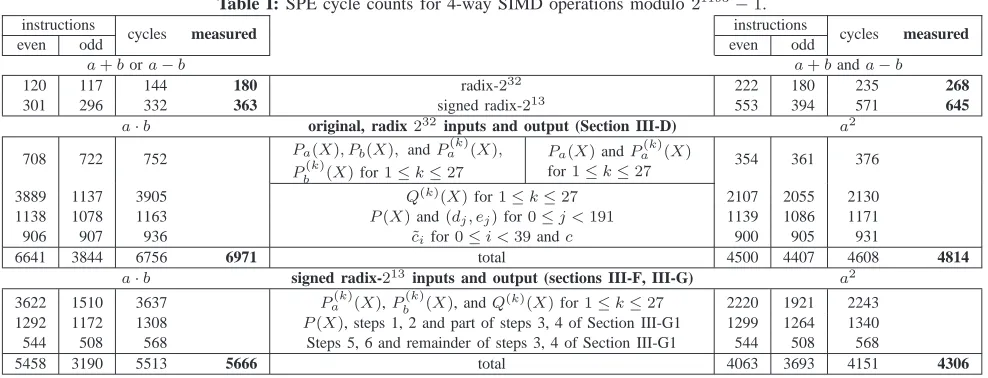
4) Repeat the previous step withc replaced byd. 5) Setcj=cj−212 anddj=dj−212 for0≤j <96. Steps 1, 2, and 5 allow arbitrary parallelization. Table I lists SPE clock cycle counts for the addition operations modulo 21193 −1: it can be seen that for signed radix-213 representation they are more than twice slower than for radix-232 representation.
D. Multiplication moduloN using radix conversions Given a pair of 4-tuples of M-bit integers, the four pairwise products result in a 4-tuple of2M-bit integers. The four reductions moduloNcan in principle be done by means of a few of the above 4-tuple additions and subtractions moduloN. Here we present our first approach that uses two different radix representations, thereby making it possible to take advantage of the fast radix-232addition and subtraction moduloN. In Section III-F another approach is described that is based on signed radix-213representation.
The multiplication modulo N of two M-bit integers a
andbgiven by their radix-232representations, each using 39 words of 32 bits, proceeds in three steps that are described in more detail in sections III-D1 through III-D3. The steps are:
1) conversion of inputs a and b to signed radix-213 representation;
2) carry-less calculation of the 2M-bit product a·b in signed 32-bit radix-213representation;
3) reduction moduloN and conversion to radix-232 rep-resentation of the 2M-bit product a·b, resulting in
c=a·bmodN ∈ {0,1, . . . , N−1}.
1) Conversion of inputs to signed radix-213 representa-tion: Given the radix-232representation of the precomputed constant C0 = 212·P95j=0213j, first calculate the radix-232 representation of a+C
0, in the usual way requiring carries. Next, using masks and shifts, extract the radix-213 representation (˜a)95
j=0 of a+C0, and finally subtract C0 again by calculating aj = ˜aj−212, for j = 0,1, . . . ,95 (becausea96= 0for our choice ofM, it is dropped). The last two steps allow various straightforward parallelizations and run twice faster (while requiring fewer registers) if two 13-bit chunks are packed into a single 32-bit word. Applying the same method to b, we find signed radix-213 representations of the inputs, below regarded as polynomials
Pa(X) =P95j=0ajXj,Pb(X) =P95j=0bjXj ∈Z[X] with
Pa(213) =aandPb(213) =b.
2) Carry-less calculation of the2M-bit product in signed 32-bit radix-213 representation: The product polynomial
P(X) = Pa(X)Pb(X) =
P190
j=0pjXj corresponds to the carry-less product calculation of a and b as represented by(aj)95j=0 and(bj)95j=0, respectively. Its coefficients satisfy |pj| ≤ 96·(212)2 <231, which allows computation mod-ulo232, resulting in a signed 32-bit radix-213representation (pj)190j=0 of the producta·b=P(213). If M <13·w with
w <96, the degree ofP(X)will be at most2w−2<190, which leads to savings here and in the description below.
The polynomial P(X) is calculated using three levels of Karatsuba multiplication [30] (but see Section III-F2 for the possibility to use more levels), resulting in 27 pairs of polynomials (Pa(k)(X), P
(k)
b (X)) of degree ≤11, fork =
1,2, . . . ,27(in the more general case whereM < u·v−2 we would use 16−ulevels). This leads to 27 independent polynomial multiplications Q(k)(X) = P(k)
a (X)Pb(k)(X), done using carry-less schoolbook multiplications. The poly-nomial P(X) is then obtained by carry-less additions and subtractions of the appropriateQ(k)(X)’s.
3) Reduction modulo N and conversion to radix-232 representation of the 2M-bit product: Given a signed 32-bit radix-213 representation (p
j)190j=0 of the 2M-bit product
a·b, regarded as the polynomialP(X) =P190j=0pjXj with
P(213) =a·b, the radix-232 representation (c
i)38i=0 of the
M-bit numberc≡P(213) modN is calculated. We use the following precomputed constants:
• C1≡ −231·P190j=0213jmodN,0≤C1< N. • Integerskj, lj andmj such that
13j=mjM+ 32lj+kj
with0≤32lj+kj < M and0≤kj<32, for 0 ≤ j < 191. Note that mj ∈ {0,1,2} because
M >827(andM <1246).
Given these values, the following four steps are carried out, the correctness of which easily follows by inspection:
1) For0≤j <191, computep˜j=pj+ 231(this allows arbitrary parallelization), so that 0≤p˜j <232. As a
result(P190j=0p˜j·213j) +C1≡P(213) modN. 2) For 0 ≤j <191, left shiftp˜j overkj bits and right
shiftp˜j over32−kj bits, to obtaindj, ej such that
˜
pj·213j ≡dj·232lj+ej·232(lj+1)modN
(this again allows arbitrary parallelization). 3) Let v0= 0. For 0≤i <39, let
ui=
X
j:lj=i dj+
X
j:lj+1=i
ej, (1)
(where the indicesjcan be precomputed) and compute ˜
ci= (vi+ui) mod 232∈ {0,1, . . . ,232−1},
vi+1 =⌊(vi+ui)/232⌋
(this allows partial parallelization). Finally, compute ˜
c39=v39+Pj:lj=38ej.
Using Eq. (1), reduction moduli N is effected by disregarding mj and grouping together identical dj -values and identical ej-values. As a result, (˜ci)39i=0 is the radix-232 representation of a number c˜ with ˜
c+C1≡cmodN.
4) Calculate c≡˜c+C1modN. Although the numbers are slightly bigger, this calculation is in principle the same as regular addition moduloN.
E. Optimizations
Swapping even for odd instructions. Modular arithmetic mostly relies on the SPE’s arithmetic instructions, which are even pipeline instructions. Following the approach from [43], [11] one may replace an even instruction by one or more odd ones with the same effect. Although this may increase the latency for the functionality of each replaced even instruction and the number of instructions, balancing the counts of even and odd instructions often increases the throughput. This method was used throughout our implementation. Examples are sketched below.
Modular squaring. When squaring polynomials of degree at most 11, half of the mixed products, i.e., 1222−12 = 66 multiplications, can be saved by doubling their resulting 21 sums (as the top elements are zero). Of these sums, the eleven for coefficients of odd degree can be doubled for free during the conversion to radix-232, by using for oddj precomputed integers˜kj,˜lj, andm˜j such that
odd pipeline, including all load and storage overheads (all 21 doublings would not have fit in the odd pipeline). As a result, all doublings required for squaring came for free.
Conversion to radix-232. The computation of d
j and ej requires a shift by kj and 32−kj, respectively, for 0 ≤
j <191, for a total of 382 even pipeline shift instructions. Ifkj ≡0 mod 8, each shift can be replaced by a single odd pipeline byte reordering instruction (or by no instruction if
kj= 0). Shift counts bigger than 8 can be replaced by three odd pipeline instructions.
M-dependent optimization. For 0 ≤j <191and mostM
we havePj:l
j+1=iej <2
32, sincee
j is obtained by a right shift over 32−kj > 0 bits and the shift amounts usually differ. Thus, for such M the second summation in Eq. (1) does not generate carries.
We have written a program that generates SPE code for each value ofM, with the applicableC0,C1,kj,lj,mj,˜kj,
˜
lj, and m˜j hard-coded and including all optimizations mentioned so far. The resulting code thus depends on the value of M used, with slightly varying performance between differentM-values. Representative instruction and cycle counts for 4-way SIMD multiplication and squaring modulo 21193 −1 on a single SPE are given in Table I. Because 14478 ·3905 ≈ 2115, the 2130 cycles required for the calculation of theQ(k)’s while squaring is very close to what one would expect based on the 3905 cycles required for multiplication.
F. Further speedups
Initial estimates indicated that the advantage of speed of the radix-232additions would outweigh the disadvantage of the conversion (in Section III-D1) to signed radix-213 rep-resentations required for the carry-less product calculation. Only after the code based on the methods described above had been used for about nine months (obtaining the results as reported in Section IV) and two further improvements had been developed, this issue was revisited. The two improvements, in sections III-F1 and III-F2, apply to the first approach as well. The alternative version of the method from Section III-D3 that normalizes (and reduces) the signed 32-bit radix-213 product to its signed radix-213 representation (as opposed to converting and reducing the product to radix-232 representation, as in Section III-D3) is presented in Section III-G.
1) Using C1 ≡ 0 modN in Section III-D3: Let γ = 13·191+18−M,β =⌊γ/13⌋andα=γ−13β. To get non-negativep˜j’s in the first step of Section III-D3, it suffices to putp˜0=p0+ 231,p˜j =pj+ 231−218for1≤j <191, and next to replacep˜βbyp˜β−2αto make sure that the sum of all values added toP190j=0pj213j telescopes to zero moduloN. Here we use thatpj≥ −96(212)(212−1)>−231+ 219>
−231+ 218 and that −231+ 219 > −231+ 218+ 2α (or
−231+219>−231+2αifβ= 0). ThusC
1in Section III-D3
is replaced by a value that is zero moduloN. This saves an addition (by C1) in the final calculation of c in the fourth step of Section III-D3.
2) Karatsuba multiplication with multiply-and-add: A more substantial improvement is obtained by noting that for 26 out of the 27k-values in Section III-D2 the coefficients of the polynomialsPa(k)(X)andP(
k)
b (X)are signed 15-bit integers. Therefore, for thesek another level of Karatsuba multiplication can be used for the calculation of Q(k)(X), while taking advantage of the SPE’s multiply-and-add in-structions. Some details are described below.
Let e, e′, f, f′ be four polynomials of degree n−1. To multiply the two polynomials e+e′Xn andf +f′Xn of degree 2n−1, calculateg =e−e′ andh=f′−f (note the asymmetry). Defining ef = U +U′Xn, e′f′ = V + V′Xn and gh = W +W′Xn, we have to calculate (e+
e′Xn)(f+f′Xn) =U+(U′+W+U+V)Xn+(V+W′+ U′+V′)X2n+V′X3n. This is done by calculating (using multiply-and-add when relevant)UandU′inn2operations, nextU′+V andV′using anothern2operations,U′+V+U (nadditions) andU′+V+V′(n−1 additions), and finally U′+V+U+W andU′+V+V′+W′ usingn2operations. In this way this final level of Karatsuba multiplication requires 3n2+ 4n−1 operations, which can be reduced to 3n2+ 3n−1 ifg andhcan be calculated twice as fast, as in our case. With n = 6 this becomes 125 operations for the calculation of each of the 26 Q(k)(X)’s to which this applies; the 27th one can be done in 144 operations, for a total of 3394 even instructions to calculate all Q(k)(X)’s. For n = 3 we get 3n2+ 3n−1 = 35 < 62, but the remaining parts of the 12-to-6-Karatsuba step take more than 20 operations, so more than 3×35 + 20 = 125 operations per Q(k)(X).
Improving the method from Section III-D using sec-tions III-F1 and III-F2 would lead to a speedup of slightly less than 10% for modular multiplication and a much smaller speedup for modular squaring. We have not used this improvement as it led to only a small speedup of the ECM application. Instead we combined the improvements with the method presented in Section III-G below as it was expected (and turned out) to lead to a more substantial speedup for the ECM application.
G. Multiplication moduloN using signed radix-213 Multiplication moduloN with inputs and output in signed radix-213 representation (and thus relatively slow addition operations) is obtained from the description in Section III-D by omitting the conversion in Section III-D1, keeping Sec-tion III-D2 in place (possibly improved as described in Section III-F2), and by replacing Section III-D3 by the reduction and normalization step described below.
Table I: SPE cycle counts for 4-way SIMD operations modulo21193−1.
instructions cycles measured instructions cycles measured
even odd even odd
a+bora−b a+banda−b
120 117 144 180 radix-232 222 180 235 268
301 296 332 363 signed radix-213 553 394 571 645
a·b original, radix232 inputs and output (Section III-D) a2
708 722 752 Pa(X), Pb(X), andP (k)
a (X), Pb(k)(X)for1≤k≤27
Pa(X)andPa(k)(X)
for1≤k≤27 354 361 376
3889 1137 3905 Q(k)(X)for1≤k≤27 2107 2055 2130
1138 1078 1163 P(X)and(dj, ej)for0≤j <191 1139 1086 1171 906 907 936 ˜cifor0≤i <39andc 900 905 931
6641 3844 6756 6971 total 4500 4407 4608 4814
a·b signed radix-213inputs and output (sections III-F, III-G) a2
3622 1510 3637 Pa(k)(X),Pb(k)(X), andQ(k)(X)for1≤k≤27 2220 1921 2243
1292 1172 1308 P(X), steps 1, 2 and part of steps 3, 4 of Section III-G1 1299 1264 1340 544 508 568 Steps 5, 6 and remainder of steps 3, 4 of Section III-G1 544 508 568
5458 3190 5513 5666 total 4063 3693 4151 4306
signed 32-bit radix-213 representation (p
j)190j=0 of the 2M -bit product a · b, regarded as the polynomial P(X) =
P190
j=0pjXj withP(213) =a·b, the signed radix-213 repre-sentation(cj)95j=0 of theM-bit numberc≡P(213) modN is calculated.
1) Compute(˜pj)190j=0 as described in Section III-F1. 2) For0≤j <96replacep˜j byp˜j+ 212. (All additions
in steps 1 and 2 are combined at a total cost of 191 even addition instructions for steps 1 and 2.)
3) For 96≤j <191 letp′
j and p
′′
j be words such that
˜
pj =p′j+p′′j216 and0 ≤p′j, p′′j <216, and replace
p′
j by p′j2 k′
j andp′′
j byp′′j2 k′′
j using odd instructions,
where 13j = m′
jM + 13ℓ′j +k′j and 13j+ 16 =
m′′
jM + 13ℓ′′j +kj′′.
4) For 96 ≤ j < 191replace p˜ℓ′
j by p˜ℓ′j +p
′
j and p˜ℓ′′ j
by p˜ℓ′′ j +p
′′
j using a total of 190 even instructions. (No overflow occurs because p′
j, p′′j ≤228 and pj <
(j+ 1)224 for0≤j <96.)
5) Perform Step 3 of the addition-subtraction method in Section III-C withc(consisting of halfwords) replaced by p˜(consisting of words). The carryτ can become as big as 219−1.
6) For0≤j <96calculate the halfwordcj= ˜pj−212. Steps 1, 2, 3, 4, and 6 allow arbitrary parallelization. The resulting SPE clock cycle counts are listed in Table I.
H. Comparison with other SPE implementations
Because an SPE runs at 3.192GHz and six are avail-able per PS3, it follows from Tavail-able I that a single PS3 can perform 13.5 (17.8) million multiplications (squarings) moduloNper second. This may be compared to 182 million and 138 million multiplications modulo 192-bit and 224-bit special moduli, respectively, as reported for a single PS3 in [8], i.e., less than an 11-fold slowdown for 5-fold bigger special moduli.
For generic moduli the same carry-less Karatsuba-based multiplication applies, but the reduction becomes more cum-bersome. We expect we can do much better than the basic approach which would reduce our performance by a factor of at most three. Compared to the roughly 102 million modular multiplications for generic moduli in the 200-bit range, as reported for a single PS3 in [6], we would get at worst a 20-fold slowdown for 6-fold bigger generic moduli.
IV. APPLICATION TOECM A. Background on ECM
ECM [38] attempts to factor a composite using a number of independent trials. The success probability per trial grows with the effort spent per trial, but decreases with the size of the smallest factor. Overall, the expected factorization effort for ECM (i.e., number of trials times effort per trial) grows subexponentially with the size of the smallest factor. For (S)NFS the effort does not depend on the size of the factor(s) but just on the size of the number being factored. For RSA moduli with two factors of about equal size, NFS is expected to be much faster than ECM. If there may be a relatively small factor (such as for composites of the form2M −1), ECM may be more efficient than (S)NFS.
Each ECM trial consists of two phases, phase one with bound B1, which is compute intensive but requires little memory, followed by a memory-hungry phase two with boundB2. Depending on the number of trials and the two bounds, the probability can be estimated that a factor up to a specific size, if present, will be found. To have probability at least e−e1 ≈0.632to find a factor of up to 65 decimal digits (when present), 24 000ECM trials with B1 = 3·109 and
Using the GMP-ECM package [58], [57] on a single core of a 2.2GHz Athlon 2427, phase one for an ECM trial for 2M−1withM around1100takes on the order of six hours, phase two takes about one hour requiring many GBytes of RAM (for generic composites of comparable size each phase takes about twice as long; more precise timings are presented in Table IV in Section IV-C below). For each composite of the form 2M −1 with 1000 ≤ M ≤ 1200 this implies about 20 core years for an ECM attempt to find a 65-digit factor, and about 90 core years for a 70-digit one. This should be compared to an SNFS effort ranging from on the order or 70 (M ≈1000) to several thousand (M ≈1200) core years. Thus, the largerM, the harder we should first try with ECM, commensurate with the expected SNFS effort and the probability that a candidate has a small factor.
Each ECM trial performs a particular sequence of addi-tions, subtracaddi-tions, and multiplications modulo the number being factored. Modular inversions can mostly be avoided. Phase one can easily be run in parallel in SIMD fashion for any number of trials. During a large scale ECM effort, overall throughput of trials is, within reason, a more impor-tant performance measure than latency per trial: for instance, being able to process four trials simultaneously in one day is better than processing (on the same platform) one trial every eight hours.
Rationale to use Cell processors for ECM on2M−1. Factor-ing numbers of the form2M−1is a “popular” activity [15] and hunting for relatively small factors is not hard given several freely available ECM packages. Nevertheless, given the efforts involved, we considered it likely that several of the unfactored composites2M−1 with1000≤M ≤1200 have a factor that can be found more economically by ECM than by SNFS. Given our research interest in the ones that cannot (relatively) easily be factored by ECM, we decided on an ECM effort down our list of at least 20 candidates, aiming to find all factors of up to, roughly, 65 digits. Since it was meant to be a simple production run, we chose to use the off-the-shelf GMP-ECM package, because it is free, easy to use, has an excellent track-record, and can take advantage of the special form of the number2M −1. Other packages may be faster, but we were not familiar with them [5].
The overall computation requires at least20×20 = 400 core years and can in principle be done on regular server-clusters. But that would be a waste of resources, because about 67th of the time is spent in phase one, which requires little memory thereby underutilizing the available RAM.
We also have access to a cluster of 215 PS3s, and thus to 215 Cell processors comprising a total of 1290 SPEs with only little memory per SPE. It could therefore be more economical for us to use those SPEs to do all phase one calculations, and to do the relatively small phase two effort whenever servers with adequate RAM would otherwise be idle. To test this we ported phase one of GMP-ECM to the
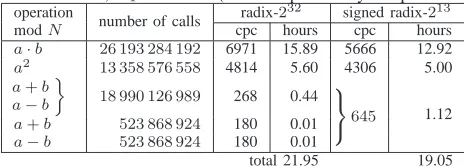
Table II: SPE effort for 4-way SIMD phase one ECM trials for N= 21193−1,B1= 3·109 (where “cpc”=“cycles per call”).
operation number of calls radix-232 signed radix-213
modN cpc hours cpc hours
a·b 26 193 284 192 6971 15.89 5666 12.92
a2 13 358 576 558 4814 5.60 4306 5.00
a+b a−b
ff
18 990 126 989 268 0.44 9
=
;
645 1.12
a+b 523 868 924 180 0.01
a−b 523 868 924 180 0.01
total 21.95 19.05
SPE, trying a variety of home-grown SPE-specific arithmetic packages (which were already known to outperform [29]). In the course of these early experiments we stumbled upon a 63-digit prime factor (of 21187 −1). This showed that conducting a thorough ECM search indeed makes sense, and stimulated development of the much faster SPE-arithmetic modulo2M−1 described in Section III.
It was not our goal to improve the ECM package that we put on top of our enhanced arithmetic. It is likely that improvements reported over GMP-ECM that are based on different elliptic curve arithmetic or representations, such as, for instance, described and implemented in [4], [5], apply to our overall performance figures as well.
ECM on the Cell processor to support (S)NFS. Although ECM factorizations have little cryptographic significance, this does not imply that ECM performance is cryptograph-ically irrelevant as well. In [7], for instance, it is observed that high performance ECM implementations on relatively inexpensive devices (given their computational power, such as on graphics cards (GPUs)), may be helpful for future (S)NFS projects. A particularly memory-hungry step of (S)NFS, sieving, generates large quantities of fairly small (100- to 200-bit) composites that must be factored. That task requires little memory and is therefore best outsourced to cheap devices, so sieving is not interrupted and all resources are used in a cost-conscious fashion. This area has seen a flurry of recent activity: see [49], [45], [24], [22] for implementations on reconfigurable hardware such as field-programmable gate arrays and [7], [6] for GPUs. In [6] the Cell architecture is covered as well.
B. ECM on the Cell applied to2M−1
from Section III-F. The measured wall-clock times are slightly larger than the estimates. For applications where additions play a more important role the method from Section III-D may outperform the method from Section III-G (where both methods are enhanced using Section III-F).
With six SPEs per Cell processor and 215 Cell processors in the PS3-cluster,4×6×215 = 5160phase one ECM trials can be processed in less than 20 hours. With 24 000 trials (cf. Section IV-A), phase one for a 65-digit search takes less than four days; phase one for the 110 000 trials for a 70-digit search takes two and a half weeks. Using our multi-core adaptation of phase two of GMP-ECM, the corresponding phase two calculations (with B2 = 103 971 375 307 818) take the same time when using 4 cores per node on a 56-node cluster (with two hexcore processors per 56-node): each trial takes15minutes on4 cores, using at most 16GBytes of RAM. Thus, the efforts of the two clusters involved in our calculations are well matched.
After nine months of sustained calculations for several
M-values (using the slower approach from Section III-D), seven new factors have been found, in the following order: a 63-digit factor forM = 1187, the 73-digit factor
1 808 422 353 177 349 564 546 512 035 512 530 001 279 481 259 854 248 860 454 348 989 451 026 887
forM = 1181, another 73-digit factor,
1 042 816 042 941 845 750 042 952 206 680 089 794 415 014 668 329 850 393 031 910 483 526 456 487,
forM = 1163, a 66-digit factor forM = 1073, a 63-digit factor for M = 1051, a 68-digit factor for M = 1139, and a 70-digit factor for M = 1237. The 241-bit, 73-digit prime factor of21181−1 is the current ECM record, beating the previous record by 5 digits. The factor was found after somewhat more than 25 000 phase one trials at approximately the 8800th corresponding phase two trial, implying that we were quite lucky finding it. Less, but still considerable luck was involved in finding the second 73-bit factor (a bit smaller at 240 bits): it was found after about 50 000 ECM trials. So far our example number 21193−1 stubbornly resisted all ECM efforts to be factored after running142 162ECM trials on it. For the numbers2M−1 that we fail to factor using ECM, such as (so far) for
M = 1193, our efforts will result in a reasonable degree of confidence that they will not have a prime factor of 65 digits or less. Only for M = 1051and M = 1237did we find composite cofactors: for M = 1051 the attempt was continued and the 63-factor was indeed re-found where it could be predicted (once it had been found), but the c248 cofactor remained unfactored.
Table III lists all results obtained using the slower ap-proach from Section III-D, with ck and pk denoting a
k-digit composite and prime, respectively. For exponents
M ∈[1000,1125](M ∈[1126,1200]) not stated in Table III
Table III: Factors found of2M−1using ECM on the Cell with the arithmetic described in Section III-D of this paper, and with
B1= 3·109 andB2≈1014.
M compositetargeted completed number of trialsphase one phase two result
1051 c310 23 136 9 186 p63·c248
1073 c281 24 504 1 460 p66·p215
1139 c313 49 080 35 490 p68·p246
1163 c318 50 152 47 768 p73·p246
1181 c291 25 393 8 808 p73·p218
1187 c266 15 089 9 860 p63·p204
1237 c373 71 556 70 809 p70·c303
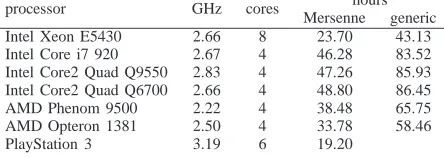
Table IV: Time to complete 24 phase one ECM trials.
processor GHz cores hours
Mersenne generic Intel Xeon E5430 2.66 8 23.70 43.13 Intel Core i7 920 2.67 4 46.28 83.52 Intel Core2 Quad Q9550 2.83 4 47.26 85.93 Intel Core2 Quad Q6700 2.66 4 48.80 86.45 AMD Phenom 9500 2.22 4 38.48 65.75 AMD Opteron 1381 2.50 4 33.78 58.46
PlayStation 3 3.19 6 19.20
roughly 25 000 (50 000) ECM trials have been completed with bounds as above without finding a factor.
Although we hope, during our continuing efforts using the faster approach from sections III-F and III-G, not to miss factors up to the 65-digit range, with ECM one can never be sure. Should we wish to find out, using SNFS is probably the best option. Using the improved arithmetic we have so far found one factorization: for M = 961 we found that c254 = p61·p193 after 1190 curves with B1 = 109 and
B2= 25 427 965 563 016.
V. CONCLUSION
For integers M in the range from 1000 to 1200 we presented our Cell processor implementation of multiplica-tion of M-bit integers, processing 24 such multiplications in parallel on a single PlayStation 3 game console, and used it to obtain efficient multiplication modulo 2M −1. The ideas underlying our implementation apply to many arithmetic contexts of cryptologic relevance, such as elliptic curve cryptosystems and cryptanalysis thereof.
We focused on application of our arithmetic to elliptic curve factoring, as a preparatory step for a potential (S)NFS factoring project. This led to the two largest factors found using ECM so far.
Acknowledgements. This work was supported by the Swiss National Science Foundation under grant num-bers 200021-119776, 206021-117409, 206021-128727 and 200020-132160 and by EPFL DIT.
REFERENCES
[1] J.-C. Bajard, L. Imbert, and T. Plantard. Modular number systems: Beyond the Mersenne family. In Selected Areas
in Cryptography, volume 3357 of LNCS, pages 159–169.
Springer, 2004.
[2] J.-C. Bajard, N. Meloni, and T. Plantard. Efficient RNS bases for cryptography. In IMACS’05 : World Congress: Scientific
Computation Applied Mathematics and Simulation, 2005.
[3] D. J. Bernstein. Curve25519: New Diffie-Hellman speed records. In PKC 2006, volume 3958 of LNCS, pages 207– 228, 2006.
[4] D. J. Bernstein, P. Birkner, T. Lange, and C. Peters. ECM using Edwards curves. Cryptology ePrint Archive, Report 2008/016, 2008. http://eprint.iacr.org/.
[5] D. J. Bernstein, P. Birkner, T. Lange, and C. Peters. EECM: ECM using Edwards curves. http://eecm.cr.yp.to/, 2010.
[6] D. J. Bernstein, H.-C. Chen, M.-S. Chen, M. Cheng, C.-H. Hsiao, T. Lange, Z.-C. Lin, and B.-Y. Yang. The billion-mulmod-per-second PC. In Workshop record of SHARCS’09, pages 131–144, 2009. http://www.hyperelliptic.org/tanja/ SHARCS/record2.pdf.
[7] D. J. Bernstein, T.-R. Chen, C.-M. Cheng, T. Lange, and B.-Y. Yang. ECM on graphics cards. In Eurocrypt 2009, volume 5479 of LNCS, pages 483–501, 2009.
[8] J. W. Bos. High-performance modular multiplication on the Cell processor. In WAIFI 2010, volume 6087 of LNCS, pages 7–24, 2010.
[9] J. W. Bos, M. E. Kaihara, and P. L. Montgomery. Pol-lard rho on the PlayStation 3. In Workshop record of
SHARCS’09, pages 35–50, 2009. http://www.hyperelliptic. org/tanja/SHARCS/record2.pdf.
[10] J. W. Bos, T. Kleinjung, R. Niederhagen, and P. Schwabe. ECC2K-130 on Cell CPUs. In Africacrypt 2010, volume 6055 of LNCS, pages 225–242, 2010.
[11] J. W. Bos and D. Stefan. Performance analysis of the SHA-3 candidates on exotic multi-core architectures. In CHES 2010, volume 6225 of LNCS, pages 279–293, 2010.
[12] S. Boussakta and A. Holt. New transform using the mersenne numbers. Vision, Image and Signal Processing, IEE
Proceed-ings -, 142(6):381–388, December 1995.
[13] R. P. Brent. Factorization of the tenth Fermat number.
Mathematics of Computation, 68(225):429–451, 1999.
[14] R. P. Brent and J. M. Pollard. Factorization of the eighth Fermat number. Mathematics of Computation, 36(154):627– 630, 1981.
[15] J. Brillhart, D. H. Lehmer, J. L. Selfridge, B. Tucker-man, and S. S. Wagstaff, Jr. Factorizations of bn ±1,
b = 2,3,5,6,7,10,11,12 up to high powers. American Mathematical Society, First edition, 1983, Second edition, 1988, Third edition, 2002. Electronic book available at: http://homes.cerias.purdue.edu/~ssw/cun/index.html, 1983.
[16] H.-C. Chen, C.-M. Cheng, S.-H. Hung, and Z.-C. Lin. In-teger number crunching on the cell processor. International
Conference on Parallel Processing, pages 508–515, 2010.
[17] J. Chung and M. A. Hasan. More generalized mersenne numbers. In Selected Areas in Cryptography, volume 3006 of LNCS, pages 335–347. Springer, 2003.
[18] N. Costigan and P. Schwabe. Fast elliptic-curve cryptography on the Cell broadband engine. In Africacrypt 2009, volume 5580 of LNCS, pages 368–385, 2009.
[19] R. Crandall and B. Fagin. Discrete weighted transforms and large-integer arithmetic. Mathematics of Computation, 62(205):305–324, 1994.
[20] R. Crandall and B. Fagin. Discrete weighted transforms and large-integer arithmetic. Math. of Comp., 62(205):305–324, 1994.
[21] A. J. C. Cunningham and H. J. Woodall. Factorizations of bn±1,b= 2,3,5,6,7,10,11,12up to high powers. Frances Hodgson, London, 1925.
[22] G. de Meulenaer, F. Gosset, G. M. de Dormale, and J.-J. Quisquater. Integer factorization based on elliptic curve method: Towards better exploitation of reconfigurable hard-ware. In FCCM 2007, pages 197–206. IEEE Computer Society, 2007.
[23] V. Dimitrov, T. Cooklev, and B. Donevsky. Generalized Fermat-Mersenne number theoretic transform. Circuits and
Systems II: Analog and Digital Signal Processing, IEEE Transactions on, 41(2):133–139, February 1994.
[24] K. Gaj, S. Kwon, P. Baier, P. Kohlbrenner, H. Le, M. Khalee-luddin, and R. Bachimanchi. Implementing the elliptic curve method of factoring in reconfigurable hardware. In CHES
2006, volume 4249 of LNCS, pages 119–133, 2006.
[25] H. L. Garner. The residue number system. IRE Transactions
[26] GIMPS Home Page. The great internet mersenne prime search. http://www.merssene.org, 2010.
[27] J. Harrison. Isolating critical cases for reciprocals using integer factorization. In IEEE Symposium on Computer
Arithmetic (Arith-16), pages 148–157, 2003.
[28] G. Hotz. Here’s your silver platter. http://rdist.root.org/2010/ 01/27/how-the-ps3-hypervisor-was-hacked/.
[29] IBM. Multi-precision math library. Example Library API Ref-erence. Available at https://www.ibm.com/developerworks/ power/cell/documents.html.
[30] A. Karatsuba and Y. Ofman. Multiplication of many-digital numbers by automatic computers. Number 145 in Proceed-ings of the USSR Academy of Science, pages 293–294, 1962.
[31] D. E. Knuth. The art of computer programming, volume 2 (3rd ed.): seminumerical algorithms. Addison-Wesley Longman Publishing Co., Inc., Boston, MA, USA, 1997.
[32] N. Koblitz. Elliptic curve cryptosystems. Mathematics of
Computation, 48:203–209, 1987.
[33] D. H. Lehmer. An extended theory of Lucas’ functions.
Annals of Mathematics, 31(3):419–448, 1930.
[34] D. N. Lehmer. Hunting big game in the theory of numbers. Scripta Mathematica, March 1933.
[35] A. K. Lenstra. Unbelievable security: Matching AES security using public key systems. In Asiacrypt 2001, volume 2248 of LNCS, pages 67–86, 2001.
[36] A. K. Lenstra and H. W. Lenstra, Jr. The Development of
the Number Field Sieve, volume 1554 of Lecture Notes in Mathematics. Springer-Verlag, 1993.
[37] A. K. Lenstra, H. W. Lenstra Jr., M. S. Manasse, and J. M. Pollard. The factorization of the ninth Fermat number.
Mathematics of Computation, 61(203):319–349, 1993.
[38] H. W. Lenstra Jr. Factoring integers with elliptic curves. Ann.
of Math., 126:649–673, 1987.
[39] E. Lucas. Théorie des fonctions numériques simplement périodiques. American Journal of Mathematics, 1(2):184–
196, 1878.
[40] R. D. Merrill. Improving digital computer performance using residue number theory. Electronic Computers, IEEE
Transactions on, EC-13(2):93–101, April 1964.
[41] V. S. Miller. Use of elliptic curves in cryptography. In Crypto
1985, volume 218 of LNCS, pages 417–426, 1986.
[42] M. A. Morrison and J. Brillhart. A method of factoring and the factorization of F7. Mathematics of Computation,
29(129):183–205, 1975.
[43] D. A. Osvik, J. W. Bos, D. Stefan, and D. Canright. Fast software AES encryption. In FSE 2010, volume 6147 of
LNCS, pages 75–93, 2010.
[44] D. A. Patterson and J. L. Hennessy. Computer Organization
and Design (4th Edition): The Hardware/Software Interface.
Morgan Kaufmann Publishers Inc., San Francisco, CA, USA, 2009.
[45] J. Pelzl, M. Šimka, T. Kleinjung, M. Drutarovský, V. Fischer, and C. Paar. Area-time efficient hardware architecture for factoring integers with the elliptic curve method. Information
Security, IEE Proceedings on, 152(1):67–78, oct 2005.
[46] J. M. Pollard. The lattice sieve. pages 43–49 in [36].
[47] R. L. Rivest, A. Shamir, and L. Adleman. A method for obtaining digital signatures and public-key cryptosystems.
Communications of the ACM, 21:120–126, 1978.
[48] A. Shamir. CryptoBytes Technical Newsletter. ftp://ftp. rsasecurity.com/pub/cryptobytes/crypto1n3.pdf.
[49] M. Šimka, J. Pelzl, T. Kleinjung, J. Franke, C. Priplata, C. Stahlke, M. Drutarovský, and V. Fischer. Hardware factorization based on elliptic curve method. In FCCM 2005, pages 107–116. IEEE Computer Society, 2005.
[50] A. Skavantzos and P. Rao. New multipliers modulo2n−1.
IEEE Transactions on Computers, 41:957–961, 1992.
[51] J. A. Solinas. Generalized Mersenne numbers. Technical Report CORR 99-39, Centre for Applied Cryptographic Re-search, University of Waterloo, 1999.
[52] M. Stevens, A. K. Lenstra, and B. de Weger. Predicting the winner of the 2008 US presidential elections using a Sony PlayStation 3. http://www.win.tue.nl/hashclash/Nostradamus/.
[53] M. Stevens, A. Sotirov, J. Appelbaum, A. K. Lenstra, D. Mol-nar, D. A. Osvik, and B. de Weger. Short chosen-prefix collisions for MD5 and the creation of a rogue CA certificate. In CRYPTO, volume 5677 of LNCS, pages 55–69, 2009.
[54] F. Taylor. Large moduli multipliers for signal processing.
Circuits and Systems, IEEE Transactions on, 28(7):731–736,
July 1981.
[55] U.S. Department of Commerce and National Institute of Standards and Technology. Digital Signature Standard (DSS). See http://csrc.nist.gov/publications/fips/fips186-3/ fips_186-3.pdf, 2009.
[56] yoyo@home and M. Thompson. Found gmp-ecm top50 factor. http://www.loria.fr/~zimmerma/records/p68, 2009.
[57] P. Zimmermann and B. Dodson. 20 years of ECM. In ANTS, volume 4076 of LNCS, pages 525–542, 2006.