TECHNICAL UNIVERSITY OF CLUJ-NAPOCA
ACTA TECHNICA NAPOCENSIS
Series: Applied Mathematics, Mechanics, and Engineering Vol. 63, Issue II, June, 2020
EVALUATION OF THE DYNAMIC COMPACTION EFFECT
WITH VIBRATING ROLLERS BASED ON
THE RHEOLOGICAL BEHAVIOUR OF SOIL
Cornelia DOBRESCU
Abstract: The dynamic response of the vibrant roll in resonance regime highlights the rheologic influence of land. Thus, for the land linear viscoelastic modelled Voigt-Kelvin or Maxwell the dynamic response in resonance may characterize the rheological and dynamic nature of the compactor roller-land interaction. This paper presents the results of the dynamic modelling highlighting the resonance regime and the technological dynamic regime in post-resonance. Thus, there are presented the results obtained for real cases, with "in situ" experiments based on which certain correlations of the response curve with the degree of compaction of the land.
Key words:dynamic compaction, soil, rheology
1. INTRODUCTION
The process of dynamic compaction through vibration of soil is performed with special dynamic equipment such as vibrating rollers. They convey to the layers of earth in the compaction process, harmonic dynamic forces at various frequencies so that the degree of compaction may be achieved after a number of successive passages. In this context, the dynamic compaction process by technological applied to the ground significantly increases density simultaneously with reducing the number of holes in soil.
In this way, it creates the possibility of increasing mechanic resistance and the stability of the natural foundation under dynamic compaction.
The variety of the foundation land by significantly different physical and mechanical parameters on the same working section, makes the rheological modelling an important factor in establishing the parameters of the vibrating system. Thus, it was found that for the same layer of soil, in various areas, placed on the length and with certain distances between them, the rheologic behaviour may be totally different.
Experimentally there have been highlighted two categories of linear viscoelastic rheological models for the process of compaction by vibration, that is: the Voigt-Kelvin and Maxwell model.
Within the research made both " in situ " or the laboratory as well as by number modelling, there highlighted the response curves in dynamic regime both for amplitude-pulse as well as for the force transmitted to the soil – pulse with the due conclusions on areas of interest.
2. THE DYNAMIC MODEL FOR
EVALUATING THE VIBRATION
COMPACTION PROCESS
The experimental and numerical modelling research highlighted two linear viscoelastic rheological models of the vibratory roll-soil interaction. The number of successive passes of the vibrator roller on the same layer makes the final remnant deformation to highlight the plastic behaviour to the last state by reaching the degree of compaction after which the compaction process is considered completed.
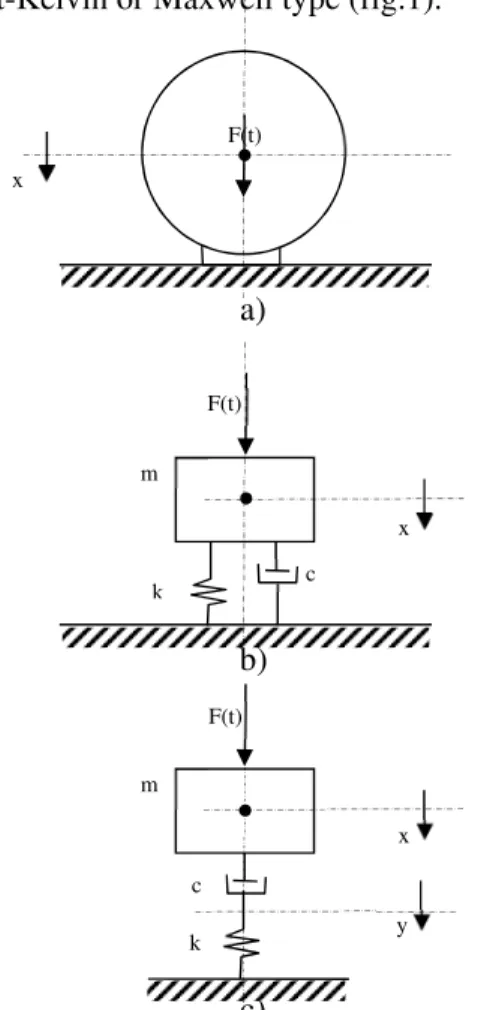
pass, until the end of compaction, can be a Voigt-Kelvin or Maxwell type (fig.1).
a)
b)
c)
Figure 1: Schematization of the vibrator-roller – soil contact
a) Mass vibrator roller and dynamic force F(t)
b) Dynamic model (m, c |k) Voigt – Kelvin with
instantaneous displacement x at force F(t)=F0sinωt
c) Dynamic model (m, c - k) Maxwell with
instantaneous displacement x at force F(t)=F0sinωt
2.1Voigt-Kelvin dynamic model
The interaction of the vibrating roller with the soil is modelled through the contact area, the nature of the soil, the weight force versus the contact area and the dynamic force of inertial type generated by the vibrator of the compactor roller. The static and vertical dynamic action, the
elasticity k and amortization c of the soil as well
as mass m in vibratory movement of the
compactor roller are physical parameters determinants of the response in displacement and respectively in the transmitted force.
The dynamic vibrator roller-soil model for a soil with natural stabilizer has a linear viscoelastic behaviour highlightable until the last pass. In this case, the level of compaction was reached, with plastic remnant deformation, corresponding to final compaction. Figure 1 presents the schematization of the vibrator roller-soil interaction and the dynamic models of Voigt-Kelvin calculation. For the dynamic model of figure 1b, the differential equation of
movement of mass m, formulated in measures of
the complex functions, may written down as
exp (1)
where we have
exp
where is the static moment of the vibrator.
ω – pulse of frequency of rotation of the vibrator
F0 – amplitude of the perturbator force F(t)
Introducing , , in relation (1) it merges the
amplitude in complex form as
(2)
The amplitude of the vibrations of the
vibrator roller of mass m emerges as being
from relation (2) as follows
/ (3)
The dynamic force transmitted to the land in complex formulation is
" exp (4)
or
" (5)
The amplitude of the transmitted force Q1
emerges from (5) as being " " , as follows:
"
/ (6)
2.2Maxwell dynamic model
Fig. 1, c presents the Maxwell schematization specific to the rheological models for soils with predominantly viscous characteristics. In this case, dusty clay predominates, mixed with sand, water and the natural stabilizer (ecologic).
The differential equations of movement in complex formulation may be written down as
# $ exp
% $& $ (7)
where we have
F(t)
x
m
k c
F(t)
x
m F(t)
c
k
x
exp cu
$ 'exp cu ' ' (
By solving system (7) we obtain
)*
' )* (8)
)*
Amplitude from relation (8)
emerges as
/
(9) The force transmitted to the soil is given by
the complex function " 'exp or as
follows
" exp )*
(10)
The amplitude of the transmitted force "
" which emerges from relation (10) as
" /
(11)
3. DYNAMIC RESPONSE OF THE
VIBRATOR ROLLER – SOIL SYSTEM
The compaction process was analysed for two distinct types of soil under its rheologic aspect, Voigt-Kelvin and Maxwell being modelled. As a result of the experimentation in the field with the same vibrator roller, there were evaluated the
parametric values for amplitudes + ,,
- and the maximum transmitted
force " "+ ,and " "-. The
experimental assessment and the numeric testing based on the calculation relations were made for each passing modifying the rigidity of the
compacted layer ki, i=1, 2…4 and of the
amortization by the amortization rate ζi. i=1,
2…4, knowing the amortization factor of the
dissipative force . 20.1 . for the linear
viscoelastic behaviour case.
The parameters of the experimental roller
vibrator are mass m=2000kg, static moment
m0r= 1kgm, and rigidity after each pass are k1 =
5 MN/m, k2 = 20 MN/m, k3 = 50 MN/m, k4 = 80
MN/m, and ζi=0.1; 0.2; 0.3; 0.4, where i=1,
2…4
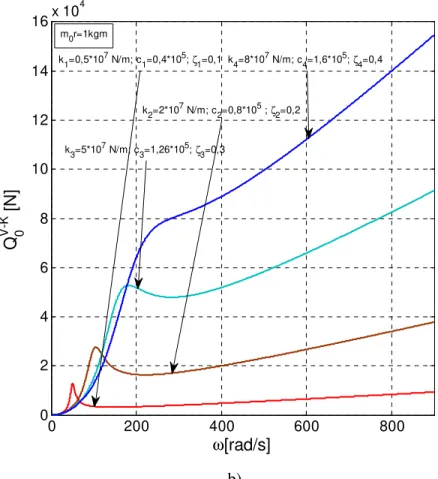
Figures 2 and 3 present the dynamic response curves for the Voigt-Kelvin model and respectively for the Maxwell model.
a)
0 200 400 600 800
0 0.5 1 1.5 2 2.5
3x 10
-3
ω[rad/s]
X 0
V
-K [
m
]
k
1=0,5*10 7 N/m; c
1=0,4*10 5; ζ
1=0,1
k3=5*107 N/m; c3=1,26*105; ζ3=0,3
k
4=8*10 7 N/m; c
4=1,6*10 5; ζ
4=0,4
k2=2*107 N/m; c2=0,8*105 ; ζ2=0,2 m
b)
Figure 2: Dynamic response for the Voigt – Kelvin rheologic model: a) Variation of amplitude according to pulse ω and rigidity k;
b) Variation of the force transmitted to the soil.
a)
b)
Figure 3: Dynamic response for the Maxwell model: a) Variation of amplitude according to pulse ω and rigidity k;
b) Variation of the force transmitted to the soil.
0 200 400 600 800
0 2 4 6 8 10 12 14 16x 10
4
ω[rad/s]
Q 0
V
-K [
N
]
k3=5*107 N/m; c3=1,26*105; ζ3=0,3
k2=2*107 N/m; c2=0,8*105 ; ζ2=0,2
k1=0,5*107 N/m; c1=0,4*105; ζ1=0,1 k4=8*107 N/m; c4=1,6*105; ζ4=0,4 m0r=1kgm
0 200 400 600 800
0 0.5 1 1.5 2 2.5 3 3.5 4 4.5
5x 10
-4
ω[rad/s]
X0 M [
m
]
k1=0,5*107 N/m; c 1=0,4*10
5; ζ 1=0,1 k2=2*107 N/m; c
2=0,8*10 5 ; ζ
2=0,2 k3=5*107 N/m; c
3=1,26*10 5; ζ
3=0,3 k4=8*107 N/m; c
4=1,6*10 5; ζ
4=0,4 m0r=1 kgm
0 200 400 600 800
0 0.5 1 1.5 2 2.5 3 3.5 4 4.5x 10
4
ω[rad/s]
Q0 M [
N
] k4=8*10
7 N/m; c 1=1,6*105; ζ=0,4
k3=5*107 N/m; c1=1,26*105 ; ζ=0,3
k2=2*107 N/m; c 1=0,8*10
5 ; ζ=0,2
4. CONCLUSIONS
For natural lands with adding of mineral aggregates and ecological stabilizers, the dynamic compaction process is of the structure of the soil. Thus, the content of clay, sand, natural aggregates, blanket and ecological stabilizers determines two categories of distinct rheological models. For the ecologically stabilized soils, the experimental results in the laboratory and "in situ", there may be established two types of rheological models, namely:
- the Voigt-Kelvin rheologic model for clay soils (30%), with sand (18%) and river mineral aggregates (10%) and water (10%) with stabilizer (2%)
- the Maxwell rheologic model for clay soils (5%), sand (30%), river mineral aggregates (5%), water (12%) and stabilizer (3%)
The experimental tests were carried out in a trial field, with successive passages on the same
layer at an excitation pulse ω = 400 rad/s with
the roller movement speed of 6 km/h. There were prepared two test tracks, arranged in parallel, with 10 m width and 1200 m length with soil layers with the compositions and dosages previously referred to.
Based on the "in situ" parametric measurements and the numerical assessments using the calculation relations from Chapter 2, the following conclusions emerged:
a) the Voigt-Kelvin model for the first category of soils, assures the significative description of the compaction process with amplitudes of vibrations included between the range of (0.50....0,52) mm and with the maximum force transmitted after each passage from 5 kN to 85 kN, reaching the compaction degree of 95% at the last passage.
b) the Maxwell model is able of describing the process of compaction of the second category f soil, with the response amplitude in the range of (0.425....0,470) mm with maximum forces transmitted from 2.5 kN to 41 kN, reaching the compaction degree of 91% at the last passage.
Consequently, it is found that the Voigt-Kelvin rheological model shows more efficient compaction of the soil in the first category at compaction by vibration. By trials "in situ" the
soil in the second category may be improved in order to increase the transmitted force and the degree of compaction.
REFERENCES
[1] Bratu, P. : Evaluation of the dissipated energy
in viscoelastic or histeretic seismic isolators
(2012), Romanian Journal of Acustics and Vibration (1) pp.53-56
[2] Bratu, P. : Dynamic Stness Dissipated Eneregy
Rating of Materials with Maxwell Rheological
Behaviour. Applied Mechanics and Materials
Vol 801 (2015) pp 115-121, Doi:10.4028 wwwwscientific.net/AMM.801-115
[3] Bratu, P., The behavior of nonlinear
viscoelastic systems subjected to harmonic dynamic excitation, The 9th International
Congress on Sound and Vibration, University of Central Florida Orlando, Florida, 8 – 11 July, (2002)
[4] Bratu, P., Dynamic response of nonlinear
systems under stationary harmonic excitation,
Non-linear acoustics and vibration, 11th
International Congress on Sound and Vibration, 2767-2770, St. Petersburg, 5 - 8 July, (2004)
[5] Bratu, P., Dynamic analysis in case of
compaction vibrating rollers intended for
road works, The 17tg International Congress
on Sound& Vibration, ICSV, Cairo, 18-22 July, (2010)
[6] Bratu, P., Debeleac, C., The analysis of
vibratory roller motion, Proceedings of the
VII International Triennale Conference Heavy Machinery – HM 2011, Session Earth-moving
and transportation machinery, Vrnjačka
Banja, Serbia, 29 June -2 July, pp.23-26, ISBN 978-86-82631-58-3, (2011)
[7] Bratu, P., Stuparu A., Popa S., Iacob N., Voicu
O., The assessment of the dynamic response to seismic excitation for constructions equipped with base isolation systems according to the
Newton-Voigt-Kelvin model, Acta Tehnica
Napocensis, series: Applied Mathematics, and Engineering, Vol 60, Issue IV, November, pp. 459-464, (2017)
[8] Bratu, P., Stuparu A., Leopa A., Popa S., The
dynamic analyses of a construction with the base insulation consisting in anti-seismic devices modeled as a Hooke-Voigt-Kelvin
linear rheological system, Acta Tehnica
and Engineering Vol 60, Issue IV, pp. 465-472, November (2018)
[9] Bratu, P., Stuparu A., Popa S., Iacob N., Voicu
O., Iacob N., Spanu G., The dynamic isolation
performances analysis of the vibrating equipment with elastic links to a fixed base,
Acta Tehnica Napocensis, series: Applied Mathematics, and Engineering Vol 61, Issue I, March, pp. 23-28, 2018;
[10] Dobrescu C. F. Highlighting the Change of the
Dynamic Response to Discrete Variation of Soil Stiffness in the Process of Dynamic Compaction with Roller Compactors Based on Linear Rheological Modeling, in: Herisanu N.,
Marinca V. (Editors), Applied Mechanics and Materials, vol. 801: Acoustics & Vibration of Mechanical Structures II, 350 page., (ISBN 978-3-03835-628-8), page. 242-248, [ISI Web of Science (WoS)], disponible at doi: 10.4028/www.scientific.net/AMM.801.242, (2015)
[11] Dobrescu C.F., Brăguţă E., Optimization of Vibro-Compaction Technological Process
Considering Rheological Properties,
Proceedings of the 14th AVMS Conference, Timisoara, Romania, May 25–26, 2017, Springer Proceedings in Physics 198, Nicolae Herisanu Vasile Marinca Editors, pp 287-293, ISSN 0930-8989 ISSN 1867-4941 (electronic) Springer Proceedings in Physics ISBN 69822-9 ISBN 978-3-319-69823-6 (eBook) https://doi.org/10.1007/978-3-319-69823-6.
[12] Leopa, A., Debeleac, C., Năstac, S.,
Simulation of Vibration Effects on Ground Produced by Technological Equipment, 12th
International Multidisciplinary Scientific
GeoConference SGEM2012, Conference Proceedings, Vol. 5, Vol. 5, pp. 743-750, ISSN 1314-2704, (2012)
[13] Bratu, P., Evaluation of the Dissipated Energy
in Viscoelastic or Hysteretic Seismic Isolators,
Romanian Journal of Acoustics and Vibration, Vol. 9, Iss. 1, pp 53-56, (2012)
[14] Bratu, P., Dynamic Stress Dissipated Energy
Rating of Materials with Maxwell Rheological Behavior, Applied Mechanics and Materials,
Vol.801, pp 115-121, DOI:
10.4028/www.scientific.net/AMM.801.115, (2015)
[15] Morariu-Gligor R., M., Crisan A., V. Şerdean
F. M., Optimal design of a one-way plate
compactor, Acta Technica Napocensis
Series: Applied Mathematics, Mechanics, and Engineering Vol. 60, Issue IV, pp. 557-564, November (2017)
[16] Pințoi R., Bordos R., Braguță E., Vibration Effects in the Process of Dynamic Compaction
of Fresh Concrete and Stabilized Earth,
Journal of Vibration Engineering & Technologies, Volume 5, ISSN 2321-3558, December (2017)
[17] Mooney, M.A., Rinehart, R.V. Field
Monitoring of Roller Vibration During
Compaction of Subgrade Soil, Journal of
Geotechnical and Geoenvironmental
Engineering, ASCE, Vol. 133, No. 3, pp. 257– 265, (2007)
[18] Mooney, M.A., Rinehart, R.V., In-Situ Soil
Response to Vibratory Loading and Its
Relationship to Roller-Measured Soil
Stiffness, Journal of Geotechnical and
Geoenvironmental Engineering, ASCE, Vol. 135, No. 8, pp. 1022–1031, (2009)
Evaluarea efectului de compactare dinamică cu rulouri vibratoare pe baza comportării reologice a terenului
Rezumat: Răspunsul dinamic al ruloului vibrator în regim de rezonanță evidențiază influența reologică a terenului. Astfel, pentru terenuri modelate vâscotic liniar Voigt-Kelvin sau Maxwell răspunsul dinamic în rezonanță poate caracteriza natura reologicăși dinamică a interacțiunii rulou compactor-teren. În cadrul lucrării sunt prezentate rezultatele modelării dinamice evidențiindu-se regimul de rezonanțăși regimul dinamic tehnologic în postrezonanță. Astfel, se prezintă pentru cazuri reale, cu experimenări “in situ” rezultatele obținute pe baza cărora pot fi stabilite corelații certe ale curbei de răspuns cu gradul de compactare a terenului.
Cornelia DOBRESCU, PhD, NIRD URBAN – INCERC, Bucharest, Romania,