M.Vijayakumar et al IJSRE Volume 05 Issue 05 May 2017 Page 6443
Volume||5||Issue||05||May-2017||Pages-6443-64429ISSN(e):2321-7545 Website: http://ijsae.in Index Copernicus Value- 56.65 DOI: http://dx.doi.org/10.18535/ijsre/v5i05.12
Pressure Performance Index (PPI) as a Modulating Factor of Shooting Performance in
Marksmen: A Pilot Study
Authors
M.Vijayakumar1, Aishwarya Dehadrai2, Lakshmi Pavani P.3, Tushar Palekar4
1
Associate professor, Dr.D.Y.Patil College of Physiotherapy, Dr.D.Y.Patil Vidyapeeth, Pune, India.
2
Dr.D.Y.Patil College of Physiotherapy, Dr.D.Y.Patil Vidyapeeth, Pune, India.
3
Dr.D.Y.Patil College of Physiotherapy , Dr.D.Y.Patil Vidyapeeth, Pune, India.
4
Principal, Dr.D.Y.Patil College of Physiotherapy, Dr.D.Y.Patil Vidyapeeth, Pune, India. Email- [email protected] [email protected] [email protected]
ABSTRACT
Background- Shooting performance is enhanced by working upon specific muscle strength with their regular general conditioning and fitness training. The stronger the muscle structure is developed, the better the movement can be coordinated and positions held. So we aim to study the effect of neck muscle strengthening on Pressure Performance Index (PPI) on shooting performance among marksmen.
Method-This is a pilot study in which 33 male as well as female Rifle Shooters within 20±5 years of age with 2-3 years of experience and participating in state/district level tournaments were assigned into 2 groups. 16 subjects were assigned in the experimental group (Group A) who underwent neck muscle strengthening along with their regular general conditioning and fitness program. While 17 subjects were assigned in the control group (Group B), who continued to practice their general conditioning and fitness program, both for 4 weeks. Evaluation and assessment was done pre and post with Pressure Performance Index (PPI) for neck muscle strength and its effect was seen on Bull’s Eye Target score.
Result- The result obtained was significant improvement in PPI (p=<0.01) and thus its effect on the Bull’s Eye Target Score (p=0.01) in Group A; whereas in Group B, no significant improvement was seen in PPI (p=>0.10) and thus its effect on the Bull’s Eye Target score (p=>0.10).
Conclusion- Neck muscle strengthening regime is comparatively more effective in improving shooting performance over general fitness and conditioning regime.
Keywords- Bull’s Eye Target Test; Marksmen; Neck muscle strengthening; Pressure Performance Index (PPI); Shooting performance.
INTRODUCTION
Shooting is the act or process of discharging firearms or other projectile weapons such as bows or crossbows. Shooting can take place in a shooting range or in the field in hunting, in shooting sports or in combat. Shooting sport is a competitive sport involving test of proficiency (accuracy and speed) using various types of guns such as firearms and air guns. A Rifle is a firearm or air gun with a rifled barrel, but commonly refers to long weapons that usually require two hands to hold and fire steadily. They generally have a long range and greater accuracy than pistols, and are popular for hunting worldwide.
M.Vijayakumar et al IJSRE Volume 05 Issue 05 May 2017 Page 6444
1897).2 The International Shooting Sport Federation still administers Olympic and non-Olympic rifle, pistol, shotgun, and running target shooting competitions, although there is also a large number of national and international shooting sports controlled by unrelated organizations.2
A recent study by Amer Al Saif et al (2011)3 mentions that in order to maintain balance, the brain receives and processes input from multiple sensory systems including the visual, vestibular, and somatosensory systems. The information from these systems is sent to the brain where the information is then combined, organized and interpreted. This results in the output of reflexes (vestibulo-ocular reflex [VOR] and the vestibulo-spinal reflex [VSR]) that work together with other motor systems to control gaze stability and control whole body equilibrium. This review supported to investigate whether impaired somatosensory information from the cervical spine, caused by neck muscle fatigue, directly influences dynamic visual stability in healthy youth or not.
Talking about the importance of general conditioning and fitness in the shooting performance, Poliquin et al (2012)4 studied Physical therapy interventions of postural alignment, flexibility, strength, postural stability and biomechanics beneficial for the shooting athlete.Thus general conditioning and fitness too cannot be ignored and definitely have some effect on the shooting performance.
Along with the somatosensory function and fitness component, muscle strength is one of the major component to be worked on in shooting athletes. David R. James and Jean L. Dyer5 in their Rifle Marksmanship Diagnostic and Training Guide have given about the neck muscle strengthening as one of the important component of training in marksmen. The stronger the muscle structure is developed, the better the movement can be coordinated and positions held. The cervical stability is provided by strengthening the neck muscles.6 Besides general conditioning practices, the muscle tension exercises make the most sense. Resistance exercises are usually in order.7
Thus above studies had proposed a few theories which were picked up for practical application in the current study, to prove them with an expected outcome in relation to a sport specific demand. So the study aimed to see the effect of neck muscle strengthening on Pressure Performance Index (PPI) on shooting performance among marksmen.
MATERIALS AND METHODOLOGY
This pilot study assesses the effect of neck muscle strengthening and ocular muscle training with respect to physical conditioning and fitness in the shooting performance among marksmen. Various Shooting ranges in Pune city were approached for this study.
This study was approved by the ethical committee of Dr.D.Y.Patil Vidyapeeth, Pimpri, Pune. 33 rifle shooters (male and female) within the age of 20±5 years with at least 2-3 years of experience in rifle shooting and having professional participation in State/District level tournaments were selected for the study. Excluding those with any of the neck related problems. Participants were recruited by simple random sampling by chit method.
The outcome measures used for this were the Pressure Performance Index (PPI) to test neck muscle strength and the Bull’s Eye Target Score to test how accurately and approximately the shot is delivered.
Materials used were the consent form, pressure biofeedback, chair, couch, stop watch, alarm clock, Bull's eye target chart.
PROCEDURE
M.Vijayakumar et al IJSRE Volume 05 Issue 05 May 2017 Page 6445
They were evaluated for their neck muscle strength with the PPI and for their shooting accuracy with a Bull’s eye target test, before commencement of rehabilitation. Single trial was given for each of the above followed by three actual attempts out of which the best score was recorded. Accordingly they were assigned a Pressure Performance Index and a Match Score (Pre Rehabilitation Assessment). The Match Score was not revealed to the participant as well as the researcher until the end of the study and was assigned by the coach in-charge. Pressure Performance Index was taken and assigned by the researcher. None among all the 2 scores were revealed to the participant.
The Experimental group (Group A) underwent the Rehabilitation Protocol in the form of Neck Muscle Strengthening with their regular general conditioning and fitness program. The neck muscle strengthening program included exercises such as Chin tucks, Back burn, Neck isometrics and Prone cobra. While the Control group (Group B) continued to practice their general conditioning and fitness program. After completion of 4 weeks of their respective rehabilitation programs, the subjects were evaluated and re-assigned with a Pressure Performance Index and a Match Score (Post Rehabilitation Assessment). The acquired data was statistically analyzed and result was obtained.
54 subjects were screened
33 met the selection criteria
Randomization done, Simple random sampling- Chit method, Double blinding done
Group A (Experimental) n=16 Group B (Control) n=17
Pre rehab evaluation Pre rehab evaluation
Match score and Pressure Performance Index
Match score and Pressure Performance Index
4 weeks of training with neck muscle strengthening with regular
4 weeks of regular conditioning exercises
Dropout- 2 participant Dropouts- 1 participants
Post rehab evaluation Post rehab evaluation
Match score and Pressure Performance Index
Match score and Pressure Performance Index
Data analysis
Interpretation of results
Conclusion
M.Vijayakumar et al IJSRE Volume 05 Issue 05 May 2017 Page 6446
Statistical analysis
Data was analyzed by using Epi info 7 and Win Pepi softwares. The Wilcoxon Signed-Rank test was used for Intra/Within group comparison of non-parametric data. ANOVA was used for Inter/Between group comparison of parametric data.
RESULTS
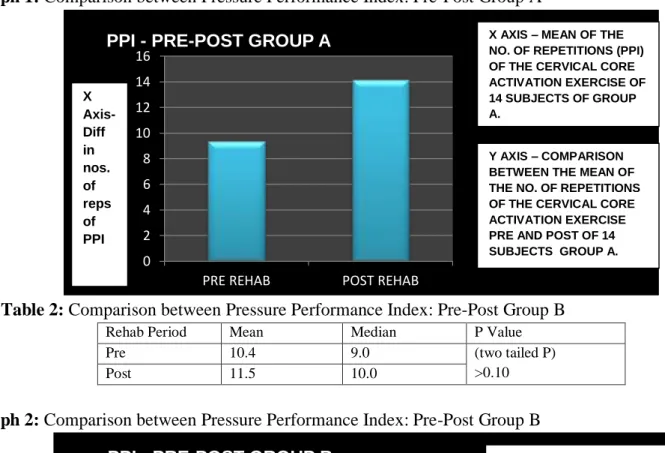
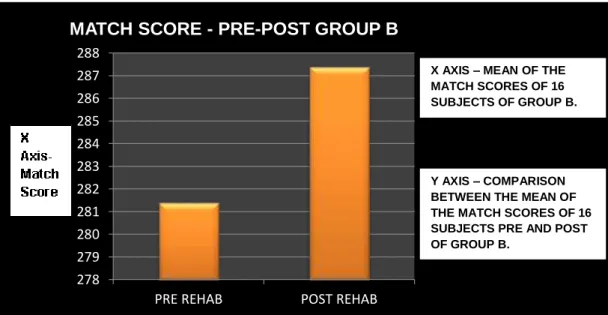
There was significant improvement in PPI and match score in Group A (experimental group), whereas, in Group B (control group) no significant improvement was noted. Table and graph number 6 shows the effect of both the rehabilitation regime on the match score. This implied that with Group A there was improvement in the Neck Muscle Strength, thus improving overall shooting performance.
Tables and Graphs of Measures of Association and Descriptive Statistics Intra/Within Group Comparison –
Table 1: Comparison between Pressure Performance Index (PPI): Pre-Post Group A
Rehab Period Mean Median P Value
Pre 9.4 10.0 (two tailed P)
<0.01
Post 14.2 15.0
Graph 1: Comparison between Pressure Performance Index: Pre-Post Group A
Table 2: Comparison between Pressure Performance Index: Pre-Post Group B
Rehab Period Mean Median P Value
Pre 10.4 9.0 (two tailed P)
>0.10
Post 11.5 10.0
Graph 2: Comparison between Pressure Performance Index: Pre-Post Group B
0 2 4 6 8 10 12 14 16
PRE REHAB POST REHAB
PPI - PRE-POST GROUP A
9.5 10 10.5 11 11.5 12
PRE REHAB POST REHAB
PPI - PRE-POST GROUP B
X Axis- Diff in nos. of reps of PPI
X AXIS – MEAN OF THE NO. OF REPETITIONS (PPI) OF THE CERVICAL CORE ACTIVATION EXERCISE OF 14 SUBJECTS OF GROUP A.
Y AXIS – COMPARISON BETWEEN THE MEAN OF THE NO. OF REPETITIONS OF THE CERVICAL CORE ACTIVATION EXERCISE PRE AND POST OF 14 SUBJECTS GROUP A.
X AXIS – MEAN OF THE NO. OF REPETITIONS (PPI) OF THE CERVICAL CORE ACTIVATION EXERCISE OF 16 SUBJECTS OF GOUP B.
M.Vijayakumar et al IJSRE Volume 05 Issue 05 May 2017 Page 6447
Table 3: Comparison between Match Score Pre-Post Group A
Rehab Period Mean Median P Value
Pre 351.1 365.0 (two tailed P)
0.01
Post 370.9 379.0
Graph 3: Comparison between Match Score Pre-Post Group A
Table 4: Comparison between Match Score Pre-Post Group B
Rehab Period Mean Median P Value
Pre 281.4 290.0 (two tailed P)
>0.10
Post 287.4 289.5
Graph 4: Comparison between Match Score Pre-Post Group B
Inter/Between Group Comparison –
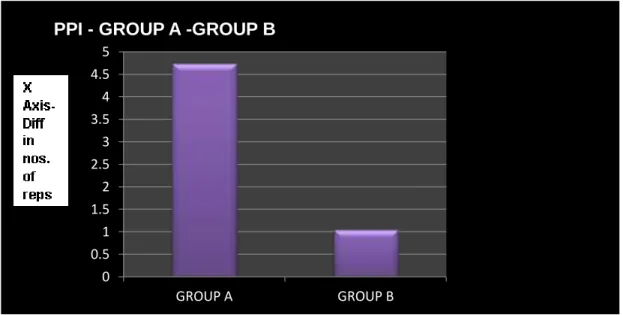
Table 5: Comparison of Pressure Performance Index between Group A-Group B Group Mean Median P Value
A 4.7500 1.2085 <0.01 B 1.0500 0.9987
340 345 350 355 360 365 370 375
PRE REHAB POST REHAB
MATCH SORE - PRE-POST GROUP A
278 279 280 281 282 283 284 285 286 287 288
PRE REHAB POST REHAB
MATCH SCORE - PRE-POST GROUP B
X Axis- Match Score
X AXIS – MEAN OF MATCH SCORES OF 14 SUBJECTS OF GROUP A.
Y AXIS – COMPARISON BETWEEN THE MEAN OF THE MATCH SCORES OF 14 SUBJECTS PRE AND POST OF GROUP A.
Y AXIS – COMPARISON BETWEEN THE MEAN OF THE MATCH SCORES OF 16 SUBJECTS PRE AND POST OF GROUP B.
M.Vijayakumar et al IJSRE Volume 05 Issue 05 May 2017 Page 6448
Graph 5: Comparison between Pressure Performance Index Group A-Group B
Table 6: Comparison between Match Score Group A-Group B
Group Mean Median P Value
A 19.70000 20.4582 >0.10
B 6.0000 31.3486
Graph 6: Comparison between Match Score Group A-Group B
DISCUSSION
The training protocol of the experimental group consisted of simple and effective exercises for the neck which if incorporated by the rifle shooters into their daily regime will be definitely helpful, provided the regularity is maintained and strict adherence to the protocol is observed.
Neck Muscle Strength Exercises has a significant effect on the shooting performance and improves the match score. Thus improving the speed and accuracy of delivering the shot. Also Neck Muscle Strength Exercises help improve the strength-endurance of the deep posterior cervical musculature (ability to maintain static neck posture and alignment in the antigravity position), resulting in less fatigue of the neck muscles.
0 5 10 15 20 25
GROUP A GROUP B
MATCH SCORE - GROUP A-GROUP B
0 0.5 1 1.5 2 2.5 3 3.5 4 4.5 5
GROUP A GROUP B
PPI - GROUP A -GROUP B
M.Vijayakumar et al IJSRE Volume 05 Issue 05 May 2017 Page 6449
General Fitness and Conditioning Regime does not have a significant effect on the shooting performance. But it has some effect in improving the rifle shooting match scores. Thus it too cannot be entirely ignored. With the strengthening exercises for 4 weeks the weaker muscles got strengthened thus increasing the stability of neck musculature. This wasn’t the case with the control group as they did not undergo any form of rehabilitation for the neck muscles in specific. Thus the partial improvement in their match scores can be attributed to other factors such as regularity in practice or change of technique.
Limitations to this study can be a larger age group, convergence insufficiencies which may lead to decreased performance which were not assessed in the study. Future recommendations can be increasing the duration of the rehabilitation protocol for more than 4 weeks, daily for about an hour or so to have more pronounced effects on performance; moreover, there should be separate time for learning the exercises followed by practice alone so that there is an equal chance for all the exercises to be practiced; technologically advanced outcome measures can be used in further studies by working on reactive agility.
CONCLUSION
An overall fitness and conditioning program too should be incorporated into the rehabilitation protocol along with the sport specific demands. Because general fitness and conditioning program cannot be entirely ignored as the statistical analysis and clinical observation reveals that there is at least some improvement in the match scores even with adherence to fitness and conditioning regime.
Thus the Neck Strengthening Exercise Regime is comparatively more effective in improving the shooting performance among the rifle shooters, over General Fitness and Conditioning Regime.
REFERENCES
1. Minshall David (2005). "Wimbledon & the Volunteers". December 2013. 2. The ISSF History". ISSF. December 2013.
3. Amer Al Saif. The Effects of Neck Muscle Fatigue on the Vestibulo-Ocular Reflex; 2011.
4. Poliquin et al. Physical therapy interventions of postural alignment, flexibility, strength, postural stability and biomechanics; APTA; (2012).
5. Rifle Marksmanship Diagnostic and Training Guide David R. James Northrop Grumman Corporation Jean L. Dyer U.S. Army Research Institute May 2011
6. Lee K et al. The Effectiveness of Cervical Strengthening on Decreasing Neck Injury Risk in Wrestling.
7. The Encyclopedia of Bullseye pistol: Army Marksmanship Training Guide 8. Gavin Morrison.(2011).Neck Strengthening exercises.
9. Hudswell et al.(2005)The cranio-cervical flexion test using pressure biofeedback: A useful measure of cervical dysfunction in the clinical setting?