Copyright © 2015 Vilnius Gediminas Technical University (VGTU) Press Technika http://www.bjrbe.vgtu.lt
OF ROAD AND BRIDGE ENGINEERING ISSN 1822-427X / eISSN 1822-4288
2015 Volume 10(4): 309–315
doi:10.3846/bjrbe.2015.39 1. Introduction
Hot mix asphalt (HMA) is a mixture of minerals (stone chips, sand and stone dust) and asphalt binder produced by hot process at temperatures ranging from 135 °C to 170 °C. Asphalt mix must meet certain requirements to ensure stable and enduring surfacing: must be resistant to traffic activities and climatic factors, the occurrence of deformation and have an appropriate acceptability and roughness in case of a final layer of pavement. In order that the asphalt mix meets all of these requirements, it must be properly manufactured and installed, as well as have adequate physico-mechanical properties.
The required physico-mechanical properties of as-phalt mixtures are achieved by the process of compaction. Compaction is the process of using external forces to re-duce the volume of air voids in the HMA mix. Squeezing the air out of the mix, it takes up less space and its spatial mass is thus increased, i.e. density (Roberts et al. 1996).
The goal of compacting asphalt mix is to produce a smooth, stable and durable asphalt pavement.
HMA compaction is influenced by several fac-tors; some related to the environment, some determined by mix and structural design (Sivilevičius et al. 2011; Vislavičius, Sivilevičius 2013) and some by contractor during construction.
The big influence on the compaction of asphalt mix-tures and their properties has the temperature of asphalt mixture. The temperature of asphalt mixture affects vis-cosity of bitumen and achievement of the maximum den-sity in asphalt mixture.
Numerous studies demonstrated a significant effect of compaction temperatures on the mechanical proper-ties of the HMA mixes. Kennedy et al. (1984) concluded that the low compaction temperature has an adverse effect on the HMA properties and thus contributes to the early failure of pavement.
Newcomb et al. (1992) conducted a laboratory and field study to evaluate HAMs and a part of their study examined the effect of compaction temperature on air voids and re-silient modulus. Compaction of specimens was performed at four temperatures: 79 °C, 116 °C, 154 °C, and 191 °C. The lowest air voids were achieved at compaction temperature 154 °C. Authors concluded that resilient moduli increased linearly with increasing temperature. McGennis et al. (1996) found that compaction temperature was not a significant factor on the compacted density of mixtures for unmodi-fied asphalts, but it was a significant factor for mixtures containing modified binders.
Authors De Sombre et al. (1998) researched the range of temperatures over which the compacting effect of HMA
INFLUENCE OF COMPACTION TEMPERATURE
ON THE PROPERTIES
OF MARSHALL SPECIMENS
Ivica Androjić1, Sanja Dimter2
1Dept of Civil Engineering, University of Rijeka, Radmile Matejčić 3, 51000 Rijeka, Republic of Croatia 2Dept of Civil Engineering, University of Osijek, Drinska 16a, 31000 Osijek, Republic of Croatia
E-mails: 1[email protected]; 2[email protected]
Abstract. Compaction of hot mix asphalt is influenced by several factors; some related to the environment, some deter-mined by mix and structural design and some by contractor during construction. The temperature of asphalt mixture has the biggest influence on the compaction of asphalt mixtures and their properties. The temperature of asphalt mix-ture affects viscosity of bitumen and achievement of the maximum density of asphalt mixmix-ture. This paper describes a laboratory study on the effects of different installation temperatures on the physico-mechanical properties of specimens of asphalt mixtures: stability, Marshall Quotient (stiffness), density, voids and voids filled with asphalt. By regression analysis of the test results the correlation of certain properties of asphalt mix and compaction temperatures was estab-lished. For all the models observed, the coefficients of determination are very high and indicate very solid links. The ob-tained research results indicate a pronounced effect of compaction temperature on each tested property of asphalt mix.
is maximized, both in laboratory and field. Six laboratory mixes using three binder grades and two aggregate gra-dations, as well as five field mixes were used in the study. It appeared that aggregate type, angularity, and gradation had a greater effect on the energy required for compaction than did the compaction temperature. Stas et al. (2007) reported about results of laboratory investigation of the influence of gradation types, compaction temperatures, and immersion times on the durability of asphalt concrete mixtures, using dolomite aggregates. Results clear showed that both compaction temperatures and immersion times greatly affect the durability of these mixes.
Lee et al. (2008a, 2008b) researched the compac-tion temperature of crumb rubber modifier (CRM) as-phalt mixes. A laboratory investigation was carried out on the volumetric properties of CRM mixes. A total of 128 specimens were manufactured using the Superpave gy-ratory compactor (SGC) and the Marshall compactor at various compaction temperatures (116 °C, 135 °C, 154 °C, and 173 °C). The results from this study indicated that the compaction temperatures significantly affected the volu-metric properties of the CRM mixes, regardless of the compaction methods.
West et al. (2010) reported about research to identify and develop a reliable and accurate procedure for deter-mining the mixing and compaction temperatures appli-cable for both modified and unmodified asphalt binders in hot-mix asphalt (HMA). Saedi (2012) researched assess-ment of compaction temperatures on HMA properties for two mixes: binder layer and top coat layer. Six compaction temperatures ranged between 85–160 °C. Results showed that density of both mixes increased with increasing com-paction temperature and the highest density occurred over the temperature of 145 °C.
Li et al. (2013) investigated effect of temperature and loading frequency on dynamic modulus and phase angle of three asphalt mixes for different gradations and bind-ers. Results indicated that the dynamic modulus of asphalt mixes decreases with either an increase in temperature or a decrease in loading frequency and relative shift with de-creasing load frequencies becoming less and less.
Park and Kim (2013) reported about study of deter-mination the compaction time at which desired tempera-ture is achieved. Compaction temperatempera-ture profiles were predicted using simulation program and results were com-pared with results of temperature profiles measured “in situ” during compaction.
With the temperature of asphalt mixture, the maxi-mum density of the asphalt layer is affected by HMA prop-erties, thickness, and stiffness of the substrate tempera-tures to which asphalt layer is deposited, air temperature, wind speed, humidity and solar radiation (Mieczkowski 2010). The same author also points to the great influence of wind speed on the compaction process in relation to the outside temperature.
Some factors have a direct impact on the speed of the layer cooling, and thus on the efficiency of its compaction.
Time available between the recommended temperature for depositing asphalt layer and termination compaction tem-perature is short, especially for rolling thin asphalt layers. Experience has shown that the rolling of the asphalt layer no longer has any effect on its density at a temperature of 85 °C (Babić, Horvat 1984). About quality assurance dur-ing construction of asphalt pavement reported Beainy
et al. (2012). The intelligent asphalt compaction analy-ser (IACA) was used to estimate asphalt pavement den-sity during construction and thereby to determine overall quality of compaction.
Some countries, with installation requirements for the minimum temperature of asphalt mixture, recom-mend the minimum temperature of the substrate to which the layer related to thickness of the pavement layer is de-posited. Thus, the authors (Roberts et al. 1996) gave ap-proximate values of temperature for the compaction of bi-tuminous mixtures that are commonly used in the United States. According to the Guidelines on Minimum Roadway Placement Temperatures of 2006, the stringent compaction requirements have been defined in relation to time (com-paction during the day or night) and min substrate temper-atures. In this way, most of the factors that affect the process of compaction and the realization of the required properties of asphalt mixtures are taken into account, and the perform-ers were given precise instructions. Furthermore, certain technical regulations define the values of compaction tem-peratures of asphalt mixtures, depending on the properties of a binder (bitumen). Thus, the compaction temperature recommended in the current procedures for Superpave as-phalt mixtures (the Asas-phalt Institute) is determined as the range of temperatures where an un-aged asphalt binder has the viscosity of 0.28±0.03 Pa·s (Lee et al. 2008a). In the Pol-ish asphalt standard PN-S-96025:2000 [Roadways and Air-port – Asphalt Pavements – Requirements] (in Polish) with usual climatic parameters (rainfall, ambient temperature) there is a requirement related to the wind speed up to 16 m/s (Mieczkowski 2007).
The current technical regulations in the Republic of Croatia (General Technical Conditions for Roadwork
such conditions asphalt mix will not be properly installed. The Croatian technical regulations (2001) define the pro-tection of asphalt mix during transportation to the place of installation and the maximum transportation time of mixtures (max 2 hours).
The two most critical procedures during which the change in temperature of asphalt mixture is the largest re-fer to the transportation of HMA mix from the base to the construction site and to the procedure of installing asphalt mixture. The process of transportation is considered criti-cal because, in addition to the price, it also affects the qual-ity of asphalt mixture, and the installation is critical because it affects the quality of the embedded layer (Roberts et al.
1996). In both of the aforementioned procedures, temper-ature changes in the asphalt mix mostly reflect the physi-co-mechanical properties of asphalt mixture and directly affect the layer compaction.
The aim of the researches described in this paper was to determine the effect of different installation tem-peratures on the physico-mechanical properties of asphalt mixture specimens (under laboratory conditions) as well as to establish their dependence correlation.
2. Materials and test program
The aim of the laboratory tests was to determine the effect of temperature variability of asphalt mixture intended for performance of the Asphalt Concrete AC 8 surf 50/70 wear layer on the achieved physical and mechanical or physico-mechanical properties of specimens. The designed asphalt mix was made of constant gradation and share of paving bitumen, of variable compaction temperature in the range of 120‒170 °C and of equal compaction energy.
Physico-mechanical properties of specimens of as-phalt mixture AC8 surf 50/70 were tested according to the Croatian standard HRN EN 13108-1:2007 Bitumi-nous mixtures – Material specifications – Part 1: Asphalt Concrete (in Croat) (EN 13108-1:2006). Mineral mixture (Fig. 1) consisted of stone fraction 0/2 mm, 2/4 mm and 4/8 mm of a volcanic origin (Vetovo quarry), stone dust of category label KB-I (Veličanka quarry). Sampling of used mineral fractions for testing was done at the landfill of stone aggregates in the asphalt plant. For each fraction used, three samples each weighing 5 kg (3×5 kg for a sin-gle fraction) were sampled. As a result, the average grada-tion was determined which was obtained from the three samples for each stone fraction (Fig. 1). Paving bitumen 50/70 was used as the binder, of standard density proper-ties ρB = 1.016 g/cm3, the softening point PK = 49.9 °C and penetration PEN = 51.7 1/10 mm. This type of bitumen is widely used in asphalt mixes in Croatia. The determina-tion of the optimal share of bitumen was performed using the Marshall›s method whereby it was adopted a constant gradation (Fig. 2) of mineral mixture. Share of bitumen was changed in the range from 4.9% to 6.1% (five series) of the total weight of the asphalt mix. The optimal share of bitumen was adopted in the proportion of 5.5%.
2.1. Design of composition of asphalt mixture
The following asphalt mixtures of an equal composition with different compaction temperatures are designed for the purposes of the planned tests:
−Mixture 170, compaction temperature 170 °C, −Mixture 160, compaction temperature 160 °C, −Mixture 150, compaction temperature 150 °C, −Mixture 140, compaction temperature 140 °C, −Mixture 130, compaction temperature 130 °C, −Mixture 120, compaction temperature 120 °C. Gradation of the stone mixture is determined according to HRN EN 12697-2:2003 Bituminous Mixtures – Test Methods for Asphalt Produced by Hot Process – Part 2: De termination of Particle Size Distribution (in Croat) and the soluble propor-tion of paving bitumen according to HRN EN 12697-1:2003 Bituminous Mixtures ‒ Test Methods for Asphalt Produced by Hot Mix – Part 1: The Soluble Share of Binder. Fig. 1 shows the gradation of stone fractions and filler used to produce asphalt mixtures.
The gradation of the designed asphalt mixture with limited curves is defined by the standard HRN EN 13108-1:2007 (Fig. 2). The default composition of stone mixture in its composition contains 3% of mineral filler, 35% of fraction 0/2 mm, 21% of fraction 2/4 mm and 41% of frac-tion 4/8 mm from the overall mass of mineral mixture. 2.2. Production of specimens of asphalt mixtures For each group of asphalt mixtures, three specimens were made according to the standard procedure of compaction on the rammer with a falling hammer. The appearance of the
Fig. 1. Gradation of stone fractions and filler of asphalt mixture
asphalt specimen is shown in Fig. 3. The temperature of as-phalt mixtures ranges from 120–170 °C. Average tempera-ture of mixing was 5 °C higher than compaction temperatempera-ture. After cooling to room temperature, the following physico-mechanical properties are determined on the specimens:
−density of asphalt specimens (EN 12697-6:2003 Bi-tuminous Mixtures – Test Methods for Asphalt Pro-duce by Hot Process – Part 6: Determination of Bulk Density of Asphalt Specimens);
−density of asphalt mixture (EN 12697-5:2003 Bi-tuminous Mixtures – Test Methods for Asphalt Pro-duced by Hot Process – Part 5: Determination of Bulk Density of Asphalt Mixtures);
−air voids content (EN 12697-8:2003 Bituminous Mixtures – Test Methods for Asphalt Produced by Hot Process – Part 8: Determination of Voids in As-phalt Specimens);
−voids in mineral aggregate (HRN EN 12697-8:2003 Bituminous Mixtures – Test Methods for Hot Mix Asphalt – Part 8: Determination of Void Character-istics of Bituminous Specimens (EN 12697-8:2003)); −voids filled with asphalt (HRN EN 12697-8:2003
Bituminous Mixtures – Test Methods for Hot Mix Asphalt – Part 8: Determination of Void Character-istics of Bituminous Specimens (EN 12697-8:2003)); −stability/flow/Marshall Quotient ( HRN EN 12697-34:2004 Bituminous Mixtures – Test Methods for As-phalt Produced by Hot Process. Marshall Test). 3. Results and discussion
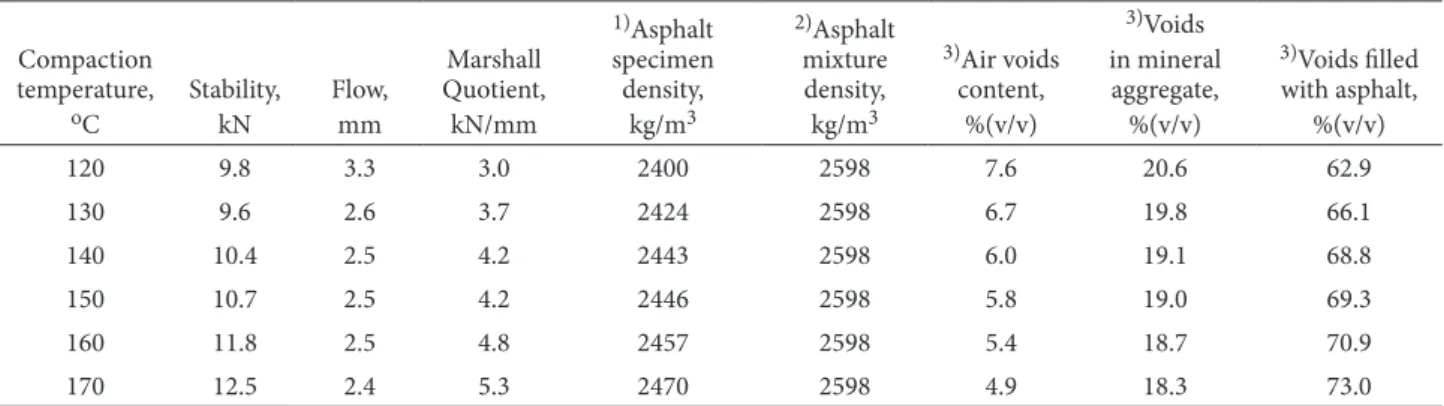
Table 1 shows the achieved results of physico-mechanical properties of asphalt specimens. Shown values are the av-erage values of the three tested specimens. The boundary
conditions of the air voids content are defined in the range from 3.0% to 6.0% and voids filled with asphalt in the range 65–83%.
The obtained results of laboratory tests clearly show that, due to the growth of temperature of installing of as-phalt mixture, it comes to the growth of stability, reduced flow, and higher density of asphalt specimens and lower air voids content as well as better filling of the voids with the paving bitumen. Lower temperatures of installing of asphalt mixture result in the appearance of reduced va-lues of the degree of compaction of the embedded layer. In continuation, by regression analysis of the test results, cor-relations of individual properties will be established and the shape and strength of these links will be determined. 3.1. Dependence of compaction temperature and Marshall Quotient of the mixture
Fig. 4 shows the dependence of Marshall Quotient of as-phalt specimens at different compaction temperatures. Marshall Quotient (or stiffness) is the ability of a material to resist the flow, and is defined as the ratio of Marshall Stability and flow. It is noticed that stiffness increases with increase of compaction temperature. Stiffness is directly proportional to Marshall Stability and inversely propor-tional to Marshall flow. By applying the obtained values of Marshall Quotient of asphalt mix (ST) and compaction temperatures (T), a linear relationship between the values is established and the link model is analysed:
. (1)
Fig. 3. Asphalt specimen
Table 1. Physico-mechanical properties of asphalt specimens
Compaction temperature,
oC Stability,kN Flow,mm
Marshall Quotient, kN/mm
1)Asphalt specimen density,
kg/m3
2)Asphalt mixture density,
kg/m3
3)Air voids content,
%(v/v)
3)Voids in mineral aggregate,
%(v/v)
3)Voids filled with asphalt,
%(v/v)
120 9.8 3.3 3.0 2400 2598 7.6 20.6 62.9
130 9.6 2.6 3.7 2424 2598 6.7 19.8 66.1
140 10.4 2.5 4.2 2443 2598 6.0 19.1 68.8
150 10.7 2.5 4.2 2446 2598 5.8 19.0 69.3
160 11.8 2.5 4.8 2457 2598 5.4 18.7 70.9
170 12.5 2.4 5.3 2470 2598 4.9 18.3 73.0
Note: according to 1) HRN EN 12697-5:2003; 2) HRN EN 12697-6:2003; 3) HRN EN 12697-8:2003.
A linear relationship between the Marshall Quotient of asphalt mix and compaction temperatures is very solid, and the coefficient of determination is very high: R2 = 0.959. That means that a large amount of data is mathematically described by the selected model. From the mathemati-cal records, it is clear that in the tested temperature range 120–170 °C every increase of compaction temperature of 10 °C results in the average higher Marshall Quotient of asphalt specimens in the amount of 11.2%.
3.2. Dependence of compaction temperature and Marshall Stability of the specimens
It is noticed that Marshall Stability increases with the increase of compaction temperature. Marshall Stability increases with the increase of compaction temperature due to the more ad-hesive forces caused by the decrease in the viscosity of the asphalt concrete to reach good workability and compac-tion condicompac-tion. Fig. 5 shows the dependence of Marshall Stability of asphalt specimens compacted at six different temperatures.
By applying the obtained values of Marshall Stability of asphalt specimens (S) and compaction temperatures (T) a square function relationship between the values is estab-lished and the link model is analysed:
. (2)
A square function relationship between the Marshall Stability of asphalt specimens and compaction tempera-tures is very solid, and the coefficient of determination is very high: R2 = 0.974 in projected area.
3.3. Dependence of compaction temperature and mixture density
The asphalt specimen density is defined as the ratio of mass and volume of asphalt specimen prepared in a Marshall rammer. As results show, density of asphalt specimens in-creases with increased compaction temperature. This is the result of asphalt binder viscosity due to temperature increase and, subsequently, the aggregates location beside each other is denser. Fig. 6 shows the dependence of densi-ty of asphalt specimens (D) and compaction temperatures (T). And in this correlation, a linear model connection is selected (Formulae (3)) although other observed models (exponential, logarithmic, polynomial) pointed to a strong link and resulted in high coefficients of determination.
. (3)
Linear relationship between the density of asphalt mix and compaction temperature is in this case very strong, and the coefficient of determination is very high: R2 = 0.953. 3.4. Dependence of compaction temperature and proportion of air voids content of asphalt specimens The proportion of air voids content in asphalt specimens is defined as the ratio of the density of asphalt specimens
and asphalt mix. The higher compaction temperature re-sults in the decreasing air voids content. The decrease in percent air voids with the increase in compaction temper-ature is due to lubricating effect of asphalt concrete keep-ing viscosity of the binder suitable for compaction. Air voids have a significant effect on the resistance of asphalt mixtures to different distresses including rutting, fatigue cracking, moisture damage and low temperature cracking.
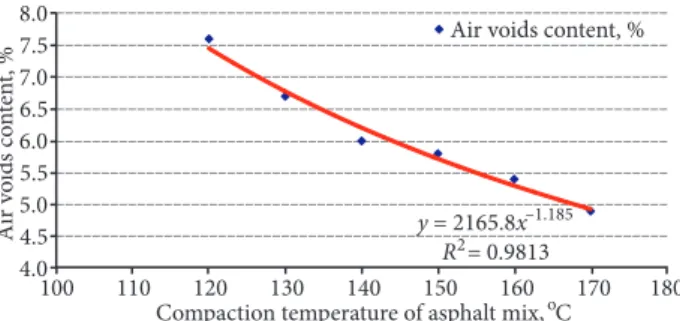
The correlation between the proportion of air voids content of asphalt specimens (SV) and compaction tem-perature (T) is shown in Fig. 7. The two mathematical models were analysed:
; (4)
. (5)
Regression analysis examined both of the proposed models, and the analysis has shown that most of the ob-tained results were accurately displayed by the model
Fig. 5. Relationship between compaction temperature and Marshall Stability
Fig. 6. Dependence of compaction temperature and density of asphalt specimens
(Eq (5)). This model has been chosen for the interpretation of the test results of the dependence of air voids content and compaction temperature. The coefficient of determi-nation in this model amounts to R2 = 0.981.
The increase in compaction temperature of asphalt mix results in a lower air voids content in asphalt specimens. 3.5. Dependence of compaction temperature and voids filled with asphalt in asphalt specimens
The compaction of asphalt mixture at lower temperatures leads to an increased air voids content in asphalt speci-mens. Higher volume of air voids content at the same proportion of bitumen leads to the insufficient filling of voids with asphalt. Dependence of compaction temper-ature (T) and voids filled with asphalt in asphalt speci-mens (VB) is shown in Fig. 8. The correlation between compaction temperature and voids filled with asphalt in asphalt specimens is observed by the model:
. (6)
The link between voids filled with asphalt in asphalt specimens and compaction temperature is in this case very strong, and the coefficient of determination very high:
R2 = 0.956. The mathematical model shows that at the test-ed temperature range 120–170 °C, every increase of com-paction temperature of 10 °C results in a low share of voids of asphalt specimens in the amount of 2.44%.
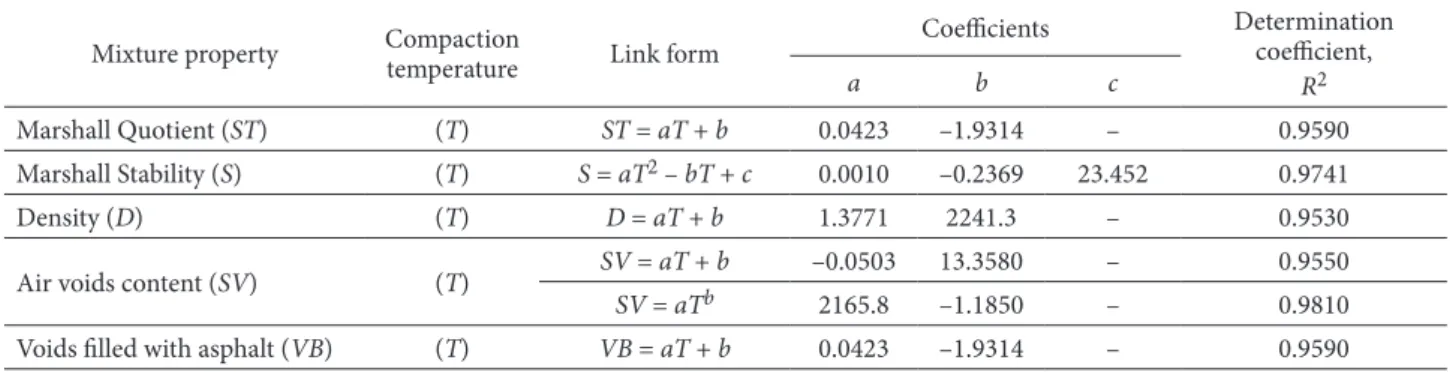
In Table 2 the correlation is visible between the proper-ties of asphalt mix and compaction temperature and the forms and strengths of links for all the obtained results.
4. Conclusions
1. The paper describes the laboratory tests of physico-me-chanical properties of asphalt mixture. The tested asphalt mix had a constant gradation, and a constant share of the paving bitumen (5.5%). The specimens were made at six different temperatures in the range 120–170 °C with equal compaction energy. Average temperature of mixing was 5 °C higher than compaction temperature.
2. The following properties of asphalt mixtures were tested: Marshall Stability, Marshall Quotient (stiffness), den-sity, air voids content, and the filling of voids with asphalt, with the aim of establishing the size of the impact of different compaction temperatures on properties of asphalt mixtures.
3. It was found that the density, Marshall Stability and Marshall Quotient values of asphalt mixes increase with in-crease of compaction temperatures, also percent of voids filled with asphalt, while percent of air voids decrease with increase of compaction temperatures at optimum bitumen contents.
4. By regression analysis of the test results, the corre-lation of certain properties of asphalt mix and compaction temperatures has been established. For all the models ob-served, the coefficients of determination are very high and indicate very strong links from 0.953 to 0.981. A strong re-lation between various parameters of Marshall specimens and compaction temperature was found:
−due to the growth of compaction temperature of as-phalt mixture (120–170 °C) the Marshall Quotient of asphalt specimens increases even for 76.67%; −an increase in compaction temperature of asphalt
mix results in higher densities of asphalt specimens to 2.92%, which ultimately leads to achieving a higher degree of compaction of the asphalt layer; −lower installation temperature results in the
ap-pearance of a larger air voids content (to 55.10%) at the same invested compaction energy;
−higher compaction temperature (170 °C) results in better voids filled with asphalt compared to as-phalt specimens compacted at lower temperatures (120 °C) even for 16.06%;
−the defined bordering conditions of air voids con-tent in the range from 3.0% to 6.0% and voids filled with asphalt in the range 65–83% indicate that the asphalt specimens compacted at lower tempera-tures (120–130 °C) are not satisfactory in terms of the requested air voids content;
Fig. 8. Dependence of compaction temperature and voids filled with asphalt
Table 2. Correlations of properties of asphalt mixtures and compaction temperatures
Mixture property Compaction temperature Link form Coefficients Determination coefficient,
R2
a b c
Marshall Quotient (ST) (T) ST = aT + b 0.0423 –1.9314 – 0.9590
Marshall Stability (S) (T) S = aT2 – bT + c 0.0010 –0.2369 23.452 0.9741
Density (D) (T) D = aT + b 1.3771 2241.3 – 0.9530
Air voids content (SV) (T) SV = aT + b –0.0503 13.3580 – 0.9550
SV = aTb 2165.8 –1.1850 – 0.9810
−asphalt specimen compacted at a temperature of 120 °C is not even adequate in terms of voids filled with asphalt.
5. From the study results obtained (also according to numerous previous research in the world) it is obvious that there is a large impact of compaction temperature on the physico-mechanical properties, and consequently on the installation of asphalt mixture at the construction site. It is very important for appropriate asphalt mixture to clearly define factors and rules (for constructors) that affect the compaction temperature and the realization of the re-quired properties of mixtures.
6. In comparison with the technical regulations of other countries, which clearly define different factors that affect the compaction of asphalt mixtures, in the (still valid) Croatian Technical Regulations (General Technical Conditions for Roadwork of 2001) certain shortcomings and ambiguities exist.
7. Considering that the development of satisfactory technical conditions is the first step towards the success-ful delivery of hot mix asphalt, in Croatia in 2012 the new Technical Regulations Elaboration of Technical Characteris-tics and Requirements for Construction Products for Asphalt Mixtures Production and Asphalt Pavement Layers were pro-posed. In the new Technical Regulations preventive mea-sures are aimed at sustainability of the optimal conditions during the installation of asphalt mixtures. Thus, these Reg-ulations impose restriction for the maximum transportation time of 2 hours or 120 km distance from the installation site. The maximum installation temperatures of asphalt mixture are defined, while the lowest installation temperatures are partly prescribed. Also, the prohibition of performing as-phalt works in the wind (although intensity has not been defined) and rainfall has been introduced.
8. The goal of compacting of asphalt mixtures is to obtain stable and constant layer (surfacing) resistant to traffic and climatic factors and the occurrence of defor-mation. Understanding the impact of various factors on the compaction of asphalt mixtures is an important step in achieving this goal.
References
Babić, B; Horvat, Z. 1984. Građenje i održavanje kolničkih kon-strukcija [Construction and Maintenance of Pavement Struc-tures], Faculty of Civil Engineering, University of Zagreb, Croatia. 145–148.
Beainy, F.; Commuri, S.; Zaman, M. 2012. Quality Assurance of Hot Mix Asphalt Pavements Using the Intelligent Asphalt Compaction Analyzer, Journal of Construction Engineering and Management 138(2): 178–187.
http://dx.doi.org/10.1061/(ASCE)CO.1943-7862.0000420
De Sombre, R.; Newcomb, D. E.; Chadbourn, B.; Voller, V. 1998. Parameters to Define the Laboratory Compaction Tempera-ture Range for Hot Mix Asphalt, Journal of the Association of Asphalt Paving Technologists 67: 125−152.
Kennedy, T. W.; Roberts, F. L.; McGennis, R. B. 1984. Effects of Com-paction Temperature and Effort on the Engineering Properties of Asphalt Concrete Mixtures. ASTM Special Technical Publica-tions 829. 48−66. http://dx.doi.org/10.1520/stp32500s
Lee, S. J.; Amirkhanian, S. N.; Shatanawi, K.; Thodesen, C. 2008a. Influence of Compaction Temperature on Rubberized As-phalt Mixes and Binders, Canadian Journal of Civil Engineer-ing 35(9): 908−917. http://dx.doi.org/10.1139/L08-045
Lee, S. J.; Amirkhaniana, S. N.; Kwonb, S. Z. 2008b. The Effects of Compaction Temperature on CRM Mixtures Made with the SGC and the Marshall Compactor, Construction and Building Materials 22(6): 1122–1128.
http://dx.doi.org/10.1016/j.conbuildmat.2007.03.003
Li, P.; Ding, Z.; Zhang, Z. 2013. Effect of Temperature and Fre-quency on Visco-Elastic Dynamic Response of Asphalt Mix-ture, Journal of Testing and Evaluation 41(4): 571–578.
http://dx.doi.org/10.1520/JTE20120044
McGennis, R. B.; Anderson, R. M.; Perdomo, D.; Turner, P. 1996. Issues Pertaining to Use of the Superpave Gyratory Compac-tor, Transportation Research Record 1543: 139–144.
http://dx.doi.org/10.3141/1543-18
Mieczkowski, P. 2010. Exchange of Heat in the Process of HMA Compaction, The Baltic Journal of Road and Bridge Engineer-ing 5(4): 191−198. http://dx.doi.org/10.3846/bjrbe.2010.27
Mieczkowski, P. 2007. The Effect of Weather and Climatic Factors on Temperature Drops in Built-in Asphalt Mixtures, F ounda-tions of Civil and Environmental Engineering 9: 95–104. Newcomb, D. E.; Stroup-Gardiner, M.; Epps, J. A. 1992.
Labo-ratory and Field Studies of Polyolefin and Latex Modifiers for Asphalt Mixtures, Polymer Modified Asphalt Binders, ASTM STP 1108. Ed. by Wardlaw, K. R.; Shuler, S. 4 Decem-ber, 1990, San Antonio, Texas. 129–150.
Park, D. W.; Kim, I. T. 2013. Thermal Properties of Permeable Fric-tion Asphalt Mixture and EstimaFric-tion of Temperature Profiles,
International Journal of Pavement Engineering 14(8): 752–759.
http://dx.doi.org/10.1080/10298436.2012.715645
Roberts, F. L.; Kandhal, P. S.; Brown, E. R., Lee, D. Y.; Kenne-dy, T. W. 1996. Hot Mix Asphalt Materials, Mixture Design, and Construction. 2nd edition, NAPA Education Foundation, Lanham, Maryland. 286–304. ISBN 953-6686-07-5
Saedi, H. 2012. Assessment of Compaction Temperatures on Hot Mix Asphalt (HMA) Properties, International Science In-dex, World Academy of Science, Engineering and Technology
6: 179–183.
Sivilevičius, H.; Podvezko, V.; Vakrinienė, S. 2011. The Use of Constrained and Unconstrained Optimization Models in Gradation Design of Hot Mix Asphalt Mixture, Construction and Building Materials 25(1): 115–122.
http://dx.doi.org/10.1016/j.conbuildmat.2010.06.050
Stas, R.; Miro, O.; Al-Shalout, I. 2007. Effects of Moisture, Compac-tion Temperature and GradaCompac-tion Types on Durability of Asphalt Concrete Mixtures, Damascus University Journal 23(2): 7–35. Vislavičius, K.; Sivilevičius, H. 2013. Effect of Reclaimed Asphalt
Pavement Gradation Variation on the Homogeneity of Re-cycled Hot-Mix Asphalt, Archives of Civil and Mechanical En-gineering 13(3): 345–353.
http://dx.doi.org/10.1016/acme2013.03.003
West, R. C.; Watson, D. E.; Turner, P. A.; Casola, J. R. 2010. Mix-ing and Compaction Temperatures of Asphalt Binders in Hot-Mix Asphalt. NCHRP Report 648. Transportation Research Board, Washington DC. 157 p.