Available on-line at: www.oapub.org/edu
Copyright © The Author(s). All Rights Reserved. doi: 10.5281/zenodo.1325932 Volume 4 │ Issue 9 │ 2018
THE REDUCED GAMES IN FUTSAL AND ITS INFLUENCE IN
TACTICAL AND TECHNICAL ACTIONS IN ATHLETES UNDER-13
José Guilherme Vicente Pinto1,
Marcelo Francisco Rodrigues2,
Marcus Vinícius de Almeida Campos3,
Rafael Dramis Calixto4,
Henrique Miguel5i
1Santo do Pinhal University Regional Center, UNIPINHAL, Physical Education Department, Brazil 2Msc; Espirito Santo do Pinhal University Regional Center,
UNIPINHAL, Physical Education Department, Brazil; Mogiana College, UNIMOGI, Physical Education Department, Brazil 3Exp; Euclides da Cunha College, FEUC, Physical Education Department, Brazil 4Msc; Machado Higher Education and Research Center,
CESEP, Physical Education Department, Brazil 5Msc; Espirito Santo do Pinhal University Regional Center,
UNIPINHAL, Physical Education Department, Brazil; Euclides da Cunha College, FEUC, Physical Education Department, Brazil;
José do Rosário Vellano University, UNIFENAS, Physical Education Department, Brazil
Abstract:
Currently in Brazil, futsal is one of the most practiced and growing modalities, due to the passion of the Brazilian by the modality, the increase of blocks in the urban areas and the ease to its practice (because it is a sport that uses a reduced space and few players). Therefore, the objective of this study was to verify how adapted games (reduced games) can influence some tactical and technical factors of the modality (ball possession, passes and finalizations). Ten male subjects aged 12 to 13 years participated in the study, who underwent a training periodization composed of 16 sessions based on reduced games only. Before and after the training, games (Game 1 and Game 2) were carried out, which were filmed and were used for scout analysis. Descriptive statistics were used. It was observed after the period of the training sessions increase in the time of possession of total ball during the match, time of possession of defensive ball, certain passes, certain finalizations, and goals scored in favor. In contrast, there was a reduction in offensive ball possession time, number of wrong passes, total number of finalizations and number of wrong finishes. It is observed that the training with reduced games can
be effective for the improvement of several technical and tactical components in collective sports games, especially in futsal. As this research approached the descriptive analysis component, we cannot affirm that there were significant changes from Game 1 to Game 2, however, in a simple analysis, small beneficial modifications were observed.
Keywords: reduced games, futsal, athletes under-13, tactical and technical actions
1. Introduction
With the advancement of the science of sports training, the various factors that encompass the dynamics of the sport have been increasingly studied and evaluated by professionals. Futsal, as an integral part of this study proposal, currently undergoes notorious transformations in its physical and tactical physical work context, showing a frightening growth in the most different and varied corners of the world (Miguel, Campos, Rodrigues, 2012, Miguel, 2014).
There are some doubts about the appearance of futsal, according to the Brazilian federation of futsal 2006 (Futsal, 2006) the emergence of indoor soccer, was at the unit Asociación Crista de moços de Montevideo in Uruguay, (ACM) created by the professor of Education Physics Juan Carlos Ceriane, in 1934 with the name of indoor foot-bool for being practiced in closed places. It began to be practiced in Brazil, in São Paulo also in the ACM in 1940, for lack of fields for practices was realized in the basketball courts and hockey. With the passing of the year's futsal created the form, the first rules, and entities of the modality were created, in 1979, he heard a general meeting where the (CBFS) Brazilian Football Confederation was created.
Futsal is a collective sport that seems simple, but it is not, the same is a very tactical and dynamic sport of a lot of strength and technique, it covers all these aspects in a limited space, so that one has an effective learning of the modality it is necessary that the professional is prepared and updated to develop the teaching and learning of the modality. One of the main concerns of teachers who teach futsal is what better training method and factors make their strategy of teaching futsal at the base more efficient.
Within trainable processes, it will be necessary for the professional to follow some norms and guidelines for an effective learning in futsal, mainly in the base. According to Mutti (1999), teachers and trainers who commit to the quality of teaching have greater success in the pedagogical process. The author also emphasizes that it is of the utmost importance the formation of the athlete together with the formation of the social side of the individual, with that it becomes necessary to use a method that guides him.
reduced and pre-sports games, thus moving to formal game phases. The author also shows that he should use games with adapted rules and that facilitate the assimilation and learning of the student.
This method is more effective in relation to the students' willingness to play, the motivation is much greater compared to the analytical method, with which teaching and learning become more effective and easier (Greco, 1998).
According to Lopes apud Pinto and Santana (2005), this method has been more used because it covers aspects such as creativity, imagination and tactical thinking of students. The author emphasizes three main objectives of this method: a) constant student decision-making, allowing solving problems that occur within a game, b) facilitating the teaching and learning of students, showing the true context of the futsal game, with offensive and defensive engagements, c) prepare the players for the game and the competitions, because they perform what they experienced in training.
The second is the synthetic partial or analytical method, which teaches through repetitive exercises, the technical gestural of the sport. According to Reis (1994), this method is one that the teacher starts by the fundamentals working alone, after mastering the technique, enters the context of the game. This method will be based on the repetition of exercises, which will be directed to the learning of futsal fundamentals, and this is totally unrelated to the context of the game, (Pinto, Santana, 2005).
In order to have more exodus in futsal, it is necessary to have a team with good possession of the ball, and to keep as much time as possible within a game for (Garganta, 2008) the team that has greater possession of ball runs less risk against its goal, through the field of departure. The team that maintains the possession for a longer time controls the game, with defensive and offensive engagements aiming to score the goal, at the exact moment that the other team cannot do the same (Jones, Mellalieu, 2004, Lake, 2007).
Analyzing recent studies on possession of the ball in the Spanish futsal league, two studies state that the teams with the most ball possession during the matches finished in the first places of the championship, Ballesteros, Peñhas, (2010), Peñhas, Dellal (2010). In literature research, there are controversies regarding the success of a team that maintains greater possession of the ball during a futsal match. In 1990 and 1994 World Cup studies, it was stated that the teams with more ball possession had more finalizations and chances to score, the same authors point out that the exploits of short attack finalizations were superior to that of teams with greater possession of the ball, (Hughes, Frank, 2005).
2. Methodology
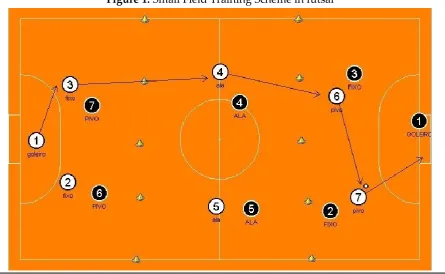
This research was carried out with 10 young men from 12 to 13 years old, from a social futsal project, called Bom de Bola Bom de Escola. These students went through 16 futsal training sessions, aiming to improve ball possession within a game. For this, it was used pieces of training with the global method, through reduced games, which means to work in smaller spaces than traditional ones with adapted rules, maintaining the context of the game and the intensity, aiming at specific works and directed according to the objective.
2.1 Methodological procedures
In a first moment, a game-training (1 game friendly - Game 1) was realized with a team of the same city, in the category under-13. The match had 2 times of 15 minutes running, with 10 minutes of interval. A scout of the match was made by recording the video made during the game. The items verified in the scout were: Time of possession of the ball in the match; Offensive ball possession time; defensive ball possession time; Right passes; Wrong passes; Number of submissions; Sure finishes; Wrong finishes; Goals in the match.
After the first friendly, 16 training sessions were applied in order to maintain possession of the ball in futsal. The sessions lasted for two months, subdivided into two weekly sessions. The training was conducted in small spaces, adopted rules, with intensity and characteristics equal to that of the game, directed to the maintenance of ball possession
At the end of the training sessions, in a second moment, the second friendly game (Game 2) was held against the same team. The match had a 2-minute 15-minute run with a 10-minute break. A scout of the match was made by recording the video made during the match, and the same items of game 1 were verified. After the collected data, a comparison was made between the scouts observed in Game 1 for Game 2. It was used only in descriptive statistics, so there was no index of significance.
3. Results
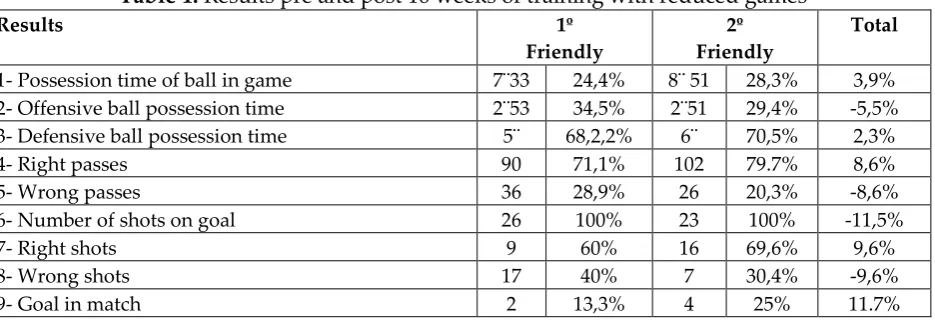
The results obtained after the data analysis can be verified in table 1 and figure 2. After the 16 training sessions reduced in game form, it was observed increased results in the time of possession of total ball during the game (3.9 %), defensive ball possession time (increase of 2.3%), certain passes (8.6% increase), certain finals (9.6% increase), and goals scored in favor (increase of 11, 7%).
In addition, there was a decrease in offensive ball possession time (5.5% drop), number of wrong passes (8.6% drop), a total number of finishes (11, 5%) and number of wrong entries (9.6% decrease).
Table 1: Results pre and post 16 weeks of training with reduced games
Results 1º
Friendly
2º Friendly
Total
1- Possession time of ball in game 7¨33 24,4% 8¨ 51 28,3% 3,9% 2- Offensive ball possession time 2¨53 34,5% 2¨51 29,4% -5,5% 3- Defensive ball possession time 5¨ 68,2,2% 6¨ 70,5% 2,3%
4- Right passes 90 71,1% 102 79.7% 8,6%
5- Wrong passes 36 28,9% 26 20,3% -8,6%
6- Number of shots on goal 26 100% 23 100% -11,5%
7- Right shots 9 60% 16 69,6% 9,6%
8- Wrong shots 17 40% 7 30,4% -9,6%
9- Goal in match 2 13,3% 4 25% 11.7%
4. Discussion
coordinating and intellectual capacities, as well as, the student can appropriate these in moments of leisure, giving vent to their needs of movement and expression.
Checking the actions described in the scout, in relation to the total ball possession time, a small but existing increase was observed. In reduced games, athletes need to think faster, seeking a better-placed colleague to be able to pass (futsal being a collective modality), and other teammates need to give effective options so that this ball is played in a way as effective as possible. According to Greco (1992), ball possession is related to the tactical factors of futsal and other collective sports games (JECs). The tactic is divided into collective and individual components, aspects of extreme importance for the training of a team. Thus, it is extremely necessary to evaluate the action of a team individually and collectively, in order to order the decisions, guide, and control in a productive way the player's behavior during the game. Looking at the data, we can see that there has been little improvement in this area.
In relation to the possession of an offensive ball, we noticed a slight fall, a fact that can be related to the exchange of passes with greater efficiency in the defensive field, where the team looked for the best moment to attack the adversary, since the time of possession of ball defensive team obtained a small increase (about 2.3%). According to Salgado (2006), possession of the ball is a very important component in futsal, as it is the continuous technical and tactical control of the ball. In order to consider the change of possession of a ball from one team to another, it is necessary that the team that has recovered it to execute a pass, a finish or to holds its control for more than two seconds. In this way, all attack moves that relate to the continuation of the previous offensive sequence, due to an interception or disarmament of the opponent, are considered as the extension of the previous ball possession.
In relation to the passes performed during the matches, there was an increase in the right passes and a decrease in the wrong passes after the training period of reduced games. According to Andrade Junior (1999), the pass is the way the ball is played and implies that the athletes communicate with each other within the court. It is of fundamental importance for team performance, as all tactical systems depend on that foundation. For Santos Filho (2000) it is necessary to verify effectively not only the position of the partner for whom the ball is intended to pass, but also that of the opponent that marks it and, from there, use the most appropriate type for the situation and goal. Following the reports of Tenroller (2004) is the action of communicating the members of a team. It is the most important technical foundation being the connecting link in a game. It happens many times in the game and more than any other foundation. To get an idea of the importance of this foundation, it is enough to see that when a high-level team leaves a defeated game, in the scout a marked number of wrong passes is verified. The movements, the plays rehearsed, technical actions, finally, everything is damaged when there is no efficiency in this foundation. Thus, the increase observed in the right passes may have effectively aided in increasing other scout actions.
match. It is characterized by hitting the ball with the foot, head or another part of the body, causing it to go towards the goal. The author still mentions that it is the force that the athlete prints on the ball aiming the goal in the opposing team. Known as a kick or shot, it is part of the essence of futsal, so finalization is very similar to the pass except for the fact that the player needs more control of strength and direction when hitting the ball. Tenroller (2004) says that it is the action of striking the still or moving ball, aiming to deflect it or to give it trajectory, preferably toward the goal. Checking the numbers of finalizations, it was observed that the total finalizations decreased from Game 1 to Game 2, with the decrease being 11.5%. However, the number of correct finalizations was greater than the number of wrong finalizations, which was the reverse before the training period with the reduced games. The increase in the number of goals scored should also be highlighted, and the team had to finish fewer times to score more goals, showing a greater effectiveness and use of attacks. While game 1 was 7.7%, game 2 was 17.4%, an increase of approximately 135%.
It is important to emphasize that systematic repetition contributes to the learning process. Thus, by being constantly subjected to activities that promote a successive repetition of non-standardized and specific futsal movements (or of any collective sports game), the athlete will simultaneously be conditioned by the dynamism of the game (relation between actions involved in soccer and its speed of execution) and developing technically (Weineck, 1999).
5. Conclusion
According to the data verified in this research, it is observed that the training with reduced games can be effective for the improvement of several technical and tactical components in collective sports games, especially in futsal. As this research approached the descriptive analysis component, we can not affirm that there were significant changes from Game 1 to Game 2, however, in a simple analysis, small beneficial modifications were observed.
Thus, more studies are necessary to reflect on the role of reduced games for collective sports games and their true effectiveness in a context of teaching and learning of the technical and tactical components inherent in the modalities.
References
1. Andrade Júnior, J.R. Futsal: aquisição, iniciação e especialização. Curitiba: Ed. Juruá. 2009.
3. Costa, F. R.; Paoli, P. B.; Silva, C. D. A importância dos jogos adaptados na iniciação aos esportes coletivos. Lecturas: Educación Física y Deportes. Vol. 12. Núm. 117. 2008.
4. Costa, C. Futsal: Aprenda a ensinar. Florianópolis, SC. Visual Books, 2007.
5. Confederação Brasileira de Futsal. Origem do futsal. Disponível em:
http://www.cbfs.com.br/novo/origem.asp. Acesso em: 20 nov. 2017.
6. Garganta, J. New trends of performance analysis in team sports: bridging the gap between reseach, training and competition. In: Conference presented to the Satellite Symposia of the European College of Sports Sciences: Sport Games Coaching and Perfomance. Lisbon, 2008. Faculty of Sports – University of Porto, Portugal. 2008
7. Greco, P. J. O componente tático. Material didático do curso de Mestrado em Ciências do Esporte. Escola de Educação Física da UFMG Belo Horizonte. 1992. 8. Hughes, M. D; Franks, I. Análise de sequências passageiras, tiros e objetivos no
futebol. Journal of Sports Sciences, Vol. 23, p.509 – 514. 2005
9. Miguel, H.; Campos, M.V.A.; Rodrigues, M.F. Análise glicêmica de atletas de futsal suplementados com maltodextrina. Revista EFDeportes, v.1, n.153, p.1-1, 2012.
10.Miguel, H. Treinamento tático no futsal. Londrina: Sport Training, 2014. 11.Mutti, D. Futsal da iniciação ao alto nível. São Paulo. Phorte. 1999.
12.Penas, C.L; Ballesteros, J.L; Dellay, A; Gómez, M.. Game-related statistics that discriminated winning, drawing and losing teams from the Spanish soccer league. Journal of Sports Sciences, Vol. 31, p.209 – 214. 2010.
13.Pinto, F. S.; Santana, W. C. Iniciação ao Futsal: as crianças jogam para aprender ou aprendem para jogar? Lecturas: Educación Física y Deportes. Vol. 12. Núm. 85. 2005.
14.Reis, H.H.B. O ensino dos jogos esportivizados na escola. Dissertação (Mestrado em Educação Física) UFSM, Santa Maria. 1994.
15.Santana, W. C. Futsal Metodologia da Participação. 2 ª edição. Londrina. Lido. 2001.
16.Salgado, B. Caracterização da intensidade do esforço no treino e no jogo de futsal. Monografia de Licenciatura. Vila Real: UTAD. 2004.
17.Santos Filho, J. L. A. Manual de futebol. São Paulo: Phorte, 2002. 18.Tenroller, C. A. Futsal: Ensino e prática. Canoas: Ed. ULBRA, 2004.
Creative Commons licensing terms