JEEECCS, Volume 3, Issue 7, pages 1-6, 2017
Production Scheduling in Flexible
Manufacturing Systems: A State of the Art
Survey
Florentina Alina Toader
Petroleum-Gas University of Ploiesti,
Bucureşti Blvd 39, Ploieşti, Romania
e-mail: [email protected]
Abstract – The complexity of production scheduling problem concerned the attention of worldwide researchers and over time different approaches were proposed in order to solve in an optimum manner this problem. This paper proposes a survey over the latest researches on this field. A complete analysis over the latest published paper in this field is presented and the most popular scheduling system available at international filed are analyzed. The modern approaches include the utilization of hybrid algorithms in order to optimally solve the production scheduling problem, and the most popular scheduling systems that are implemented in real flexible manufacturing systems must be well designed and extremely complex in order to satisfy all the market demands. Comparisons are made considering various criteria and conclusions are presented.
Keywords - Flexible Manufacturing Systems, Production Scheduling, Artificial Intelligence
I.
INTRODUCTIONScheduling problem consist in the identification of
methods for organizing the operations set execution
under certain constraints of time (total time of
execution, operations precedence constraints, etc.) as
well as capacity constraints in resources [1].
The scheduling result is represented by the
description of the resource allocation for each time
value and the order of the tasks execution. His purpose
is to achieve resource optimization and the
minimization of the execution total time.
The conceptual model of a planning system, is
introduced by Ghallab in 2004 and can be considered
extremely useful because it presents the basic concepts
and theoretical restrictions in a simple manner.
A planning system can be formally represented as
a 4-tuple
, where [2]:
is a finite set of states;
is a finite set of actions
(operations);
is a finite set of discrete
events;
is a transition function.
A classical scheduling problem is represented by
, where
is the initial state of the
problem and is a set of requirements that must be
fulfilled to satisfy scheduling purposes;
The scheduling problem solution is classically
represented by a plan π detailing the action sequence
that needed to fulfill the requirements set.
The elements that define a planning problem are
[4]:
A set of resources;
A set of requirements that must be met and the
resources associated with their achievement;
A set of constraints on resources and actions;
A function
f
for calculating the cost.
The main objective of scheduling is to optimize the
value of the
f
function and to achieve this objective are
taken into account several criteria such as [3]:
The total time required to complete the
schedule;
The biggest delay associated with the
proposed schedule;
The total delays;
The total cost associated with the plan.
The classical type of scheduling problems can be
classified as:
One Machine Scheduling Problem – OMSP;
Parallel Machine Scheduling Problem – PMSP
Flow Shop Scheduling Problem – FSSP
Job Shop Scheduling Problem – JSSP
Open Shop Scheduling Problem – OSSP
systems. The considered systems are compared and
conclusions are drawn.
II.
FLEXIBLE MANUFACTURING SYSTEMS
Developing a reliable production system requires
consideration of social and economic trends related to
the decreased usage of natural resources and raw
materials and the increase of competition in
international markets.
To meet these new challenges, new production
systems will have to meet a number of requirements,
such as:
consumption of raw materials and energy
decrease;
Increasing labor productivity;
Increasing product reliability;
Minimize design and manufacturing time;
Diversification of obtained products;
Minimizing production cost.
Flexible Manufacturing Systems (FMS) offer a
solution to achieve these requirements. Such a system
must have the following characteristics [4]:
Integrability - the property to be integrated
into a production system and to be
interconnected with other production systems;
Adequacy - the property to fully exploit the
production capacity, with minimal expenses;
Adaptability - the property to adapt quickly to
changing production tasks;
Dynamic structural - the ability to change the
structure of FMS depending on production
requirements.
The main goal is to increase resilience to problems
along the production line, to increase the equipment
workload and to reduce execution time.
Production scheduling problem in a flexible
manufacturing system is described by JSSP. This
problem is one of the most intractable in the industry
and has been included in the category of NP-complex,
according to Srinivas and Allada in 2004 [5].
In these circumstances the complexity of
production planning problem represents a real
challenge for the scientific community and thus a
variety of methods have been proposed to solve this
problem.
III.
PRODUCTION SCHEDULING ALGORITHMS:
MODERN DIRECTIONS
Production scheduling is an extremely important
tool in terms of increased efficiency for using the
available resources and reducing waste. The
importance of this production process stage went to
applying different methods for optimal organization of
each step in the operation sequence.
In addition to classical methods enshrined in
scheduling, new tools have already been proposed
based on other algorithms that provide an optimization
of certain terms that characterize the production (total
time of execution, the use of machines, optimizing the
use of resources, etc.)
Those new approaches are listed below:
Artificial Intelligence Algorithms (Ant Colony
Optimization - ACO [6], Particle Swarm
Optimization – PSO [7], Artificial Bee Colony
Algorithm – ABC [8], Genetic Algorithms -
GA [9]);
State space search algorithms (Progression
Scheduling, Regression Scheduling, Mixt
Scheduling) [10];
Partial Order Planning - POP [11];
GraphPlan Algorithm [11];
Decision Tree Method [12];
PERT Method [13];
Critical Path Method [14];
Just in Time Method [15].
In the specific literature, different approaches for
solving the production scheduling problem are
presented, most of them being based on Artificial
Intelligence techniques.
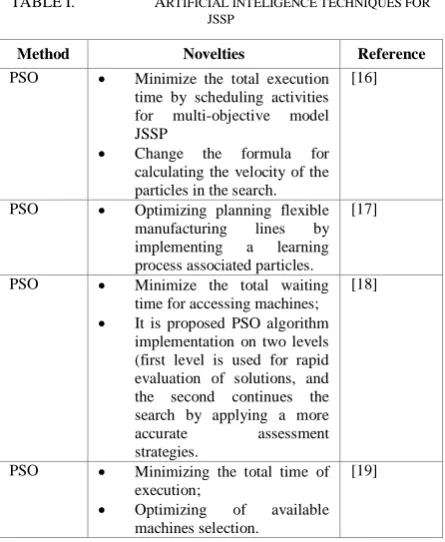
One of the most eloquent examples is shown in
Table I. The attention of researchers is concentrated
mainly on minimizing the total time involved in the
process of production, maximizing machine utilization
and minimize waiting times.
TABLE I. ARTIFICIAL INTELIGENCE TECHNIQUES FOR JSSP
Method Novelties Reference
PSO Minimize the total execution time by scheduling activities for multi-objective model JSSP
Change the formula for calculating the velocity of the particles in the search.
[16]
PSO Optimizing planning flexible manufacturing lines by implementing a learning process associated particles.
[17]
PSO Minimize the total waiting time for accessing machines;
It is proposed PSO algorithm implementation on two levels (first level is used for rapid evaluation of solutions, and the second continues the search by applying a more accurate assessment strategies.
[18]
PSO Minimizing the total time of execution;
Optimizing of available machines selection.
AG The initial population of AG consists of randomly generated solutions;
The solution is then obtained from AG undergone a local search function using a different heuristic
[20]
AG Simulation made for a flexible manufacturing system for the routes followed if products are not fixed.
[21]
TS Improving how search solutions space by changing the structure and implementation of special filters neighbors.
[22]
ACO Change the amount of pheromone based on the occupancy of machines.
[23]
ACO Integrating the knowledge base within the ACO algorithm.
[24]
BC Minimizing the total time required execution.
[25]
Table II summarizes the latest papers published in the
production scheduling field that proposes the
utilization of hybrid algorithms in order to combine
the advantages offered by the original methods and
minimize each ones’ disadvantages.
TABLE II. HYBRID TECHNIQUES FOR JSSP
Hybrid Method based on
Novelties Reference
PSO TS
A different way of representation of particles in PSO;
Change the particles movement by using TS search space;
[26]
ABC PA
Combining ABC with a Pareto analysis of partial solutions to identify the most reliable solution;
[27]
AG SA
At the end of AG execution the resulting solutions will be refined using SA;
[28]
ACO TS
Propose a planning optimization by selecting neighbors for ACO using TS;
[29]
PSO SA
Proposed the SA algorithm modification by searching the solution through the search space consisting in PSO generated neighbors;
[30]
PSO SA
The PSO solutions are optimisez by using SA;
[31]
PSO SA
Offer another approach by selecting an random number of SA solutions to be a part of PSO algorithm;
[32]
PSO SA
The intial solution for SA algorithm is generated by using PSO algorithm to optimize the total time required execution;
[33]
PSI AG Kacem allocation scheme
The initial population of solutions is pseudo-randomly generated first, then modified based on Kacem allocation scheme;
Apply specific AG genetic operators every step of the PSO algorithm;
[34]
AG Local Search
AG specific genetic operators are modified by adding a local search operator;
[35]
AG PSO
Proposed to adjust PSO by introducing at every step of algorithms AG specific operators (selection, crossing and mutation);
[36]
PSO Artificial Immune System
Propose combining local search strategy with PSO mechanisms with adaptation and evaluation strategies offered by Artificial Immune System Algorithm;
[37]
PSO Artificial Immune System
AIS algorithm is modified by inserting a acceleration search methode based on PSO optimal solution identification;
[38]
AG Local Search
Integrating a Local Search procedures into AG;
[39]
PSO G&T Algorithm
Within PSO, after the step of updating the particle position G & T algorithm is applied to identify changes to be made on critical operations;
[40]
SA PSO
Offer combining the advantages of global search by PSO with the local search by SA;
[41]
PSO SA
Proposes the integration of SA technique intro the initial population generation of PSO;
At each step of PSO, SA is applied to a randomly selected set of particles;
[42]
IV.
DEDICATED PRODUCTION SCHEDULING
SYSTEMS. AN OVERVIEW
In this section of the paper there are studied a set
of 16 scheduling systems that are used in different
areas for production scheduling in real manufacturing
systems.
The studied systems are presented below:
LEKIN
®System developed by Stern School of
Business (New York) in collaboration with
Columbia University was created as an
educational tool and it allows modifications
into the scheduling algorithms [43];
GSCPS
System
developed
by
SIM
Technologies China is mainly implemented in
the cosmetics industry, the production of
electronical compounds and the production of
agriculture equipment [45];
FMSS developed by SIM Technologies China
for Cincinnati is used by companies such as:
Sunstrand Corporation - producing equipment
for aircraft and electrical systems for
industrial, PHB Incorporated - producing tools
of zinc and aluminum used in various fields,
TRW - producing parts automobile [45];
Tupas PSS is proposed by Tupas Softwares
and is applied in USA in the pharmaceutical
industry and constructions industry [46];
Asprova APS is designed by Asprova
Corporation Japan and represents a very
popular scheduling software solution in Japan
(it is used by over 1,000 small and medium
enterprises with diverse production activities
in the country) [47];
JobPack Driving Solution developed by SAP
is implemented in the pharmaceutical and
plastics production field [48];
IQMS Manufacturing ERP proposed by IQMS
Canada is implemented in Nord America and
Asia. Areas of industry where this system is
already
implemented
are:
automobile
production, food production, production of
plastics and metal [49];
PLEX Software System is implemented at
international level in the car production and
plastics manufacturing [50];
SeikiSoftware Advanced Manufacturing is the
international market leader in the production
scheduling
on
manufacturing
systems
specialized in steel processing [51];
Preactor Advanced Planning & Scheduling
Software is developed by Siemens and is
already implemented in different areas of
industry such as car production, production of
aircraft equipment, food processing, glass and
plastics processing, pharmaceutical and textile
industry [52];
PIMSS (Process Industry Manufacturing
Scheduling System) is proposed by MJC
2and
is implemented in different areas of industry
such as: food processing, textile production
and automotive production [53];
Demand Solutions Advanced Planning &
Scheduling
System
is
implemented
at
international level in areas such as the food
industry, production of medical equipment,
production of alcoholic beverages [54];
Tricorn Systems is widespread in UK in areas
such as metals manufacturing, production of
precision medical equipment, food processing
[55];
Giraffe Production Systems is implemented at
international level and the industrial fields
covered by this system are: metal processing,
production of construction materials and
packaging production [56];
SEMS® System is proposed by Steelman
Software Solutions Inc and his main
application field is metal processing [57].
In Table III are highlighted input parameters of the
scheduling system that can be set by the human
operator through the user interface: SS – the structure
of the system (number of cars, the number of transport
devices), RMS - the current stock of raw material, SC
– the storage capacity to deposits raw materials or
finished products, LPLE- the lots of products launched
in execution, Mb – the machine breakdowns.
It is noted that the majority of all these features
enables modification for the best possible control over
the scheduling system.
TABLE III. INPUT PARAMETERS
System name SS RMS SC LPLE MB
LEKIN® X X X X X
AIMMS X X X
GSCPS X X
FMSS X X X X X
Tupas PSS X X X X X
Asprova APS X X X X X
JobPac Driving Solution
X X X X X
IQMS Manufacturing
ERP
X X X X X
PLEX X X X X X
SeikiSoftware Advanced Manufacturing
X X X X X
Preactor Advanced Planning & Scheduling Software
X X X X X
PIMSS X X X X X
Demand Solutions Advanced Planning & Scheduling
X X X X X
Tricorn Systems X X X X X
Giraffe Production
Systems
X X
SEMS® X
simple use of the system as well as ease visualization
software schedule history.
TABLE IV. MODELING AND SIMULATION FACILITIES
System name FF 2DM G SI GR SH
LEKIN® X X X
AIMMS X
GSCPS X X X
FMSS X X X X X X
Tupas PSS X X X
Asprova APS X X
JobPac Driving Solution
X X X X
IQMS Manufacturing
ERP
X X X X
PLEX X X X X X
SeikiSoftware Advanced Manufacturing
X X X X
Preactor Advanced Planning & Scheduling Software
X X X X
PIMSS X X X X X X
Demand Solutions Advanced Planning & Scheduling
X X X X X
Tricorn Systems
X X X X
Giraffe Production
Systems
X X X
SEMS® X X X
Current trends are reflected by developing
complex scheduling systems based on different
scheduling techniques (based on IA and not only) that
meets increasingly clear market on optimizing
manufacturing process, minimizing the total time
required in production, using the machines at full
capacity, avoiding storage overloading, with the ability
to make changes in real time, etc.
Another trend refers to the development of systems
as easy to use with a friendly interface, which presents
the scheduling results in a manner as easy to interpret
(such as Gantt charts). Other facilities offered the
studied scheduling systems are: the 2D representation
of the manufacturing system, generate reports, store
planning history etc.
CONCLUSION
This paper presents a survey on the automated
scheduling
systems
state
of
the
art.
The main types of scheduling problems are presented
and it is highlighted the fact that JSSP is one of the
NP-complex problems in the manufacturing area.
This study consists also in the analysis of 16
scheduling systems developed for both academic and
commercial environment, applicable in various fields
of industry.
It notes that the studied systems are also suitable
for application in flexible manufacturing systems for
JSS problem, this area being far from exhausted. An
optimal scheduling system must provide a friendly
user interface, must be adaptable to different
production systems, to optimize machines utilization,
avoid overloading the available storages and so one.
The results of this study are leading to the conclusion
that the researches in this area should continue, in the
hope of a better scheduling system will be found, that
can optimize increasingly more the whole production
process.
REFERENCES
[1] M. P. Groover, “Automation Systems and Computer Integrated Manufacturing”, Second Edition, 2003.
[2] M., Ghallab, D. Nau and P. Traverso, “Automated Planning. Theory and practice”, Elsevier, 2014
[3] S. Nahmias, “Production and Operation Analysis”, Santa Clara University, 2005
[4] T. Sawik, “Production Planning and scheduling in flexible assembly systems”, Springer, 1999
[5] M.K.T. Srinivas and V. Allada, “Solving the machine loading problem in a flexible manufacturing system using a combinatorial auction-based approach”, International Journal of Production Research, Vol. 42, No. 9, 2004, p. 1879-1893. [6] M. Dorigo and C. Blum, “Ant Theory Optimization theory : A
survey”, Theoretical Computer Science, Vol. 344, nr. 3-4, pp. 243-278, Elsevier, 2005
[7] R. Poli, J. Kennedy and T. Blackwell, “Particle swarm optimization. An overview. ”, Swarm Intelligence, Vol. 1, nr. 1, pp. 33-57, 2007.
[8] D. Karaboga and B. Basturk, “A powerful and efficient algorithm for numerical function optimization: artificial bee colony (ABC) algorithm”, Journal of Global Optimization, vol. 39, nr. 3, pp. 459-471, 2007
[9] M. Affenzeller, S. Winkler, S., Wagner, and A. Beham, “Genetic Algorithms and Genetic Programming. Modern Concepts and Practical Applications”, ISBN 978-1-58488-629-7, CRC Press, Taylor & Francis Group, 2009
[10] B. Peter, “Scheduling Algorithms”, Springer, 2007
[11] J. Heizer, “Production and Operations Management”, Allyn and Macon, Needham Heights, Massachusetts, 1991. [12] W. Stevenson, “Introduction to Management Science”,
2nd ed., Richard D. Irwin, Burr Ridge, Illinois, 1992.
[13] S. Nahmias, “Production and Operations Analysis”, 6th ed, Mc Graw Hill, 2009
[14] C. Ispas, C. Mohoră, S. Caramihai and O. Călin, “Simularea sistemelor integrate de fabricație”, ISBN 973-9493-15-7 , Editura Bren, București, 1999.
[15] C. Mohora and C. E. Coteț., Pătraşcu, G., “Simularea sistemelor de producţie”, ISBN 973-2708-68-9, Editura Agir, Bucureşti, 2001.
[16] D.Y. Sha and H.H. Lin, “A multi-objective PSO for job shop scheduling problems”, Expert Systems with Applications, Vol. 37, Issue 2, p. 1065-1070, 2010.
[17] P. Pongchairerks and V. Kachitvichyanukul, “A Particle Swarm Optimization Algorithm on Job Shop Scheduling Problem with Multi-Purpose Machine”, Asia-Pacific Journal of Operational Research, Vol. 2, Issue 2, p.161-184, 2009. [18] R. Zhang, S. Song and C. Wu, “A two-stage hybrid particle
swarm optimization algorithm for the stochastic job shop scheduling problem”, Knowledge Based Systems, Vol. 27, 2012, p. 393-206
Swarm Optimization”, Studies in Informatics and Control, ISSN 1220-1766, vol. 17 (3), p. 241-252, 2008.
[20] C.I. Zobolas, C.D. Trantilis and G. Ioannou, “A hybrid evolutionary algorithm for the job shop scheduling problem”, Journal of the Operational Research Society, Vol. 60, No. 2, 2009, p. 221-235.
[21] E.S. Nicoara, F.G. Filip and N. Paraschiv, “Simulation-based Optimization using Genetic Algorithms for multi-objective Flexible JSSP”, Studies in Informatics and Control, ISSN 1220-1766, vol. 20 (4), p. 333-344, 2011.
[22] Z.C. Zhu, K.M. Ng and H.L. Ong, “A modified tabu search algorithm for cost-based job shop problem”, Journal of the Operational Research Society, Vol. 61, No. 4, 2010, p. 611-619.
[23] E. Florez, W. Gomez, and L. Bautista, “Ant Colony Optimization Algorithm for Job Shop Scheduling Problem”, International Journal of Artificial Intelligence & Application, Vol. 4, No. 4, 2013, p. 56-66.
[24] L.N. Xing, L.N. Chen, P. Wang, Q.S. Zhao and J. Xiong, A Knowledge Based Ant Colony Optimization for Flexible Job Shop Scheduling Problems, Applied Soft Comuting, Vol. 10, Issue 3, 2010, p. 888-896.
[25] Hong-Wei, G.,Wen-Li, D., Feng, Q., Lu, W., “An Intelligent Hybrid Algorithm for Job-Shop Scheduling Based on Particle Swarm Optimization and Artificial Immune System”, Advances in Soft Computing , Volume 41, pp. 628-637, 2007. [26] D.Y. Sha and C.Y Hsu, “A hybrid particle swarm optimization approach for the job shop scheduling problem”, Computer and Industrial Engineering, Vol.51, Issue 4, p. 791-808, 2006.
[27] J. Li, Q. Pan, S. Xie and S. Wang, “A hybrid artificial bee colony algorithm for flexible job shop scheduling problem”, International Journal of Computers, Communications & Control, Vol. IV, No. 2, 2011, p. 286-296.
[28] A. Tamilarasi and T. Anantha Kumar, “An enhanced genetic algorithm with simulated annealing for job shop scheduling”, International Journal of Engineering, Science and Technology, Vol. 2, No. 1, 2010, p. 144-151.
[29] V.P. Eswaramurthy and A. Tamilarasi, “Hybridizing tabu search with ant colony optimization for solving job shop scheduling problems”, International Journal of Advanced Manufacturing Technology, Vol.40, Issue 9-10, 2010, p. 1004-1015.
[30] H. Ge, W. Du and F. Qian, “A Hybrid Algorithm Based on Particle Swarm Optimization and Simulated Annealing for Job shop Scheduling”, Proceedings of the Third International Conference on Natural Computation, Vol. 3, 2007, p. 715-719 [31] A. Jamili, M.A. Shafia and R. A., Tavakkoli-Moghaddam, “Hybrid Algorithm based on Particle Swarm Optimization and Simulated Annealing for Periodic Job Shop Scheduling Problem”, The International Journal of Advanced Manufacturing Technology, ISSN 0268-3768, vol. 54 (1-4), pp. 309-322, 2010.
[32] X. Song, Y. Cao and C. Chang, “A hybrid Algorithm of PSO and SA for Solving JSP”, Proceedings of the Fifth International Conference on Fuzzy Systems and Knowledge Discovery, ISBN 978-0-7695-3305-6, vol. 1, p. 111-115. [33] C.L Song., X.B. Liu, W. Wang and B. Xin, “A Hybrid
Particle Swarm Optimization Algorithm for Job Shop Scheduling Problem”, International Journal of Advancements in Computing Technology, vol. 3 (4), p. 79-88, 2011. [34] J. Thang, G. Zhang, B. Lin and B. Zhang, “A Hybrid
Algorithm for Job Shop Scheduling Problem”, Procedia Engineering, Volume 15, pp. 3678-3683, 2011
[35] Q. Ren and Y. Wang, “A new hybrid genetic algorithm for job shop scheduling problem”, Computer & Operation Research, Volume 39, Issue 10, pp. 2291-2299, 2012 [36] L.L. Liu, R.S. Hu, X.P. Hu, G.P. Zhao and S. Wang, “A
hybrid PSO-GA algorithm for job shop scheduling in machine
tool production”, International Journal of Production Research, Volume 53, Issue 19, pp. 5751-5781, 2015 [37] G. Hong-Wei, D. Wen-Li, Q. Feng and W. Lu, “An
Intelligent Hybrid Algorithm for Job-Shop Scheduling Based on Particle Swarm Optimization and Artificial Immune System,” Advances in Soft Computing , Volume 41, pp. 628-637, 2007.
[38] X. Qiu and H. Lau, “An AIS-based hybrid algorithm for static job shop scheduling problem”, Journal of Intelligent Manufacturing, Volume 25, Issue 3, pp. 489-503, 2014. [39] M. A. Gonzalez, C.R. Vela and R. Varela, “A New Hybrid
Genetic Algorithm for the Job Shop Scheduling Problem with Setup Times”, Proceedings of the Eighteenth International Conference on Automated Planning and Scheduling (ICAPS 2008), pp116-123. 2008.
[40] X. Song, “Hybrid particle swarm algorithm for job shop scheduling problems”, Future Manufacturing Systems , ISBN 978-953-307-128-2, Chapter 12, pp. 235-268, 2010 [41] W.J. Xia and Z. M. Wu, “An effective hybrid optimization
approach for multi-objective flexible job shop scheduling problems”, Computers & Industrial Engineering. Volume 48, pp. 409-425, 2005
[42] F.A.Toader, “A Hybrid Algorithm for Job Shop Scheduling Problem”, Studies in Informatics and Control, ISSN 1220-1766, vol. 24 (2), pp. 171-180, 2015.
[43] ***, Lekin Software,
http://www.stern.nyu.edu/om/software/lekin/ index.htm. accesed on 12.11.2016
[44] ***, AIMMS, http://www.aimms.com/. [45] ***, SIM System,
http://www.simtechcorp.com/flexiblemanufacturing.html, accesed on 5.11.2016
[46] ***, Tupas Software , http://www.tuppas.com/advanced-planning-software/advanced-planning-software.htm, accesed on 11.12.2016
[47] ***, Asprova, http://www.asprova.com/, accesed on 12.11.2016
[48] ***, SAP FAIR VALUE ERP, http://jobpack.com//, accesed on 21.10.2016
[49] ***, IQMS Manufacturing ERP,
http://www.iqms.com/products/erp/manufacturing/scheduling. accesed on 12.11.2016
[50] ***, PLEX System,
http://www.plex.com/products/manufacturing-operations- management-mom/advanced-planning-production-scheduling-software.html, accesed on 17.11.2016 [51] ***, SeikiSoftware Advanced Manufacturing System,
http://www.seikisystems.co.uk/product/production-planning-and-scheduling/, accesed on 21.10.2016
[52] ***, Preactor System,
http://www.preactor.com/Home.aspx#.WBzBu_mLS70, accesed on 5.11.2016
[53] ***, PIMSS System, https://www.mjc2.com/production-planning-software.htm, accesed on 21.10.2016 [54] ***, Demand Solutions System,
http://www.demandsolutions.com/advanced-planning-production-planning-scheduling-software.html, accesed on 12.11.2016
[55] ***, Tricorn Systems, http://www.tricornsystems.co.uk/. [56] ***, Giraffe Production Systems,
http://www.automationmag.com/directory/lean- manufacturing/flow/jit/106-giraffe-production-systems-pty-ltd/view-details.html, accesed on 5.11.2016
[57] ***, SEMS System,